

How to Handle Any Price Objection: Psychology, Framework, and Scripts That Work
"That's more than we expected." Six words, and your stomach drops. A sales leader writing for HubSpot described losing a six-figure deal exactly this way - they panicked, discounted too fast, and watched the prospect walk anyway. The objection wasn't about price. An analysis of 300 million cold calls shows 49.5% of objections are knee-jerk dismissals and another 42.6% are situational - reflexive pushback or context-dependent resistance, not genuine budget constraints. The real problem lives underneath, and most reps never dig deep enough to find it.
Why Price Objections Are Rarely About Price
Most pricing objections are your fault, not the prospect's. That sounds harsh, but the data backs it up. When Sales Gravy broke down what "price is too high" actually means, they found five hidden meanings behind the words:
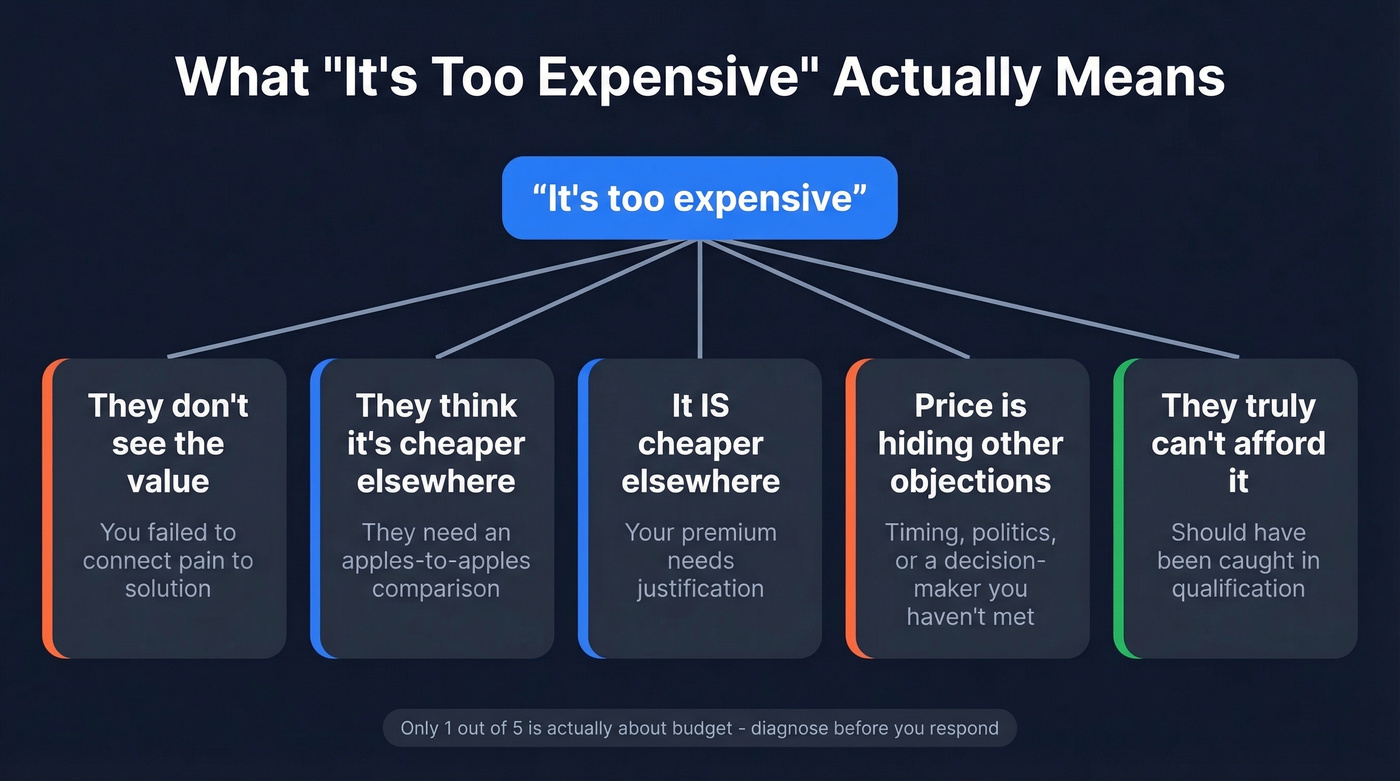
- They don't see the value. You didn't uncover their real pain or connect your solution to it. Think about the junk removal company that charges $500 to haul away a basement full of debris - the homeowner balks until they realize the alternative is renting a truck, spending a weekend, and paying dump fees that total $600 anyway. Same dynamic in B2B.
- They believe they can get it cheaper elsewhere. They need an apples-to-apples comparison, not a lower number.
- They actually can get it cheaper elsewhere. Your premium needs justification - trust, support, speed, quality.
- Price is hiding other objections. Timing, internal politics, a competing initiative, a decision-maker you haven't met.
- They truly can't afford it. This should've been caught in qualification, not in negotiation.
"It's too expensive" is the most socially acceptable way to end a sales conversation. Prospects know this. As one r/sales practitioner put it in a detailed breakdown, price pushback is usually about lack of certainty, not lack of budget. Buyers have learned that pushing back on cost gets them a discount, a concession, or an easy exit. Understanding the "too expensive" objection for what it really is - a signal, not a verdict - changes how you respond entirely.
Then there's the psychology. Kahneman and Tversky's anchoring bias research shows that the first number a person hears becomes their reference point, and every subsequent number gets judged against it. A Consumers' Checkbook study tracked 25 retailers over 33 weeks and found that at eight of them, more than half of tracked items carried false discounts every single week. Foot Locker items were "on sale" 98% of the time. Your prospects have been trained by every consumer experience they've ever had to assume the first price is negotiable.
The first step isn't responding to cost pushback. It's diagnosing which of those five problems you're actually facing.
The 3-Step Framework for Overcoming Price Objections
You don't need a dozen frameworks. You need one that works under pressure. Validate, Isolate, Reframe covers every variant, and it's simple enough to internalize after a few reps.
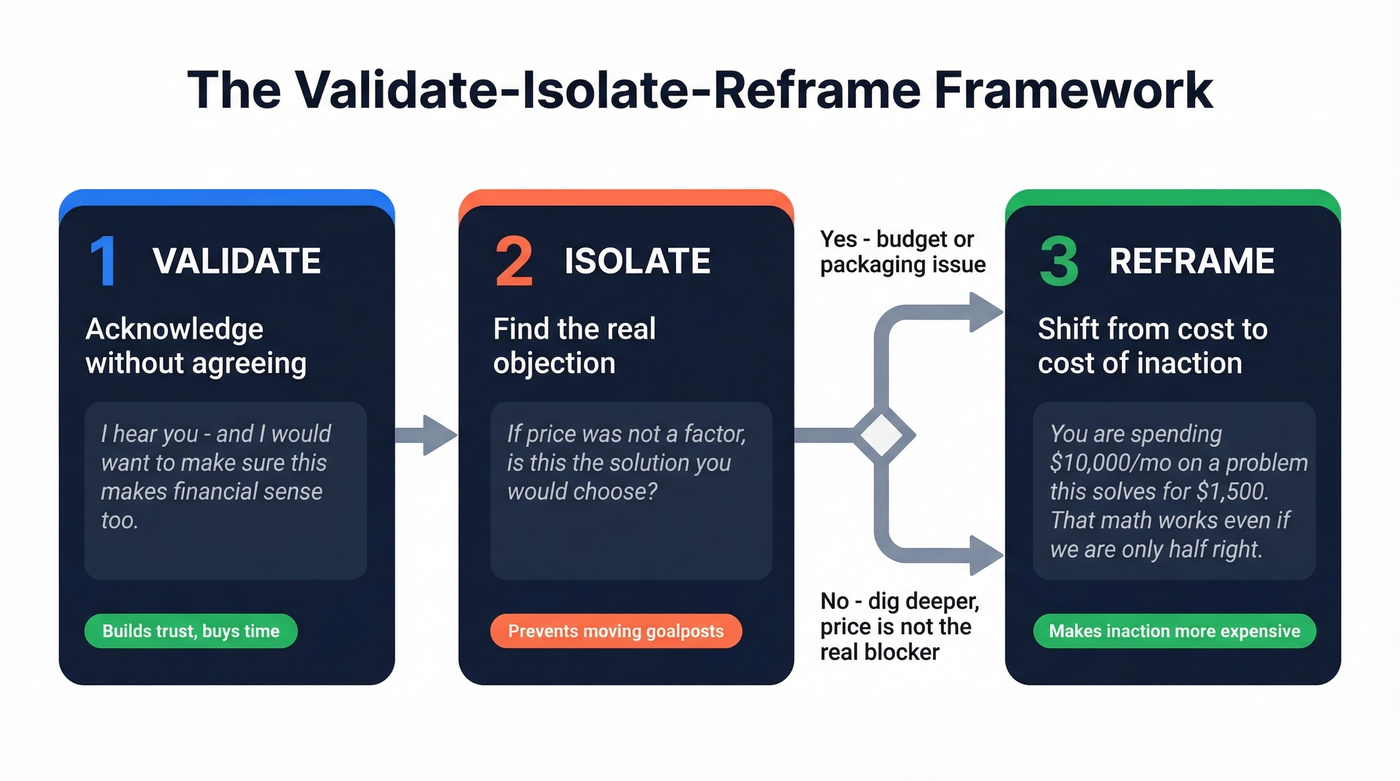
Step 1 - Validate
Acknowledge the concern without agreeing with it. Most reps skip this - they jump straight to defending the price, which triggers defensiveness in the prospect.
"I hear you - and I'd want to make sure this makes financial sense too." That single sentence signals you're listening, aligns you with their concern, and buys you time to think. If you get defensive, they dig in. If you stay calm and curious, they open up. Prospects mirror your energy.
Step 2 - Isolate
Find the real objection. The key question: "If price wasn't a factor, is this the solution you'd choose?"
If they say yes, you've got a budget or packaging issue - not a value problem. If they say no, price isn't the real blocker and you need to dig deeper. Follow up with: "Is price the only thing stopping us?" This prevents the goalposts from moving. You solve the price issue, and suddenly it's timing. You solve timing, and now it's authority. Isolate first.
Step 3 - Reframe
Shift from cost to cost-of-inaction. This is where the diagnostic questions from discovery pay off. "What happens if this problem isn't solved in the next 6 months?" forces the prospect to articulate the pain of doing nothing.
If your solution costs $1,500/mo and reduces churn enough to save $10,000/mo, that's a 6x return. Don't say "we deliver strong ROI." Say "you're spending $10,000 a month on a problem this solves for $1,500. That math works even if we're only half right." You make inaction more expensive than action - that's the whole game.
Scripts for Every Pricing Objection Variant
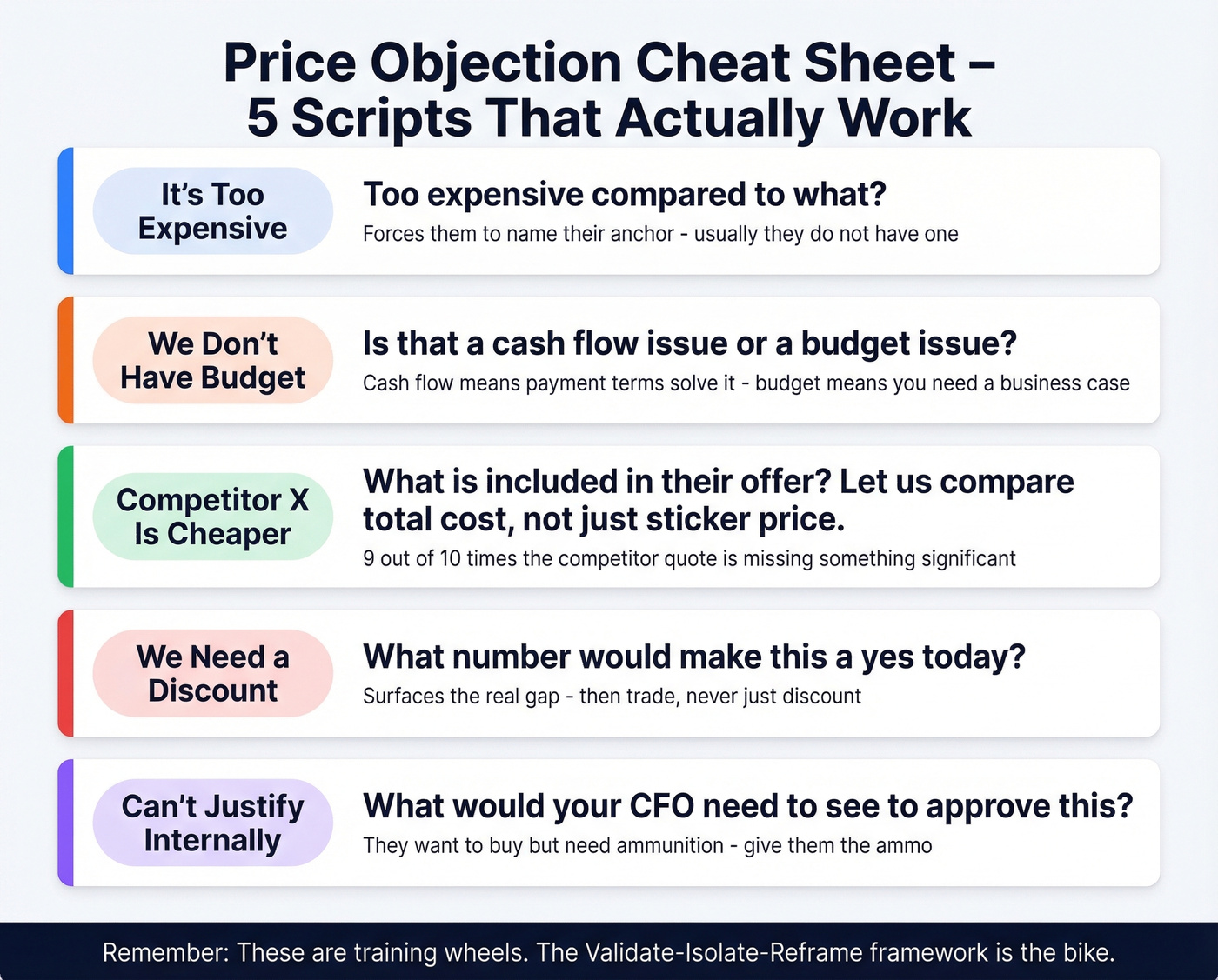
You don't need 30 scripts. You need three diagnostic questions and one framework. These scripts are training wheels - the framework is the bike.
"It's Too Expensive"
The classic. Almost always a smokescreen. It's the single most common pushback reps face, and it's also the most misdiagnosed.
- "Too expensive compared to what?" - forces them to name the anchor.
- "What would make this feel like a fair investment?"
- "Let's talk about what outcomes would make this worthwhile."
"We Don't Have Budget"
Budget vs. cash flow - two completely different problems.
- "Is that a cash flow issue or a budget issue?" Cash flow means payment terms solve it. Budget means you need a business case.
- "Many teams reallocate when they see the impact - can we map the potential ROI together?"
- "If budget opened up next quarter, would this be a priority?" That last question tells you whether budget is real or a polite exit.
"Competitor X Is Cheaper"
This is almost never an apples-to-apples comparison.
Imagine the prospect says: "We got a quote from [Competitor] for 40% less." Your instinct is to defend. Instead, try: "That's worth looking at. What's included in their offer? Let's compare total cost - onboarding, support, and results, not just the sticker price." Then follow with: "Cheaper at what? If their solution takes twice as long to implement, the real cost is higher." Nine times out of ten, the competitor quote is missing something significant - implementation support, a dedicated CSM, or a feature the prospect assumed was included.
"We Need a Discount"
- "Before we adjust pricing, let's make sure the package matches your must-haves."
- "I can look at pricing if we adjust scope or timeline - what matters most to you?"
- "What number would make this a yes today?" - this surfaces the real gap.
"I Can't Justify This Internally"
When someone says they can't justify it, they're telling you they want to buy but need ammunition. Give them the ammo.
"What would your CFO need to see to approve this?" and "Let me build you a one-pager with the business case - what metrics matter most to your leadership?" turn you from a vendor into an ally. We've seen deals close two weeks faster when reps proactively build the internal business case instead of waiting for the champion to figure it out alone.

The best way to neutralize price objections? Prove ROI before the call. Prospeo gives you 98% accurate emails and 125M+ verified mobiles so every dollar spent on outreach actually connects you to real buyers - not dead ends.
Stop defending your price when your data is the problem.
When to Talk Price
An analysis of 25,537 sales calls found two optimal windows for discussing price: 13-20 minutes and 40-49 minutes into the conversation - roughly 20% and 65% of the way through a typical call. Too early, and you haven't earned the right. Too late, and you're rushing.
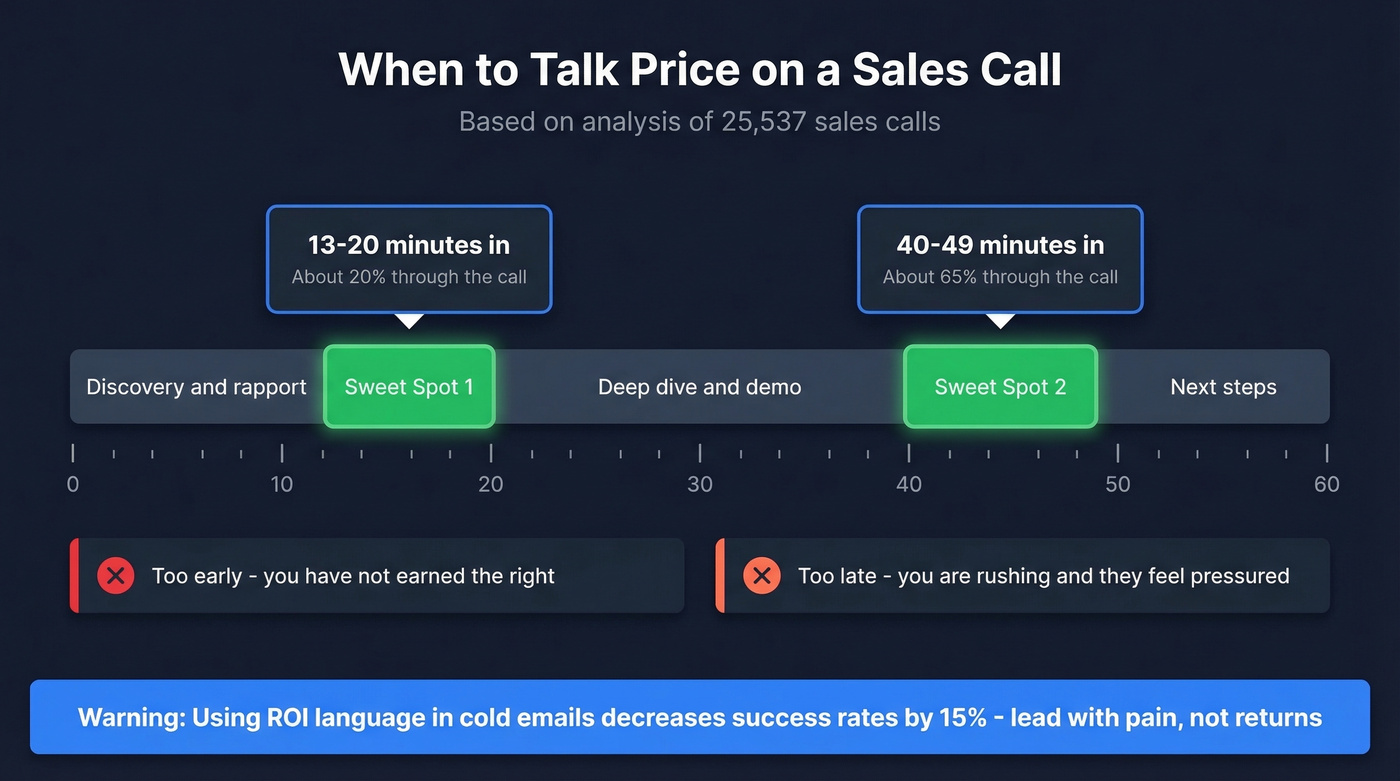
Now the counterintuitive part: when you do talk price, don't lead with ROI. Gong's analysis of 132,552 cold emails found that using ROI language actually decreases success rates by 15%. Prospects have heard "let me show you the ROI" a thousand times. It triggers skepticism, not confidence.
Instead, earn the right to discuss price by aligning on pain first. If a prospect pushes for pricing early, pivot: "Happy to get to that - can I first learn more about your priorities? The answer really does depend on what you're looking for." That's not evasion. That's ensuring the number you give has context.
Here's the thing: generic ROI claims are the "thoughts and prayers" of sales conversations. Specific, quantified pain is what moves deals forward.
Don't Discount - Trade
Discounting is the laziest move in sales. Every discount trains the prospect - and every future prospect they refer - to push back on price. Here's our hot take: if your average deal size is under $15k, you should have zero discount authority on the team. Build the trade muscle instead.
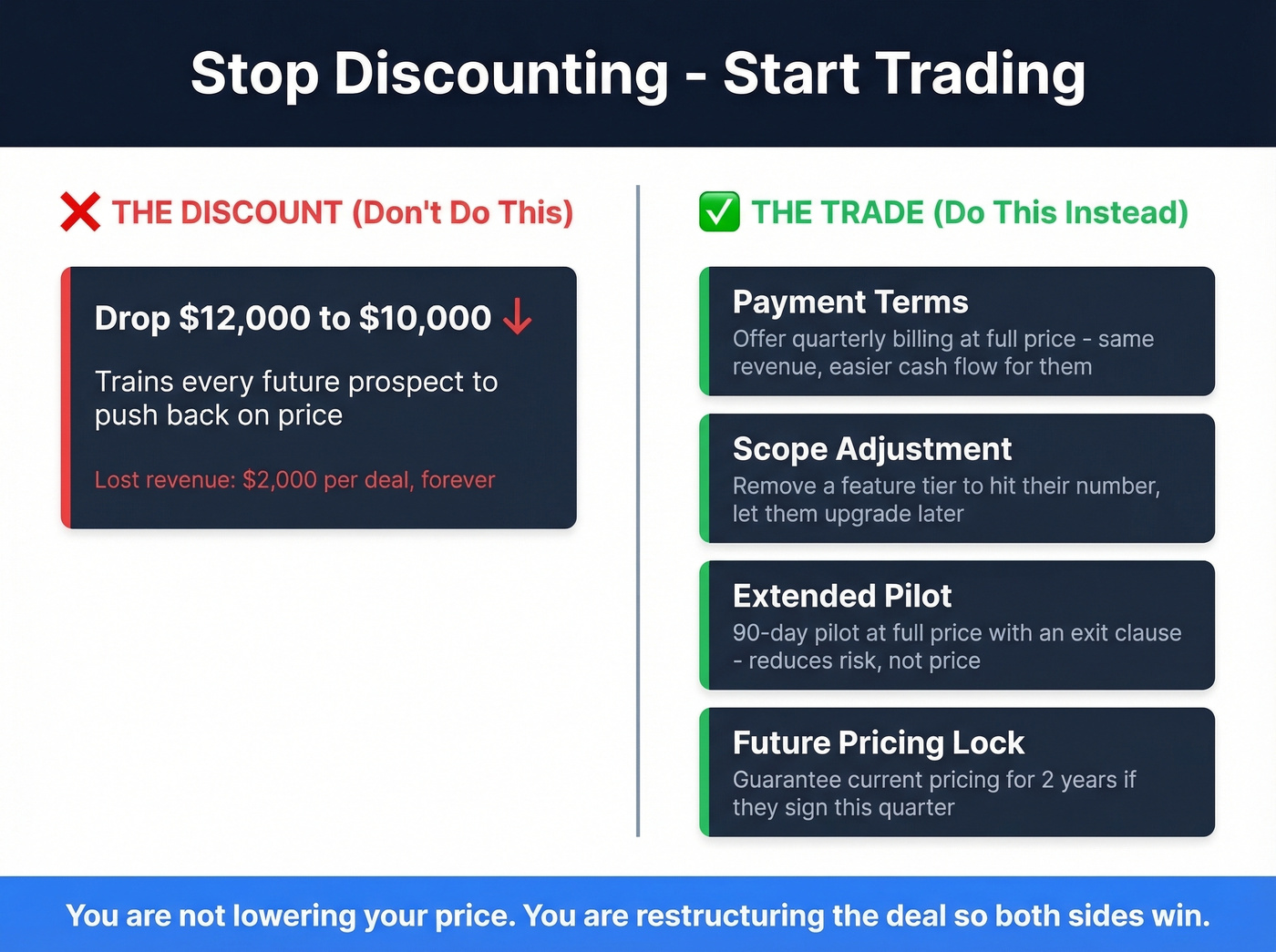
Payment terms and phased rollouts are your first levers. Instead of dropping $12,000 to $10,000, offer quarterly billing at full price - same revenue, easier cash flow for them. Or start with one team, expand after proving value. Lower initial commitment, full per-unit price.
Scope adjustment and extended pilots work when the prospect's budget is genuinely constrained. Remove a feature tier to hit their number and let them upgrade later. Or offer a 90-day pilot at full price with an exit clause - reduces risk without reducing price.
Future pricing locks and tiered packaging create urgency without concessions. Guarantee current pricing for two years if they sign this quarter. Present three options where the middle tier looks like the obvious choice.
You're not lowering your price. You're restructuring the deal so both sides win.
Kill Price Objections Before They Start
The best objection handlers don't have better scripts. They have better discovery. Prevention beats treatment every time.
Qualify Budget Early
Qualify budget in the first 20% of your sales process, not the last 20%. If you're running MEDDIC, the "E" (Economic Buyer) exists for a reason. Use anchored budget questions early: "Would you consider investing $8K-$12K to solve this?" That sets the reference point before the formal proposal ever lands. When the "price is too high" pushback surfaces later, it's almost always because this step was skipped.
Target the Right Buyers
Half of cost objections happen because you're talking to someone who doesn't have budget authority or doesn't match your ICP. Bad prospect data puts you in front of people who were never going to buy at any price - and then you wonder why they pushed back.
This is where data quality becomes an objection-prevention tool. We've found that teams using Prospeo's 30+ search filters - buyer intent, company revenue, headcount growth, funding stage - spend far less time fielding "too expensive" from the wrong people. When your list is built from 300M+ profiles refreshed every 7 days with 98% email accuracy, you're reaching actual decision-makers, not dead-end contacts from a stale spreadsheet.
Structure Your Pricing Presentation
Present the highest option first. The first number becomes the anchor, and everything after it feels more reasonable by comparison. Three tiers work better than one - the middle option should be the one you actually want them to buy, flanked by a stripped-down version and a premium package that makes the middle look like a smart choice.
If you want a deeper breakdown of anchoring tactics, see our guide on the anchor in negotiation.
When prospects say "Competitor X is cheaper," your data quality is your best reframe. Teams using Prospeo book 26% more meetings than ZoomInfo users at 90% lower cost - that's the ROI story that closes deals.
Build the business case with data that actually converts.
What NOT to Do
Don't panic and discount. That's how you lose six-figure deals. The HubSpot anecdote isn't unusual - it's the default response for untrained reps, and it almost never works.
Don't lead with ROI in cold outreach. ROI language in cold emails drops success rates by 15%. Counterintuitive, but proven across 132K+ emails. If you're tightening outbound, pair this with better sales prospecting techniques and cleaner messaging.
Don't talk price before earning the right. If you haven't aligned on pain, any number feels too high. Period. Strong discovery makes pricing feel inevitable, not negotiable.
Don't give up after one "no." 98.6% of eventual conversations occur by the fifth call attempt. Persistence isn't pushy - quitting is. Use a consistent sales follow-up system so you don't rely on memory.
Don't prospect with bad data. Verify contacts before you dial. A 7-day data refresh cycle means your list isn't six weeks stale by the time you pick up the phone. If you're fixing list quality, start with data enrichment and a reliable sales prospecting database.
FAQ
What is a price objection?
A price objection is any pushback from a prospect indicating your product or service costs more than they're willing or able to pay. It's the most common sales objection, but research shows nearly half are knee-jerk reactions - not genuine budget concerns. Diagnosing the root cause before responding is critical.
What's the best response to "your price is too high"?
Don't defend or discount. Use the Validate-Isolate-Reframe framework: acknowledge the concern, ask "Is price the only thing stopping us?", then reframe around cost-of-inaction. The goal is diagnosis, not persuasion.
When should you discuss pricing on a sales call?
Analysis of 25,537 sales calls found the best windows are 13-20 minutes and 40-49 minutes into the conversation - roughly 20% and 65% of the way through. Earn the right to talk price by aligning on pain first.
How do you prevent pricing pushback entirely?
Qualify budget early, target verified decision-makers who match your ICP, structure pricing with tiered packages and anchoring, and make sure discovery uncovers real pain before you quote a number. Filtering prospects by revenue, funding stage, and buyer intent means you're only pitching people who can actually buy.
Should you ever offer a discount?
Rarely, and never as a first move. Instead, trade: adjust payment terms, phase the rollout, reduce scope, or offer a pilot at full price with an exit clause. Every unprompted discount trains buyers to push back harder in every future deal.