

How to End an Email to a Client: A Framework, Not a List
Figuring out how to end an email to a client shouldn't take longer than writing the email itself - but it does, constantly. You've nailed the update, the ask is reasonable, and now you're staring at the cursor. "Best regards? Kind regards? Just... thanks?"
A ZeroBounce survey of nearly 1,400 Gen Zers found 57% aren't sure how formal to be in email. And here's the kicker: emails ending with a thankful closing get a 62% response rate vs. 46% without. But the sign-off is the least important part of your email ending. The closing line - that sentence right before "Best regards" - is what actually drives a reply.
The Three-Part Closing Framework
Every email ending has three components, and most people only think about one.
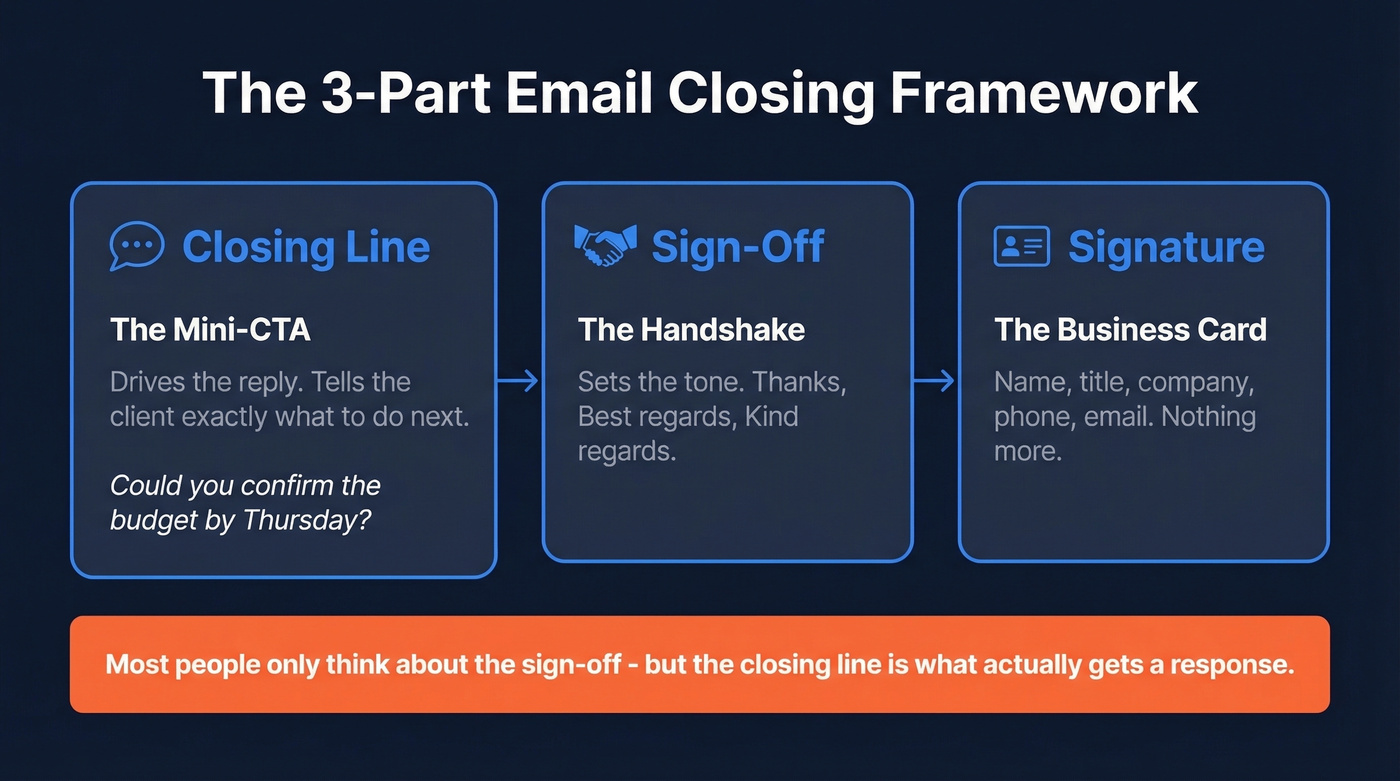
Your closing line is a mini-CTA - it tells the client what to do next. Place it at the end of your email, after context, not before. "Could you confirm the budget by Thursday?" is a closing line. "Let me know if you have questions" is a weaker one, but still counts.
Your sign-off is just a handshake - "Thanks," "Kind regards," "Best" - setting tone without driving action. Your signature is a business card: name, title, company, phone, email. That's it. Three layers, each doing a different job.
To pick the right sign-off, consider the relationship (new vs. established), the purpose (asking vs. informing), and industry norms (finance is formal, tech is casual). "Best regards" is the Swiss Army knife. "Kind regards" works when you're requesting something. "Warm regards" implies genuine personal connection - don't use it until you've actually built one.
Which Sign-Offs Actually Get Replies
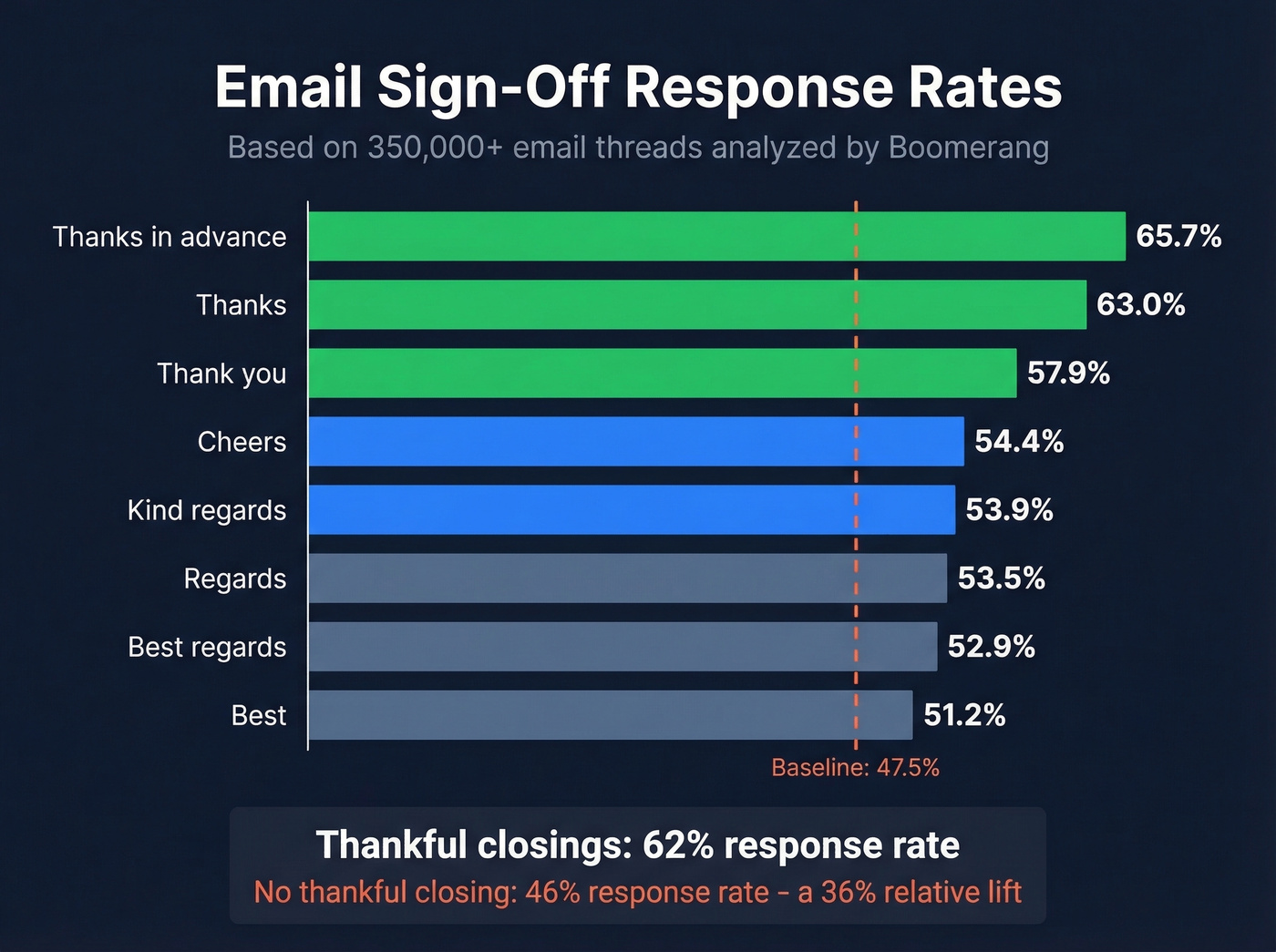
Boomerang analyzed 350,000+ email threads and measured response rates by sign-off. Their dataset came from mailing list archives across 20+ online communities, and the baseline response rate was 47.5%.
| Sign-Off | Response Rate |
|---|---|
| Thanks in advance | 65.7% |
| Thanks | 63.0% |
| Thank you | 57.9% |
| Cheers | 54.4% |
| Kind regards | 53.9% |
| Regards | 53.5% |
| Best regards | 52.9% |
| Best | 51.2% |
Thankful closings hit a 62% response rate vs. 46% without - a 36% relative lift. "Thanks in advance" wins, but only use it when you've actually asked for something. Dropping it after a status update feels presumptuous.
We've tested this across hundreds of client threads on our team: "Thanks" or "Kind regards" covers 90% of situations. Pick one as your default and stop overthinking it.
Closing Lines for 6 Client Scenarios
The sign-off is the handshake. These closing lines are the part that matters.
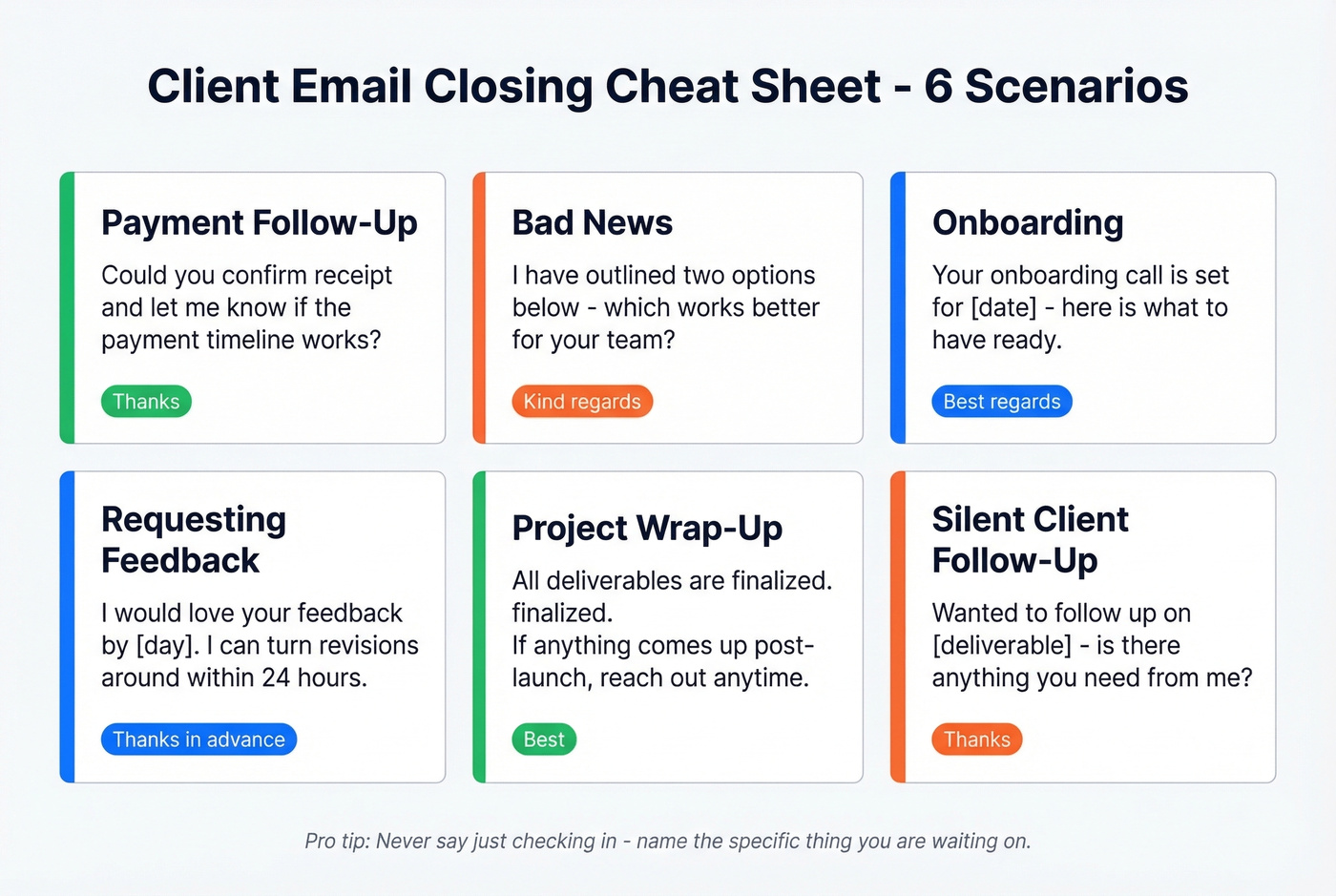
Payment or Invoice Follow-Up
"I've attached the invoice for [project/month]. Could you confirm receipt and let me know if the payment timeline works?"
Sign-off: Thanks
Delivering Bad News
"I know this timeline shift isn't ideal. I've outlined two options below - which works better for your team?"
Sign-off: Kind regards
Onboarding a New Client
"We're excited to get started. Your onboarding call is set for [date] - here's what to have ready so we can make the most of our first session."
Sign-off: Best regards
Requesting Approval or Feedback
"I'd love your feedback on the attached by [day]. If anything needs adjusting, I can turn revisions around within 24 hours."
Sign-off: Thanks in advance
Project Wrap-Up
"All deliverables are finalized and uploaded to [location]. Great project - if anything comes up post-launch, reach out anytime."
Sign-off: Best
Following Up When a Client Goes Silent
"Wanted to follow up on [specific deliverable] - is there anything you need from me before we move forward?"
Sign-off: Thanks
Here's the thing: "Just checking in" reads as passive-aggressive to most people. Name the specific thing you're waiting on - it shows you're organized, not nagging. If you need options, borrow a few lines from these sales follow-up templates.

You just spent 10 minutes crafting the perfect closing line - don't let it land in a dead inbox. Prospeo verifies emails in real time with 98% accuracy, so every carefully worded sign-off actually reaches your client.
Verify your client list before your next send - 75 emails free, no card required.
Phrases to Avoid in Client Emails
"Per my last email" and "just checking in" read as passive-aggressive even when you don't mean them that way. Restate the point instead. If you want a cleaner alternative, see how to say just checking in professionally.
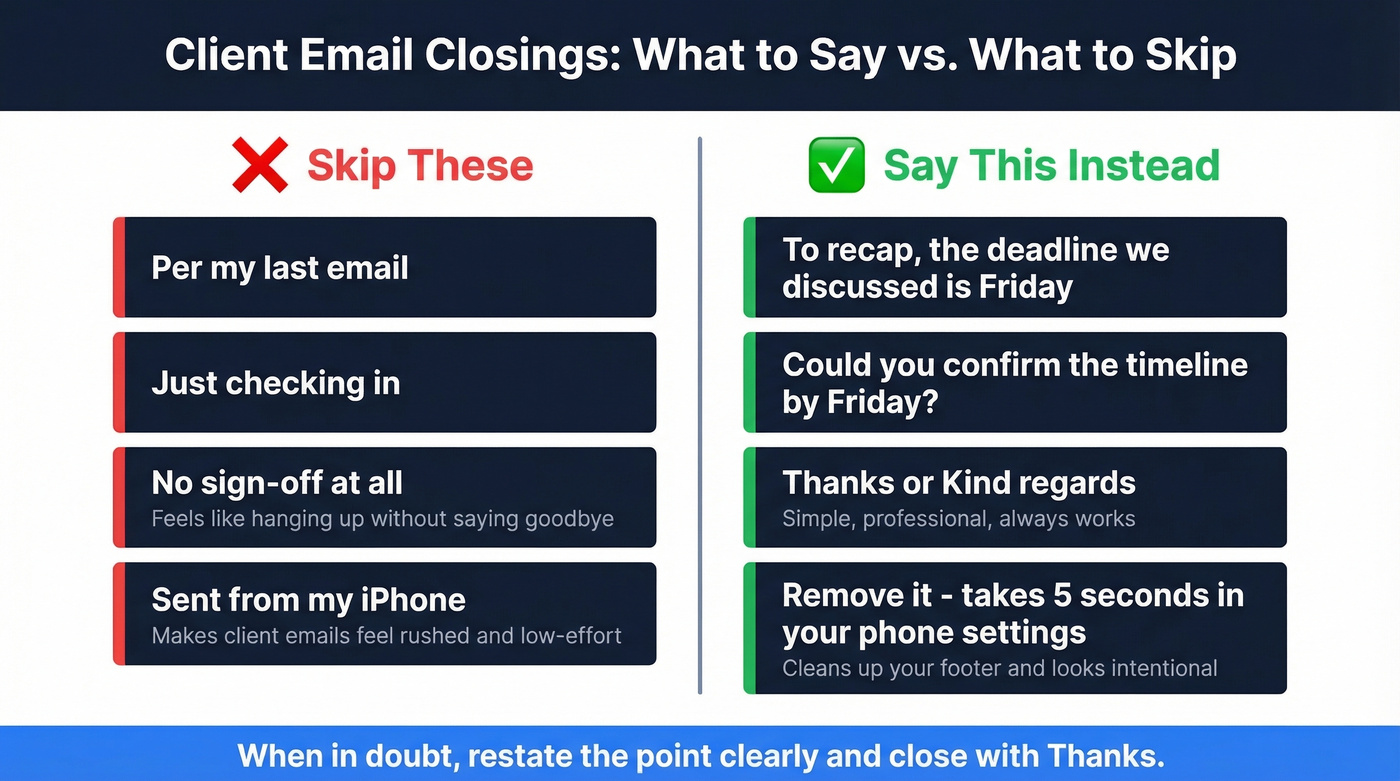
Ending with no sign-off at all feels like hanging up without saying goodbye. And "Sent from my iPhone" can make a client email feel rushed or low-effort - remove it. It takes five seconds and the difference in perception is real.
Emailing International Clients
Your default sign-off might be working against you across borders. In the UK, "Regards" alone can sound cold - "Kind regards" is safer. One BBC-cited study found 40% of Korean respondents considered Australian emails impolite, while only 28% of Australians felt the same about Korean emails. Perception gaps are real, and they're bigger than most people assume.
"Un abrazo" (Spanish) or "Um abraco" (Portuguese) - meaning "a hug" - is semi-formal in parts of Latin America, but it'd land strangely in a German inbox. When in doubt, "Kind regards" is globally safe. It's never wrong.
Before You Hit Send
Quick signature checklist: name, title, company, phone, email. Skip the oversized logos and inspirational quotes - visual clutter increases spam filter risk.
Let's be honest, though: none of your careful closing work matters if the email bounces. We've seen teams spend hours crafting the perfect client email only to discover the address was outdated. Prospeo's real-time email verification catches bad addresses before you send, so your closing line actually reaches the person it's meant for. If you're troubleshooting deliverability, start with email bounce rate and this email deliverability guide.
Bounced emails don't just waste your closing lines - they wreck your domain reputation and tank future deliverability. Prospeo's 5-step verification catches bad addresses at ~$0.01/email, with data refreshed every 7 days so client contacts never go stale.
Protect your sender reputation and make every client email count.
FAQ
Is "Best" too casual for client emails?
"Best" is perfectly appropriate for ongoing client relationships where you've exchanged several messages. For first contact or formal industries like finance and law, use "Best regards" or "Kind regards" instead.
Should I change my sign-off mid-thread?
Yes - start formal, then relax as the conversation progresses. The simplest rule: match the client's tone. If they switch to "Thanks," you can too.
What's the best closing line for a follow-up email?
Lead with a specific ask rather than a vague nudge: "Could you confirm the timeline by Friday?" Then sign off with "Thanks" - it drives a 63% response rate. Skip "just checking in," which reads as passive-aggressive.
How do I make sure my client email actually gets delivered?
Use a verified email address - bounced messages kill your domain reputation. Tools like Prospeo check deliverability before you send, and the free tier covers 75 verifications per month with no contracts.