

How to Get Sales Calls (Booked and Held) in 2026
Getting a prospect's email or direct dial isn't the hard part anymore. Getting them to reply, book, and actually show up is. If you're searching for how to get sales calls in 2026, stop optimizing for activity and build a system that optimizes for held meetings.
Held meetings create pipeline. Pipeline pays.
Here's the playbook I'd run if I had to build pipeline from scratch this quarter, with the stuff that actually moves the needle (and the stuff I'd skip).
What you need (quick version)
Held meetings are the only metric that matters.
Do these three things this week - no heroics, no "100 dials/day" theater:
Fix your data + deliverability guardrails first
- Enforce bounce <2% and spam placement <5% before you scale volume.
- Kill any list that can't hit those numbers. Bad data turns outbound into a deliverability problem.
- Operationally: verify emails, dedupe, suppress role accounts, and stop mixing cold + warm sends on the same domain.
- To keep bounce <2%, run verification before every upload. It's the fastest way to stop "phantom non-interest" that's really just bounces.
Build a small list that can actually convert
- Pick one ICP slice and one trigger (job change, headcount growth, new funding, new tool install).
- Build 50 high-intent contacts and run a tight sequence before you add more.
- You're trying to prove a funnel, not win a vanity metric.
Run one multichannel sequence and one reply-management routine
- Use a 28-32 day cadence (email + calls + light social touches).
- Run two daily call blocks and match time zones so you're not calling West Coast at 8am their time.
- Block 30 minutes daily for reply-to-meeting conversion. Replies are the conversion engine; treat them like revenue, not inbox cleanup.
- Protect held rate with a simple checklist: confirm time + send a 1-paragraph agenda + include a "bring X" ask (e.g., "bring your current workflow" or "bring your tool list").
Your scoreboard: Held Meetings per Rep Hour. It punishes busywork and rewards clean data, tight targeting, and fast follow-up.
Why you're not getting sales calls (the real reason it's hard)
"Outbound is dead" is the loudest take in tech sales right now. Reps are tired. Prospects think every unknown number's a scam. And list coverage gets weird fast once you go outside the US or outside the obvious titles.
Outbound isn't dead. Sloppy outbound is dead.
The myth that keeps teams stuck is the activity fantasy: "Just do 80-100 calls/day and it'll work." Here's the thing: list building is the bottleneck, not dialing. I've seen teams crank dial counts with weak data and call it "grit." What they actually built was a machine that creates wrong numbers, spam flags, and burnout.
The other reason you're not getting sales calls is simpler: you're optimizing for the wrong outcome. Booked meetings feel good. Held meetings pay commissions.
Define the goal: booked vs held meetings (and the only scoreboard that matters)
A booked meeting is a calendar event.

A held meeting is a real conversation with the right person, at the right company, who actually shows up.
That difference is everything.
The north-star metric we like (and the one that punishes busywork) is Held Meetings per Rep Hour. It forces you to care about list quality, deliverability, routing, and follow-up - not just "touches."
A simple KPI stack that works:
- North star: Held Meetings per Rep Hour
- Quality gate: held rate 70-85%
- Email health: bounce <2%, spam placement <5%
- Call effectiveness: connect-to-meeting conversion 10-25%
- Pipeline sanity: SQL rate 30-60%, close rate 10-25%
If your held rate's 40-50%, you don't have a "booking" problem. You've got a targeting + expectation-setting + confirmation problem.
And if your held rate's 80% but you're not booking enough, you don't need more hustle. You need more sequence-ready, verified contacts and a tighter reply-to-meeting motion.
Benchmarks + funnel math (so you know what "good" looks like)
Gong Labs' cold calling benchmarks are one of the cleanest reality checks out there because they're based on massive volume (300M+ calls).

Two numbers drive everything:
- Connect rate (dials → conversations): 5.4% average vs 13.3% top quartile
- Set rate (conversations → meetings): 4.6% average vs 16.7% top quartile
Cold call funnel benchmarks (Gong Labs)
| Stage | Average | Top quartile |
|---|---|---|
| Connect rate | 5.4% | 13.3% |
| Dials per convo | 19 | 8 |
| Set rate | 4.6% | 16.7% |
Now the math that makes this feel real.
Assume 800 dials/month (about 40/day over 20 days):
Average rep math
- 800 dials × 5.4% connect = 43 conversations
- 43 conversations × 4.6% set rate = 2 meetings
Top quartile math
- 800 dials × 13.3% connect = 106 conversations
- 106 conversations × 16.7% set rate = 18 meetings
That gap isn't "talent." It's usually three controllables: better lists, better timing, better follow-up.

You just read the math: top-quartile reps book 9x more meetings from the same dial count. The difference is list quality. Prospeo gives you 300M+ profiles with 98% email accuracy, 125M+ verified mobiles, and intent data across 15,000 topics - so every call block starts with contacts who are real, reachable, and in-market.
Keep bounce under 2% before you even upload. Start free.
Build a list that can actually produce calls (ICP → triggers → verified contacts)
This is where most outbound programs quietly fail.

They start with a sequence. They should start with a list.
Step 1: Pick one ICP slice you can win
Don't write an ICP essay. Write a filter.
Good ICP filters look like:
- Industry + employee band + region
- One buyer role (not "anyone in revenue")
- One tech signal (uses X, doesn't use Y)
- One trigger (hiring, funding, job change, new compliance requirement)
Bad ICP filters look like:
- "B2B SaaS, 50-500 employees, needs growth"
Step 2: Add triggers so you're not calling random Tuesday humans
Triggers give you a reason to exist in their week.
The ones that consistently create conversations:
- Job change (new VP/Head is building their plan)
- Headcount growth (pain is showing up in the org chart)
- New funding (budget + urgency)
- Tooling change (new stack = new problems)
- Intent topics (they're actively researching your category)
Step 3: Stop chasing volume; build 50 high-intent contacts
If 50 high-intent contacts can't produce replies and connects, 5,000 won't save you. It'll just fail louder.
This is also where deliverability guardrails matter. If you can't keep bounce <2% and spam placement <5%, you're not "doing outbound." You're damaging your domain and wasting rep hours.
Step 4: Add an accuracy layer (so your sequence starts clean)
In our experience, the fastest way to get more calls isn't a new script. It's removing bad inputs so your reps stop spending prime call blocks dialing dead numbers and emailing addresses that were never deliverable in the first place.
Pricing's straightforward and self-serve: ~$0.01 per verified email, and 10 credits per mobile (in practice, budget roughly $0.50-$2 per mobile, depending on plan and volume). There's also a free tier with 75 emails + 100 extension credits/month. No contracts.
A workflow that works in real life (and doesn't turn into spreadsheet misery):
- Search your ICP with filters (role, seniority, geo, company size, tech, triggers).
- Prioritize by intent: filter by intent topic (15,000 topics powered by Bombora) and put those accounts into your call blocks first.
- Verify emails/mobiles in real time (don't "assume deliverable").
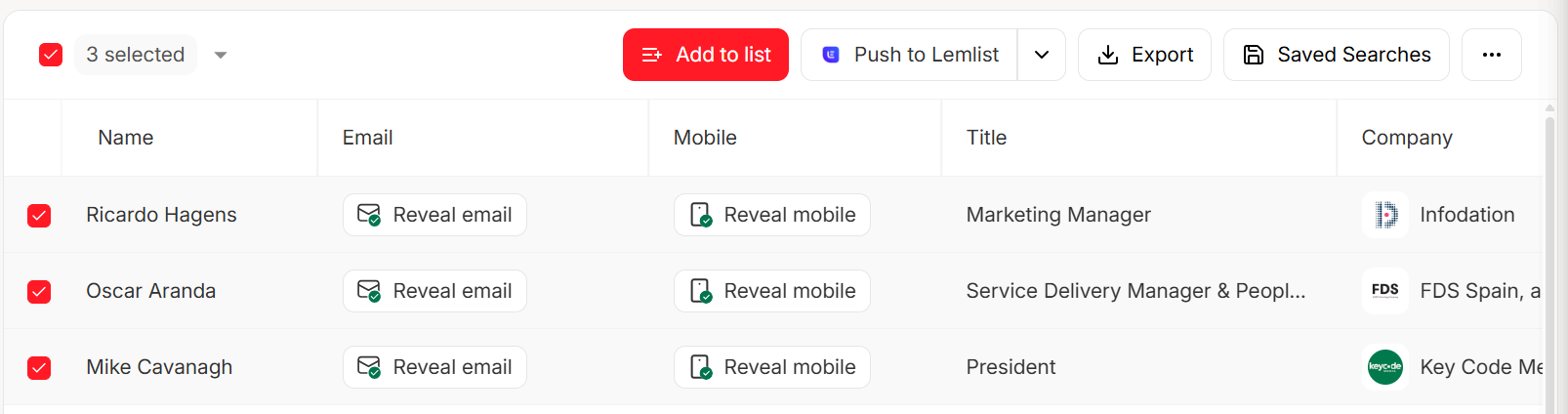
- Push to your stack using integrations (Salesforce, HubSpot, Smartlead, Instantly, Lemlist, Clay, Zapier, Make, Salesloft, Outreach, n8n) so reps aren't copy/pasting.
- Refresh weekly so you're not calling people who left three weeks ago.
Hot take: if your deal size isn't huge, you probably don't need an all-in-one enterprise suite. You need accurate contacts, clean deliverability, and a tight reply-to-meeting motion. Most teams buy too much platform and not enough precision.
Tool categories that impact booked calls (and typical pricing)
Prospecting isn't one tool. It's a small stack. Here's what typically hits your budget:
| Category | What it does | Typical pricing | Best for |
|---|---|---|---|
| Enterprise data providers | Big database + intent + org charts | $30k-$80k/year | 10+ SDRs, multi-region coverage, heavy enrichment workflows |
| Sales engagement | Sequences + tasks + analytics | $100-$200+/user/mo | Teams running 12+ touch sequences with strict task hygiene |
| Dialers/phone systems | Calling + routing + local presence | $30-$150/user/mo | Teams doing two daily call blocks and monitoring number reputation |
| Prospeo | Verified data + refresh + enrichment | ~$0.01/email; mobiles ~$0.50-$2 each | Accuracy-first outbound + deliverability protection + self-serve speed |
How to get sales calls with a 28-32 day multichannel sequence
Most sequences fail for one of two reasons: they're too short, so you never earn familiarity, or they're too long, so there's no urgency and reps stop executing.
The sweet spot is a 12-step, 28-32 day sequence with two dial bursts--but only for the right people.
Define "warmed" (so your call bursts actually work)
"Warmed" means the account did something measurable:
- opened 2+ times
- clicked
- visited pricing
- replied (even a brush-off)
- or showed third-party intent (intent topic match)
Only warmed accounts get the dial bursts. Everyone else stays on the standard cadence.
12-step sequence (28-32 days)
| Day | Channel | Touch | Use/skip notes |
|---|---|---|---|
| 1 | Value-first opener | Keep it <90 words. One pain, one outcome, one question. | |
| 2 | Call | Call + no VM | No VM on touch 1 unless you've got a trigger. |
| 4 | Proof + 1 question | Proof must match their segment (not your biggest logo). | |
| 6 | Call | Call + VM | VM's job: drive email reply, not callback. |
| 8 | Social | Light touch | Only if your profile's real and your message is specific. |
| 11 | "Did I miss?" | Short, direct, no guilt language. | |
| 14 | Call | Dial burst (2 attempts) | Only warmed accounts. Two attempts, 90-120 minutes apart. |
| 18 | New angle/trigger | Switch angle: different pain, same outcome. | |
| 21 | Call | Call + no VM | Use local presence if appropriate. |
| 24 | Breakup w/ value | Offer a useful asset or a quick audit. | |
| 28 | "Close the loop" | Ask for redirect to the right owner. | |
| 32 | Call | Final attempt | Only top-priority warmed accounts. Otherwise, recycle later. |

Email copy blocks + subject lines (steal these)
Email 1: Value-first opener
Subject line options:
- "Quick question about {{team}}"
- "{{Company}} + {{trigger}}"
Body pattern:
- 1 line trigger/context
- 1 line outcome you drive
- 1 question that's easy to answer
Example:
"Saw you're hiring {{role}}--usually that's when {{problem}} starts showing up. We help {{peer group}} cut {{pain}} so {{outcome}} improves. Are you the person who owns {{area}}, or is it someone else?"
Email 2: Proof + 1 question
Subject line options:
- "How {{peer}} handled {{problem}}"
- "Worth testing this at {{Company}}?"
Keep proof tight:
- "We helped X reduce Y by Z" (one sentence)
- then one question
Email 3: "Did I miss?"
Subject line options:
- "Wrong person?"
- "Should I close this out?"
Body:
"Did I miss you, or is {{problem}} just not a priority right now?"
Email 4: New angle/trigger
Subject line options:
- "Different angle on {{outcome}}"
- "If you're focused on {{initiative}}..."
Switch the pain point. Don't re-send the same email with new adjectives.
Email 5: Breakup with value
Subject line options:
- "I'll stop after this"
- "Last note + a quick idea"
Offer something concrete:
- a 3-bullet teardown
- a short benchmark
- a "here's what I'd do in week 1" outline
Branching logic: what to do if they open/click
This is where sequences turn into meetings.
If they open 2+ times (no click): Next call opener: "Calling because you looked at my note a couple times - quick yes/no: is {{problem}} on your radar this quarter?"
If they click a case study: Next email: "If you tell me whether {{constraint}} is true at {{Company}}, I'll send the 2-step version of how {{peer}} fixed it."
If they visit pricing: Next call opener: "You probably saw pricing - before we talk numbers, are you trying to solve {{problem A}} or {{problem B}}?"
If they reply "not now": Don't argue. Pin it: "What month should I circle back?" Then actually disappear until then.
Exec vs manager variant (same sequence, different angle)
If you're emailing/calling execs (VP/C-level):
- Lead with risk, opportunity cost, and time-to-impact.
- Ask for a 10-minute triage call.
- Keep it outcome-only; skip feature talk.
If you're emailing/calling managers (Director/IC owner):
- Lead with workflow pain and operational friction.
- Offer a quick teardown ("I'll map your current flow and show 2 fixes").
- Ask a practical question: "What are you using today for {{workflow}}?"
How to run the "parallel dial burst" without chaos
Most teams "do a burst" and it turns into random dialing. Do it like this:
- Every morning, pull a Warmed Call List (opens 2+, clicks, pricing visits, intent matches).
- Run Burst #1 in your first call block (e.g., 9:00-10:30am local).
- Run Burst #2 later the same day (90-120 minutes after) only for:
- no-answers
- "call me later"
- and "send me an email" responses
- Everyone else stays on the normal cadence. No warmed signal, no burst.
This keeps your call blocks high-signal and stops reps from burning numbers on cold, low-probability dials.
When to call: best days + best hours (and a timezone-safe weekly schedule)
Timing won't fix a bad list, but it amplifies a good one.
ZoomInfo analyzed 1.4M calls and the pattern's consistent:
- Tuesday, Wednesday, Thursday are best overall
- Tuesday + Wednesday = 44% of demos
- Monday's efficient: call-to-demo 1.19% and positive call rate 4.8%
- Friday performs worst across key metrics
Full breakdown: ZoomInfo's best days to cold call.
Hour-of-day matters too. MightyCall analyzed 251,256 call records, filtered to 187,684 valid weekday calls (8am-8pm local time), and found:
- Best window: 8-11am local time
- Best single slot: Monday 8am = 30.4% "successful" calls (30+ seconds)
- Overall "successful outbound call" rate: 20.8%
A timezone-safe weekly calling schedule (simple and repeatable)
If you're calling across US time zones, don't freestyle it. Run blocks:
Mon
- 8:00-10:30am local time (East → Central → Mountain → Pacific)
- 4:00-5:00pm local time (catch late-day gaps)
Tue-Thu
- 9:00-11:30am local time (primary block)
- 3:30-5:00pm local time (secondary block)
Fri
- Only call hot accounts (intent + engagement). Otherwise, do list building + personalization + call review.
Pickup-rate levers (number reputation, local presence, rotation, hygiene)
If "nobody picks up," it's usually not just the script. It's your number strategy.
Use this checklist:
- HLR checks so you're not dialing dead/invalid numbers.
- E.164 formatting everywhere (consistency reduces carrier weirdness).
- Number rotation so you don't burn one caller ID with high volume.
- Local presence dialing where it's appropriate (match the geography you're actually calling).
- Spam-flag monitoring: if a number gets labeled, pull it immediately and swap.
- Volume caps per number (carriers punish obvious spam patterns).
- Hygiene: dedupe accounts, suppress wrong departments, stop calling HQ lines when you've got mobiles.
Operator note: I've seen connect rates jump inside two weeks just by cleaning the list and rotating numbers - no new dialer, no new script, no new "enablement initiative."
Weekly call review loop (the fastest way to improve without "more activity")
If you want more sales calls next week, review calls this week. Non-negotiable.
Run a 45-minute weekly review per rep:
- Listen to 5 calls (2 connects, 3 no-connect attempts with voicemails).
- Grade the first 20 seconds: clear reason for the call, or rambling?
- Track talk ratio: aim for 45-55% rep talk time (rule of thumb).
- Track question pace: keep it under ~2 questions/minute (rule of thumb). Better questions beat more questions.
- Check the next-step ask: did they ask for a meeting like it's normal?
- Check disposition hygiene: correct outcome logged, next touch scheduled, notes usable.
- Pull 1 pattern to fix next week (one, not five).
Voicemail + call-first sequencing (voicemail's real job is email replies)
Voicemail's misunderstood.
Its job usually isn't to get a callback. Its job is to make your next email feel like a continuation of a real attempt.
Gong's data makes this clear:
- Leaving voicemails increased email reply rate from 2.73% → 5.87%
- Calling in a multichannel flow increases email replies 3.44% vs 1.81% even without a live connect
Voicemail scripts (steal these)
Script 1: 12 seconds, value-first
"Hey {{Name}}, it's {{Rep}}. I sent an email with {{1-line value}} for {{Company}}. If it's not you, who owns {{problem}}? I'll follow up by email."
Script 2: trigger-based
"{{Name}}, {{Rep}} here. Noticed {{trigger}} at {{Company}}. Quick idea on {{outcome}}--I'll send it over. If it's worth a 10-minute chat, just reply 'yes.'"
Keep it short. Then email immediately with a subject like: "Left you a quick voicemail" and one sentence of context.
A simple sales call agenda (so calls get held and move forward)
Use this for a 10-15 minute first call.
Share with the prospect (in the invite + reminder)
- 60 seconds: what prompted the outreach (trigger)
- 3 minutes: their current workflow + what's broken
- 5 minutes: 2 options (do nothing vs fix) + what "good" looks like
- 2 minutes: decide next step (deeper demo, technical call, or disqualify)
Keep internal (rep notes)
- 1-2 qualification questions you must answer
- a single "exit criteria" for next step (e.g., "confirm owner + timeline")
This agenda alone lifts show rate because it sets expectations and makes the call feel purposeful, and it also gives you a clean way to end calls that aren't going anywhere without dragging them into a 45-minute demo nobody asked for.
Objection-handling dialogue: "We already have X"
Use this exact flow:
- Confirm
"Makes sense - most teams I talk to already have something."
- Isolate
"Is it working the way you want, or is it more 'good enough for now'?"
- Narrow
"If you could change one thing about it, what would it be?"
- Next step
"If I can show you a way to fix that one thing in 10 minutes, is it worth a quick look Tuesday or Wednesday?"
It's calm, it's respectful, and it moves the conversation forward without trashing their current tool.
How to get sales calls from replies (and increase held rate)
Most teams treat replies like an inbox chore. That's backwards. Replies are where meetings get created.
A scenario we've seen a bunch: an SDR gets a "yeah, send info" reply, drops a calendar link, and calls it a win. Then the prospect ghosts, the meeting (if it gets booked) doesn't hold, and the rep blames "flaky buyers." Real talk: that one's on the process.
A GrowthHacking practitioner who booked 675 calls used a tactic more SDR teams should copy: 3-5 back-and-forth replies before sending a calendar link. The show-up rate's higher because the prospect already invested in the conversation.
They also pulled ~30% of booked calls from stalled-thread follow-ups. That matches real pipelines: the money's in threads that went quiet, not the brand-new ones.
RevenueHero's benchmark is a good sanity check: 20-30% of replies convert into booked meetings when you handle them well. If you're at 5-10%, you're leaving calls on the table.
The reply-to-meeting playbook (what to do daily)
Block 30 minutes twice a day for replies:
- Morning: convert fresh replies while they're still online
- Late afternoon: revive stalled threads and confirm tomorrow's meetings
Decision tree:
Positive reply (interest) → ask 1 question, then propose 2 times
- Don't drop a calendar link immediately.
- Ask one qualifier that improves show rate (e.g., "Are you the owner of X, or does someone else run it?").
"Send info" → send a 3-bullet answer + a micro-CTA
- Give them something real (not a deck).
- End with: "Worth a 10-min call to see if this fits, or should I close the loop?"
Objection (timing/budget) → reframe + set a future pin
- "Fair - what month does this become a priority? I'll disappear until then."
No response after interest → stalled-thread follow-up
- Day 2: "Want me to send the 2 ideas here, or should I stop bugging you?"
- Day 5: "Closing the loop - should I talk to {{alt person}} instead?"
- Day 10: new angle tied to trigger
Data points to personalize with (so your reply rate stops being random)
If you want more replies, stop "personalizing" with compliments and start personalizing with relevance:
- Tech stack (what they run today)
- Hiring (roles, team shape)
- Funding / expansion signals
- Competitor usage / migration hints
- Recent post/comment from the buyer (one line, not a paragraph)
Tools that make this fast: BuiltWith (tech), Crunchbase (funding), and Clay (workflowing signals into lists). Use them to earn a reply, not to write a novel.
Skip this if you're selling a $5k ACV product with a one-call close. You'll move faster with a simpler motion: one question, one time offer, one link.
Mini-templates (copy/paste)
After "yes, interested"
"Awesome. Quick one so I don't waste your time - are you trying to improve {{metric}} this quarter, or is it more about {{alt metric}}? If it's relevant, I can do Tue 10:30 or Wed 2:00."
After "who are you / what is this?"
"Fair. One line: we help {{peer group}} achieve {{outcome}} without {{common pain}}. If you tell me whether {{problem}} matters at {{Company}}, I'll send 2 specific ideas."
Stalled thread (after they asked a question)
"Circling back - should I send the quick breakdown here, or is this not a priority anymore?"
Inbound fast lane: turn hand-raisers into sales calls in minutes
Outbound's a grind. Inbound's a gift - if you don't fumble it.
Chili Piper's benchmark across ~4M submissions is brutal and motivating:
- 66.7% of qualified form fills book when you offer instant scheduling
- Baseline is 30%
- 14.1% of form fills are disqualified (spam/personal emails/fails criteria)
- Removing "double form fill" can lift conversion 50%
- Adding a "live call" option lifts conversion to 69.2% vs 66.7%
Quick wins we'd implement this week:
- Put scheduling on the thank-you screen (and in the confirmation email).
- Ask fewer questions. Route with enrichment instead of form fields.
- Add a "call me now" option during business hours.
- SLA: first human touch in <5 minutes for qualified hand-raisers.
If you're spending money to drive inbound and then making people wait 24 hours, you're donating pipeline to competitors.
Compliance that affects your ability to book calls (TCPA/DNC basics)
This isn't legal advice. It's the minimum you need to not do something dumb.
If you're calling in the US, TCPA and DNC rules affect your ability to run outbound at scale.
Use this checklist:
- Maintain a company-specific do-not-call list and honor it.
- The National Do-Not-Call registry's been in effect since Oct 1, 2003.
- For robocalls / artificial or prerecorded voice, the 2012 TCPA revisions require prior express written consent.
- If you record calls, consent rules vary by state and country - check your local requirements before you roll out recording or AI voice features.
The practical takeaway: build opt-out handling into your process, train reps on it, and don't let automation push you into risky behavior.
FAQ
How many dials does it take to book a meeting?
Using Gong Labs benchmarks, average connect rate is 5.4% and average set rate is 4.6%, which works out to roughly 2 meetings per 800 dials per month. Top quartile reps hit 13.3% connect and 16.7% set rate, which can produce about 18 meetings from the same 800 dials.
What's the best time and day to cold call in 2026?
Tuesday through Thursday are the best days overall, and Tuesday plus Wednesday drive 44% of demos in ZoomInfo's 1.4M-call analysis. For time of day, MightyCall's dataset shows 8-11am local time performs best, with Monday 8am as the single strongest slot by "successful call" rate.
Should I leave voicemails or just email?
Leave voicemails selectively because voicemail's main job is to increase email replies, not get callbacks. Gong found voicemail lifts email reply rate from 2.73% to 5.87%. Keep voicemails under 15 seconds and immediately follow with an email referencing the call.
How do I improve show rate after someone books?
Improve show rate by treating booking like a conversation, not a link drop: aim for 3-5 back-and-forth replies before sending the calendar link, confirm the meeting the day before, and send a one-paragraph agenda. This sets expectations, qualifies lightly, and helps you lock down meetings that actually get held.
What tool helps me find verified emails and mobile numbers quickly?
Prospeo is the fastest path to sequence-ready contacts because it delivers 98% accurate verified emails, 125M+ verified mobile numbers, and a 7-day refresh cycle. It's self-serve with transparent pricing, so you can move from "list building" to "calling" in the same day.
Bad data doesn't just waste dials - it kills deliverability and burns domains. Prospeo's 7-day data refresh and 5-step verification keep bounce rates under control at ~$0.01 per verified email. Layer job changes, headcount growth, and funding triggers with 30+ filters so your reps call prospects who have a reason to talk this week.
Fix the list first. The held meetings follow.
Summary: the system for how to get sales calls (that actually happen)
If you want a reliable answer to how to get sales calls, stop chasing dial counts and start protecting the funnel: verified contacts, deliverability guardrails, a 28-32 day multichannel cadence, timezone-safe call blocks, and a daily reply-to-meeting routine. Do that, and you'll book fewer "calendar maybes" and more held conversations that turn into pipeline.
