

How to Build a Multi-Channel Engagement Strategy That Actually Converts
You've built a 10-step outbound sequence. Reply rates are stuck at 2%. You add social touches, tweak subject lines, swap CTAs - still 2%. Then you check your bounce report and realize one in five emails never landed.
The problem isn't your messaging. It's your foundation. A multi-channel engagement strategy only works when the data underneath it is clean.
The average B2B SaaS deal takes [211 days and 76 touchpoints](https://thewisemarketer.com/research-reveals-the-complexity-of-b2b-buying-journeys/) across 3.7 channels. Every guide tells you to be everywhere your customer is. That's terrible advice. Be in three to four channels with verified data and adapted messaging - not seven channels with copy-paste and a prayer.
Multichannel vs. Cross-Channel vs. Omnichannel
These terms get thrown around interchangeably, but they describe different maturity levels:

| Multichannel | Cross-Channel | Omnichannel | |
|---|---|---|---|
| Definition | Multiple channels, run independently | Channels integrated with shared triggers | Fully unified experience across all touchpoints |
| Integration | Low - siloed teams, separate data | Medium - shared data, coordinated actions | High - single customer view |
| B2B example | Email + calls + ads, managed separately | Email open triggers a call task | Unified account experience, real-time sync |
Most B2B teams should master multichannel before attempting omnichannel. A cross-channel approach - where an email open triggers a call task or a site visit fires a retargeting ad - is the natural next step once your channels share data reliably.
Trying to skip ahead to full omnichannel without the data infrastructure is how you burn six months and a quarter-million dollars on a platform nobody uses. I've watched it happen twice at companies that should've known better.
Why Multichannel Outreach Matters in B2B
B2B buying committees now include 14-23 stakeholders. You're not convincing one person - you're reaching a group spanning procurement, technical evaluation, and executive sign-off. A single channel can't cover that surface area.
Companies with strong omnichannel strategies achieve 89% customer retention versus 33% for those with weak ones. Omnichannel buyers generate 3.5x faster revenue growth than single-channel users. One multichannel case study tracked CPC dropping from $2.10 to $1.65 and conversion rates jumping from 2.4% to 4.1% after integrating channels. The lift isn't marginal - it's structural.

A multichannel strategy across email, phone, and social only works when every contact is real. Prospeo gives you 98% accurate emails and 125M+ verified mobile numbers - refreshed every 7 days, not every 6 weeks. Snyk ran this playbook with 50 AEs and saw bounce rates drop from 35% to under 5%.
Fix your foundation before you add another channel.
Build Your Strategy in 4 Steps
Map Channels to Lifecycle Stages
Don't pick channels randomly. Map them to Discovery, Engage, Convert, and Retain. Email delivers [$36-$45 per $1 spent](https://www.forbes.com/advisor/business/software/email-marketing-statistics-feb-26/) - it's the backbone. But adding non-email channels to lifecycle campaigns drove a 123% increase in conversions in one Adobe benchmark. Email starts the conversation; phone and social close it.

Adapt Messaging Per Channel
Copy-pasting the same message across channels is the fastest way to sound like a bot. A [Twilio survey of 4,800+ consumers](https://www.twilio.com/en-us/resource-center/2024-global-messaging-engagement-report) found 95% like brand emails and 89% like SMS, but only 61% subscribe to SMS. The channel shapes the expectation - respect it.
Your email can run detailed. Your social touch should be conversational. Your call should reference what you've already sent. Each touchpoint earns the next one.
Verify Your Contact Data First
Here's the thing: ask any SDR team on r/sales or in outbound Slack groups, and you'll hear the same complaint - deliverability tanks before the sequence even gets going.
Prospeo solves this at the foundation. With 98% email accuracy, 300M+ professional profiles, and a 7-day data refresh cycle, your sequences actually reach real people. Snyk's team of 50 AEs saw bounce rates drop from 35-40% to under 5%, and AE-sourced pipeline jumped 180%.
To keep your list clean at scale, use an email verification workflow and monitor hard bounce rates closely.
Set Up Attribution Before You Launch
Last-click attribution makes your breakup email look like a hero and your awareness channels look useless. In our experience, it's the single biggest source of misallocated budget in B2B.
Combine multi-touch attribution for daily optimization with marketing mix modeling for strategic allocation. One warning worth flagging: GA4's data-driven attribution needs [400+ conversions within 28 days](https://support.google.com/analytics/answer/3070276?hl=en) to work reliably. Below that threshold, it silently falls back to last-click and you won't even know it.
If you're building this into RevOps, set up clean lead source tracking and keep CRM hygiene tight from day one.
A 14-Day Sequence You Can Steal
Here's a concrete cadence built around multiple contact points. Before launching, run your list through a verification tool to eliminate dead contacts - high bounce rates will crater your domain reputation fast. If you need more structure, start from a proven sales cadence example and adapt it to your channels.
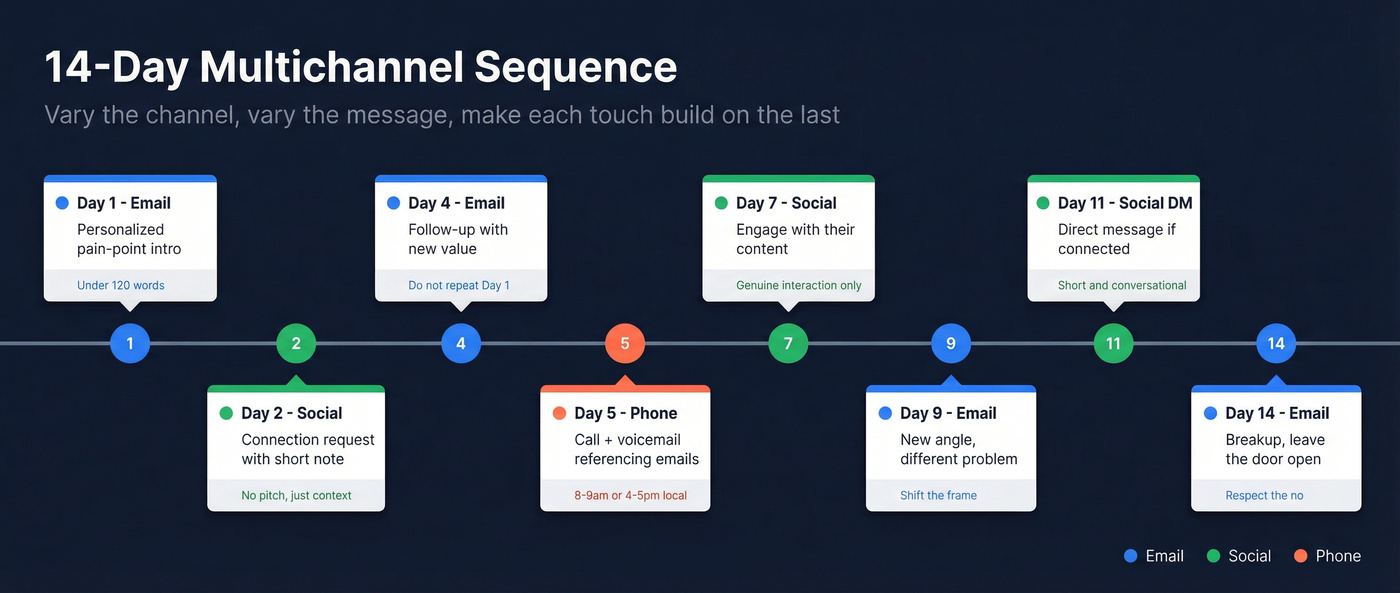
| Day | Channel | Action | Tip |
|---|---|---|---|
| 1 | Personalized pain-point intro | Under 120 words | |
| 2 | Social | Connection request, short note | No pitch - just context |
| 4 | Follow-up with new value | Don't repeat Day 1 | |
| 5 | Phone | Call + voicemail referencing emails | 8-9am or 4-5pm local |
| 7 | Social | Engage with their content | Genuine interaction only |
| 9 | New angle, different problem | Shift the frame | |
| 11 | Social DM | Direct message if connected | Short, conversational |
| 14 | Breakup - leave the door open | Respect the no |
Adjust timing based on your sales cycle and buyer seniority. But the principle holds: vary the channel, vary the message, and make each touch build on the last. A deliberate touchpoint strategy ensures every interaction adds context rather than noise.
Skip this cadence if your average deal size is under $5K - at that price point, a tighter 7-day email-only sequence with one phone call is usually more efficient than spreading across four channels.
If you're leaning into social touches, build a repeatable social selling strategy so reps don't wing it.
Every touchpoint in your 14-day sequence burns credibility if it hits a dead email or wrong number. Prospeo's 300M+ profiles with direct dials and verified emails at $0.01 each mean your multichannel cadence actually reaches the 14-23 stakeholders on the buying committee.
Stop sequencing into the void - start with data that connects.
Mistakes That Kill Multichannel Campaigns
Copy-paste messaging across channels. An email that works in an inbox feels lazy as a DM. Adapt the format, tone, and length to each channel's norms. Use a tested outreach email template as a baseline, then rewrite for each channel.
Over-automating everything. Automation handles timing and triggers. The actual message - especially on social and phone - needs a human fingerprint. Robotic sequences get ignored or reported. We've tested fully automated social touches against semi-manual ones, and the semi-manual approach pulled 3x the response rate. It's not close.
Running on stale segments. Your ICP from six months ago isn't your ICP today. If you're not refreshing behavioral data and re-segmenting regularly, your targeting drifts and performance flatlines. A simple behavioral segmentation refresh can fix this fast.
Defaulting to last-click attribution. Let's be honest - this is the silent killer. It makes your breakup email look like the MVP and your awareness channels look worthless. Set up multi-touch attribution before you launch, not after you've already misallocated budget for a quarter.
FAQ
How many channels should a B2B multichannel strategy use?
Three to four channels with clean data and adapted messaging outperform scattered presence across seven or more. Campaigns using 3+ channels see 250% higher purchase rates than single-channel efforts. Start with email, phone, and social - add channels only when you can maintain quality on each.
What's the difference between multichannel and omnichannel?
Multichannel uses multiple independent channels, often managed by separate teams. Omnichannel integrates them into one unified experience where every touchpoint shares context. Master multichannel coordination before investing in full omnichannel infrastructure - most B2B teams aren't ready for the data requirements, and that's fine. Get the basics right first.
How do I keep contact data accurate across channels?
Use a data provider with frequent refresh cycles and pair it with regular list hygiene. A 7-day refresh cycle beats the six-week industry average by a wide margin - fewer bounces and dead numbers means your multi-channel engagement strategy actually reaches the people you're targeting.
