

How to Build a Sales System That Actually Works
It's Q2 planning. Your CRM has 40,000 contacts, your reps are running three different outreach workflows, and nobody can explain why pipeline coverage dropped 30% since January. The problem isn't effort - your team's working hard. The problem is you don't have a system.
Reps spend just 28% of their week actually selling, and with 6-10 decision-makers involved in every B2B deal, winging it doesn't scale. Building effective sales systems starts with understanding what's broken - and it's almost never what you think.
The Core Argument
- A CRM isn't a sales system. It's one component of five. Stop treating it as the whole thing.
- The five layers are: plan, process, people, metrics, technology. Miss one and the others underperform.
- Build in that order. Most teams start with tools and wonder why nothing works. Strategy first, software last.
- The average team runs 8.3 tools at $187/rep/month with 73% overlap waste. Consolidate to 4-6 integrated platforms.
- Data quality is the most underinvested layer. Bad contacts poison everything downstream - sequences, forecasts, rep confidence, domain reputation. Fix the data and half your "process problems" disappear.
Stop buying tools. Start building a system.
What Is a Sales System?
A sales management system is a predictable, repeatable, scalable revenue engine that aligns sales, marketing, and customer success around a shared process. That's the textbook version. The practical one: it's the difference between a team that hits quota because three reps got lucky and a team that hits quota because the machine is designed to produce that outcome.

The system has five layers, and they stack on each other:
- Sales plan - where you're going and how you'll get there
- Sales process - the repeatable steps from prospect to close
- People - the roles, skills, and coaching cadence
- Metrics - the leading indicators that tell you if the system's working
- Technology - the tools that automate, track, and accelerate
A CRM is one component of the technology layer. Treating Salesforce or HubSpot as your "system" is like calling an engine a car. You need the chassis, the steering, the fuel, and someone who knows how to drive.
The 5 Components That Matter
Sales Plan
Every system starts with a destination. Your sales plan defines quarterly and annual revenue targets, breaks them down by product line and territory, and aligns individual quotas to the company number. But targets alone aren't a plan.
You also need a clear ICP and buyer personas. Who are you selling to? What titles? What company size? What triggers a buying conversation? Without this, your reps are prospecting into the void.
The best planning frameworks follow a five-stage model: define goals, review current performance, map your go-to-market strategy, build the execution plan, then monitor and adapt. The critical word is "adapt." A sales plan isn't a document you write in January and forget. Quarterly recalibration - reviewing pipeline health, capacity changes, and market shifts - separates teams that hit targets from teams that "almost" hit targets every quarter.
Sales Process
Your process is the repeatable sequence from stranger to customer. A clean B2B pipeline typically runs six stages: prospect identification, initial contact, needs assessment, proposal, negotiation, and closing with onboarding.
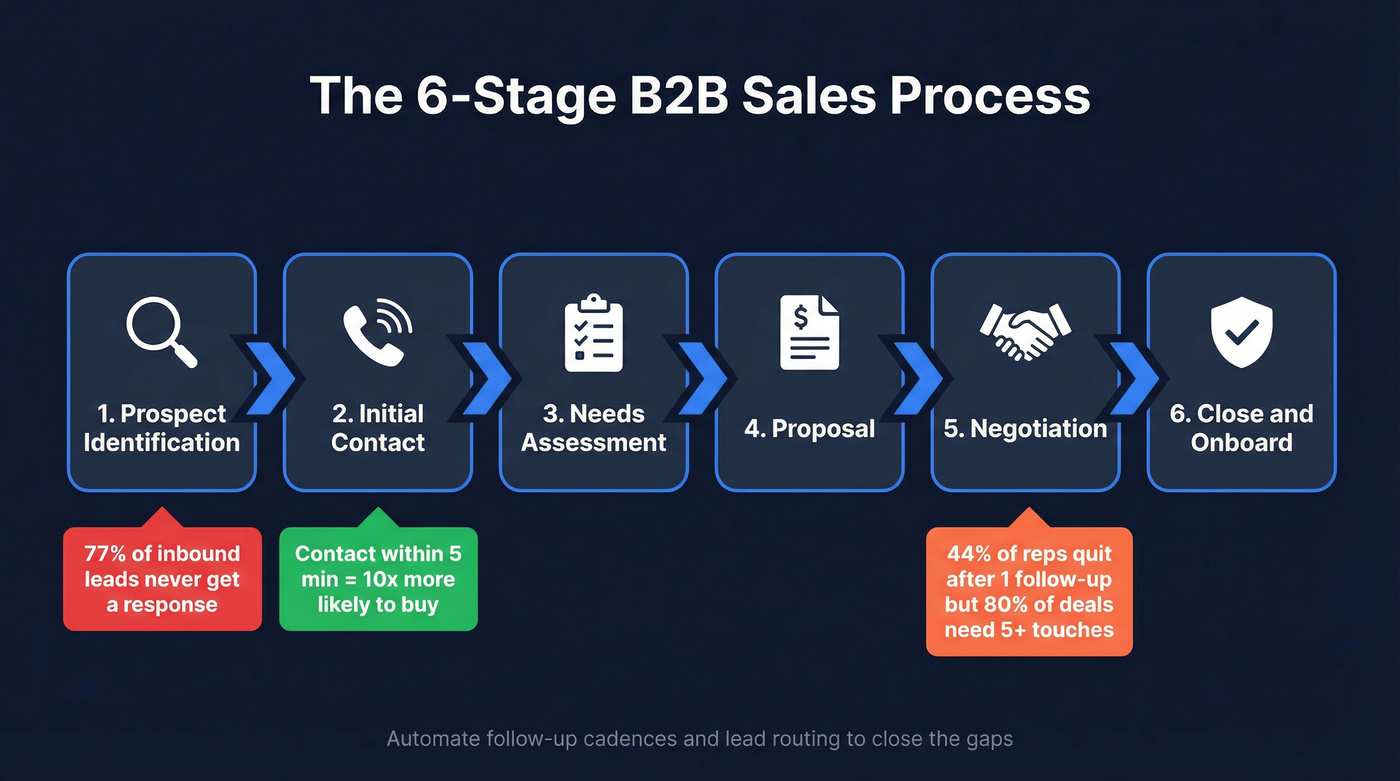
Two stats should haunt every sales leader. First, contacting a lead within 5 minutes makes them 10x more likely to buy. Second, 44% of reps give up after a single follow-up - but 80% of successful sales require five or more touches. That's not a motivation problem. That's a process problem. If your tech stack doesn't automate follow-up cadences and route leads instantly, you're leaving revenue on the table.
And 77% of inbound leads never get a response at all. A documented process with automated triggers fixes this without adding headcount.
People
You can't systematize talent, but you can systematize how talent operates. Scalable sales orgs divide responsibilities into specialized roles - SDRs for pipeline generation, AEs for closing, CSMs for retention, and RevOps to keep the machine running. Asking every rep to do everything is how you get inconsistency.
Coaching is the force multiplier most teams underinvest in. Regular 1:1s, role-playing sessions, and structured performance reviews prevent bad habits from calcifying. New reps take up to 10 months to reach full productivity, but a documented playbook and coaching cadence can compress that timeline dramatically - GreyScout cut rep ramp time from 8-10 weeks down to 4 with the right onboarding system.
Here's a benchmark worth pinning to the wall: Gong's analysis of 25,000 sales calls found that top performers talk 40% of the time and listen 60%. Bottom performers flip that ratio - talking 70%, listening 30%. Your coaching program should measure this.
Metrics
Most teams track too many metrics or the wrong ones. Focus on leading indicators: pipeline coverage, conversion rates by stage, deal cycle duration, quota attainment, and win rates. These tell you where the system's breaking before revenue shows it.
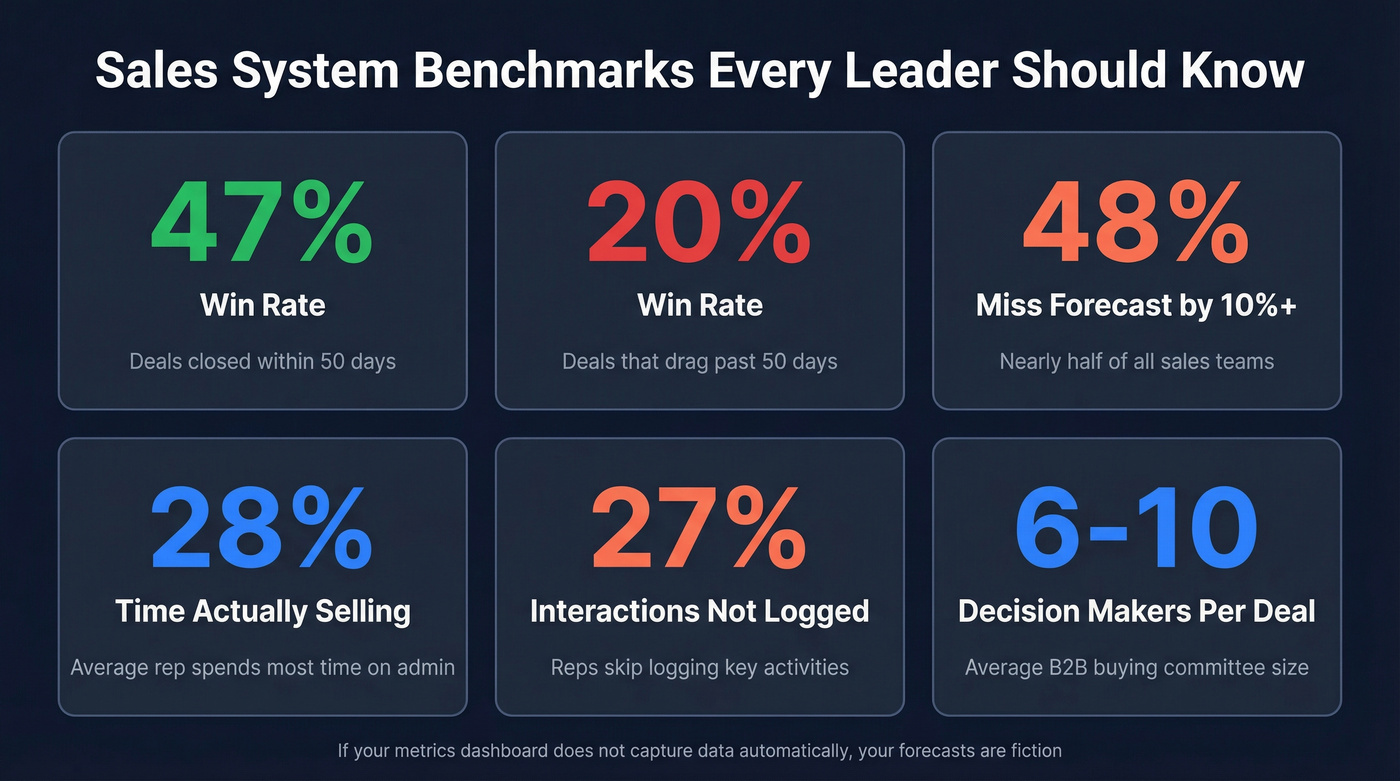
The speed benchmark is striking: deals closed within 50 days show a 47% win rate. Beyond 50 days, that drops to 20%. If your average cycle is stretching, the system has a leak - probably in qualification or follow-up.
On the forecasting side, 48% of sales teams miss their forecasts by 10% or more. A big reason: reps skip logging 27% of key customer interactions. Your metrics are only as good as the data feeding them. If activity isn't captured automatically, your dashboards are fiction. A good management framework captures this data without relying on manual rep input.
Technology
The average B2B sales team runs 8.3 tools at $187/rep/month. That's $2,244/rep/year - and 73% of teams report significant overlap waste, burning roughly $2,340/rep/year on redundant functionality. The industry is consolidating from 8-12 point solutions down to 4-6 integrated platforms, and for good reason.
In practice, modern platforms collapse into fewer buckets: CRM, prospecting and data, engagement, conversation intelligence, intent data, lead routing, integrations, and data enrichment. You don't need a separate tool for each. The best stacks collapse several categories into fewer platforms.
The principle is simple: buy tools that integrate natively, eliminate overlap, and solve a specific bottleneck in your process. If you can't name the bottleneck a tool solves, you don't need it.
Your Playbook Is the Operating System
If your playbook is still a PDF in a shared drive, it's not a system - it's a suggestion. The shift from static to dynamic playbooks is one of the biggest operational upgrades a sales team can make right now.
| Static Playbook | Dynamic Playbook | |
|---|---|---|
| Format | PDF, binders, docs | CRM-embedded cards |
| Updates | Quarterly or annual | Real-time |
| Personalization | Generic, one-size | Stage/persona-specific |
| Analytics | None | Usage tracking built in |
A dynamic playbook lives inside your CRM and surfaces the right guidance at the right moment - different talk tracks for different industries, different objection-handling for different deal stages, different competitive intel based on who you're up against. It captures what top performers actually do and makes that behavior the default for everyone.
We've seen teams try to shortcut this by buying an AI tool and hoping it generates a playbook for them. It doesn't work. The playbook has to come from your actual sales conversations, your real objections, your specific competitive landscape. Build it before hiring the next rep. It's the single highest-leverage investment in scaling consistency.

You read it above: bad contacts poison everything downstream - sequences, forecasts, rep confidence, domain reputation. Prospeo's 5-step verification delivers 98% email accuracy with a 7-day refresh cycle, so your sales system runs on data you can trust. 143M+ verified emails, 125M+ mobiles, $0.01/lead.
Fix the data layer and watch the rest of your system actually work.
Best Platforms for Your Tech Stack
61% of companies exceeding revenue targets credit their tech stack as a key driver. But the stack itself matters less than how it's integrated. AI-native tools deliver 241% ROI compared to 87% for traditional tools, and AI CRMs can reach time-to-value in 7 days versus 90 for traditional implementations.

A well-architected stack breaks down like this:
| Category | Recommended Tool(s) | Starting Price | Notes |
|---|---|---|---|
| CRM | HubSpot, Salesforce, Pipedrive | Free - ~$300/user/mo | HubSpot for SMB; Salesforce for enterprise |
| Prospecting & Data | Prospeo, Apollo | Free - ~$0.01/email | 98% email accuracy, 7-day refresh cycle |
| Sales Engagement | Outreach, Salesloft | ~$100+/user/mo | Pick one, not both |
| Conversation Intel | Gong | Custom | 11 days faster close time |
| Intent Data | Bombora | ~$25K-$50K/yr | Buyer intent + growth signals |
| Lead Routing | Chili Piper, Default | $45-$500/mo | Automate speed-to-lead |
| Integrations | Zapier, Clay, Make | Free - ~$50/mo | Glue layer for the stack |
| Data Enrichment | Prospeo, Clay, ZoomInfo | ~$0.01/lead - $15K+/yr | Up to 92% match rate |
For CRM, HubSpot's free tier is genuinely good for small teams. Salesforce is the enterprise standard and often takes months to implement well. Pipedrive works for smaller teams that want visual pipeline management. For engagement, Outreach and Salesloft are functionally similar - pick one and commit.
The most underinvested category is prospecting and data. Teams will spend $150/user/month on a sequencer but feed it unverified contacts from a stale database. That's like buying a Ferrari and filling it with cooking oil. Data freshness is the single biggest differentiator between tools that generate pipeline and tools that burn your domain. Prospeo's 7-day refresh cycle - versus the 6-week industry average - exists specifically to solve this, with 300M+ professional profiles, 98% email accuracy, and native integrations into Salesforce, HubSpot, Smartlead, and Instantly.

How to Build Your Revenue Engine
The implementation sequence matters. Resist the urge to start with tools.
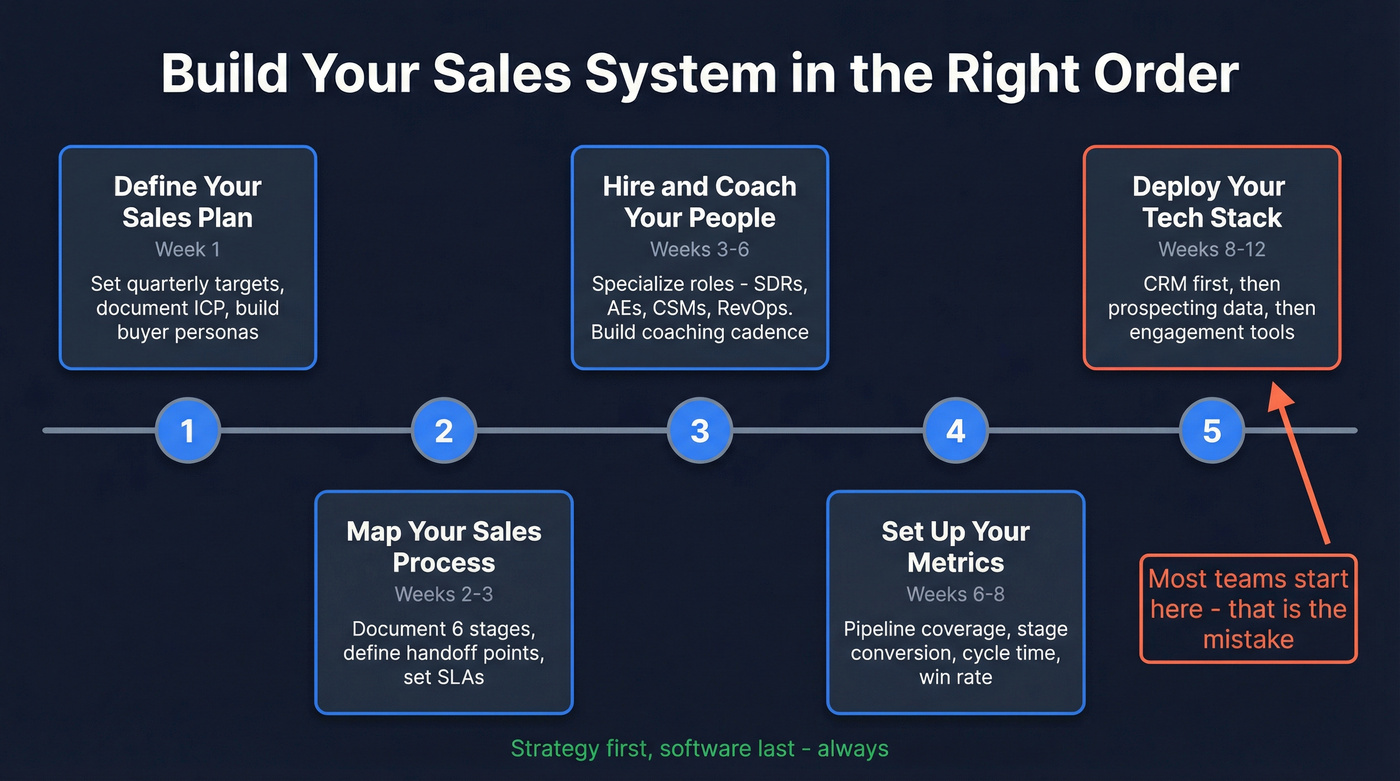
Step 1: Define your sales plan (1 week). Set quarterly revenue targets, document your ICP, and build buyer personas. Don't overthink it - you'll recalibrate quarterly.
Step 2: Map your sales process (1-2 weeks). Document the six stages from prospect identification to close. Define what happens at each stage, what qualifies a deal to move forward, and what triggers automated follow-up. Write it down. If it's not written, it doesn't exist.
Step 3: Structure your people (start week 3, ongoing). Assign specialized roles. Build a coaching cadence - weekly 1:1s, monthly role-plays, quarterly performance reviews. Build the playbook before hiring the next rep. A new hire with a playbook ramps in weeks. Without one, they take months and invent their own process.
Step 4: Establish your metrics (week 3-4). Pick 5-7 leading indicators. Build a dashboard. Review weekly with the team, quarterly with leadership. Don't track 30 metrics - track the ones that predict revenue.
Step 5: Select your technology (week 4+). Now - and only now - buy tools. Start with three: a CRM, one prospecting/data tool, and one engagement platform. That's your minimum viable stack. Add conversation intelligence and intent data once the foundation is solid. The best platform for your team is the one that solves a specific bottleneck, not the one with the longest feature list.
Step 6: Review and iterate (quarterly). Quarterly recalibration isn't optional. Review pipeline health, win rates, cycle times, and tool utilization. Kill what's not working. Double down on what is.
5 Mistakes That Kill Revenue
Mistake 1: Tool sprawl without integration. You've got 8 tools and none of them talk to each other. Data lives in silos, reps toggle between tabs, and 73% of your stack budget is wasted on overlap. The fix: audit your stack quarterly. Teams that do this often save 20-30% on tool spend. If two tools do the same thing, kill one.
Mistake 2: Bad data poisoning the pipeline. Your SDR sends 5,000 emails. 800 bounce. Your domain reputation tanks, and now even the good emails land in spam. About 50% of leads are subpar quality to begin with - and stale data makes it worse. Meritt saw exactly this: 35% bounce rates that cratered deliverability. After switching to a 7-day data refresh cycle, bounces dropped to under 4% and pipeline tripled from $100K to $300K/week.
Mistake 3: No documented process. When there's no system, every rep invents their own approach. One qualifies on budget first, another on timeline, a third skips discovery entirely. The result: unpredictable outcomes and coaching that's impossible to standardize. A documented process with automation reclaims hours from the other 72% of the week reps currently spend on non-selling activities.
Mistake 4: Selling before listening. Gong's analysis of 25,000 calls is clear: top performers listen 60% of the time. And 50% of decision-makers say they're willing to engage if they don't feel like they're being sold to. Your playbook should enforce discovery before pitch. Every time.
Mistake 5: No follow-up system. 44% of reps give up after one follow-up. 80% of deals need five or more. And 77% of inbound leads never get any response. This isn't a people problem - it's a system problem. Automated sequences with escalation triggers solve it without relying on rep discipline.
The AI Layer in 2026
The global sales automation market grew from $7.8B in 2019 to $16B by 2025. The question now isn't whether to use AI - it's where to deploy it.
45% of high-performing sales teams have adopted hybrid human-AI SDR models. AI handles research, identification, and first-touch personalization. Humans handle relationship-building and qualification. Among teams using AI SDR tools, 100% report saving time on prospecting, and 40% save 4-7 hours per week.
The productivity gains are real. LivePerson reduced prospect research time from 20 minutes to 2 minutes and saw a 35% lift in engagement rates. That's a 90% reduction in research time - time that goes back into actual selling.
Conversation intelligence is another high-ROI layer. Teams using it close deals 11 days faster on average and see a 10-percentage-point win-rate improvement on deals over $50K. If you're running a complex B2B cycle, this pays for itself in one quarter.
Let's be honest: if your average deal size is under $15K, you probably don't need a full AI-powered tech stack. A CRM, a solid data tool, and a sequencer will outperform a bloated enterprise stack every time. The teams drowning in AI tools are usually the ones that skipped building the system underneath.
AI doesn't replace your sales system - it accelerates it. Without the underlying plan, process, people, and metrics, AI just helps you do the wrong things faster. With a solid foundation, it becomes the multiplier that turns a good team into an exceptional one.
Maturity Model
Where does your team fall?
- Level 1 - Ad hoc. No documented process. Every rep does their own thing. Forecasting is guesswork.
- Level 2 - Defined. Process exists on paper. CRM is in place but inconsistently used. Coaching is reactive.
- Level 3 - Repeatable. Process is followed. Metrics are tracked weekly. Playbook is documented and referenced.
- Level 4 - Optimized. Dynamic playbook embedded in CRM. Quarterly stack audits. Leading indicators drive decisions.
- Level 5 - Predictive. AI augments every layer. Forecasts are within 5%. The system self-corrects based on data.
Most teams are stuck at Level 2 and buying Level 5 tools. Close the gap by building the layers in order.
Your team runs 8+ tools at $187/rep/month with 73% overlap. Prospeo consolidates prospecting, data enrichment, email verification, intent signals, and CRM enrichment into one platform - with native Salesforce, HubSpot, and sequencer integrations. 90% cheaper than ZoomInfo with higher accuracy.
Collapse your stack from eight tools to one that actually scales.
FAQ
What's the difference between a sales system and a CRM?
A CRM is one component - the technology layer - of a five-part system that also includes your sales plan, repeatable process, team structure with coaching cadences, and metrics framework. Without those four layers, a CRM is just an expensive contact database. Think of it as the engine, not the car.
How much does a sales system cost?
The average B2B team spends $187/rep/month across 8.3 tools, but a well-architected stack of 4-6 integrated tools costs less and performs better. Start with a free CRM like HubSpot, a prospecting tool at ~$0.01/email, and one engagement platform. A functional setup often runs under $100/rep/month.
How long does implementation take?
Core infrastructure - CRM, documented process, and initial playbook - takes 4-8 weeks. Full maturity with coaching cadences, metrics dashboards, and quarterly review cycles takes 2-3 quarters. AI CRMs can reach time-to-value in as little as 7 days, but the human layers take longer to embed.
What metrics should I track?
Focus on five to seven leading indicators: pipeline coverage, stage-by-stage conversion rates, deal cycle length, win rate, and quota attainment. Track activity metrics as inputs, not outcomes. More than seven metrics and nobody watches any of them - keep the dashboard tight.
Do small teams need a formal system?
A 5-person team benefits more from a documented system than a 50-person team does. Without one, every rep invents their own process, coaching becomes impossible, and ramp time stretches to 10 months. A playbook plus 2-3 integrated tools creates more leverage than hiring another rep.
