Manual vs Automated Follow-Ups: What the Data Actually Says
48% of salespeople never follow up. Not once. Meanwhile, 80% of successful sales require five or more touches, and a single follow-up boosts reply rates by 49%. That gap between what works and what reps actually do is where most pipeline dies - quietly, in a CRM nobody's checking.
The fix isn't "just automate everything" or "just be more disciplined." It's knowing which follow-ups need a human and which ones a machine handles better. Follow-ups drive 42% of all cold email replies, so skipping them isn't an option. And none of it works if your contact data is bad - verify your list before you automate anything.
When Manual Follow-Ups Win
Manual follow-ups earn their keep in enterprise deals where a generic sequence would get you blacklisted. Multi-threaded accounts where you need to reference a specific conversation, a board deck, or a competitor's contract renewal date. Any situation where the prospect already knows your name.
Skip this approach if you're running volume outbound to cold lists. Manual follow-ups at scale don't fail because reps are lazy - they fail because humans are inconsistent. 44% of reps quit after a single follow-up attempt. Context switching kills the rest. A rep juggles 30 open deals, and follow-up #3 to a cold prospect just doesn't make the priority list.
Here's the thing: Gartner found 73% of B2B buyers avoid suppliers that send irrelevant outreach. But manual doesn't automatically mean personalized - it just means slower. If your reps are sending "just bumping this to the top of your inbox," automation would actually be an upgrade.
When Automated Follow-Ups Win
Automated sequences shine in high-volume outbound where consistency matters more than customization - SDR teams running 200+ prospects per rep, or any sequence where the first three touches are essentially the same message with minor variations.
Skip this if your average deal size is six figures and your buyer expects a consultative relationship from touch one. Or if your data is dirty. Automating follow-ups to bad emails is like putting a turbocharger on a car with no wheels.
The numbers are stark. Automated sequences hit 99% follow-up consistency vs 60-70% for manual processes. Reps save 2-3 hours daily. And speed matters: HBR research shows that waiting just 5 minutes to respond reduces lead qualification likelihood by 10x. On top of that, 61% of B2B buyers now prefer a rep-free buying experience, which means your automated touches may actually be what they want - as long as they're relevant.
Side-by-Side Comparison
| Factor | Manual | Automated | Winner |
|---|---|---|---|
| Consistency | 60-70% | 99% | Automated |
| Personalization | High (if done well) | Low-medium | Manual |
| Annual cost | $75k-$100k/SDR | $500-$2,000/mo | Automated |
| Scalability | Limited by headcount | Near-unlimited | Automated |
| Risk | Missed follow-ups | Deliverability damage | Manual (lower blast radius) |
| Best use case | Warm/complex deals | Cold volume outbound | Depends on ACV |
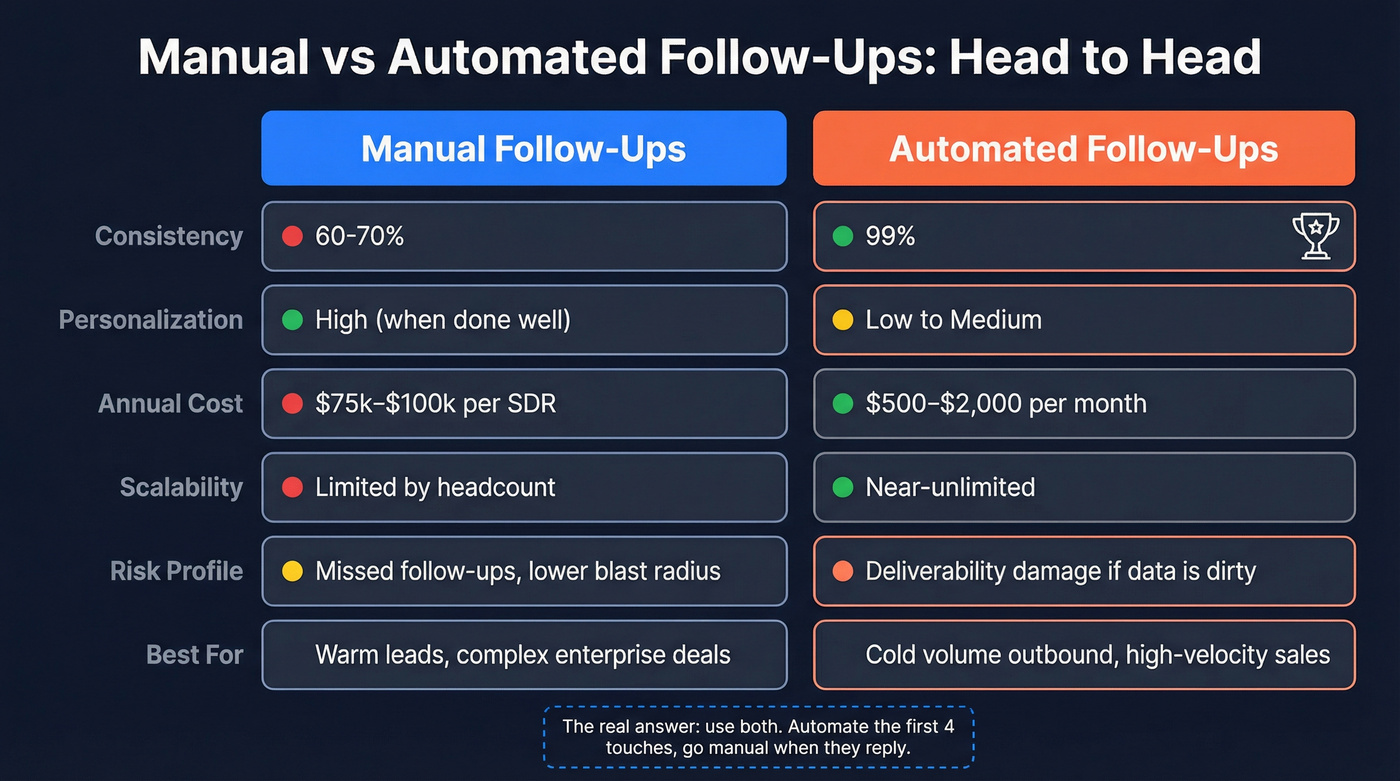
The cost line is the one that gets CFOs' attention. A fully loaded SDR runs $75k-$100k/year and handles 15-20 qualified opportunities per month. An automation platform at $500-$2,000/month can push 40-60 qualified opportunities - assuming the data feeding it is clean.
If your average contract value sits below $10k, you probably don't need manual touches at all until a prospect replies. Automate the first four touches. Save human effort for conversations that are actually happening.
Follow-Up Benchmarks Worth Knowing
Most articles on this topic cite stats with zero attribution. Let's fix that.
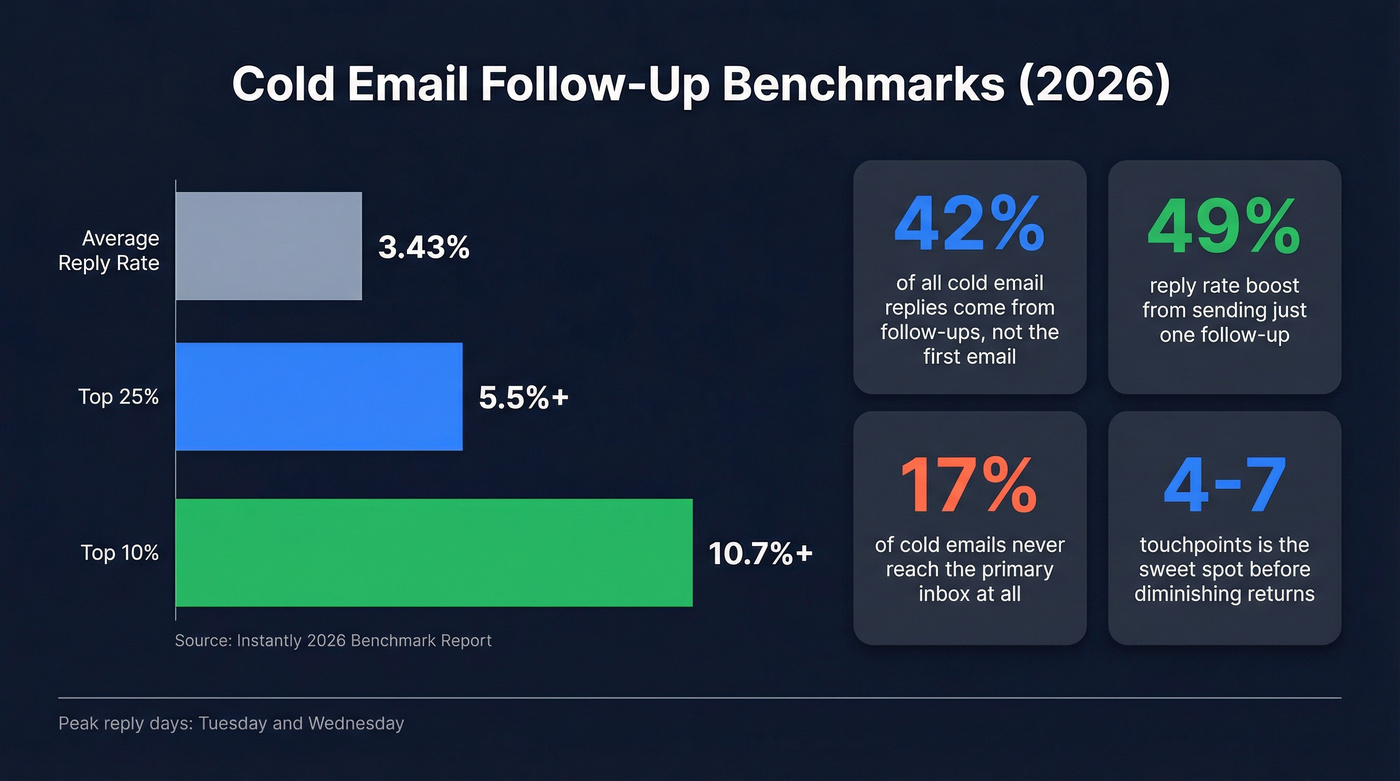
Instantly's 2026 benchmark report - built on billions of platform interactions - puts the average cold email reply rate at 3.43%. Top quartile hits 5.5%+, and the top 10% breaks 10.7%. The split between first-touch and follow-up replies is 58/42, meaning follow-ups generate nearly half your responses. Tuesday and Wednesday are peak reply days, with Wednesday highest. Time your sequences accordingly.
The sweet spot is 4-7 touchpoints. Fewer than 4 and you're leaving replies on the table. More than 7 shows diminishing returns unless each touch adds genuinely new value. Belkins' data tells a complementary story: a first follow-up boosts reply rates by 49%, and three email rounds average a 9% reply rate. SalesHive pegs the broader cold B2B email reply rate at ~5.1%, but flags that 17% of cold emails never reach the primary inbox at all.
That last number should keep you up at night.

17% of cold emails never reach the inbox - and bad data is the top reason. Prospeo's 5-step verification catches spam traps, honeypots, and catch-all domains before they tank your sender reputation. At $0.01 per email with 98% accuracy, cleaning your list costs less than a single bounced sequence.
Fix your data before you automate another follow-up.
Seven Mistakes That Kill Sequences
1. Automating without mapping your process. 62% of organizations have mapped 25% or fewer of their processes. Automation doesn't fix chaos - it scales it. Map your sales stages and define handoff triggers first.
If you need a blueprint, start with a sales process your reps will actually follow.
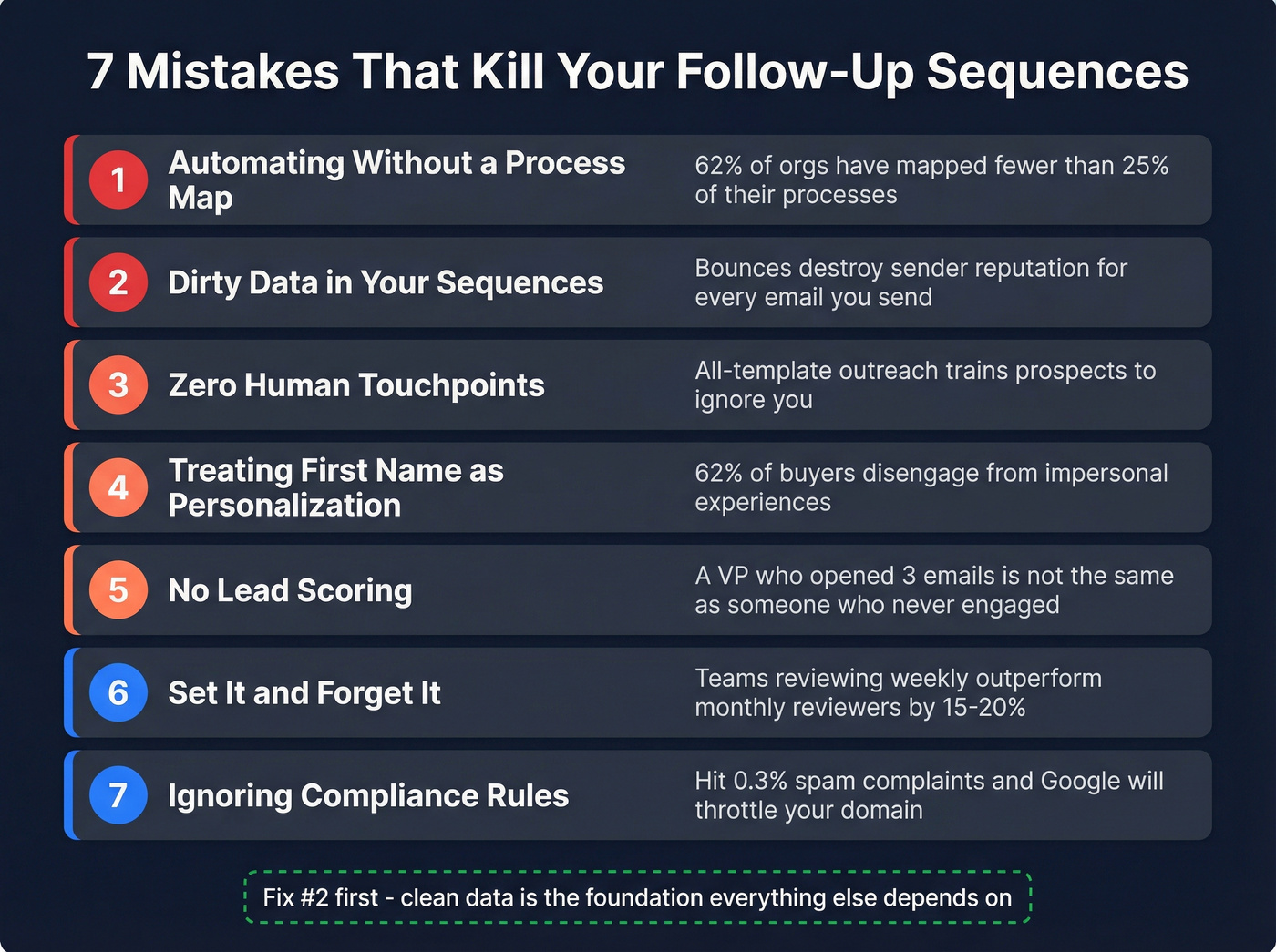
2. Dirty data feeding your sequences. This is the silent killer. Unverified emails bounce, bounces damage your sender reputation, and a damaged domain tanks deliverability for every email you send. We've seen teams cut bounce rates from 20% to under 3% just by running verification before launching sequences. Prospeo's 5-step verification catches spam traps, honeypots, and catch-all domains before they hit your sending infrastructure, and native integrations with Instantly, Smartlead, Lemlist, and HubSpot push verified data straight into your sequences without manual exports.
If you're comparing vendors, use this list of email validators to sanity-check accuracy claims.
3. Over-automation with zero human touchpoints. If every interaction a prospect has with your company is a templated email, you're training them to ignore you. Build manual checkpoints into every sequence.
4. Treating "{First Name}" as personalization. It's not. 62% of consumers are less likely to stay loyal to brands that deliver impersonal experiences. Real personalization means segmentation, behavioral triggers, and references to something specific about the prospect's company or role - not a merge tag.
5. No lead scoring. Without scoring, your automation treats a VP who opened three emails the same as a coordinator who never engaged. Automate task assignment for high-scoring leads and let low-scorers stay in the nurture track.
If you don't have a model, build a simple lead scoring system before you scale volume.
6. Set-and-forget. Launching a sequence and never checking open/click/reply rates is like running ads without looking at the dashboard. Review weekly. Kill underperforming steps. A/B test subject lines. In our experience, teams that review sequences every Friday consistently outperform those running monthly audits by 15-20% on reply rates.
7. Ignoring compliance. Google and Yahoo's bulk sender rules require SPF/DKIM/DMARC authentication, one-click unsubscribe, and spam complaint rates below 0.1%. Hit 0.3% and you're in serious trouble. Automated sequences make it dangerously easy to blast past these thresholds.
If you're implementing auth, follow an SPF, DKIM, DMARC checklist before you send at scale.
The Deliverability Problem Nobody Mentions
Your follow-ups can't work if they land in spam. And this is a bigger problem than most teams realize.
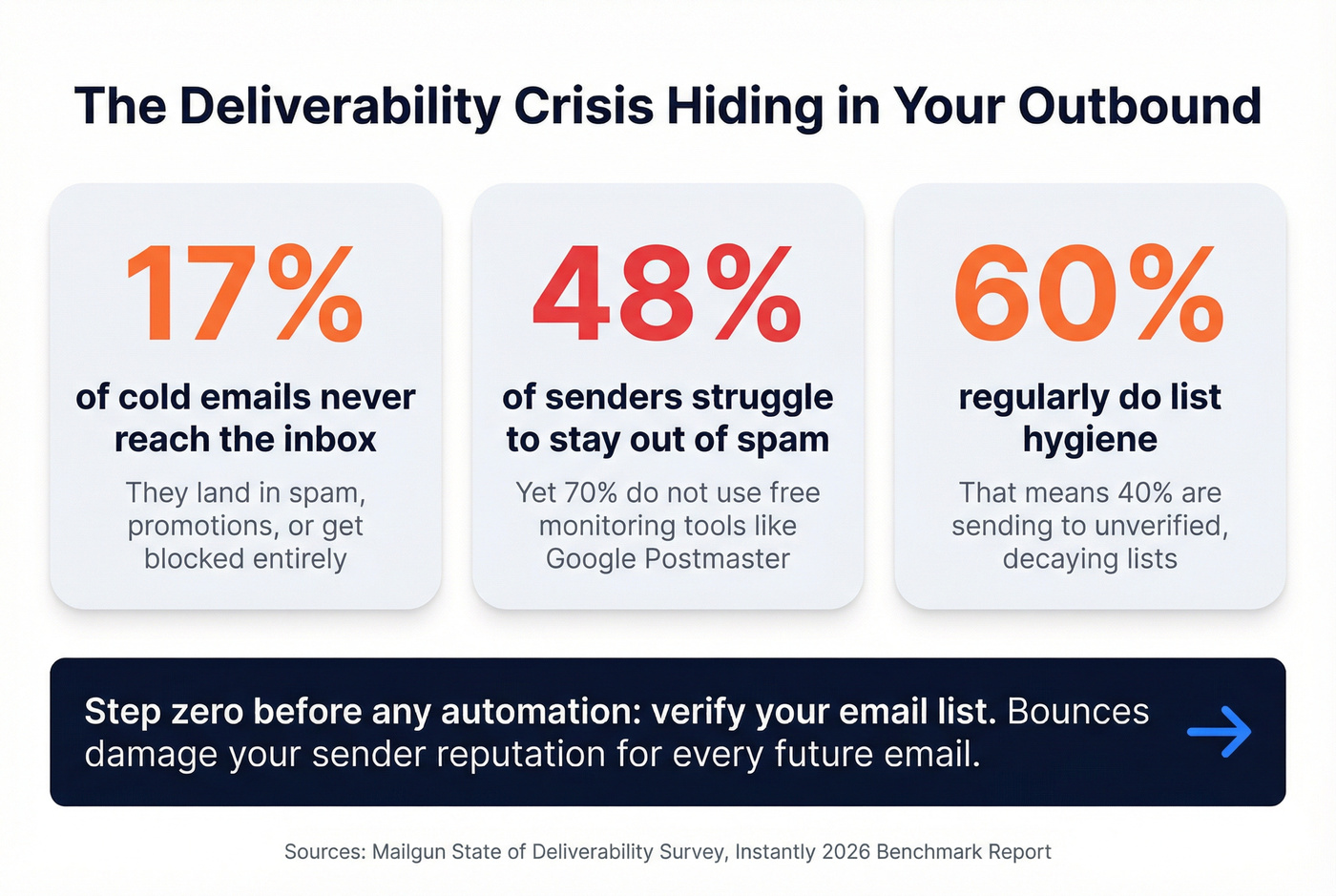
17% of cold emails never reach the primary inbox. A Mailgun survey of 1,100+ senders found that 48% struggle to stay out of spam, yet 70% aren't even using free tools like Google Postmaster Tools to monitor their sender reputation. Only 60% regularly do list hygiene. Ask anyone on r/sales and they'll tell you the same thing - automation without clean data is just faster failure.
If you want the full playbook, start with an email deliverability checklist and work backward from bounces/complaints.
Google and Yahoo don't care whether your follow-up was manual or automated. They care about authentication, complaint rates, and bounce rates. Step zero is verifying your list before anything else touches your sending infrastructure.
Automated sequences only scale when the contacts are real. Prospeo pushes verified emails and direct dials straight into Instantly, Smartlead, Lemlist, and HubSpot - no CSV exports, no manual cleanup. Teams using Prospeo cut bounce rates from 35% to under 4% and tripled their pipeline.
Stop automating follow-ups to dead email addresses.
The Hybrid Framework
The real question isn't which approach to pick - it's knowing which touches to automate and which to keep human. McKinsey found B2B customers now use 10+ channels on average, and 94% say omnichannel is as effective or more effective than traditional approaches. Here's a 5-step sequence built around the 4-7 touch sweet spot:
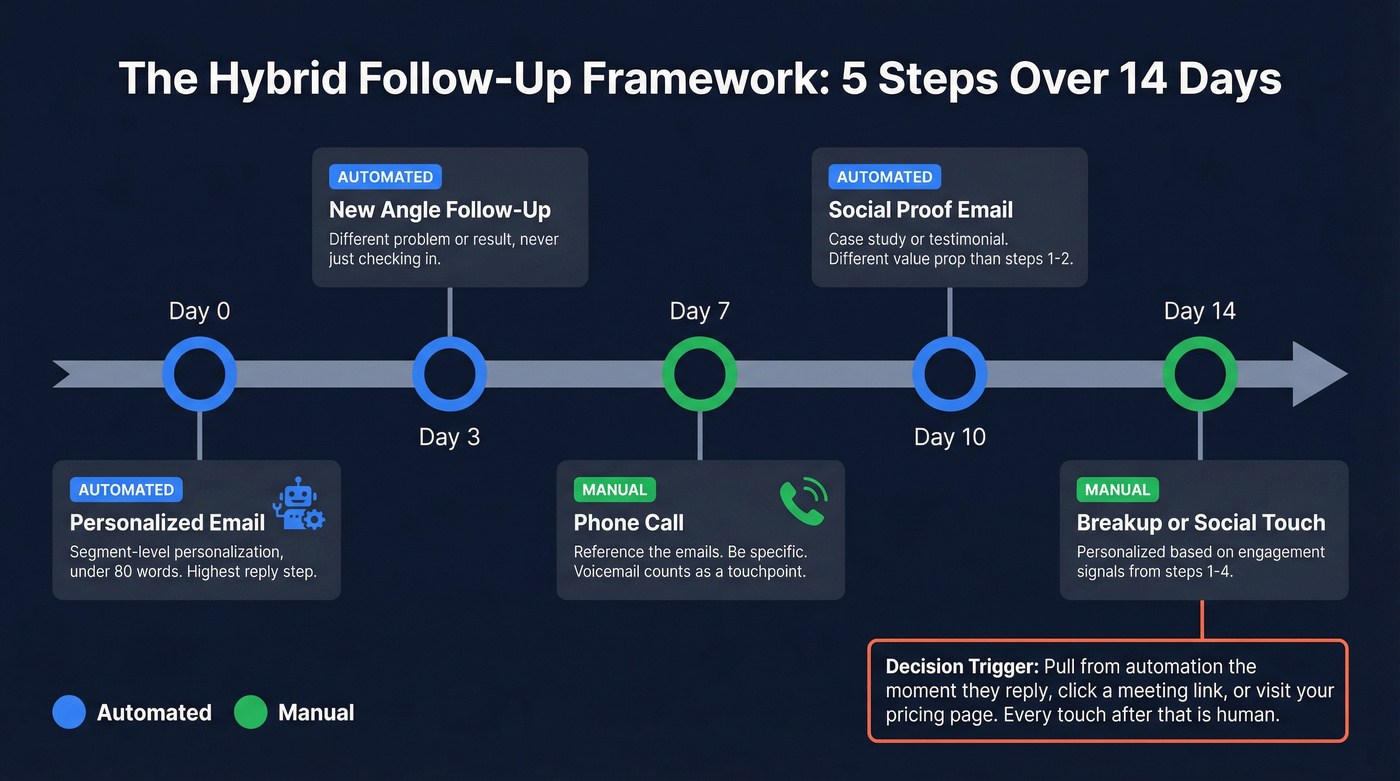
Step 1 (Day 0) - Automated email. Personalized by segment, not by individual. Under 80 words. This is your highest-reply step.
Step 2 (Day 3) - Automated follow-up. New angle, not "just checking in." Reference a specific problem or result.
Step 3 (Day 7) - Phone call (manual). This is where humans earn their keep. Reference the emails. Be specific. Even a voicemail creates a multi-channel touchpoint.
If you're adding calls, use a cold call checklist so reps stay consistent.
Step 4 (Day 10) - Automated email. Social proof or case study. Different value prop than steps 1-2.
Step 5 (Day 14) - Manual breakup email or social touch. Personalized based on engagement signals from steps 1-4. If they opened step 4 twice, reference the case study. Zero engagement? Send a clean breakup.
The decision trigger: Pull a lead out of automation the moment they reply, click a meeting link, or visit your pricing page. From that point forward, every touch is human.
Expect 3-6 months to see positive ROI from automation, and budget 40-60 hours upfront for data cleaning and segmentation. We've watched teams skip this prep work and end up rebuilding their sequences from scratch within 90 days.
Tools for a Hybrid Approach
| Tool | Category | Starting Price | Best For |
|---|---|---|---|
| Prospeo | Email verification & data | Free tier; ~$0.01/email | Verifying lists pre-automation |
| Instantly | Cold email platform | ~$30/mo | High-volume outbound |
| Smartlead | Multi-sender delivery | ~$39/mo | Agency-scale sending |
| HubSpot Sales Hub | CRM-native automation | Free CRM; ~$20/user/mo | SMB simplicity |
| Apollo | Prospecting + sequences | Free tier; ~$49/user/mo | Budget-conscious teams |
| Salesloft / Outreach | Enterprise orchestration | ~$100-$150/user/mo | Large sales orgs |
| Lemlist | Personalized sequencing | ~$39/user/mo | Creative outbound |
A human SDR costs $75k-$100k/year all-in. Most teams don't need to choose between humans and tools - they need the right combination with a verification layer sitting upstream of everything else.
If you're building your stack from scratch, start with a lean set of cold email marketing tools and add complexity only when the numbers justify it.
FAQ
How many follow-up emails should I send?
Four to seven touches is the sweet spot based on Instantly's 2026 data. Follow-ups generate 42% of all cold email replies, so fewer than four leaves significant pipeline on the table. More than seven shows diminishing returns unless each touch adds genuinely new value.
Can I automate follow-ups without hurting my domain?
Yes - if your data is clean and you stay under Google's 0.1% spam complaint threshold. Verify your list first, authenticate with SPF/DKIM/DMARC, and include one-click unsubscribe in every message.
When should I switch from automated to manual?
Pull leads out of sequences the moment they show buying signals - a reply, a pricing page visit, or a meeting link click. Automation handles consistency at scale while humans handle nuance. For deals above $50k ACV, consider adding a manual phone touch by step 3 even without engagement signals.