How to Run a SaaS Competitor Analysis That Actually Gets Used
Most SaaS competitor analyses are useless because they document everything instead of answering one question: where's the gap we can exploit?
Your CEO just asked how you stack up against that competitor who keeps showing up in deals. Nobody had a clear answer. The last "competitive analysis" anyone remembers was a 40-slide deck from two years ago that lived in a Google Drive folder and died there. Here's a better approach - one that takes 2-3 hours and produces something your sales team will actually open.
The urgency is real. Sales teams face direct competition in 68% of deals, yet competitive selling preparedness sits at 3.8 out of 10. With median SaaS growth rates at 26% and CAC ratios hitting $2.00 per dollar of new ARR across 500+ company B2B SaaS benchmarks, you can't afford to compete blind.
The 2-3 Hour Process
Step 1: Map Your Competitors
SWOT is fine as a starting framework, but if your analysis ends at a 2x2 grid, you've wasted your time. Skip Porter's Five Forces too - you need exploitable gaps, not academic exercises.
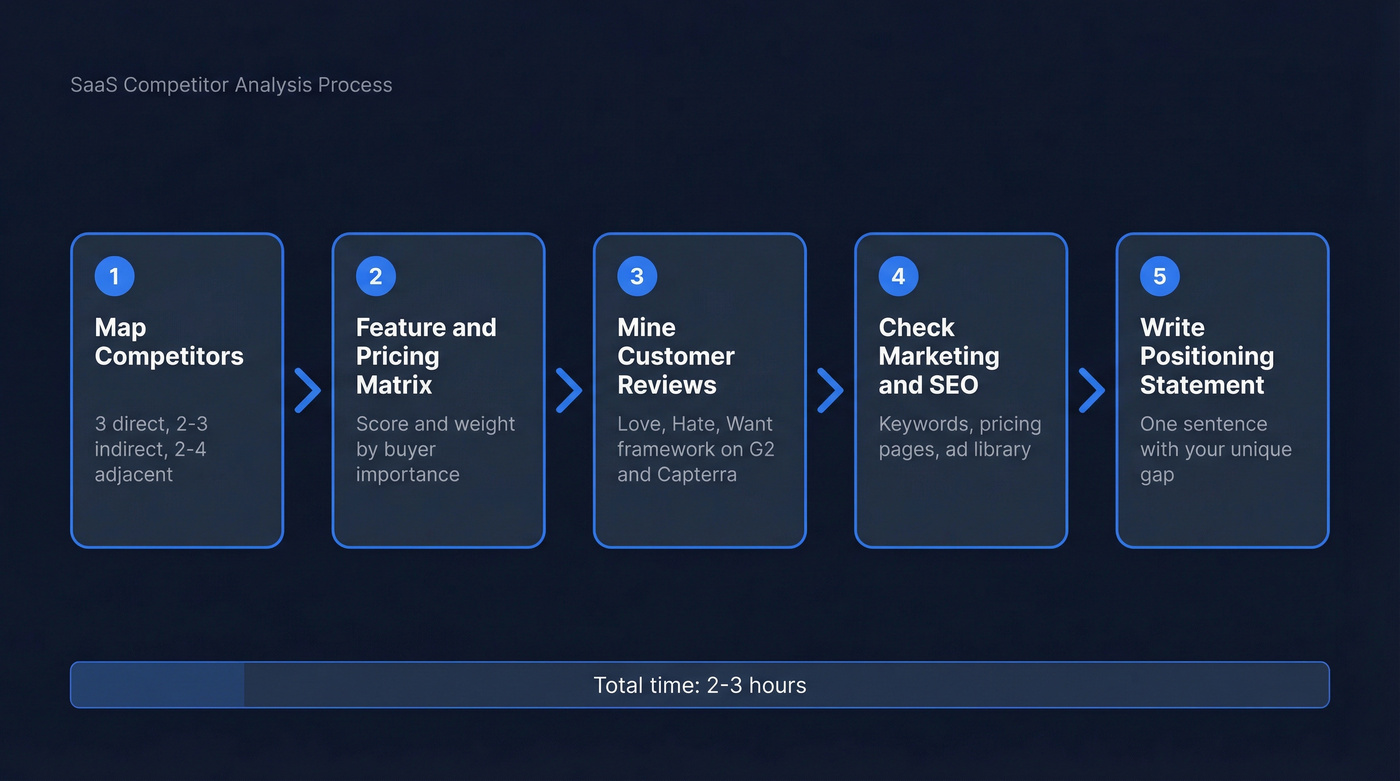
Sort competitors into three buckets. Direct competitors sell the same thing to the same buyer. Indirect competitors solve the same problem differently. Adjacent competitors overlap on one dimension - maybe the same persona, different product category. Three direct, two to three indirect, and two to four adjacent gives you a field of 5-10. Most teams track this in a spreadsheet they update when they remember. You're about to build something better.
Step 2: Build a Feature & Pricing Matrix
Columns are competitors. Rows are the dimensions that matter: core features, differentiators, pricing model, target market, integrations, support. Score each cell:
| Score | Meaning |
|---|---|
| ❌ | None |
| ⚠️ | Basic |
| ✅ | Good |
| ⭐ | Excellent |
Weight each row by importance to your buyer. A ⭐ in a feature nobody cares about is worth less than a ✅ in the one that closes deals. When you see a column full of ⚠️ next to your ⭐, that's a positioning angle. When you see a row where everyone's at ✅ and you're at ⚠️, that's a gap to close or deprioritize in messaging.
For pricing, document the model (per-seat, usage-based, flat), price range, free tier, and trial length. Don't skip this - pricing architecture tells you as much about a competitor's strategy as their feature set does.
Step 3: Mine Customer Reviews
This is where most analyses get lazy. Don't just read reviews - create a "Love / Hate / Want" spreadsheet for each competitor using G2, Capterra, and TrustRadius. In our experience, this framework surfaces more actionable intel in 30 minutes than a week of feature-by-feature comparison.
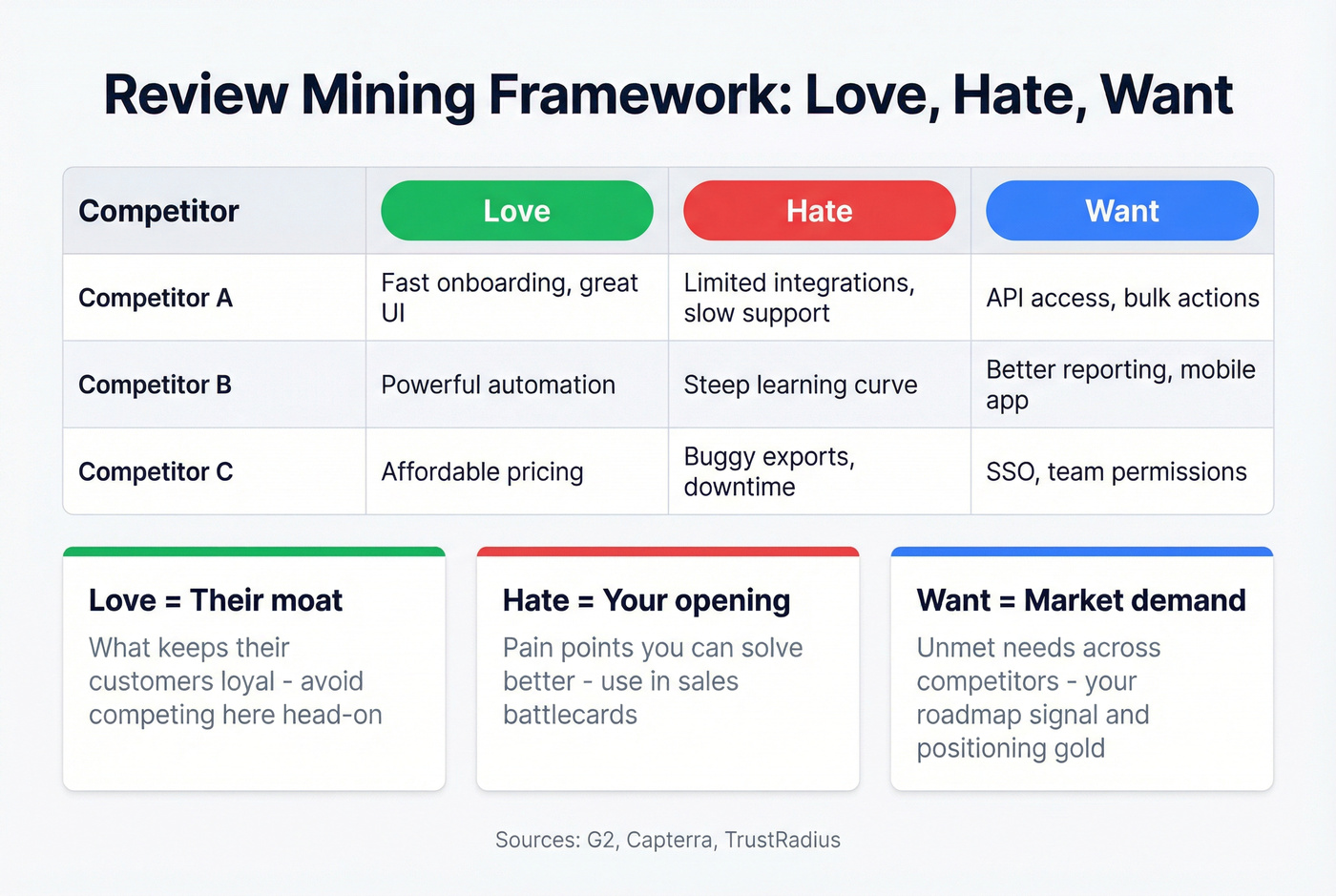
The "Want" column is gold. Feature requests appearing across multiple competitors represent unmet market demand - that's your roadmap signal.
One important distinction: a feature gap and a UX gap are different problems. A competitor might match your feature set but win on implementation. We've seen teams obsess over feature parity while ignoring that their onboarding flow takes three times longer than the competitor's. The consensus on r/SaaS threads about competitive analysis echoes this - users switch for experience, not checkboxes.
Step 4: Check Marketing & SEO
Pull each competitor's top organic keywords using Semrush's free tier (10 daily credits). Screenshot their pricing pages - these change often at fast-moving SaaS companies. The Meta Ad Library is free and underrated: filter by competitor name to see which messages they're investing behind.
Look, this step isn't glamorous. But the team that notices a competitor quietly A/B testing "enterprise-grade security" messaging three months before launching an enterprise tier has a real head start.
Step 5: Write Your Positioning Statement
Everything above feeds into one sentence:
"For [target customer], [your product] is the [category] that [unique value proposition], unlike [competitor] which [their limitation]."
If you can't fill it in clearly, you haven't found your gap yet. Go back to the matrix.
Tools for SaaS Competitive Intelligence
Here's what the tools cost and when you need them:
| Tool | What It Does | Price |
|---|---|---|
| Semrush | SEO/keyword gap | $139.95-$499.95/mo |
| Ahrefs | Backlink intel | $99-$999/mo |
| Klue | Battlecards & CI | ~$20-40K/yr |
| Crayon | Website tracking | ~$25-40K/yr |
| Kompyte | CI + battlecards | From $300/mo |
| Prospeo | Verified contacts | Free / ~$0.01/email |
| Owler | Company alerts | Free / $35/mo |
| Similarweb | Traffic data | Free tier |
| Visualping | Page monitoring | Free-$100/mo |
| Google Alerts | Mention tracking | Free |
| Meta Ad Library | Ad intelligence | Free |

Most SaaS teams don't need Klue or Crayon. Those are built for larger organizations running competitive enablement at scale - if your sales team is under 20 reps, skip them and save $30K. The budget stack that actually works: Google Alerts + G2 reviews + Meta Ad Library + Similarweb free tier. Total cost: $0 in software spend.
Here's the thing: if your average deal size is under five figures, you probably don't need enterprise CI platforms at all. Spend that budget on acting faster instead. Competitive analysis identifies target accounts and decision-makers, but intelligence is useless if you can't reach them. Prospeo fills that gap with 98% verified emails across 300M+ profiles on a 7-day refresh cycle, and the free tier gives you 75 emails per month to start acting on what your analysis uncovers.

Competitive intelligence is only valuable if you can act on it. Once you've mapped gaps and identified target accounts, Prospeo gives you 98% accurate emails across 300M+ profiles - refreshed every 7 days, not every 6 weeks. Start with 75 free emails per month.
Turn competitor gaps into booked meetings, not another dead slide deck.
Mistakes That Kill Results
Imitation disguised as strategy. You study a competitor, see what works, and build the same thing. That's not competitive intelligence - that's following. The whole point of this exercise is to find where you're different, not where you're the same.
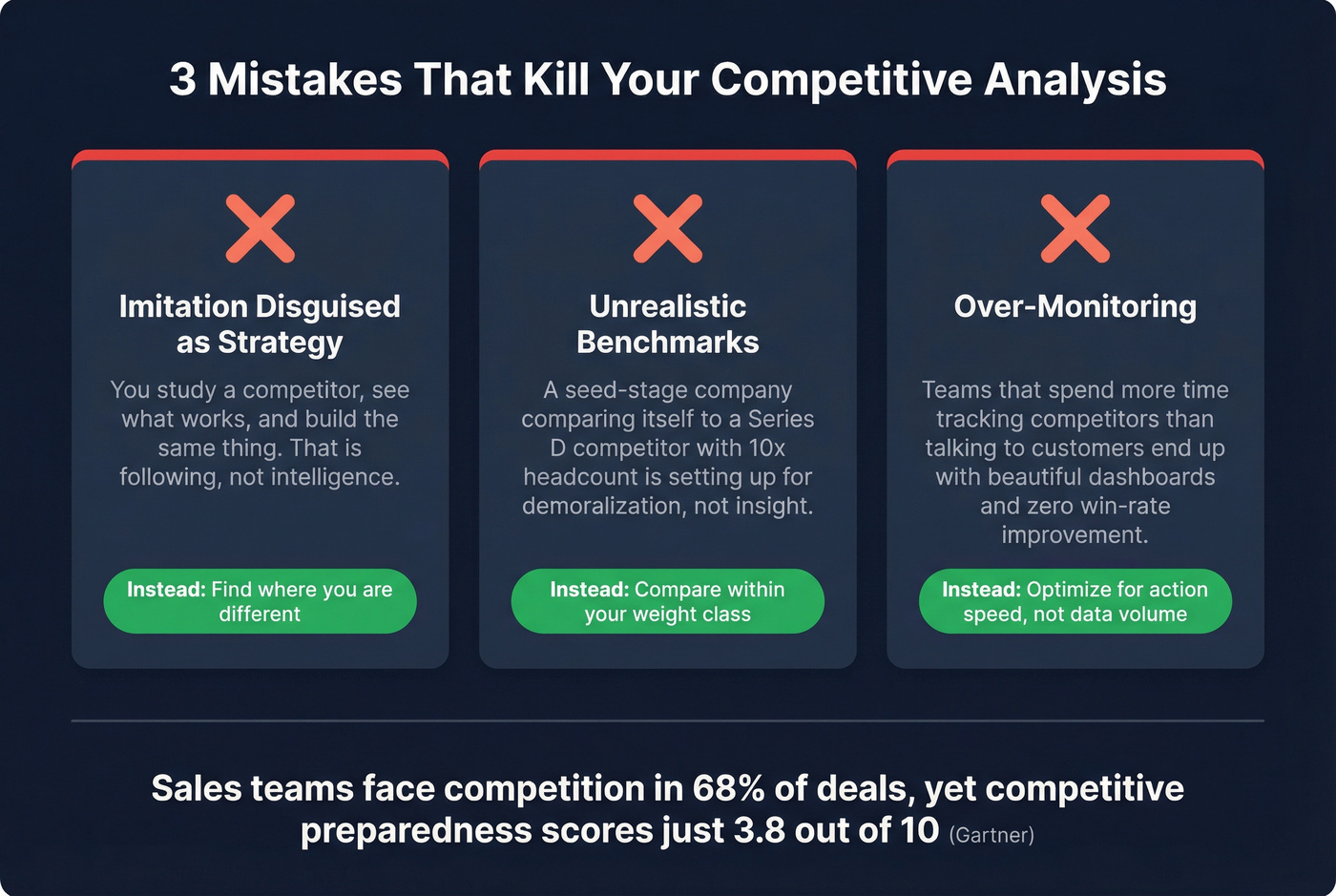
Unrealistic benchmarks. A seed-stage company comparing itself to a Series D competitor with 10x headcount is setting up for demoralization, not insight. Compare within your weight class.
Over-monitoring. Teams that spend more time tracking competitors than talking to customers end up with beautiful dashboards and zero win-rate improvement. We've watched this happen more than once - a RevOps team builds a gorgeous Notion wiki of competitor intel that nobody on the sales floor ever opens because it doesn't answer "what do I say when the prospect mentions [Competitor X] on a call?"
Set a Cadence, Not a Calendar
Stop running your competitive analysis quarterly. The SaaS market moves weekly.
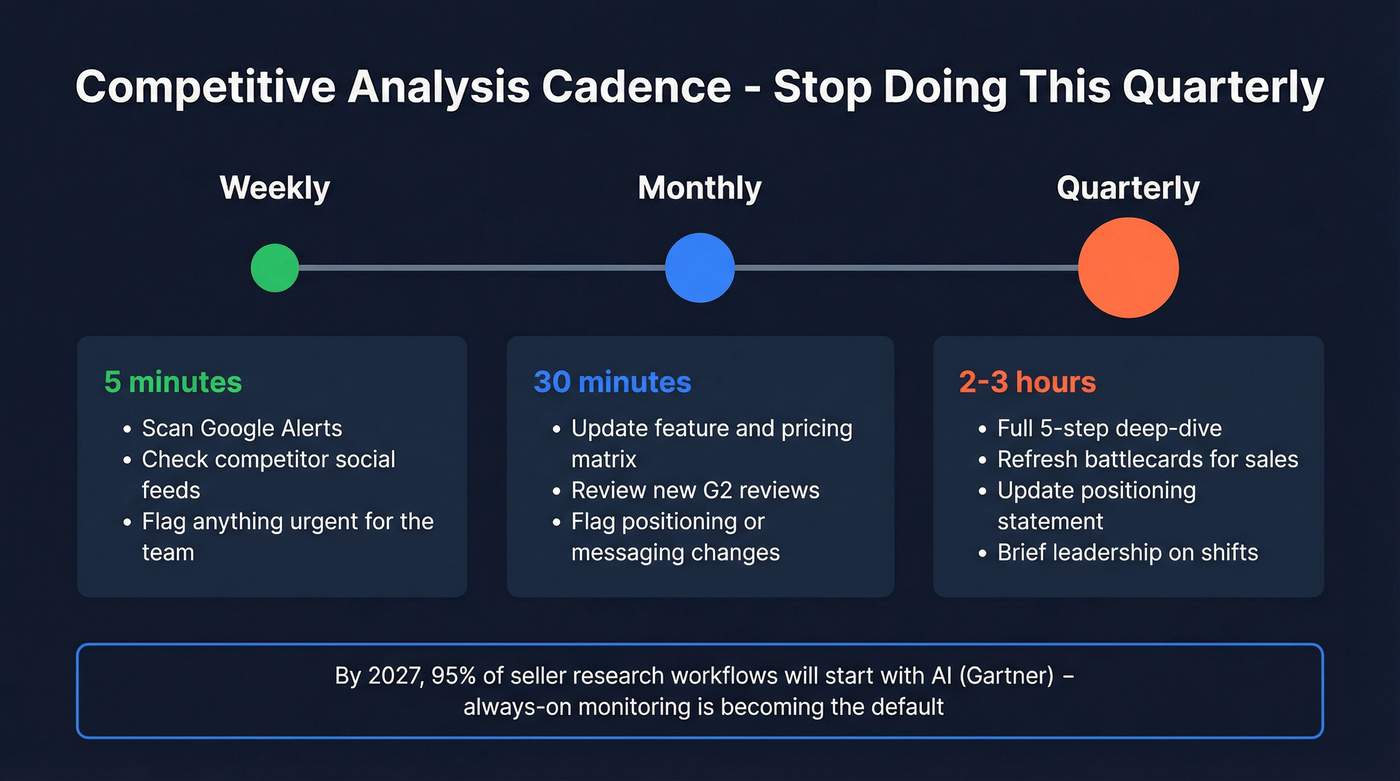
Weekly: scan automated alerts in five minutes. Monthly: update your matrix, flag positioning changes in thirty minutes. Quarterly: run the full 2-3 hour deep-dive. Gartner projects 95% of seller research workflows will start with AI by 2027, so always-on monitoring is quickly becoming the default rather than the exception.
The biggest competitive advantage isn't knowing what competitors do - it's acting on accurate data faster than they do.
You just spent 2-3 hours finding positioning gaps and target accounts. Don't lose momentum to bad contact data. Prospeo's 30+ search filters - buyer intent, technographics, headcount growth - let you build lists that match the exact segments your analysis uncovered, at $0.01 per email.
Stop analyzing competitors and start outselling them.
FAQ
How many competitors should I analyze?
Five to ten: three direct, two to three indirect, two to four adjacent. Prioritize competitors you actually lose deals to - review your CRM's closed-lost reasons to identify which names appear most often. If a competitor shows up in fewer than 5% of your losses, they aren't worth a deep-dive yet.
What's the best free tool for SaaS competitor analysis?
Semrush's free tier gives you 10 daily keyword and backlink credits - enough for focused deep-dives. Pair it with Google Alerts for ongoing monitoring and the Meta Ad Library for messaging intelligence. That three-tool combo covers SEO gaps, news, and paid positioning without spending a dollar.
How often should I update my competitive analysis?
Weekly automated alerts (five minutes), monthly matrix updates (thirty minutes), quarterly full deep-dives (two to three hours). The weekly layer catches pricing changes and new feature launches before they surprise you mid-deal. Let's be honest - if you're only updating quarterly, you're reacting to moves your competitors made months ago.