
Forager Pricing: Plans, Credit Costs, and How It Compares
$50/month for a B2B data tool that actually publishes its prices on the website. In a market where "Contact Sales" is the default answer, Forager.ai's transparent pricing page is refreshing - and worth breaking down properly.
Here's the thing, though: the sticker price doesn't tell you much. What matters is the credit system underneath it, because that's where costs quietly balloon. We've mapped out every plan, every credit action, and every per-contact cost so you can budget accurately before signing up.
Not the Forager you're looking for? If you landed here searching for a hiring platform (forager.app), an investment fund, or agricultural equipment, this isn't it. This covers Forager.ai, the B2B contact data platform for sales and GTM teams.
30-Second Verdict
Starter ($50/mo) fits solo SDRs doing under 150 mobile lookups a month. Effective cost per mobile runs $0.33 - not cheap, but predictable enough to budget around.
Growth ($100/mo) makes sense for small teams burning through 350+ mobiles monthly. Per-mobile cost drops to $0.29, and the 1,050 email credits cover a focused outbound motion without overage anxiety.
Pro ($250/mo) is the play if direct dials are your primary channel. You get 1,080 mobiles/month at $0.23 each - the best per-mobile rate Forager publishes across its self-serve tiers.
Plans and Costs Breakdown
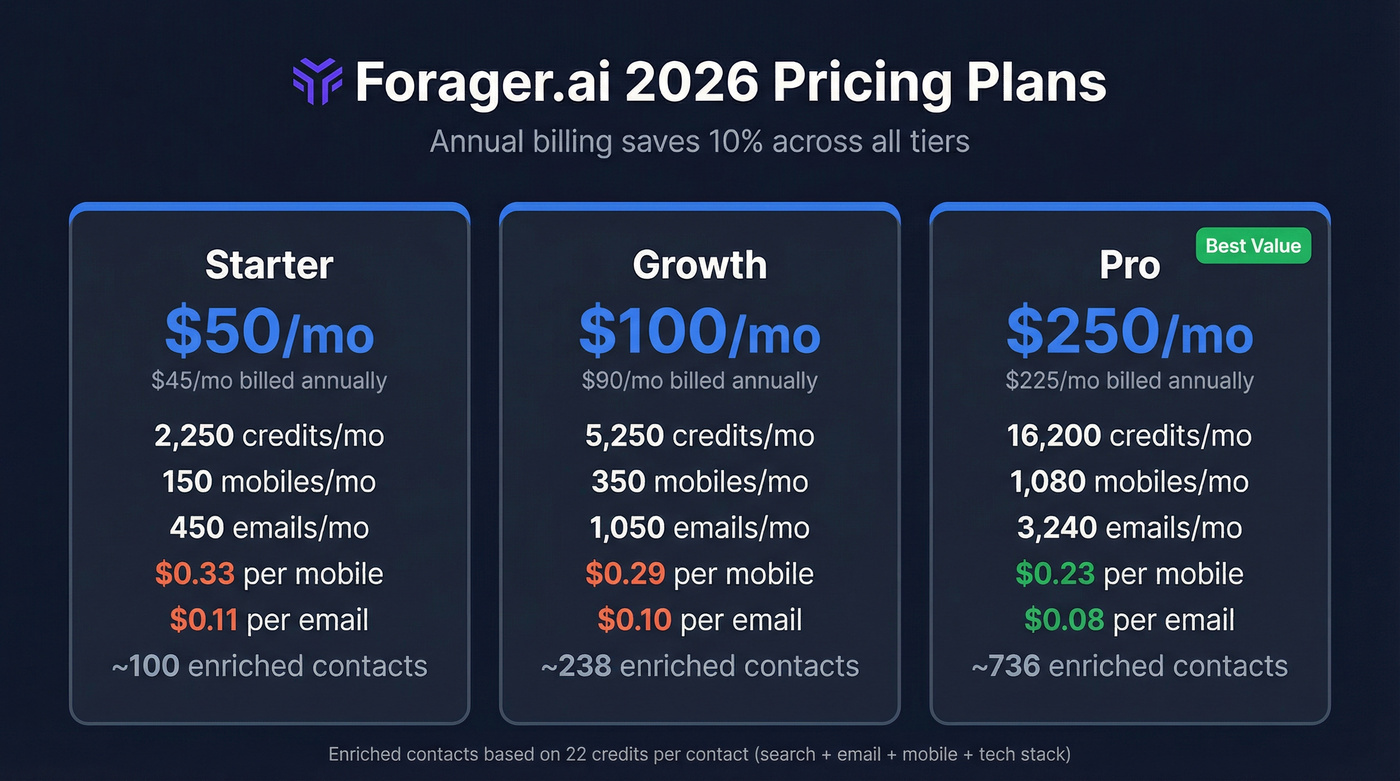
Here's the full breakdown from Forager.ai's pricing page:
| Starter | Growth | Pro | |
|---|---|---|---|
| Monthly price | $50/mo | $100/mo | $250/mo |
| Annual price | $45/mo | $90/mo | $225/mo |
| Credits/month | 2,250 | 5,250 | 16,200 |
| Mobiles/month | 150 | 350 | 1,080 |
| Emails/month | 450 | 1,050 | 3,240 |
| $/mobile | $0.33 | $0.29 | $0.23 |
| $0.11 | $0.10 | $0.08 |
Annual billing saves 10% and grants all credits upfront at the start of the billing period. Unused credits roll over on monthly plans, which is genuinely useful if your usage spikes and dips month to month.
Enterprise pricing isn't published. Expect custom volume allotments at discounted per-lookup rates, starting in the mid-four-figures annually and scaling with usage.
How Credits Actually Burn
Credits burn faster than you'd expect. Every API action has a cost, and a single enriched contact eats through more than the headline numbers suggest.
| Action | Credits |
|---|---|
| Person details | 1 |
| Work email lookup | 5 |
| Personal email lookup | 5 |
| Phone number lookup | 15 |
| Reverse email / phone search | 5 / 15 |
| Role details / Role search | 1 each |
| Job search | 2 |
| Org search / Org technologies | 1 each |
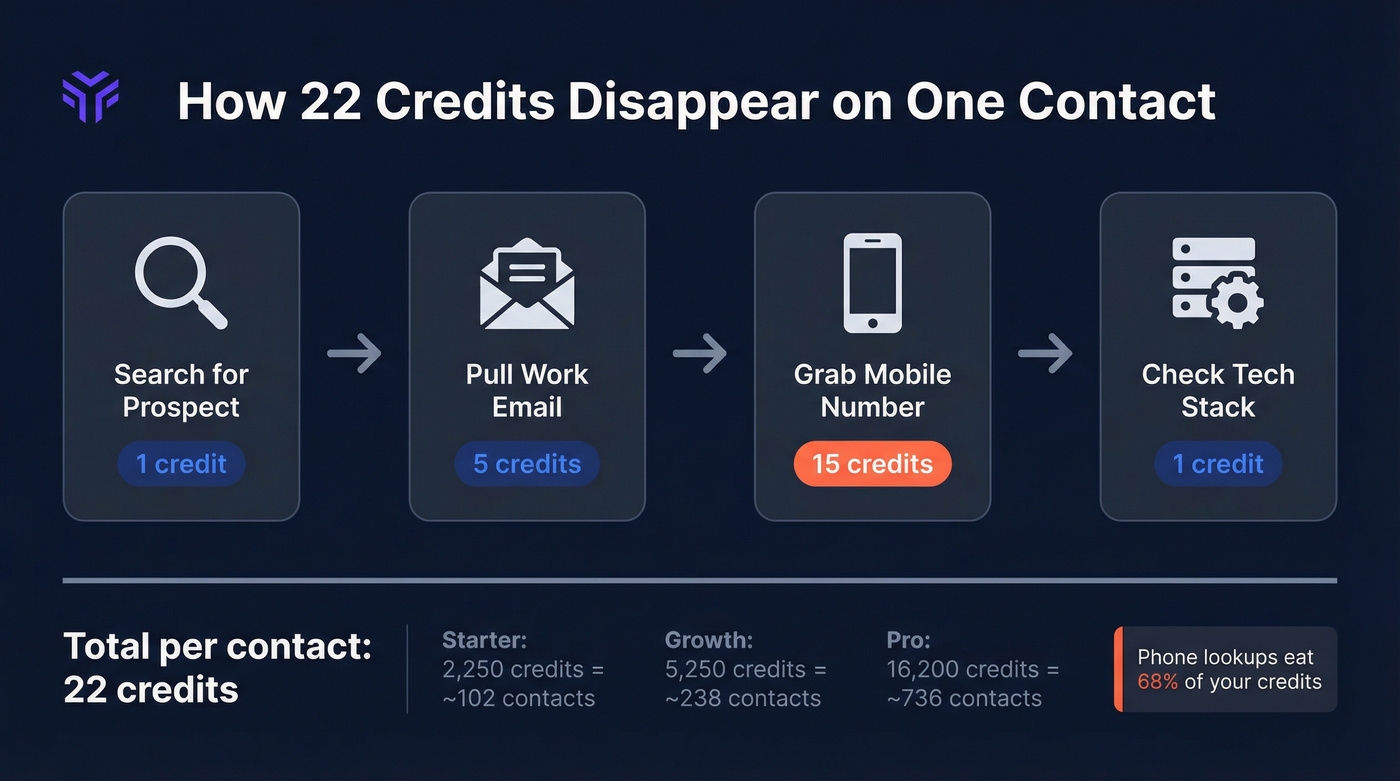
Let's walk through a typical SDR session: search for a prospect (1 credit), pull their work email (5), grab their mobile (15), check their company's tech stack (1). That's 22 credits for a single enriched contact. On the Starter plan's 2,250 monthly credits, you're looking at roughly 100 fully enriched contacts before you run dry. About 5 per business day. Plan accordingly, because that ceiling arrives faster than most people expect when they see "2,250 credits" on the pricing page.

At 22 credits per enriched contact, Forager's Starter plan caps you at ~100 contacts/month. Prospeo's credit system is built differently: emails cost ~$0.01 each with 98% accuracy, and mobiles run ~$0.10 - 3x cheaper than Forager's best tier. No credit gymnastics, no surprise ceilings.
Stop doing credit math. Start reaching real buyers.
What You Get for the Price
Forager.ai cites 850M+ person and company records and 200M+ mobile phone numbers. Records are refreshed every 2.5 weeks, and the platform ingests 100M+ intent signals monthly covering job postings, tech adoption, and funding data.
On accuracy, Forager.ai lists 99% on its homepage. Their Datarade profile tells a slightly different story: 825M+ global people and company profiles, bi-weekly updates, and 95%+ email and phone accuracy with a 4.9/5 rating across 5 reviews. Review themes are consistent - strong data quality, lower coverage at times. Forager has minimal Reddit presence, so most user feedback lives on Datarade. Keep the small sample size in mind.
Our take: Forager is a solid tool for teams that prioritize mobile numbers over everything else. But if your outbound motion is email-first (and most are), you're overpaying for credits you won't use. The credit system taxes every action, which means email-heavy workflows get expensive fast compared to tools built specifically for email accuracy.
Forager.ai vs. Competitors
| Tool | Starting price | $/Mobile | Contract | Best for | |
|---|---|---|---|---|---|
| Prospeo | Free / ~$39/mo | ~$0.10 | ~$0.01 | No | Email accuracy + data freshness |
| Forager.ai | $50/mo | $0.23-$0.33 | $0.08-$0.11 | No | Mobile-first prospecting |
| Lusha | $29.90/user/mo | ~$1.20 | ~$0.12 | No | Quick enrichment from profiles |
| Apollo | $49/user/mo | ~$0.20 overage | Included | Annual | All-in-one sequencing |
| Cognism | ~$8K-$15K/yr | Custom | Custom | Annual | European mobile data |
| ZoomInfo | ~$15K+/yr | Bundled | Bundled | Annual | Enterprise intent + workflows |
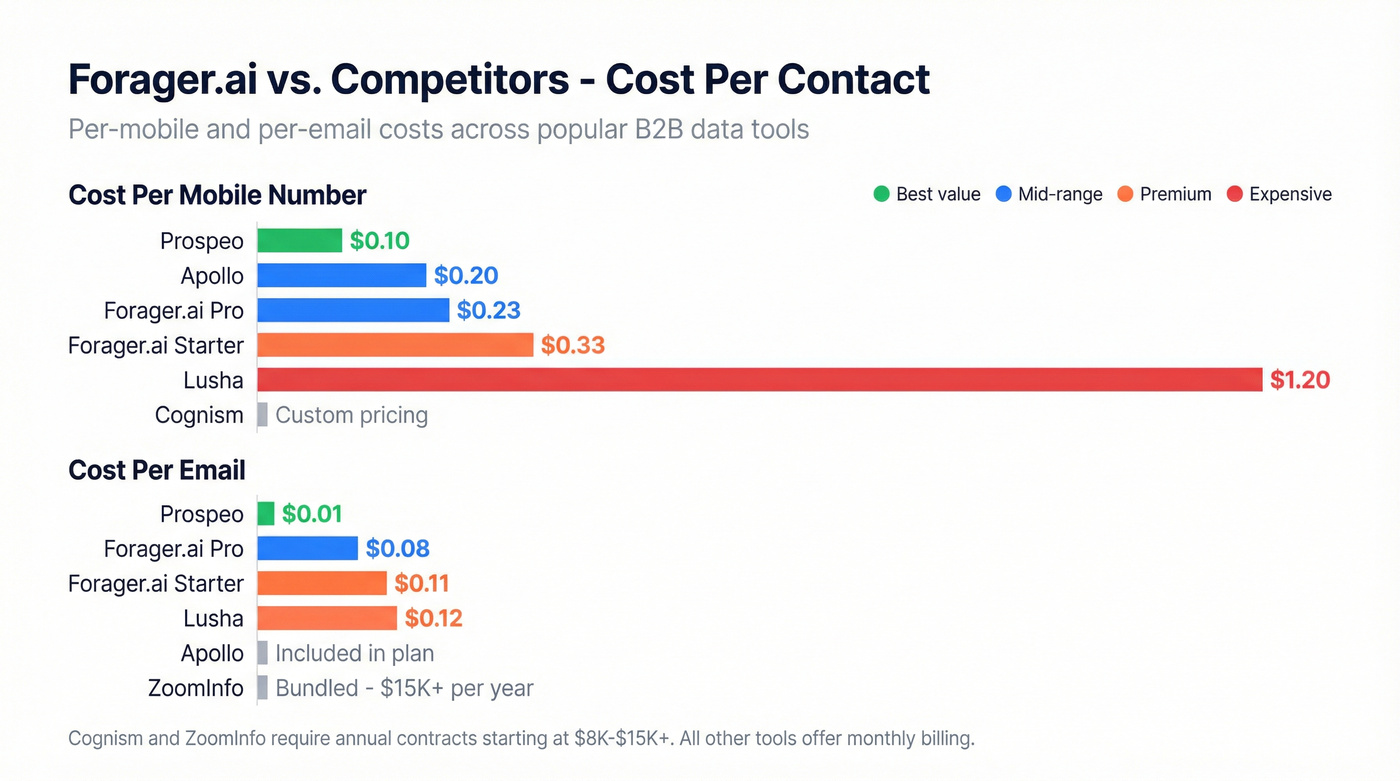
Lusha looks cheaper until you do the math. The Pro plan runs $29.90/user/month with 250 credits, and phone reveals cost 10 credits each. That's 25 phone numbers for $29.90 - roughly $1.20 per mobile. Forager is significantly cheaper per phone number.
Apollo's overage bills are the real cost. Apollo's pricing is commonly shown as $49-$119/user/month on annual billing, with mobile reveals at 8 credits each. Credits don't roll over, and overages can cost $0.20 per credit. We've seen teams get blindsided by overage bills when reps go heavy on mobile lookups mid-quarter.
Cognism and ZoomInfo play in a different league. Both require annual contracts and sales conversations. Cognism typically runs $8K-$15K/year; ZoomInfo starts around $15K and scales to $40K+ with intent data modules. If you need bundled intent data and workflow tools alongside the database, they're worth evaluating - but skip them if your team is under 10 reps.

Which Plan Should You Pick?
The right plan hinges on your mobile-to-email ratio and team size.
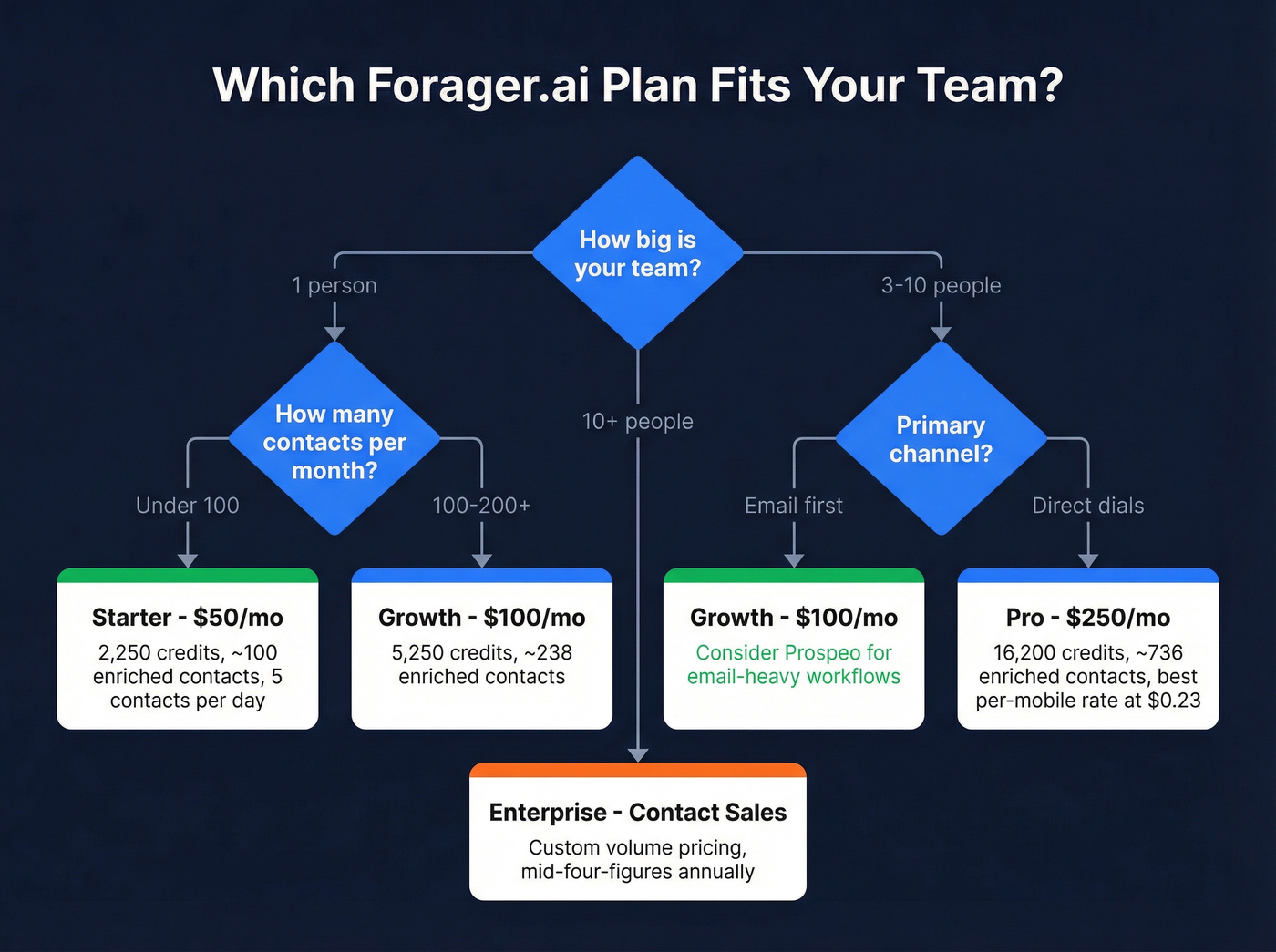
Solo SDR or founder doing outbound: Starter at $50/mo gives you about 100 fully enriched contacts at 22 credits each. That's roughly 5 contacts per business day - enough for targeted outbound, tight for high-volume plays.
Small team of 3-5 reps: Growth at $100/mo stretches to 238 enriched contacts. Assign credit budgets per rep and you'll avoid mid-month shortfalls. If one rep burns through their allocation early, the whole team feels it.
Heavy mobile usage: Pro at $250/mo is the only plan where per-mobile costs drop below $0.25. If direct dials are your primary channel, this is where the economics work. At 16,200 credits, you're looking at 736 enriched contacts monthly - enough headroom for a small team to prospect aggressively without watching the meter.
Enterprise or 10+ seats: Contact Forager.ai's sales team for custom volume pricing.
Forager refreshes data every 2.5 weeks. Prospeo refreshes every 7 days - across 300M+ profiles, 143M+ verified emails, and 125M+ verified mobiles. When you're comparing per-contact costs, factor in the data that bounces. At 98% email accuracy, Prospeo keeps your domain clean and your pipeline moving.
Get fresher data at a fraction of Forager's cost.
FAQ
Does Forager.ai offer a free trial?
Forager.ai doesn't advertise a free trial on its pricing page. Plans are cancel-anytime with credit rollover on monthly billing, so the Starter plan at $50/month functions as a low-risk test.
Do unused Forager.ai credits roll over?
Yes, on monthly plans. On annual plans, all credits are granted upfront at the start of the billing period - you get the full year's allotment immediately but don't accumulate additional rollover.
How much does a single enriched contact cost on Forager?
At 22 credits per fully enriched contact (person search + work email + mobile + tech stack), the effective cost is $0.49 on Starter, $0.42 on Growth, and $0.34 on Pro. Factor this per-contact cost into your ROI model rather than the headline monthly price.
How does Forager.ai's Enterprise plan work?
Enterprise pricing isn't published. Expect contracts starting in the mid-four-figures annually with higher credit allotments at discounted per-lookup rates, scaling with usage volume and number of seats.