

How to Incentivize Sales Reps: The Operating Manual Most Guides Skip
It's mid-Q3 and your team is sitting at 38% of annual quota. You've already lowered targets twice. If you're figuring out how to incentivize sales reps, the answer isn't more money - it's better math. 43% of reps hit quota in Q4 2024, and 76.6% missed quotas that had already been reduced. The incentive plan isn't broken because reps are lazy. It's broken because the plan was built on fantasy math.
Here's the short version: simplify your plan to 3-5 measures, set payout ranges (50% at threshold to 200% at max), and match comp splits to role - SDR 70/30, AE 50/50, CSM 80/20. Use SPIFs as a scalpel for 1-4 weeks at a time, not a monthly crutch. And before touching the comp plan at all, audit your prospect data. If reps are dialing dead numbers, no incentive on earth fixes that.
Why Incentives Move Revenue
Gallup's 10th meta-analysis - 2.7 million employees across 112,312 work units in 96 countries - found that top-quartile engaged teams deliver 23% higher profitability and 18% higher productivity. Turnover drops 43% in low-turnover organizations.
You'll see "21%" cited everywhere. That's the old number. The actual profitability delta is 23%, and the difference tells you who's done the reading and who's copying from whoever ranked first last year.
Incentive Types That Actually Work
Not every incentive is a commission check. Over 80% of firms now use non-cash rewards, up from roughly 25% in the 1990s. But monetary value still matters - an IRF survey of 500 participants found it's the appealing factor in 52% of responses and the only factor in 35%. A $25 gift card for closing a $50K deal is insulting. Match the reward to the effort.
Cash-based incentives remain the backbone. Commission accelerators - kickers above 100% attainment - keep your top performers pushing after they've hit quota instead of coasting into next quarter. SPIFs work when you need to move a particular product or fill pipeline in a specific segment.
Non-cash rewards now dominate program design, and for good reason. Program owners treat cash as compensation but non-cash as celebration - merchandise, points, and branded items create bragging rights and friendly competition that a direct deposit never will. Non-cash rewards tied to specific behaviors can drive a 5-15% lift when the reward is visible and time-boxed. Experiential rewards like dinners, trips, and concerts are memorable in ways cash isn't. People talk about the steak dinner for months; they forget the $200 bonus by next paycheck.
Low-cost, high-impact options round out the toolkit. Recognition - leaderboards, Slack shoutouts, all-hands callouts - costs nothing and changes behavior. PTO and flex time are increasingly effective with younger reps who value autonomy alongside compensation. An extra Friday off for hitting a stretch goal often costs less than a bonus. Team incentives across SDR + AE pods work when you need cross-functional collaboration, though we've found they're most effective when paired with individual kickers so top performers don't feel dragged down.
The SPIF Playbook
Let's be honest: if you're running SPIFs every month, your core comp plan is broken. SPIF stands for Sales Performance Incentive Fund - a short-term bonus layered on top of your core plan to drive a specific behavior, not a replacement for a broken one.
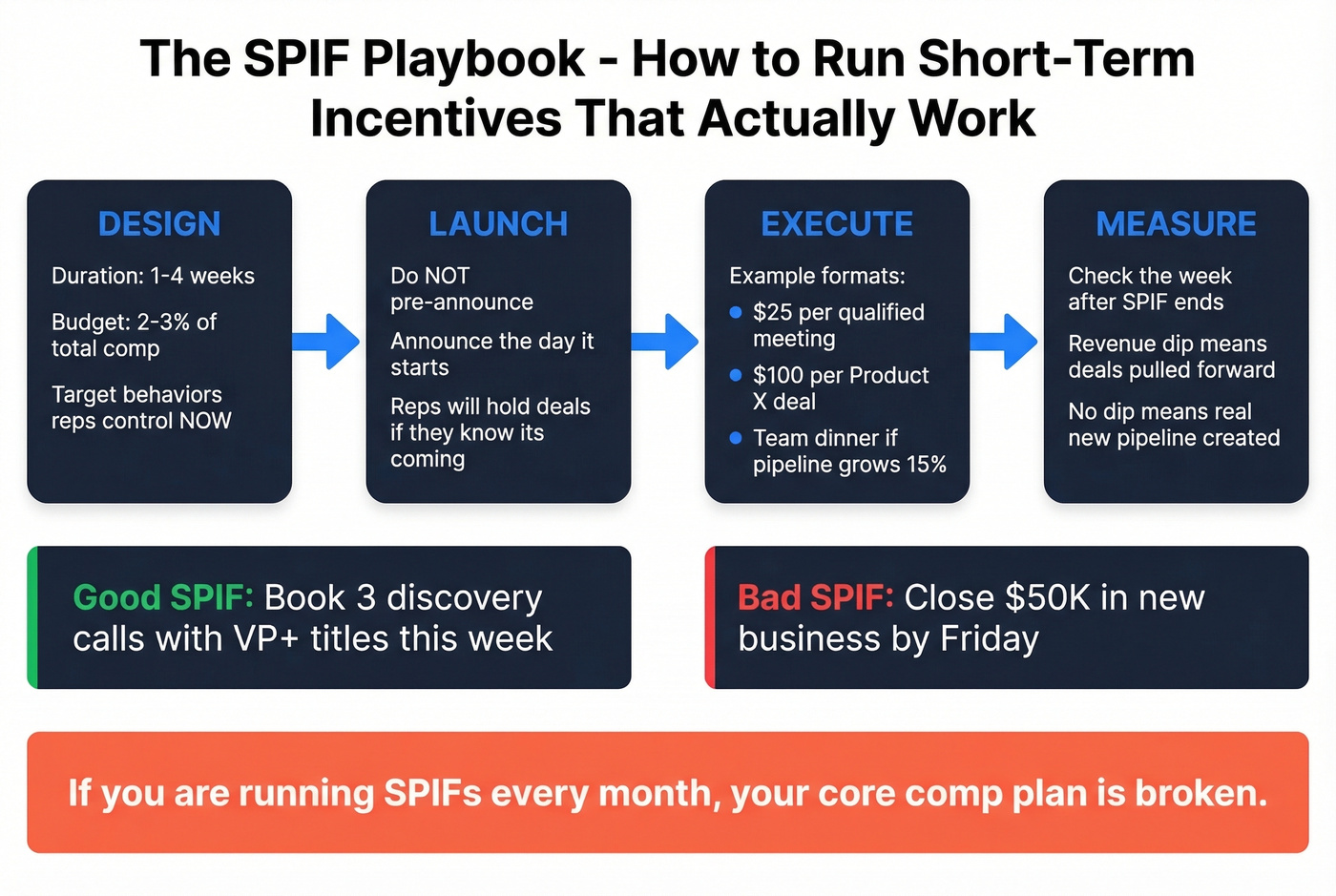
- Duration: 1-4 weeks. Anything longer loses urgency.
- Budget: Ring-fence 2-3% of total comp budget for proactive SPIFs and 2-3% for reactive ones. That's your ceiling.
- Don't pre-announce. Reps will hold deals until the SPIF window opens. Announce it the day it starts.
- Example formats: $25 per qualified meeting set, $100 per Product X deal closed, team dinner if pipeline grows 15% in two weeks.
- Measure the aftermath. If revenue dips the week after a SPIF ends, reps were pulling deals forward, not creating new ones.
One thing we've seen repeatedly: the best SPIFs target behaviors your reps can control right now, not lagging indicators like closed-won revenue that take weeks to materialize. "Book 3 discovery calls with VP+ titles this week" beats "close $50K in new business by Friday" every time because the rep can actually act on it today.

You just designed a SPIF targeting "3 discovery calls with VP+ titles this week." Now ask: can your reps actually reach those VPs? Prospeo's 125M+ verified mobile numbers hit a 30% pickup rate - 3x the industry average. Pair that with 98% email accuracy and your incentive plan finally has data that lets reps earn.
Stop incentivizing reps to dial dead numbers.
Comp Splits by Role
| Role | Split (Base/Var) | Typical KPIs | Commission Benchmark |
|---|---|---|---|
| SDR | 70/30 | Meetings set, SQLs | $25-$75 per qualified meeting |
| AE | 50/50 | Closed-won, ACV | ~11.5% of ACV |
| CSM | 80/20 or 90/10 | NRR, expansion | Quarterly bonus |
| AM | 70/30 to 80/20 | Renewals, upsell | 5-8% of expansion ACV |
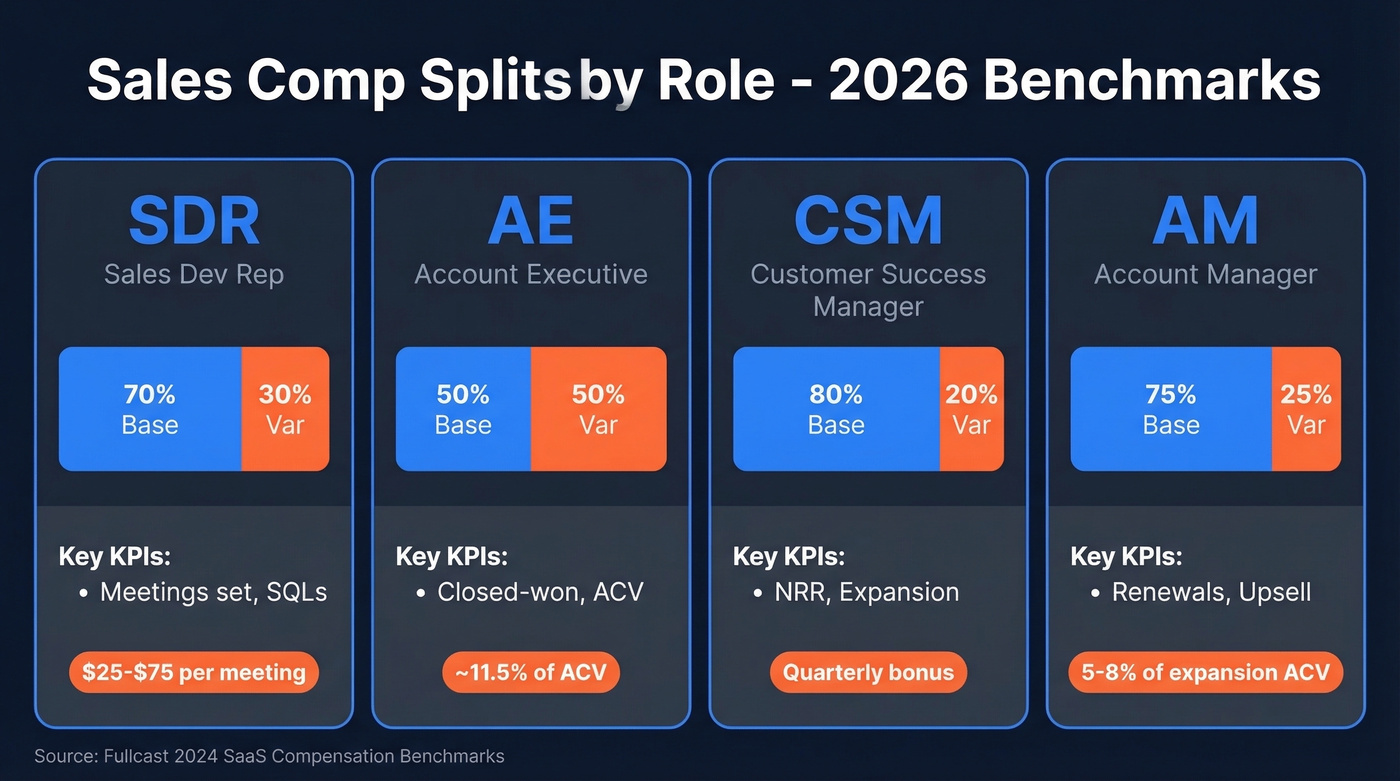
The median SaaS AE earns 11.5% of ACV at 100% attainment. If you're paying significantly above or below, you're either overspending or losing reps to companies that aren't. Skip the 60/40 split for SDRs unless they're doing significant outbound discovery - 70/30 is the right default.
President's Club belongs here too. Keep it exclusive: 5-20% of the team, entry at ~125% of quota. If everyone qualifies, it's just a company trip. (If you want a full breakdown of rules and thresholds, see President's Club.)
Quarterly bonuses are most effective for lower performers. Annual quotas motivate your top reps; shorter goal cycles keep the middle of the pack engaged and prevent early-year coasting.
How to Motivate Reps to Hit Quota
The fastest motivation killers are unclear rules and late commission checks. Here are the five structural failures behind that frustration - and I've watched every single one tank a team's morale in real time.
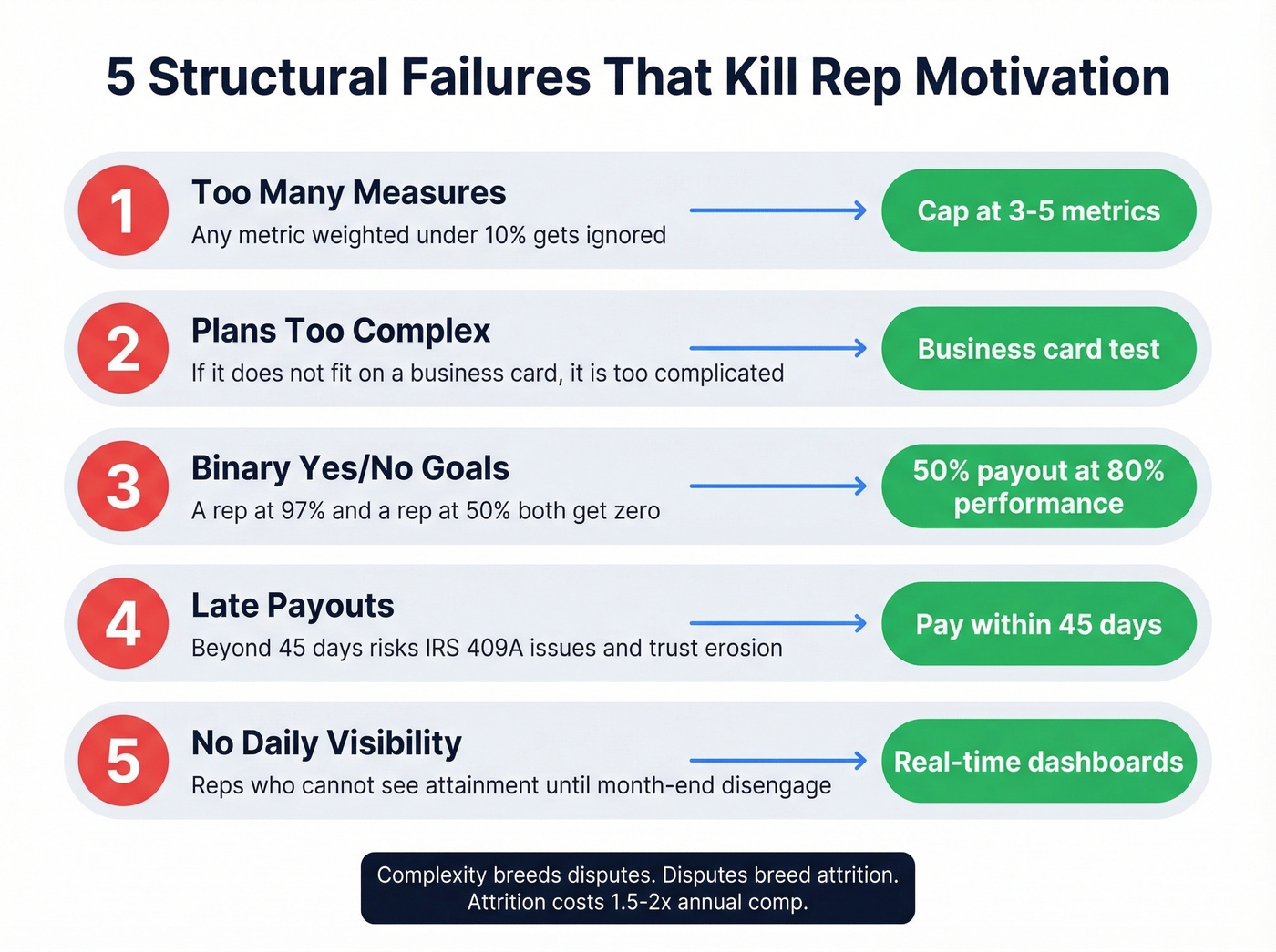
Too many measures. Cap at 3-5. Any metric weighted under 10% of total incentive gets ignored. (If you need a KPI shortlist, start with B2B Sales KPIs.)
Plans too complex. The business card test is the single best heuristic: if you can't fit the comp plan on a business card, it's too complicated. Complexity breeds commission disputes, disputes breed attrition, and attrition costs you 1.5-2x the rep's annual comp to replace them.
Binary yes/no goals. A rep at 97% and a rep at 50% shouldn't get the same payout of zero. Define threshold (50% payout at 80% performance), target (100%), and max (200% at 120%). (For quota math, use quota setting best practices.)
Late payouts. Pay within 45 days. Beyond that, you risk IRS 409A deferred compensation classification - and you definitely risk reps who stop trusting the system.
No daily visibility. If reps can't see where they stand until month-end, motivation dies. Daily dashboards, weekly standups, real-time leaderboards - pick at least one. The consensus on r/sales is overwhelmingly clear on this: nothing kills drive faster than opacity around comp. (A simple starting point is a sales leaderboard.)
The Data Problem Nobody Talks About
You can design the perfect incentive plan and still watch it fail if your reps are burning hours on dead contacts. Bounce rates above 5% or connect rates below 10% are practical signals that the data - not the comp plan - is the bottleneck. (If you’re diagnosing deliverability, start with email bounce.)

When reps dial numbers that don't connect and send emails that bounce, effort feels wasted. The incentive plan feels unfair. Disengagement follows. Snyk ran into exactly this - bounce rates at 35-40% across 50 AEs. After switching to Prospeo for their contact data, bounces dropped under 5%. AE-sourced pipeline grew 180%. The team now generates 200+ new opportunities per month. The comp plan didn't change. The data did.
Here's the thing: most teams trying to fix motivation with comp plan redesigns actually have a data quality problem. Before you spend six weeks in spreadsheets redesigning variable comp, check your bounce rates and connect rates. If they're ugly, fix the data first. It's faster, cheaper, and the ROI shows up in weeks, not quarters. (If you’re evaluating vendors, compare options in a business contact database roundup.)
Measuring Incentive ROI
The formula: (Incremental Profit - Program Costs) / Program Costs. A $50,000 program generating $100,000 in incremental profit delivers 100% ROI. (If you want a more detailed framework, use a Sales ROI Calculator.)
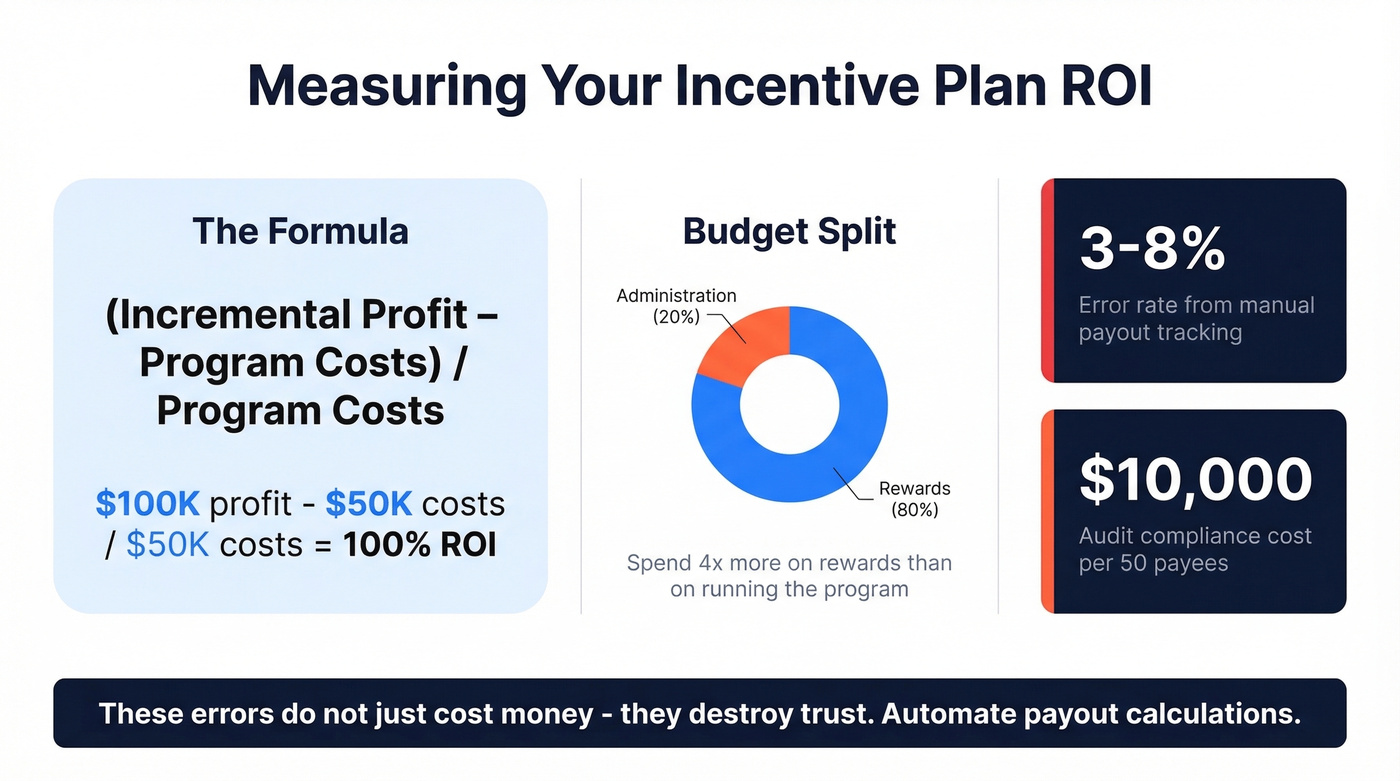
Budget 80% toward rewards and 20% toward administration. Watch the hidden costs: manual payout tracking produces a 3-8% error rate, and audit compliance runs roughly $10,000 for every 50 payees. Those errors don't just cost money - they destroy trust. Automate payout calculations or accept that you're leaking both dollars and credibility. (This is where sales performance management systems usually pay for themselves.)
Knowing how to incentivize sales reps is only half the equation. The other half is giving them a territory worth working - clean data, realistic quotas, and a comp plan they can explain in one sentence. Get those three right and the incentive plan practically runs itself. (For a full blueprint, see Incentive Plan for Sales Team.)
Your comp plan has the right splits, the right accelerators, and the right SPIF cadence. But if reps burn 4-6 hours a week on bounced emails and disconnected numbers, you're paying for activity that never converts. Prospeo refreshes 300M+ profiles every 7 days - not every 6 weeks - so your team works live data, not last quarter's leftovers.
The best incentive is a prospect list that actually connects.
FAQ
What's the best comp split for SDRs vs AEs?
SDRs should get 70/30 (base/variable) and AEs 50/50. The variable percentage should match the rep's direct influence on revenue - SDRs control activity volume, AEs control deal outcomes. CSMs typically sit at 80/20 or 90/10 since retention is partially product-driven.
How often should you run SPIFs?
One to two per quarter, max. Budget 2-3% of total comp per cycle. If you're running them monthly, that's a signal your core plan needs a redesign, not another band-aid.
How do you prevent reps from gaming incentive plans?
Don't pre-announce SPIFs, cap measures at 3-5, and ensure daily visibility into attainment. Clean prospect data also reduces gaming - when effort converts to real results, reps don't need to cut corners.
Can non-cash rewards really outperform cash bonuses?
Over 80% of companies now use non-cash rewards because they create visible recognition that cash deposits can't. Experiential rewards - dinners, trips, extra PTO - drive 5-15% performance lifts when time-boxed and tied to specific behaviors. The key: the reward value must match the effort. A $25 gift card for a $50K deal backfires every time.