

How to Build an Incentive Plan for Your Sales Team (With Real Numbers)
You just got promoted to VP of Sales. The CEO wants a comp plan in three weeks. Every guide you find gives you definitions and theory - not a single one hands you the actual numbers. Meanwhile, McKinsey's research shows that revising compensation models can have a 50% higher impact on sales than changes in advertising spend. The incentive plan you're about to build matters more than your next campaign.
Practitioners don't ask "what is an incentive plan?" They ask for real commission percentages, revenue vs. margin guidance, base vs. variable pay mix, accelerator structures, and how quota gets determined. This guide answers those specific questions with real numbers.
The Five Numbers That Matter
Every sales incentive plan comes down to five numbers. Get these right and the rest is formatting:
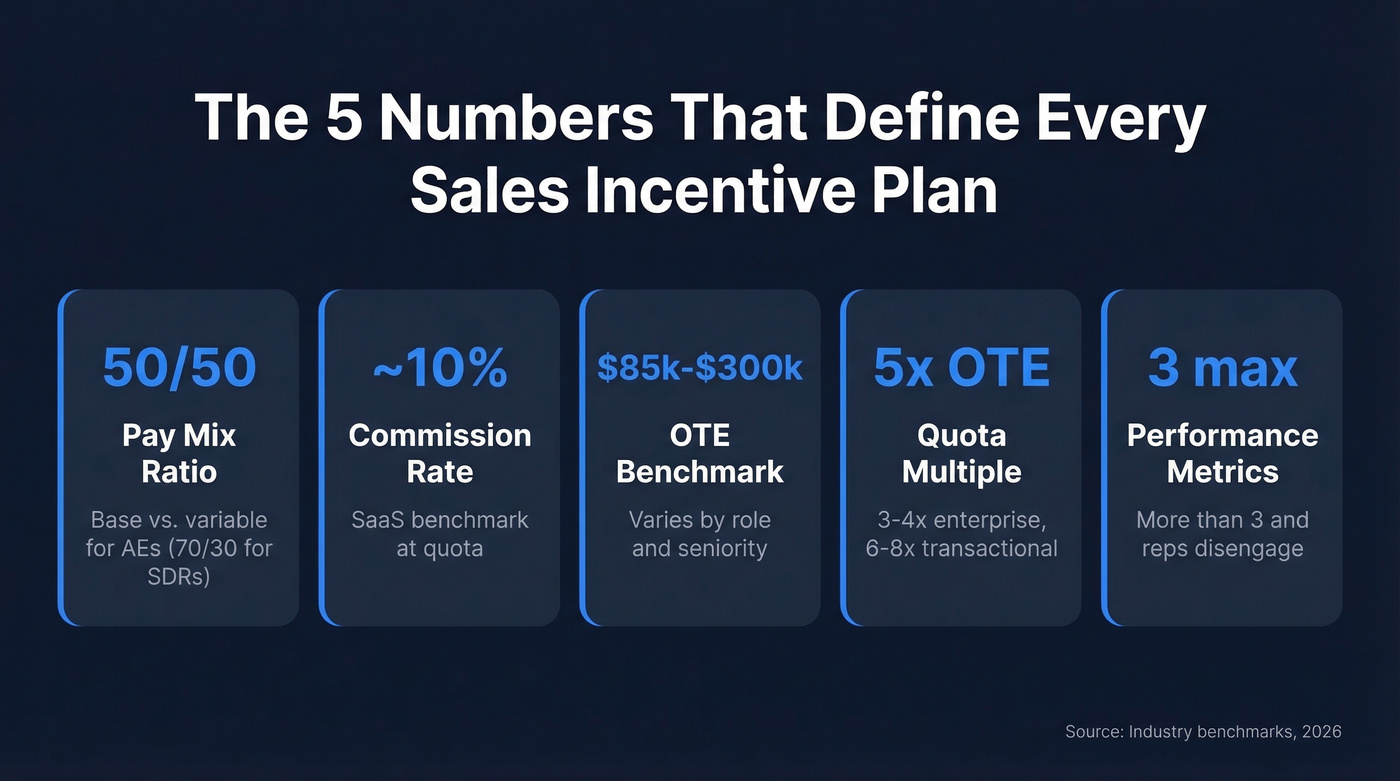
- Pay mix ratio - how much base vs. variable (50/50 for AEs, 70/30 for SDRs)
- Commission rate - SaaS benchmark is ~10% at quota
- OTE benchmark - what the market pays for each role (see the table below) (and how to calculate OTE)
- Quota multiple - typically 5x OTE (sanity-check against sales pipeline benchmarks)
- Performance metrics - cap it at 3. More than that and reps disengage.
Teams with best-in-class compensation structures see 20% higher lead closure rates than industry averages.
What a Sales Incentive Plan Actually Is
A sales incentive plan isn't an HR exercise. It's a retention tool disguised as a pay structure.
Sales turnover runs ~35% - nearly three times the 13% average across other industries. That's not just a hiring problem; it's a revenue problem. Every rep who walks takes pipeline, relationships, and institutional knowledge with them.
The fix sounds simple: 71% of organizations now tie compensation directly to measurable performance goals. But here's the uncomfortable part - only 1 in 3 sales leaders actually align their plans to organizational goals. That means two-thirds of plans are rewarding behaviors that don't map to what the company needs. A well-designed plan tells reps exactly what behaviors the company values, exactly how they'll be rewarded, and exactly when they'll get paid. It turns ambiguity into a contract. Contracts keep people around.
2026 Compensation Benchmarks by Role
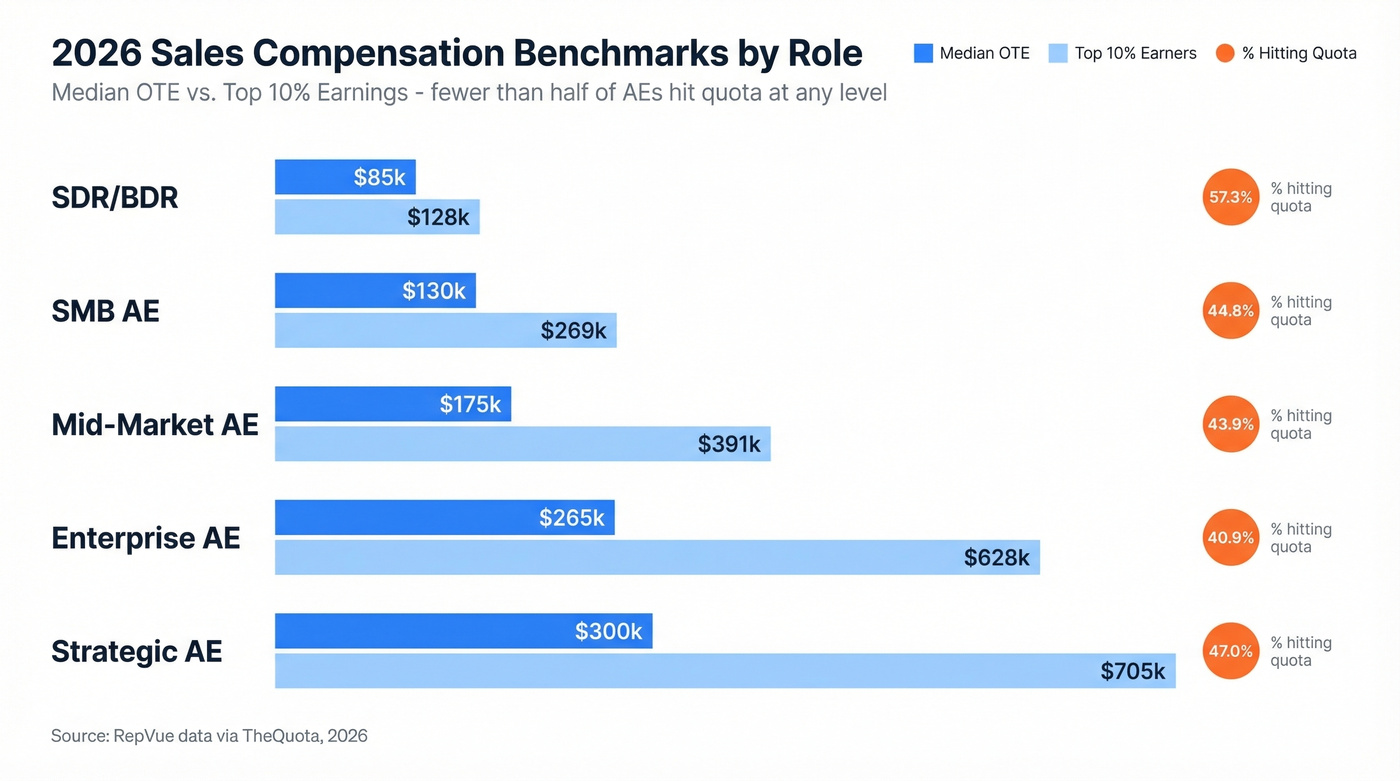
Here's what the market actually pays, based on RepVue data compiled by TheQuota. These are medians - your geography and industry will shift things, but this is the baseline.
| Role | Base | OTE | % Hitting Quota | Top 10% Earners |
|---|---|---|---|---|
| SDR/BDR | $60k | $85k | 57.3% | $128k |
| SMB AE | $70k | $130k | 44.8% | $269k |
| Mid-Market AE | $90k | $175k | 43.9% | $391k |
| Enterprise AE | $135k | $265k | 40.9% | $628k |
| Strategic AE | $150k | $300k | 47.0% | $705k |
Fewer than half of AEs hit quota at every level. Sit with that for a second. If you're setting OTE at $175k for mid-market reps, typical earnings will land meaningfully below OTE when attainment is under 100%. Your plan needs to account for this reality - not pretend every rep will hit target.
Pay mix follows a simple pattern. AEs typically run 50/50 because they control the close. SDRs and support roles sit at 70/30 or 80/20 because they influence pipeline but don't own the deal. Match the variable component to how much the rep actually controls the outcome.
Types of Sales Compensation Plans
Not every plan fits every team. Here's when each type works - and when it doesn't.
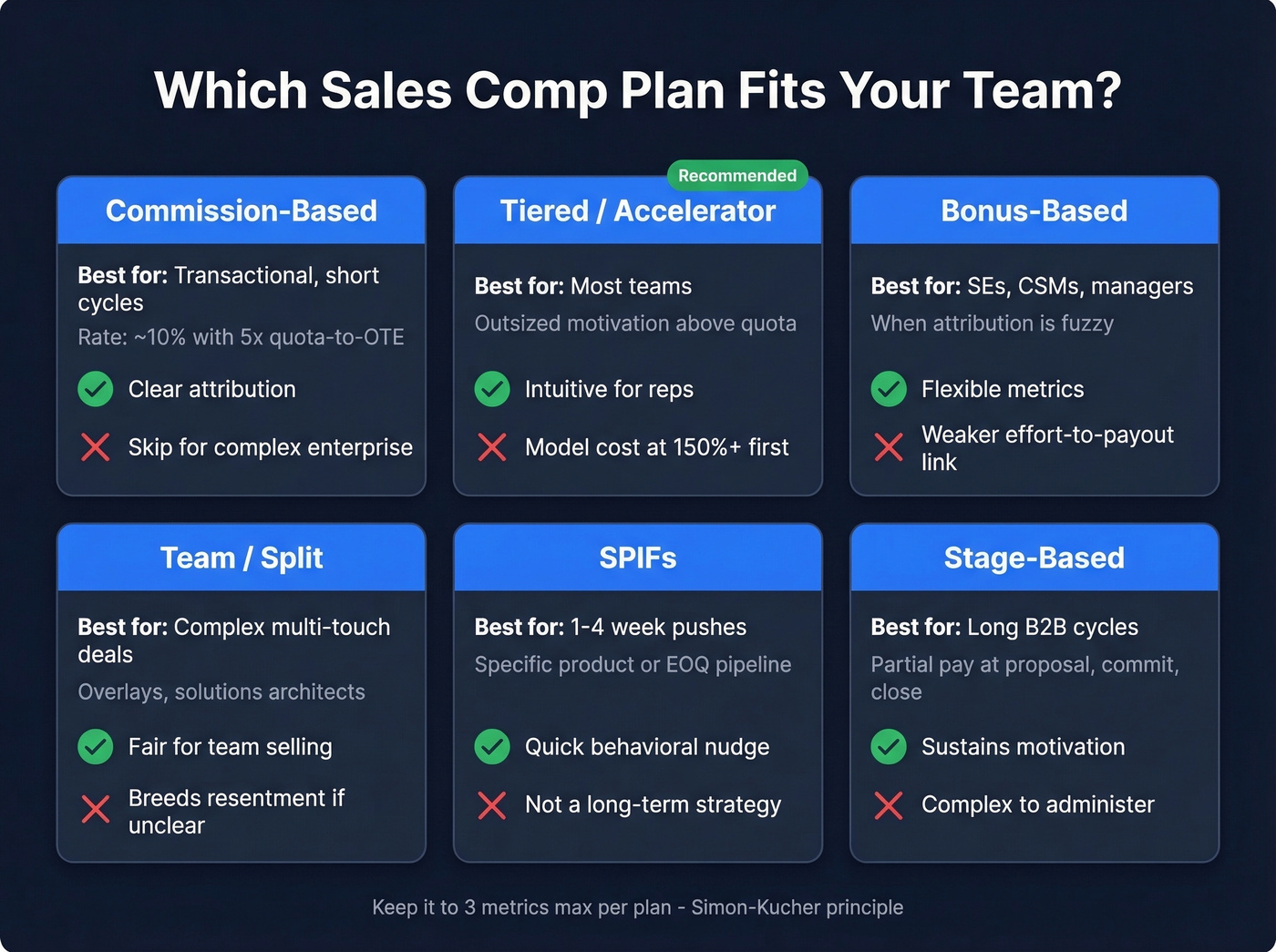
Commission-based (straight percentage) works best for transactional sales with short cycles and clear attribution. SaaS benchmark is ~10% with a 5x Quota:OTE ratio. Skip it for complex enterprise deals where multiple people touch the revenue (see enterprise B2B sales).
Tiered / accelerator is the structure we recommend for most teams. It's the most intuitive model for reps and creates outsized motivation above quota. Just make sure you can model the cost of 150%+ attainment without flinching.
Bonus-based fits roles where revenue attribution is fuzzy - SEs, CSMs, managers. The tradeoff: reps feel less direct connection between effort and payout.
Team-based / split handles complex deals with multiple contributors - overlay reps, solutions architects, channel partners. These work well when you define each person's contribution clearly. Skip the structure if you can't, or resentment builds fast (more on team selling).
SPIFs are a 1-4 week tool, not a strategy. They're great for pushing a specific product or clearing end-of-quarter pipeline. If you're running them every month, that's just a broken comp plan with extra steps.
Stage-based payouts deserve a mention for long B2B cycles: paying partial commission at proposal, verbal commit, and close sustains motivation across deals that would otherwise feel like running a marathon with no mile markers.
The Simon-Kucher principle applies across all of these: reps perform best with roughly 3 variables. Stack more than four metrics into any plan type and engagement drops off a cliff.

Fewer than half of AEs hit quota - and bad prospect data makes it worse. Prospeo gives your reps 300M+ verified contacts with 98% email accuracy, so every dial and send counts. Teams using Prospeo book 26% more meetings than ZoomInfo users.
Stop letting bad data sabotage your incentive plan ROI.
How to Build Your Plan Step by Step
Step 1: Define Eligibility and Measures
Start with who gets incentive pay - and why. Pay for contribution, not org chart position. A sales manager who doesn't carry a personal quota shouldn't be on the same plan as a closing AE. A solutions architect who influences deals but doesn't own them needs a different structure entirely.
Next, pick your measures. Revenue is the default, but it's not always the right one. If your company cares about profitability, paying purely on revenue creates a discount machine - reps slash prices to close deals and your margins evaporate. Consider profitability proxies like product weighting (higher commission on high-margin SKUs) or price realization (percentage of list price captured). The goal is to drive specific behaviors, so make sure the metrics you choose actually reward those behaviors (see sales performance management).
Step 2: Set Pay Mix and OTE
Use the benchmarks table above as your starting point. Then adjust for two factors.
Sales cycle length. Short-cycle, high-volume roles can carry more variable pay (50/50 or even 40/60). Long, complex enterprise cycles need more fixed pay (60/40) because reps can't control timing on six-month deals.
Market competitiveness. If you're hiring in a hot market, your OTE needs to be at or above median. Underpaying OTE by 10-15% doesn't save money - it just means you're hiring from the bottom of the talent pool.
Here's the thing: 87% of sales leaders set quota targets without a structured method. They pick a number that feels right, divide it across the team, and hope for the best. Don't be that leader. Back into quota from OTE using the 5x multiple (or 3-4x for enterprise, 6-8x for transactional), then validate against historical attainment data.
Step 3: Design Payout Mechanics
Thresholds. Most plans don't pay commission below 50-80% attainment. This protects the company from paying variable comp to reps who aren't performing. A good rule of thumb: roughly 90% of your sales force should clear the minimum threshold. If more than 10% are below it, you're either hiring wrong or the threshold is too high.
Accelerators. This is where the plan earns its keep. Above-quota performance should pay disproportionately well - a 1.25x-2x multiplier above 100% attainment is standard. We've seen the best plans use the tiered structure in the next section. It's clean, predictable, and easy for reps to calculate on the fly.
Caps. Almost always a mistake. More on this in the FAQ.
Payout frequency matters more than most leaders realize. Monthly or quarterly payouts work best for short-cycle sales because reps see cause and effect quickly. Annual bonuses encourage deal-timing manipulation - reps sandbag Q3 deals into Q4 to hit a bonus threshold. If you've ever watched a rep mysteriously "discover" a deal on January 2nd that was clearly ready in December, you know exactly what I mean.
Step 4: Communicate, Simulate, Stress-Test
The best comp plan in the world fails if reps don't understand it. The "cocktail napkin" test is the gold standard: if a rep can't explain their plan on a napkin, it's too complicated.
Before you launch, simulate three scenarios: a top performer at 150% attainment, an average performer at 80%, and a struggling rep at 50%. Check that payouts make sense at every level and that total comp cost doesn't blow your budget if the whole team overperforms. Then build a rep-facing calculator. Over a third of organizations cite lack of seller transparency into comp calculations as a top challenge. A simple spreadsheet where reps plug in their numbers and see projected earnings eliminates most comp disputes before they start (and helps tighten sales operations metrics).
Sample Tiered Commission Table
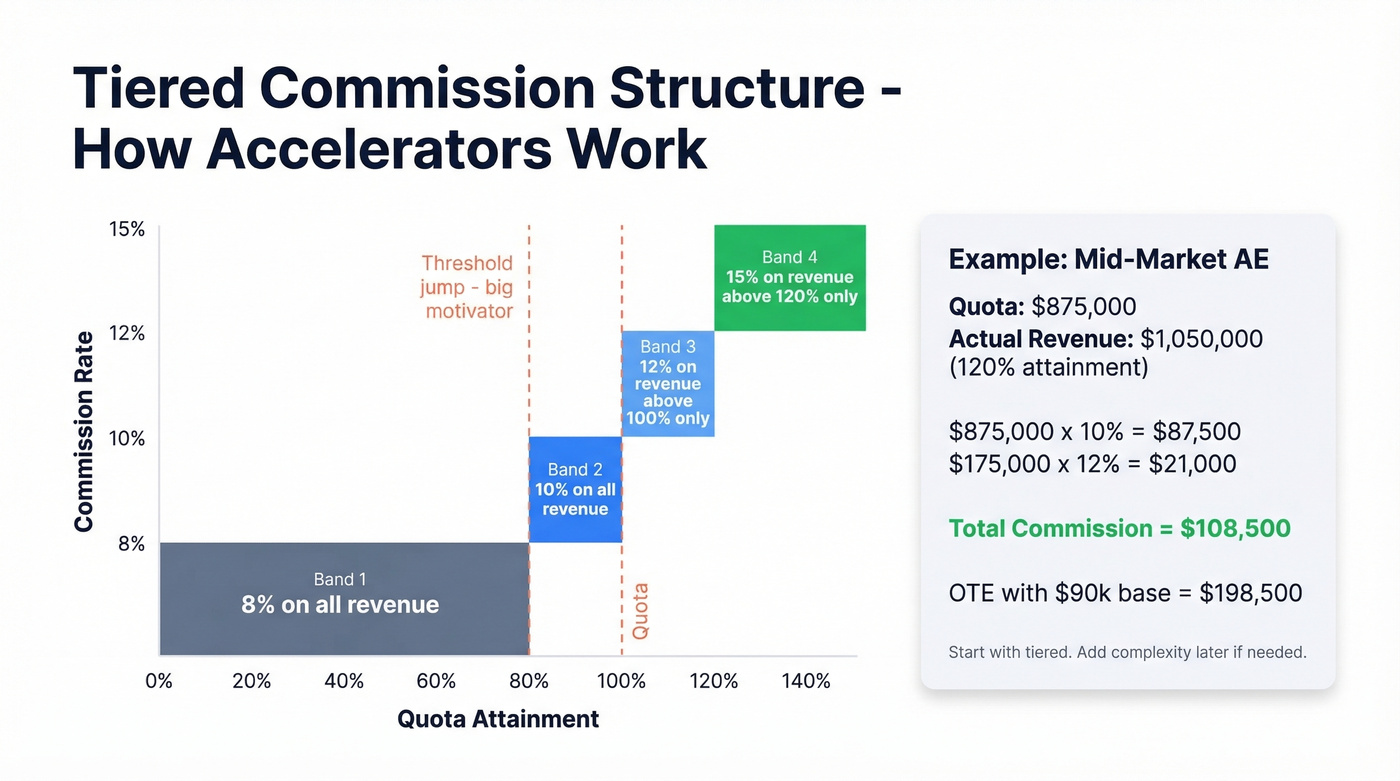
This is the structure we recommend starting with. It's the most intuitive model for reps:
| Quota Attainment | Commission Rate | Applies To |
|---|---|---|
| 0-80% | 8% | All revenue |
| 81-100% | 10% | All revenue |
| 101-120% | 12% | Revenue above 100% |
| 121%+ | 15% | Revenue above 120% |
The jump from 8% to 10% at 81% creates a meaningful incentive to push past the threshold. The accelerators above 100% reward overperformance without creating runaway costs - because the higher rates only apply to incremental revenue.
Start with tiered. You can always add complexity later. You can't easily simplify a plan that's already too complicated.
7 Mistakes That Kill Sales Incentive Plans
1. One-size-fits-all across roles. An SDR booking meetings and an enterprise AE closing seven-figure deals don't belong on the same plan. Different roles need different metrics, different pay mixes, and different payout frequencies (see sales activities).
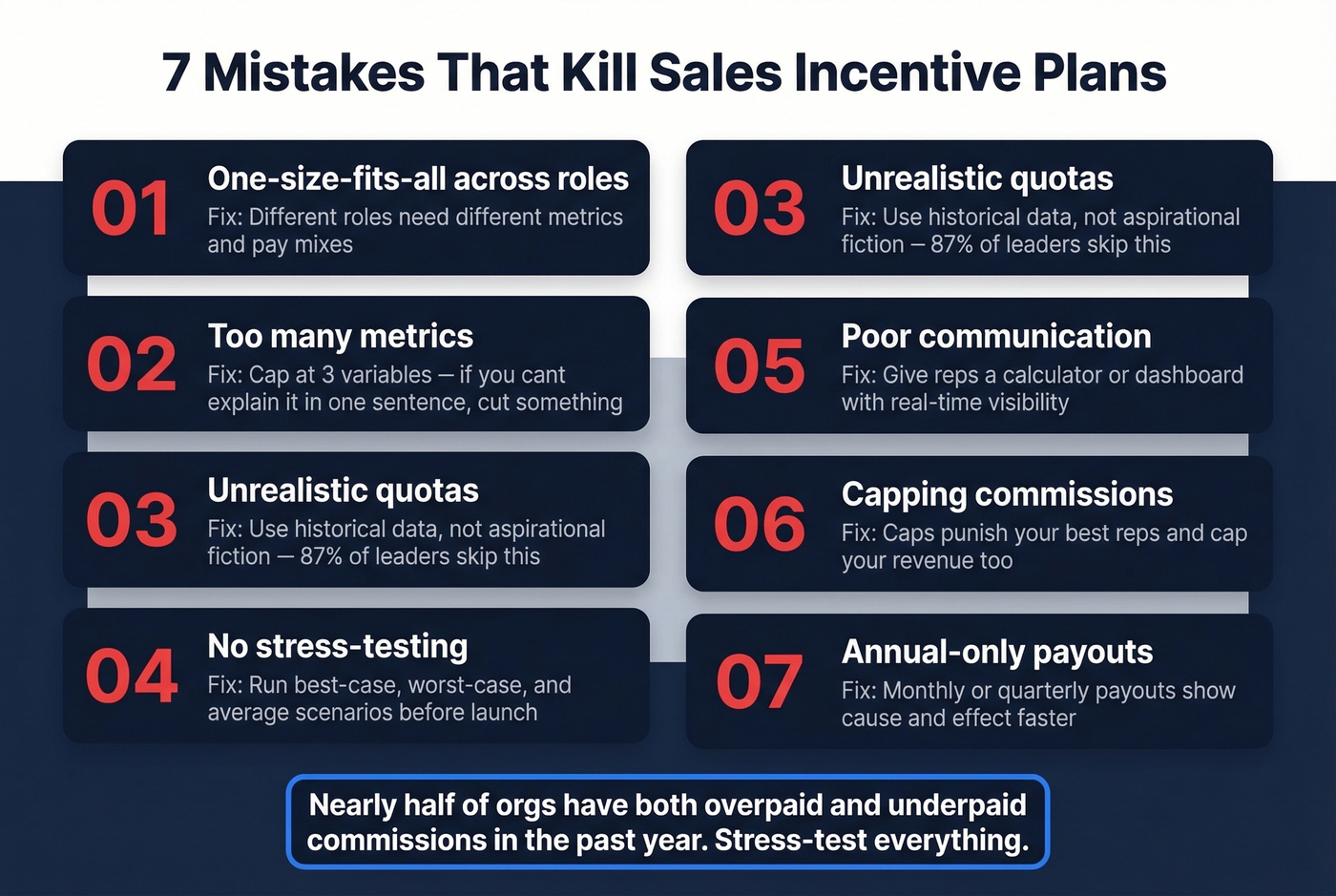
2. Too many metrics. Reps perform best with ~3 variables. Push past four and they stop trying to optimize. If you can't explain the plan's metrics in one sentence, cut something.
3. Unrealistic quotas. When 87% of leaders set quotas without a structured method, most quotas are aspirational fiction. Use historical attainment data, territory potential analysis, and market benchmarks. Look - if fewer than 40% of your team is hitting quota, the plan is broken, not the reps (see sales pipeline challenges).
4. No stress-testing. Nearly half of organizations have both over- and underpaid commissions in the past year. That's not a rounding error - it's a planning failure. Run your plan through best-case, worst-case, and average scenarios before launch.
5. Poor communication. Only half of companies provide sellers real-time visibility into current and potential earnings. Give reps a calculator, a dashboard, or at minimum a clear document they can reference. Confusion breeds distrust, and distrust breeds turnover.
6. No mid-cycle review. Markets shift. Products launch. Territories get rebalanced. A plan designed in January can be obsolete by July. Build in quarterly check-ins and have the courage to adjust mid-year if the plan stops driving the right behaviors (tie it into your QBR cadence).
7. Ignoring data quality in the pipeline. Your plan assumes reps have a fair shot at quota. If too many of their emails bounce and their call lists are full of wrong numbers, they don't. This is the execution gap most comp plans ignore. Prospeo verifies contact data with 98% email accuracy and refreshes records every 7 days, so your pipeline reflects reality - not last quarter's stale CRM exports. When reps trust their data, they trust their quota (see data enrichment services).
You're designing accelerators to reward top performers - make sure they have the data to actually accelerate. Prospeo delivers 125M+ verified mobile numbers with a 30% pickup rate and refreshes every 7 days, not 6 weeks.
Give your reps the contacts to blow past quota, not just hit it.
Plan Document Checklist
Before you roll out, make sure your plan document covers these core components - and that your sellers can actually use it:
- ☐ Base salary by role
- ☐ OTE and pay mix ratio
- ☐ Commission rate(s) and calculation method
- ☐ Quota amount and measurement period
- ☐ Accelerator/decelerator tiers
- ☐ Bonus criteria (if applicable)
- ☐ Clawback terms and conditions
- ☐ Payout frequency and timing
If the document can't pass the cocktail napkin test - where a rep reads it once and understands how they get paid - simplify until it does.
Most Teams Overthink This
Let's be honest: if your average deal size is under $25k, you probably don't need a sophisticated multi-tier compensation structure. A clean 50/50 split with a 10% commission rate and a single accelerator above quota will outperform a 15-page comp plan that nobody reads.
Complexity is the enemy of motivation. The teams we've seen crush quota aren't the ones with the cleverest plan architecture - they're the ones where every rep can calculate their next paycheck in their head. A strong incentive plan for your sales team is one they actually understand.
FAQ
Should I cap commissions?
No. Caps demotivate your top performers and signal that the company doesn't want to pay for outsized results. Use decelerators above 150% attainment instead - the rate drops but never hits zero. Capping commissions is how you lose your best closers to competitors who don't.
What's a good Quota-to-OTE ratio?
The SaaS standard is 5x. A rep with $130k OTE carries a $650k quota, earning ~10% commission on closed revenue. Lower ratios (3-4x) suit complex enterprise cycles with 6+ month deal timelines. Higher ratios (6-8x) work for transactional, high-volume roles.
How do employee sales incentive programs differ from standard comp plans?
Employee sales incentive programs layer additional motivators - SPIFs, President's Club trips, recognition awards - on top of the base commission structure. The core comp plan defines how reps earn their variable pay, while incentive programs create short-term pushes toward specific goals like new product adoption or end-of-quarter pipeline acceleration. Use them as supplements, not replacements.
How do I make sure reps can actually hit their targets?
Set quotas using real attainment data - fewer than half of AEs hit quota today, so targets assuming 80% attainment are built on fiction. Then make sure reps have accurate prospect data to work with. Stale contact lists with 30%+ bounce rates aren't a minor inconvenience; they're a structural barrier to quota attainment. The consensus on r/sales is that bad data wastes more selling time than bad process - and we've seen that play out firsthand with teams who cleaned up their pipeline data and saw immediate lifts in connect rates.