

Quota Setting Best Practices: The Operator's Playbook With Real Math
Your Quota Is 18% Higher. Nobody Said Why.
You open the new comp plan and your quota's up again. No model, no territory logic, just a bigger number and a "we believe in you" speech.
Reps on Reddit keep saying leadership "just raises the number for the sake of raising the number and hope that the team doesn't complain too much." And quota trust is collapsing: 91% of sales teams failed to hit quota expectations in QuotaPath's 2024 compensation report. That number should alarm every VP of Sales reading this.
Here's the thing - good quotas aren't "motivational." They're math, capacity, and governance, done early enough that people can actually plan their year. Following quota setting best practices means grounding every number in territory reality, not executive optimism.
Do three things and you'll be ahead of most companies:
- Set quotas from account-opportunity reality, not "last year + 10%."
- Communicate quotas before the fiscal year starts - only 34% of companies manage this.
- Reverse-funnel the number and aim for ~60% of reps hitting plan, not 20% "crushing it" and everyone else disengaging.
Current Quota Attainment Benchmarks
AE quota attainment is basically a coin flip. 2024 benchmarks from Bridge Group roundups peg AE attainment at 51%, with the miss rate worsening from 34% in 2022 to 49% in 2024. Broader Salesforce research puts the figure at 84% of reps missing quota. Whether your exact number is 60% or 84%, the direction is the same - quota math has to get more rigorous.
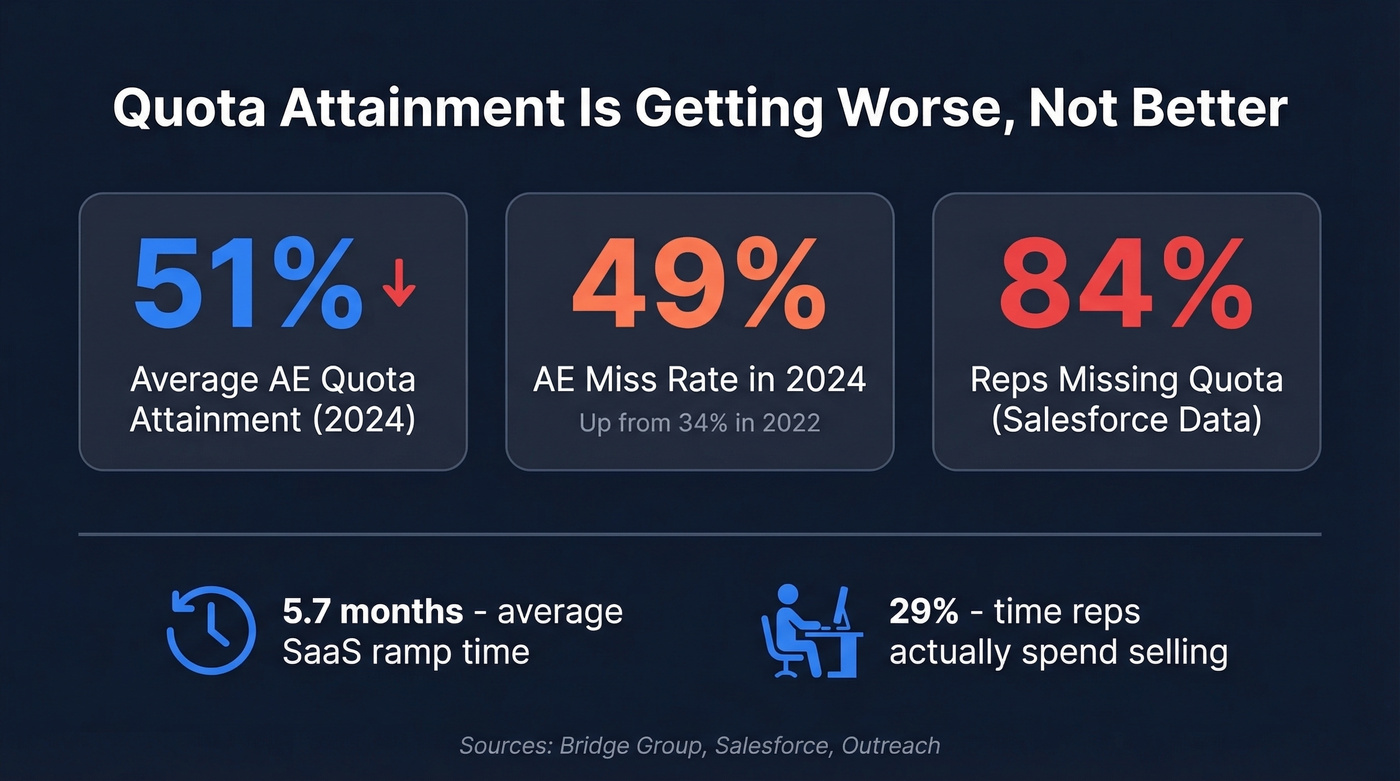
Two forces make it worse. Average SaaS ramp runs 5.7 months, meaning a big chunk of your headcount plan isn't fully productive for half the year. And sellers spend only 29% of their time actually selling. That's why top-down quotas feel delusional: you're planning for a full-time seller and getting a part-time one.
Most quota problems aren't quota problems. They're territory allocation and data quality problems wearing a quota costume. Fix those two things and attainment jumps before you touch a single number.
Choosing a Quota-Setting Method
SalesGlobe's taxonomy is the cleanest framework we've found. If you pick one method to start with, start with account-opportunity. It's the only one that forces you to confront territory reality.
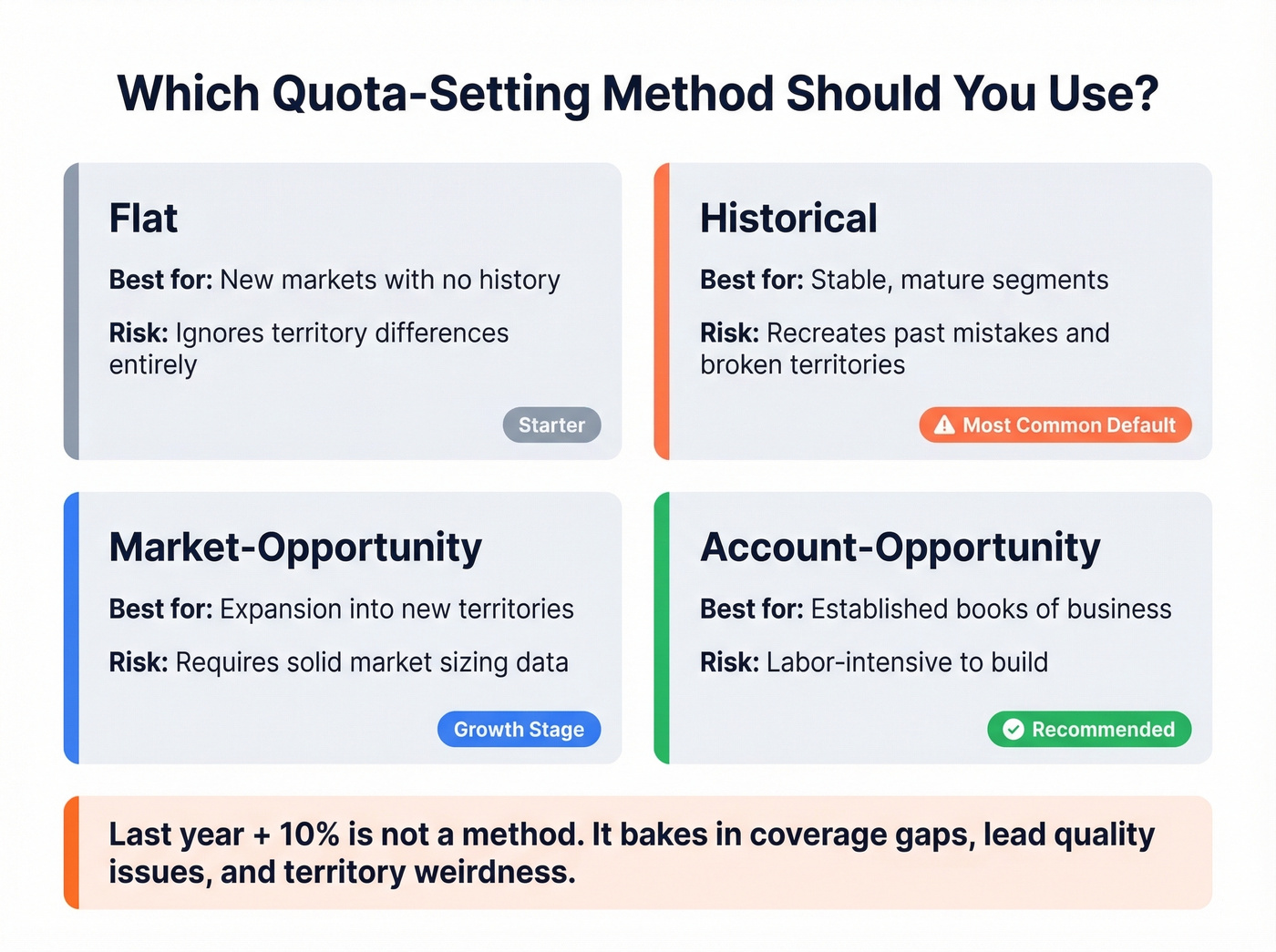
And no - "last year + 10%" isn't a method. It's a shortcut that bakes in last year's coverage gaps, lead quality issues, and territory weirdness.
| Method | Best For | Watch Out |
|---|---|---|
| Flat | New markets, no history | Ignores territory differences |
| Historical | Stable, mature segments | Recreates past mistakes |
| Market-Opportunity | Expansion territories | Requires market sizing data |
| Account-Opportunity | Established books of business | Labor-intensive to build |
Flat is fine when you truly don't know yet - use it briefly, then graduate. Historical is what most teams do by default; it's also how you keep rewarding broken territories and punishing good ones. Account-opportunity takes work, but it's defensible. We've seen teams win back rep trust fast just by showing the account math, even when quotas went up.
The Math - How to Calculate Quotas
Quota math should feel boring. Boring is good.
Deal-Based Sanity Check
Revenue target divided by average deal size. A $200,000 target with $20,000 average deals means 10 closed deals. If your rep's historical win rate and cycle length make 10 deals impossible, stop here and fix the assumptions before going further.
Reverse-Funnel to Activities
Translate outcomes into upstream work. To close 30 deals/year with typical conversion rates:
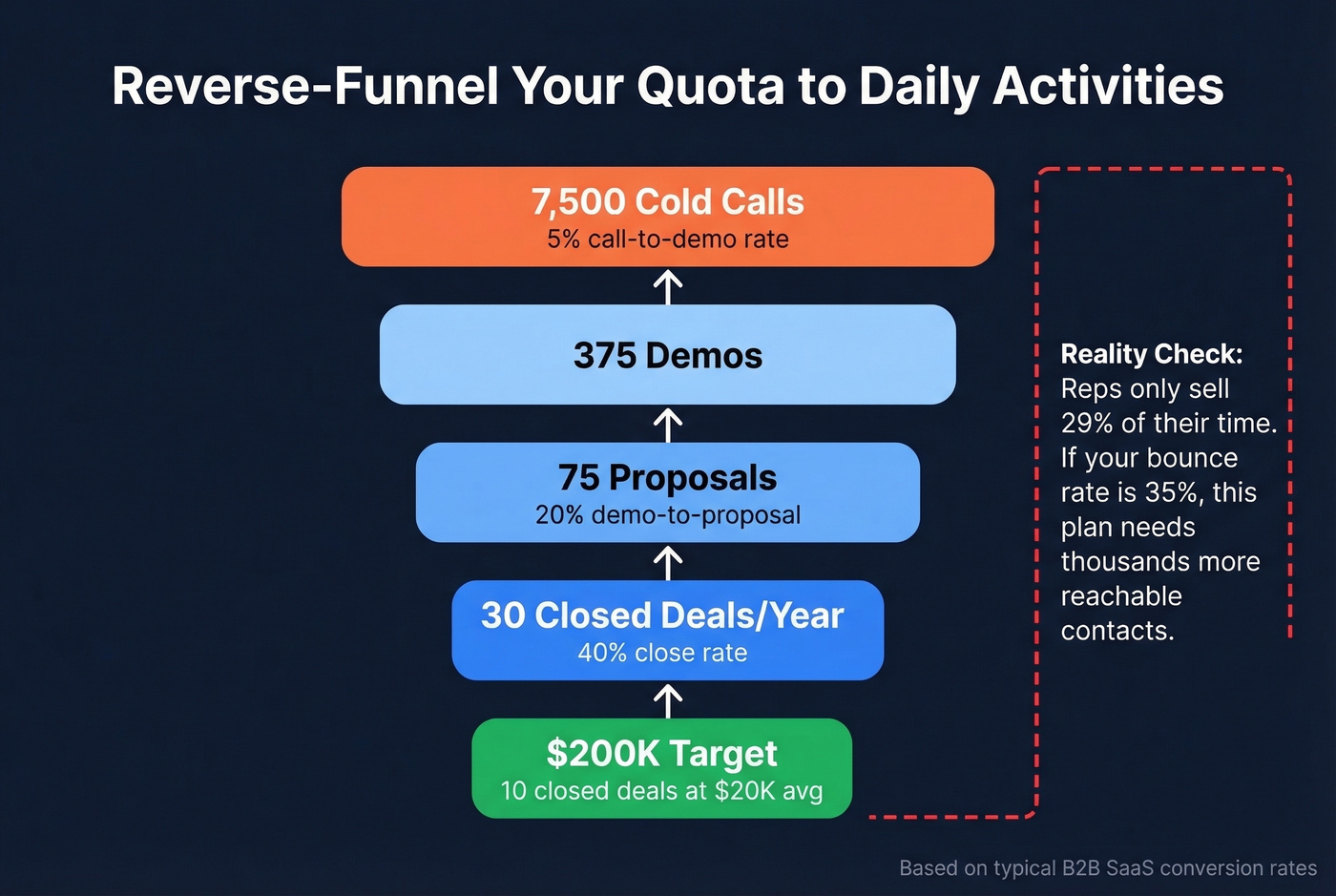
- Proposal to closed-won at 40% = 75 proposals
- Demo to proposal at 20% = 375 demos
- Cold call to demo at 5% = 7,500 calls
This is where leadership teams accidentally set "perfect quarter" quotas. You can't demand 7,500 calls if the rep only has 29% selling time and half their list is junk.
Let's be honest about what this math assumes: reps can actually reach people. If your bounce rate is running ~35%, your activity plan is really a "find thousands more reachable contacts" plan. Prospeo's 98% email accuracy and 7-day refresh cycle keep that activity model from collapsing in week one.
Capacity Math (Don't Forget Ramp)
Two reps each have a $10k/month quota, but one is two months into a five-month ramp at 40% productivity. Your real capacity isn't $20k - it's $14k. I see this mistake in nearly every planning spreadsheet: headcount counted as "fully ramped" because it's easier. It's also wrong. If you want a tighter system for this, use a dedicated quota management process instead of ad-hoc spreadsheets.
FP&A Sanity Checks
Before you finalize, run these rules of thumb that most finance teams already know but sales leaders ignore:
- Rep quota should be at least 5x OTE. If a rep earns $200k OTE and carries a $600k quota, the unit economics are marginal at best.
- Roughly 1/3 of the org should be quota carriers. If that ratio is way off, you're either over-staffed in support or under-invested in selling capacity.
- Plan for ~80% aggregate achievement, not 100%. Building a revenue plan that requires every rep to hit is a plan that requires a miracle.

Your reverse-funnel math only works if reps can actually reach prospects. A 35% bounce rate turns 7,500 calls into wasted quota capacity. Prospeo's 98% email accuracy and 7-day data refresh mean your activity-based quotas are built on contacts that exist - not stale records from six weeks ago.
Stop setting quotas on unreachable contacts. Start with verified data.
Sales Quota Targets by Role
Role clarity is quota clarity. When teams blur SDR/AE/CSM accountability, quotas turn into politics.
| Role | Primary Metric | Comp Split | Typical Attainment |
|---|---|---|---|
| SDR | Meetings booked + qualified opps | 70/30 | ~63% |
| AE | Bookings / ACV | 50/50 | ~51% |
| CSM | GRR / NRR / expansion | 80/20 | Varies widely |
SDRs need a blend of activity and outcomes - don't pay purely on meetings if you care about pipeline quality. If you need role-specific benchmarks, start with SDR benchmarks. AEs should carry quota on bookings, not "pipeline created." For SaaS, median commission lands around 11.5% of ACV at 100% attainment - track it alongside your Account Executive KPIs. CSMs tied to GRR/NRR and expansion stay focused on retention without becoming pure farmers.
Pipeline sourcing mix matters too. A healthy default: marketing 25-30%, SDR 40%, AE 30%. If your model assumes AEs source 70% of pipeline, you're not setting quotas - you're outsourcing demand gen to your closers. (If you want a full operating model, align this with your sales team strategy.)
Ramp Quotas by Segment
Ramp isn't a nice-to-have. It's the difference between "challenging" and "mathematically impossible."
| Segment | Ramp Time | Q1 Quota | Q2 Quota | Q3+ Quota |
|---|---|---|---|---|
| Enterprise | 9-12 months | 40% | 75% | 100% |
| Mid-Market | 4-6 months | 40% | 75% | 100% |
| SMB | 1-3 months | 75% | 100% | 100% |
The 40% / 75% / 100% phasing pattern holds across most orgs we've talked to. Real-world ramp distribution is messier: roughly 19% ramp in 1-3 months, 39% in 3-5, 23% in 5-7, and 18% take 7+ months. Teams that don't formalize ramp quotas end up with a "new hire attrition" problem that's actually a "new hire got an impossible number" problem. Every time. If you need levers to shorten time-to-productivity, see ramp sales reps faster.
Governance and Rollout Timeline
Only 34% of companies communicate quotas ahead of the fiscal year. That's wild, because 41% of reps interpret late quotas as incompetence and 43% say early quotas significantly improve their productivity.
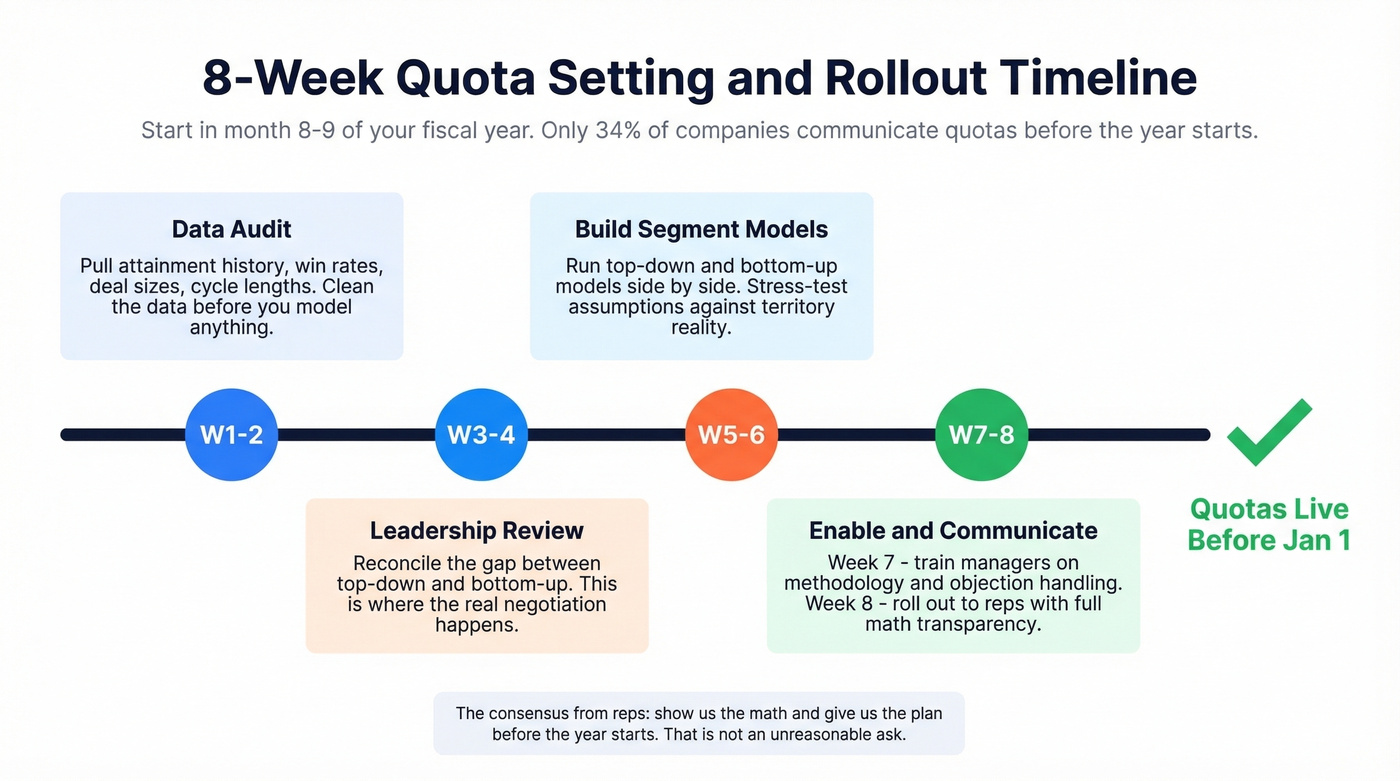
Start quota work in month 8-9 of your fiscal year and run a tight 6-8 week process. Most teams try to compress this into 3 weeks and regret it. This is also where a strong RevOps function earns its keep.
| Week | Milestone |
|---|---|
| 1-2 | Data audit: attainment, win rates, deal sizes, cycle lengths |
| 3-4 | Build segment models (top-down + bottom-up); stress-test assumptions |
| 5-6 | Leadership review; reconcile gap between models |
| 7 | Manager enablement: explain methodology, handle objections |
| 8 | Rep rollout: communicate quotas with full transparency on the math |
The consensus on r/sales is simple: show us the math and give us the plan before January 1. That's not an unreasonable ask. If your managers struggle to land the message, standardize the cadence with a 1:1 meeting template.
Common Mistakes That Wreck Attainment
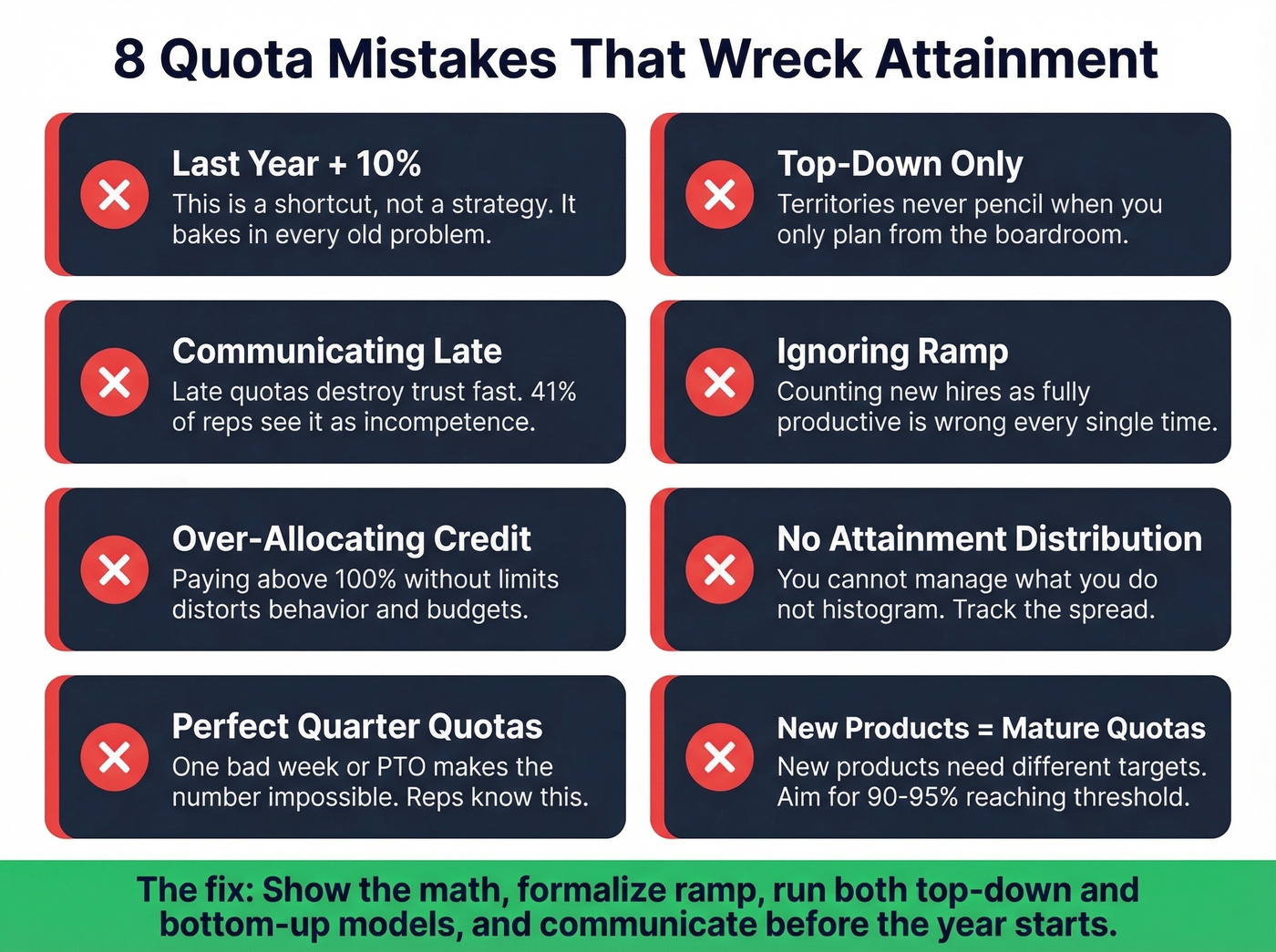
- Treating "last year + 10%" as strategy. It's not. It never was.
- Going top-down only, then acting surprised when territories don't pencil. (This is usually a sales territory design issue, not a rep issue.)
- Communicating late. Late quotas destroy trust fast - the data is clear on this.
- Ignoring ramp in capacity math, then blaming reps for "underperformance."
- Over-allocating credit above 100% and pretending it won't distort behavior.
- Not tracking attainment distribution. You can't manage what you don't histogram - build it into your sales performance analysis.
- Setting "perfect quarter" quotas where one bad week or PTO makes the number impossible - reps describe this exact trap regularly.
- Treating new products like mature ones. New products need different distributions - aim for 90-95% reaching threshold and 60-70% at plan.
Skip the temptation to "stretch" quotas for your top performers. If someone's consistently at 150%, the answer is a bigger territory or a promotion, not a quota that punishes success.
You just calculated that AEs need 375 demos and 7,500 calls to hit plan - but reps only sell 29% of the time. Don't waste that window on bad numbers. Prospeo gives your team 300M+ verified profiles with direct dials (125M+ mobiles, 30% pickup rate) so every activity counts toward quota.
Make every rep hour count with contacts that actually pick up.
FAQ
What Percentage of Reps Should Hit Quota?
About 60% at or above plan signals healthy calibration. Alexander Group's guidance targets roughly 60% at/above and 40% below. If fewer than 40% hit, quotas are usually too aggressive or territory allocation is broken.
How Far in Advance Should Quotas Be Set?
Communicate quotas 4-8 weeks before the fiscal year starts so managers can coach and reps can build pipeline. Only 34% of companies do this, yet 43% of reps say early quotas significantly improve their productivity. There's no good excuse for missing this window.
What Are the Most Overlooked Quota Setting Best Practices?
Formalizing ramp schedules, auditing territory data before assigning numbers, and running both top-down and bottom-up models so you can reconcile the gap. Most teams skip one or more of these steps and end up with quotas that look clean in a spreadsheet but fall apart in the field.
How Do You Set Realistic Activity Quotas?
Run a reverse-funnel calculation from revenue down to daily activities, then validate reps have enough reachable contacts to execute. If your email bounce rate is above 10%, your required-activity targets are quietly inflated by dead records - fix the data first, then set the numbers.