

Sales Territory Design: A Practical Guide for 2026
A RevOps lead we know ran a territory redesign last quarter after discovering three reps were fighting over the same 200 accounts in Chicago while nobody owned a single account in the fastest-growing vertical. After the redesign, pipeline coverage in that neglected vertical went from 1.2x to 2.8x within one quarter. That's not an edge case - it's the norm. Up to 70% of B2B reps missed quota recently, and bad sales territory design is one of the biggest reasons why.
Effective territory realignment can lift revenue 2-7% without adding a single rep, according to research cited by Xactly from Harvard Business Review. The Alexander Group benchmarks an additional 10-20% in sales productivity gains from thoughtful territory optimization. On a $20M book, that's real money. Yet most teams still split territories by eyeballing zip codes in a spreadsheet and calling it done.
TL;DR: Territory design is a 2-7% revenue lever most teams ignore. Stop splitting maps by zip code. Fix your data, score accounts, balance workload within plus or minus 10%, and review quarterly. You don't need fancy software - you need clean data and a repeatable framework.
What Territory Design Actually Means
Sales territory design isn't just splitting a map into patches. It's the process of segmenting your addressable market, assigning accounts to reps, and balancing workload so every territory has a realistic shot at hitting quota.
Three things have to work together: segmentation (how you divide the market), assignment (who owns what), and balancing (ensuring no rep is starving while another drowns). Get any one wrong and you'll see it in pipeline coverage, rep turnover, and forecast accuracy within a quarter.
Forrester's core principle is that structure follows strategy - your territory model should flow from your growth plan, not the other way around. In practice, getting role and coverage design right means every rep has a clearly defined patch with enough opportunity to hit plan.
Segmentation Models
Before you draw a single boundary, decide how you're slicing the market. Also consider whether your model is static or dynamic - fixed annual assignments versus territories that shift as data changes mid-cycle.
| Model | Use When... | Skip When... |
|---|---|---|
| Geography | Field reps, high travel, local relationships | Remote team, vertical specialization |
| Industry/Vertical | Domain expertise drives deals, long cycles | Small TAM per vertical, generalist reps |
| Company Size | Clear SMB/mid/enterprise motion | Uniform deal sizes across book |
| Named Accounts | ABM strategy, high ACV, fewer than 200 targets | High-volume transactional sales |
| Hybrid | Field + remote mix, multiple ICPs, 50+ reps | Early-stage team with fewer than 10 reps |
Geography is the default, and it's the default for a reason - it's simple. But simple breaks fast. A rep covering Manhattan and a rep covering rural Montana don't have remotely comparable opportunity density, even if their zip code counts look balanced on paper. Most teams above 20 reps end up at a hybrid model whether they plan for it or not.
How to Design Territories: A 6-Step Framework
Step 0: Fix Your Data First
Everything downstream depends on this. 64% of organizations cite data quality as their top territory planning challenge, and it's easy to see why - you can't score accounts you don't have firmographic data on, and you can't assign reps to contacts whose emails bounce.
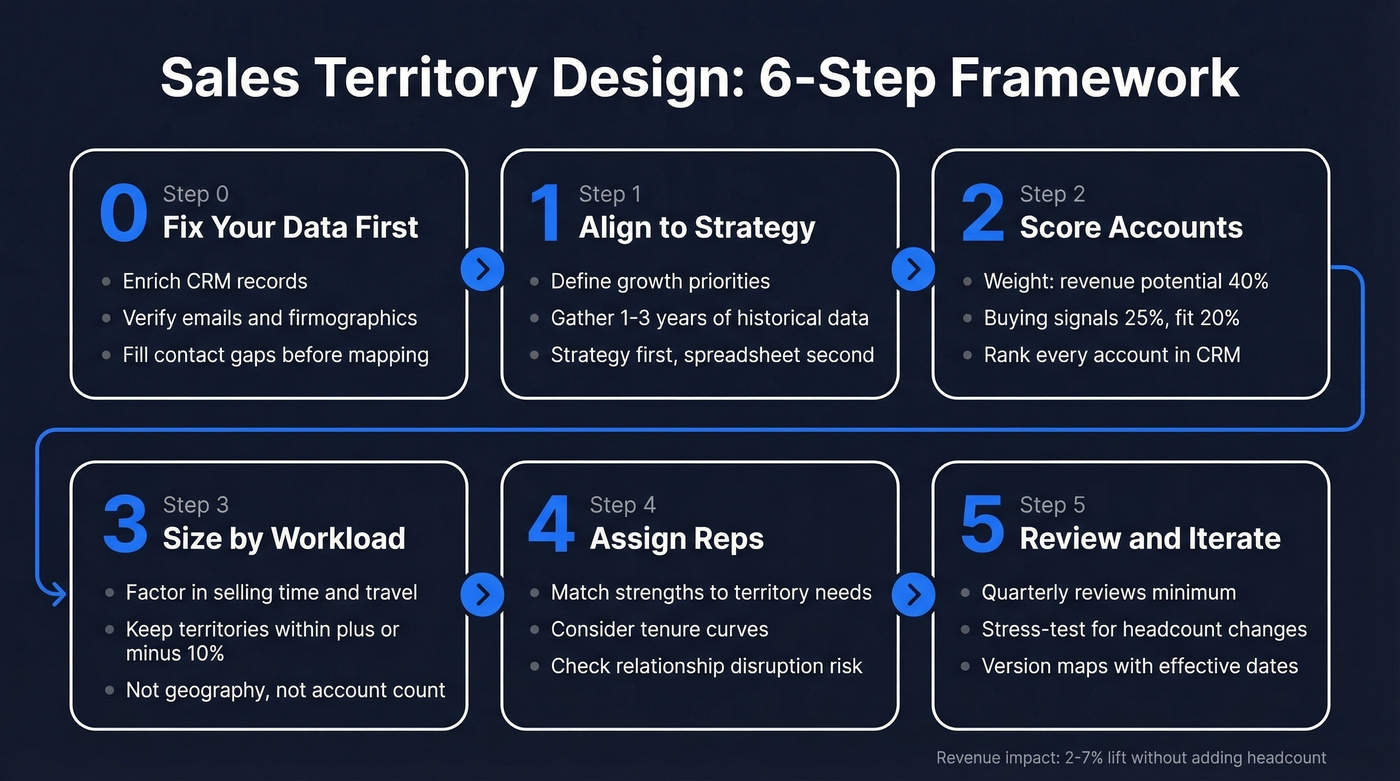
Before you touch a mapping tool, run your CRM through enrichment. We've used Prospeo's enrichment workflows for this exact purpose - its 83% match rate across 300M+ professional profiles fills in the gaps that make territory assignments fall apart. At 98% email accuracy on a 7-day refresh cycle, your reps can actually reach the accounts you assign them. Territory assignments are worthless if a big chunk of the contact records are stale.

Step 1: Align Territories to Strategy
Forrester's methodology starts here: what's your growth plan? They recommend gathering at least one year of historical performance data by rep, territory, and account before making any changes - three years is better if you have it.
If you're expanding into healthcare, your territories need to reflect that. Not just mirror last year's map with a few accounts shuffled around. Write down the strategic priorities before opening a spreadsheet. Territories built without a strategy tend to calcify around whoever happened to own the account two years ago.
Step 2: Score and Prioritize Accounts
Not all accounts are equal, and your territories shouldn't treat them that way. Build a scoring model with weighted parameters: revenue potential at 40%, buying signals like job postings or tech adoption at 25%, strategic fit at 20%, existing relationship at 15%.
Score every account in your CRM, then rank them. This scored list becomes the input for territory balancing - not zip codes. (If you need a starting rubric, borrow a scoring model and adapt it to your ICP.)
Step 3: Size by Workload, Not Geography
Here's where most teams go wrong. They balance territories by account count or revenue and call it fair. But a territory with 50 enterprise accounts requiring quarterly business reviews is a fundamentally different workload than 50 SMB accounts on a self-serve motion.
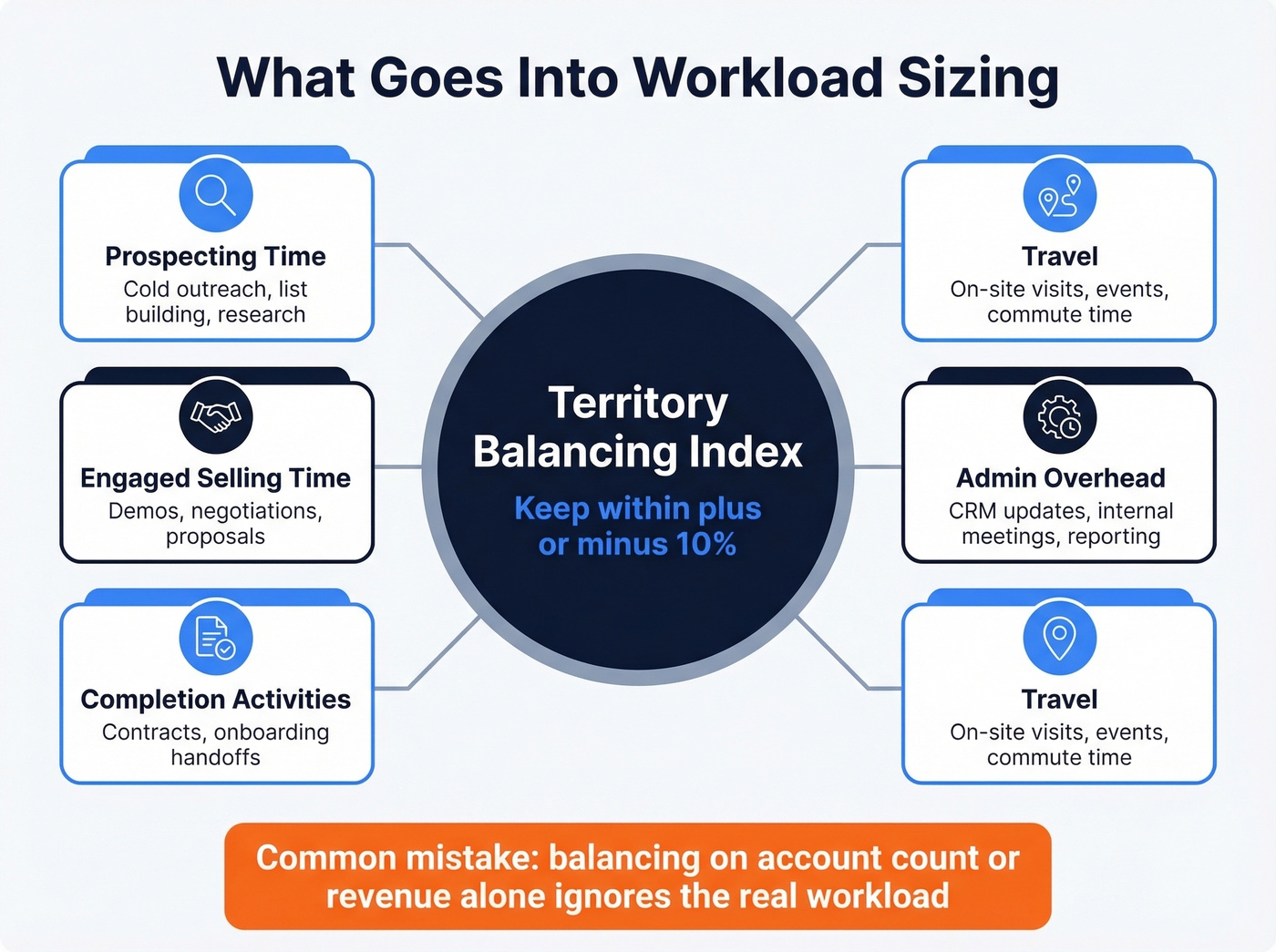
The Alexander Group recommends capacity models that factor in five categories: prospecting time, engaged selling time, completion activities, admin overhead, and travel. Build a territory balancing index by weighting these variables alongside account count and revenue potential. The guardrail: keep territories within plus or minus 10% of each other on your balancing index. If one territory is 25% heavier than another, you've got a problem that'll show up in attrition within two quarters.
Step 4: Assign Reps to Territories
Match rep strengths to territory needs. A rep with deep fintech relationships shouldn't be covering healthcare accounts just because they live nearby.
Consider tenure curves too. Based on Xactly Insights' aggregated pay and performance data, sales reps hit peak performance at three years, and by year five they often begin to decline as they shift into maintenance selling. Pair newer reps with high-growth territories. Put veterans on complex, relationship-heavy patches.
Don't skip the relationship disruption check. Reassigning a rep's top three accounts mid-deal is a pipeline killer. And don't forget CS - territory imbalance affects customer success managers too, driving CSM burnout and degraded renewal rates.
Step 5: Review, Stress-Test, Iterate
Drawing territory boundaries isn't a once-a-year event. Set a quarterly review cadence, and do a full redesign annually at minimum. Without regular adjustment, 20-30% of territories become growth-constrained as reps spend more time servicing existing accounts than hunting new ones.
Version your territory maps with effective dates so you can compare performance across redesigns and maintain an audit trail. Stress-test against scenarios: what happens if you lose two reps? What if a key vertical doubles in TAM? If your model can't absorb a 15% headcount change without a full rebuild, it's too brittle. Create a transition policy before announcing new territories - Forrester's implementation guidance emphasizes change management for good reason, because reps who feel blindsided by territory changes will fight the new map instead of working it.

64% of teams say data quality is their top territory planning challenge. Prospeo's CRM enrichment fills the gaps - 83% match rate across 300M+ profiles, 98% email accuracy, and a 7-day refresh cycle so reps can actually reach the accounts you assign them.
Score and assign territories on data that's current, not six weeks stale.
Five Territory Design Mistakes That Kill Performance
Static territories in dynamic markets. Markets shift. Competitors enter. Verticals heat up and cool down. Xactly calls this the number one pitfall - treating territories as set in stone when the market underneath them is moving.
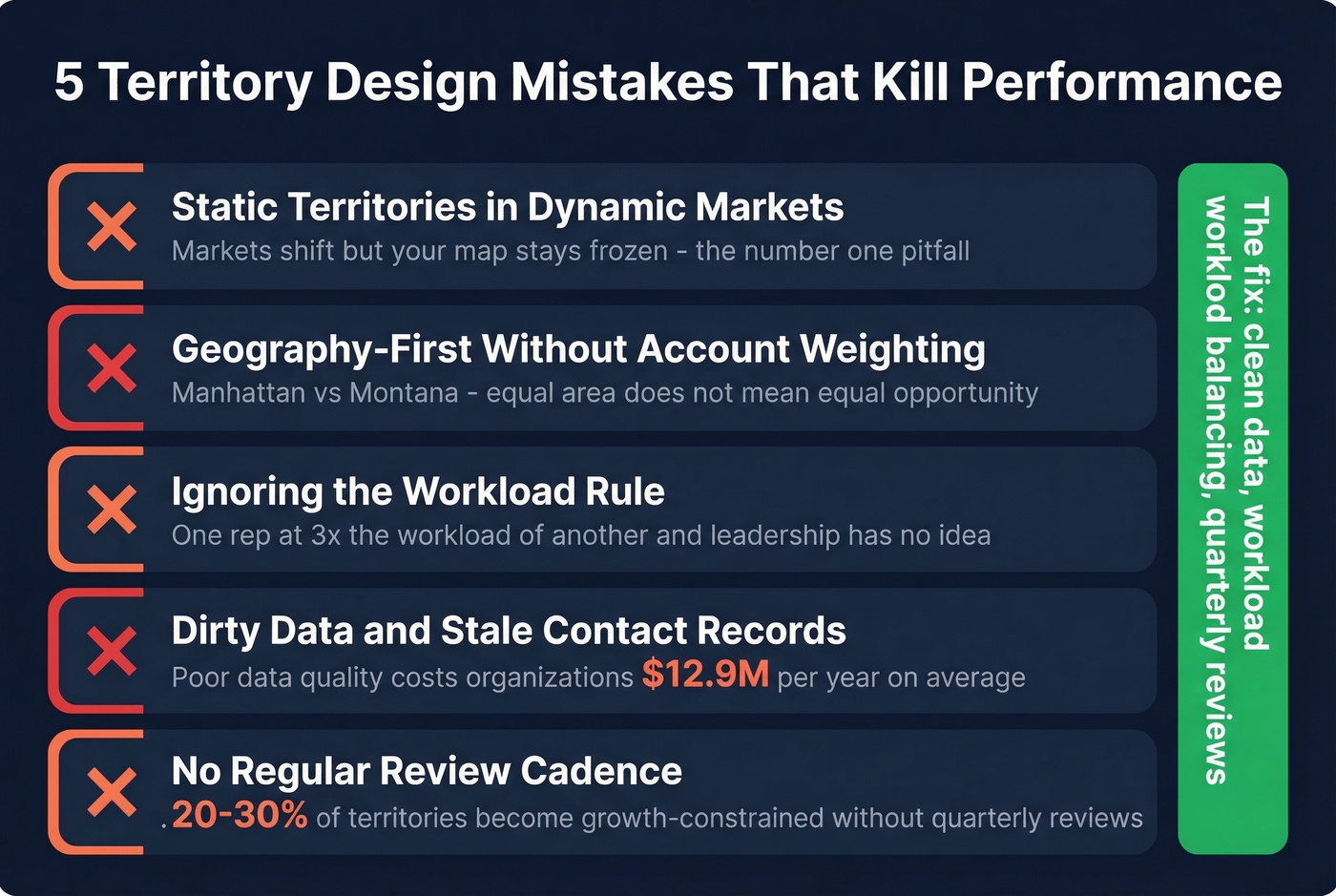
Geography-first without account potential weighting. The Manhattan vs. Montana problem. Equal geographic area doesn't mean equal opportunity. If you're balancing on square miles, you're doing it wrong.
Ignoring the workload rule. We've seen teams where one rep has 3x the workload of another and leadership genuinely didn't know. If you aren't measuring workload balance, you're guessing - and your reps know it even if you don't.
Dirty data and incomplete contact records. Gartner estimates poor data quality costs organizations $12.9M annually. In territory planning specifically, stale records mean reps waste hours chasing contacts who've changed jobs. This is the single most fixable problem on the list, and it's the one teams procrastinate on the longest. (If you're evaluating vendors, start with a shortlist of data enrichment services.)
No regular review cadence. The consensus on r/SalesOperations is that territory logic lives in a massive Excel sheet built on tribal knowledge, and nobody touches it until reps start complaining. By then, you've already lost pipeline.
How to Measure Territory Health
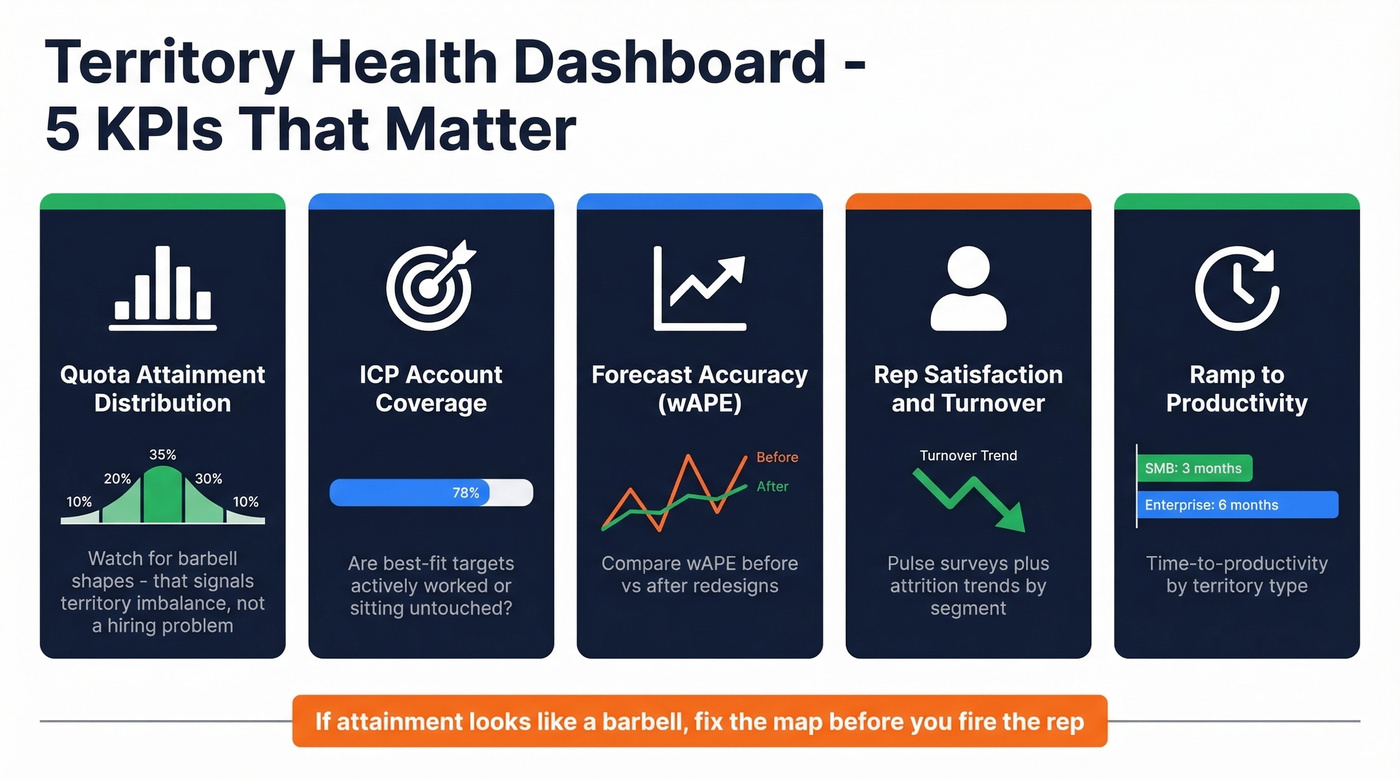
You can't manage what you don't measure. These five KPIs tell you whether your territories are working:
| KPI | What to Look For |
|---|---|
| Quota attainment distribution | Evaluate median attainment and the interquartile range each quarter |
| ICP account coverage | Are your best-fit targets being actively worked, or sitting untouched? |
| Forecast accuracy (wAPE) | Track wAPE before vs. after redesigns to see if predictability improves |
| Rep satisfaction / turnover | Pulse surveys + attrition trends by segment and region |
| Ramp to productivity | Time-to-productivity by territory type - SMB vs enterprise, greenfield vs existing |
If your quota attainment distribution looks like a barbell - a few reps crushing it, most missing - that's a territory problem, not a hiring problem. Wide variance in attainment is one of the clearest signals that your territories are unbalanced.
Let's be honest: most teams blame hiring when reps miss quota. Most of the time, the territory map is the real culprit. Fix the map before you fire the rep.
Territory Planning Tools
You don't need an enterprise planning suite to get started. The sales mapping software market is projected to hit $7B by 2033, so options are expanding fast - but you still need to pick the right category for your problem.
| Tool | Category | Starting Price | Best For |
|---|---|---|---|
| Prospeo | Data enrichment | Free tier; ~$0.01/email | Contact data quality |
| Xactly AlignStar | Enterprise planning | Custom ($30K-75K+/year) | Complex hierarchies |
| eSpatial | Mapping + optimization | $1,295/user/yr | Scenario planning |
| Spotio | Field sales mapping | $39/user/mo | Outside sales teams |
| Badger Maps | Route + territory | $49/user/mo | Drive time optimization |
| MapBusinessOnline | Budget mapping | $29/mo | Small teams, basic viz |
| Maptitude | Desktop GIS | $695 one-time | Offline demographic analysis |
The mapping tools above solve the visualization and balancing problem. None of them fix the underlying data. If your CRM has stale emails and missing phone numbers, even the best territory map won't help reps connect with buyers. Clean your data first, then layer a mapping tool on top. (If you're building a broader stack, compare categories like sales mapping software and sales forecasting solutions.)
For teams that want to skip the "talk to sales" gate entirely, self-serve tools with transparent pricing - Prospeo, Spotio, Badger Maps - let you test the workflow before committing budget.
FAQ
How often should you redesign sales territories?
Review quarterly, redesign annually. Without regular adjustment, 20-30% of territories become growth-constrained within a year. Quarterly reviews catch emerging imbalances before they tank pipeline or drive rep attrition.
What data do you need for territory planning?
You need CRM history, firmographic data, TAM estimates, workload metrics, and verified contact records. Enrichment tools that return 50+ data points per record ensure territory assignments map to reachable buyers, not dead-end records.
Geographic vs. named-account territories - which is better?
Named accounts work best for high-ACV ABM motions with fewer than 200 targets per rep. Geographic suits field-heavy teams needing local presence. Most orgs above 20 reps run a hybrid combining both models.
How do you balance territories fairly?
Build a composite workload index factoring account count, revenue potential, deal complexity, and travel time - then keep every territory within plus or minus 10% of the median. Balancing on a single dimension like account count or geography alone creates hidden inequities that surface as missed quotas.
What's the biggest mistake in sales territory design?
Treating territories as static annual assignments in a dynamic market. Markets shift, competitors enter, and verticals evolve. Teams that don't adjust at least quarterly see 20-30% of territories become growth-constrained within a year.