

How to Make an Elevator Pitch (2026 Guide)
You're at a networking event. Someone asks what you do. You launch into a three-minute monologue about your background, your company's mission, and that project you're proud of. By sentence four, their eyes are scanning the room for someone else to talk to.
Princeton psychologists Willis and Todorov found that people form impressions in 100 milliseconds - a tenth of a second. A huge share of roles get filled through networking, which makes knowing how to make an elevator pitch one of the most important skills in your professional toolkit. It doesn't need to be perfect. It needs to be fast, clear, and human. That's what we're building today - a pitch that earns you the next conversation.
The Cheat Sheet
Before we go deep, here's the short version:
- Keep it 30-60 seconds (around 75-160 words). Longer is too long.
- Use the 4-part structure: Who you are → What you do → Why it matters → Your ask.
- Memorize the structure, not the script. Sound human, not rehearsed.
- Tailor every pitch to the person in front of you. One-size-fits-all pitches fail.
That's the whole framework. Everything below is the how and why.
What Is an Elevator Pitch?
The term comes from the idea that you should be able to deliver your pitch in the time it takes to ride an elevator - roughly 30 to 60 seconds. That's around 75-160 words at a natural pace.
It's not a pitch deck. It's not a sales presentation. It's the verbal equivalent of a business card - just enough to make someone want to keep talking. The same skill powers "tell me about yourself" in interviews, "what does your company do?" at conferences, and "who are you?" when you walk into a meeting with a skeptical stakeholder. Nail this, and you nail all of those.
How to Structure Your Pitch
Most guides overcomplicate this. Cognitive load is real: cram in too many ideas and the message blurs. Four parts. That's it.
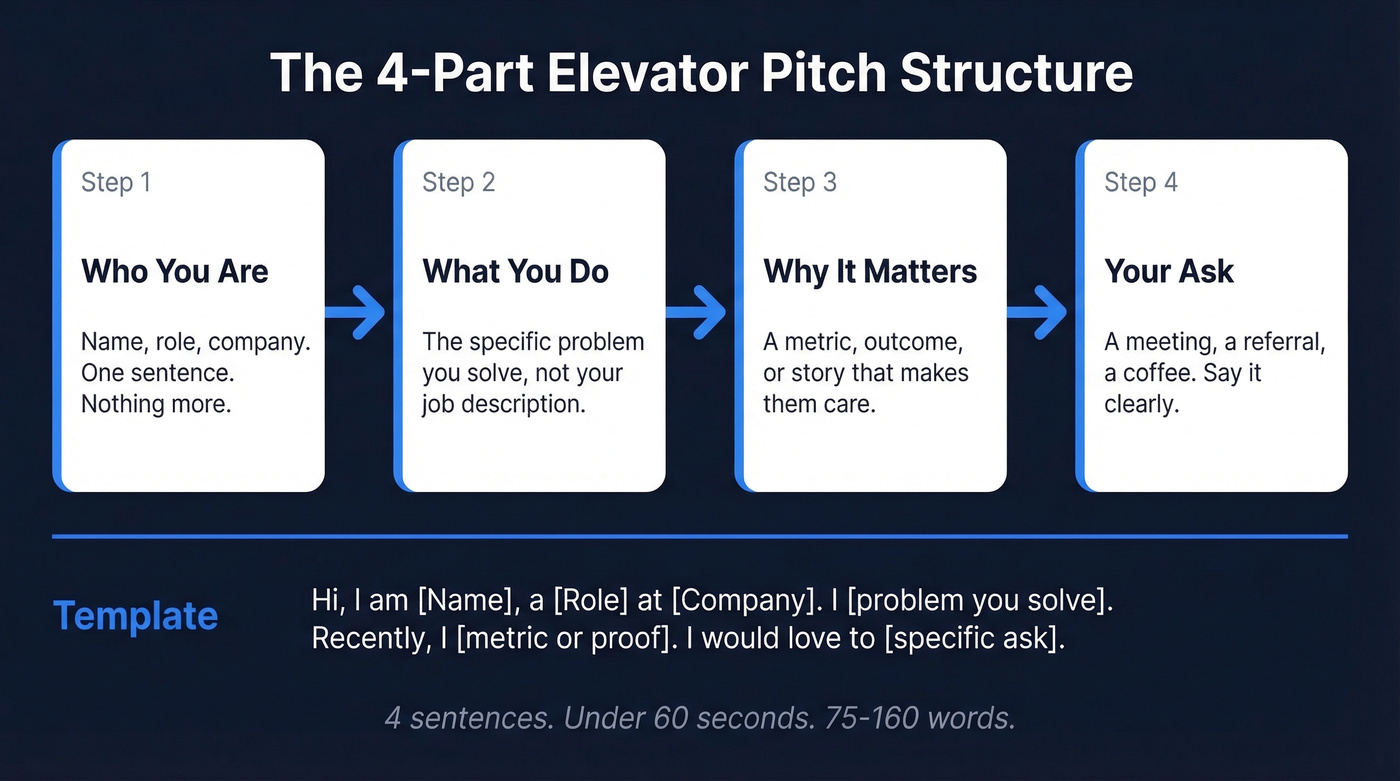
Step 1: Who you are. One sentence. Name, role, company. Nothing more.
Step 2: What you do. One sentence describing the specific problem you solve or value you create. Not your job description - your impact.
Step 3: Why it matters. One sentence with a metric, outcome, or story that makes the listener care. This is where most pitches fall apart. "I help businesses grow" means nothing. "I helped a SaaS company cut churn by 12% in one quarter" means everything.
Step 4: Your ask. What do you want? A meeting, a referral, a follow-up coffee, a card? Say it. Don't leave the listener guessing.
The fill-in template:
"Hi, I'm [Name], a [Role] at [Company]. I [what you do - specific problem you solve]. Recently, I [metric or outcome that proves it]. I'd love to [specific ask]."
Four sentences. Under 60 seconds. Memorize this skeleton, then fill it differently every time depending on who you're talking to. If you want more ready-to-use variations, pull ideas from these elevator pitch examples.

A perfect elevator pitch means nothing if you're delivering it to the wrong person - or dialing a dead number. Prospeo gives you 98% accurate emails and verified mobile numbers across 300M+ profiles, so every pitch lands with a real decision-maker.
Stop wasting your best pitch on bad data.
Elevator Pitch Examples
Job Seeker (Entry-Level)
"Hi, I'm Sarah Chen. I just finished my degree in data science at Michigan, where I built a customer segmentation model for a local retailer that increased their email campaign ROI by 34%. I'm looking for analyst roles where I can bring that kind of impact to a larger dataset. Could I send you my portfolio?"
This works because it leads with a specific result, not a GPA. At a career fair, the recruiter hears dozens of "I'm a recent grad looking for opportunities." The metric is what sticks.
Job Seeker (Career Changer)
"I'm James, a data analyst transitioning from marketing operations. In my last role, I built a churn-prediction model that reduced customer churn by 12% - saving the company about $800K annually. I'm exploring roles where I can apply that kind of predictive work full-time. Could we grab a 15-minute virtual coffee this week?"
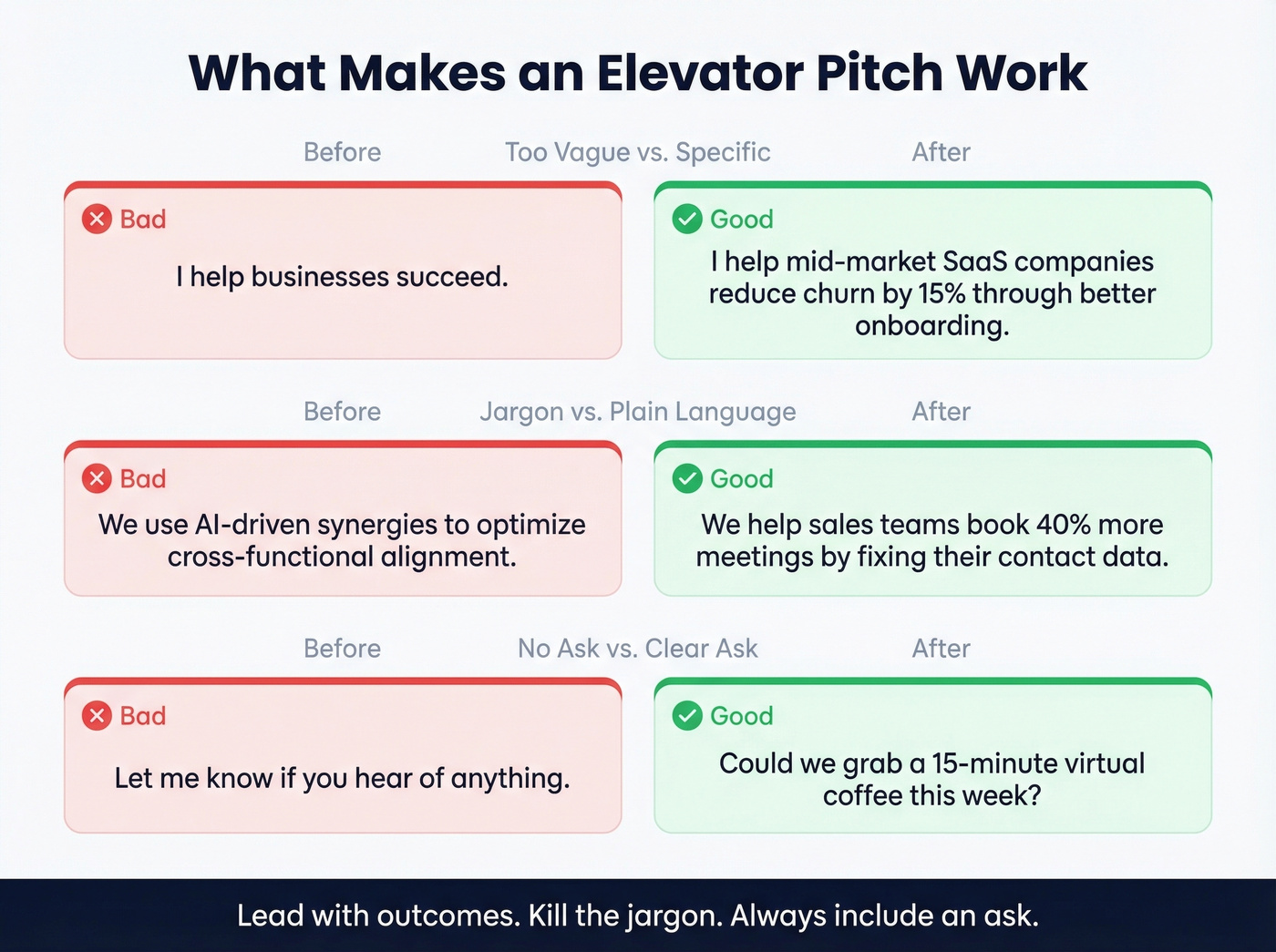
The "15-minute virtual coffee" is a low-friction ask - specific, easy to say yes to, and respectful of the listener's time. Compare that to "let me know if you hear of anything," which is so vague it's basically asking to be forgotten.
Founder / Entrepreneur
"We make it easy to say 'thank you' at work."
That's a real pitch from an HR software company featured by Keap. Nine words. It works because it leads with the outcome, not the product category. Another favorite: "I make energy from cigarette butts." You don't know what the company does yet, but you're absolutely going to ask a follow-up question. That's the whole point - a great one-line pitch creates curiosity, not comprehension.
The mistake founders make is leading with the company name and a feature list. Nobody cares about your company name yet. They care about the problem you solve. Lead with the problem, or lead with a curiosity hook that forces a question.
Sales Professional
For sales, the structure shifts slightly. You're not introducing yourself - you're opening a conversation with a prospect. The 5-component approach compresses well into a 15-second cold call opener:
"Hey [Name], quick question - are you still running outbound with a team of five? We helped [similar company] book 40% more meetings last quarter by fixing their contact data. Worth a 10-minute call?"
Here's the thing: the best opener in the world is worthless if you're dialing a disconnected number. Before you pitch anyone, make sure your contact data is actually good. We've seen teams waste entire sprint cycles burning through openers on bad numbers and bounced emails - and the fix is usually just verifying your list before you dial. Tools like Prospeo can help here, with 98% email accuracy and verified mobile numbers across 300M+ profiles. If you're building a repeatable outbound motion, these sales prospecting techniques help you turn a good pitch into a consistent pipeline.
Internal Introduction
A scenario from a Reddit thread that doesn't get enough attention: you're meeting a new stakeholder who thinks your department is a cost center. They've already decided you're not strategic. You have 30 seconds to change their mind.
The draft pitch from that thread: "I'm a strategic instructional designer who partners with SMEs, leveraging learning science to create impactful experiences."
The rewrite: "I design training programs that actually change behavior. Last quarter, our onboarding redesign cut new-hire ramp time from 12 weeks to 7 - which saved the sales team about $200K in lost productivity."
Same person, same role. The second version leads with an outcome the stakeholder cares about. Kill the jargon. Lead with the number.
Written Pitch (Cold Email / Bio)
Your elevator pitch isn't just spoken. It shows up in cold emails, professional bios, and conference speaker intros. The rules are the same, but tighter - cold emails under 150 words see up to 20% higher reply rates, and with 46% of email opens happening on phones, your pitch needs to land in the first two lines before the fold. If you're writing outreach, borrow a few patterns from these sales follow-up templates to keep the ask crisp.
For a professional bio, use the same 4-part structure in third person: "Sarah Chen is a data scientist who builds churn-prediction models for SaaS companies. Her most recent model reduced churn by 12% at [Company], saving $800K annually."
Five Mistakes That Kill Your Pitch
Too long. One Reddit poster's "tell me about yourself" answer ran five minutes - two minutes on their "brand," three more connecting experience. They weren't sure if it was too long. It was. If you're past 60 seconds, cut it in half. Then cut it again.
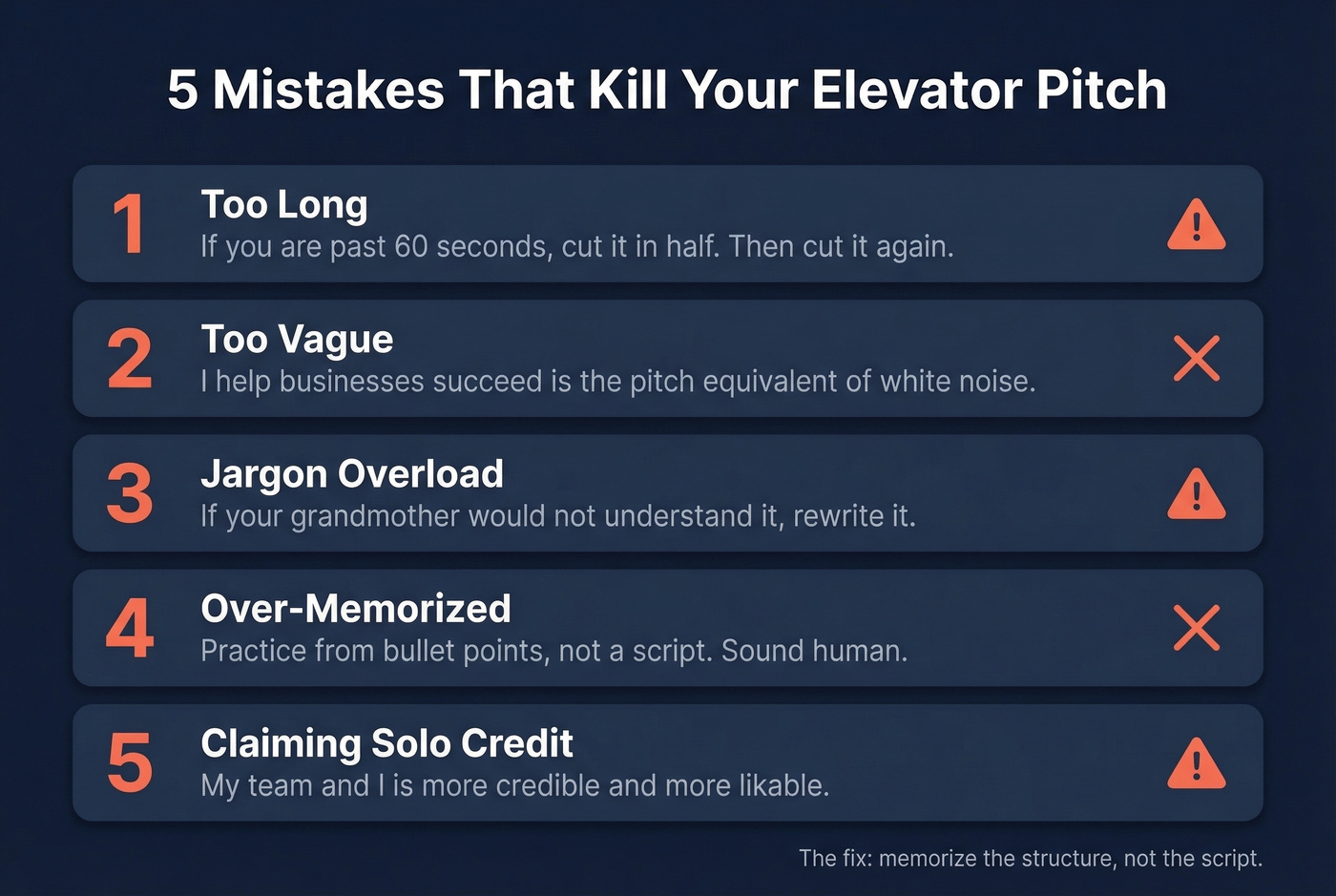
Too vague. "I help businesses succeed" is the pitch equivalent of white noise. Rewrite it: "I help mid-market SaaS companies reduce churn by an average of 15% through better onboarding sequences." Specificity is what makes people lean in.
Jargon overload. "We use AI-driven synergies to optimize cross-functional alignment." Nobody knows what that means. Speak conversationally. Use short sentences. If your grandmother wouldn't understand the sentence, rewrite it.
Over-memorized and robotic. Practice from bullet points, not a script. Know your four key points. Vary the wording every time. The slight imperfection is what makes you sound human.
Claiming solo credit. "I single-handedly rebuilt our pipeline" sounds arrogant and probably isn't true. "My team and I" is more credible and more likable. Give credit where it's due - listeners notice.
How to Practice
Stop memorizing word-for-word. Memorize the structure, not the script.
The bullet-point method works best. Write your four key points - who, what, why, ask - on a sticky note. Practice delivering them out loud, using different words each time. Record yourself on your phone and time it. You'll be surprised how much filler you can cut once you hear it played back.
Peer feedback is underrated. A Reddit thread in r/Entrepreneur where founders shared and critiqued each other's pitches showed that small tweaks from outside perspectives made a real difference - the OP called the replies "eye opening." Find a colleague, a friend, or a community and workshop your pitch out loud. A systematic literature review of elevator pitch studies from 2014-2024 confirms that pitch practice boosts self-efficacy - the confidence that you can deliver under pressure. The reps matter more than the words. If you're practicing for outbound, pair this with a simple cold calling system so your reps translate practice into booked meetings.
Delivery Tips for Any Setting
In person: Make eye contact. Open posture - uncrossed arms, slight forward lean. Speak at a conversational pace, not an auctioneer's pace. Smile when you say your name.
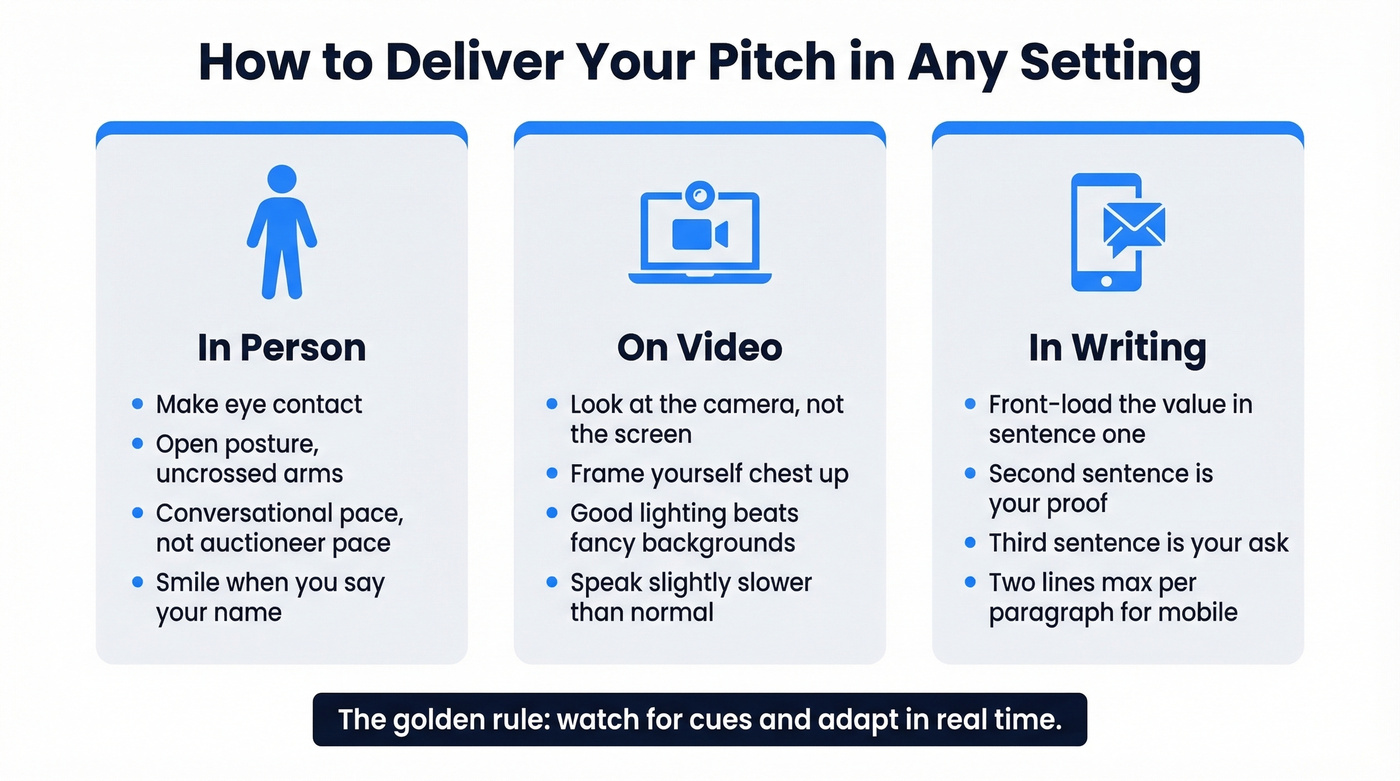
On video: Look at the camera, not the screen. Frame yourself from the chest up. Good lighting matters more than a fancy background. Speak slightly slower than you think you need to - audio compression on video calls flattens your vocal range, so you need to overcompensate with deliberate pacing and vocal variety.
In writing: Front-load the value. First sentence = who you are and what you do. Second sentence = proof. Third sentence = ask. Keep paragraphs to two lines max for mobile readability. If you're sending this as outreach, protect deliverability with the basics in this email deliverability guide.
In real time: Watch for cues. If the listener's eyes light up at your metric, expand on it. If they look confused, simplify. The best pitchers adjust their technical depth on the fly based on verbal and non-verbal feedback. A pitch isn't a monologue - it's the opening move in a two-way conversation.
If templates feel too rigid, try the storytelling alternative: Desire (what your audience wants), Difficulty (what's blocking them), Denouement (how you resolve it). Same structure dressed in narrative clothing, and many people find it easier to deliver naturally.
Let's be honest about one thing: if your average deal closes under $15K, your elevator pitch matters more than your slide deck. At that price point, people buy from people they trust in the first 60 seconds - not from a 40-page presentation they'll never reopen. Invest your prep time accordingly. If you're selling B2B, it also helps to understand the bigger context of B2B sales and how your pitch fits into the full funnel.
You just built a killer 30-second pitch. Now scale it. Prospeo's 125M+ verified mobile numbers have a 30% pickup rate - that means real conversations, not voicemails. At $0.01 per email, you can build a list of ideal prospects before your next networking event even starts.
Pair your pitch with contacts that actually pick up the phone.
FAQ
How long should an elevator pitch be?
Aim for 30-60 seconds spoken, roughly 75-160 words. Cold call openers should compress to 15 seconds. Job interview intros can stretch to a full 60 seconds. If you time yourself and you're over a minute, cut - every second past 60 costs you goodwill.
Can I use my pitch in cold emails?
Yes - and it should be even shorter. Keep cold email intros under 150 words with a single low-friction CTA like "10 minutes this week?" Make sure you're verifying your list before sending, too. High bounce rates don't just waste your pitch - they tank your domain reputation.
What if someone interrupts my pitch?
That's a good sign - it means they're engaged. Answer their question directly, then steer back to your ask. The best pitches aren't monologues; they're the opening move in a conversation you want to have.
How do I tailor my pitch to different audiences?
Same structure, different emphasis. For a VP of Engineering, highlight technical outcomes. For a recruiter, highlight role fit and culture. For an investor, highlight market size and traction. Rewrite the "why it matters" sentence for each audience - the rest stays the same.