

How to Make a Sale - The Practitioner's Playbook With Scripts and Benchmarks
Every sales guide tells you to "build rapport" without a single line of what to actually say. We've read dozens of them, and they all blur together into the same motivational mush. This article is different: you'll get the steps in order, scripts word-for-word, and benchmarks that tell you whether your numbers are normal or broken.
The Playbook in Five Bullets
- Sales is a 7-stage process. Learn the sequence, not random tips.
- Ask better questions and talk less. Top closers speak just 43% of the call.
- Use actual closing scripts. Seven below - word-for-word lines you can steal today.
- Follow up at least 5 times. 48% of sales teams never follow up once.
- Verify your prospect data before outreach. Bad emails kill deals before they start.
Zero to One Is the Hardest Sale
Every sale after your first one gets easier. On r/smallbusiness, the most common question isn't "how do I close?" - it's "how do I even get someone to talk to me?" That's the real zero-to-one problem: every step is new, every objection feels personal, and you don't have a reference point for "normal."
As Jayanti Gupta, founder of Parinita, put it: "Our first three or four sales came from friends and colleagues." That's not a weakness. Sales grow from the inside out - friends, then acquaintances, then strangers. The mistake is waiting to be "ready" instead of picking up the phone and talking to someone who already trusts you.
The 7-Stage Sales Process
Every sale - whether it's a $29 product or a $290,000 contract - follows the same sequence. Understanding these stages as a connected system, rather than isolated moves, is what separates consistent closers from one-hit wonders.
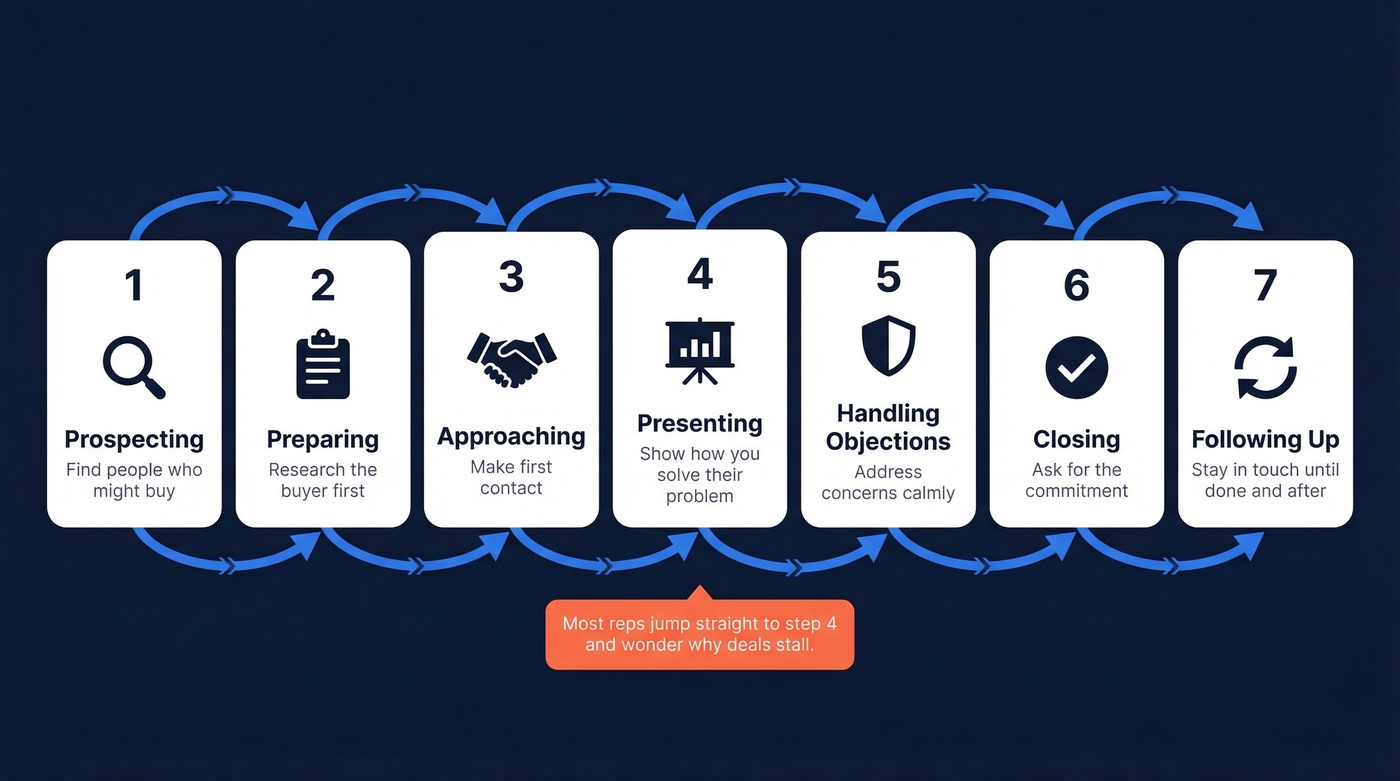
- Prospecting - finding people who might buy
- Preparing - researching the buyer before you reach out
- Approaching - making first contact via email, call, or meeting
- Presenting - showing how you solve their problem
- Handling objections - addressing concerns without getting defensive
- Closing - asking for the commitment
- Following up - staying in touch until the deal is done and after
Most reps jump straight to step 4 and wonder why deals stall. Skip preparation and you'll pitch the wrong thing. Skip follow-up and you'll lose deals you already won.
Know Your Buyer Before You Pitch
57% of the buying journey is already completed before a prospect ever talks to sales. They've Googled you, read your reviews, and compared you to two competitors. You're not introducing yourself - you're joining a conversation already in progress.
Here's the thing: 67% of customers prefer self-service over speaking to a rep. When someone does agree to a call, they've already decided you're worth their time. Don't waste it by asking questions you could've answered with five minutes of research.
Before any outreach, know three things: what the company does, what problem they're likely facing, and who else is involved in the decision. Without that foundation, even the best pitch falls flat.
Ask Better Questions (SPIN Framework)
SPIN Selling is still the most research-backed framework in sales. Neil Rackham developed it from 35,000+ sales calls over 12 years - that's a dataset, not an opinion.
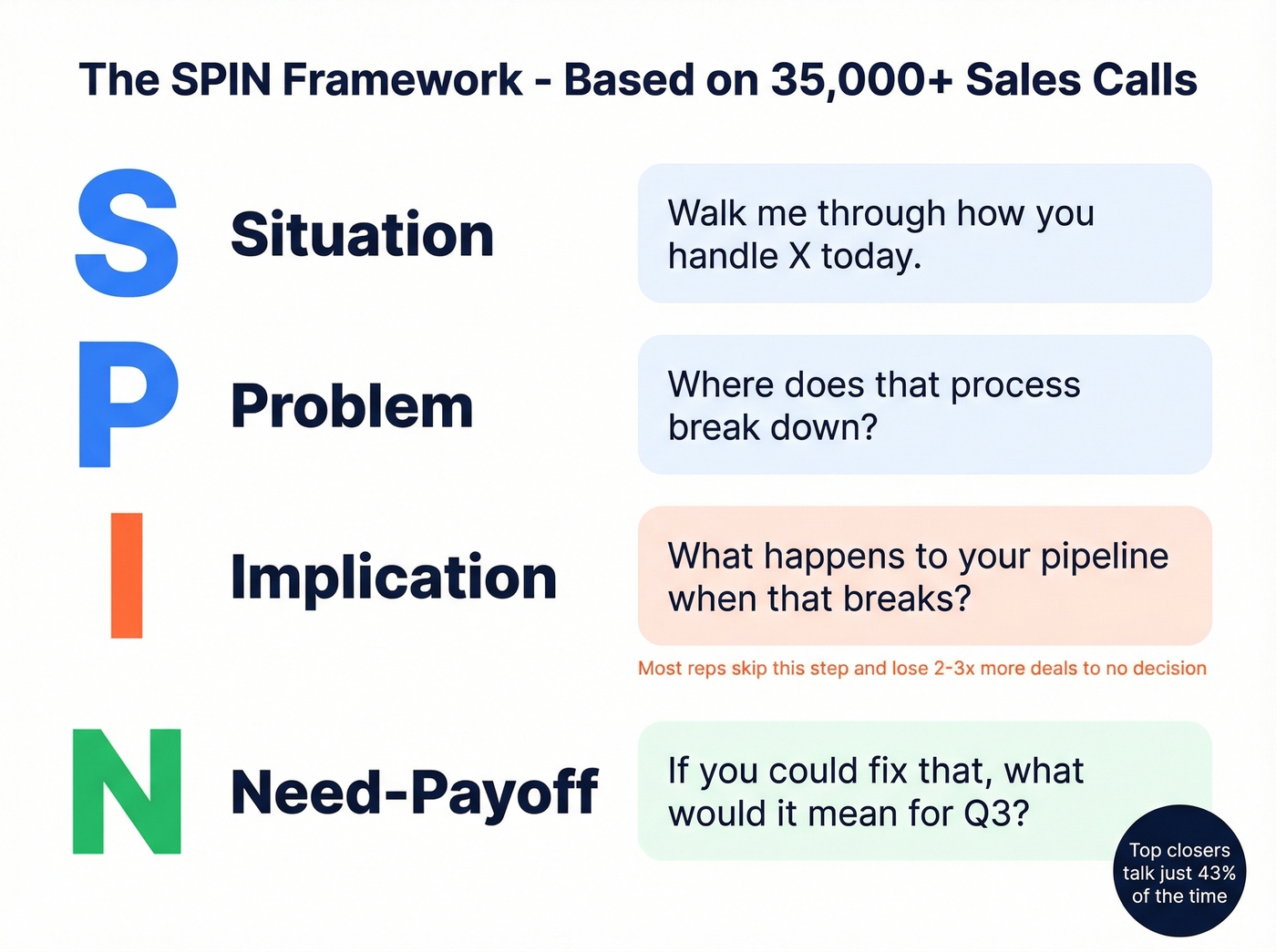
- Situation: Understand their current state. "Walk me through how you're handling X today."
- Problem: Surface pain. "Where does that process break down?"
- Implication: Make the pain expensive. "What happens to your pipeline when that breaks?"
- Need-Payoff: Let them sell themselves. "If you could fix that, what would it mean for Q3?"
The most common mistake is skipping implication questions. Reps hear a problem, get excited, and jump straight to their pitch. In our experience, reps who skip that step lose 2-3x more deals to "no decision" - the prospect thinks "yeah, that's annoying but not urgent," and the deal dies in committee. We've watched it happen over and over: a great discovery call, a solid demo, then radio silence because nobody felt the pain was worth the effort of changing vendors.
One benchmark to internalize: Gong's data shows top closers speak just 43% of the time on calls. Average reps hit 65%. Ask more, talk less.

You just read that 57% of the buying journey happens before a prospect talks to sales. That means your research phase has to be flawless - wrong email, wrong number, dead deal. Prospeo gives you 300M+ profiles with 98% email accuracy and 125M+ verified mobiles, refreshed every 7 days. Know your buyer and actually reach them.
Stop losing deals to bad contact data before your pitch even lands.
Seven Closing Scripts That Work
35% of salespeople say closing is the hardest part of the job. It gets harder when you remember that B2B deals involve 6-10 decision-makers on average - your close often needs to survive a committee, not just one conversation. But most of the difficulty comes from not having the words ready.
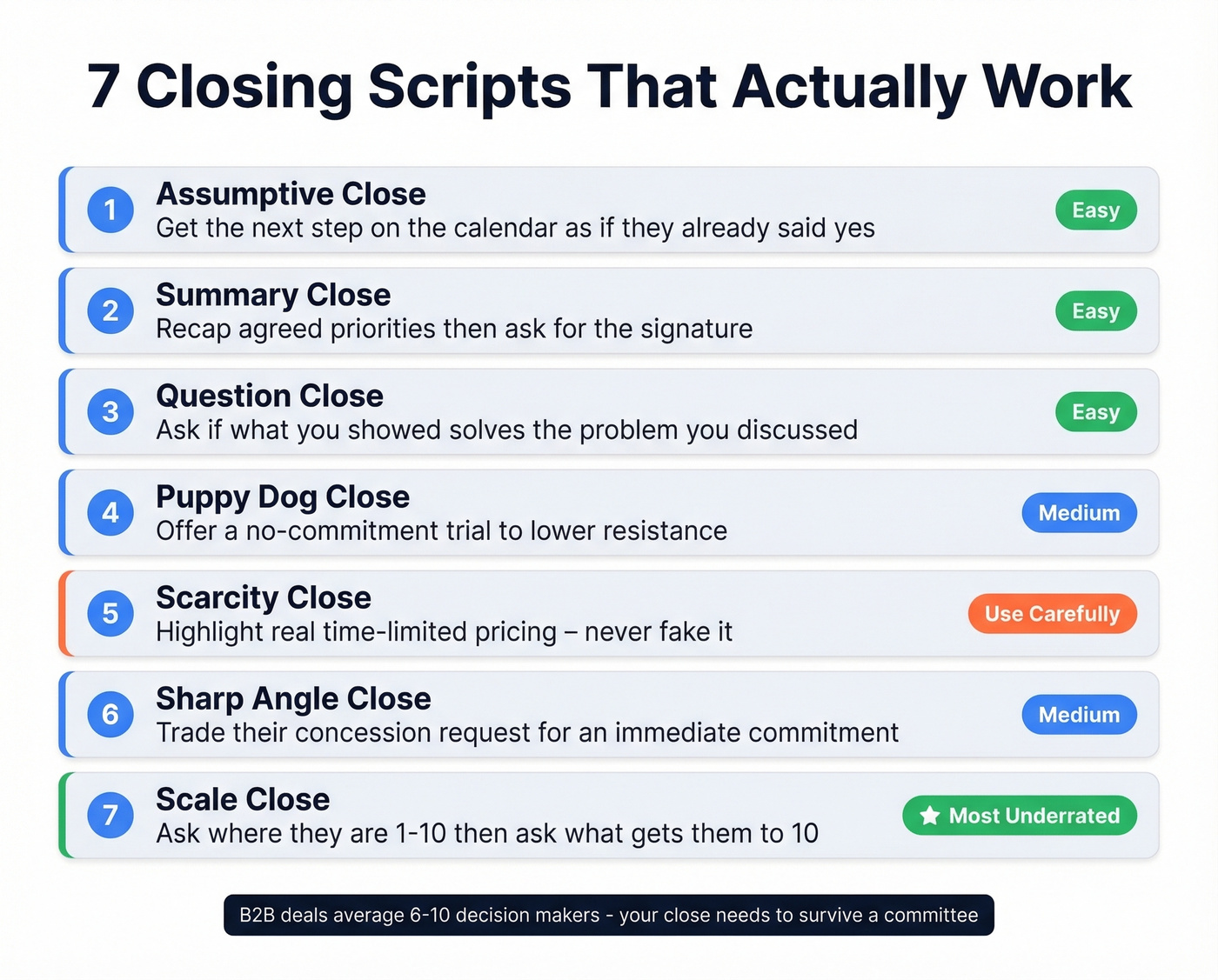
Assumptive close: "Let's get your onboarding kickoff on the calendar. Does Tuesday or Thursday work better?"
Summary close: "We've agreed that [outcome A], [outcome B], and [outcome C] are the priorities. The plan hits all three - should I send the agreement?"
Question close: "In your opinion, does what I've shown you solve the problem we discussed?"
Puppy dog close: "Try it for 14 days - no commitment, no credit card. If it doesn't work, we part as friends." This low-stakes approach lowers resistance while keeping momentum on your side.
Scarcity close: "This pricing is locked through the end of the month. After that, it goes up 15%." Never fake scarcity. Buyers can smell it, and you'll lose trust permanently.
Sharp angle close: "If I can include [their concession], are you prepared to sign today?"
Scale close: "On a scale of 1 to 10, how close are you to moving forward?" Then: "What would it take to get to a 10?"
The scale close is the most underrated technique on this list. It surfaces hidden objections without making the conversation adversarial, and it works on committees - ask each stakeholder separately and you'll map exactly where resistance lives.
Follow Up or Lose the Deal
48% of sales teams never attempt a single follow-up after initial contact, and 44% of reps give up after one follow-up. Meanwhile, 80% of sales require roughly 5 follow-up calls after the initial meeting, and 60% of customers say "no" four times before saying yes.
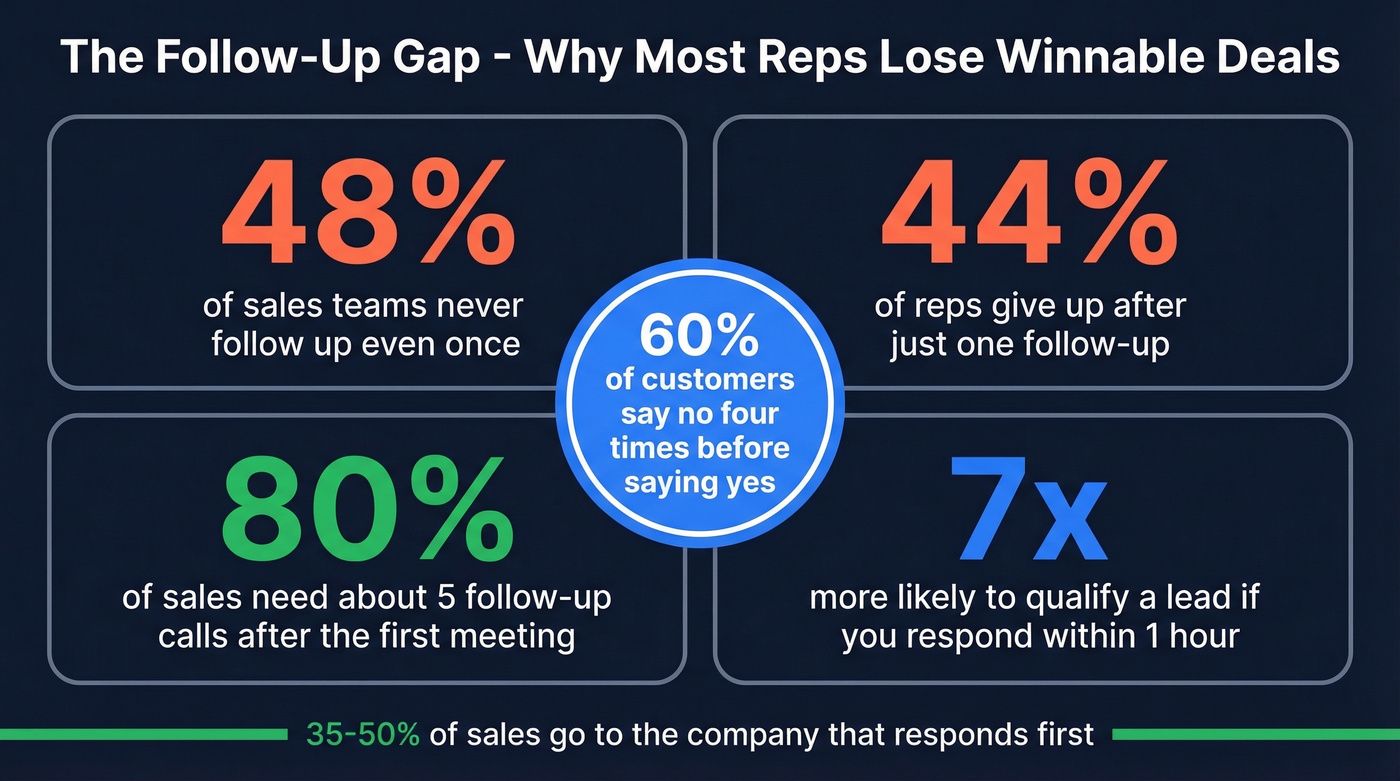
Let's be honest: those numbers are embarrassing for the profession. The majority of deals require persistence that the majority of reps simply don't have.
Speed matters too. Contacting a lead within one hour makes you 7x more likely to qualify them versus waiting 24 hours, and 35-50% of sales go to the company that responds first. Your follow-up cadence is the single highest-leverage activity in your entire sales process - more than your pitch, more than your demo, more than your pricing page.
The patience part: 63% of people requesting information won't buy for at least 3 months. Your job isn't to close them on the second email. It's to stay relevant until they're ready. That only works if you're reaching the right person with verified contact data, so your persistence hits real inboxes instead of bouncing into a void.
Three Easiest Sales You Can Make Today
If you need revenue this week, skip cold outreach. Start with people who already know you.
| Client Type | Script Opener | Expected Response | Best Channel |
|---|---|---|---|
| Satisfied (upsell) | "We just launched [feature] that companies like yours use to boost [metric] 10-30%. Can I walk you through it?" | 30-40% reply rate | Email or call |
| Referral (intro) | "Do you know anyone in [industry] who might benefit? A quick intro email with a CC would be perfect." | 15-25% intro rate | Call then email |
| Dormant (reactivation) | "It's been a while. A lot has changed on our end - worth a quick call?" | 20-30% reply rate | Email sequence |
These categories convert at dramatically higher rates than cold outreach because trust already exists. If you're ignoring your existing customer base to chase strangers, you're leaving the easiest money on the table.
Unusual Tips That Move the Needle
Not every effective approach comes from a textbook. Some of the best unconventional tactics are backed by behavioral psychology, even if they sound counterintuitive:
Lead with a concession. Tell the prospect what your product doesn't do well before they ask. Radical honesty triggers reciprocity and builds trust faster than any pitch deck. I once watched a rep open a demo by saying "We're terrible at X, so if that's your top priority, I'll save you 30 minutes." The prospect laughed, relaxed, and signed a six-figure deal two weeks later.
Send a breakup email early. Instead of waiting for silence, send a "Should I close your file?" message after the third follow-up. It creates urgency without pressure, and reply rates often spike 30-40%.
Mirror their exact words. When a prospect says "we need to streamline onboarding," don't rephrase it as "optimize your workflow." Use their language verbatim - it signals you actually listened.
These tactics won't replace a solid process, but layered on top of the 7-stage framework above, they give you an edge in conversations where every rep sounds the same.
Conversion Benchmarks - What "Normal" Looks Like
Before you panic about your numbers, here's what normal actually looks like, based on FirstPageSage's multi-year funnel analysis and Ruler Analytics' study of 100M+ data points:
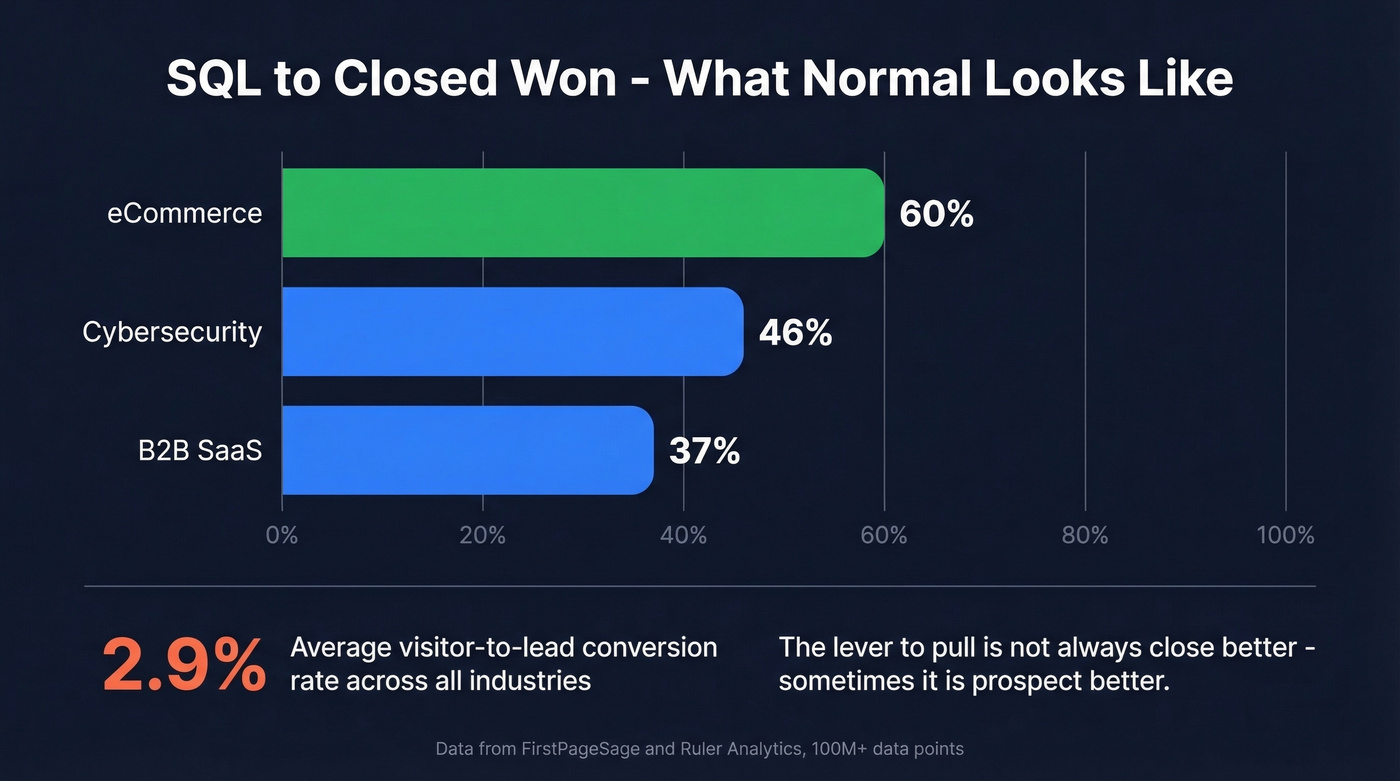
| Industry | SQL to Closed Won |
|---|---|
| B2B SaaS | 37% |
| eCommerce | 60% |
| Cybersecurity | 46% |
Across all industries, the average visitor-to-lead conversion rate sits at 2.9%. If you're near that number, you're average - not failing. The lever to pull isn't always "close better." Sometimes it's "prospect better" so you're closing warmer leads.
The Step Everyone Skips - Data Quality
You sent 200 cold emails and got zero replies. Before you blame your pitch, check your list.
We've watched this pattern play out dozens of times: a team invests in scripts, cadences, and training - then sends everything to outdated email addresses. Bounces, spam folders, wrecked sender reputation. Meritt, a sales agency, was stuck at a 35% bounce rate before switching to verified data. After cleaning their list, bounces dropped to under 4% and their pipeline tripled from $100K to $300K per week.
Prospeo fixes this upstream. With 143M+ verified emails run through a 5-step verification process - catch-all handling, spam-trap removal, honeypot filtering - you're sending to real inboxes. The free tier gives you 75 verified emails per month to test before committing a dollar. Skip this step if your list is already clean and your bounce rate is under 5%, but for everyone else, verification isn't optional. If you're troubleshooting bounces, start with bounce rate and then work backward through deliverability and sender reputation.
80% of sales need 5+ follow-ups, but every follow-up that bounces resets your count to zero and torches your domain reputation. Prospeo's 5-step email verification and catch-all handling keep your bounce rate under 4% - just like Meritt, who tripled their pipeline to $300K/week after switching. At $0.01 per email, persistence finally pays off.
Make all five follow-ups count with emails that actually deliver.
FAQ
How many follow-ups does it take to close a sale?
Most deals close between the 5th and 7th touchpoint. 80% of sales require at least 5 follow-up calls, yet 44% of reps quit after just one. Build a cadence with mixed channels - email, call, voicemail - and expect diminishing returns around the 6th-8th touch.
What's the best sales framework for beginners?
SPIN Selling, developed from 35,000+ sales calls across 12 years, gives beginners a repeatable question sequence that works in any industry. Focus on implication questions - they're where urgency gets created and where most new reps fall short.
How do I make sure my cold emails get delivered?
Verify your list before every send. Unverified lists routinely bounce at 20-35%, which tanks your domain reputation. A 5-step verification process delivering 98% email accuracy is the standard to aim for; free tiers from verification tools let you test without spending a dollar.
Do closing techniques work across industries?
Yes. The SPIN framework, the seven closing scripts above, and a disciplined follow-up cadence are industry-agnostic. Specific language changes, but the structure - research, question, present, close, follow up - works whether you're selling SaaS, consulting, or physical goods.