

How to Pitch to Decision Makers: The Full Playbook From Access to Close
You prepped for three days. Built a killer deck. Nailed the demo. Then the VP didn't show, a junior analyst took notes, and two weeks later you got the email: "We've decided to go in a different direction."
The pitch wasn't the problem. The audience was. Learning how to pitch to decision makers starts well before you open your slide deck - it starts with access.
Why Your Pitch Never Reaches the Right Person
If you want to sell effectively, the first problem to solve isn't your deck - it's getting in front of the person who signs the check. 86% of B2B purchases stall during the buying process, and the most common reason isn't a bad product or a weak pitch. It's that the pitch never reached the person with budget authority. Meanwhile, 83% of buyers have already defined their requirements before they ever speak with a salesperson, which means you're not just competing against other vendors - you're competing against a decision that's already half-made, delivered to someone who wasn't in the room.
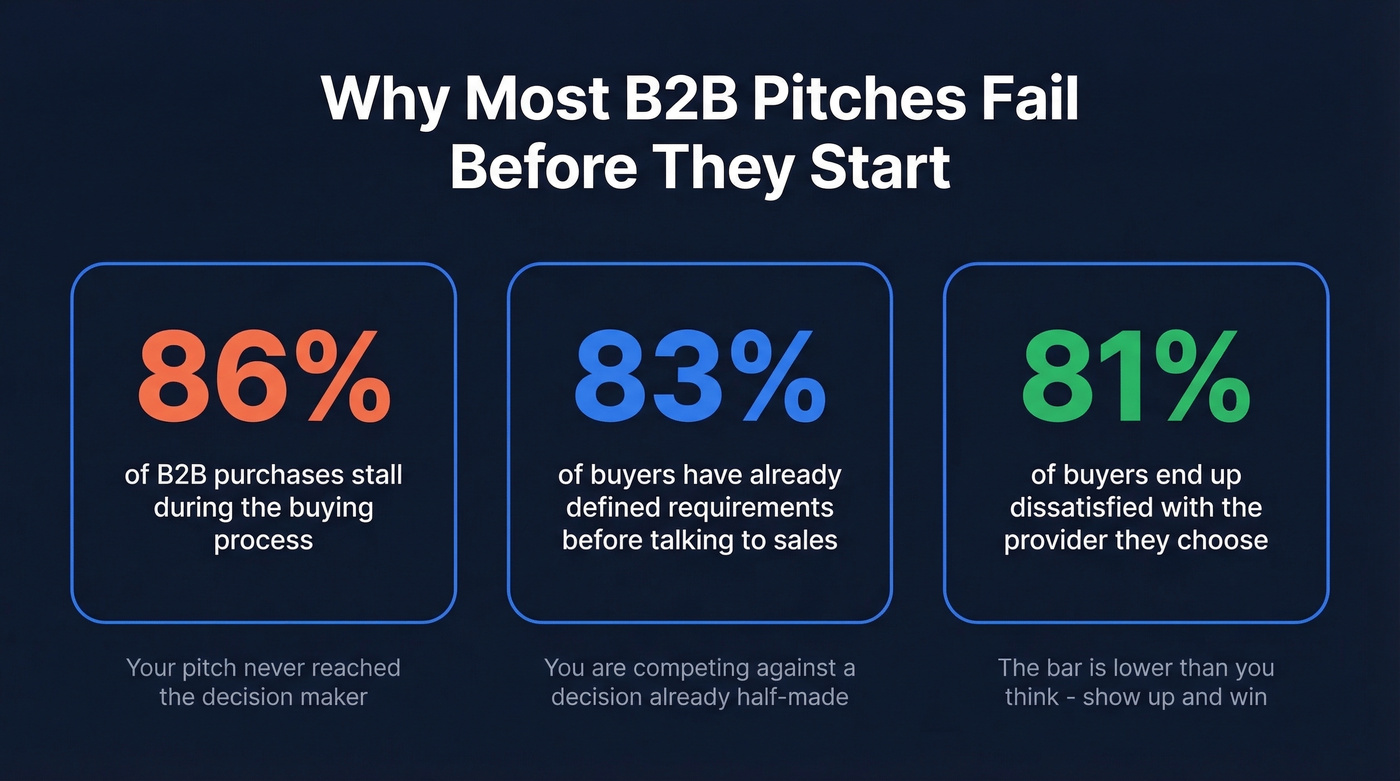
Here's the kicker: 81% of buyers end up dissatisfied with the provider they ultimately choose. The bar is lower than you think. If you can reach the right person and run a tight process, you're already ahead of most competitors.
Access matters more than polish. A mediocre pitch delivered to the right person beats a flawless pitch delivered to the wrong one, every single time. Let's fix both.
What You Need (Quick Version)
If you're short on time, three principles matter most:
- Reach the actual decision maker, not their proxy. Use direct mobile numbers and verified emails to skip gatekeepers entirely. If you're pitching to someone who "needs to run it by their boss," you haven't started selling yet.
- Open with their problem and its cost, not your company story. Buyers have already defined requirements before talking to you. They don't need your origin story - they need to know you understand theirs.
- Leave 50% of the meeting for questions. The best pitches feel like conversations, not presentations. Executives value dialogue over monologue.
How to Actually Reach the Decision Maker
Most deals die before the pitch happens. Not because the seller couldn't present, but because they never got the right person on the call.
Reframe How You Think About Gatekeepers
Gatekeepers - executive assistants, receptionists, junior team members screening calls - aren't obstacles. They're internal risk managers. They protect their boss's time because that's literally their job. Pushy behavior gets remembered and shared internally, and it poisons the account before you ever get a shot.
When you do encounter a gatekeeper, a few tactics consistently work. Use the decision maker's first name - it signals an existing relationship. Call outside normal business hours when assistants aren't screening. And always have a reason for the call beyond "I'd love to chat." Something like "I'm following up on an email I sent Tuesday about [specific problem]" gives the gatekeeper a reason to put you through.
But the real move is asking the qualifying question early. When you're talking to anyone who isn't the final decision maker, say this:
"Who else needs to be part of this conversation so that when we get to recommendations, we're not starting over?"
That one question, adapted from ChannelPro's sales playbook, does two things. It surfaces the real buying committee, and it signals that you're a professional who respects their time.
The Better Path: Go Direct
The fastest way to bypass gatekeepers is to skip them entirely. Call the decision maker's mobile or email them directly. This isn't a hack - it's the standard playbook for serious outbound today.
Think about what you're up against: many executives receive an estimated 20,000+ vendor emails per year. The main line and the info@ inbox are black holes. Direct mobile and verified email are the only channels that consistently break through.
We've seen this play out across thousands of outbound campaigns. Prospeo's database covers 125M+ verified mobile numbers with a 30% pickup rate, plus 143M+ verified emails at 98% accuracy. Search by seniority, department, and company size using firmographic filters and 30+ filters, find the VP or C-level contact you actually need, and reach out directly. No gatekeeper, no "I'll pass along your message," no waiting.
Know Your Buying Committee
Even when you reach the decision maker, they're rarely deciding alone. In healthcare tech buying, one Gartner-cited benchmark puts it at 87% of decisions involving 2-7 buyers, and in enterprise deals, that number often stretches to 6-10 stakeholders. The CFO is involved in over half of purchase decisions. You need to know who's in the room - and what each person cares about.
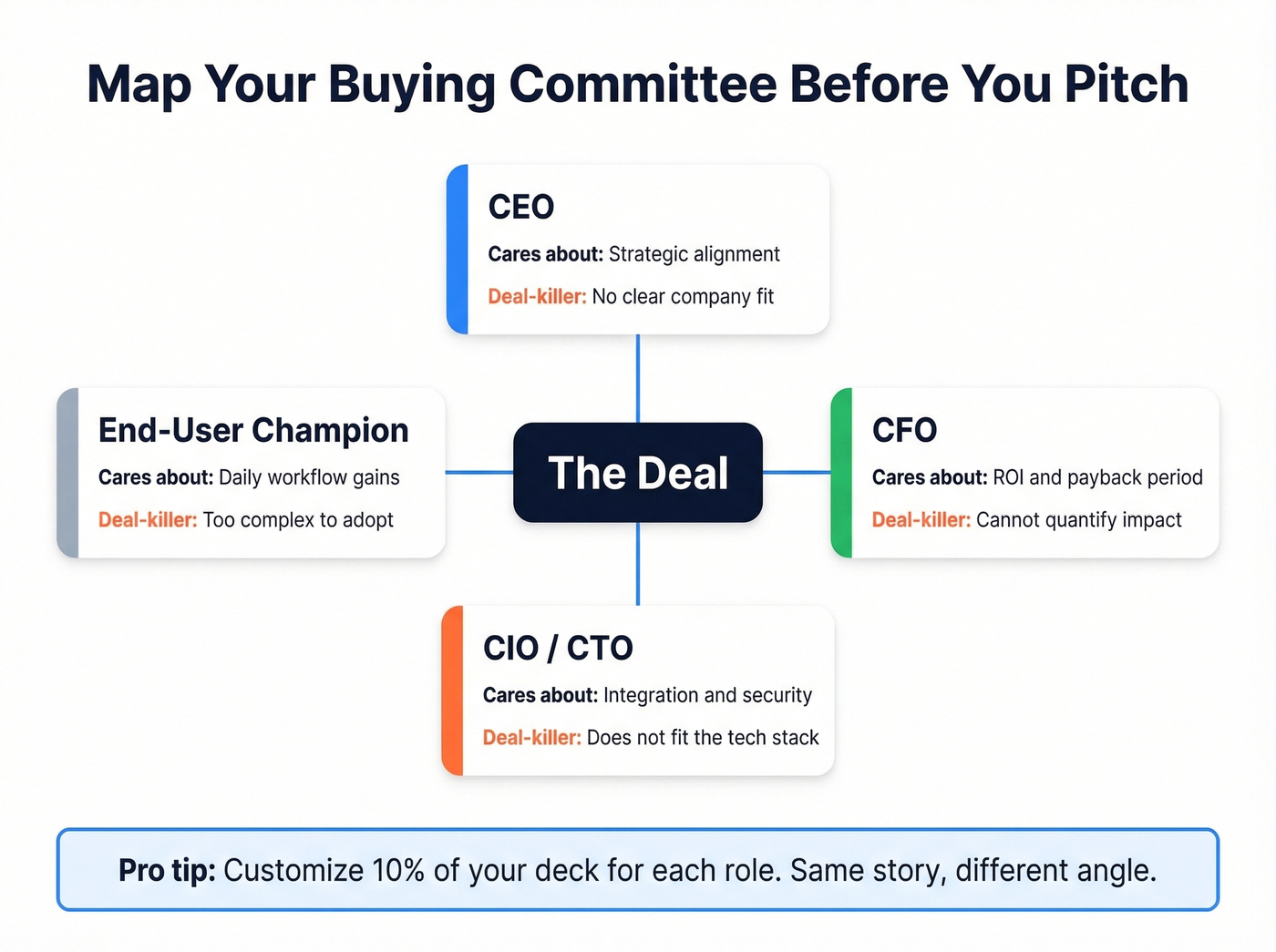
| Role | Primary concern | Deal-killer |
|---|---|---|
| CEO | Strategic alignment | No clear company fit |
| CFO | ROI, payback period | Can't quantify impact |
| CIO/CTO | Integration, security | Doesn't fit the stack |
| End-user champion | Daily workflow gains | Too complex to adopt |
The CFO row deserves extra attention. If you can't show a payback period under 12 months with hard numbers, expect the deal to stall in finance review. The CIO/CTO row is equally dangerous - "doesn't fit the stack" is code for "this creates more work for my team," and no executive will champion a tool that makes their engineers' lives harder.
The mistake most reps make is pitching the same story to every stakeholder. Your CEO pitch should center on competitive advantage and strategic direction. Your CFO pitch needs hard numbers - payback period, cost savings, revenue impact. Your CIO pitch should address integration complexity and security posture. Keep 90% of your deck standardized and customize the remaining 10%: the company-specific slide, the relevant case study, the tailored ROI calculation.
94% of buyers now use LLMs during their buying process. That means your decision maker has probably already asked ChatGPT about your category before you walk in the room. If your pitch repeats what an AI summary would say, you've added zero value. The bar for insight is higher than it's ever been.

Your pitch is only as good as the person hearing it. Prospeo gives you direct access to 125M+ verified mobile numbers (30% pickup rate) and 143M+ emails at 98% accuracy - filtered by seniority, department, and company size. Skip the gatekeeper. Call the VP directly.
Find the decision maker's direct number in seconds, not weeks.
How to Structure Your Pitch for C-Suite Audiences
The First 60 Seconds
In a classroom exercise by Chip Heath at Stanford, 63% of students remembered stories from presentations, but only 5% remembered a single data point. Your opening slide full of market-size numbers? Nobody remembers it. The story about a customer who was bleeding $200K/quarter on a broken process? That sticks.
Sabina Nawaz's Harvard Business Review framework identifies four traps when presenting to the C-suite. The first is presenting an idea without its problem - jumping straight to your solution before the executive understands why they should care. The third is delivering a presentation without interaction, which is why Nawaz recommends leaving 50% of your allotted time for questions.
The first 30 seconds should sound something like this:
"Your sales team is spending 6 hours a week on manual prospecting. That's 300 hours a month across 50 reps - roughly $180K in loaded salary cost going to data entry instead of selling. We've helped companies like [similar company] cut that to under an hour. I'd love to show you how, but first - is that consistent with what you're seeing?"
Notice the structure: problem, cost of the problem, bridge to your solution, then an immediate question. You're not presenting. You're starting a conversation.
The Six-Step Framework
Once you've earned the room's attention, follow this structure:
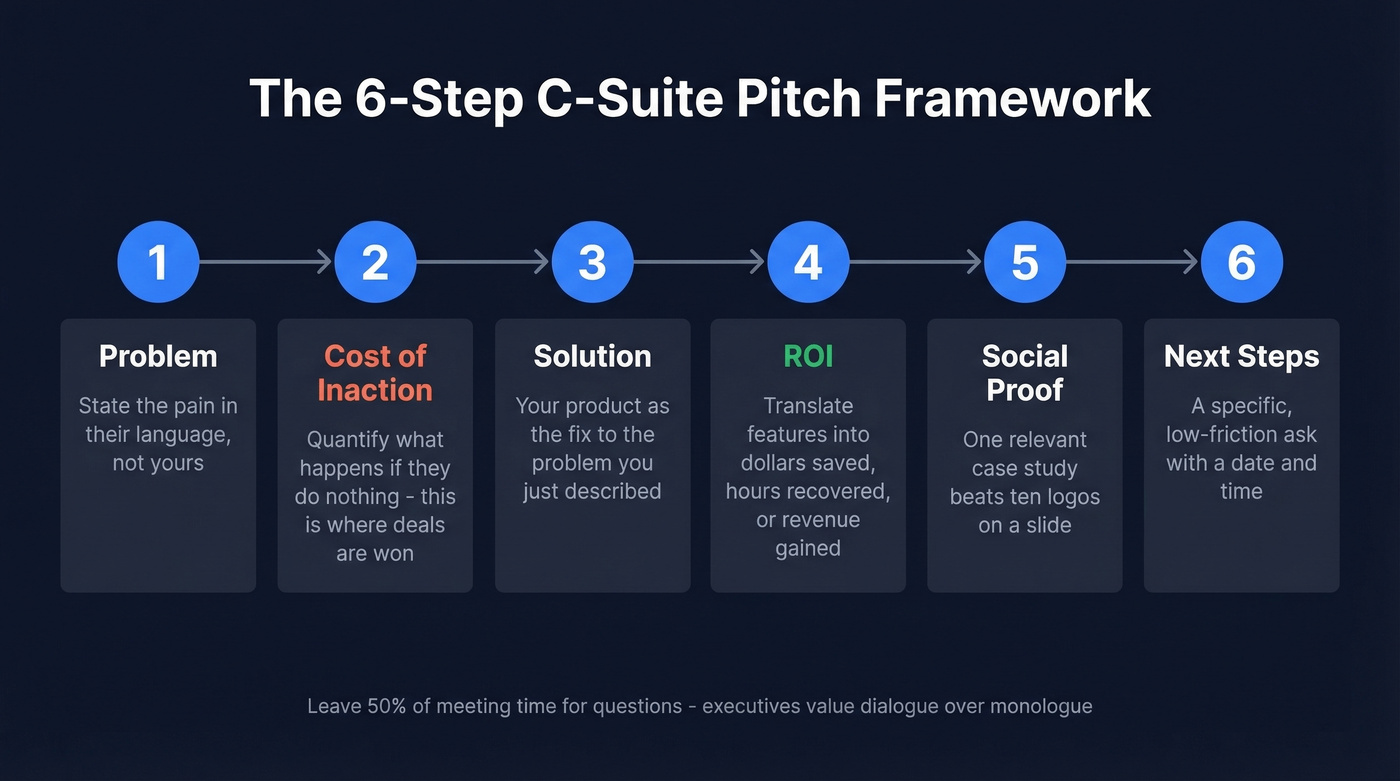
- Problem - State the specific pain in their language, not yours.
- Cost of inaction - Quantify what happens if they do nothing. This is where deals are won.
- Solution - Your product, positioned as the fix to the problem you just described.
- ROI - Show how the solution pays for itself. Use their numbers when possible. Nawaz's second trap - presenting an idea without clear ROI - is why this step matters most. Strong ROI messaging for executive buyers means translating features into dollars saved, hours recovered, or revenue gained. Skip it and you'll lose the CFO before you finish the sentence.
- Social proof - One relevant case study beats ten logos on a slide.
- Next steps - A specific, low-friction ask. "Can we schedule a 30-minute technical review with your team next Tuesday?" beats "Let us know if you're interested."
Your Deck Needs to Sell Without You
That 83% stat means your deck is probably being forwarded, screenshotted, and reviewed by people who weren't in the meeting. It needs to work asynchronously.
Build in an FAQ slide that pre-handles the three most common blockers: security, integration, and pricing. Include a team-by-team benefits breakdown - what Finance gets, what IT gets, what end users get. This approach, highlighted in Pitch.com's analysis of effective sales decks, ensures every stakeholder who reads the deck sees themselves in it.
If you want a tighter narrative arc, sales deck storytelling is the skill that makes executive decks land.
Arm Your Internal Champion
Most deals don't die in the pitch meeting. They die afterward, when your champion tries to relay your value proposition to the CFO in a two-sentence Slack message.
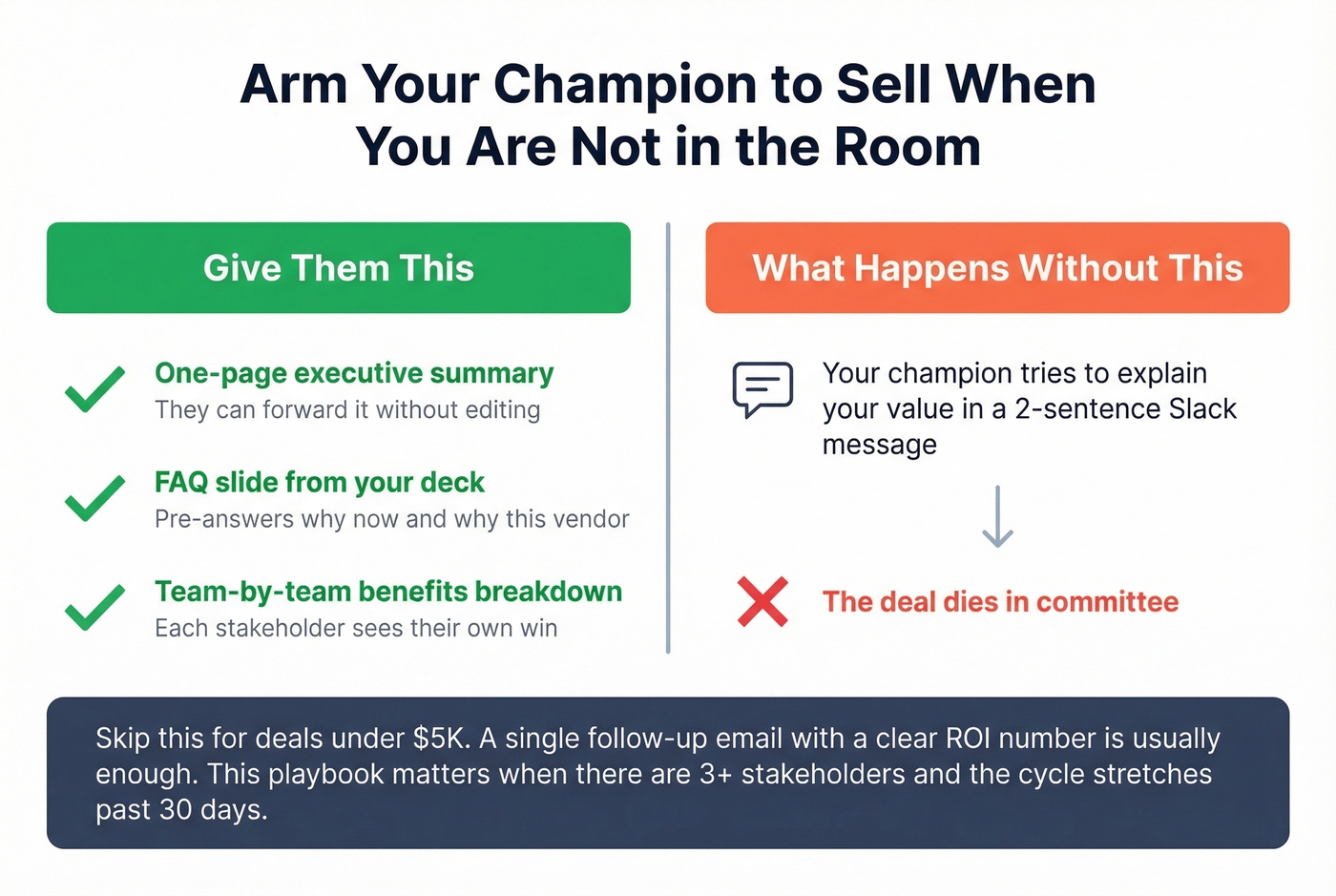
We've watched this happen dozens of times in our own sales process, and the consensus on r/sales backs it up: if your champion can't articulate your value in 30 seconds, the deal is dead. Give them the tools to sell when you're not in the room.
Give them this:
- A one-page executive summary they can forward without editing
- The FAQ slide from your deck, pre-answering "why now" and "why this vendor"
- A team-by-team benefits breakdown so each stakeholder sees their win
Skip this if you're selling a sub-$5K deal. For smaller transactions, a single follow-up email with a clear ROI number is usually enough. The champion-arming playbook matters most when there are 3+ stakeholders and the deal cycle stretches past 30 days.
If you're building a repeatable process for this, sales enablement is what keeps the champion toolkit consistent across reps.
The article says it clearly: 86% of deals stall because pitches never reach the right person. Prospeo's 30+ search filters - including job title, seniority, department headcount, and buyer intent - let you map the entire buying committee before your first outreach. At $0.01 per email, building your contact list costs less than the coffee you'll drink preparing the pitch.
Map the buying committee before your competitor even finds the gatekeeper.
Handle Objections Without Losing the Room
Nawaz's fourth trap is relevant here: data without attention to detail. If an executive asks a question and you don't know the answer, don't guess. Say "I want to give you an accurate number - let me follow up by end of day." That builds more trust than a confident wrong answer ever will.
The best objection handlers use a "yes, and" technique - acknowledge the concern as valid, then redirect to new information. Three objections you'll hear in almost every executive pitch:
"We're happy with our current vendor." They're not asking you to leave. They're testing whether you've done your homework. Respond: "That makes sense - [vendor] is solid. Most of our customers used them too. The shift usually happens when [specific trigger, e.g., 'bounce rates start creeping above 10%' or 'the team outgrows the reporting']. Is that something you've noticed?"
"This isn't a priority right now."
Translation: you haven't connected the problem to something they're measured on. Respond: "Totally fair. Can I ask - what is the top priority this quarter? Because [problem your product solves] usually ties directly to [their likely priority]. Let me show you how."
"I need to run this by my team." This is the champion relay problem in real time. Respond: "Absolutely. Would it help if I put together a one-page summary your team can review? I can include the ROI numbers we discussed and an FAQ that addresses the technical questions they'll probably have."
If objections are a recurring pattern, it usually points to qualification gaps - tighten your discovery questions before you ever present.
The Follow-Up That Gets Replies
The follow-up is where most reps drop the ball. "Just checking in" emails get deleted. Every single time.
Here's the cadence that works:
Same day: Send a recap email within 2 hours. Restate the problem they described in their words, the ROI number you discussed, and one clear next step.
Day 3: Share something valuable - a relevant case study, a benchmark report, or a short video that addresses a concern they raised.
Day 7: Direct check-in with a specific ask. "Are you available Thursday at 2 PM for the technical review we discussed?" Not "just wanted to circle back."
Every follow-up should reference something specific from the conversation. Generic templates signal that you weren't listening. I can't stress this enough: if you can't remember what the executive said was their biggest challenge, you weren't paying attention during the meeting, and no follow-up template will save you.
If you want plug-and-play language, use these sales follow-up templates and adapt them to the exec's exact words.
For more on building outbound sequences that actually get opened, check out our guide to cold email deliverability.
FAQ
How do you identify the real decision maker?
Map the buying committee early by asking: "Who else needs to be part of this conversation so we're not starting over?" Look for titles with budget authority - VP and above in most orgs. Prospeo's B2B database lets you filter by seniority and department across 300M+ profiles to find the right contact before your first outreach.
What's the biggest mistake when pitching to executives?
Opening with your company's story instead of their problem. Executives don't care about your founding year or feature list - they care about the cost of the pain they're facing. Lead with a quantified problem statement, back it with a dollar figure, then bridge to your solution.
How long should a pitch to a decision maker be?
Keep your presentation to half the allotted time. If you have 30 minutes, present for 15 and leave 15 for questions. Nawaz's HBR research recommends 50% Q&A time. Executives value dialogue over monologue - the conversation is the pitch, not the slides.
Should you send a deck before or after the meeting?
Both. Send a concise pre-read the day before so the executive arrives informed. After the meeting, send the full deck with an FAQ slide and team-by-team benefits breakdown - this is what gets forwarded internally to stakeholders who weren't in the room.
How do you get past gatekeepers to reach executives?
Call direct mobile numbers to bypass gatekeepers entirely, reach out outside normal business hours when assistants aren't screening, and use the executive's first name to signal familiarity. Going direct is faster and more reliable than working through a switchboard - and it's how most high-performing outbound teams operate today.
Access is the whole game. A flawless pitch to the wrong person is a wasted pitch. Get to the decision maker, open with their problem, leave room for conversation, and arm your champion to sell when you're not in the room. That's how to pitch to decision makers - and it's the only playbook that consistently closes.
If you need more top-of-funnel volume to create those executive conversations, start with sales prospecting techniques and build a system you can run every week.