

How to Reduce No-Shows in Sales (2026 Playbook)
It's 2:03 PM. You're staring at an empty Zoom room, cursor blinking on a slide deck you spent 45 minutes customizing. The prospect who confirmed yesterday is gone - no message, no reschedule, just silence.
The standard no-show rate sits around 20%. One in five carefully booked meetings evaporates before a single word is exchanged. And buyers spend only 17% of their total buying time meeting with potential suppliers, so you're fighting for a sliver of their calendar - and losing.
Here's what makes it sting: the prep time, the pipeline that looked real but wasn't, the opportunity cost of a rep sitting idle when they could've been working a deal that actually closes. Every missed meeting compounds. Across a quarter, across a team, the damage is enormous - and almost entirely preventable. We've watched teams cut their no-show rate in half with changes that took a single afternoon to implement. This playbook breaks down exactly how.
Three Changes That Move the Needle Fastest
If you're short on time, start here:
- Stop booking meetings more than 2 weeks out. Priority drift kills attendance. The longer the gap, the more likely something "comes up."
- Add a confirmation step that requires a reply. A calendar accept isn't commitment. A typed response is.
- Switch your same-day reminder to SMS. Email open rates hover around 20-32%. SMS hits 98%. For the reminder that matters most, use the channel that actually gets seen.
One diagnostic before you go deeper: if your no-show rate is above 25%, skip straight to the lead quality section below. Your problem isn't reminders - it's who you're booking meetings with.
What's a Normal No-Show Rate?
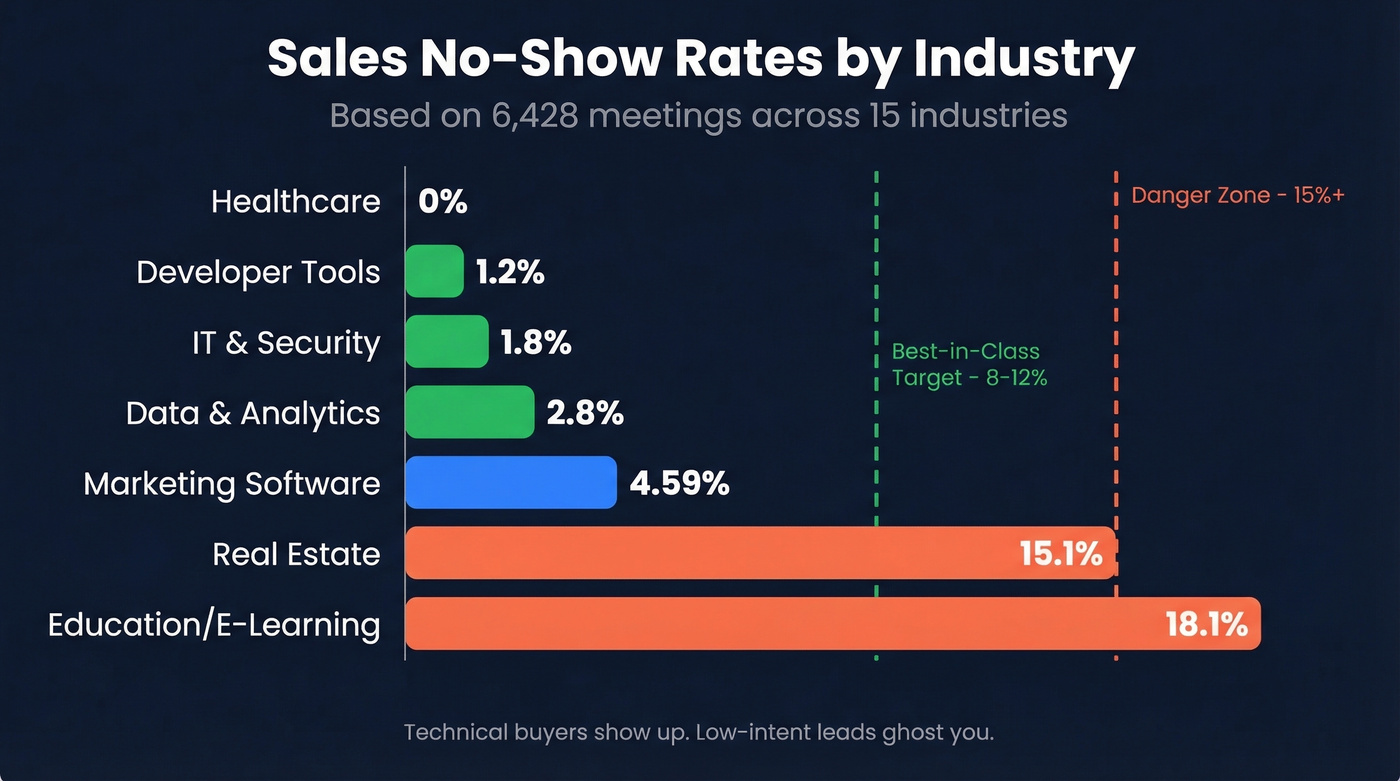
The answer depends on what you sell and who you sell it to. RevenueHero analyzed 6,428 meetings across 15 industries and found an overall no-show rate of 6.5% - 419 no-shows representing roughly 209.5 hours of lost sales time. That average hides massive variance:
| Industry | Meetings | No-Shows | No-Show Rate |
|---|---|---|---|
| Healthcare | 179 | 0 | 0% |
| Developer Tools | 241 | 3 | 1.2% |
| IT & Security | 395 | 7 | 1.8% |
| Data & Analytics | 318 | 9 | 2.8% |
| Marketing Software | 522 | 24 | 4.59% |
| Real Estate | 714 | 108 | 15.1% |
| Education/E-Learning | 425 | 77 | 18.1% |
The pattern is clear: technical buyers show up. Healthcare, dev tools, IT security - these are people evaluating solutions to specific, urgent problems. Education and real estate, where leads are often earlier in their journey or less technically motivated, see dramatically higher rates.
Best-in-class teams keep their rate between 8-12%. Below that, your process is working. Above 15%, something structural is broken - and more reminders won't fix it.
The Real Cost of Missed Meetings
Let's run the math. Say your team books 100 B2B sales appointments a month with a 25% meeting-to-SQL conversion, a 20% close rate, and a $20K average deal. At a 65% attendance rate, that's 65 meetings, 16.25 SQLs, 3.25 closed deals, $65K/month. Improve attendance to 80% and you get 80 meetings, 20 SQLs, 4 closed deals, $80K/month.
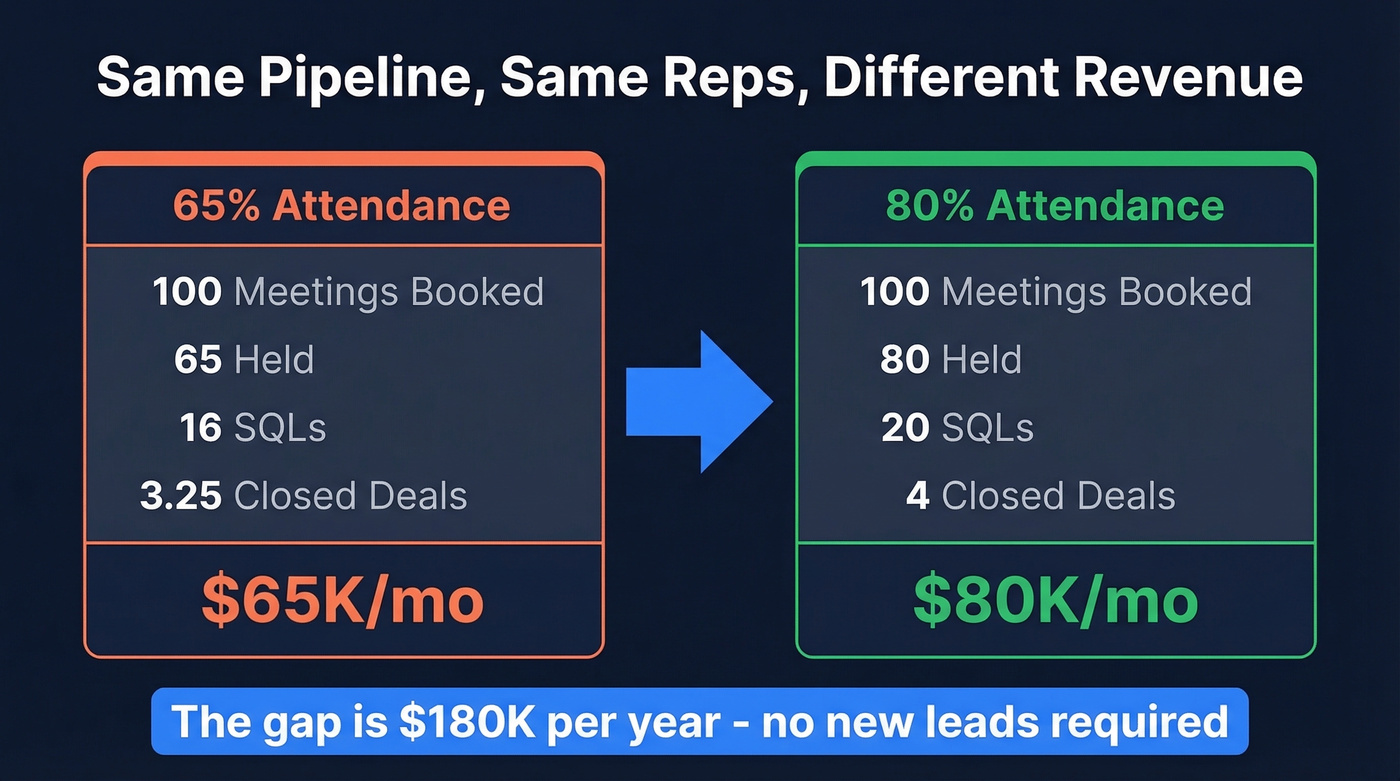
The delta is $15K/month - $180K/year - from the same pipeline, the same reps, the same product. No new leads required.
Every no-show isn't just an empty Zoom room. It's phantom pipeline that was never real, and it's the kind of leak that quietly destroys a quarter before anyone notices.
Why Prospects Ghost (and How to Fix It)
Low-Intent Leads Booked Too Easily
Booking a meeting with someone who said "sure, whatever" to end your cold call isn't pipeline - it's theater. If your booking flow has zero friction - click a link, pick a time, done - you'll fill calendars with people who had no real intent to begin with.
The fix isn't fewer meetings. It's better-qualified meetings. A prospect who answers two qualifying questions before seeing your calendar link is dramatically more likely to show up than one who clicked a Calendly link in a mass email. This is where appointment setters earn their keep - qualifying intent before locking in a time slot, not just filling the calendar.
The Lead Source Problem
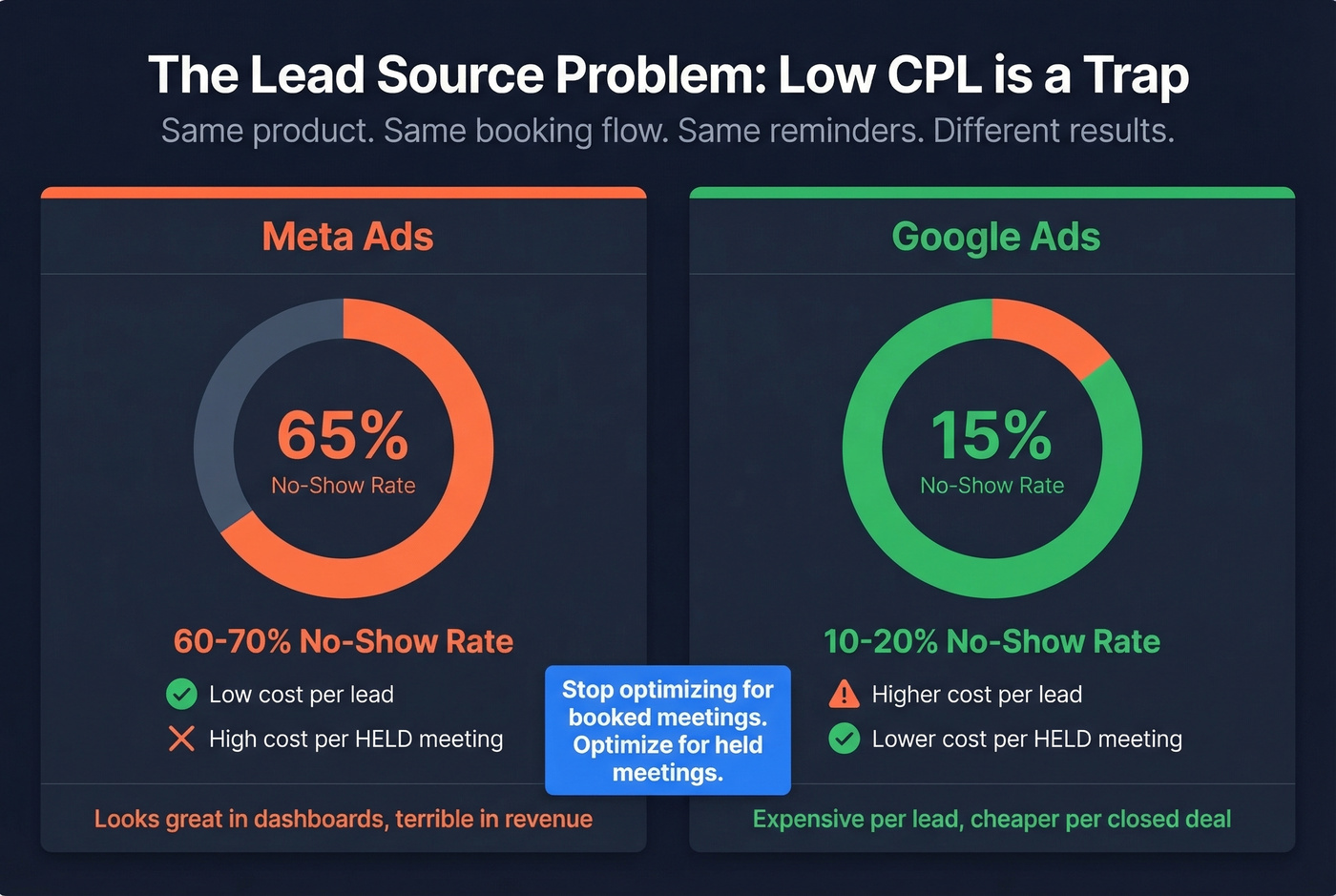
A practitioner on r/b2b_sales shared numbers that should make every demand gen leader pause:
| Channel | No-Show Rate | Effective Cost per Held Meeting |
|---|---|---|
| Meta Ads | 60-70% | Higher (despite low CPL) |
| Google Ads | 10-20% | Lower (despite higher CPL) |
Same product. Same booking flow. Same reminder sequence. The only variable was lead intent.
Low CPL from Meta feels great in a dashboard. But if seven out of ten demos ghost you, your cost per held meeting is actually worse than the "expensive" Google channel. We've seen this pattern repeatedly - teams optimize for booked meetings instead of held meetings, then wonder why pipeline doesn't convert. One cold outreach team we reviewed saw no-show rates drop from 40% to 15% after tightening their ICP targeting, without changing a single reminder.
Here's the thing: if your average deal size is under $15K, you probably shouldn't be running paid demo ads at all. The no-show math destroys your unit economics. Invest in content-driven inbound where the prospect self-qualifies before they ever see a booking link.
Bad Data Breaks Your Reminders
Your reminder cadence is only as good as your contact data. You can build the perfect four-touch sequence, but if prospect emails bounce and phone numbers are dead, your reminders never arrive. The prospect didn't ghost you - they never got your message.
Verify prospect emails and phone numbers before building your reminder workflow. Meritt, a B2B agency, switched to Prospeo for verification and saw their bounce rate drop from 35% to under 4%. That's the difference between a reminder cadence that works and one that's shouting into the void.

Seasonal Timing Kills Attendance
One factor teams consistently underestimate: no-shows during holidays spike dramatically. The weeks around Thanksgiving, Christmas, and even long weekends see attendance plummet as prospects mentally check out before their OOO auto-reply goes live. Plan lighter meeting blocks during holiday weeks and front-load your pipeline in the weeks before. Skip this if you're selling into industries with counter-cyclical buying patterns like tax software or year-end budget tools - those teams actually see spikes in December engagement.

Your reminder sequence is useless if emails bounce and phone numbers are dead. Prospeo verifies every contact through a 5-step process - 98% email accuracy, 125M+ verified mobiles, refreshed every 7 days. Meritt cut their bounce rate from 35% to under 4% and tripled their pipeline.
Stop sending reminders into the void. Verify every contact before you book.
Before, During, and After the Call
Before You Book - Add Friction
Gate your calendar link behind qualifying criteria. A short intake form - even two or three questions - filters out low-intent leads and creates psychological commitment. Ask about their timeline, current solution, and what they'd want from the call. If someone won't spend 90 seconds answering those questions, they weren't going to spend 30 minutes on your demo.
Don't send an open Calendly link in a cold email blast. Don't book calls more than two weeks out - longer lead times directly correlate with lower show rates. Outreach's data backs this up: opportunities closed within 50 days have a 47% win rate vs. roughly 20% beyond that threshold. Urgency matters at every stage. And avoid Monday mornings and Friday afternoons - those slots are a recipe for reschedules.
At Booking - Invites That Work
Your calendar invite is doing more work than you think. Most reps send a bare link with a generic title.
Use a title formula like "{Your Company} + {Their Company}: {Topic}" - not "Quick Chat" or "Intro Call." The body should include the purpose of the meeting, expected length, who's attending, one clear goal, and a reschedule link. If the invite isn't accepted within 24 hours, prepend "(Please Confirm:)" to the title and resend. An unaccepted invite is a no-show waiting to happen. Include a direct reschedule link - a prospect who reschedules is infinitely more valuable than one who silently disappears.
Before the Meeting - Reminder Cadence
Four touches is the sweet spot. In our experience, the 48-hour reminder is the one most teams skip - and it's the one that matters second-most after SMS.
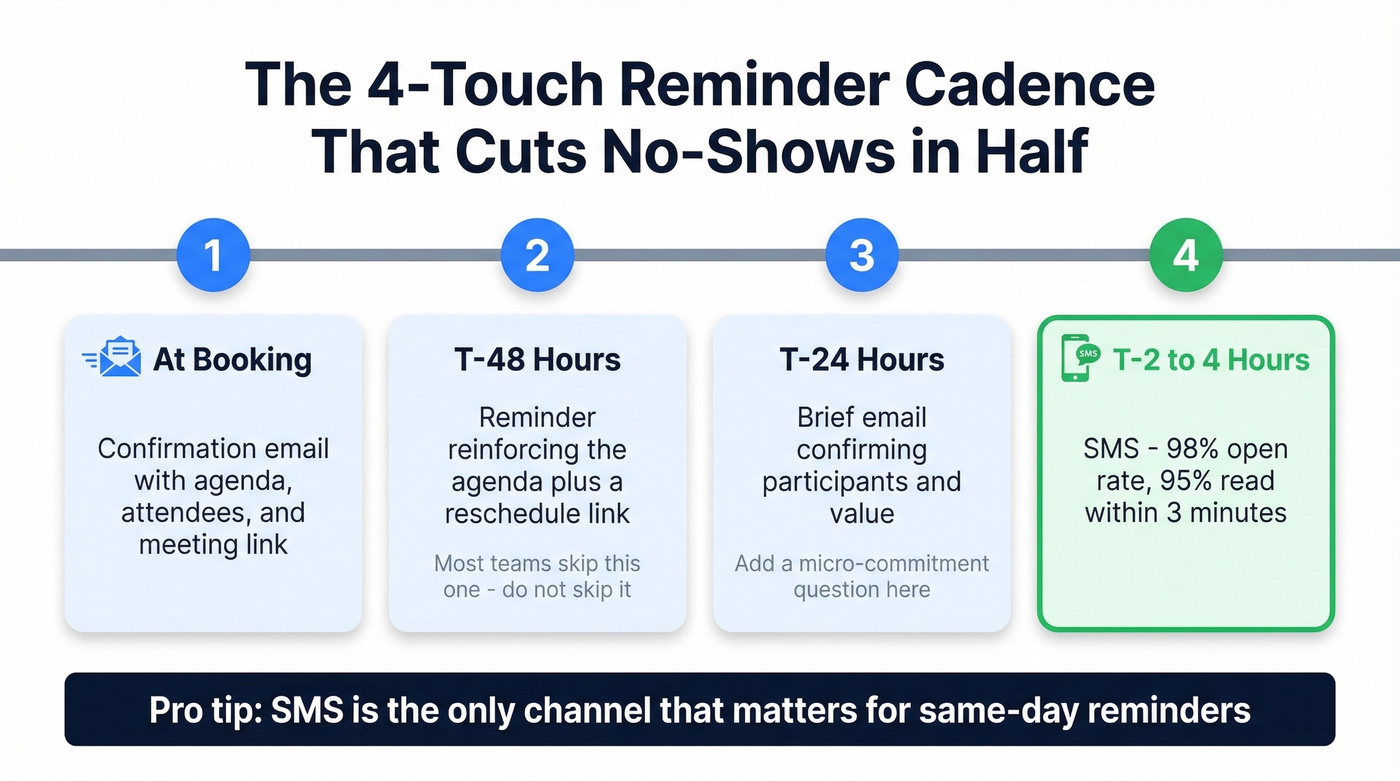
- Immediately after booking: Confirmation email with agenda, attendees, and meeting link
- 48 hours before: Reminder reinforcing the agenda plus a reschedule link
- 24 hours before: Brief email confirming participants and value
- 2-4 hours before: SMS - this is the one that matters most
Why SMS for the same-day touch? The numbers aren't close:
| Metric | SMS | |
|---|---|---|
| Open rate | 98% | 20-32% |
| Response rate | 45% | 6% |
| Read within 3 min | 95% | ~15% |
For the reminder closest to meeting time - the one where you need immediate attention - SMS is the only channel that matters. Gartner projects that 80% of B2B sales interactions will happen through digital channels. Your reminder strategy should already reflect that.
The Micro-Commitment Trick
Most reps are too afraid to try this. They're wrong. Before the meeting - ideally in your 24-hour reminder - ask a question that requires a real reply: "What's the one thing you'd want to walk away with from our call tomorrow?"
It forces engagement. The prospect has to think about the meeting, formulate a response, and type it out - three micro-commitments in 30 seconds. Psychologically, they've now invested. People don't skip things they've invested in. This single tactic can cut missed meetings more effectively than adding a fifth or sixth reminder touch.
When They Ghost - Recovery Protocol
They didn't show. Don't panic, don't guilt-trip, and don't wait until tomorrow.
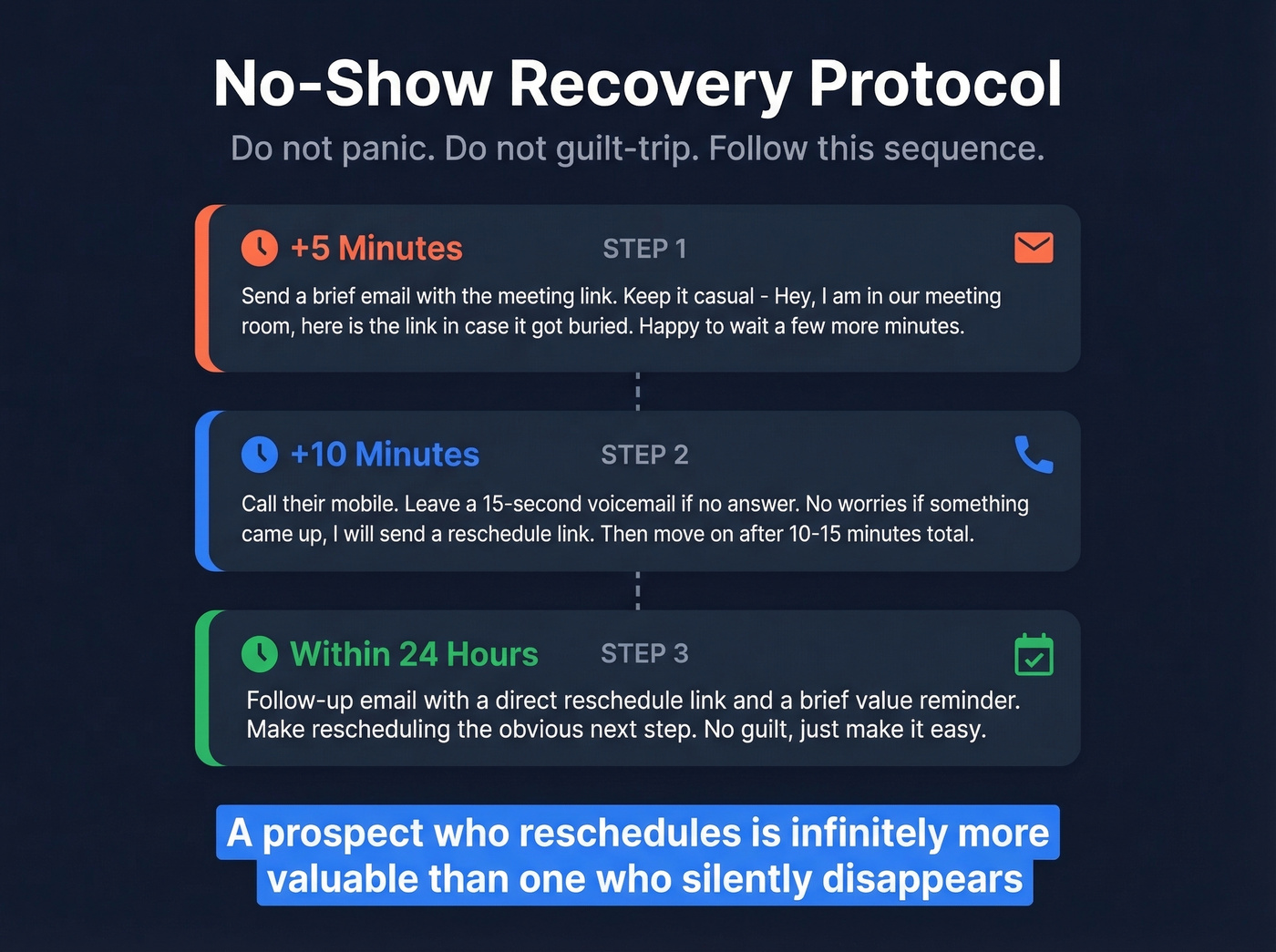
At 5 minutes past: Send a brief email. "Hey [Name], I'm in our meeting room - here's the link in case it got buried: [meeting_link]. Happy to wait a few more minutes." No passive aggression.
At 10 minutes past: Call their mobile. If voicemail, leave a 15-second message: "Hey [Name], it's [You] from [Company]. We had a call on the books - no worries if something came up. I'll send over a reschedule link. Talk soon." Give a 10-15 minute window before moving on.
Within 24 hours: Send a follow-up email with a direct reschedule link and a brief value reminder. Keep it polite, keep it short, and make rescheduling the obvious next step. No guilt. No "I noticed you missed our meeting." Just make it easy to rebook.
Copy/Paste Templates
Each template below reads in 20-30 seconds. Brevity signals respect for their time - which is the whole reason they no-showed in the first place.
Day-Before Reminder Email
Subject: Tomorrow: [Your Company] + [Their Company] - [Topic]
Hi [First Name],
Quick reminder - we're on for tomorrow at [Time] [Timezone]. Here's the meeting link: [Link]
We'll cover [one-sentence agenda]. If you need to move it, no problem - grab a new time here: [Reschedule Link]
See you tomorrow.
[Your Name]
Same-Day SMS Reminder
Hi [First Name], it's [Your Name] from [Company]. We're on at [Time] today - here's the link: [Link]. Looking forward to it! Reply RESCHEDULE if you need to move it.
Post-No-Show Follow-Up Email
Subject: Missed you today - let's reschedule
Hi [First Name],
Looks like we missed each other today. Totally understand - things come up.
I still think [one sentence of value prop] is worth 20 minutes of your time. Grab a slot that works better here: [Reschedule Link]
[Your Name]
Tools That Actually Help
You don't need a $50K tech stack to cut your no-show rate. Three categories matter.
Data verification is the foundation. If your reminders bounce, nothing else matters. Prospeo verifies emails at 98% accuracy with a 7-day data refresh cycle - the industry average is six weeks. It also provides 125M+ verified mobile numbers with a 30% pickup rate, which matters when your same-day SMS needs a real number on the other end. Free tier gives you 75 emails/month, paid plans start at roughly $0.01/email on a credit-based model, no contracts. If you're auditing deliverability end-to-end, start with bounce rate and work backward.
Scheduling and reminders come next. Calendly has a free tier with paid plans around $10-20/user/month and handles the basics well. Chili Piper runs around $30-60/user/month, is purpose-built for inbound sales, and has achieved outbound no-show rates under 5% with automated reminders. RevenueHero typically runs $15-30/user/month and is a strong mid-market option with solid routing and analytics.
SMS is the last piece. Most scheduling tools offer SMS reminders as an add-on or integration. If yours doesn't, Twilio or a simple Zapier workflow can trigger texts at the 2-4 hour mark for minimal cost. If you're building a multi-touch outbound motion, pair this with sales follow-up templates so reps don't improvise under pressure.
You just read that tighter ICP targeting dropped one team's no-show rate from 40% to 15%. Prospeo's 30+ filters - buyer intent, technographics, job changes, headcount growth - let you book meetings with prospects who actually have a reason to show up. At $0.01 per email, fixing lead quality costs less than a single no-show.
Book meetings with buyers who have a reason to attend, not just an open calendar slot.
FAQ
What's a good no-show rate for B2B sales?
Best-in-class teams maintain 8-12%. Healthcare and developer tools run near 0-1.2%, while education and real estate hit 15-18%. If you're consistently above 15%, your lead qualification - not your reminders - needs work.
How many reminders should I send before a sales call?
Four: immediate confirmation at booking, a 48-hour email, a 24-hour email, and a same-day SMS 2-4 hours before the call. This cadence balances persistence with professionalism - more than four feels pushy, fewer leaves gaps.
Does SMS actually reduce missed meetings?
SMS has a 98% open rate versus 20-32% for email and a 45% response rate versus 6%. For same-day reminders, nothing else comes close. Teams that switch their final touch to text consistently see 10-15% attendance improvements.
Can bad contact data cause no-shows?
Bounced emails and disconnected numbers mean your reminders never arrive. Meritt cut their bounce rate from 35% to under 4% after switching to verified contact data, which directly improved their show rates.
How should I handle holiday no-shows?
Holiday weeks consistently produce 20-40% higher no-show rates. Send an extra confirmation 72 hours out, reduce your meeting volume during known slow periods like Thanksgiving and year-end, and front-load pipeline into the weeks immediately before major holidays.