

How to Respond When a Prospect Says No - Scripts, Frameworks, and Follow-Up Plays
You just got through to a VP after 12 dials. You deliver your opener. They say "not interested" and you can hear them reaching for the phone. You have maybe three seconds.
Most rejections aren't final. [40-60% of deals](https://hbr.org/2022/06/stop-losing-sales-to-customer-indecision) don't die from rejection - they die from indecision, according to an analysis of 2.5 million recorded sales conversations. Meanwhile, [96% of prospects](https://blog.hubspot.com/sales/sales-statistics) research before they ever talk to a rep. The "no" you're hearing is a reflex, not a verdict.
Most guides stop at scripts. They never address why you're hearing "no" in the first place - wrong contacts, single-threaded deals, stale data. You need one framework, a handful of scripts by objection type, and a multi-channel follow-up cadence. Let's break it down.
Why Prospects Really Say No
About half of cold calls get stopped by some version of "not interested." That phrase almost never means what it says. It's loss aversion, status quo bias, or simply the need to feel in control.
Here's the thing: 71% of buyers prefer doing their own research over talking to a rep. When you cold-call someone, you're interrupting a person who'd rather be Googling. Their "no" is a reflex, not a conclusion - and understanding that distinction changes everything about how you respond.
Permission-based openers like "Mind if I tell you why I'm calling?" are rejection machines. They invite the no before you've said anything worth hearing. Stop doing this.
What to Do on a Live Call
Forget memorizing dozens of scripts. Learn this three-step flow - a version of which we've seen shared repeatedly on r/sales - and adapt it to whatever the prospect throws at you.
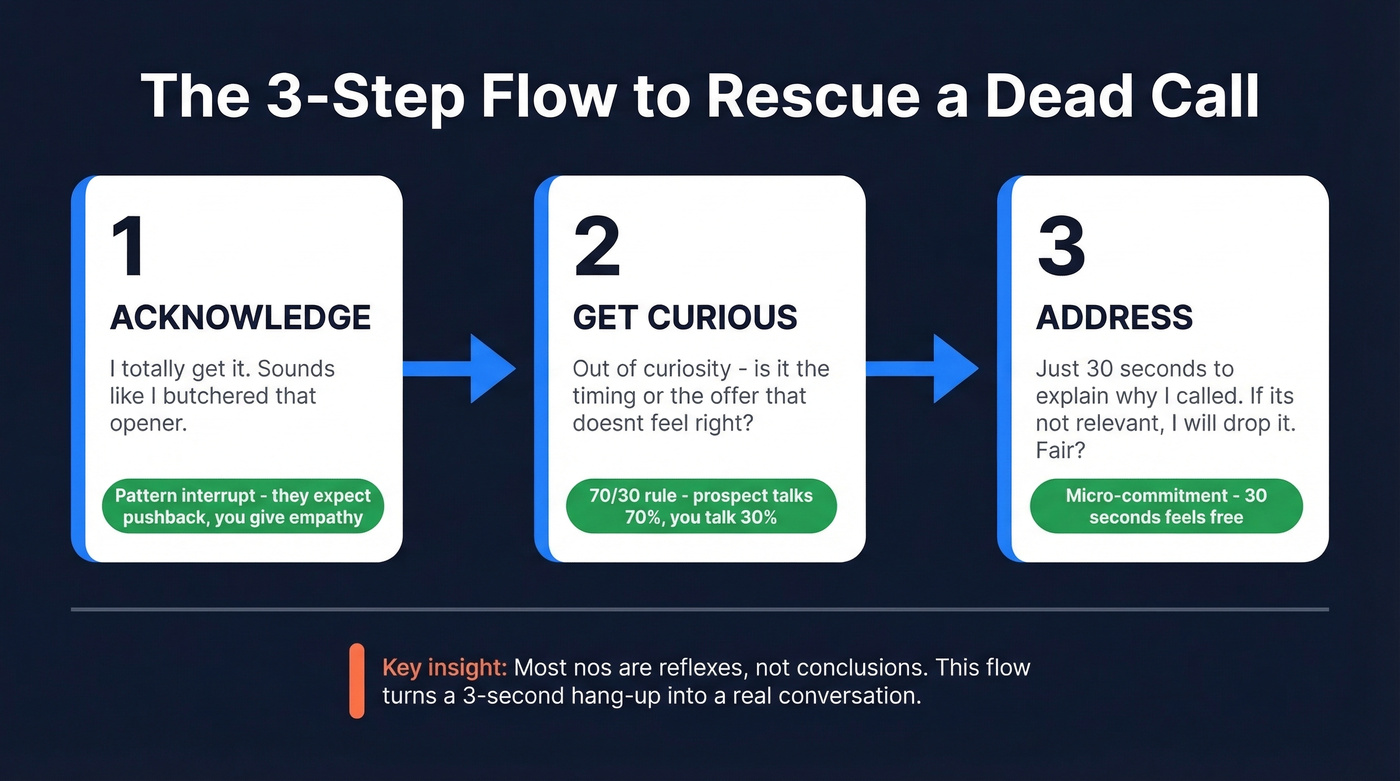
Step 1: Acknowledge. Don't argue. Don't pitch harder. Say something human.
"I totally get it. Sounds like I butchered that opener."
This is a pattern interrupt. The prospect expects you to push back. When you don't, they relax - and stay on the line.
Step 2: Get Curious. Ask one question that separates timing from fit.
"Out of curiosity - is it the timing or the offer that doesn't feel right?"
Now you're in a conversation, not a pitch. Follow the 70/30 rule: the prospect talks 70%, you talk 30%. After you ask, pause. Don't fill the silence.
Step 3: Address what you learned. If it's timing, ask when. If it's budget, talk ROI, not features. If it's genuine disinterest, exit gracefully.
"Just 30 seconds to explain why I called. If it's not relevant, I'll drop it. Does that sound fair?"
That micro-commitment line - credited to Morgan J. Ingram - is a go-to cold-calling tactic. It lowers the stakes to almost nothing. Thirty seconds feels free. We've watched reps rescue calls that were dead on arrival with this single sentence.
Scripts by Objection Type
Different objections need different one-liners:
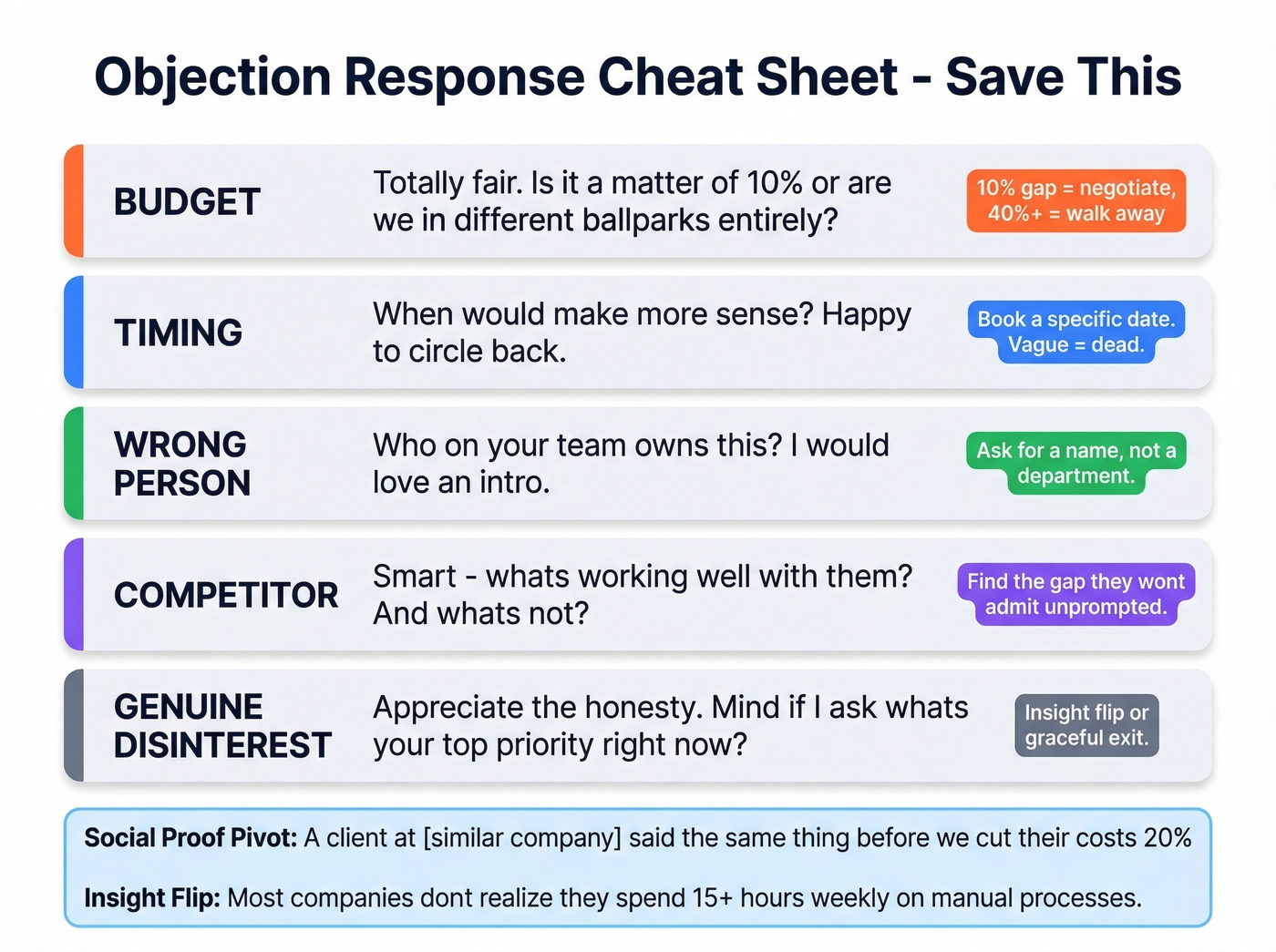
| Objection | Script | Next Move |
|---|---|---|
| Budget | "Totally fair. Is it a matter of 10% or are we in different ballparks entirely?" | 5-10% gap: negotiate. 40%+: walk away. |
| Timing | "When would make more sense? Happy to circle back." | Book a specific date. Vague = dead. |
| Wrong person | "Who on your team owns this? I'd love an intro." | Ask for a name, not a department. |
| Competitor | "Smart - what's working well with them? And what's not?" | Find the gap they won't admit unprompted. |
| Genuine disinterest | "Appreciate the honesty. Mind if I ask what your top priority is right now?" | Insight flip or graceful exit. |
Two lines worth memorizing for any objection: the social proof pivot - "A client at [similar company] said the same thing before we cut their costs 20%" - and the insight flip - "Most companies don't realize they're spending 15+ hours weekly on manual processes." Both reliably reopen conversations without sounding pushy.
Pick a Framework
| Framework | Steps | Best For |
|---|---|---|
| ARC | Acknowledge, Respond, Close | Mid-call speed; most objections |
| LAARC | Listen, Acknowledge, Assess, Respond, Confirm | Complex enterprise deals |
| Feel-Felt-Found | "I understand how you feel. Others felt the same. Here's what they found." | Empathy-heavy conversations |
Start with ARC. It's three steps, easy to remember when a VP is about to hang up, and it covers 80% of situations. Graduate to LAARC when deals get complex and you're navigating multiple stakeholders across procurement, legal, and the business unit (especially in enterprise deals).
The persistence data backs this up: six out of ten people say no four times before buying. But only 12% of reps make three or more follow-ups. The framework matters less than the willingness to keep showing up.

Most "no"s happen because you're calling the wrong person with stale data. Prospeo's 300M+ profiles refresh every 7 days - not every 6 weeks - so you reach real decision-makers with 98% verified emails and 125M+ direct dials.
Stop rescuing dead calls. Start with the right contact.
Following Up After a "No"
The call ended. They said no. Now what?
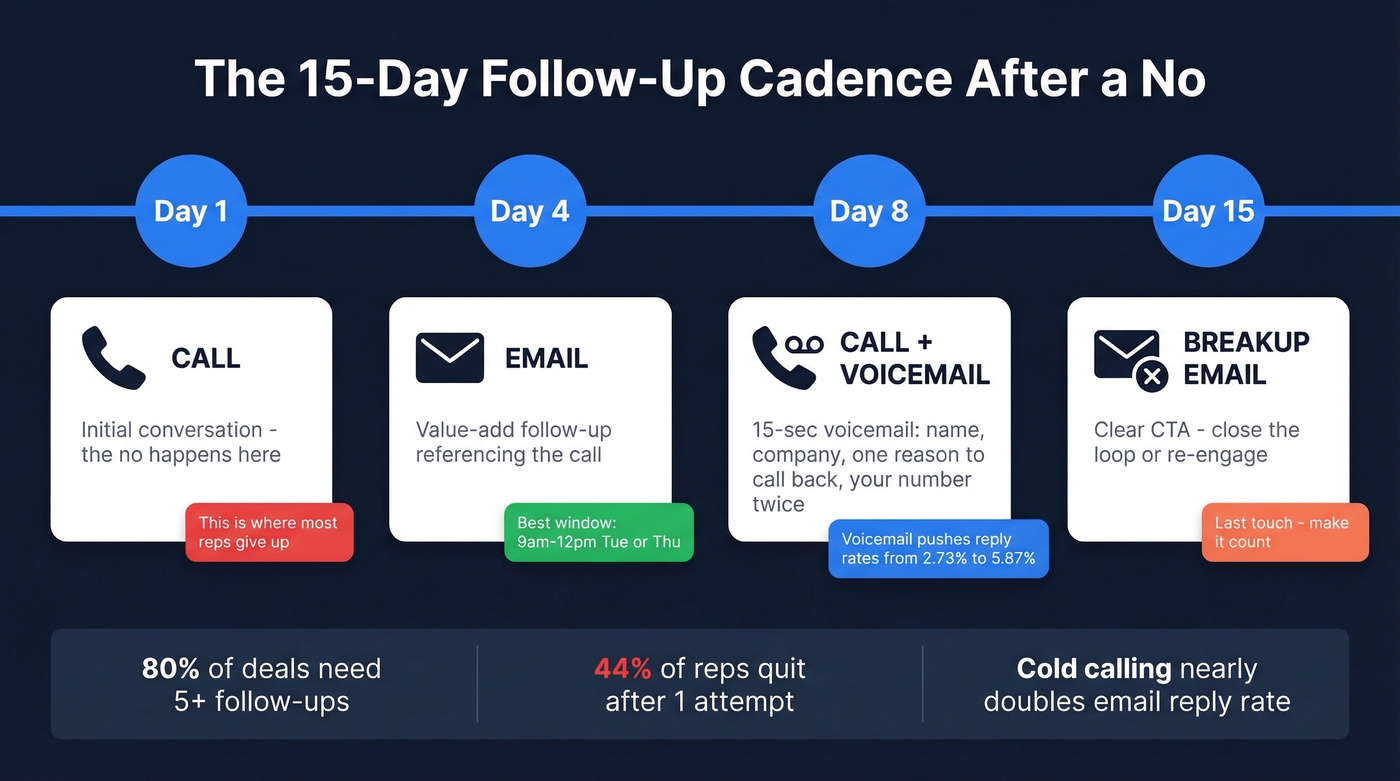
80% of deals require five or more follow-ups, yet 44% of reps give up after one attempt. Top-quartile cold callers book 3x more meetings than average peers - and the difference isn't talent, it's system. We've seen this play out across dozens of teams we work with: the reps who build a cadence and stick to it consistently outperform the ones who wing it.
| Day | Channel | Action |
|---|---|---|
| Day 1 | Call | Initial conversation (the "no") |
| Day 4 | Value-add follow-up referencing the call | |
| Day 8 | Call + voicemail | 15-second voicemail: name, company, one reason to call back, your number twice |
| Day 15 | Breakup email with a clear CTA |
Send your first follow-up email after three days - response rates drop after five. Best window: 9am-12pm in the prospect's time zone, Tuesday or Thursday. Cold calling nearly doubles email reply rate (3.44% vs 1.81%), and adding a voicemail pushes reply rates from 2.73% to 5.87%.
If you want more plug-and-play options, keep a few sales follow-up templates ready so you don't improvise under pressure.
Follow-up email (Day 4):
Subject: Quick thought after our call
Hey [Name], I know you mentioned the timing wasn't right. Totally respect that. One thing I didn't get to share - [one-sentence insight or result relevant to their role]. Worth a 10-minute look when [trigger event]? Either way, no pressure. - [Your name]
Breakup email (Day 15):
Subject: Closing the loop
Hey [Name], I don't want to be that rep who won't take a hint. If this isn't a priority, I'll close out my notes. If anything changes, hit reply - I'll be here. - [Your name]
The entire goal of this cadence is staying relevant without being annoying. Every touch should deliver value, not just ask for time.
One "No" Doesn't Kill the Account
One contact saying no doesn't mean the account is dead.
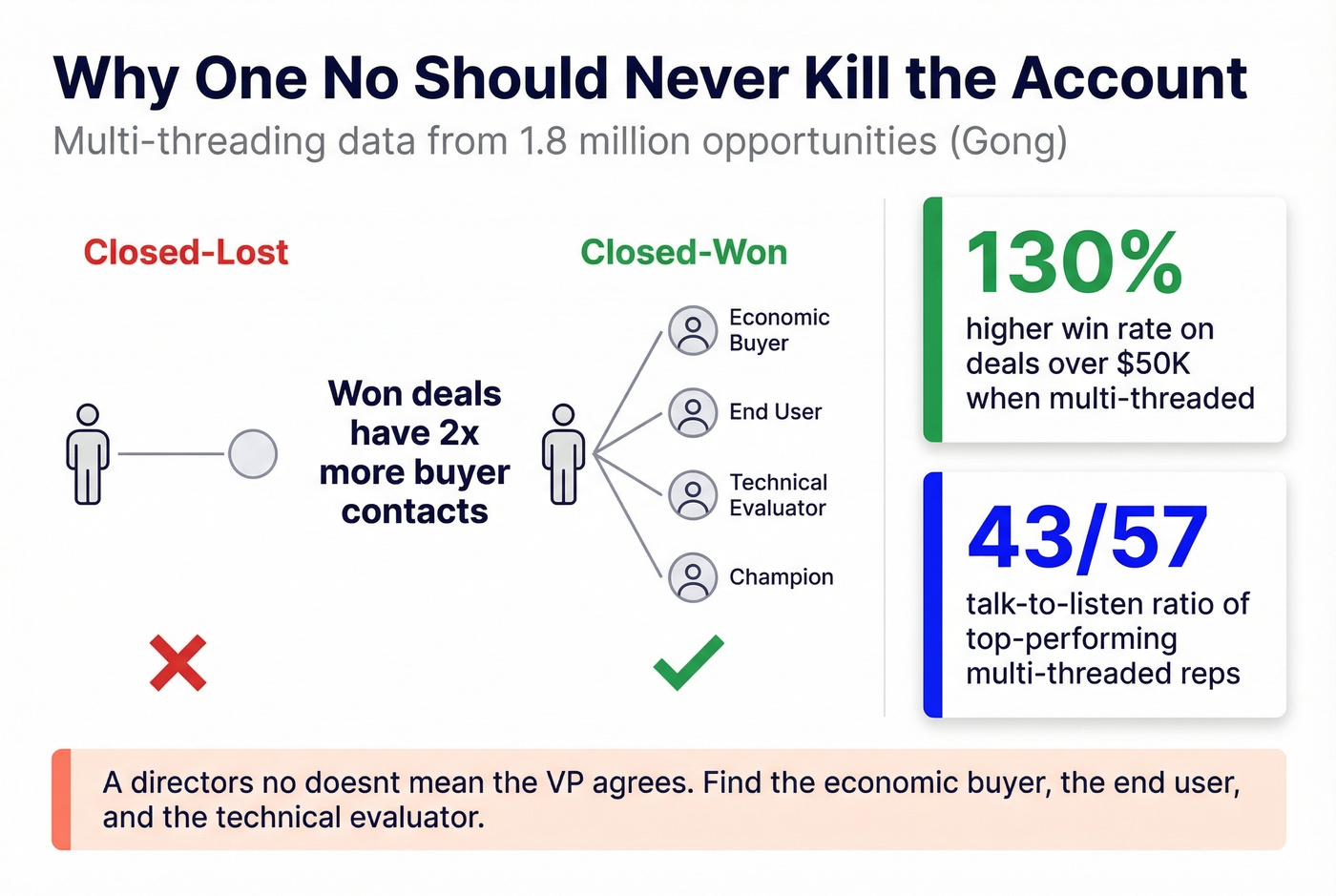
This is where multi-threading matters most. Gong's analysis of 1.8 million opportunities found that closed-won deals have twice as many buyer contacts as closed-lost. On deals over $50K, multi-threading lifts win rates by 130%. In our experience, the reps who multi-thread close at nearly double the rate of those who don't - and they maintain a consistent 43/57 talk-to-listen ratio across all their calls. If you're single-threaded into one champion and they go dark, you've lost the deal. Find the economic buyer, the end user, the technical evaluator (or use a MEDDPICC economic buyer approach). A director's "no" doesn't mean the VP agrees.
When to Accept the No
Not every rejection is worth fighting. Walk away when:
- The prospect can't articulate a pain you solve
- You have no access to a decision-maker
- The timeline is 12+ months out
- They're deep into evaluations with three or more vendors
The graceful exit matters more than you think. "Totally understand - I'll make a note and check back in six months. Appreciate your time." Log the reason in your CRM (or your contact management software). Future you will thank present you when that account resurfaces.
For teams with average deal sizes under $10K, you probably can't afford more than two follow-up attempts on a hard no. Spend those hours finding new accounts instead of resuscitating dead ones. Getting to no quickly is a skill, not a failure.
The Upstream Fix: Better Data
Here's what most objection-handling content ignores: a huge percentage of "no"s aren't about your pitch. They're about reaching the wrong person, a dead number, or an email that bounces. No script saves a call to someone who left the company three months ago. I've seen reps burn through 50 dials with zero connects because their list was three months stale.
Prospeo covers 300M+ professional profiles with 98% email accuracy and 125M+ verified mobile numbers that hit a 30% pickup rate. The data refreshes every seven days - compared to the six-week industry average - so you're not working off stale records. A verified email costs a penny. A wasted cold call costs five minutes of your SDR's time. Before you stress about rebuttals, make sure you're reaching the right person with solid sales prospecting techniques and clean inputs like data enrichment.

Multi-threading turns one rejection into a multi-contact account play. Prospeo gives you 30+ filters - job title, department headcount, buyer intent - to find every stakeholder in the deal, with verified emails at $0.01 each.
One "no" shouldn't kill the deal. Find every buyer in the account.
FAQ
How should you respond when a prospect says no multiple times?
Follow up at least five times across multiple channels. 80% of deals require five or more touches, yet 92% of reps stop after four. Each follow-up should add new value - a case study, a relevant insight, a trigger event - not just repeat the same ask.
What's the best framework for handling sales objections?
ARC - Acknowledge, Respond, Close. It's three steps, easy to recall mid-call, and flexible enough for budget, timing, and competitor objections alike. Graduate to LAARC for enterprise deals with multiple stakeholders.
Does bad contact data cause more rejections?
Yes. Dialing dead numbers or emailing the wrong person guarantees a "no" before you open your mouth. Verifying contacts on a weekly refresh cycle means your rebuttals land on prospects who can actually say yes.
Is it better to qualify out fast or keep pushing?
Getting to no quickly is a skill, not a failure. Qualifying out early frees you to spend time on accounts where you can actually win. The goal isn't to avoid hearing no - it's to distinguish a real no from a reflexive one and respond accordingly.