

How to Sell Consulting Services: The 7-Step System That Replaces Hustle With Pipeline
You're three months into your consulting practice. The first two clients came from your network. Month three, the phone stops ringing. You check your pipeline and realize there isn't one - just a vague hope that someone will refer you again.
This is the feast-or-famine cycle, and it's the default state for most consultants learning how to sell consulting services. One month you're billing $30-50K; the next, referrals dry up and revenue drops to $10K. The US consulting market runs north of $399B. There's plenty of demand. The problem isn't the market - it's that most consultants don't have a sales system. They have a referral habit.
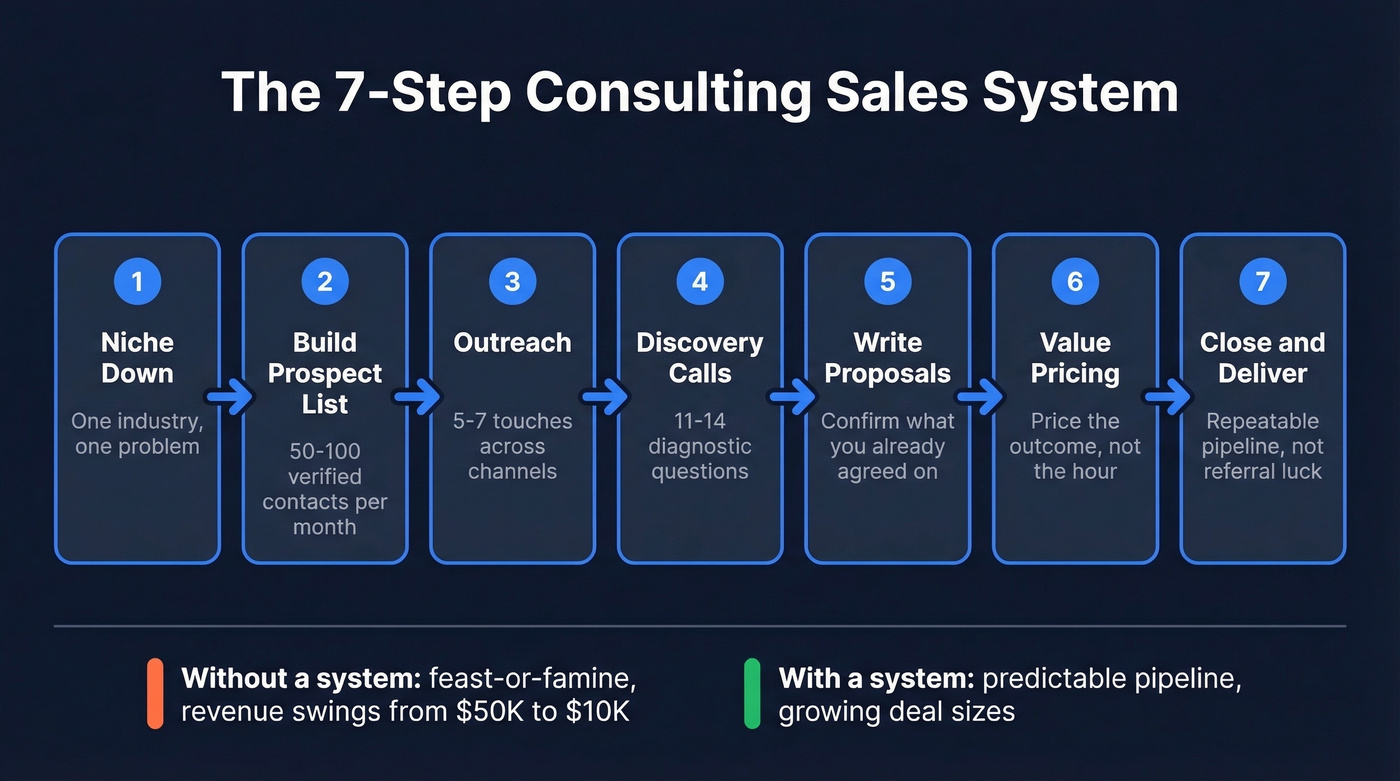
If you only do three things: niche your positioning to one industry or one problem, build a repeatable outreach system with verified contact data, and switch from hourly to value-based pricing. You don't need 37 tips. You need a 7-step system you can run every week.
Why Selling Consulting Feels Impossible
Nobody taught you this. MBA programs teach strategy frameworks, not how to close a $50K engagement over Zoom. And selling consulting is genuinely harder than selling software or physical products - there's nothing to demo, nothing to measure in advance, nothing to touch. As one consultant put it on r/sales, selling intangibles feels like "difficulty level 5."
The reframe that changes everything: consulting sales isn't persuasion. It's diagnosis. You're not convincing someone to buy something they don't need - you're running a structured process to determine whether you can solve their problem, then showing them exactly how.
The 2026 market makes this more urgent. Gartner projects worldwide IT spending to hit $6.08T, up nearly 10% from 2025. Buyers are spending, but they're spending differently. Outcome-based pricing and quantified ROI are becoming baseline expectations, and the industry is bifurcating: scaled ecosystem integrators on one end, high-specialization boutiques on the other. If you don't have a clear niche and a repeatable sales process, you're competing on price - and that's a race you'll lose.
The 7-Step System for Consulting Sales
Step 1 - Niche Down and Package Your Expertise
If you can't explain what you do in one sentence, you're not niched enough.
Visible Authority documented a case that illustrates this perfectly. A data and analytics consulting firm was pitching to anyone who'd listen. Over about two years, they repositioned entirely around supermarket operations - forecasting, inventory optimization, supply chain analytics for grocery. The result: larger deal sizes, longer contracts, and dramatically lower client acquisition costs. They went from competing with every analytics firm on the planet to being the obvious choice for a specific buyer.
The one-sentence test: "I help [specific type of company] solve [specific problem] so they can [specific outcome]." If your sentence includes "various industries" or "a range of challenges," you're still too broad. Specialization feels risky because it means saying no to potential revenue. But generalists spend longer closing fewer deals at lower fees.
Packaging your services also reduces delivery variance. When you productize a repeatable engagement - say, a 90-day supply chain diagnostic - you improve margins because your team isn't reinventing the wheel every time. The sales conversation gets easier too, because you're selling a defined outcome instead of "whatever you need."
One approach you'll encounter: doing free work to get in the door. Some consultants swear by it. We've seen it work exactly once - for a consultant who parlayed a free assessment into a $200K engagement. The other dozen times, it set a dangerous precedent on pricing and positioned the consultant as dispensable. Don't give away the thing you're selling.
Step 2 - Build Your Prospect List
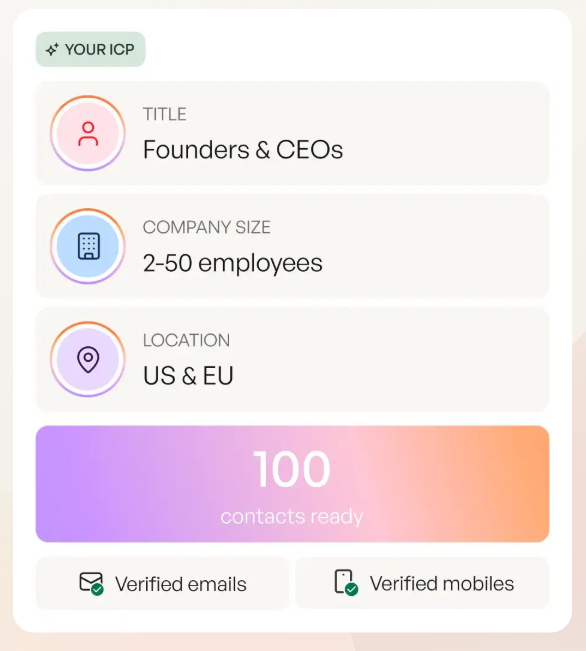
You've defined your ideal client. Now you need their actual contact data - not a guess at their email format.
Most consultants skip this step entirely. They wait for inbound, attend networking events, and hope messages get read. That's not a system. A system means identifying 50-100 ideal prospects per month by industry, company size, and decision-maker title, then getting verified contact information for each one.
Data quality matters more for consultants than almost anyone else because only 50-60% of your working hours are billable. Every hour you spend chasing bounced emails or dialing dead numbers is an hour you can't bill. At $200/hr, a wasted afternoon of bad outreach costs you $800 in lost billable time.
We've tested several data platforms for this, and Prospeo stands out for solo consultants and small firms. Its 300M+ professional profiles with 30+ search filters let you zero in on the right decision-makers fast, and 98% email accuracy means your outreach actually reaches inboxes. The intent data - tracking 15,000 topics via Bombora - surfaces companies actively researching your specialty before they start looking for consultants. It plugs into HubSpot, Salesforce, Smartlead, Instantly, Lemlist, Clay, Zapier, and Make, so there's no manual CSV juggling between tools.

Step 3 - Outreach That Gets Responses
Cold outreach works for consultants. But only if you do it right.
Email-only campaigns typically pull around 3% response rates. Stack email with phone calls and professional network touches, and that number can climb past 15%. The difference isn't magic - it's persistence and channel diversity. Plan for 5-7 touches over 2-3 weeks before writing someone off.
In our experience, the consultants who struggle most with outreach are the ones sending unverified emails to generic addresses. Your cold emails should follow a simple structure - AIDA or PAS both work. Keep subject lines short (use a swipe file of subject lines if you need ideas). Personalize the opener with something specific about their company, not a generic "I noticed your company is growing." Make the CTA low-friction: "Worth a 15-minute call?" beats "I'd love to schedule a comprehensive discovery session at your earliest convenience."
Before you send a single cold email, verify your list. High bounce rates don't just waste time - they destroy your domain reputation. If you're warming a new domain, give it at least 21 days before ramping volume. Domain reputation is fragile and expensive to rebuild.
Don't blast 500 emails on day one. Start with 20-30 per day, increase gradually, and monitor bounce rates weekly. Deliverability is the unsexy foundation that makes everything else work (and it's fixable with the right email deliverability setup).


Every hour spent chasing bounced emails is an hour you can't bill. Prospeo's 98% email accuracy and 30+ search filters let you build a list of 50-100 ideal prospects by industry, title, and company size in minutes - not days. Intent data across 15,000 topics surfaces companies researching your specialty right now.
Replace referral roulette with a prospect list that actually converts.
Step 4 - Run Discovery Calls That Convert
Discovery is the most important step in the entire process. Get it right and the proposal writes itself. Get it wrong and you're guessing at what the client needs - which means you'll either underprice, overscope, or lose the deal entirely.
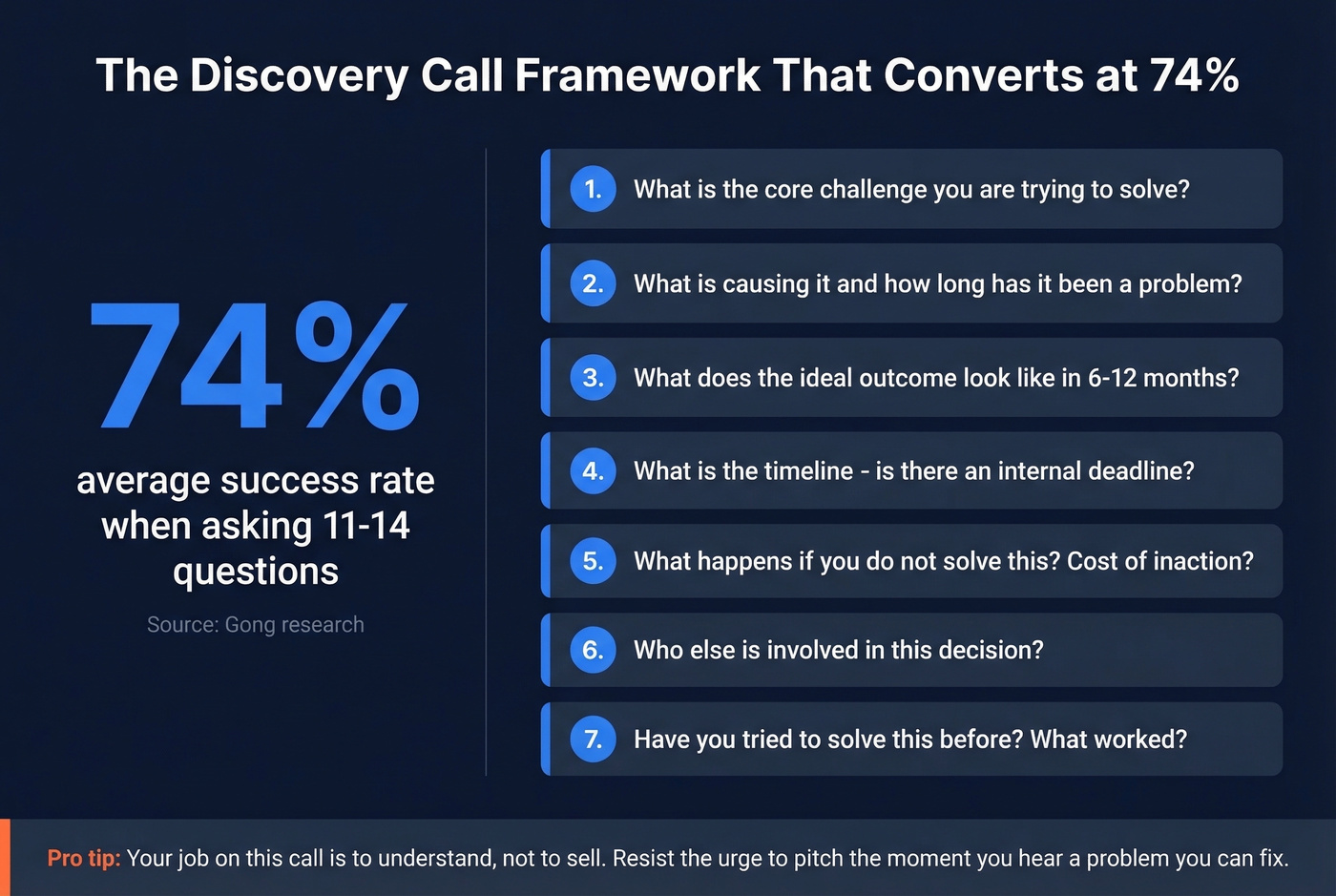
Gong's research shows that salespeople who ask 11-14 questions on a prospect call hit a 74% average success rate. The key isn't volume - it's asking the right questions and actually listening to the answers. We've sat through hundreds of discovery calls, and the ones that convert always follow this pattern:
- What's the core challenge you're trying to solve?
- What's causing it? How long has it been a problem?
- What does the ideal outcome look like in 6-12 months?
- What's the timeline? Is there an internal deadline driving urgency?
- What happens if you don't solve this? What's the cost of inaction?
- Who else is involved in this decision?
- Have you tried to solve this before? What worked and what didn't?
The temptation on discovery calls is to start pitching your solution the moment you hear a problem you can fix. Resist it. Your job on this call is to understand, not to sell. The selling happens when you reflect their problem back to them more clearly than they could articulate it themselves - that's when trust forms.
Step 5 - Write Proposals That Win
You sent a 12-page proposal to someone you've spoken to once. They said they'd "review it internally." That was six weeks ago.
Here's the thing: a proposal should never be your primary sales pitch. By the time you write one, the client should already want to work with you. The proposal is a formality - a written confirmation of what you've already agreed on verbally. If you're using proposals to convince people, you skipped discovery.
Only 30% of consultants report winning proposals submitted through an RFP process. That's a brutal close rate, largely because RFPs force you to pitch on paper to people you haven't diagnosed.
When you do write a proposal, structure the executive summary using the SCR framework - Situation, Complication, Resolution - then cover these sections: Executive Summary, Problem Statement, Objectives, Approach, Scope of Services, Timeline, Outcomes and Deliverables, Relevant Experience, Client Responsibilities, ROI/KPIs, Pricing Structure, Terms and Conditions, and Next Steps. Every section should reinforce what you discussed in discovery. The client should read it and think "yes, this is exactly what we talked about" - not "who is this person and why are they sending me a document?"
Step 6 - Price for Value, Not Time
Hourly billing is the worst pricing model for consultants. Full stop. It punishes efficiency, creates misaligned incentives, and puts a hard ceiling on your income. If you solve a $500K problem in 20 hours, billing $200/hr means you earned $4,000 for half a million dollars of value. That math is broken.
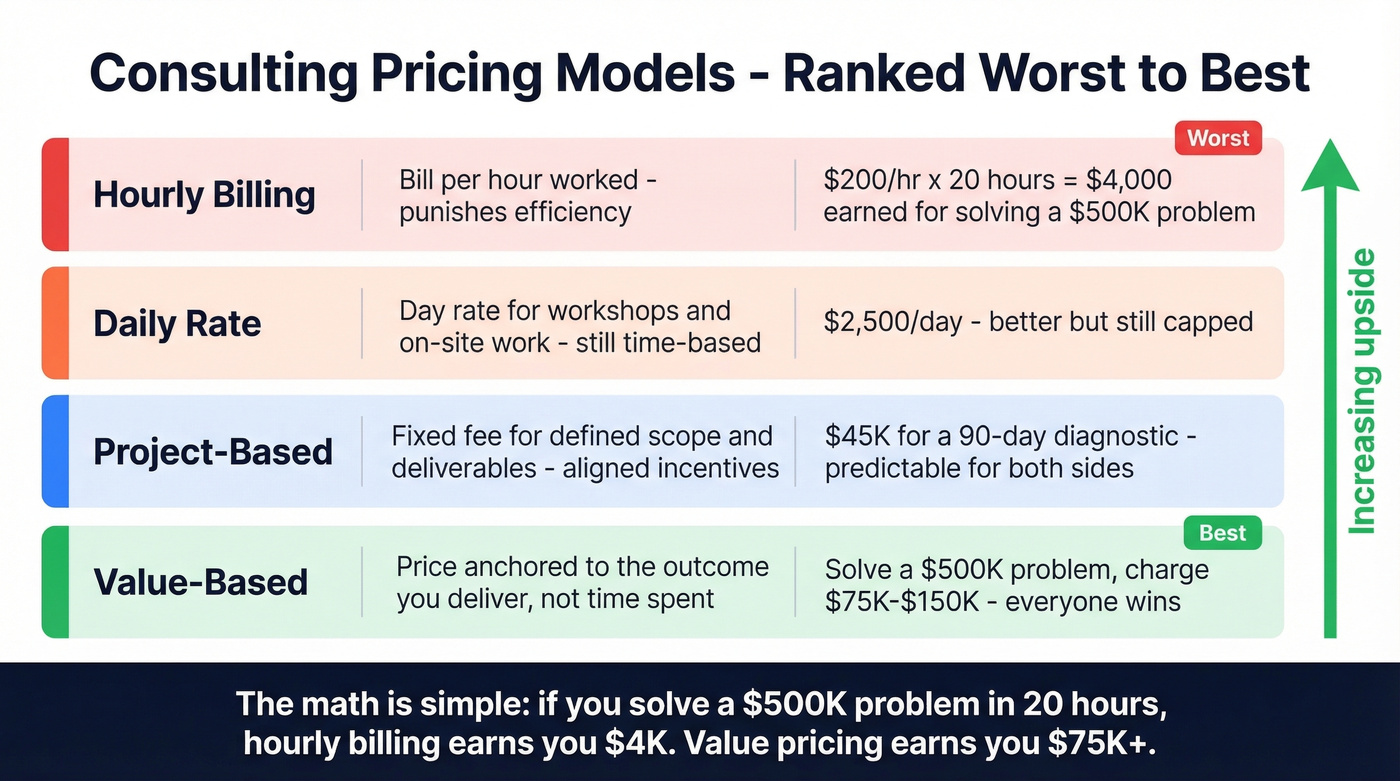
These models rank from worst to best:
| Model | How It Works | Best For | Risk Level |
|---|---|---|---|
| Hourly | Bill per hour | Staff aug, time tasks | Low risk, low upside |
| Daily | Day rate | Workshops, on-site | Low risk, moderate upside |
| Retainer | Fixed monthly fee | Advisory, fractional | Moderate, predictable |
| Project-based | Fixed per engagement | Defined-scope work | Moderate, good upside |
| Value-based | Fee tied to results | Transformation, revenue | Higher risk, highest upside |
To set your floor rate, use this formula: (Target annual income + Annual business costs) / Billable hours. Remember, you're only billing 50-60% of your working hours. Out of 2,000 hours worked per year, expect 1,000-1,200 to be billable.
In North America, charging under $150/hr signals inexperience. Here's where rates typically land:
| Experience Level | Hourly Range | Project Range |
|---|---|---|
| New (0-2 years) | $100-$200/hr | $5K-$25K |
| Specialist (3-7 years) | $200-$400/hr | $25K-$100K |
| Senior / boutique | $400-$750/hr | $100K-$500K+ |
The move toward value-based pricing isn't optional in 2026. Clients increasingly expect outcome-based fees with quantified ROI. If you're still billing by the hour, you're competing on cost instead of value - and there's always someone cheaper.
Hot take: If your average engagement is under $15K, you probably don't need a complex pricing strategy. Charge a flat project fee, deliver results, and raise your rate 15% every quarter until clients push back. The consultants who obsess over pricing frameworks at small deal sizes are avoiding the real problem - they need more pipeline, not a better spreadsheet.
Step 7 - Handle Objections and Close
Most objections fall into four categories. Knowing which one you're dealing with determines how you respond.
| Category | What They Say | How to Respond |
|---|---|---|
| Budget | "Too expensive" / "No budget" | Reframe toward ROI and cost of inaction |
| Timing | "Not the right time" | Quantify delay cost; offer phased start |
| Need | "We can handle internally" | Surface capability gaps with questions |
| Authority | "I need to check with..." | Offer to join the internal conversation |
The instinct when you hear "too expensive" is to drop your price. Don't. Instead, ask what they're comparing it to. Often the objection isn't about your fee - it's about uncertainty around the outcome. "What does another quarter of this problem cost you?" is a more powerful response than a 15% discount.
Let's be honest about timelines: consulting sales cycles run 6-36 weeks from first contact to signed engagement, with close rates typically between 10-20%. Enterprise deals skew longer. Niche specialists with warm leads close faster. Set your expectations accordingly and don't panic when deals take time. The system works - but it works over months, not days.
The emphasis throughout objection handling is listening first. Understand the "why" behind the objection before you respond. A budget objection from a VP who loves your approach but needs CFO approval is a completely different conversation than a budget objection from someone who doesn't see the value.
Your consulting pipeline shouldn't depend on hope. Prospeo gives you 300M+ professional profiles with verified emails at $0.01 each - so your 5-7 touch outreach sequences land in real inboxes, not bounce folders. Native integrations with HubSpot, Smartlead, and Instantly mean zero CSV juggling.
Build the repeatable outreach system your consulting practice needs.
After the Close - Retain and Expand
Closing the first engagement is the hardest sale. Everything after that should be easier - if you set it up right.
A single well-documented case study with hard numbers closes more deals than any pitch deck. Track client outcomes obsessively - documented results become your best sales asset and the foundation of every future proposal. Deliver a quick win in the first 30 days. Early results build trust and create internal champions who'll advocate for expanding the engagement without you having to push.
Propose follow-on work before the current engagement ends - don't wait for the client to ask. Structure retainers for recurring revenue: a $5K/month advisory retainer is worth $60K/year with zero acquisition cost. Build referral requests into your offboarding process by asking for introductions to specific people, not generic "know anyone who needs help?"
Referrals are a bonus, not a strategy. We've seen too many consultants build their entire business on referral networks, then watch revenue collapse when those networks go quiet. Referrals should supplement your outbound system, not replace it.
Mistakes That Kill Consulting Sales
Underpricing. Charging $75/hr doesn't make you competitive - it signals you're inexperienced. Clients with real budgets will pass because your rate tells them you can't handle serious work.
Unclear scope. Always send a detailed SOW before starting work. Scope creep is the #1 margin killer for consultants, and it's entirely preventable with a clear document.
Taking any client. Bad-fit clients drain your energy, damage your reputation, and generate zero referrals. Saying no to wrong-fit work is a sales skill. Skip this lesson and you'll learn it the expensive way.
No pipeline system. If your only lead source is "people I know," you don't have a business - you have a side hustle. Build outbound into your weekly rhythm (a simple set of weekly sales activities is enough to start).
Poor cash flow management. Invoice promptly. Require 30-50% deposits for large projects. Net-60 payment terms on a $40K engagement means you're financing your client's business for two months.
FAQ
How long does it take to close a consulting deal?
Expect 6-36 weeks from first contact to signed engagement, with 10-20% close rates. Niche specialists working warm leads can close in 4-8 weeks. Build your pipeline assuming a 3-month average cycle.
What should I charge as a new consultant?
Use the formula: (Target income + business costs) / billable hours. For $150K income with $30K costs, that's about $164/hr as your floor. In North America, most new independents land between $100-$200/hr.
Does cold outreach actually work for consultants?
Yes - with verified data and multi-channel execution. Email-only pulls around 3% response rates. Stacking email, phone, and professional network touches pushes past 15%. Using a platform with 98% email accuracy keeps bounce rates under 4% so your domain stays healthy across campaigns.
What's the best approach to a consulting sales conversation?
It isn't a pitch - it's a structured discovery conversation. Lead with the prospect's problem, quantify the cost of inaction, and present your methodology as the bridge between where they are and where they need to be. Proposals support the conversation; they don't replace it.
How do I find the right prospects to contact?
Define your ideal client by industry, company size, and decision-maker title. Then use a B2B data platform to pull verified emails and direct dials - filter by buyer intent, headcount growth, or funding stage to prioritize companies most likely to need your expertise right now.