

How to Verify That an Email Address Is Valid - Without Getting Burned
You launched a 2,000-contact sequence last Tuesday. By Wednesday morning, 8% had bounced and your ESP sent a warning. One more campaign like that and you're on probation.
The problem isn't your copy or your targeting - it's that nobody told you what "verified" actually means. If you want to know how to verify that an email address is valid, you need to go deeper than a green checkmark.
Most "how to verify" guides tell you to paste an email into a free tool and trust the result. That's not verification - that's a coin flip with extra steps. Email lists decay roughly 28% every year. A Clearout analysis of about 1 billion emails found only 80.94% were valid - nearly 1 in 5 addresses dead on arrival. Cross the 2% bounce-rate threshold and ISPs start throttling your domain.
Here's what actually happens under the hood when you click "verify," why the results lie more often than you'd think, and how to keep your sender reputation intact.
What You Need (Quick Version)
- Spot-checking one email before sending? Use Hunter's Email Verifier or Verifalia's free single-check tool.
- Cleaning a list before a campaign? ZeroBounce or NeverBounce for bulk verification.
How Email Verification Actually Works
Every verification tool runs the same three-layer process. The quality of execution varies wildly.
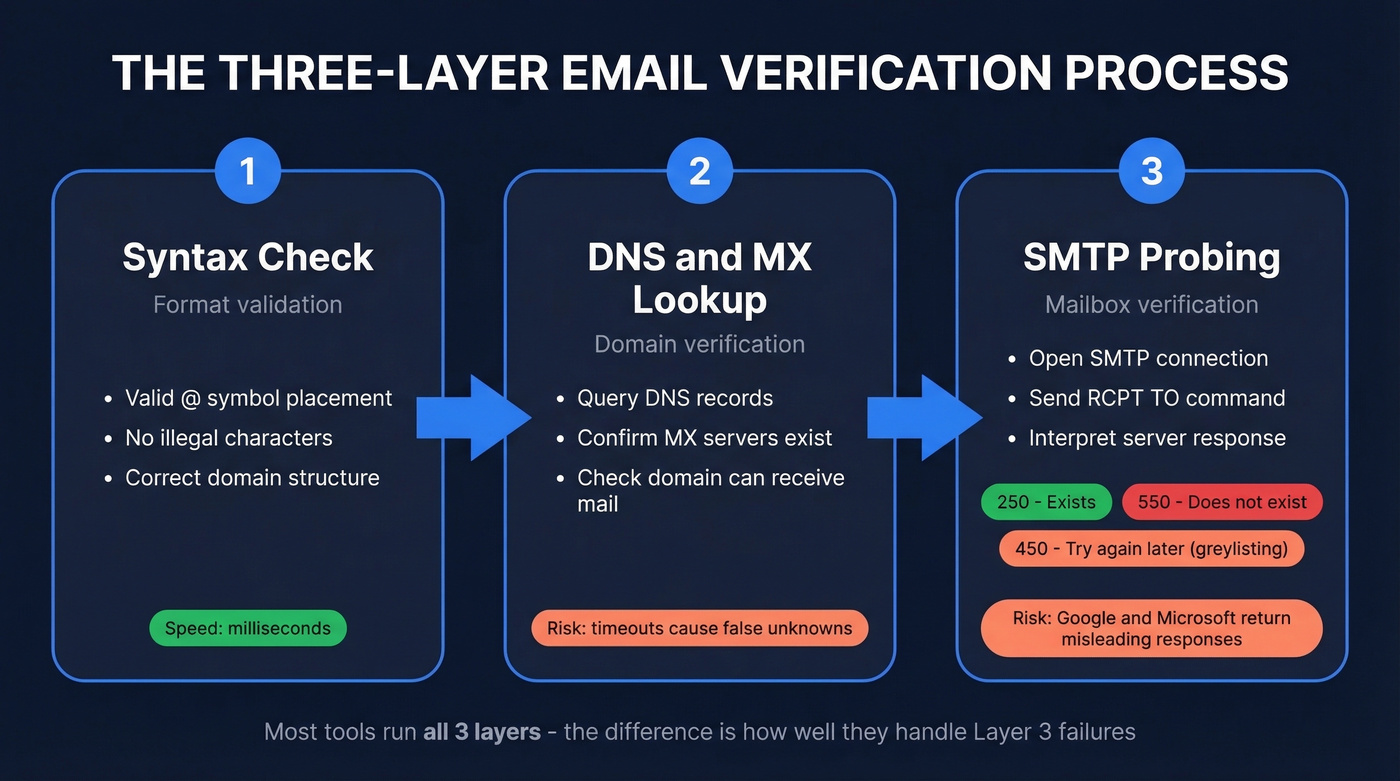
Layer 1 - Syntax check. Does the address follow the right format? No double @ symbols, no illegal characters, valid domain structure. Every tool nails this in milliseconds.
Layer 2 - DNS and MX lookup. The tool queries the domain's DNS records to confirm mail exchange servers exist. No MX record means the domain can't receive email. Simple enough, but DNS results are a snapshot - timeouts can produce false "unknowns" on perfectly healthy domains.
Layer 3 - SMTP probing. This is where it gets interesting. The tool opens a connection to the mail server, initiates an SMTP handshake, and issues a RCPT TO command. A 250 response means the mailbox exists. A 550 means it doesn't. A 450 or 421 means "try again later" - greylisting designed to slow down automated probes.
Large providers like Google and Microsoft intentionally return misleading responses to block mailbox enumeration. Better verifiers use multi-pass strategies, retrying from different IPs at different times with exponential backoff across 15-30 minute windows, and treat the pattern across attempts as the real signal rather than trusting any single response.
Manual SMTP Verification (Just Don't)
You can technically verify an email yourself. Run nslookup with set type=mx to find the domain's mail server, then open a telnet session on port 25 and walk through the SMTP handshake - EHLO, MAIL FROM, RCPT TO.
Here's the thing: the VRFY command designed for exactly this purpose is disabled on virtually every modern mail server because spammers abused it into oblivion. Probing SMTP servers manually will get your IP blacklisted fast. Practitioners on Stack Overflow have flagged this repeatedly. Learn how it works conceptually, then let a tool handle it.

Manual SMTP probes get your IP blacklisted. Verification-only tools miss 30-40% of catch-all domains. Prospeo's 5-step verification pipeline handles catch-all detection, spam-trap removal, and honeypot filtering at the point of discovery - so bad emails never enter your pipeline. 98% accuracy at $0.01 per email.
Find and verify emails in one step. No separate cleaning tool needed.
Why Tools Return "Unknown"
This is the part most verification guides skip - and it's the single biggest reason your "verified" list still bounces.
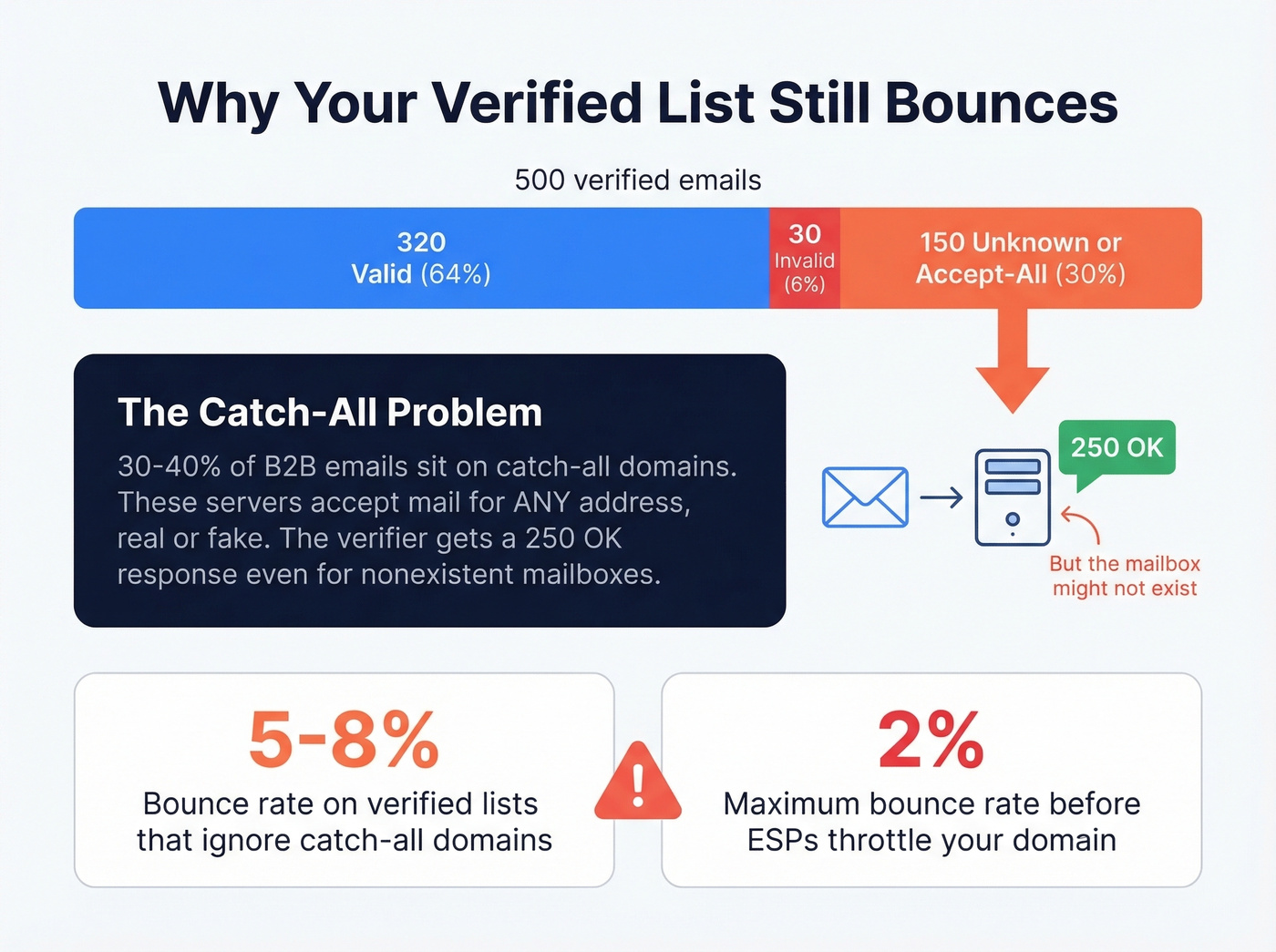
You verify 500 emails. 320 come back valid, 30 invalid, and 150 return "unknown" or "accept-all." An estimated 30-40% of B2B email addresses sit on catch-all domains - servers configured to accept mail for any address, real or fake. When a verifier sends a RCPT TO for a nonexistent address and the server still returns 250 OK, there's no way to distinguish real mailboxes from dead ones. The standard detection method (testing a random gibberish address at the domain) can flag catch-all behavior, but it can't resolve which specific addresses are valid.
Enterprise domains make this worse. Secure email gateways from Proofpoint, Mimecast, and Microsoft Defender add greylisting and rate limiting that block probes entirely.
If you've ever wondered why a "fully verified" list can still bounce at 5-8%, this is usually the answer.

The Truth About Accuracy Claims
Most verification tools claim ~99% accuracy. Independent testing tells a different story.
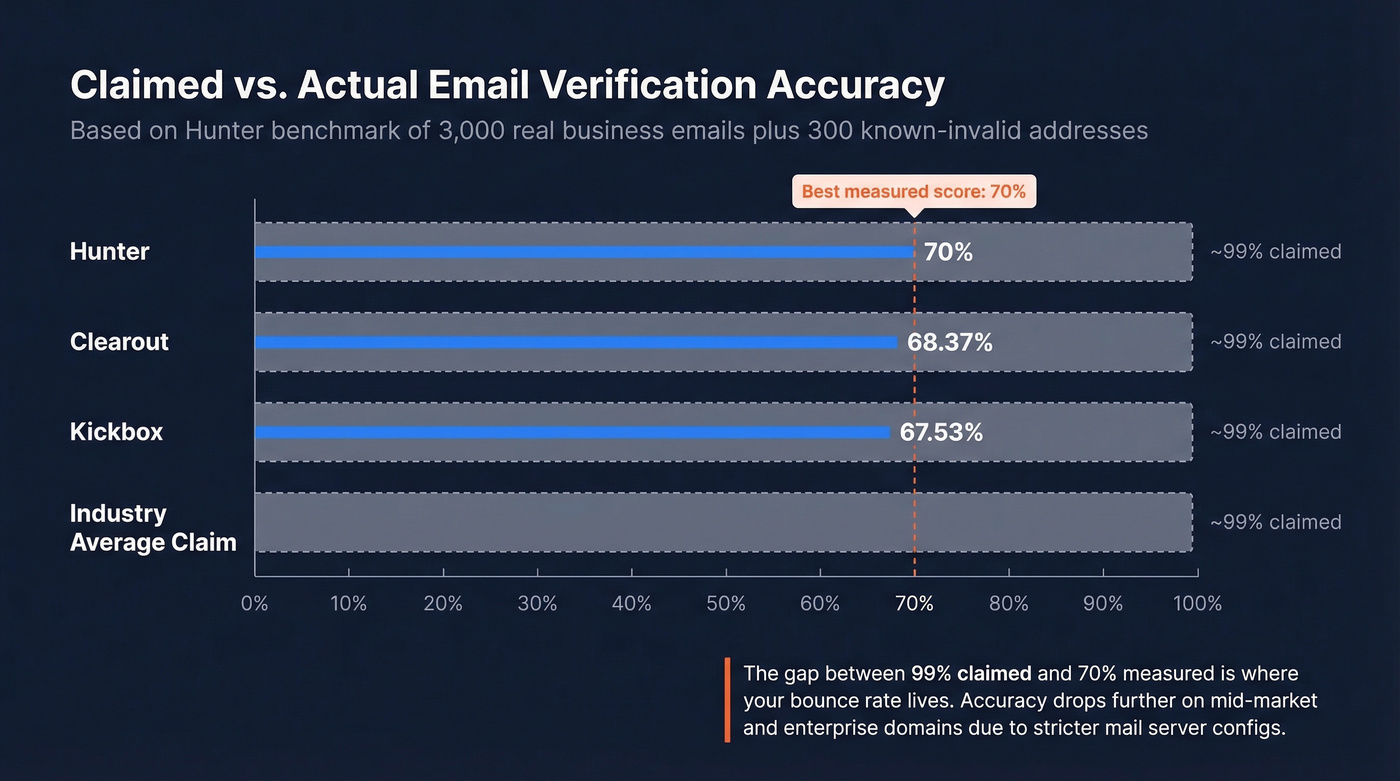
Hunter ran a benchmark across 15 email verifiers using 3,000 real business emails segmented by company size, plus 300 known-invalid addresses. The top overall accuracy score was 70%. Hunter hit 70%, Clearout 68.37%, Kickbox 67.53%. Accuracy dropped further on mid-market and enterprise domains due to stricter mail server configurations.
Worth noting: the dataset was sourced from Hunter's own activity, which may advantage their tool. But even with that caveat, the gap between "99% claimed" and "70% measured" is striking.
Let's be honest - we've seen this pattern play out with our own customers who come to us after burning their domain reputation on "verified" lists from other providers. Don't build your outbound motion around a verification-only step and assume it makes bad data disappear. You're better off using a tool that verifies at the point of discovery, before bad data ever enters your pipeline, than cleaning a dirty list after the fact.
Best Email Verification Tools Compared
| Tool | Free Tier | Cost | Key Strength |
|---|---|---|---|
| Prospeo | 75 emails/mo | $0.01/email | Find + verify in one step |
| Hunter | 100/mo (free plan) | From $49/mo | Benchmark leader (70%) |
| ZeroBounce | 100 credits/mo | $15/2K min | Strong integrations |
| NeverBounce | 1,000 free trial credits | ~$8/1K | Low per-email cost |
| Bouncer | 1,000 free trial credits | ~$7/1K | Budget-friendly bulk |
| Verifalia | Free singles | Paid plans for bulk | Quick one-off checks |
For spot checks, Hunter or Verifalia get the job done free. For bulk list cleaning, ZeroBounce or NeverBounce offer solid per-email economics.
For building B2B prospect lists with verified emails from the start, Prospeo is the strongest option - $0.01 per email, 98% accuracy, catch-all handling baked into a 5-step verification pipeline that includes spam-trap removal and honeypot filtering. Data refreshes every 7 days versus the 6-week industry average, so you're not verifying against stale records. You never need a separate verification step.
Skip NeverBounce if you need catch-all handling - it doesn't resolve accept-all domains, which means you'll still get unknowns on a huge chunk of B2B addresses.
Protecting Deliverability Long-Term
One-and-done verification is the most common mistake we see. B2B contact data decays roughly 2.1% per month - and can decay as much as 70.3% annually depending on the industry. Re-verify every 3-4 months minimum.
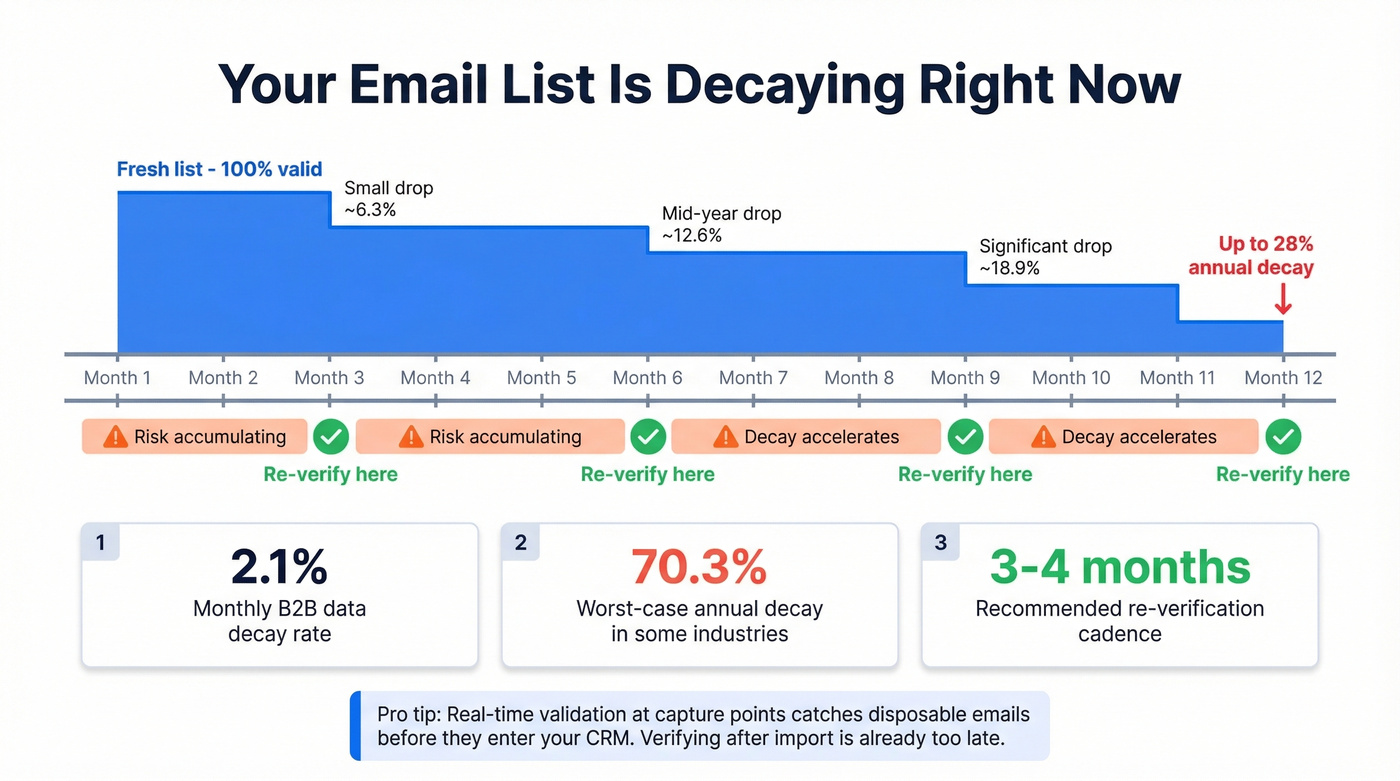
Disposable emails will burn you quietly. Temporary addresses pass syntax and SMTP checks, then die within hours. Real-time validation at capture points - on form submission, not after the list is already in your CRM - catches these before they cause damage.
Don't trust "valid" forever. B2B contacts change jobs, companies rebrand domains, servers get reconfigured. And sending the same person three emails from three different lists because you didn't deduplicate? That's a fast path to spam complaints. One outbound agency we talked to, Stack Optimize, cut their client bounce rates to under 3% and hit 94%+ deliverability by validating at the point of discovery rather than cleaning lists after the fact.
If you're building outbound at scale, pair verification with a real email deliverability workflow, watch your email bounce rate, and stay under safe email velocity limits.
The best verification tools scored 70% in independent benchmarks. The problem? You're verifying data that was already stale. Prospeo refreshes 300M+ profiles every 7 days - not every 6 weeks - so you're building lists from fresh records with 98% email accuracy baked in from the start.
Stop cleaning dirty lists. Start with data that doesn't need cleaning.
FAQ
How can I check if an email address is valid for free?
Hunter provides 100 free verifications per month, and Verifalia lets you verify individual addresses at no cost. Prospeo's free tier includes 75 credits with full 5-step verification including catch-all handling. Free tools work for spot checks, but they typically lack the multi-pass SMTP probing needed to handle enterprise domains accurately.
Can you verify an email without sending a message?
Yes. SMTP probing checks whether a mailbox exists by initiating a server handshake without delivering any mail. The limitation is that catch-all domains and greylisting can produce false positives, so "verified" doesn't always mean "will land in the inbox."
How often should I re-verify my email list?
Every 3-4 months at minimum. Email lists decay 28% annually, and B2B contact data decays even faster - up to 2.1% per month. Quarterly verification is the minimum cadence to stay under the 2% bounce threshold most ESPs enforce.
What's the most accurate email verification tool in 2026?
Independent benchmarks show top verification-only tools scoring around 70% accuracy - far below the 99% most vendors claim. Tools that verify at the point of discovery consistently outperform standalone verifiers because they catch bad data before it enters your pipeline. Choosing the right workflow matters more than choosing the right checker.