


Hubforce Pricing, Reviews, Pros and Cons: An Honest 2026 Assessment
Try finding an independent take on Hubforce and you'll come up empty. Google serves WorkforceHub, Humanforce, and HubSpot results instead. No G2 profile. No real Reddit threads - just a promotional Product Hunt launch post. So we built the review ourselves.
Quick Verdict
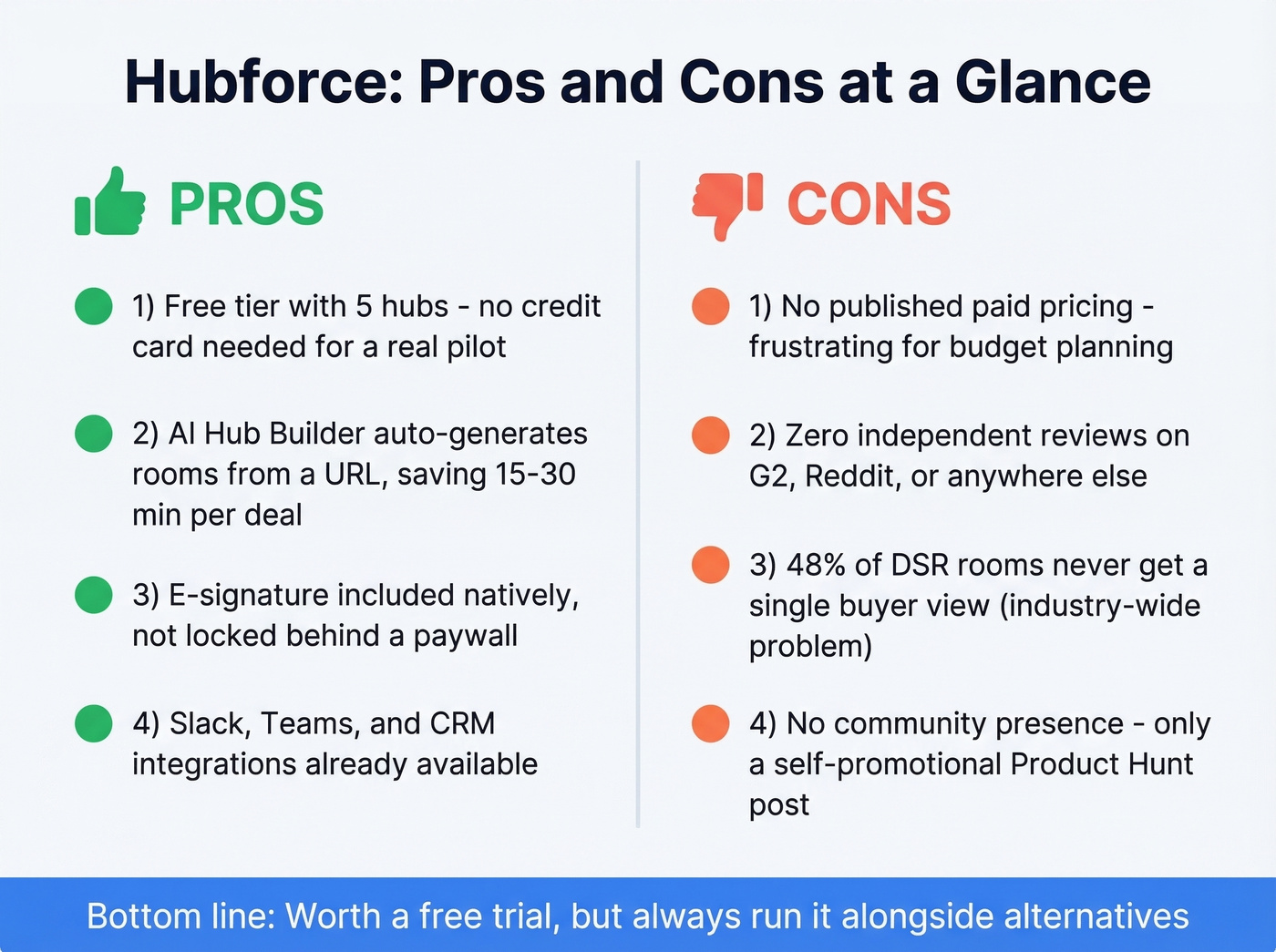
- What it is: A digital sales room (DSR) that centralizes content, analytics, and e-signatures into personalized "hubs" for buyers.
- Free tier: 5 hubs, no credit card.
- Paid pricing: Not published. Expect $25-65/user/month based on DSR benchmarks.
- Independent reviews: Essentially zero.
- Best for: B2B sales teams already committed to DSR workflows who want AI-powered room creation.
- Our take: Worth a free trial, but run it alongside Aligned and Trumpet so you have a real comparison.
What Is Hubforce?
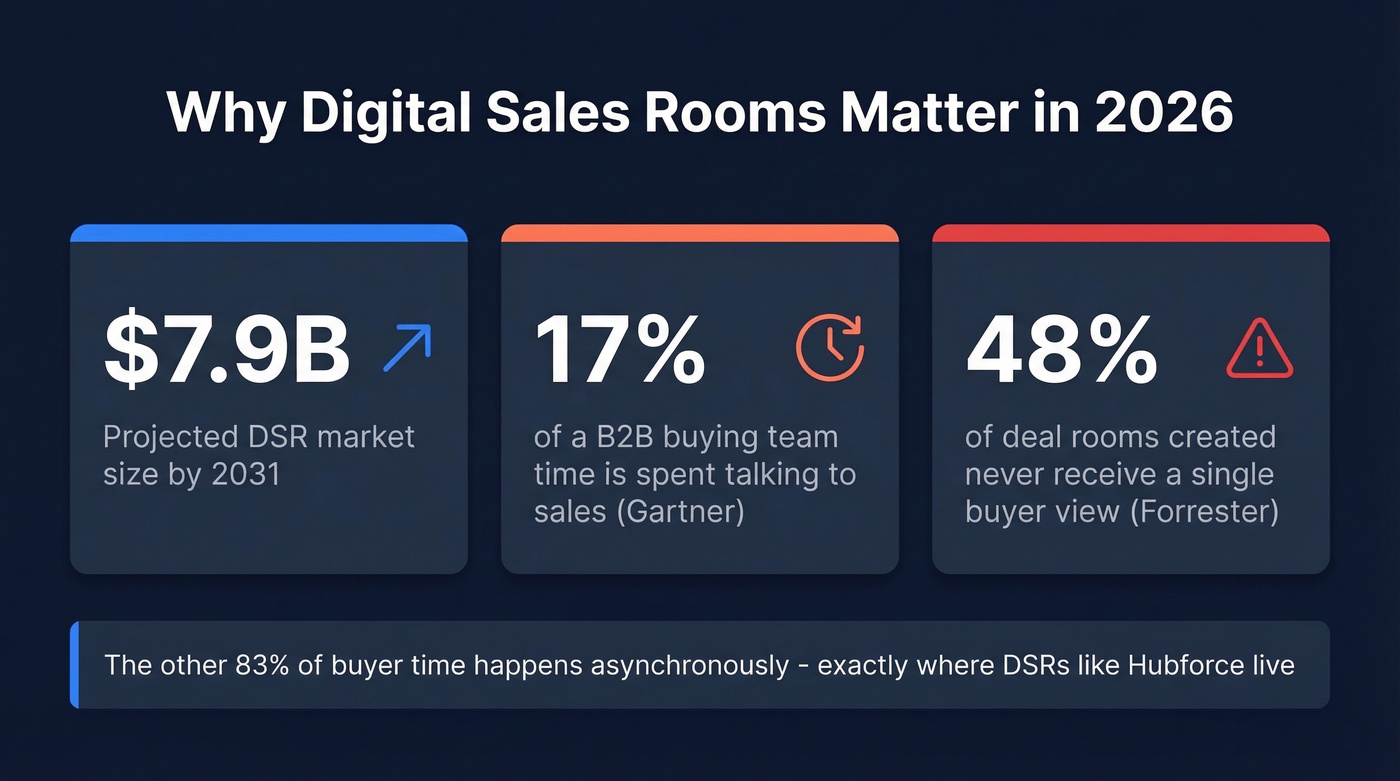
Digital sales rooms give buyers a single shared space - proposals, demos, contracts, mutual action plans - instead of scattered email threads. The DSR market is projected to hit $7.9B by 2031, and Hubforce is betting on AI to carve out its share. Drop in a website URL or existing content, and the AI Hub Builder generates a personalized room automatically.

The pitch tracks with buyer behavior: Gartner found that only 17% of a B2B buying team's time is spent talking to sales. The rest happens asynchronously - exactly where DSRs live. Whether Hubforce specifically earns that async attention is harder to say without real user data.
Key Features
| Feature | What It Does |
|---|---|
| AI Hub Builder | Generates a personalized hub from a URL or content library |
| Analytics | Tracks "digital body language" - page views, time spent, engagement scoring |
| Chat | Buyer Q&A with page/asset-level comments and live notifications |
| Mutual Action Plans | Shared tasks, deadlines, and progress tracking |
| E-Signature | Document viewing and signing inside the hub |
| Templates | Pre-built layouts for sales rooms, onboarding, support, pitching, recruitment, and M&A |
| Embedded Content | Add external tools/pages directly into hubs |
| Builder | Drag-and-drop, no-code editor with navigation tiles |
Integrations cover the essentials: Slack, Microsoft Teams, and CRM connections.
How Much Does Hubforce Cost?
Hubforce's free tier is genuinely generous - 5 hubs, no credit card required. But paid pricing isn't published, which is frustrating for a category where most competitors post at least a starting number. We've seen this pattern before with early-stage tools, and it usually means one of two things: the pricing model is still being figured out, or they're qualifying every lead through a sales conversation.
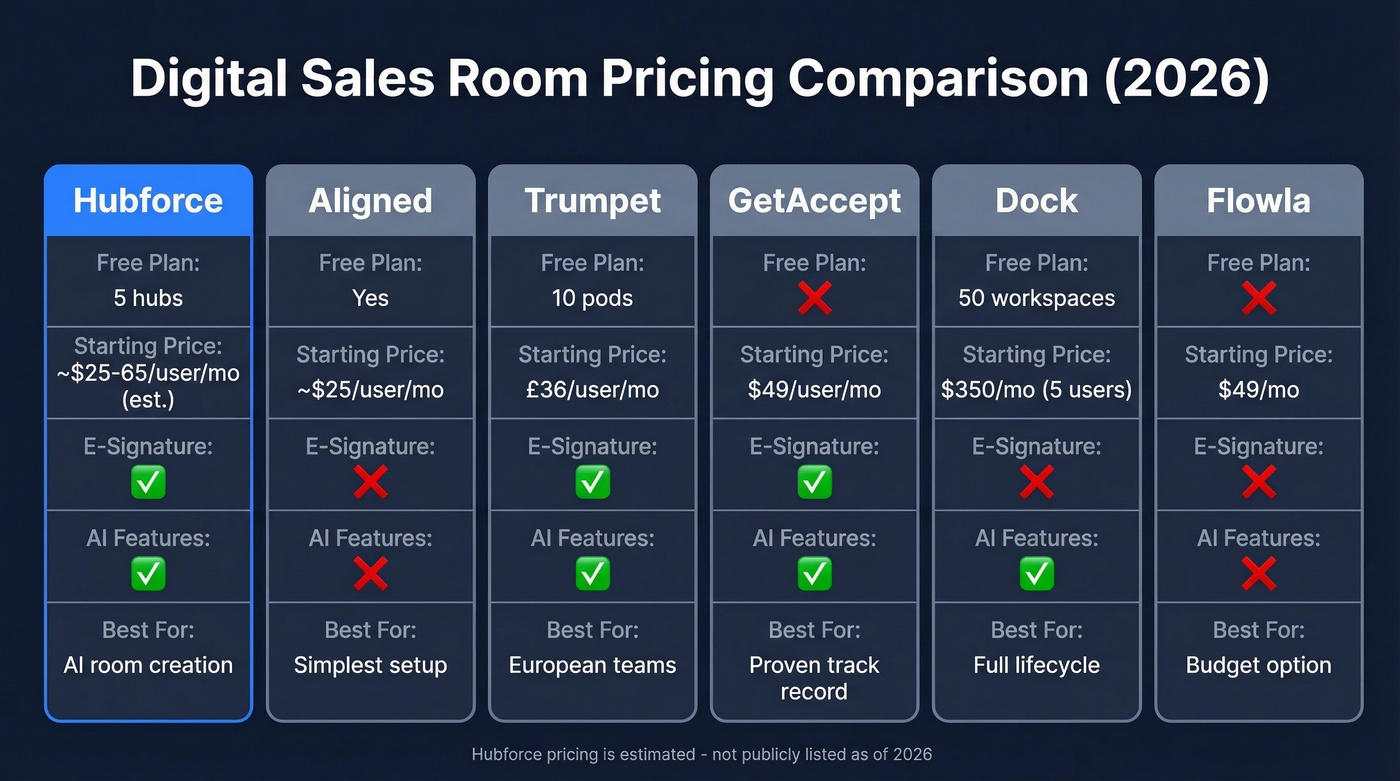
| Tool | Free Plan | Starting Price | E-Sig | AI | Best For |
|---|---|---|---|---|---|
| Hubforce | 5 hubs | ~$25-65/user/mo (est.) | Yes | Yes | AI room creation |
| Aligned | Yes | ~$25/user/mo | No | No | Simplest setup |
| Trumpet | 10 pods free | £36/user/mo | Yes | Yes | European teams |
| GetAccept | No | $49/user/mo | Yes | Yes | Proven track record |
| Dock | 50 workspaces | $350/mo (5 users) | No | Yes | Full lifecycle |
| Flowla | No | $49/mo | No | No | Budget option |
If Hubforce lands in the $25-40/user/month range, it's competitive. Above $50, the value proposition falls apart against tools with actual track records and hundreds of G2 reviews.

The best digital sales room is worthless if your buyer never sees it. 48% of DSR rooms go unopened - and bad contact data is a top reason. Prospeo's 98% email accuracy and 7-day refresh cycle ensure your Hubforce rooms reach real inboxes, not dead addresses.
Fix the data before you fix the room. Start free, no credit card.
Pros and Cons
Pros:
- The free tier lets you run a real pilot before committing a dollar.
- AI Hub Builder is a genuine differentiator - most competitors require manual room setup, which eats 15-30 minutes per deal.
- E-signature is included natively, not gated behind an upgrade.
- Solid integration story with Slack, Teams, and CRM connections for a tool this early.
Cons:
- No published paid pricing. In 2026, this signals either early-stage experimentation or enterprise-only ambitions - neither reassures SMBs.
- Zero independent reviews anywhere. You're flying blind on reliability and support quality.
- DSRs have a brutal adoption problem: roughly 48% of rooms created never receive a single buyer view. That's not Hubforce-specific, but it means the tool only works if buyers actually open the link.
- No real community footprint yet. The only Reddit mention we found is a self-promotional Product Hunt launch post.
What Users Say
There's nothing to report, and that itself is the review. SaaSHub has had a placeholder page since June 2023 - no pricing, no reviews. No G2 profile exists. The only Reddit mention is a self-promotional post from the Hubforce team.
Here's the thing: we've seen early-stage tools deliver better support and more flexibility because they're hungry for every customer. But you're beta-testing whether you realize it or not. Go in with a backup plan.
Alternatives Worth Testing
Let's be honest about DSRs: the room itself matters far less than whether the right person opens it. That 48% "never viewed" stat isn't a software problem - it's a data problem. You still need a room, though, so here are the options worth your time.
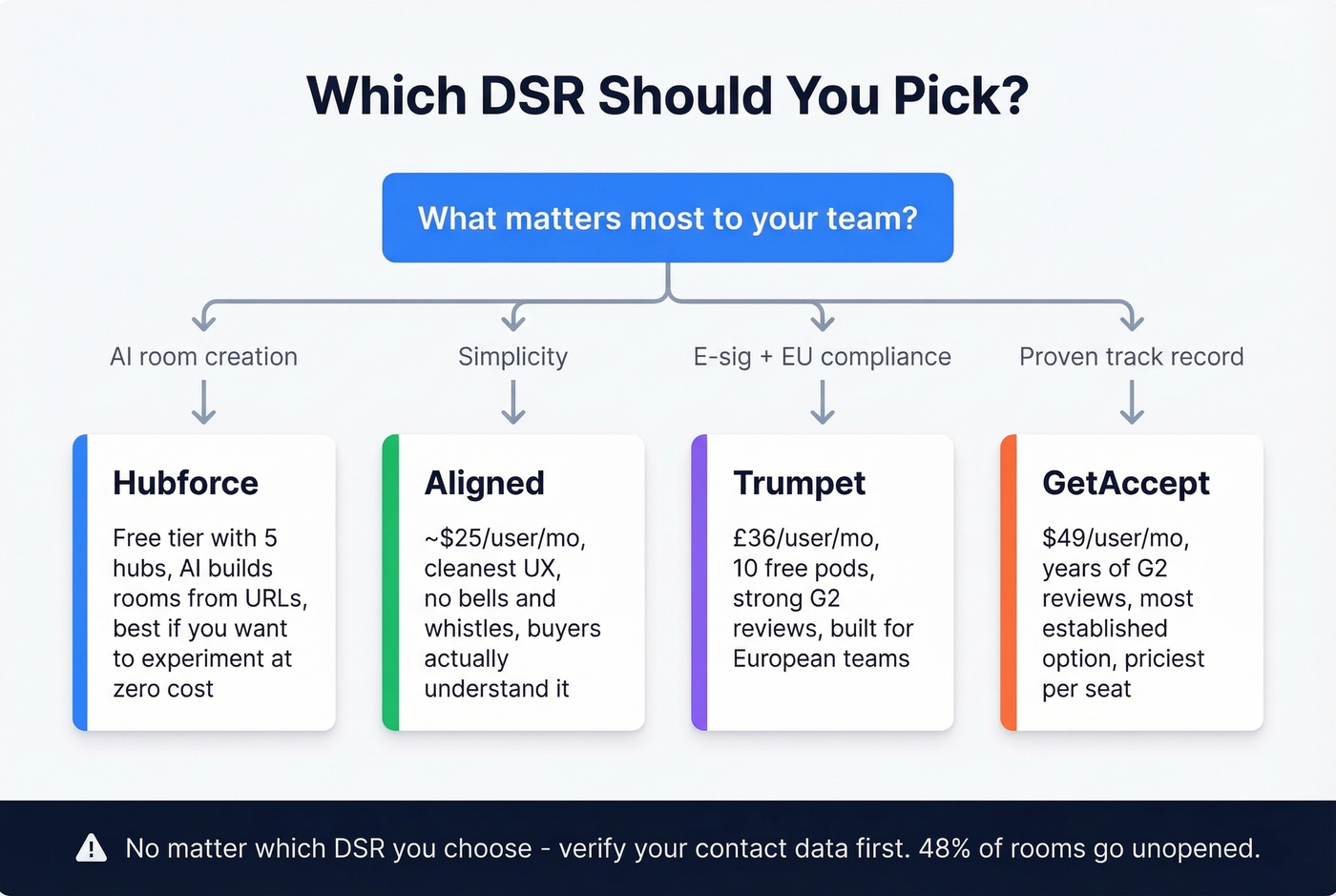
For the fastest setup and simplest UX, Aligned starts around $25/user/month and strips away complexity. No e-signatures, no AI gimmicks - just a clean room that buyers actually understand how to use.
For European teams needing e-signatures and AI, Trumpet at £36/user/month checks both boxes and has a 10-pod free tier that's generous enough for a real evaluation. Their G2 reviews are solid.
For a proven DSR with real user feedback, GetAccept at $49/user/month has years of G2 reviews and a track record you can actually verify. Skip this if you're budget-constrained - it's the priciest per-seat option here.
For lifecycle workspaces beyond deal rooms, Dock at $350/month for 5 users works well for teams that want onboarding, renewal, and expansion rooms alongside sales.
The missing layer across all of these is contact accuracy. Half of all deal rooms go unopened, and bad email data is a major contributor. Prospeo's 98% email accuracy and 7-day data refresh cycle help ensure your rooms land in real inboxes - not dead-end addresses. If you're tightening your outbound engine, start with email deliverability and keep an eye on email bounce rate as you scale.
Running a DSR bake-off between Hubforce, Aligned, and Trumpet? None of them solve the contact accuracy problem. Export your prospect lists through Prospeo first - 143M+ verified emails, ~$0.01 each, and bounce rates under 4% like the teams already using it.
Stop sending deal rooms to bad emails. Verify every contact before you hit send.
Who Should Use Hubforce?
Hubforce is worth testing if you want AI-powered room creation without paying upfront. The free tier makes the risk near-zero. But don't test it alone - trial Aligned and Trumpet alongside it and compare buyer engagement across all three. We ran a similar three-way test with a client last quarter, and the winner wasn't the fanciest tool; it was the one their buyers actually clicked.
The tool matters less than the process. If half of deal rooms never get a buyer view, your biggest lever isn't which DSR you pick - it's whether you're sending rooms to verified contacts who actually open them. Nail the data first, then optimize the room. For a deeper dive on why these rooms fail, see our breakdown of the digital sales room model, and pair it with practical sales prospecting techniques and sales follow-up templates to increase opens and replies.