

Hunter vs MailRush.io: They Don't Actually Compete
Comparing Hunter to MailRush.io is like comparing a fishing rod to a cooler. One finds the fish; the other keeps them cold for the trip. Hunter is an email finding and verification tool. MailRush.io is a cold email sending platform with built-in SMTP. They solve different problems, and you'd typically use both in the same stack - not choose between them.
There aren't many direct comparisons out there because they sit in different categories entirely. But if you're evaluating your outbound stack and both names came up, here's what each actually does, what it costs, and whether either deserves a spot in your workflow.
30-Second Verdict
Pick Hunter if you need to find and verify professional email addresses. It's well-established, carries a 4.4/5 on G2 from 634 reviews, and verification accuracy is solid for mid-volume teams.
Pick MailRush.io if you need a budget cold email sender with built-in SMTP and warmup. But proceed with caution - it carries a 2.9/5 on G2 from just 7 reviews, and the support complaints are hard to ignore.
Skip both if you want a stronger data layer than Hunter and a more proven sender than MailRush. Prospeo offers 143M+ verified emails with 98% accuracy and a 5-step verification process that handles catch-all domains - then pair it with Instantly or Smartlead for sending.
We've seen teams waste weeks trying to force a sender to do data work, or expecting a finder to handle deliverability. Don't make that mistake. Build your stack in layers.
Feature and Pricing Comparison
| Hunter | MailRush.io | |
|---|---|---|
| Primary function | Email finding & verification | Cold email sending |
| Free tier/trial | Yes (50 credits/mo) | 14-day free trial |
| Email finding | ✅ | ❌ |
| Email verification | ✅ (0.5 credit each) | ✅ (bundled, capped by plan) |
| Cold email sending | ✅ (basic sequences) | ✅ (core feature) |
| Warmup | ❌ | ✅ (all plans) |
| SMTP included | ❌ | ✅ (shared or dedicated) |
| Dedicated IP option | ❌ | ✅ |
| Spintax support | ❌ | ✅ |
| Webhooks / Zapier | API only | ✅ (Zapier + webhooks) |
| G2 rating | 4.4/5 (634 reviews) | 2.9/5 (7 reviews) |
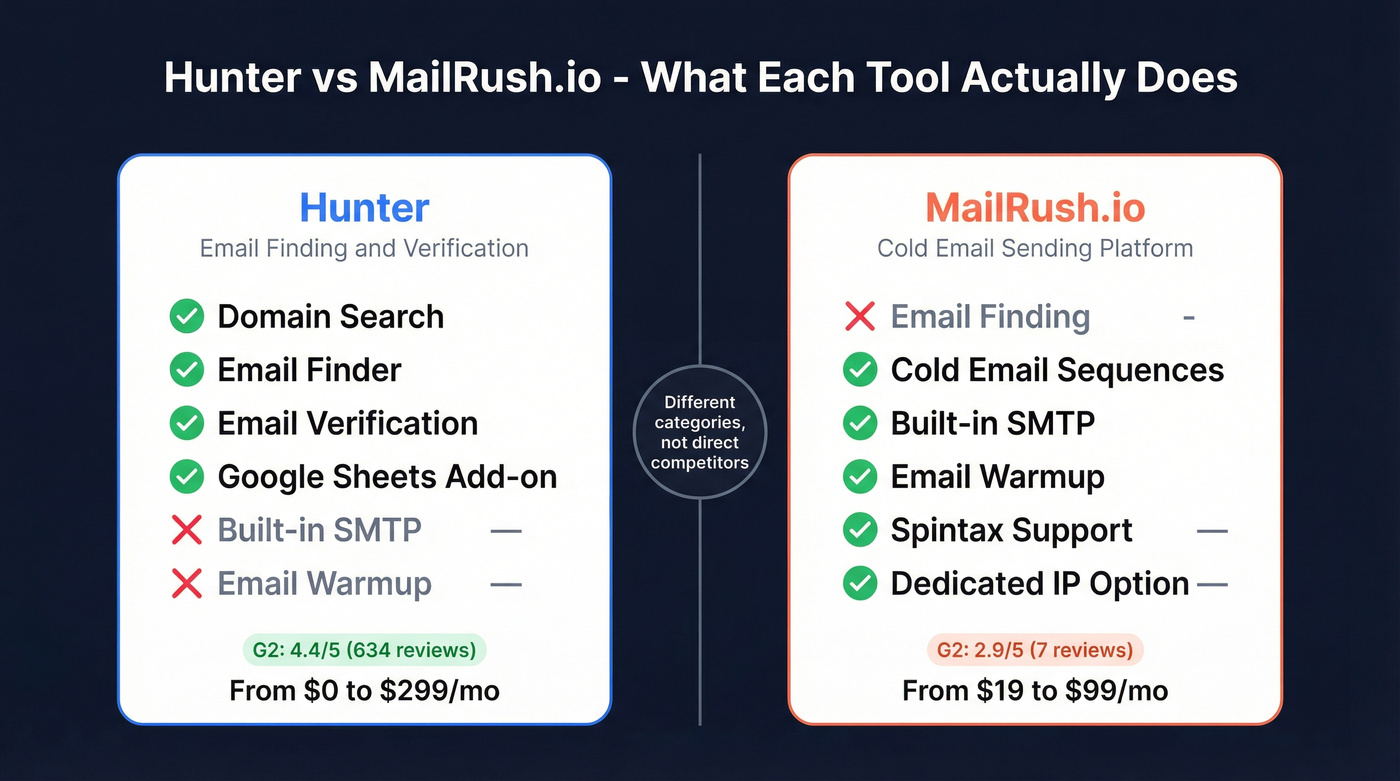
Pricing Tiers
Hunter: Free $0 (50 credits/mo) - Starter $49/mo (2,000 credits) - Growth $149/mo (10,000 credits) - Scale $299/mo (25,000 credits). One credit finds one email; verification costs 0.5 credits. So 2,000 Starter credits translate to roughly 2,000 email finds or 4,000 verifications, not both.
MailRush.io: Starter $19/mo (up to 1,000 emails/day, 5,000 emails/month, 1,000 contacts, 1,000 validations) - Pro $39/mo (up to 1,500 emails/day, 10,000 emails/month, 30,000 contacts, 3,000 validations) - Scale $99/mo (up to 3,000 emails/day, 25,000 emails/month, 50,000 contacts, 4,000 validations). All plans include warmup and unlimited email accounts.
What the Table Hides
Comparing these prices side-by-side is misleading because they bill for completely different actions. Hunter charges per data discovery credit. MailRush charges based on sending volume limits. A fair cost comparison would stack Hunter's finding costs against another finder, and MailRush's sending costs against tools like Instantly or Smartlead.
The other hidden gap is verification quality. MailRush bundles email validation, but it's capped at 1,000 validations on Starter, and it doesn't handle catch-all domains well. Catch-all domains accept every email address at the SMTP level, which makes validation look clean while emails still bounce later. This is exactly why a dedicated verification layer with catch-all handling matters more than a bundled checkbox feature - if your bounce rate creeps above 3-4%, your domain reputation takes a hit and inbox placement drops across every campaign you run. (If you want benchmarks and fixes, see our guide on bounce rate.)
What a Real Stack Looks Like
The outbound workflow has three layers: find, verify, send. Hunter covers find and verify. MailRush covers send. Neither covers all three well. The strongest setup pairs a high-accuracy finder with a purpose-built sender, keeping each tool in its lane.

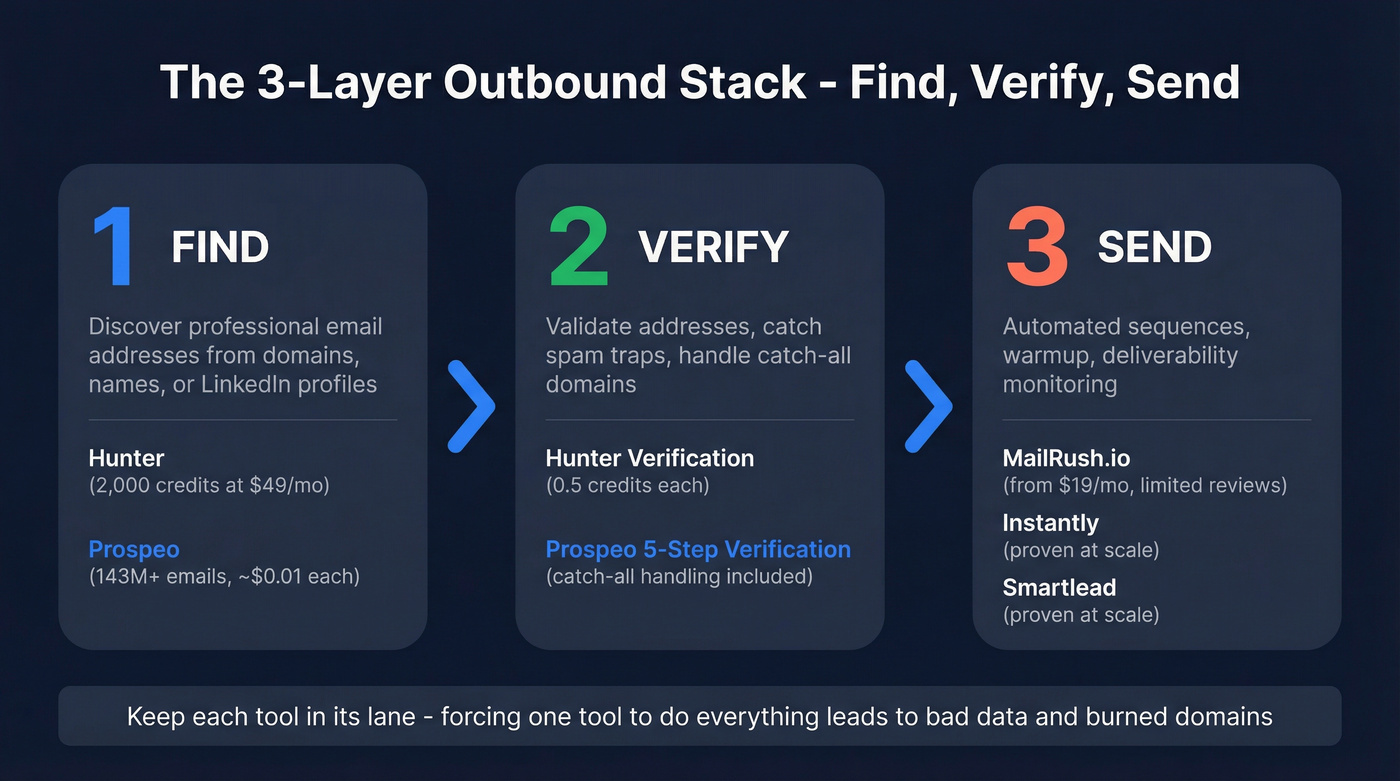

Hunter's credit limits choke high-volume teams. Prospeo delivers 143M+ verified emails with 98% accuracy and catch-all domain handling - the exact verification gap MailRush can't fill. At ~$0.01 per email, you get deeper coverage without the credit math.
Replace your finder bottleneck with 300M+ profiles and 5-step verification.
Hunter - Strengths and Gaps
Hunter's calling card is simplicity. The domain search, email finder, and overall workflow are easy to use - 42 G2 reviewers specifically praise ease of use, and the Google Sheets add-on fits naturally into prospecting workflows. Verification accuracy gets 24 positive G2 mentions, making it a reliable layer for teams that don't need massive daily volume.
What works well:
- Dead-simple UI with strong browser and Sheets integrations
- Solid verification accuracy for common email patterns
- Generous free tier for testing (50 credits/mo)
- Well-maintained product with active G2 presence
Where it falls short:
- Credit limits frustrate users fast (10 G2 mentions). Growth tier teams can burn through 10,000 credits in a week or two of active prospecting.
- Gets expensive at scale - another 10 G2 mentions flag this. $299/mo for Scale still caps at 25,000 credits.
- Data gaps for smaller companies (6 mentions). The database skews toward larger organizations.
For teams running 500-1,000 emails/day, Hunter often becomes a bottleneck as a primary list source. Reddit practitioners echo this: Hunter "works better as a verification layer than a primary source," as one agency thread put it. At high volume, you need deeper coverage (and a clearer lead generation workflow so tools don’t get misused).
MailRush.io - Strengths and Red Flags
MailRush.io packs a surprising amount into a $19/mo starting price. It's cold email software that combines automation with a proprietary SMTP service, including shared or dedicated IP options. Warmup and email validation are included on all plans, and the platform has a spam score assessment tool to help you catch issues before campaigns go live. You also get suppression list management, blacklist notifications, spintax for message variation, webhooks, Zapier integration, and a WordPress plugin for lead capture. Unlimited email accounts on every tier is genuinely generous for agencies managing multiple client domains. (If you’re comparing warmup options, see our roundup of unlimited email warmup tools.)
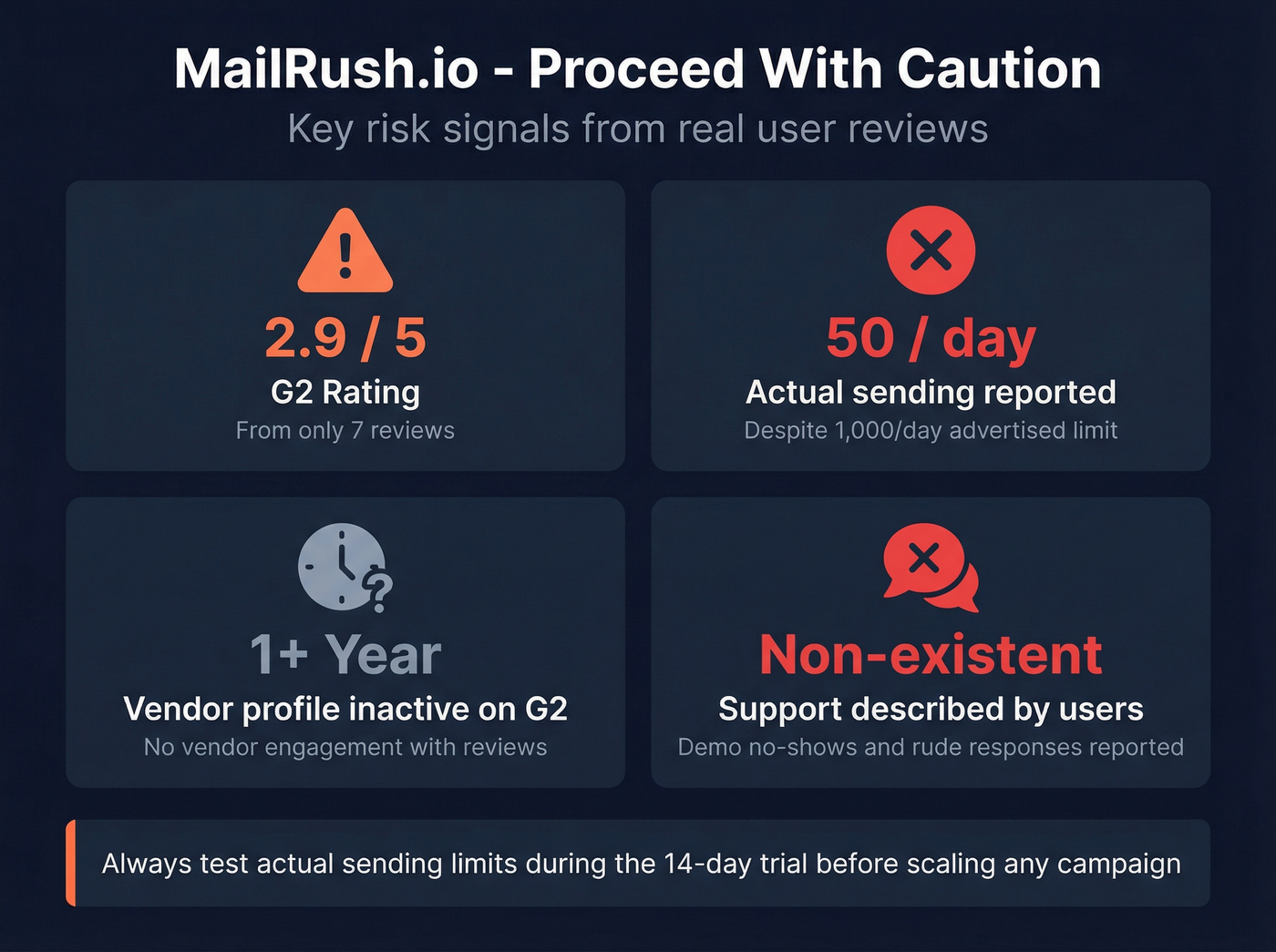
The red flags are serious, though. That 2.9/5 G2 rating from 7 reviews isn't just low - G2 notes the vendor profile hasn't been active for over a year, which at minimum means the listing isn't being maintained. One G2 reviewer reported a daily sending cap of around 50 emails despite the advertised 1,000/day limit. That's a massive gap between promise and delivery.
Customer support is described as "non existent" in one G2 review, and a Capterra review calls support "rude" and "useless" during DNS setup issues. DNS setup friction compounds the problem when you can't get help configuring SPF, DKIM, and DMARC records. (If you need a quick reference, here are SPF record examples and a guide on how to verify DKIM is working.) The Capterra rating (4.2/5 from 14 reviews) looks better on paper, but 14 reviews is still a tiny sample.
Here's the thing: don't choose MailRush for production sending unless the 14-day trial proves you can actually hit the advertised daily volume. We wouldn't run a client program on a tool with 7 G2 reviews and support complaints like these. The $19/mo price is attractive until you factor in the risk of burned domains and missed sends.
Which Should You Actually Use?
Let's be honest - most outbound teams need both categories of tool, a finder and a sender, but not necessarily these specific products.
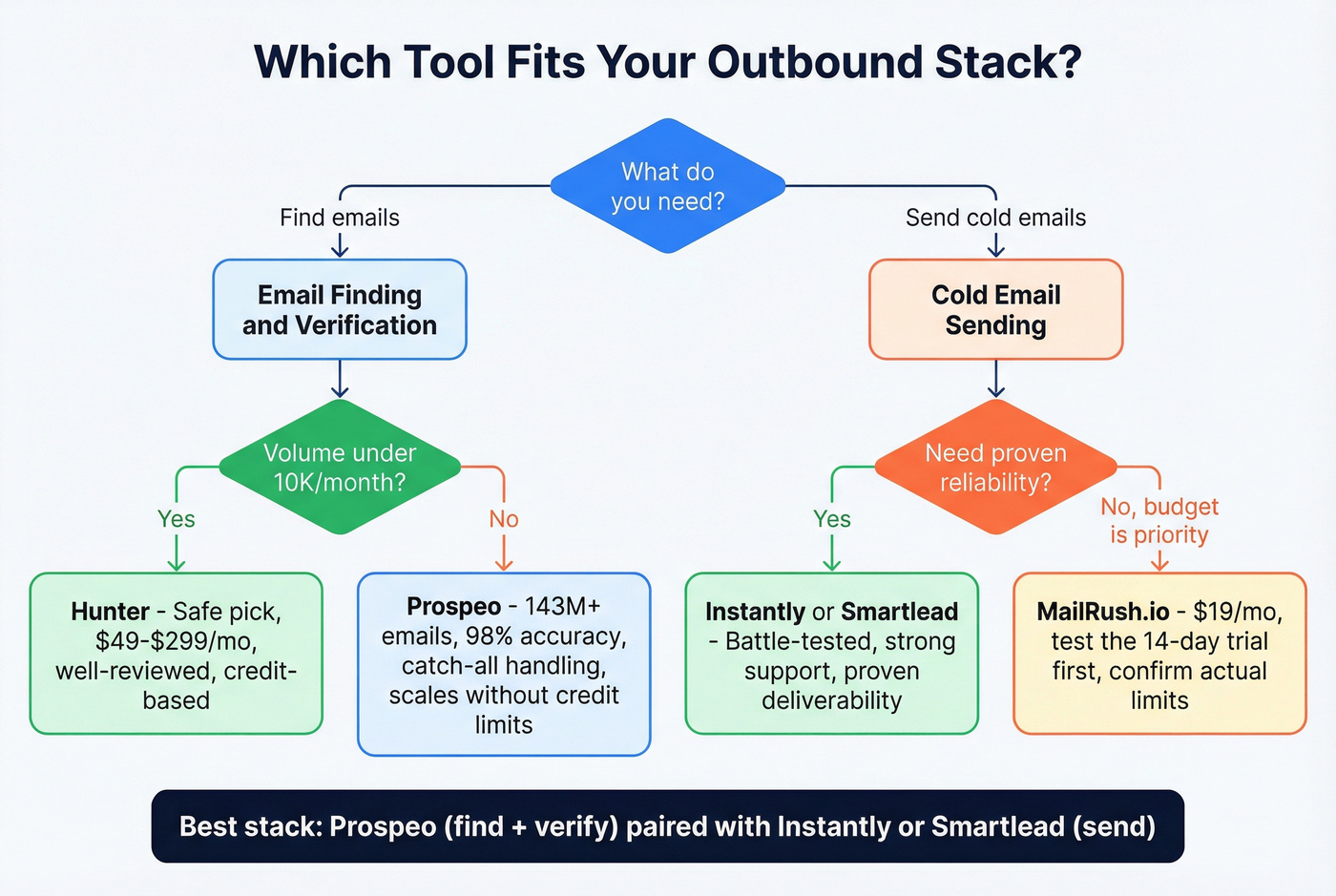
Hunter is a safe pick for email finding if your volume stays under 10,000 lookups per month and you're comfortable with the credit math. It's battle-tested, well-reviewed, and the free tier lets you validate data quality before committing. (If you’re shopping around, compare options in our list of Hunter alternatives.)
MailRush.io is a riskier bet. The feature set on paper competes with senders charging 3-5x more, but the thin review base and support complaints introduce real operational risk. If you're an agency with clients depending on consistent deliverability and warm-up volume, that risk isn't worth the small monthly savings over more established senders like Instantly or Smartlead.
The finding and verification layer is the foundation of your entire outbound stack. Get that wrong, and it doesn't matter how good your sender is - bad data means bounced emails, burned domains, and tanked sender reputation. (For a deeper breakdown, see our email deliverability guide.) One of our customers, Stack Optimize, built from $0 to $1M ARR running client deliverability at 94%+ with bounce rates under 3% and zero domain flags - that kind of consistency starts with clean data, not clever copy.

Your outbound stack needs a data layer you can trust. Prospeo's 5-step verification catches what bundled validators miss - spam traps, honeypots, and catch-all domains that silently destroy deliverability. Pair it with Instantly or Smartlead and your bounce rate stays under 3%.
Stop stacking workarounds. Start with data that's accurate on day one.
FAQ
Can I use Hunter and MailRush.io together?
Yes - they serve complementary functions. Use Hunter to build your verified contact list, then import those contacts into MailRush.io for automated sequences with spintax, warmup, and follow-ups. For higher accuracy on the finding side, Prospeo's 5-step verification with catch-all handling produces cleaner lists that protect your domain reputation downstream.
Is MailRush.io still actively maintained?
It's unclear. The G2 vendor profile hasn't been active for over a year, and recent reviews cite serious support issues including demo no-shows and unresponsive tickets. Test deliverability with a small batch during the 14-day trial before scaling any campaign - confirm actual sending limits match advertised ones.
How do catch-all domains affect verification?
Catch-all domains accept every email address at the SMTP level, so standard verification returns "valid" even for nonexistent addresses. This inflates list quality on paper while causing bounces in practice. Dedicated verification tools with catch-all handling flag these addresses separately so you can reduce volume or skip them entirely - bundled validation inside sending tools rarely makes this distinction.