

Hunter vs Ocean.io: Different Tools for Different Jobs
The Hunter vs Ocean.io comparison is misleading because these tools barely overlap. Hunter finds and verifies email addresses from domains you already know. Ocean.io uses AI to find new companies that look like your best customers. Picking between them depends entirely on which problem is actually costing you pipeline right now.
30-Second Verdict
Pick Hunter if you've got a list of target companies and need verified emails fast, plus built-in cold email sequences.
Pick Ocean.io if you've nailed your ICP and want to discover lookalike accounts across new markets or geographies.
Skip both if your real bottleneck is email accuracy and data freshness at scale - you'll find a better option below.
What Each Tool Actually Does
Hunter
You know which companies to target and need emails to reach them. That's Hunter's sweet spot. Its core is domain search: punch in a company domain, get associated email addresses. It also offers email verification, a [Chrome extension](https://chromewebstore.google.com/detail/hunter-email-finder-exten/hgmhmanijnjhaffoampdlllchpolkdnj, and built-in cold email sequences.
Hunter shows where each email was sourced - a transparency detail that matters for GDPR-conscious teams. Pricing runs from free (50 credits/month) through Starter at $49/mo, Growth at $149/mo, and Scale at $299/mo. Straightforward, no surprises.
Skip this if you need to discover new accounts you haven't identified yet. Hunter doesn't do that.
Ocean.io
Ocean.io's standout is its AI-powered lookalike search, which analyzes firmographics, technographics, and professional roles to surface accounts that resemble your best customers. It includes unlimited seats - a genuine differentiator for larger teams - and GDPR-compliant contact data.
Pricing runs on a universal credit system at $0.064/credit with a 9,000-credit minimum ($576 entry point). Capterra lists Ocean.io starting at $79/month, though the credit minimum makes the real floor higher for most use cases.
Skip this if you just need emails for a known target list. You'd be paying for account discovery you don't need.
Feature Comparison
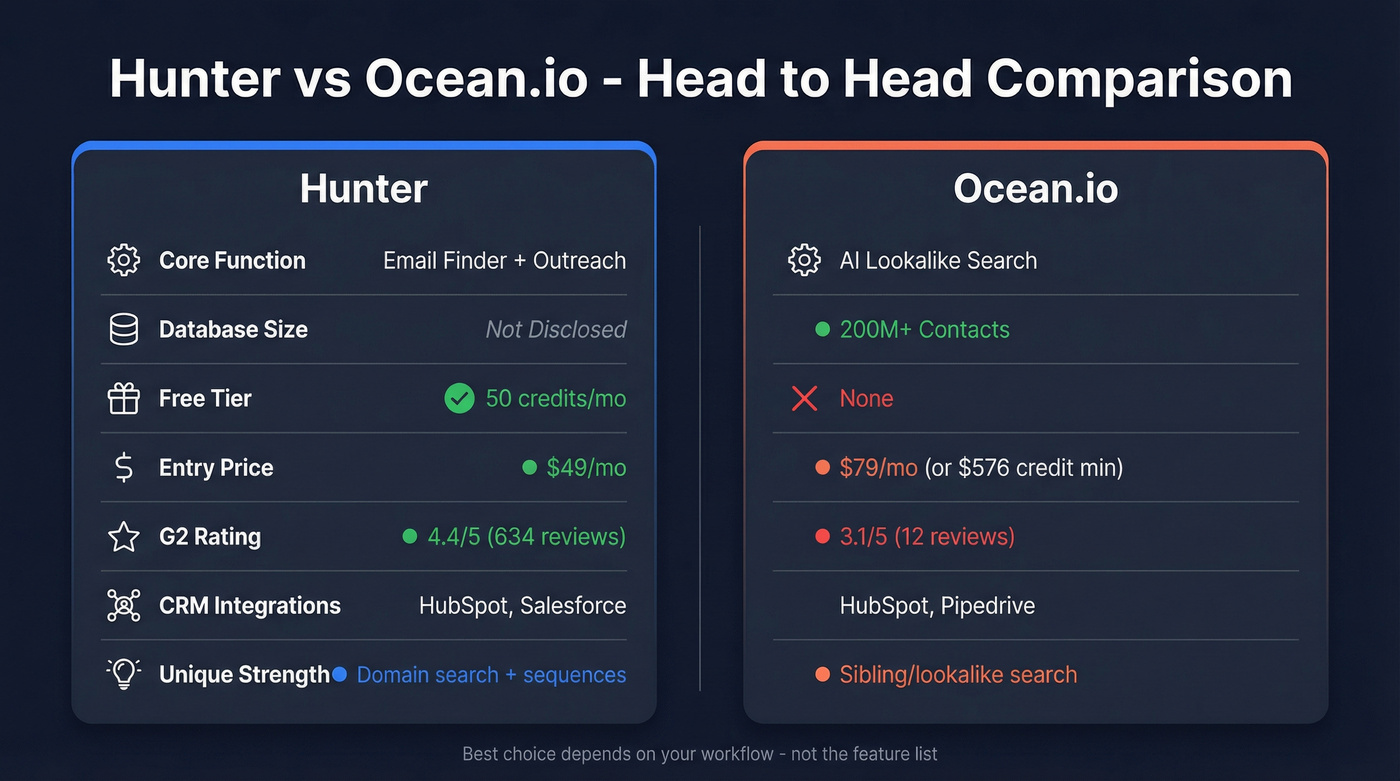
| Hunter | Ocean.io | Winner | |
|---|---|---|---|
| Core function | Email finder + outreach | AI lookalike search | Depends on need |
| Database size | Not disclosed | 200M+ contacts | Ocean.io |
| Free tier | 50 credits/mo | No | Hunter |
| Entry price | $49/mo | ~$79/mo (or $576 credit min) | Hunter |
| G2 rating | 4.4/5 (634 reviews) | 3.1/5 (12 reviews) | Hunter |
| Capterra rating | 4.6/5 | 4.4/5 (ease-of-use: 4.7) | Hunter |
| CRM integrations | HubSpot, Salesforce | HubSpot, Pipedrive | Hunter |
| Unique strength | Domain search + sequences | Sibling/lookalike search | Tie |
The cost-per-email gap matters, but Ocean.io's credit system is deceptive at first glance. One verified email costs 1 credit, but a direct phone number costs 10 credits, and each search result consumes 0.2 credits. A prospecting session that returns 50 results, enriches 20 emails, and pulls 5 phone numbers burns 80 credits - not the 25 you'd naively expect.

Hunter caps your credits. Ocean.io burns them on stale contacts. Prospeo delivers 300M+ profiles at 98% email accuracy, refreshed every 7 days - not 6 weeks. At $0.01/email, one Prospeo plan replaces the $800/month Hunter + Ocean.io stack.
Stop splitting budget across two tools that still bounce emails.
Where Each Tool Falls Short
Hunter's Weak Spots
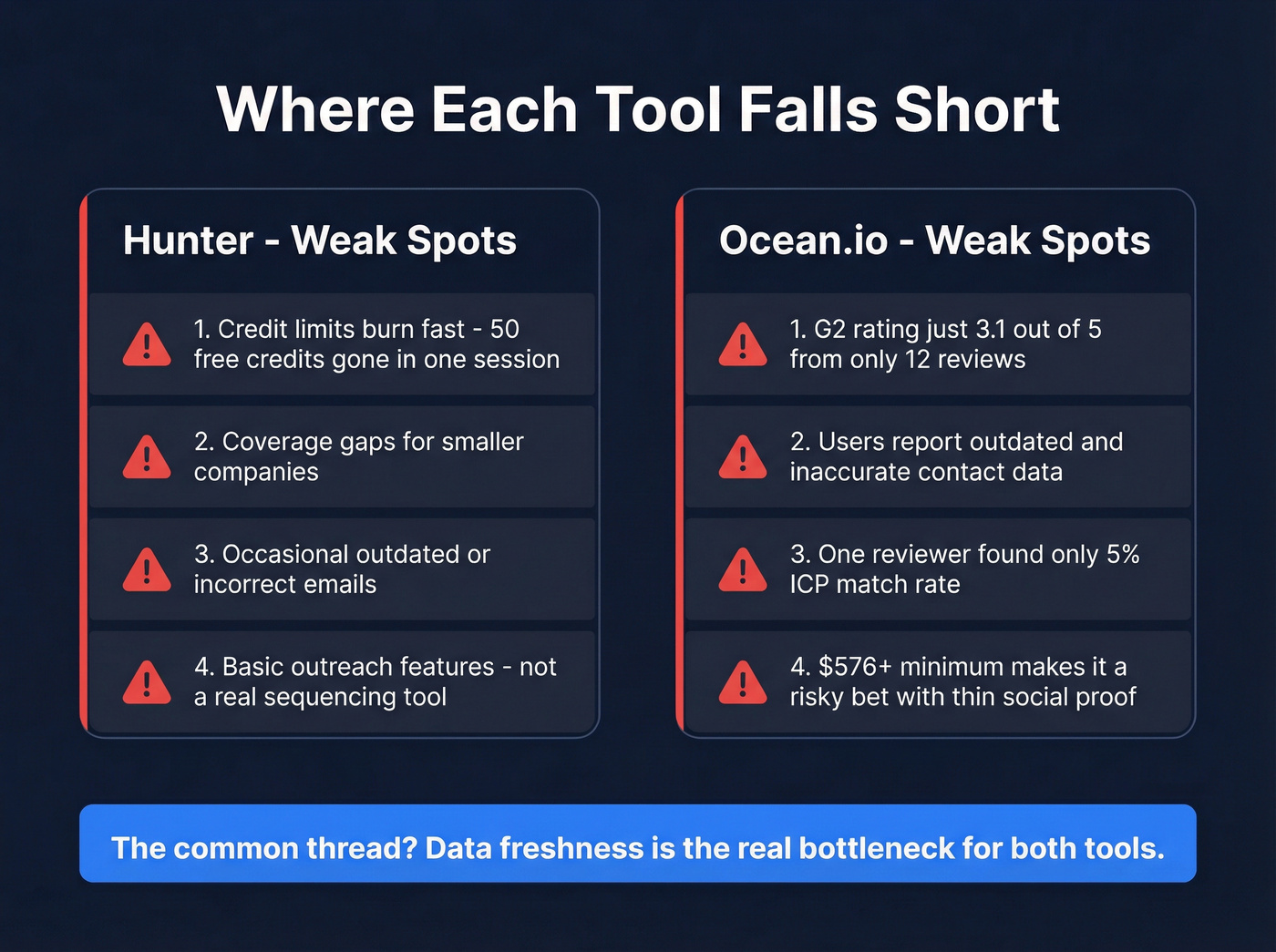
Credit limits are a recurring frustration in Hunter's G2 feedback. The free tier's 50 credits disappear in a single prospecting session, and even the $299/mo Scale plan has limits that high-volume teams burn through. Coverage can be uneven for smaller companies, and you'll still hit occasional outdated or incorrect emails. If this is your situation, compare options in our Hunter alternatives guide.
The outreach features are functional but basic compared to dedicated sequencing tools like Instantly or Lemlist. If you're already running sequences elsewhere, Hunter's built-in campaigns won't replace them.
Ocean.io's Weak Spots
Here's the thing: Ocean.io's review profile is a red flag. Its G2 rating sits at 3.1/5 from just 12 reviews, with tags including "outdated data," "inaccurate data," "poor filtering," and "expensive."
One Capterra reviewer reported a 5% ICP match rate - compared to 40-50% with competing tools. The consensus on Reddit threads echoes this: teams are tired of spending a fortune on prospect lists that don't convert. The sibling search feature genuinely impresses teams who need it, but the underlying data quality can undermine the value of finding the right accounts if the contact info attached to them is stale.
Ocean.io solves a real problem - account discovery - but it's a $576+ bet on a tool with thin social proof. If your average deal size is under $15k, the math often doesn't work.
When to Pick One Over the Other
Go with Hunter if you:
- Already know your target companies and need emails from their domains
- Want email finding and cold outreach in one tool
- Run low-to-medium volume campaigns (under ~3,000 emails/month). If deliverability is a concern, use an email deliverability guide to protect your domain.
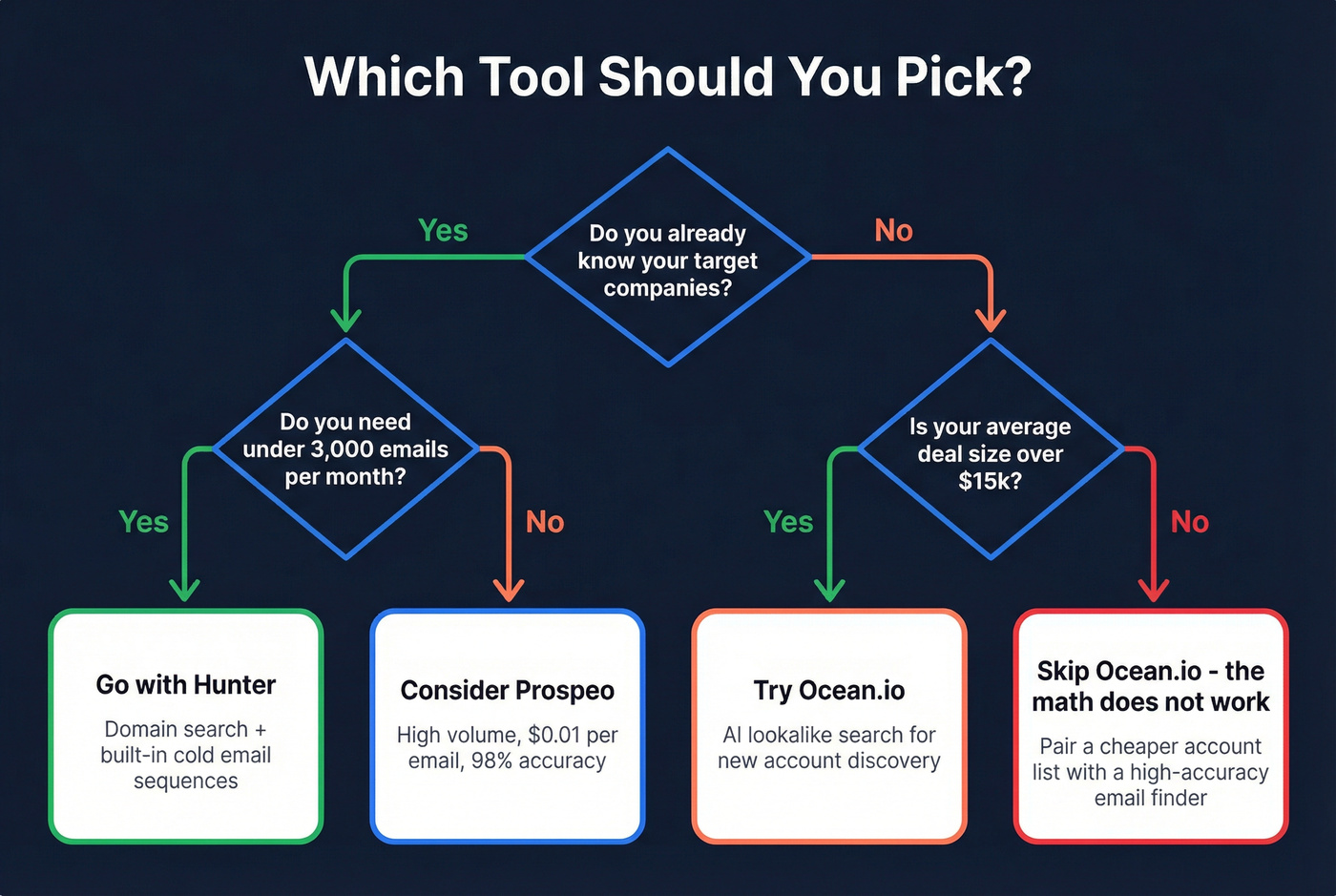
Go with Ocean.io if you:
- Need to discover new accounts that resemble your best customers
- Are expanding into new markets or geographies where sibling search shines
- Care more about account discovery than contact-level data quality
When Neither Tool Fits
We've watched teams pair Ocean.io's account discovery with Hunter's email finding, only to hit credit walls on both sides. One agency we spoke with was spending $800/month across both tools and still seeing 15%+ bounce rates on their campaigns. If your sequences are tanking because of bounced emails and stale data, the bottleneck isn't account discovery or domain search - it's data quality. Start by benchmarking your email bounce rate and tightening list hygiene with data enrichment.
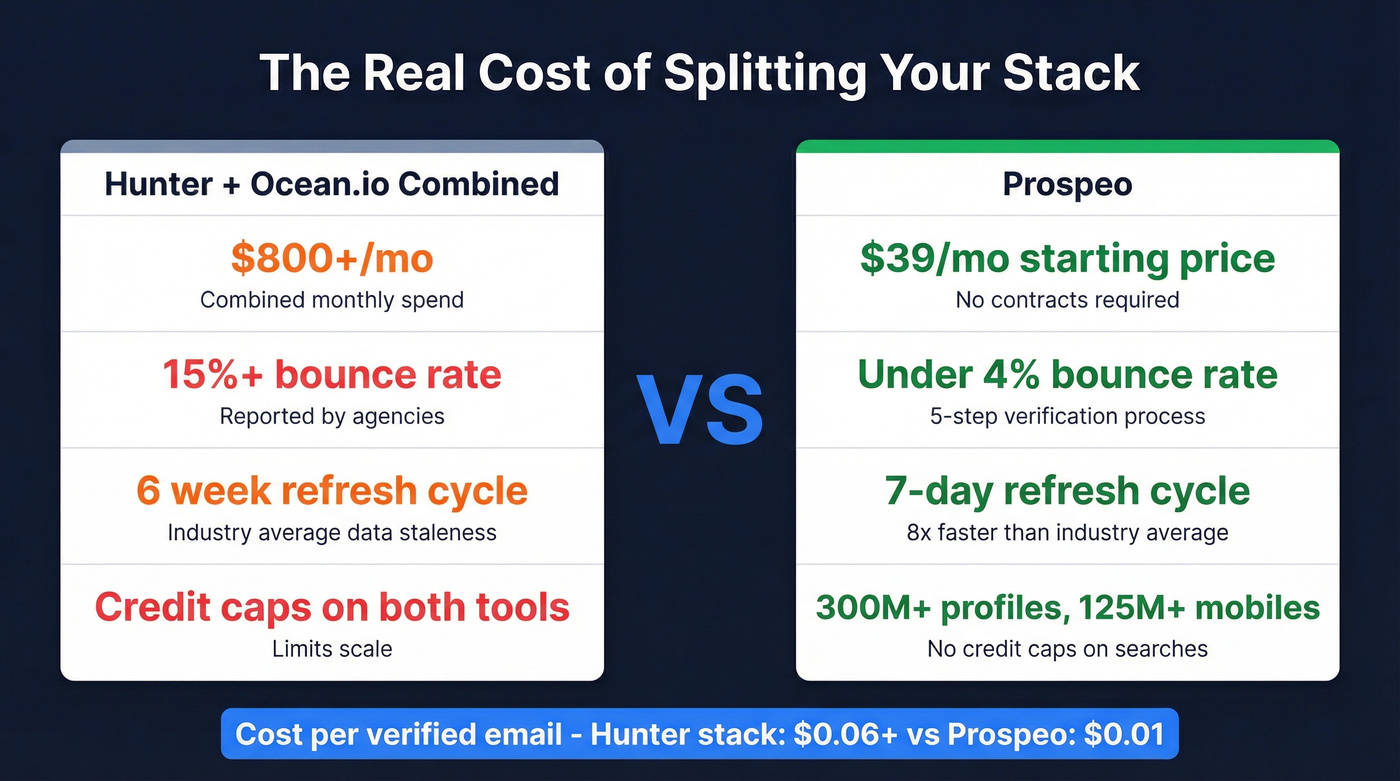
Prospeo covers 300M+ professional profiles with 98% email accuracy and 125M+ verified mobile numbers, all refreshed on a 7-day cycle versus the 6-week industry average. The free tier gives you 75 emails/month, paid plans start around $39/mo with no contracts, and cost per email lands at roughly $0.01. For teams burning sender reputation on bad data, that's the actual fix.
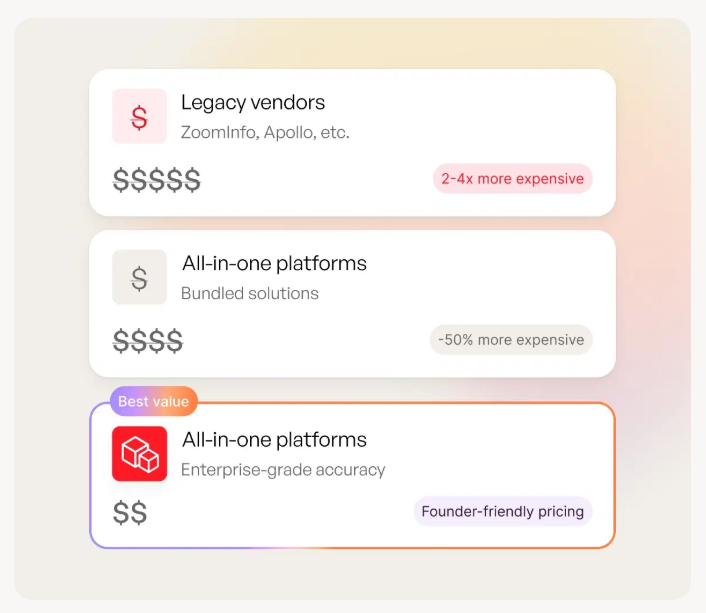
The real bottleneck in the Hunter vs Ocean.io debate isn't account discovery or domain search - it's data freshness. Prospeo's 7-day refresh cycle and 5-step verification keep bounce rates under 4%, while 125M+ verified mobiles give you a direct line when email alone isn't enough.
Fix your bounce rate before you fix your tech stack.
FAQ
Can I use Hunter and Ocean.io together?
Yes - Ocean.io finds accounts, then you use a separate tool for contact data. But Hunter's credit limits make this pairing expensive at scale. A more cost-effective workflow pairs Ocean.io's account discovery with a high-volume email finder that charges ~$0.01/email without credit caps on searches.
Is Ocean.io's data accurate?
Reviews are split. Capterra gives it 4.4/5 with strong ease-of-use scores, but G2 rates it 3.1/5 with recurring complaints about outdated contacts. The lookalike engine is clever; data freshness remains the weak link.
What's the cheapest way to get verified B2B emails?
Prospeo starts free at 75 emails/month and charges ~$0.01/email on paid plans - significantly cheaper than Hunter's $49+ tiers and Ocean.io's $0.064/credit system, with 98% accuracy and weekly data refreshes baked in.
Which tool is better for outbound agencies?
Hunter works for low-volume, single-client setups. Ocean.io suits agencies doing market expansion research. Neither scales well for multi-client outbound - credit limits and per-seat pricing add up fast. Agencies running campaigns across several clients typically need a self-serve platform with transparent pricing and no contracts, which is exactly why teams like Stack Optimize built to $1M ARR using a tool that kept bounce rates under 3% across all their clients.