

The Hybrid Sales Model: How to Actually Build One (Not Just Define It)
Your CEO came back from a conference and said "we need a hybrid sales model." Your CRO nodded. Now it's on your desk, and you've got no playbook. Every McKinsey deck defines the concept beautifully. None of them tell you how to set comp plans, size teams, or pick the five tools that actually matter.
What It Actually Means
A hybrid sales model blends in-person, remote, and digital self-serve motions into a single go-to-market engine. It's not a philosophy - it's an org design choice. Some teams call this an allbound go-to-market approach, combining inbound, outbound, and product-led motions under one roof.
The "rule of thirds" captures it cleanly: at any buying stage, roughly one-third of buyers prefer in-person, one-third prefer remote, and one-third prefer digital self-serve. Buyers now use about 10 channels on average, up from 5 in 2016. The model exists because buyers demanded it - and more than half say they'll switch suppliers if the experience isn't smooth across those channels.
This isn't a pandemic artifact. Over 90% of enterprises plan to sustain the sales force structure changes they made to enable hybrid selling. It's the permanent operating model now.
The Short Version
Here's what matters most before we get into the details:
The rule of thirds isn't a suggestion - it's buyer behavior. One-third in-person, one-third remote, one-third self-serve. Companies covering all three drive up to 50% more revenue.
The org chart matters more than the strategy deck. Role design, manager spans, and SDR-to-AE ratios determine whether hybrid actually works or just sounds good in a board presentation.
Hybrid fails at the comp plan, not the channel mix. 75% of B2B buyers will prefer human interaction over AI by 2030. The humans still matter. But if your incentives reward the wrong channel, reps optimize for easy closes and ignore the motions that build pipeline.
Why Hybrid Selling Works - The Numbers
McKinsey's research, spanning 2,500+ sales organizations plus B2B Pulse survey data and interviews, found that hybrid approaches drive up to 50% more revenue. Remote reps can reach 4x as many accounts in the same time window. Their 2024 B2B Pulse Survey of about 4,000 decision makers across 34 sectors and 13 countries confirms the "rule of thirds" and the 10-channel buying journey aren't edge cases - they're the norm.
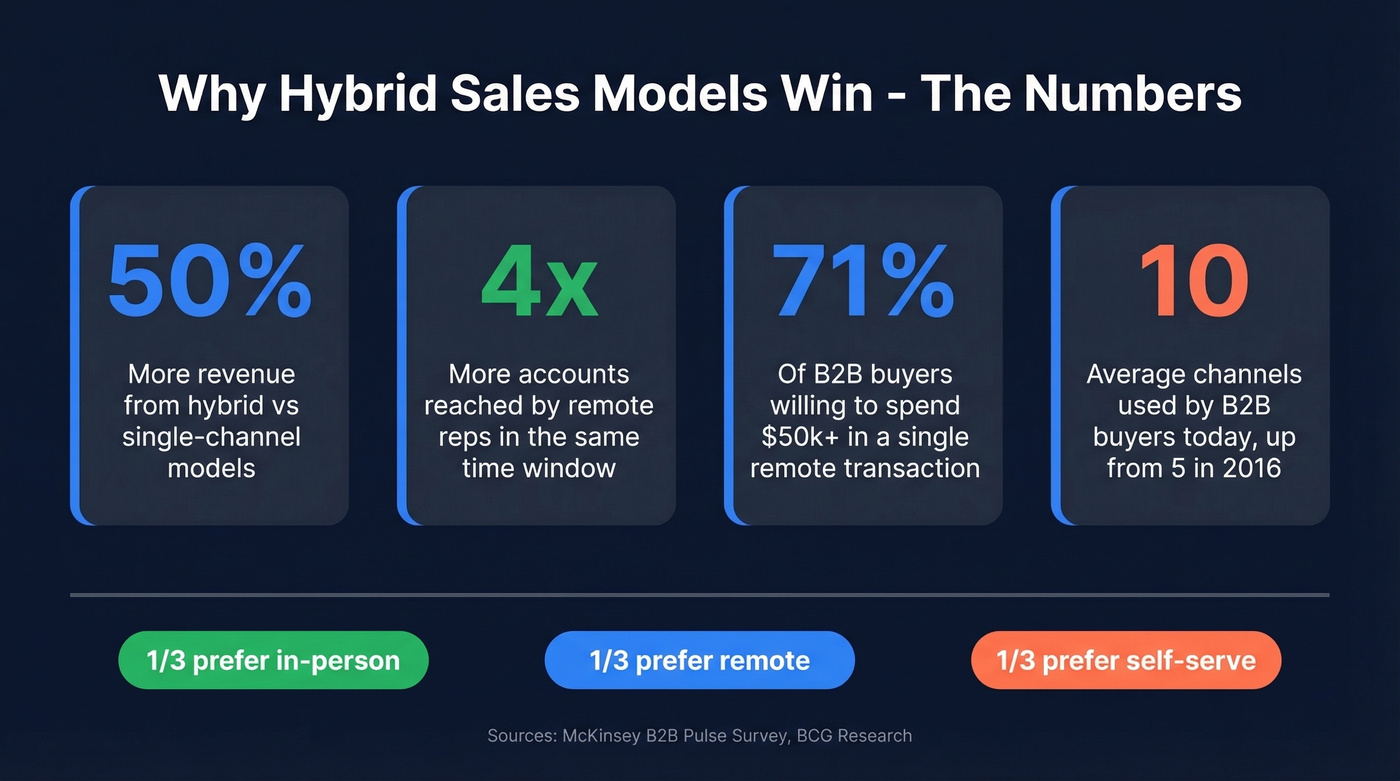
The buyer side is equally telling. 71% of B2B buyers are willing to spend more than $50,000 in a single remote transaction. 27% would go above $500,000. The old assumption that big deals require a handshake is dead.
Among companies offering e-commerce, it's now the top revenue-generating channel, with more than a third of revenue flowing through it - in-person revenue dropped 5 percentage points year-over-year. Gartner projects 80% of CSOs will need AI-augmented plans by 2030 to navigate these shifts, and early GenAI adopters in B2B sales are already 1.7x more likely to increase market share.
BCG's research adds a concrete proof point: a Fortune 100 B2B services company redesigned its digital journey, aligned tools and training across marketing and sales, and doubled its close rate within three months. In another BCG example, an inside-sales pilot with roughly 200 reps increased conversion roughly ten-fold and generated more than $100 million in incremental annual recurring revenue.
Here's the thing: if your average deal size is under $15k, you probably don't need a field sales team at all. Remote plus self-serve will outperform a blended model that includes expensive in-person reps. Hybrid doesn't mean "add every channel" - it means match your motions to your deal economics.
How to Structure a Hybrid Sales Org
This is the section nobody else writes, because it requires actual operational knowledge.
Start with the SDR-to-AE ratio. The Bridge Group benchmark is about 1 SDR per 2.6 AEs on average, but that shifts based on deal complexity. Work backward from your AE's opportunity needs: if an AE needs 15 qualified opps per month and an SDR generates 10, you need closer to 1.5 SDRs per AE.
Manager span of control matters just as much. The Alexander Group benchmarks break down cleanly:
| Role Type | Manager Span |
|---|---|
| Inside sales | 8-12 reps |
| Field (transactional) | 8-10 reps |
| Field (complex/enterprise) | 5-8 reps |
| SDR teams | 10-12 reps |
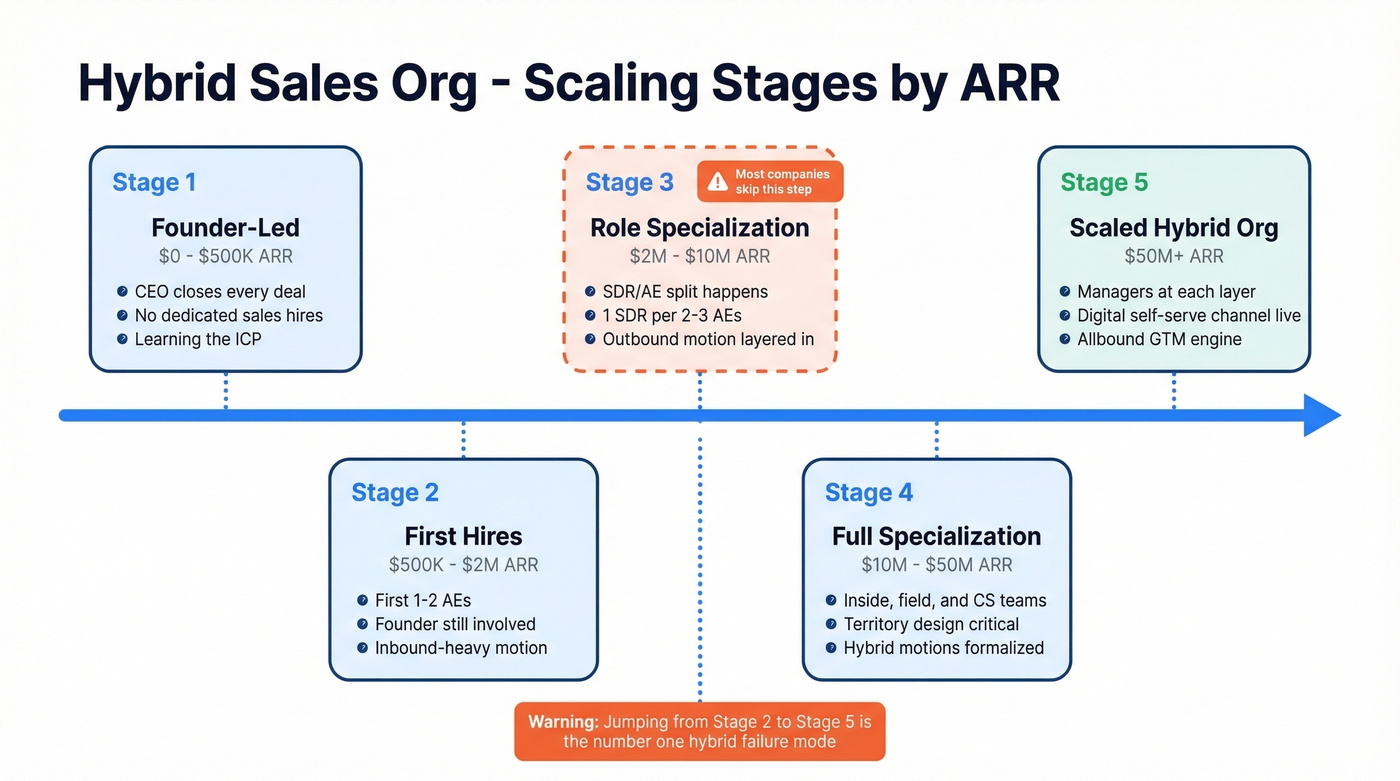
The scaling stages follow a predictable arc by ARR: founder-led selling, then first dedicated hires, then role specialization (the SDR/AE split), then full specialization with inside, field, and CS teams, and finally a scaled org with managers at each layer. Most companies try to skip the specialization step and jump straight to "hybrid," which just means everyone does everything poorly. The transition from a self-service to outbound motion is particularly tricky - you need to layer in human-led motions without breaking the product-led flywheel that got you there.
Territory design is where hybrid orgs live or die. We've seen teams assign 300-400 accounts per hunter territory with a target of 10-15 new logos per year, while farmers manage 25-35 accounts on 3-6 month cycles. When you combine those roles into a single "hybrid rep," the rep defaults to farming existing accounts because it's easier. The org chart has to enforce the separation that the strategy deck promises - no amount of enablement training overrides misaligned incentives.
Building a Hybrid Outreach Strategy
The channel mix is only half the equation. How reps engage across those channels determines whether hybrid prospecting actually generates pipeline or just creates noise.
The core tension is warm outreach vs cold outreach. Cold outreach casts a wide net - high volume, low personalization, low response rates. Warm outreach uses existing signals: website visits, content downloads, mutual connections, or intent data. The warm outreach benefits are measurable: higher reply rates, shorter sales cycles, and better conversion to qualified pipeline. A hybrid sales strategy sequences both - cold to create awareness, warm to convert it - rather than treating them as competing motions.
In practice, the best allbound sales teams layer signals on top of outbound sequences. An SDR starts with a cold email to a target account, then shifts to warm outbound once the prospect engages with a case study or visits the pricing page. Understanding cold outreach vs warm outbound isn't about picking one. It's about knowing when each motion earns the next touch.

Your hybrid reps are working 10 channels. Bad data kills every one of them. Prospeo's 98% email accuracy and 125M+ verified mobiles mean your SDRs and AEs connect on the first touch - whether they're running cold outbound, warm sequences, or self-serve follow-ups.
Feed your hybrid sales engine data that actually converts.
The Comp Problem Nobody Talks About
Let's be honest - this is where most hybrid rollouts actually die.
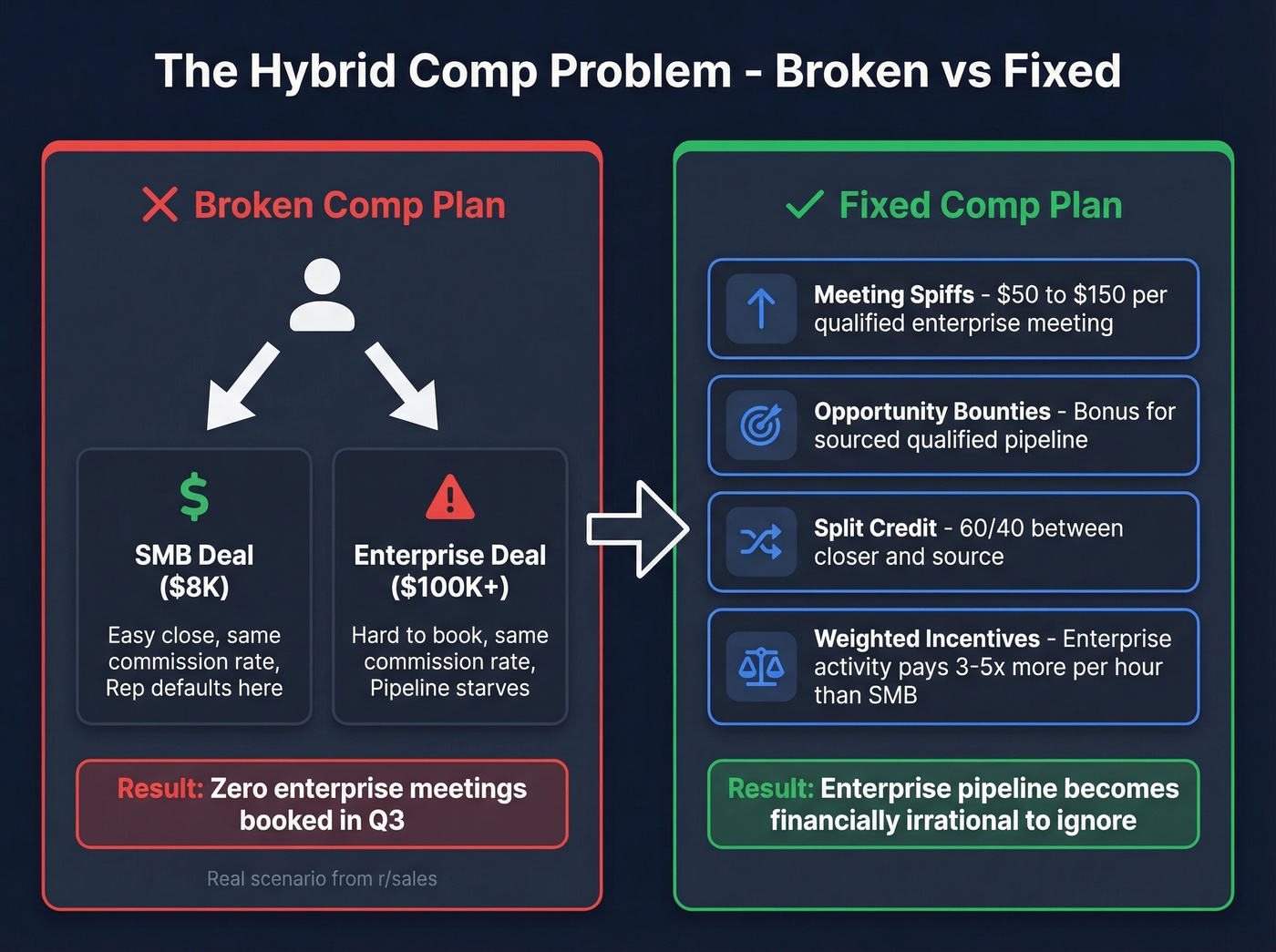
A real scenario from r/sales: an SDR is expected to book enterprise meetings (>$100k ACV) while also closing SMB deals under $8k. Predictably, the rep gravitates toward the easier SMB closes because the comp plan doesn't differentiate. The enterprise pipeline starves.
BCG calls this the "channel fiefdom" problem - when compensation and incentives are tied to individual channel transactions, each channel operates as an isolated kingdom. The customer experience fragments, and the hybrid model exists only on paper.
The fix is structural: meeting spiffs ($50-$150 per qualified enterprise meeting booked), qualified opportunity bounties, split credit (60/40 between closer and source), and weighted incentives by deal size so enterprise activity pays disproportionately more than SMB closes. Make the harder motion financially irrational to ignore.
Your Hybrid Tech Stack
Every hybrid sales guide says "use technology." None tell you that your reps are spending 21% of their time managing tools instead of selling. The average B2B company uses 87 software tools, but only 23% directly impact revenue.
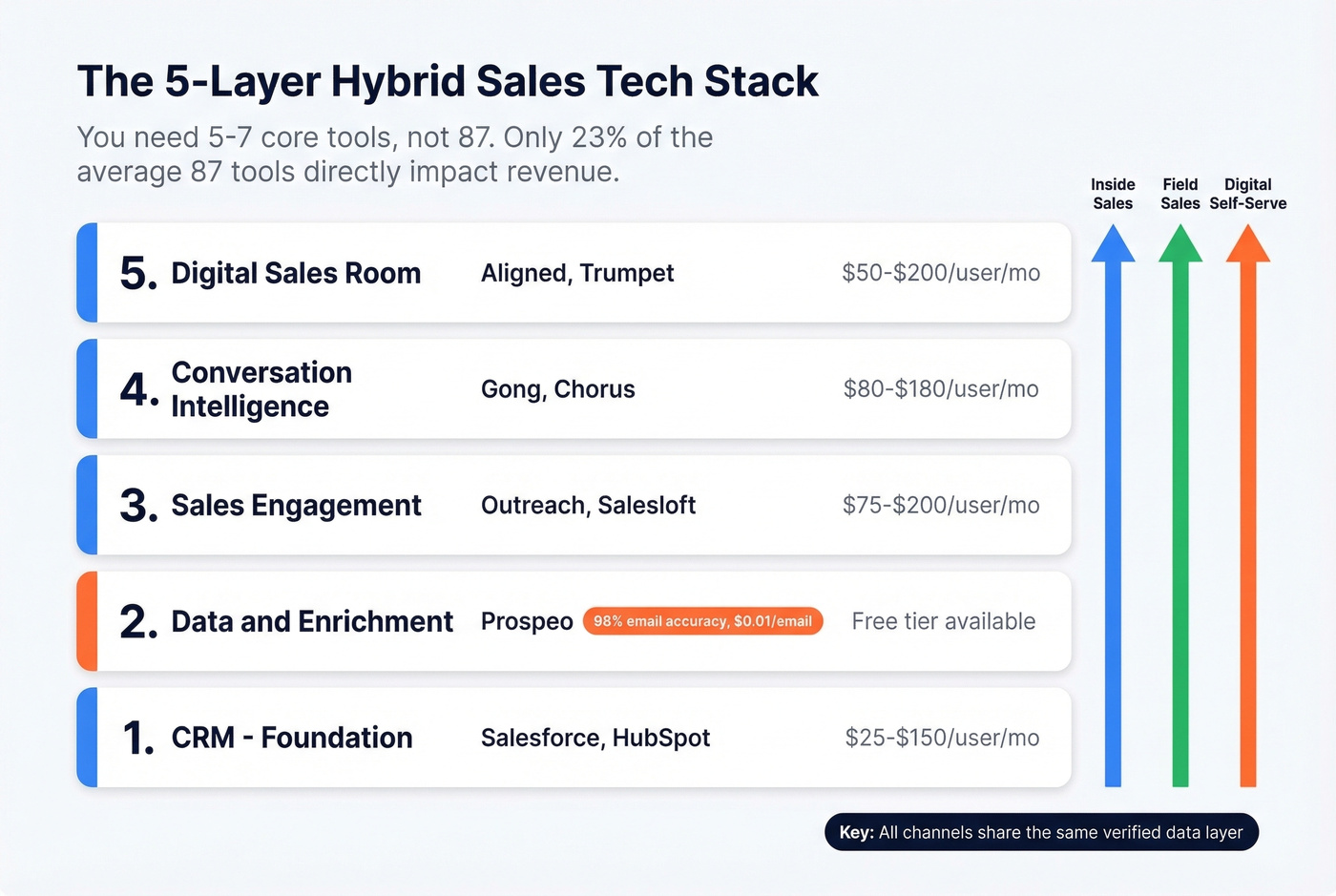
You need 5-7 core tools. Not 87.
| Layer | Example | Typical Cost |
|---|---|---|
| CRM | Salesforce, HubSpot | $25-$150/user/mo |
| Data & enrichment | Prospeo | ~$0.01/email, free tier |
| Sales engagement | Outreach, Salesloft | $75-$200/user/mo |
| Conversation intel | Gong, Chorus | $80-$180/user/mo |
| Digital sales room | Aligned, Trumpet | $50-$200/user/mo |
Hybrid selling multiplies touchpoints, which multiplies the cost of stale data. For the enrichment layer, Prospeo refreshes 300M+ profiles every 7 days - compared to the 6-week industry average - and runs 98% email accuracy. It integrates natively with Salesforce, HubSpot, Outreach, Salesloft, and outbound tools like Smartlead, Instantly, and Lemlist, so inside, field, and digital teams all work from the same verified data.
Three Failure Patterns to Avoid
Comp misalignment kills more hybrid rollouts than anything else. A rep on r/sales described booking zero enterprise meetings in Q3 because SMB closes paid the same commission rate on a per-hour basis. The diagnosis is always the same: incentives reward individual channel transactions instead of customer outcomes. Shift comp to pipeline influenced, opportunities sourced, and revenue per account.
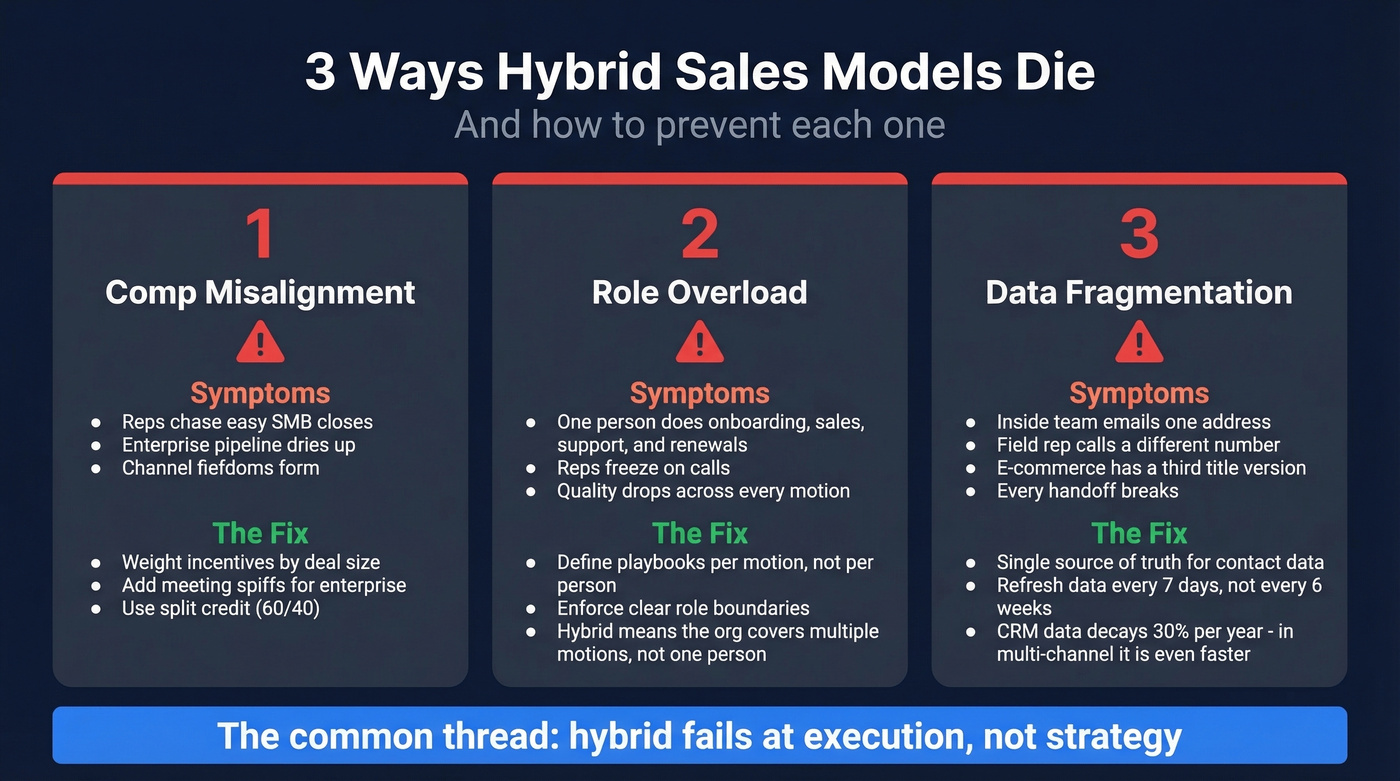
Role overload is the second killer. A practitioner on r/CustomerSuccess described "freezing" on calls because their hybrid CS/sales role bundled onboarding, free-to-paid conversion, support, and renewals into one seat. Hybrid doesn't mean one person does everything - it means the org covers multiple motions with clear role boundaries. Define playbooks per motion, not per person.
Data fragmentation is the most insidious. Your inside team emails one address, the field rep calls a different number, and e-commerce has a third title version for the same contact. Every handoff breaks. We've watched teams invest six figures in org redesign only to see it collapse because nobody owned data hygiene across channels. If your CRM data decays at the standard rate of 30% per year, no amount of org design saves you - and in a multi-channel model, the rot spreads faster because every handoff amplifies the error. Skip this problem at your own risk.
Scaling a hybrid org means more reps, more accounts, more channels - and exponentially more contact data to verify. Prospeo refreshes 300M+ profiles every 7 days, so your field reps, inside sales, and digital motions all work from the same accurate dataset. At $0.01 per email, scaling doesn't break the budget.
Stop letting stale data sabotage your hybrid GTM motion.
What to Measure
Lead-to-customer conversion rate: 2-5% is the B2B benchmark. Below 2% after going hybrid means your channels aren't reinforcing each other.
Channel-attributed pipeline: What percentage originates from each motion? If one channel dominates 80%+, you don't have a hybrid model - you have a single-channel model with extra overhead.
Cross-channel handoff completion rate: Low rates signal data or process gaps between motions. This is the metric most teams forget to track, and it's the one that tells you whether hybrid is actually working or just creating busywork.
Time-to-first-meeting by channel: Remote should be faster than field. If it's not, your inside team has a tooling problem.
Quota attainment distribution: Up to 70% of B2B reps missed quota in 2024. Track whether hybrid reps hit quota at higher rates than single-motion reps - that's your proof the model works.
Operational Best Practices
Before you roll out, pressure-test your plan against these guardrails.
Define clear swim lanes per role. Hybrid prospecting works when SDRs, AEs, and CS each own specific motions - not when everyone "helps out" across channels. The moment you blur those boundaries, accountability disappears and pipeline suffers.
Sequence cold and warm outreach deliberately. Cold opens doors; warm outreach converts. Map your cadences so signal-based touches follow high-volume outbound, not the other way around. For teams that already have intent data flowing, this sequencing is where you'll see the biggest lift.
Audit your tech stack quarterly. If a tool doesn't directly accelerate pipeline or reduce handoff friction, cut it. We've found that most teams can drop 30-40% of their tools without any measurable impact on output.
Refresh contact data weekly, not quarterly. In a multi-channel model, stale data doesn't just hurt one channel - it breaks every handoff downstream.
Run a 90-day pilot before full rollout. Test the strategy with one segment or territory, measure conversion and handoff rates, then scale what works. Don't try to boil the ocean.
FAQ
What's the difference between hybrid and omnichannel sales?
Omnichannel describes the buyer's experience - consistent across channels. Hybrid describes the seller's org design - reps work across in-person, remote, and digital motions. You need a hybrid org to deliver an omnichannel experience, but they solve different sides of the equation: one is demand-side, the other supply-side.
How many channels should a hybrid team cover?
Buyers use about 10 channels on average, but your team doesn't need all 10. Covering in-person, remote (video/phone), email, and digital self-serve is the minimum viable motion. Add channels based on where your buyers actually spend time, not where a consultant tells you to be.
What tools does a hybrid sales team need?
Five to seven core tools: a CRM, a data enrichment platform for verified contacts across channels, a sales engagement tool, conversation intelligence, and optionally a digital sales room. Most teams over-tool - consolidate before adding.
What is allbound sales and how does it relate to hybrid?
Allbound unifies inbound, outbound, and product-led motions into a single revenue engine rather than treating them as separate teams. A hybrid sales model is the operational structure that makes allbound work - it provides the org design, comp plans, and tech stack needed to execute across all those motions simultaneously.
Now go back to that CEO who said "we need a hybrid sales model." Hand them this: an org chart with clear role boundaries, a comp plan that rewards the hard motions, five tools instead of eighty-seven, and a weekly data refresh cycle so nothing breaks at the handoff. That's not a strategy deck. That's a machine.