

ICP Meaning in Software: How to Build One and Activate It
The VP of Sales asks the room to define the ICP. Marketing says "mid-market SaaS companies." The SDR lead says "anyone with 50+ employees using HubSpot." The founder says "companies like the one we just closed." Everyone's right, and everyone's wrong - because nobody wrote it down.
Only 42% of companies have a formally documented ideal customer profile. The ones that do see 50% lower CAC and sales cycles that shrink by 30% or more. That gap isn't a coincidence. Understanding what ICP actually means in software is the first step toward closing it.
What Does ICP Mean in Software?
In B2B software, an ICP defines the attributes of a company most likely to become a loyal, profitable customer. Not a buyer persona. Not a target market. The specific company profile that tells your team which accounts to pursue and which to ignore.
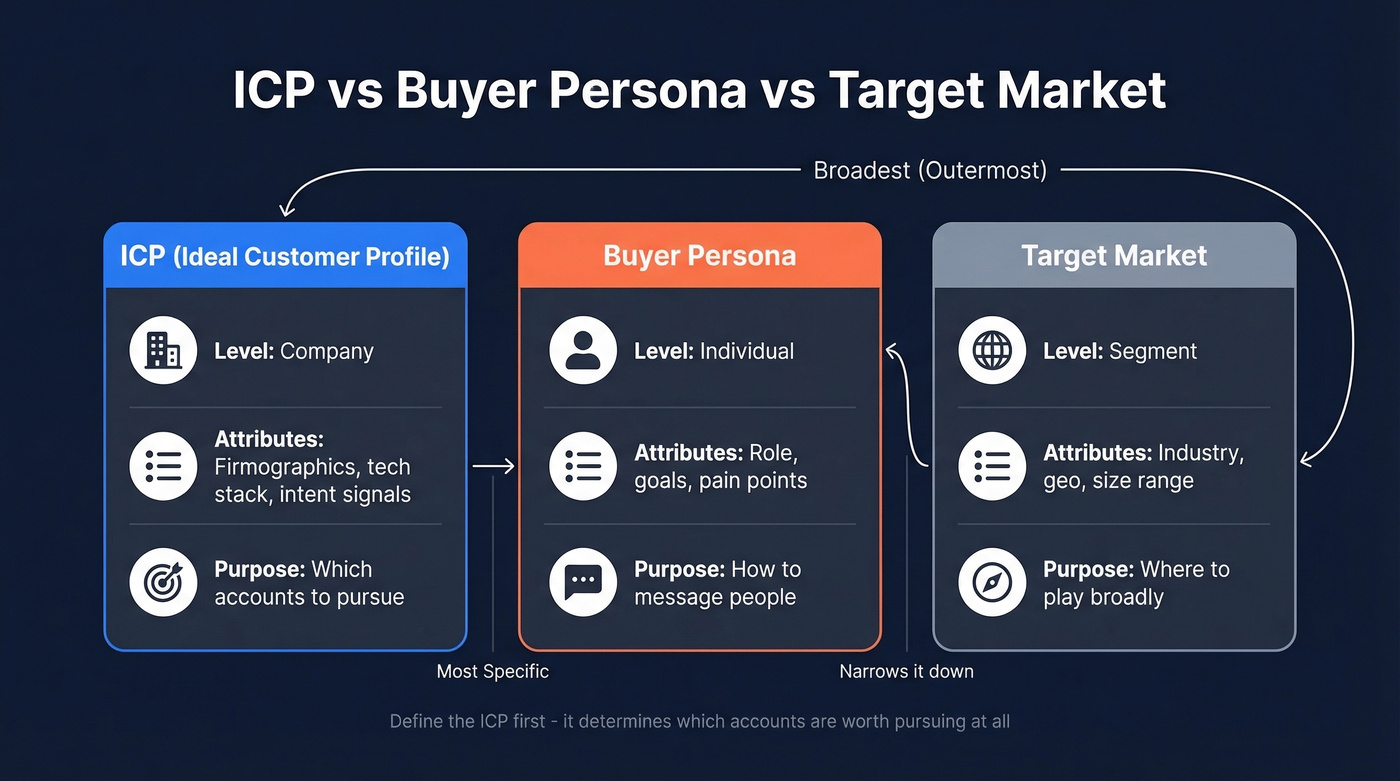
This distinction matters more in software than in most industries, because the person who decides, the person who pays, and the person who uses your product are rarely the same - Gartner puts the average buying committee at five decision-makers. Your ideal customer profile defines the company where those five people sit. Buyer personas define the individuals.
| ICP | Buyer Persona | Target Market | |
|---|---|---|---|
| Level | Company | Individual | Segment |
| Attributes | Firmographics, tech stack, intent | Role, goals, pain points | Industry, geo, size range |
| Purpose | Which accounts to pursue | How to message individuals | Where to play broadly |
How to Build Your ICP
Step 1: Analyze Closed-Won Deals
Pull 50-100 closed-won deals from your CRM. You'll find that 70-80% of wins share 3-5 traits - industry, headcount range, tech stack, or buying trigger. Those patterns are your foundation, and they're far more reliable than whatever your team brainstormed on a whiteboard last quarter.
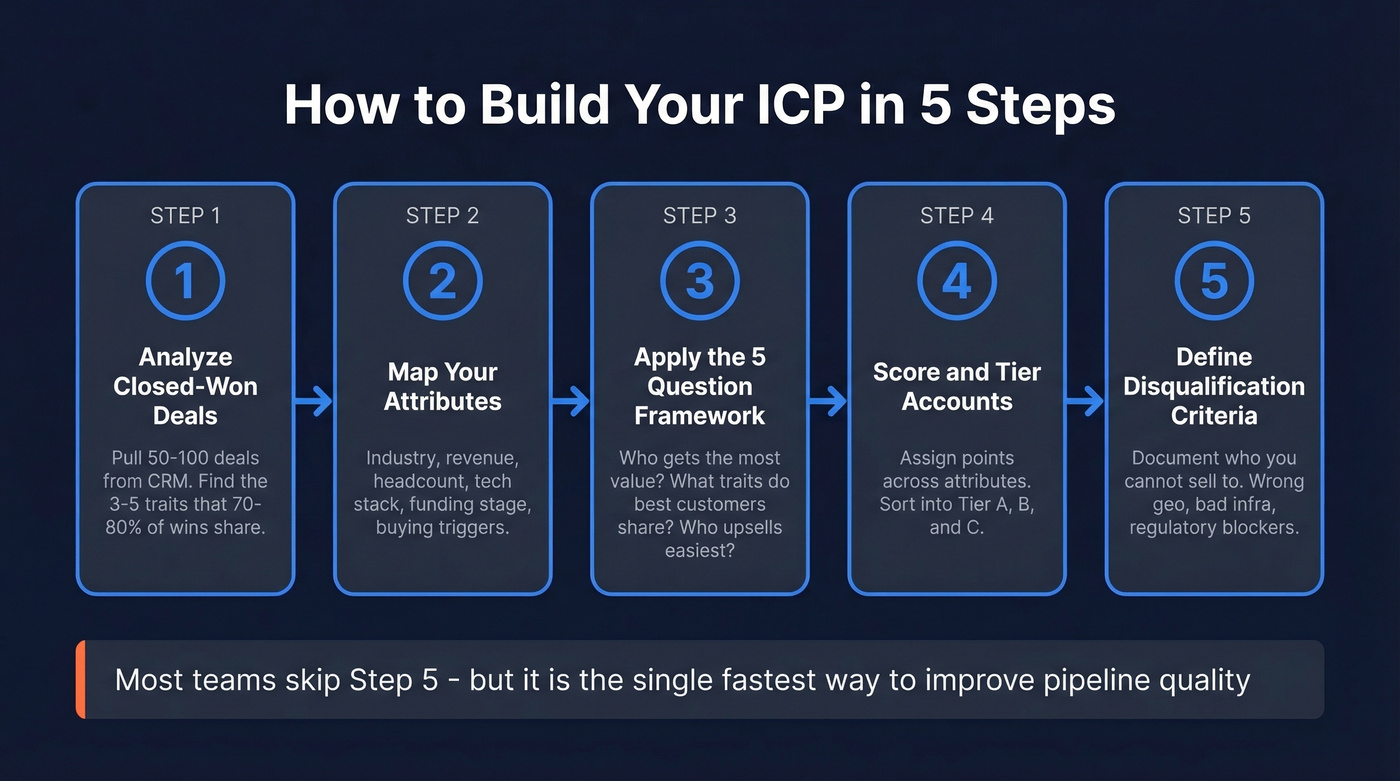
Step 2: Map Your Attributes
Document what matters: industry, revenue range, employee count, technology stack, funding stage, buying triggers, perceived barriers, and active intent signals. Define concrete thresholds. "Mid-market" might mean 100-1,000 employees and $10M-$100M revenue, but base those numbers on your closed-won data, not industry defaults.
Step 3: Apply the Five Question Framework
The a16z framework cuts through guesswork with five questions: Which customers get the most value? What traits do your best customers share? What objections keep appearing in lost deals? Who upsells easiest? What do your competitors' customers have in common? Cohort by fastest revenue growth and shortest sales cycles - not just highest deal size.
Step 4: Score and Tier Accounts
Assign points across your ICP attributes and sort accounts into tiers. This turns a qualitative profile into a quantitative system your whole team can use. We cover the scoring rubric in the next section.
Step 5: Define Disqualification Criteria
Here's the step most teams skip. Explicitly document the accounts you can't sell to - wrong geography, incompatible infrastructure, regulatory constraints. It saves reps from chasing deals that were never going to close, and it's the single fastest way to improve pipeline quality without changing anything else about your process.
Don't build "fairytale personas" in a conference room. The consensus on r/b2bmarketing is blunt: ICPs built without customer or sales input "collect dust."

You just mapped your ICP attributes - firmographics, technographics, intent signals. Prospeo's 30+ search filters match all three layers across 300M+ profiles. Filter by buyer intent across 15,000 topics, tech stack, headcount growth, and funding stage. 98% email accuracy at $0.01/lead.
Stop defining your ICP in spreadsheets. Start building pipeline from it.
ICP Scoring Rubric
A documented profile only works if you can score accounts against it. Here's a 100-point system we've seen work well across mid-market SaaS teams:
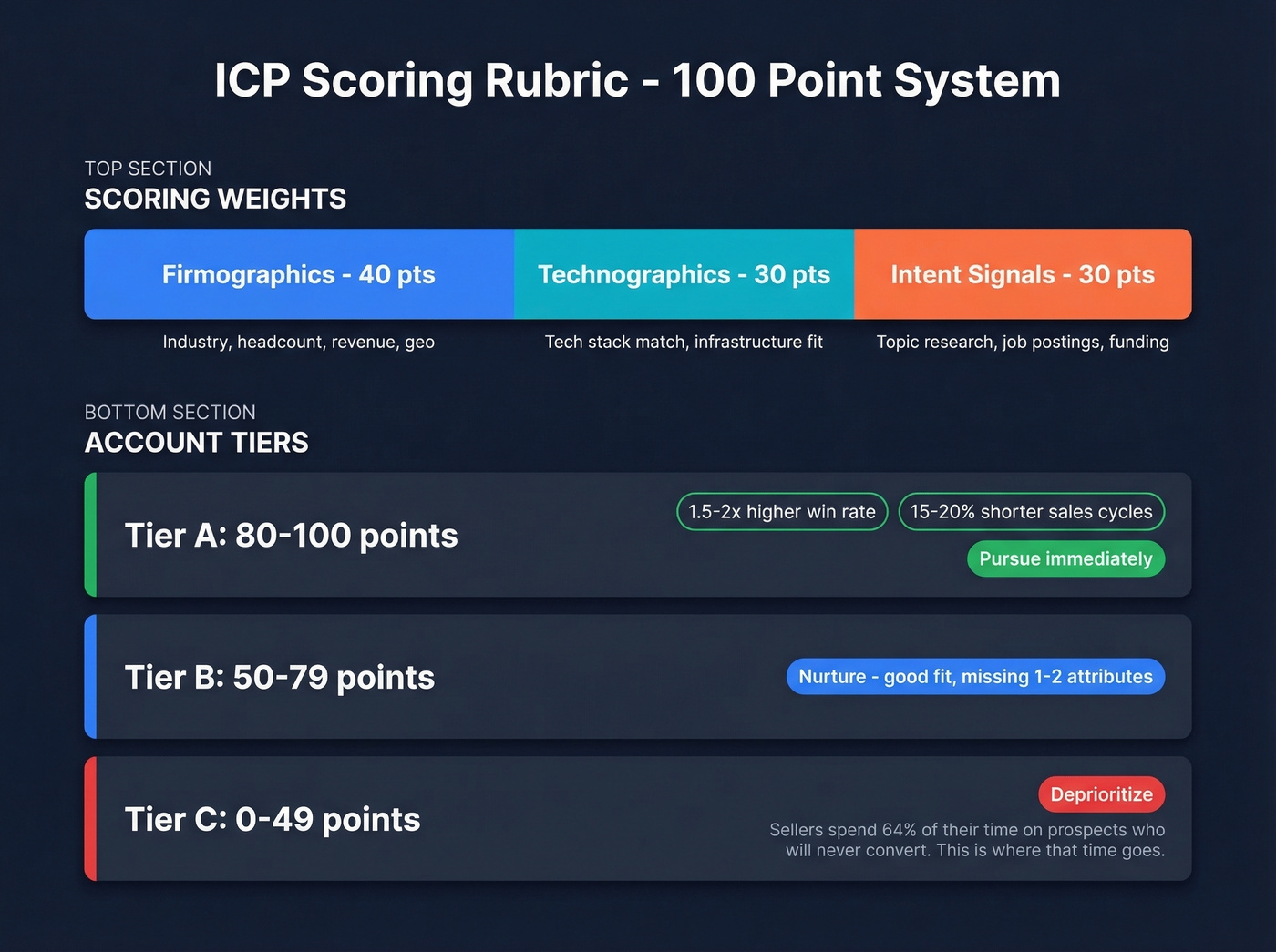
| Category | Weight | Example Attributes |
|---|---|---|
| Firmographics | 40 pts | Industry, headcount, revenue, geo |
| Technographics | 30 pts | Tech stack match, infrastructure fit |
| Intent Signals | 30 pts | Topic research, job postings, funding |
A SaaS company selling $50K ACV deals might weight "uses Salesforce + HubSpot" at 15 points and "actively hiring SDRs" at 10 points. Customize the weights to your sales motion - there's no universal formula.
Tier A (80-100): Pursue immediately. Win rates run 1.5-2x higher than Tier B, with 15-20% shorter sales cycles.
Tier B (50-79): Nurture. Good fit, missing one or two key attributes.
Tier C (0-49): Deprioritize. Sellers spend 64% of their time on prospects who'll never convert. Tier C is where that time goes to die.
Common ICP Mistakes
Fairytale personas get built in conference rooms without talking to customers or sales. They look polished and get ignored.
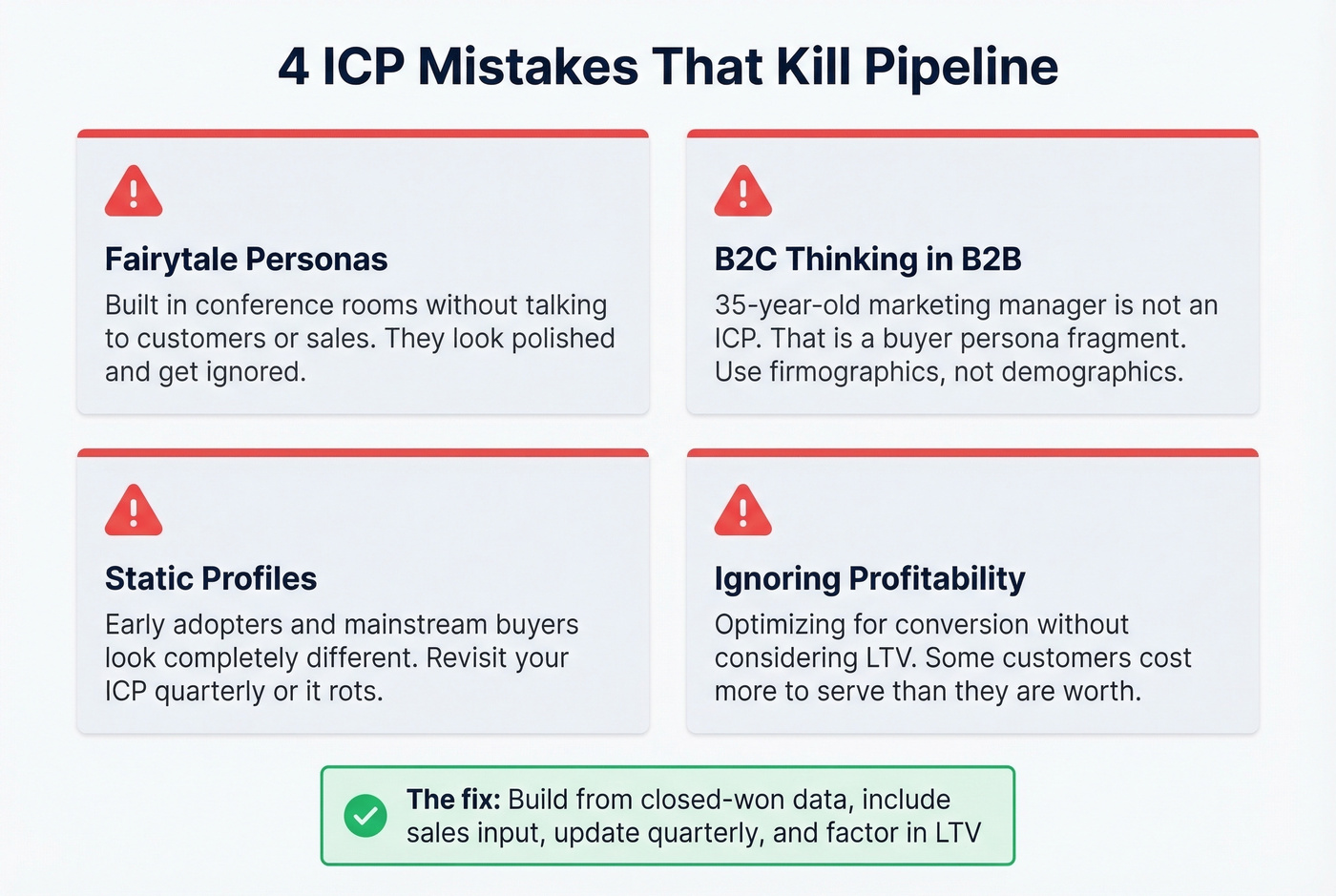
B2C thinking applied to B2B substitutes demographics for firmographics - "35-year-old marketing manager" isn't an ICP, it's a buyer persona fragment. Static profiles rot fast because early adopters and mainstream buyers have fundamentally different characteristics; revisit quarterly. And ignoring profitability means optimizing for conversion without considering LTV. Some customers cost more to serve than they're worth, and your ICP should reflect that.
Tools to Activate Your ICP
Let's be honest: you don't need a $75K ABM platform. You need a clear ideal customer profile, a CRM, and a data provider with the right filters. Once you know how to operationalize your profile through enrichment and scoring, the tech stack decisions get simpler. Tools fall into three buckets.
Enrichment and contact data is where most teams should start. Prospeo covers 300M+ professional profiles with 30+ search filters that map directly to ICP attributes - buyer intent across 15,000 topics, technographics, headcount growth, funding rounds, and revenue. Email accuracy runs 98% on a 7-day refresh cycle. The free tier gives you 75 emails plus 100 Chrome extension credits per month, and paid plans run about $0.01 per lead with no contracts.

Apollo covers 275M+ contacts with 65+ filters and built-in sequences - solid for mid-market teams that want database and outreach in one platform. Starts at $49/user/month. ZoomInfo is the enterprise default with intent data, but a 5-seat contract starts around $15K/year. It makes sense for large sales orgs. Skip it if you're a team of 10 or fewer - you're paying for features you won't activate.
| Category | Tool | Starting Price | Best For |
|---|---|---|---|
| Enrichment | Prospeo | Free (75 emails/mo); ~$0.01/lead | ICP activation + intent data |
| Enrichment | Apollo | $49/user/mo | Database + sequences combined |
| Enrichment | ZoomInfo | ~$15K/yr | Enterprise intent data |
| Enrichment | Lusha | Free; Pro ~$22/user/mo | Quick lookups, SMB budgets |
| HubSpot Native | Breeze Intelligence | ~$30/mo (100 credits) | HubSpot-native enrichment |
| Website Visitor ID | Leadfeeder (Dealfront) | Free; paid ~$99/mo | Website visitor identification |
| ABM | 6sense | ~$75K+/yr | Enterprise predictive scoring |
| ABM | Demandbase | ~$50K+/yr | Enterprise ABM + advertising |
Lusha works for quick lookups on a tight budget. Breeze Intelligence fits HubSpot-native teams. Leadfeeder identifies website visitors matching your profile. 6sense and Demandbase are enterprise ABM platforms - powerful, but $50-75K+ per year and months to implement. For teams under 50 reps, we've found the enrichment-first approach delivers faster ROI than jumping straight to a full ABM suite.
If you're building outbound around Tier A accounts, start with proven sales prospecting techniques and a clean scoring model.
Tier A accounts only matter if you can reach the right people inside them. Prospeo returns verified emails and direct dials for decision-makers at your best-fit companies - refreshed every 7 days, not every 6 weeks. Layer intent data on top and you're contacting buyers already researching your category.
Turn your ICP scoring rubric into a live prospecting list in minutes.
FAQ
What's the difference between ICP and buyer persona?
An ICP describes the ideal company - firmographics, tech stack, revenue range. A buyer persona describes the ideal individual within that company - their role, goals, and pain points. Define the ICP first. It determines which accounts are worth pursuing at all, and the personas follow from there.
How often should you update your ICP?
Revisit quarterly or after major product changes. The companies that bought in year one rarely look like the companies buying in year three. Early adopters and mainstream buyers have fundamentally different profiles, and if your ICP doesn't evolve with your customer base, you'll end up optimizing for a market you've already outgrown.
What does ICP mean in tech vs. other industries?
In tech, ICP definitions lean heavily on technographic and intent data - what tools a prospect already uses, what integrations they need, and whether they're actively researching solutions in your category. Other industries rely more on firmographics alone. Tech demands that stack compatibility and adoption signals sit at the center of your scoring rubric.
Do I need dedicated software to operationalize my ICP?
No. You need a clear framework, a CRM, and a data provider with filters matching your ICP attributes. Any of the enrichment tools in the comparison table above will get you from documented profile to live outbound list in under an hour. The real bottleneck is almost never the tooling - it's whether your team actually agreed on the profile in the first place.