

How to Build an Ideal Customer Profile for SaaS (That You'll Actually Use)
Your SDR team sent 500 emails last week. Three meetings booked. The problem isn't the copy, the cadence, or the reps - it's the list. They're spraying into accounts that were never going to buy.
An ideal customer profile for SaaS fixes this, but only if it's something you can actually filter on - not a 15-page strategy doc collecting dust in Notion. 86% of buyers are more likely to purchase when a vendor understands their goals. You can't understand goals if you're targeting the wrong companies entirely.
What You Need (Quick Version)
Your SaaS ICP needs exactly five filterable attributes - not a manifesto. Define them from churn and CLV data if you have customers, or from five discovery calls if you don't. Validate with unit economics: CLV should be at least 3x your CAC. Then plug those attributes into a data platform and build a live prospect list.
That last step is where most guides abandon you, and it's the step that actually generates pipeline.
What Is an ICP in SaaS?
An ICP describes the company most likely to buy, expand, and stick around. It's not a buyer persona - that's the individual human inside the company. Confusing the two is the most common mistake we see on early-stage SaaS teams.
| ICP | Buyer Persona | |
|---|---|---|
| Describes | Company / account | Individual decision-maker |
| Attributes | Revenue, headcount, tech stack | Job title, goals, pain points |
| Used for | Account targeting, list building, lead scoring | Messaging, content, ABM |
"Mid-market B2B companies in North America" isn't an ICP. It's a census category. You need attributes specific enough to type into a search filter and get a list back.
The 5 ICP Attributes That Matter
Not all attributes carry equal weight. Psychographics matter more than firmographics - a 200-person company actively looking to replace their current tool beats a 500-person company locked into a three-year contract every time. Some frameworks focus on buyer readiness checks like financial readiness, urgency, and effort, which are useful for coaching individual deals but less useful for building targetable lists at scale. Prioritize accordingly.
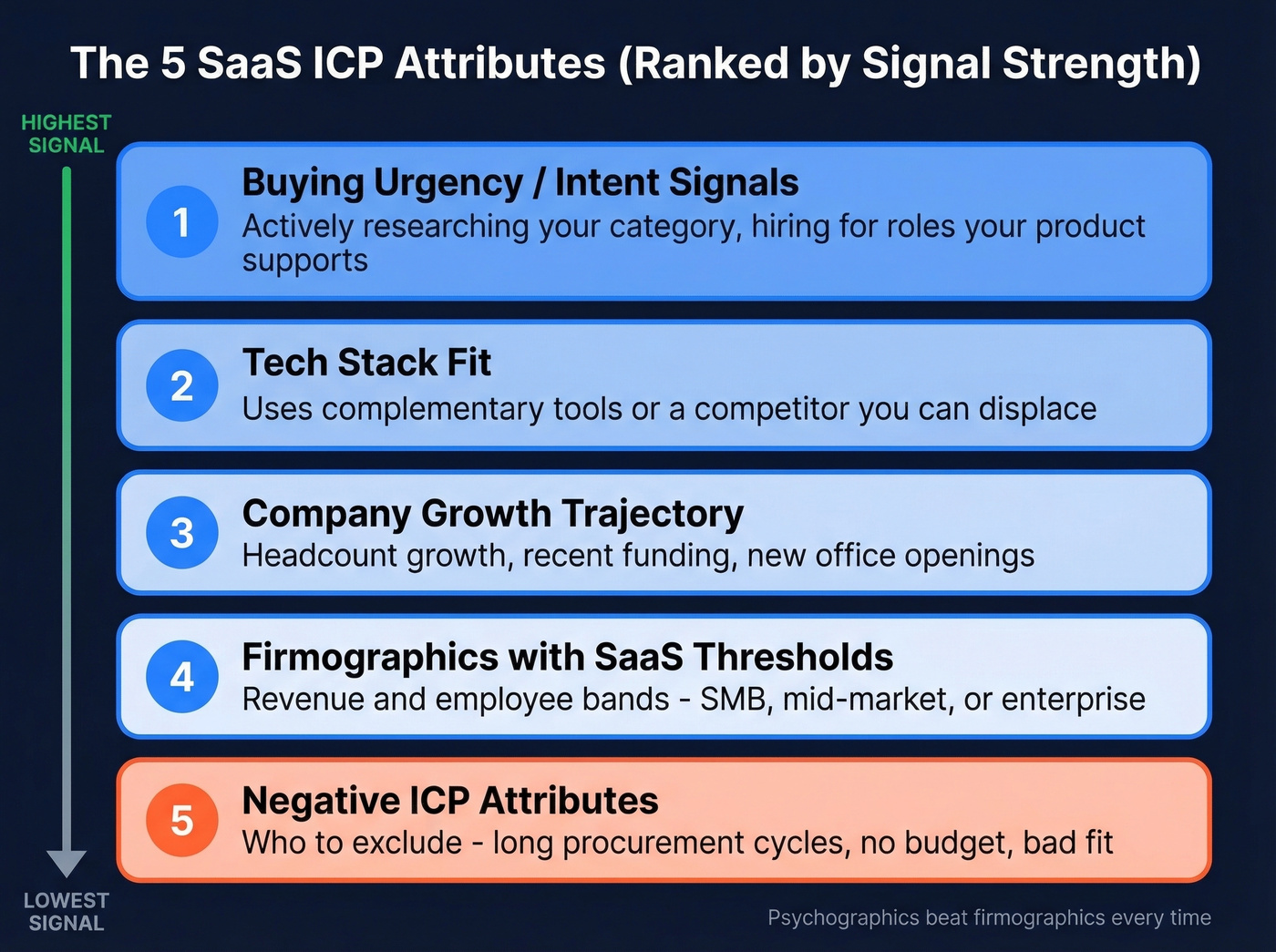
1. Buying urgency / intent signals. Are they actively researching your category? Hiring for roles your product supports? This is the highest-signal attribute and the one most teams skip.
2. Tech stack fit. Technographic data tells you whether a prospect already uses complementary tools - or a competitor you can displace. A company running Salesforce, Outreach, and no enrichment tool is a very different prospect than one locked into a full ZoomInfo suite.
3. Company growth trajectory. Headcount growth, recent funding rounds, new office openings. These signal budget and urgency. Static companies rarely buy new software.
4. Firmographics with SaaS-specific thresholds. A common segmentation framework uses these bands: under $50M revenue / under 500 employees for SMB, $50M-$1B / 500-2,000 employees for mid-market, and $1B+ / 2,000+ employees for enterprise. Pick your lane and commit.
5. Negative ICP attributes. Who should you exclude? Government agencies with 18-month procurement cycles? Companies under 10 employees with no budget? Defining who you don't want saves more pipeline time than defining who you do.
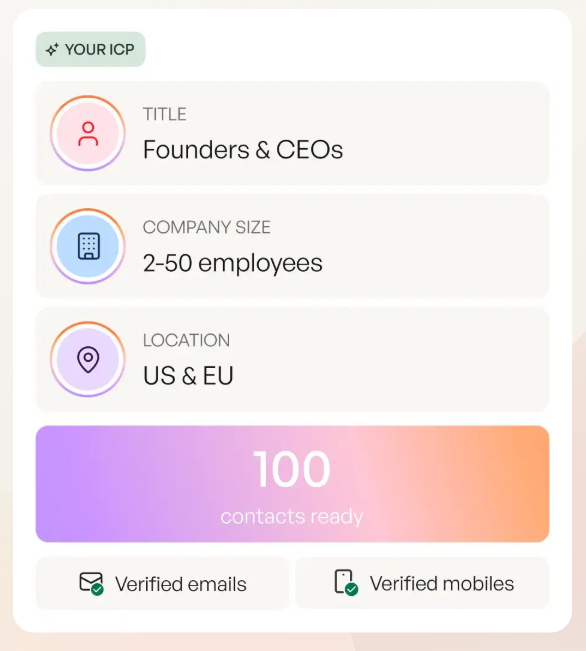

You just defined five filterable ICP attributes. Prospeo's 30+ search filters map to every one of them - buyer intent across 15,000 Bombora topics, technographics, headcount growth, funding stage, and revenue. 300M+ profiles, 98% email accuracy, refreshed every 7 days.
Turn your ICP doc into a verified prospect list in under five minutes.
How to Build Your SaaS ICP
Two paths, depending on whether you've found product-market fit.
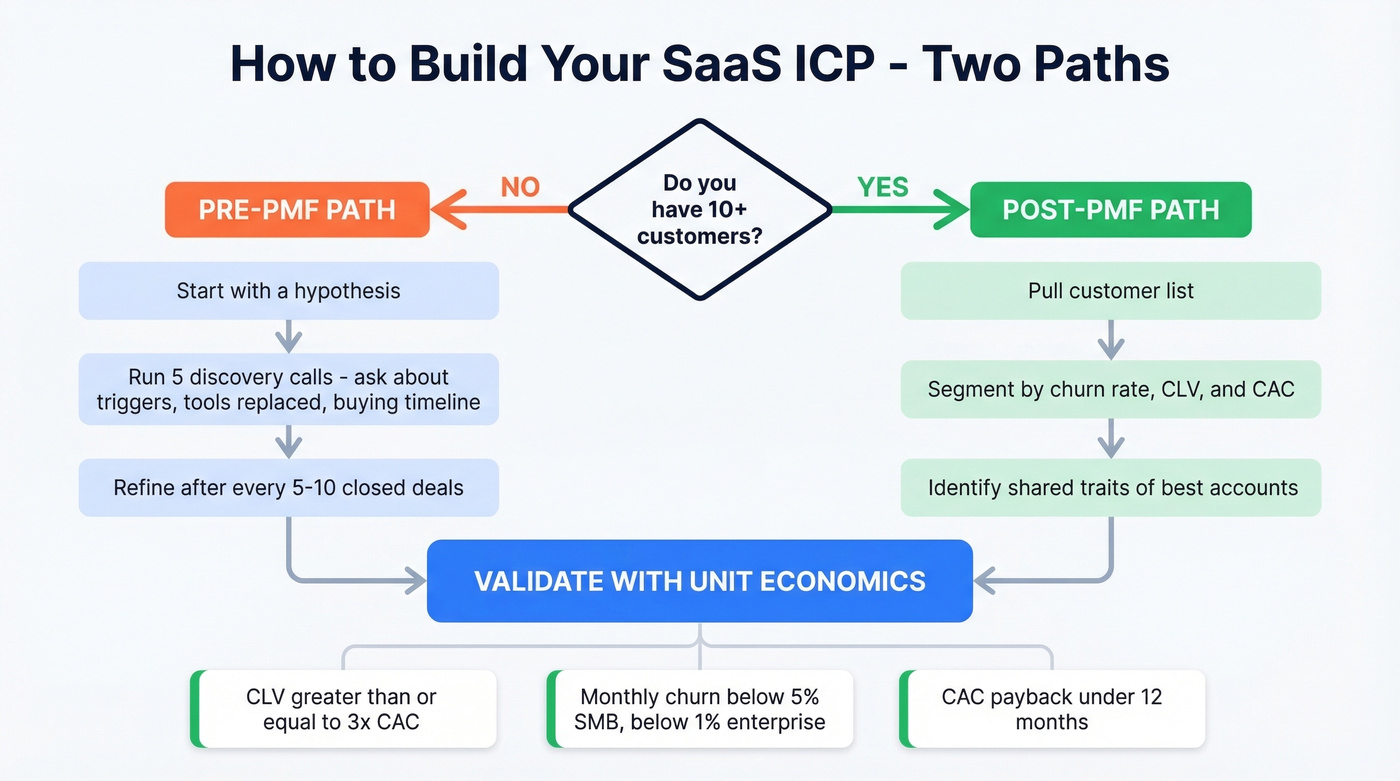
Pre-PMF (fewer than 10 customers): Start with a hypothesis. Run five structured discovery calls with your best-fit prospects. Ask what triggered their search, what tools they're replacing, and what their buying timeline looks like. You're pattern-matching, not doing statistical analysis. Refine after every 5-10 closed deals.
Post-PMF (enough data to segment): Pull your customer list and segment by churn rate, CLV, and CAC. The accounts that stay longest and expand fastest share common traits - those traits are your ICP. We've seen teams discover that 70% of their churned accounts fell outside their profile once they actually ran this analysis. That's not a coincidence; it's a targeting problem.
Here's the thing most ICP guides won't tell you: your ICP is the single best leading indicator of churn. Accounts outside your profile churn at 2-3x the rate, and no amount of CS heroics will fix a bad-fit account. Share it across Sales, CS, and Product - it's not a sales document, it's an operating filter for the whole company.
Validate with three benchmarks:
- CLV ≥ 3x CAC If you're spending more than a third of lifetime value to acquire, the economics don't work.
- Monthly churn below 5% for SMB, below 1% for enterprise. Anything higher means your profile is letting in bad-fit accounts.
- CAC payback under 12 months. If your ICP segment doesn't hit this, tighten the profile.
Concrete SaaS ICP Examples
Two filled-out profiles you can steal and adapt. Both are specific enough to plug directly into search filters.
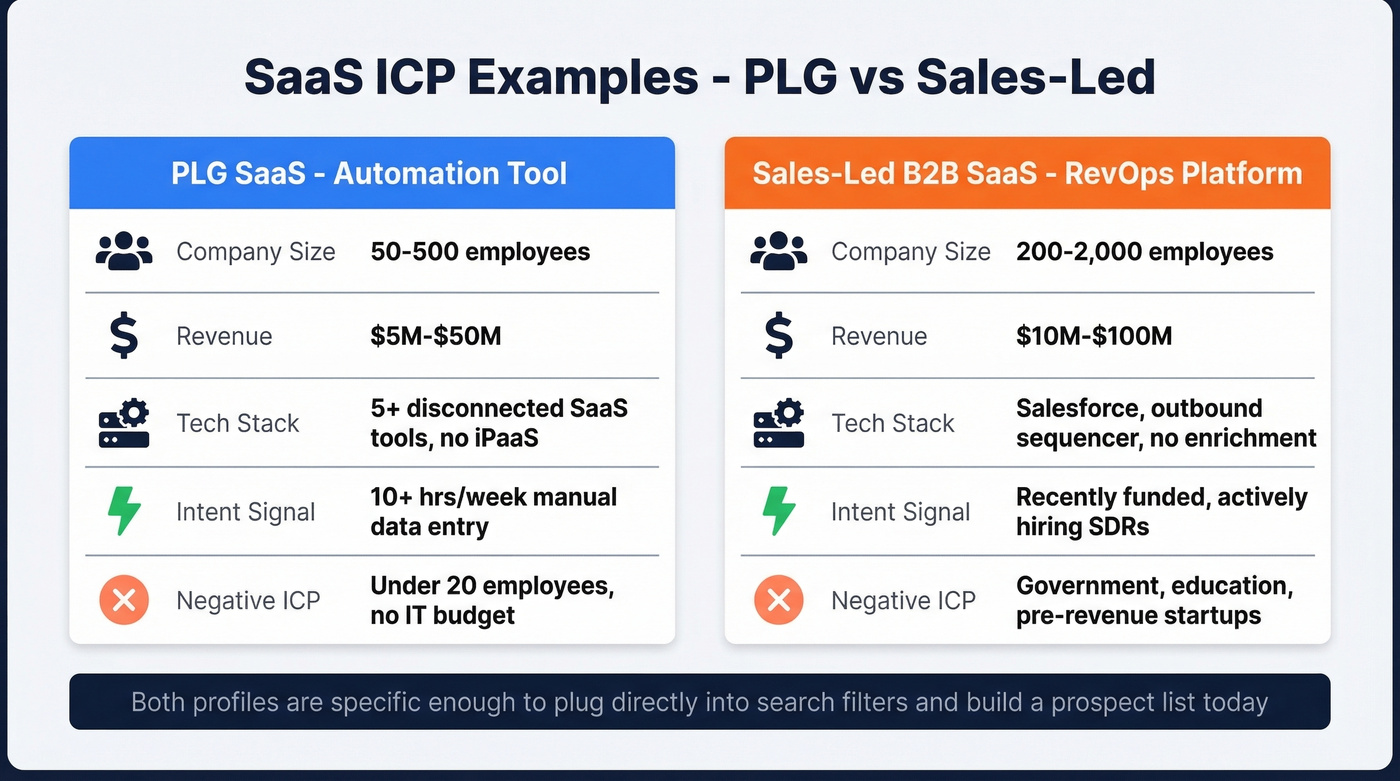
| Attribute | PLG SaaS (Automation Tool) | Sales-Led B2B SaaS (RevOps Platform) |
|---|---|---|
| Company size | 50-500 employees | 200-2,000 employees |
| Revenue | $5M-$50M | $10M-$100M |
| Tech stack | 5+ disconnected SaaS tools, no iPaaS | Salesforce, outbound sequencer, no enrichment |
| Intent signal | 10+ hrs/week manual data entry | Recently funded, actively hiring SDRs |
| Negative ICP | Under 20 employees, no IT budget | Government, education, pre-revenue startups |
The PLG example targets companies drowning in manual workflows that self-serve into a product - modeled on HubSpot's ICP framework for automation tool adoption patterns. The sales-led example targets companies with budget, growth signals, and a gap in their stack you can fill.
From Document to Pipeline
Let's be honest: defining an ICP without operationalizing it is like writing a workout plan and never going to the gym. The r/SaaS and r/sales communities are full of founders who built elaborate ICP documents and never activated them - the operationalization step is where the breakdown happens.
Take your ICP attributes - say, "Series B+ SaaS companies, 200-1,000 employees, using Salesforce, showing intent for 'sales engagement,' based in North America." You need a platform where you can set those exact filters and get verified contacts back.
Prospeo's B2B database maps directly to this workflow. Its 30+ search filters cover buyer intent via 15,000 Bombora topics, technographics, headcount growth, funding, and revenue - the same attributes you just defined. The database refreshes every 7 days, and with 300M+ professional profiles at 98% email accuracy, the contacts you pull are actually reachable. Free tier gets you started without a sales call.

Bad-fit accounts churn 2-3x faster and burn your domain reputation along the way. Prospeo's 98% email accuracy and 7-day data refresh mean you reach real buyers inside your ICP - not bounced inboxes outside it. Start free, no sales call required.
Stop spraying into accounts that were never going to buy.
Common ICP Mistakes in SaaS
Too broad. "Mid-market B2B in North America" describes tens of thousands of companies. That's a TAM slide, not an ICP. Narrow until your list is in the hundreds or low thousands.
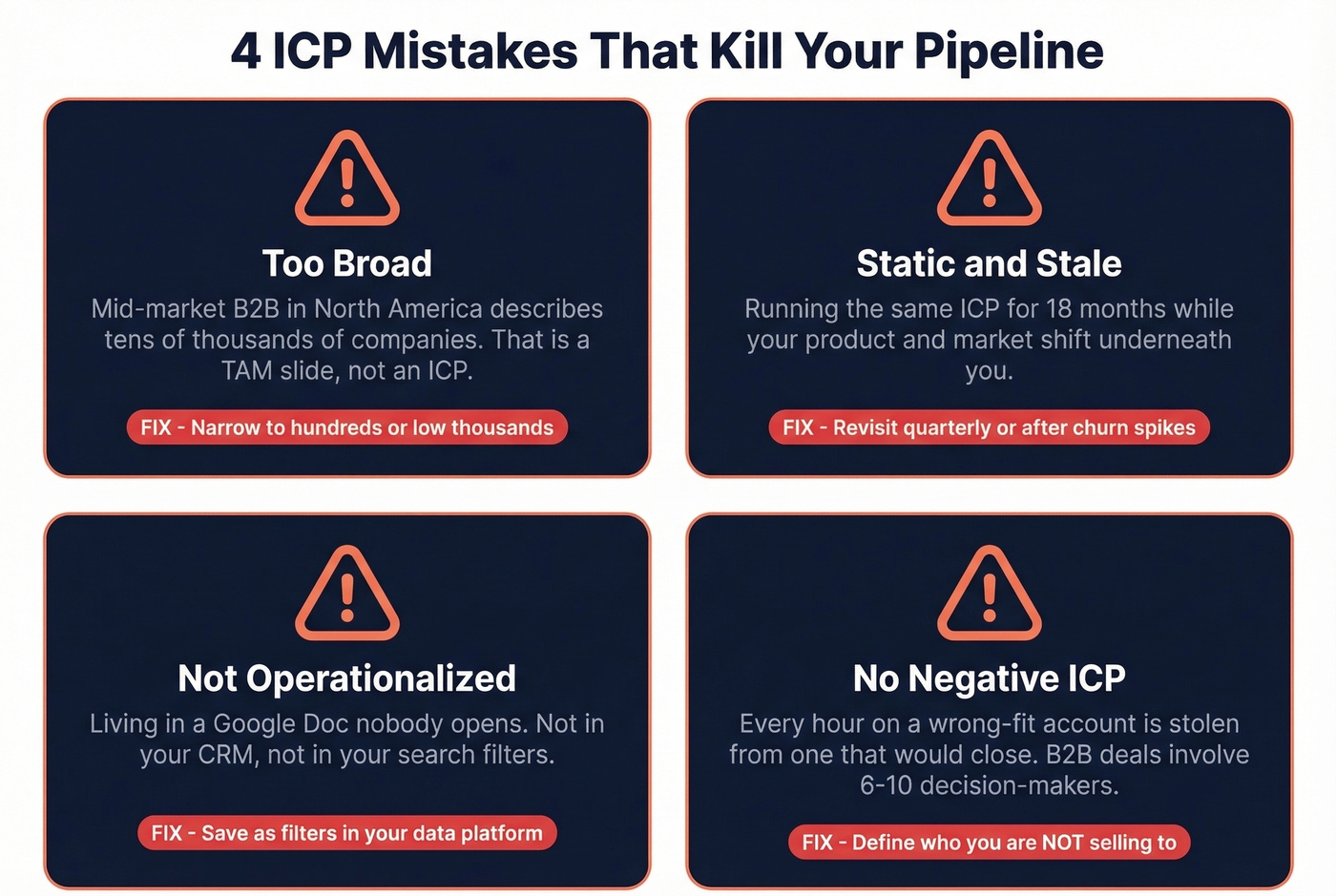
Static and stale. Your profile should evolve quarterly. New product tiers, new market segments, and churn spikes all warrant a revisit. I've watched teams run the same ICP for 18 months while their product and market shifted underneath them - don't be that team.
Not operationalized. If your ICP lives in a Google Doc that nobody opens, it's not a profile - it's a homework assignment. It needs to exist as saved search filters in your data platform and lead scoring rules in your CRM. Most guides end at "now put this in your CRM" without showing you how to find and reach these accounts. That gap is the whole point of the section above.
Ignoring the negative ICP. Every hour a rep spends on an account that was never going to close is an hour stolen from one that would. Define who you're not selling to with the same rigor you define who you are. Skip this step at your own peril - according to Gartner's B2B buying research, the average B2B deal now involves 6-10 decision-makers, so wasting cycles on wrong-fit accounts compounds fast.
FAQ
How often should you update your SaaS ICP?
Revisit quarterly or after any major shift - a new product tier, a new market segment, or a churn spike above 5%. Your profile should evolve alongside your customer data, not sit frozen in a strategy deck from last year.
Is an ICP different for PLG vs. sales-led SaaS?
Yes. PLG profiles weight self-serve behavior and tech stack fit more heavily. Sales-led profiles emphasize budget authority, buying committee size, and deal complexity. The two template examples above show the concrete differences.
How do you build an ICP with fewer than 10 customers?
Start with a hypothesis from five discovery calls, then validate with unit economics as you close your first 10-20 deals. Test against a real database to see how many companies match your filters - if the list is under 200, you're probably too narrow; over 10,000, too broad.
What's the fastest way to turn an ICP into a prospect list?
Use a B2B data platform with filters matching your ICP attributes - intent signals, technographics, headcount, funding stage, and revenue. Set the filters, pull the list, and start outreach the same day. That's the workflow we built Prospeo around: define once, filter, and go.