

How to Implicate the Pain in MEDDPICC (Without Sounding Like a Robot)
You've filled out every MEDDPICC field in Salesforce. Champion? Check. Metrics? Check. Pain? "Customer says reporting is slow." That's not implicating pain - that's taking notes. And it's why the deal stalls in Week 6 when your champion can't sell the urgency internally.
Companies that follow a defined sales process are 33% more likely to be high performers. But the process only works when reps move beyond identification into real implication - the part that makes a prospect feel the cost of doing nothing.
To implicate the pain means making the prospect feel the consequences of inaction, not just acknowledge a problem. Use the Three I's progression: Identify, Indicate, Implicate. Below: the exact questions, a before/after script, and the five mistakes that kill implication.
What Does "Implicate the Pain" Actually Mean?
Andy Whyte frames this as a Three I's progression: Identify, Indicate, Implicate.
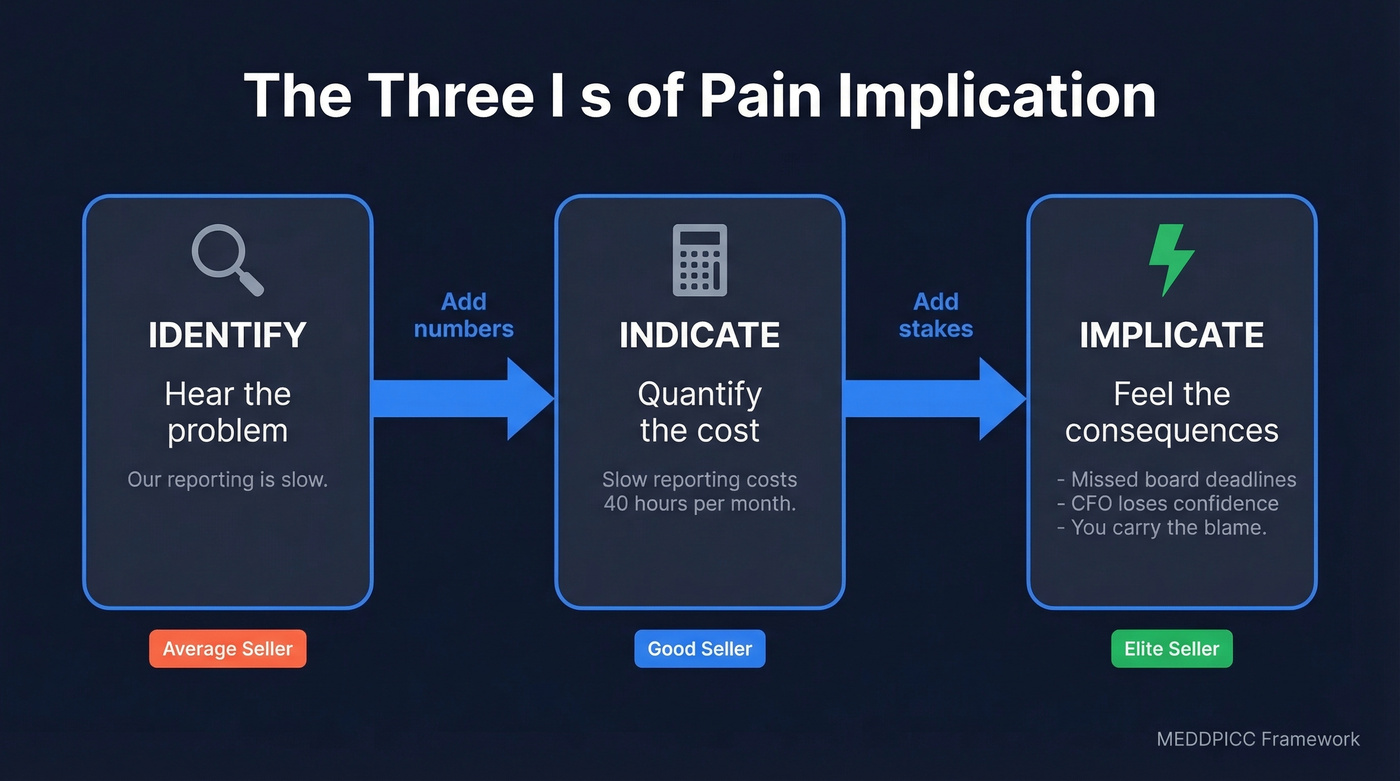
| Seller Level | What They Do | Example |
|---|---|---|
| Average | Identify pain | "Our reporting is slow." |
| Good | Indicate pain | "Slow reporting costs ~40 hours/month." |
| Elite | Implicate pain | "Those 40 hours mean you miss board deadlines, your CFO loses confidence, and you personally carry the blame." |
Average sellers hear a problem and map it to a feature. Good sellers quantify it into an ROI doc or business case. Elite sellers make the prospect feel the downstream consequences - business impact, personal stakes, career risk - until inaction becomes intolerable.
One common misconception is treating the "I" (Implicate) as a step you rush through to get to "P" (Pain). In practice, implication is what turns pain into urgency.
If you've studied Neil Rackham's SPIN Selling, this'll feel familiar. SPIN's "Implication Questions" do the same work, but MEDDPICC wraps implication into a broader qualification framework, so you're not just uncovering pain - you're validating that the deal has the structure to close.
Why Implication Creates Urgency
Here's the thing: "no decision" is your #1 competitor. Not the other vendor. Not the incumbent. The status quo.
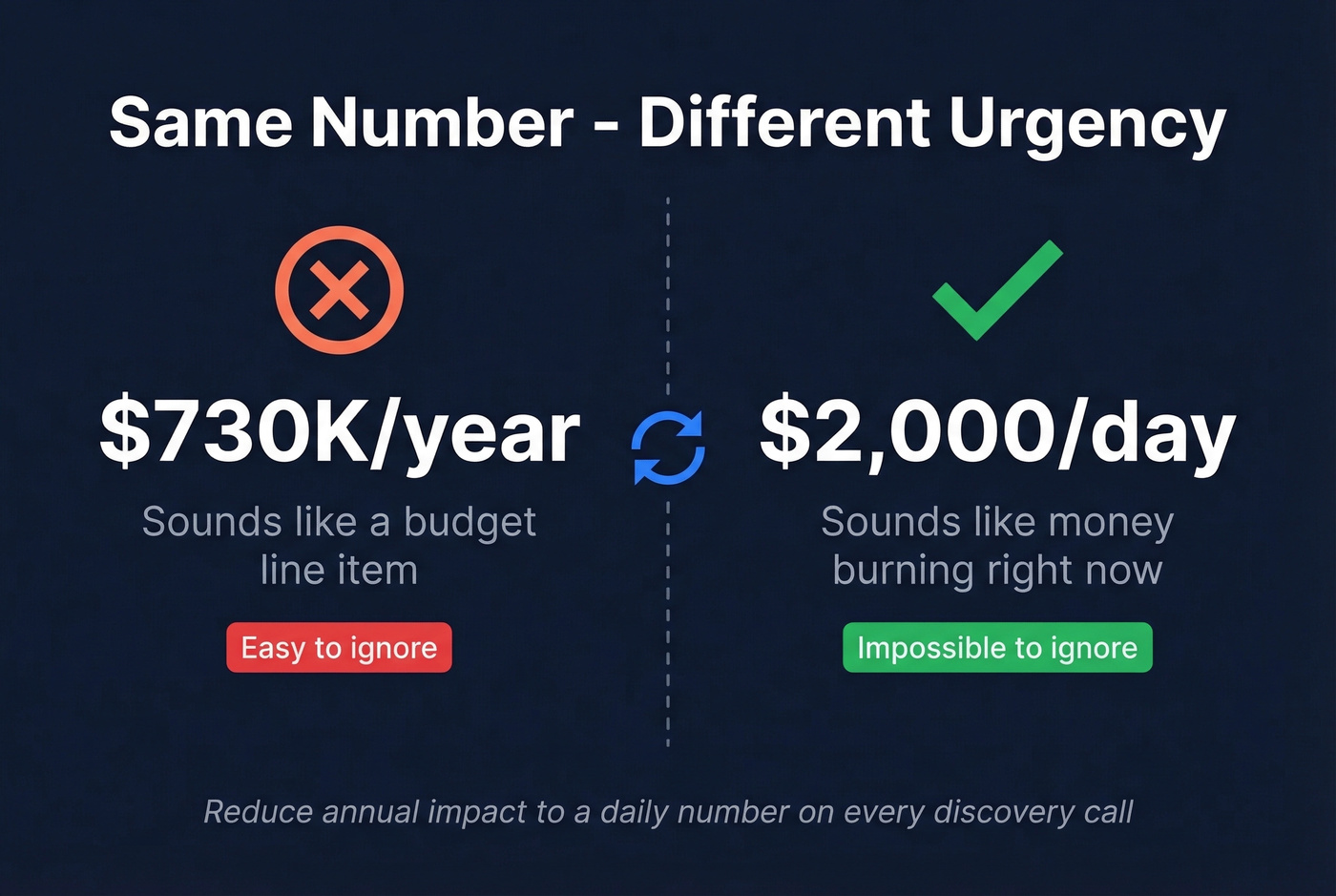
The status quo wins when pain stays abstract, and understanding the difference between active and latent pain is critical here. Active pain is something the prospect is already trying to solve - they have budget, they're evaluating vendors. Latent pain is a problem they've normalized or haven't fully recognized yet. Implication converts latent pain into active pain by making the consequences impossible to ignore.
The most effective talk track is dead simple: "Every day we wait, you're losing $X." Reduce the annual impact to a daily number. $730K/year sounds like a budget line. $2,000/day sounds like money burning while you're on this call.
Let's be honest about how fast urgency can snap into place. One practitioner describes closing a $400K enterprise deal in 48 hours with 0% discount because the solution avoided $1M in penalties due 72 hours later. When the prospect's own math makes waiting feel reckless, the deal stops drifting. A compelling event doesn't need to exist at the start; you can build urgency credibly by quantifying the cost of doing nothing.

Implication only works when you're talking to real decision-makers. Prospeo gives you 300M+ verified contacts with 30+ filters - buyer intent, job changes, department headcount - so you reach the people who actually feel the pain.
Stop implicating pain to the wrong person. Find the right one in seconds.
7 Questions That Drive Pain Implication
Not all discovery questions are equal. Having a structured question ladder also prevents the mid-call brain-blank that shows up even for reps with years in the seat. These seven move prospects from "yeah, that's a problem" to "we need to fix this now."
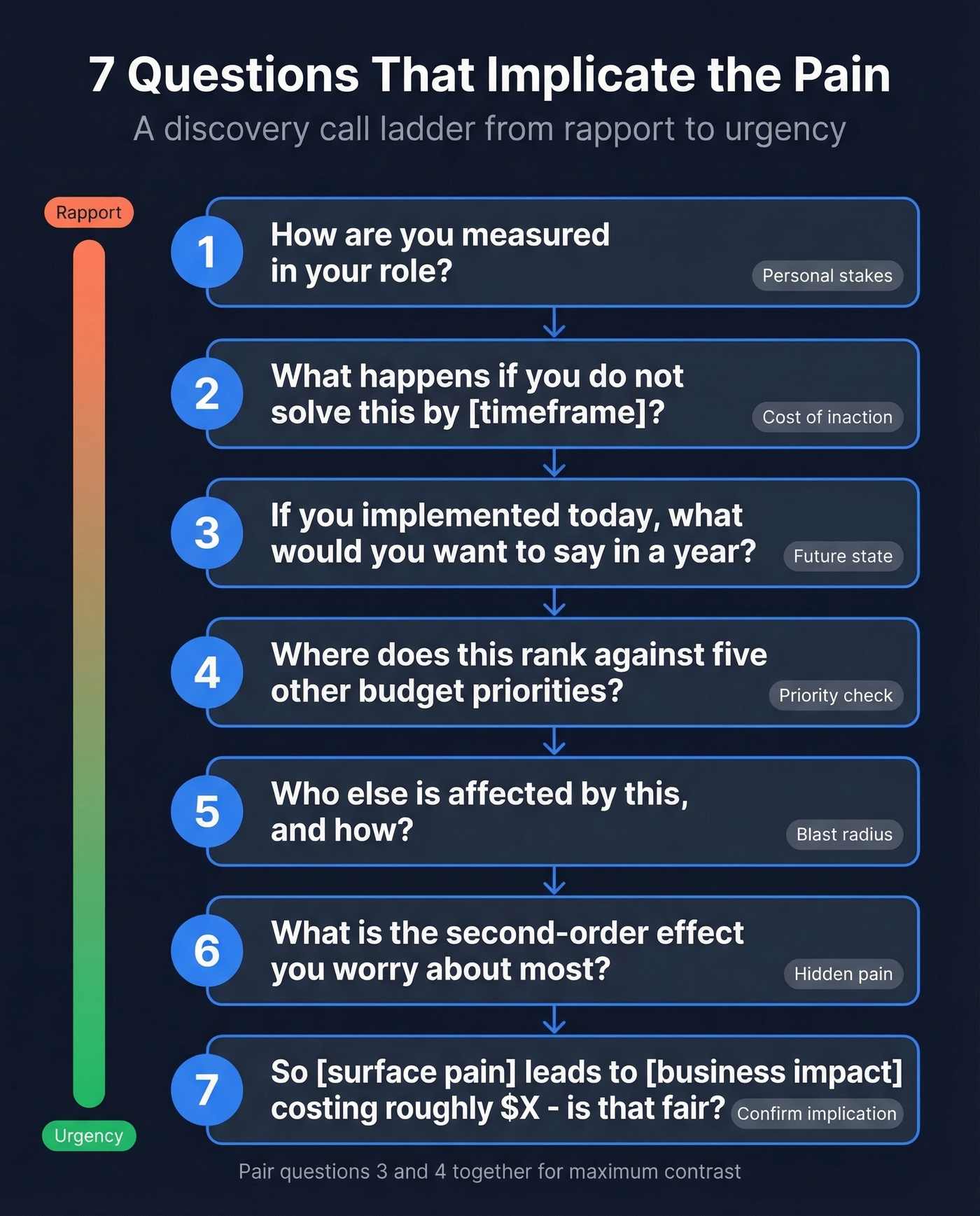
"How are you measured in your role?" This surfaces personal stakes. If your champion's bonus or promotion ties to the problem you solve, urgency becomes self-generating.
"What happens if you don't solve this by [timeframe]?" This forces the prospect to articulate the cost of inaction out loud. Most people haven't done this math explicitly, and when they hear themselves say it, the urgency lands differently. That's the core mechanism - not telling them they have a problem, but letting them walk themselves into the realization.
The next two questions work best as a pair. Start with "If you implemented today and a year from now you were in a leadership meeting, what would you want to be able to say?" This future-state question flips the conversation from pain avoidance to outcome visualization. Then follow with "Where does this rank against the other five things competing for your budget?" The contrast between their aspirational answer and their honest prioritization tells you exactly how much work remains.
"Who else is affected by this, and how?" Pain rarely stays in one department. Slow reporting hits finance, then operations, then the exec team. Mapping the blast radius builds multi-threaded urgency and gives you names for your next outreach.
"What's the second-order effect you're most worried about?" We've seen this one crack open deals that felt stuck. A fraud prevention lead acknowledges false positives as the surface problem - but the real implication is degraded customer experience driving churn driving revenue loss. The secondary pain is often bigger than the presenting symptom.
Weak vs. Strong Implication
Same scenario. Two reps. Night and day.
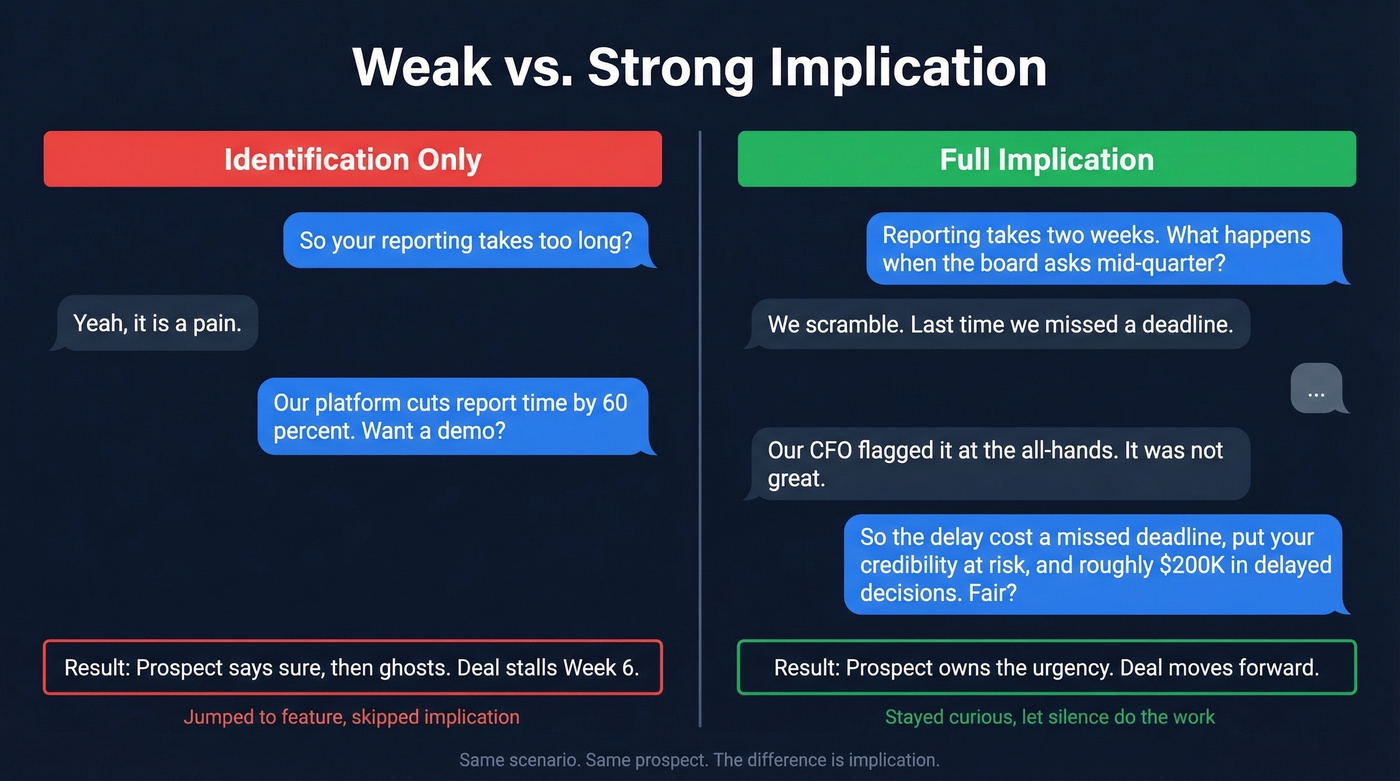
Weak (identification only):
Rep: "So your reporting takes too long?" Prospect: "Yeah, it's a pain." Rep: "Got it. Our platform cuts report time by 60%. Want to see a demo?"
Strong (full implication):
Rep: "You mentioned reporting takes two weeks. What happens when the board asks for numbers mid-quarter?" Prospect: "Honestly, we scramble. Last time we missed a deadline." Rep: (silence - lets it sit) Prospect: "...and our CFO flagged it in the all-hands. It wasn't great." Rep: "So the reporting delay cost you a missed board deadline, put your team's credibility at risk, and you're estimating roughly $200K in delayed decisions. Is that fair?"
In our experience, the silence after the prospect's first answer is where implication actually happens. Notice the paraphrase that connects surface pain to business impact to a dollar figure. That's the full progression from identification through implication. The weak rep jumped to a feature; the strong rep stayed curious long enough for the prospect to convince themselves.
5 Mistakes That Kill Pain Implication
Interrogation mode. Rapid-fire closed questions make prospects shut down. The #1 complaint on r/sales about discovery calls? They feel like a police interrogation. If your prospect is giving one-word answers, you're going too fast.
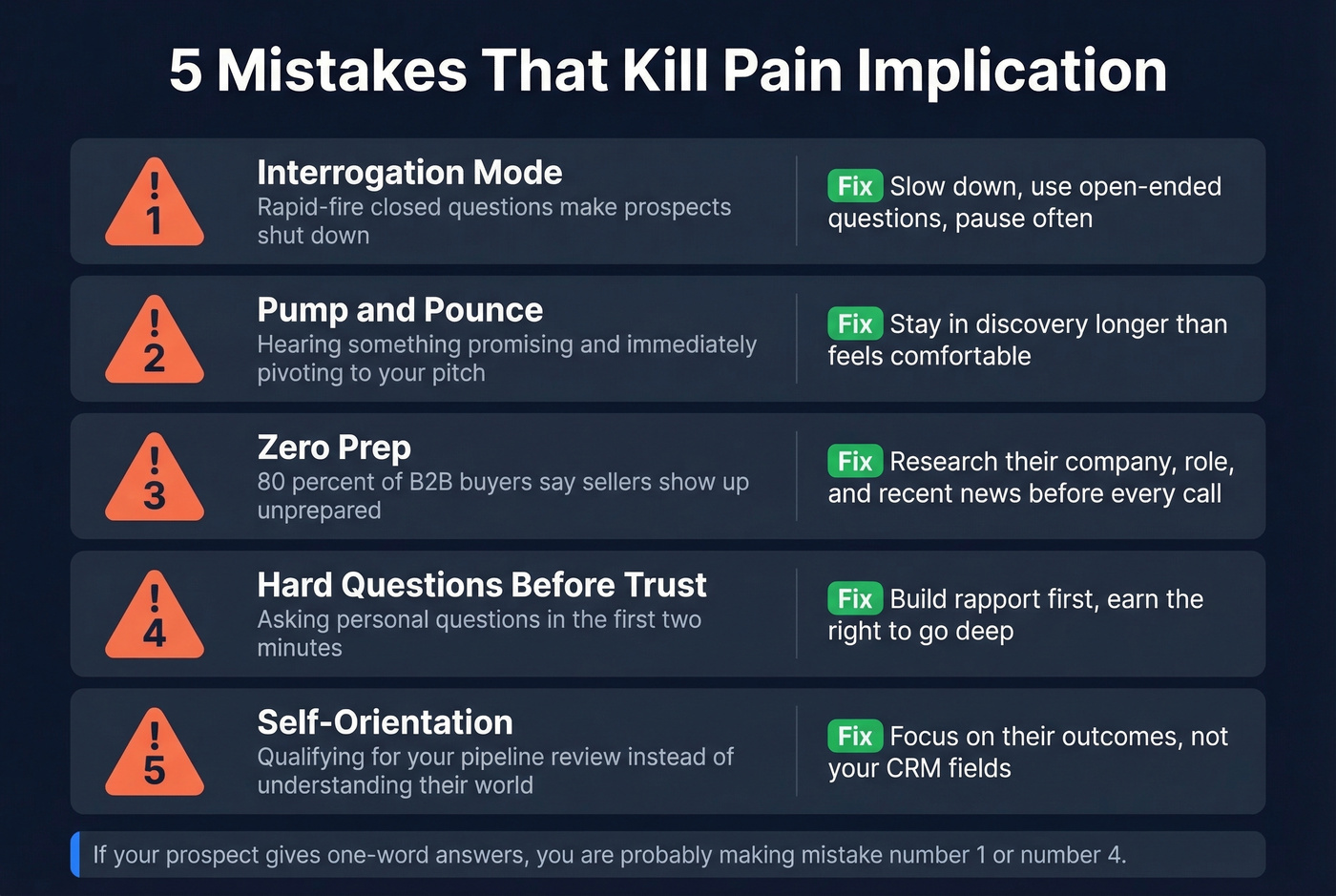
Pump and pounce. You ask three questions, hear something promising, and immediately pivot to your pitch. You just killed the implication before it started. Stay in discovery longer than feels comfortable.
Zero prep. 80% of B2B buyers say salespeople show up unprepared. Asking "so what does your company do?" when the answer is on their homepage destroys the credibility you need for hard implication questions.
Hard questions before trust. "How are you measured in your role?" is powerful but deeply personal. Ask it in the first two minutes and you'll get a deflection. Build rapport first - earn the right to go deep. (If you need a tighter structure, use a discovery question ladder.)
Self-orientation. If your discovery is about qualifying the deal for your pipeline review instead of genuinely understanding the prospect's world, they'll feel it. The CRM checkbox version of MEDDPICC is what happens when managers prioritize fields over conversations. We've watched reps skip straight from identification to demo. It almost never works. If your team is stuck here, revisit MEDDIC sales qualification and align on what “qualified” actually means.
Make It Stick
Implication isn't a checkbox. The reps who consistently implicate the pain aren't following a rigid playbook - they're genuinely curious about the prospect's business and comfortable sitting in uncomfortable silence while the implications land.
Hot take: Most teams don't have an implication problem. They have a targeting problem. They're running brilliant discovery with someone three levels removed from the pain. If your champion doesn't flinch when you ask "what happens if this doesn't get solved?" - you're talking to the wrong person. Skip the implication playbook and fix your targeting first with an Ideal Customer Profile and a clear plan for account-based selling.
But none of this matters if your discovery call never happens because the contact data bounced. Prospeo gives you 300M+ professional profiles with 98% email accuracy and a 7-day data refresh cycle, so you're actually reaching the champion who feels the pain. (If bounces are a recurring issue, start with email bounce rate benchmarks and fixes.)
You just mapped the blast radius and identified five stakeholders affected by the problem. Now you need their direct emails and mobile numbers. Prospeo delivers 98% accurate emails and 125M+ verified mobiles - so your multi-threaded outreach actually connects.
Turn your pain map into booked meetings at $0.01 per verified email.
FAQ
What's the difference between identifying and implicating pain?
Identification means the prospect acknowledges a problem exists. Implication means they feel the downstream consequences - business impact, personal stakes, daily cost of inaction - until waiting becomes intolerable. Identification is step one; implication is what converts awareness into urgency that drives a purchase decision.
Does MEDDPICC work without a compelling event?
Yes. You can construct urgency through implication by reducing the cost of inaction to a daily dollar figure. $730K/year feels like a budget line item; $2,000/day feels like money burning on every call. That daily math replaces the need for an external deadline.
How do I find the right person to run discovery with?
Target the champion - the person who personally feels the consequences. Prospeo lets you filter by job title, department, and buyer intent across 15,000 topics to reach someone who cares about solving the problem, not just someone who'll take the meeting.