

Why Sales Forecasting Matters (And Why Most Teams Still Get It Wrong)
It's the last week of the quarter. Your VP of Sales is staring at a pipeline that says $2.1M, but the real number - the one Finance will report - lands closer to $1.4M. Again.
The gap between what your CRM says and what actually closes isn't a rounding error. It's a forecasting failure. Understanding the importance of sales forecasting starts here, with the reality that 61% of companies missed their revenue targets entirely and 84% of reps didn't meet quota last year. Forecasting isn't a reporting exercise. It's the operating rhythm of the entire company, and when it breaks, everything downstream breaks with it: hiring plans, cash flow projections, board confidence, rep morale.
The Short Version
Forecasting drives quota attainment. Companies with best-in-class forecasting hit quota at a 97% rate. Those without? 55%. Nearly a 2x gap from the same pipeline.
Start with weighted pipeline forecasting. Assign stage-based probabilities to every deal, multiply by deal value, and roll it up. Measure accuracy with WMAPE. Run a weekly cadence.
None of it works if your pipeline data is dirty. Ghost contacts, bounced emails, and disconnected numbers inflate your pipeline with fiction. Clean contact data is the prerequisite - tools like Prospeo verify emails at 98% accuracy and refresh every 7 days, so your pipeline reflects reality instead of wishful thinking.
What Is Sales Forecasting?
Sales forecasting predicts near-term revenue based on current pipeline signals - deal stages, win rates, rep activity, and historical patterns. It's not sales planning. Planning sets long-term targets and resource allocation on a quarterly or annual basis. Forecasting runs weekly or monthly and tells you whether you're on track to hit those targets.
Most teams conflate the two, treating the forecast as a way to confirm the plan. That's backwards. Forecasting should challenge the plan, not validate it.
Why Sales Forecasting Matters Beyond Revenue
Forecasting is the connective tissue between sales, finance, operations, and the executive team. Here's why 65% of B2B sales organizations have shifted to data-driven forecasting over gut-feel decision-making.
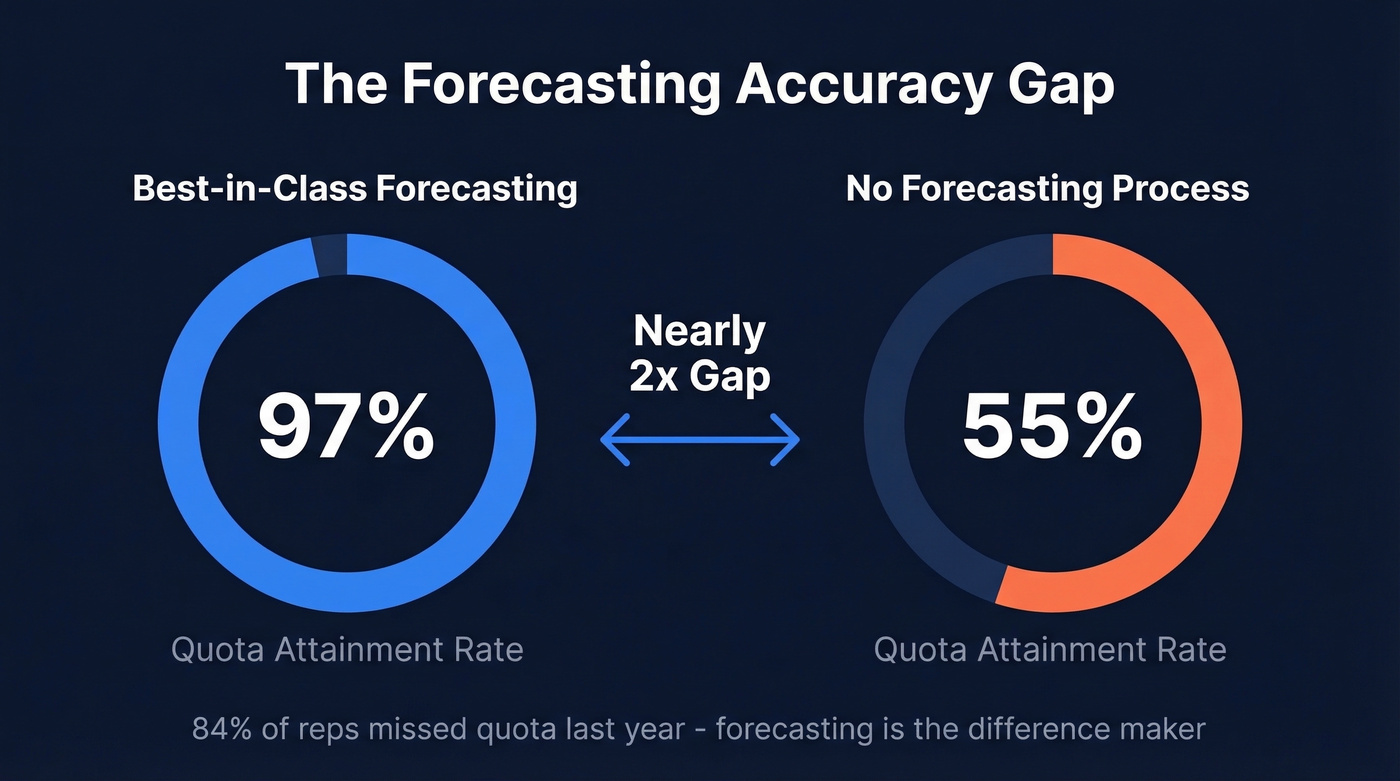
Revenue predictability. Companies with best-in-class forecasting hit quota 97% of the time. Companies without strong processes? Just 55%. That's the difference between a predictable business and a guessing game.
Smarter resource allocation. Accurate forecasts tell you where to deploy headcount, marketing budget, and inventory. Without them, you're either overstaffed in a slow quarter or scrambling to hire when pipeline surges. This is one of the most tangible sales forecasting benefits - turning guesswork into informed capacity planning.
Cash flow confidence. Finance sets headcount plans, vendor commitments, and cash reserves based on your Q3 forecast. Over-forecast, and they've committed capital that doesn't exist. That's not a sales problem. It's a company problem.
Realistic quota-setting. The 84% quota miss rate isn't just a rep performance issue. Bad forecasts produce bad quotas, which produce demoralized teams, which produce worse forecasts. The cycle feeds itself.
Early warning system. A well-run forecast surfaces pipeline gaps weeks before they become revenue misses - enough time to spin up outbound campaigns, accelerate stuck deals, or adjust expectations with the board.
Team accountability. When reps know their forecast is being measured - not just their close rate - they inspect their pipeline more honestly. Sandbagging and happy ears both decrease when accuracy is tracked.
Board and investor confidence. Teams that master forecasting are 10% more likely to grow annual revenue and twice as likely to outcompete their industry peers. Predictability is a competitive advantage, full stop.
Which Forecasting Method to Use
Every article on this topic lists six to eight methods and says "choose the right one for your business." That's useless advice. Here's what actually works: start with weighted pipeline, measure your accuracy, and only add complexity when the data tells you to.
Weighted Pipeline (Start Here)
We've tested weighted pipeline against regression models across dozens of teams, and weighted pipeline wins for accuracy-per-effort for most organizations early on. You assign a probability to each deal stage based on historical win rates, multiply by deal value, and sum the pipeline.
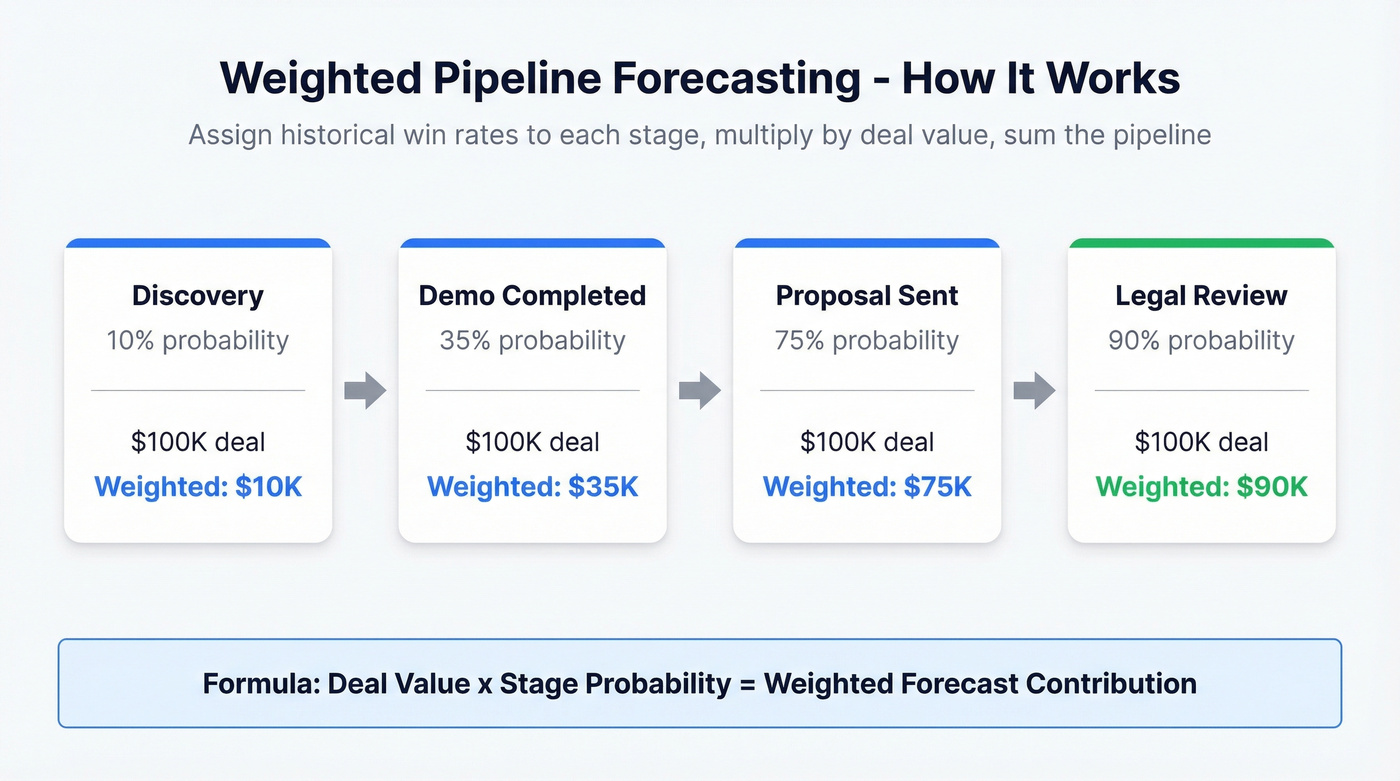
A concrete example: Discovery = 10%, Demo = 35%, Proposal = 75%, Legal Review = 90%. A $100K deal in the Proposal stage contributes $75K to your weighted forecast. Simple, transparent, grounded in your own data.
The catch? Fewer than 20% of B2B organizations consistently forecast within 5% of actual revenue. Not because the method is broken, but because teams don't calibrate their stage probabilities or measure accuracy over time. They set probabilities once, never revisit them, and then wonder why the numbers drift.
Historical / Time-Series
Best for stable, recurring businesses with 12+ months of clean data. You project forward from past performance, adjusted for seasonality and growth trends. Works well for renewals and expansion revenue. Falls apart for new business in volatile markets.
Multivariate Regression
For high-growth teams with multiple signal sources - stakeholder count, meeting attendance, content engagement, email response rates. Regression models weight these variables against historical outcomes. More accurate than weighted pipeline, but it requires clean data across multiple systems, and most teams don't have that yet.
AI/ML-Augmented
Traditional methods typically produce 15-40% MAPE. Advanced ML systems often reach 5-15% MAPE. For mid-market teams, expect $75K-$200K in implementation costs; enterprise deployments can exceed $500K. ROI typically takes 12-24 months. This is a scale play, not a starter kit.
Qualitative / Intuitive
Last resort. Only appropriate for new markets with zero historical data - a brand-new product line, a new geography, a completely novel ICP. Move to weighted pipeline the moment you have enough closed deals to calculate stage probabilities. In our experience, that's usually 20-30 closed-won deals.
| Method | Best For | Data Needed | Accuracy Range |
|---|---|---|---|
| Weighted Pipeline | B2B with CRM | Stage probs + deal values | Moderate-High |
| Historical | Stable/recurring | 12+ months sales data | Moderate |
| Multivariate | High-growth | Multiple signal sources | High |
| AI/ML-Augmented | Scale operations | Clean CRM + activity data | Highest |
| Qualitative | New markets | Rep judgment | Low |

84% of reps missed quota last year - and dirty pipeline data is a root cause. Ghost contacts and bounced emails inflate your forecast with deals that were never real. Prospeo's 98% email accuracy and 7-day data refresh cycle ensure every contact in your pipeline is reachable, so your weighted forecast reflects reality.
Stop forecasting on fiction. Start with verified pipeline data.
Measuring Forecast Accuracy
Here's the thing: if you can't tell me your forecast accuracy within 5 percentage points, you don't have a forecasting process. You have a guessing ritual. Only 7% of organizations achieve forecast accuracy of 90% or higher. Most teams don't even measure it.
If you're evaluating platforms to operationalize this, start with sales forecasting solutions and compare against your CRM workflow.
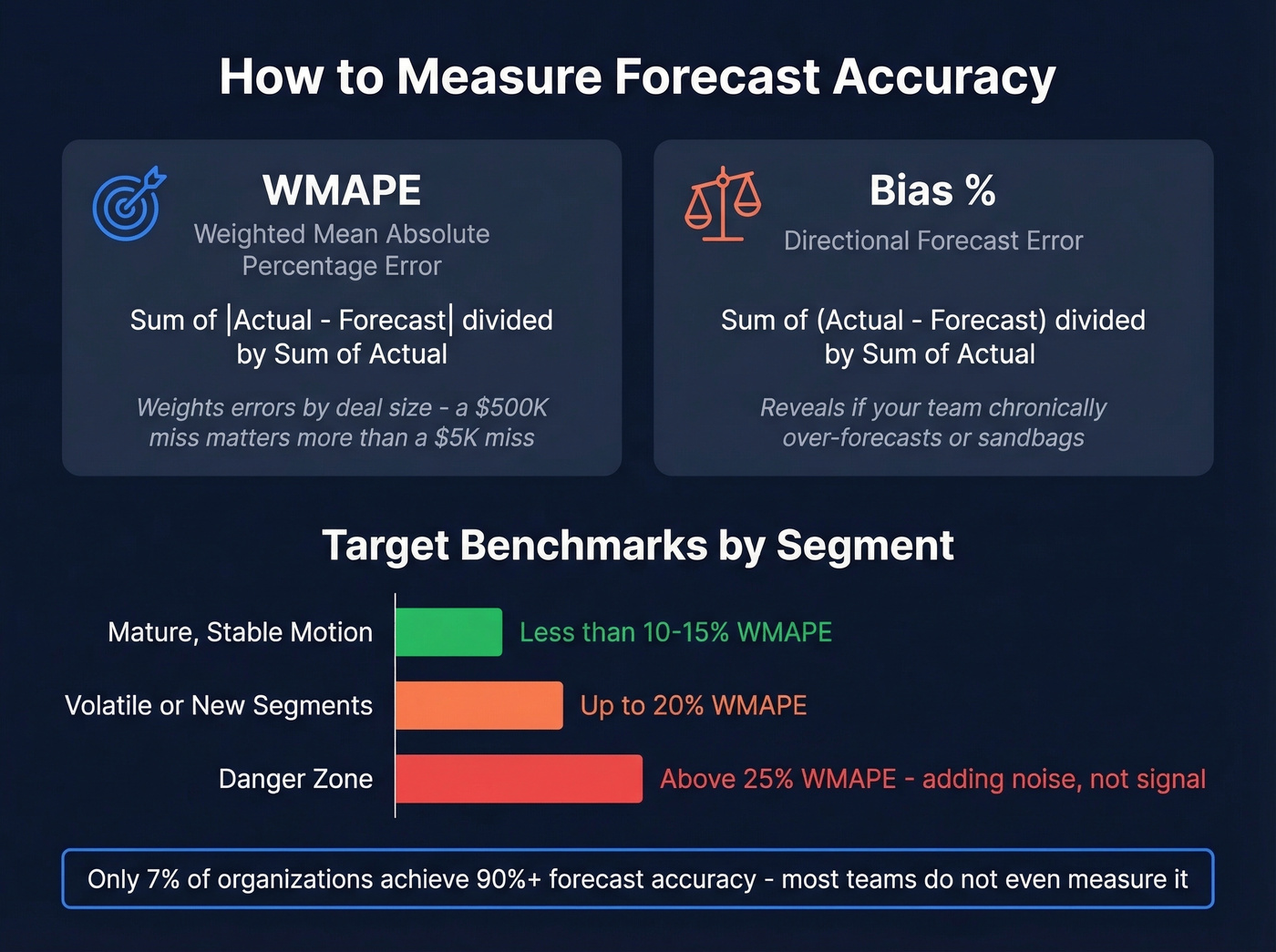
WMAPE (Weighted Mean Absolute Percentage Error) = S|Actual - Forecast| / SActual. This is the right metric for revenue teams because it weights errors by deal size. A $500K miss matters more than a $5K miss, and WMAPE reflects that.
Bias % = S(Actual - Forecast) / SActual. This reveals whether your team chronically over-forecasts (happy ears) or under-forecasts (sandbagging). Aggregate accuracy can look fine while bias hides systematic problems underneath.
The critical process step most teams skip: the lockdown snapshot. Freeze your forecast at the start of each period. Don't let reps update it retroactively. Compare that frozen number to actuals at period end. We've seen this firsthand - teams that skip this step never improve accuracy because they're just measuring hindsight, not prediction.
Target benchmarks: mature, stable motions should aim for less than 10-15% WMAPE. Volatile or new segments can tolerate up to 20%. Anything above 25% means your forecast is adding noise, not signal. And always measure by segment, by rep, and by deal type. Errors cancel across segments, making blended numbers look deceptively reasonable.
Common Forecasting Mistakes
We've seen the same failure modes across dozens of teams. Let's be honest - most of them are avoidable.
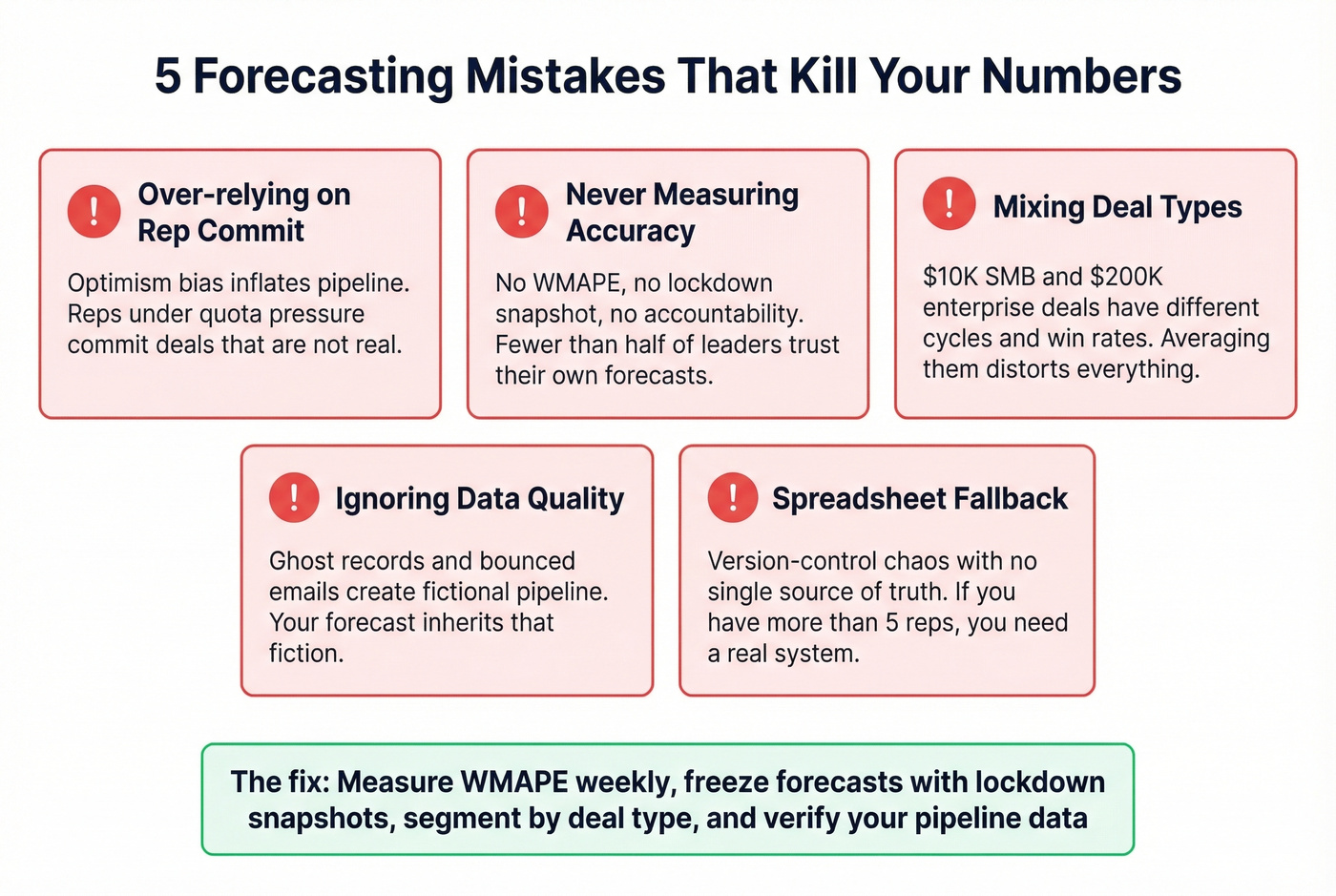
Over-relying on rep commit. Optimism bias inflates pipeline. Reps under quota pressure commit deals that aren't real. The consensus on r/sales is pretty clear: rep commit is one of the biggest sources of forecast error, and most managers know it but don't have a system to counterbalance it.
Never measuring accuracy. No WMAPE, no lockdown snapshot, no accountability. Fewer than half of sales leaders even have high confidence in their own forecasts.
Mixing deal types. A $10K SMB deal and a $200K enterprise deal have completely different cycles, win rates, and stage probabilities. Averaging them in one model distorts everything. If you're struggling here, start by fixing your sales pipeline challenges before you touch the model.
Ignoring data quality. Ghost records inflate pipeline. If a meaningful chunk of your contacts have bounced emails or disconnected numbers, those "opportunities" are fiction - and your forecast inherits that fiction. This is where data enrichment services and verification tools earn their keep, cleaning bad records before they corrupt your numbers.
Spreadsheet fallback. Even teams with modern sales stacks still default back to spreadsheets for forecast submissions, creating version-control chaos and no single source of truth. Skip this if you have more than five reps - you need a system, not a shared Google Sheet.
The Data Quality Foundation
If your average deal size exceeds $25K, bad pipeline data is costing you more than your entire tech stack combined. And yet 74% of sales teams with AI are prioritizing data hygiene only after learning the hard way that AI amplifies whatever data you feed it.
Your forecast starts with whether your reps can actually reach the people in their pipeline. Picture this: a rep has 40 "opportunities" but 12 of them are built on bounced emails and dead numbers. That's not a $400K pipeline - it's a $280K pipeline with $120K of noise baked in. Accurate revenue prediction begins long before the forecast call. It starts with the data feeding your pipeline.
Prospeo solves this at the source: 98% email accuracy, 143M+ verified emails, 125M+ verified mobile numbers, and a 7-day data refresh cycle while the industry average sits at six weeks. When your contact data is accurate, your pipeline is accurate. When your pipeline is accurate, your forecast is accurate. The chain is that direct. If you're building a repeatable outbound motion, pair this with proven sales prospecting techniques so the pipeline you forecast is the pipeline you can actually work.
The gap between your CRM forecast and actual revenue starts with bad contact data. Prospeo enriches your pipeline with 50+ verified data points per contact at a 92% match rate - so your stage probabilities are built on real conversations, not phantom opportunities.
Accurate forecasts start with accurate data. Try Prospeo free.
AI and Forecasting in 2026
AI in sales forecasting is promising but overhyped. The numbers look compelling - AI users report a 47% productivity boost and save an average of 12 hours per week. Sellers who partner with AI tools are 3.7x more likely to meet quota. And Gartner projects that 80% of CSOs will require AI-augmented plans by 2030.
If you're trying to make forecasting more objective, it helps to align on data-driven forecasting inputs before you automate anything.
But 32% of sales professionals still never use AI tools. The gap between "AI can improve forecasts" and "our AI actually improves our forecasts" is filled with dirty CRM data, inconsistent rep logging, and tools that weren't built for your specific sales motion. Get the fundamentals right - weighted pipeline, WMAPE tracking, clean contact data - and then layer in AI when you've outgrown the basics. AI doesn't fix bad data. It amplifies it.
Sales Forecasting FAQ
What's the difference between sales planning and sales forecasting?
Planning sets long-term targets and resource allocation, typically quarterly or annually. Forecasting predicts near-term revenue based on current pipeline signals and runs weekly or monthly. Planning answers "where are we going?" Forecasting answers "are we on track to get there?"
How accurate should a sales forecast be?
Best-in-class teams target less than 10-15% WMAPE. Most organizations operate in the 15-30% range. Only 7% of companies achieve 90%+ forecast accuracy. If you're consistently above 20% WMAPE, your process needs structural changes - not just better rep inputs.
What's the best forecasting method for B2B teams?
Weighted pipeline forecasting. Use your CRM stage data and historical win rates to produce probability-weighted revenue projections. Assign probabilities to each stage, multiply by deal value, and roll up. Start here, measure accuracy quarterly, and layer in regression or ML only when the data justifies the complexity.
Why use data-driven forecasting instead of rep intuition?
Rep intuition is subject to optimism bias, recency bias, and quota pressure - all of which distort pipeline visibility. A structured process grounds predictions in historical win rates and deal-stage data. Teams that move from gut feel to data-driven forecasting see measurable improvements in accuracy and quota attainment.
How does data quality affect forecast accuracy?
Directly and significantly. If your pipeline contains deals built on bounced emails and disconnected numbers, those "opportunities" inflate your forecast with fiction. Verifying contact data at 98% email accuracy on a weekly refresh cycle ensures your pipeline reflects actual reachable prospects rather than stale records.