

Inbound Lead Definition: What It Really Means (And Why Most Teams Get It Wrong)
A prospect downloaded your pricing guide at 2:14 PM Tuesday. Your SDR emailed at 10:30 AM Thursday. By then, they'd already booked a demo with your competitor.
That gap between having inbound leads and converting them starts with getting the definition right - and building a process that doesn't let good leads rot in a queue.
What Is an Inbound Lead?
An inbound lead is a person or company that initiates contact with your business through a marketing channel. They're a hand-raiser, not a cold target. They filled out a form, downloaded a whitepaper, requested a demo, or started a live chat. The defining characteristic is direction: they came to you.
This matters because 67% of buyers now prefer self-service over speaking to a representative. How your team defines an inbound lead determines whether marketing and sales agree on what counts as a real opportunity - or spend every pipeline review arguing about lead quality.
Not all inbound actions carry equal weight. A demo request signals far more intent than a blog subscription. A pricing page visit with a form fill outranks a newsletter signup. That's where qualification comes in, and we'll get to frameworks shortly.
The quick version:
- Definition: Anyone who initiates contact through a marketing channel - form fill, download, demo request, chat.
- How it differs from MQL/SQL: An inbound lead is raw and unvetted. An MQL has met marketing's scoring threshold. An SQL has been accepted by sales as worth pursuing.
- The one metric to fix first: Speed-to-lead. Respond within 5 minutes or lose the deal.
Lead vs. Prospect vs. Opportunity
These terms get used interchangeably in most orgs, and it causes real damage. Marketing says they delivered 500 leads. Sales says they were garbage. The problem isn't the leads - it's that nobody agreed on what a "lead" actually means.
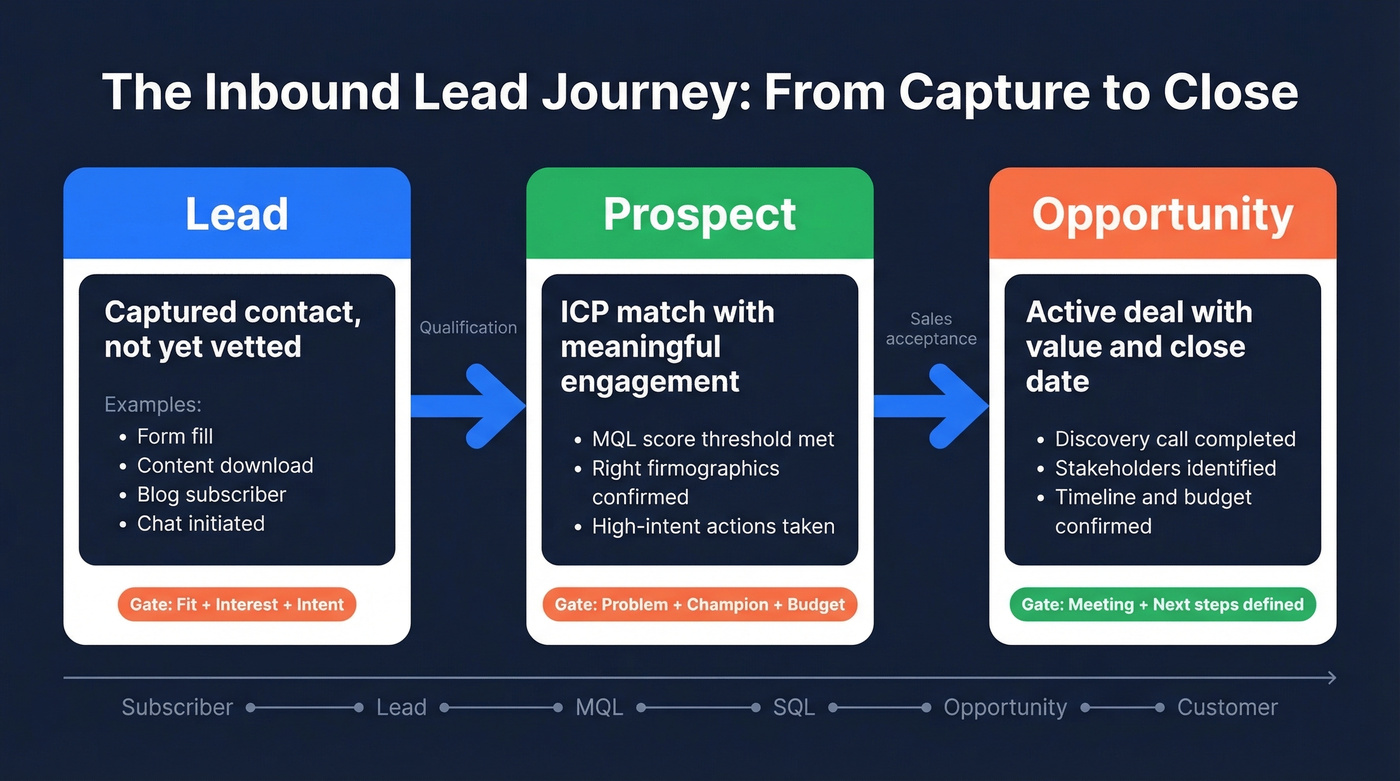
On r/B2Bmarketing, teams describe this exact pattern over and over: MQL counts look healthy, but conversion to opportunity is terrible. The root cause almost always traces back to undefined or unenforced stage gates. Without a shared definition, every handoff becomes a friction point that erodes trust between departments.
Here's a clean taxonomy:
| Stage | Definition | Gate to Next Stage |
|---|---|---|
| Lead | Captured contact, not vetted | Fit + Interest + Intent |
| Prospect | ICP match, meaningful engagement | Problem + Champion + Budget |
| Opportunity | Active deal with value and close date | Meeting + next steps defined |
Within the Lead stage, you've got sub-classifications that map to HubSpot's lifecycle flow: Subscriber, Lead, MQL, SQL, Opportunity, Customer.
An MQL is a lead that hit marketing's scoring threshold - enough engagement, right firmographics, maybe downloaded a high-intent asset. An SQL is an MQL that sales has accepted after a conversation. And a PQL (product-qualified lead) is someone who's used your free tier or trial and hit usage triggers that signal buying readiness. If you're running a product-led motion, PQLs often convert better than MQLs because the buyer has already experienced value firsthand rather than just reading about it.
Inbound vs. Outbound Leads
| Dimension | Inbound | Outbound |
|---|---|---|
| Who initiates | Buyer | Seller |
| Intent level | Medium to high | Low to medium |
| Typical CPL | $75-$150 | $200-$500 |
| Conversion rate | Higher per lead | Lower per lead |
| Sales cycle | Shorter | Longer |
| Asset longevity | Compounds over time | Stops when spend stops |
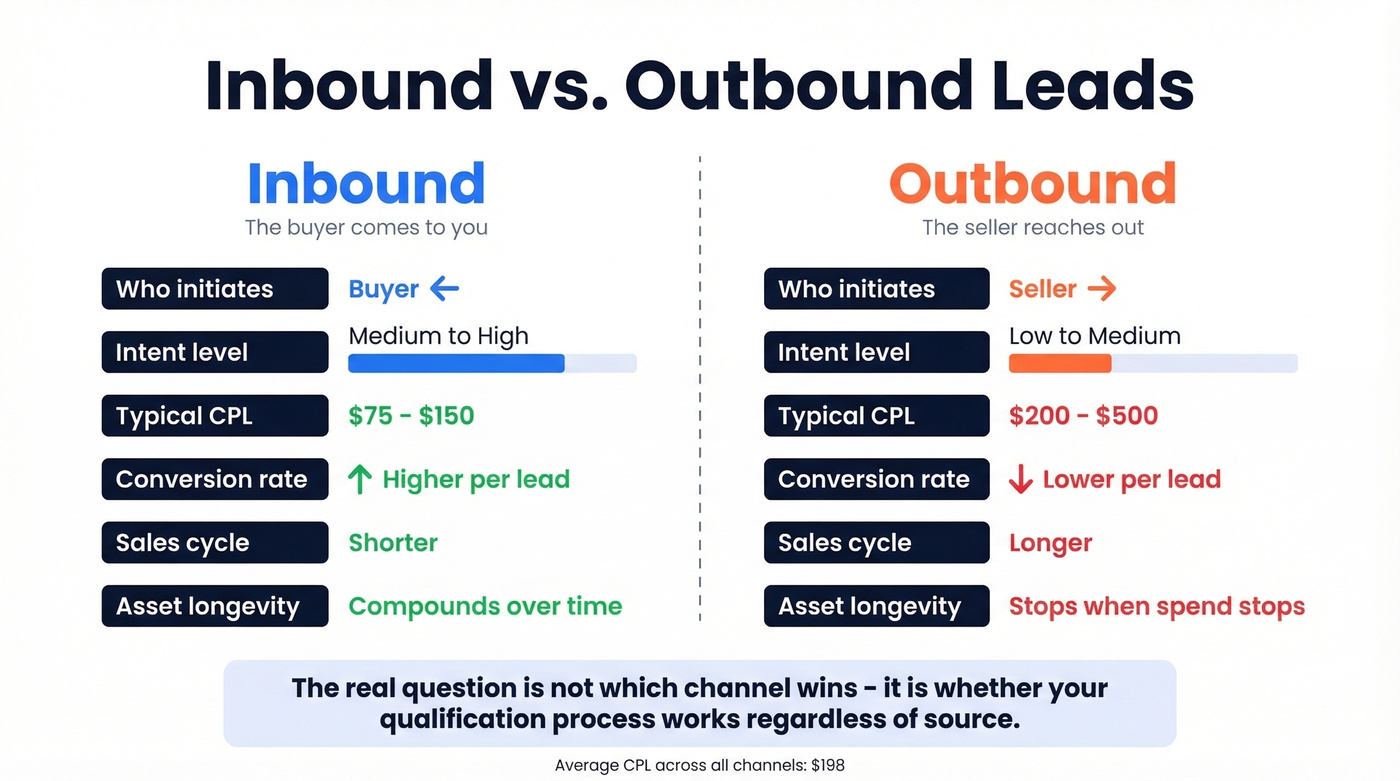
For context, the average CPL across all channels is roughly $198 - but inbound consistently comes in below that, while outbound skews well above it. Industries like legal and financial services see CPLs above $600.
Here's the thing: the inbound vs. outbound debate is a distraction. The real question is whether you have a qualification process that works regardless of where the lead originated. We've seen teams with beautiful inbound funnels waste every lead because nobody followed up for 48 hours. And we've seen outbound-heavy orgs close faster than inbound shops because their qualification was airtight. The channel matters less than the process.

Speed-to-lead kills most inbound funnels. When a prospect fills out your form, you need verified contact data instantly - not a 48-hour enrichment delay. Prospeo enriches inbound leads with 50+ data points at a 92% match rate, so your SDRs respond in minutes with the right phone number and verified email.
Stop letting inbound leads rot. Enrich and qualify them in real time.
Inbound Lead Benchmarks for 2026
Ruler Analytics analyzed 100M+ data points across 14 industries and found the average conversion rate to qualified lead is 2.9%, breaking down to a 1.7% form rate and a 1.2% call rate.
For B2B SaaS specifically, the numbers are sobering. Default.com analyzed 100 B2B software websites and found that companies with 25,000+ monthly visitors typically see under 1% visitor-to-demo-request conversion rates. Scale dilutes conversion - more traffic doesn't mean proportionally more demos.
HubSpot's State of Marketing report puts the top ROI channels for B2B as website/blog/SEO, paid social, and social media shopping tools. And 50% of marketers now use CRO as a top optimization technique - because when traffic gets harder to acquire, you squeeze more from what you've got.
Types of Inbound Leads and How to Qualify Them
Qualification isn't scoring. Scoring prioritizes - it tells you which leads to call first. Qualification filters out - it decides whether a lead moves forward at all. Most teams confuse them, and the confusion kills pipeline.
A webinar attendee, a pricing page form fill, a free trial signup, and a blog subscriber all represent different intent levels. Each requires a different qualification approach, and lumping them together is how you end up with SDRs spending 30 minutes on a lead who just wanted a PDF.
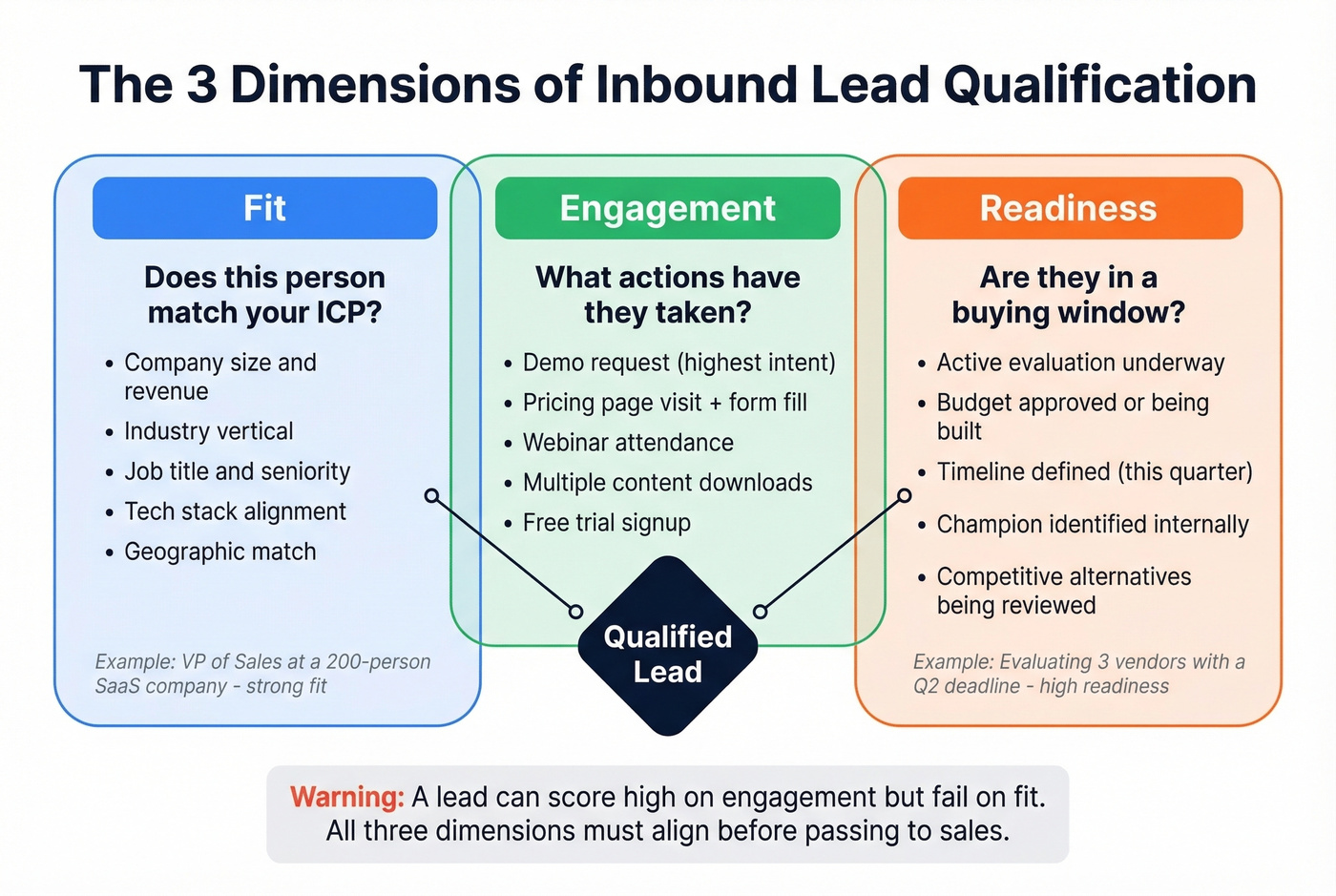
The overarching model is three-dimensional: Fit (does this person match your ICP?), Engagement (what actions have they taken?), and Readiness (are they in a buying window?). A lead can score high on engagement - downloaded five assets, attended two webinars - but fail on fit if they're at a 3-person company and you sell enterprise software. The framework you pick depends on your sales motion.
BANT: The Speed Triage
Budget, Authority, Need, Timeline. Picture a SaaS team handling 200+ inbound leads a month with a $12K average deal. They don't have time for discovery calls with everyone. BANT gets them to yes-or-no in under five minutes.
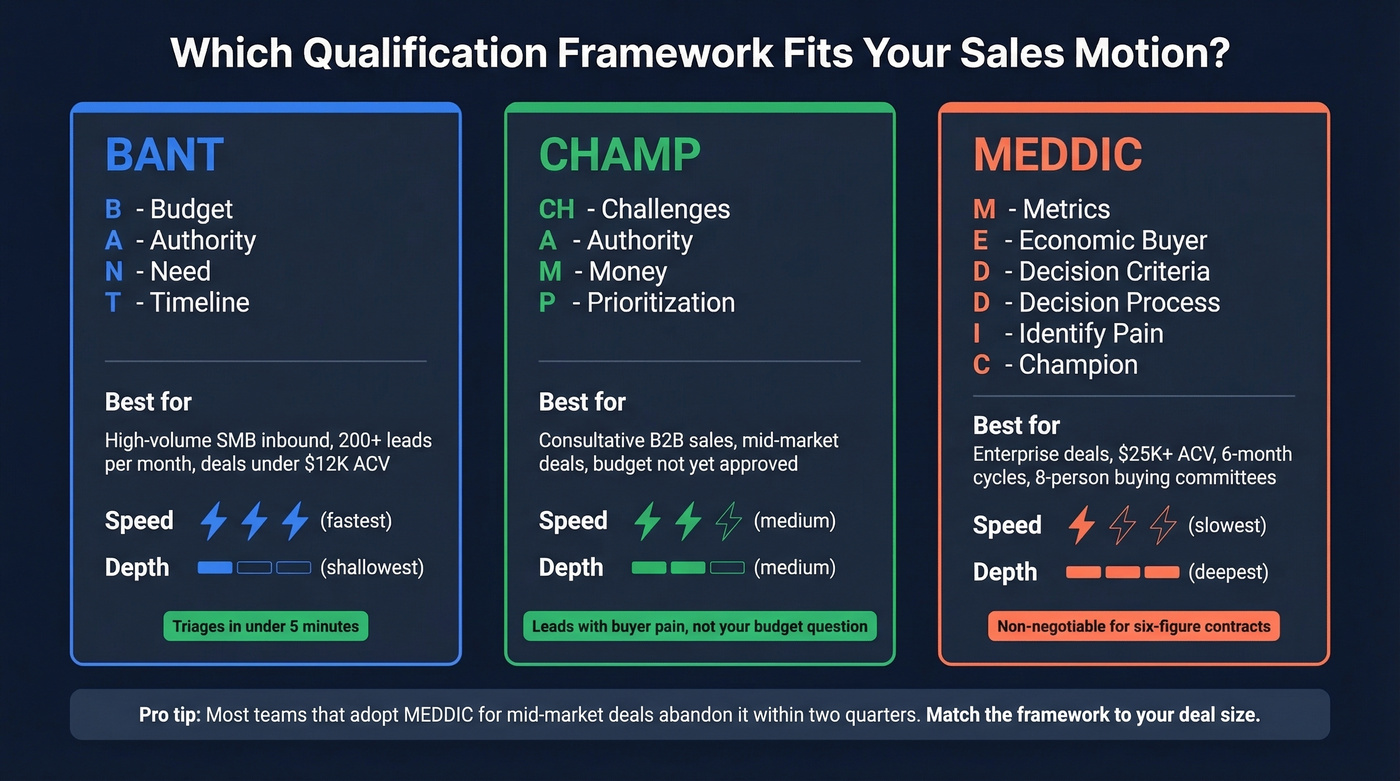
The knock on BANT is that it's seller-centric - you're interrogating the buyer rather than understanding their problem. Fair criticism. But for high-volume SMB inbound, nothing triages faster. Skip this if your average deal is above $50K and involves multiple stakeholders; you'll need something with more depth.
CHAMP: Lead With the Problem
| CHAMP Element | What You're Asking |
|---|---|
| Challenges | What problem are you solving? |
| Authority | Who else is involved in this decision? |
| Money | Is there budget, or do we need to build a case? |
| Prioritization | Where does this rank against other initiatives? |
CHAMP flips the script by leading with the buyer's pain, not your budget question. This works better for consultative B2B sales where the budget doesn't exist yet - it gets created after you build a business case. One mid-market SaaS team we spoke with switched from BANT to CHAMP and saw their MQL-to-SQL rate climb 15% in a single quarter, simply because reps stopped disqualifying leads who had real problems but no pre-approved budget.
MEDDIC: Enterprise Deals Only
Metrics, Economic Buyer, Decision Criteria, Decision Process, Identify Pain, Champion. The heavyweight framework for enterprise, multi-stakeholder deals. MEDDPICC adds Paper Process and Competition.
If you're selling six-figure contracts with 6-month sales cycles and buying committees of eight people, this is non-negotiable. For anything under $25K ACV, it's overhead that slows your team down. Let's be honest - most teams that adopt MEDDIC for mid-market deals end up abandoning it within two quarters because reps find it too heavy for the deal size.
Speed-to-Lead: The Silent ROI Killer
This is where we get frustrated. A RevenueHero study of 1,000 companies found that 63.5% never responded to inbound leads at all. Service businesses average 47 hours to respond. Even among companies that do respond, the average is 29+ hours.
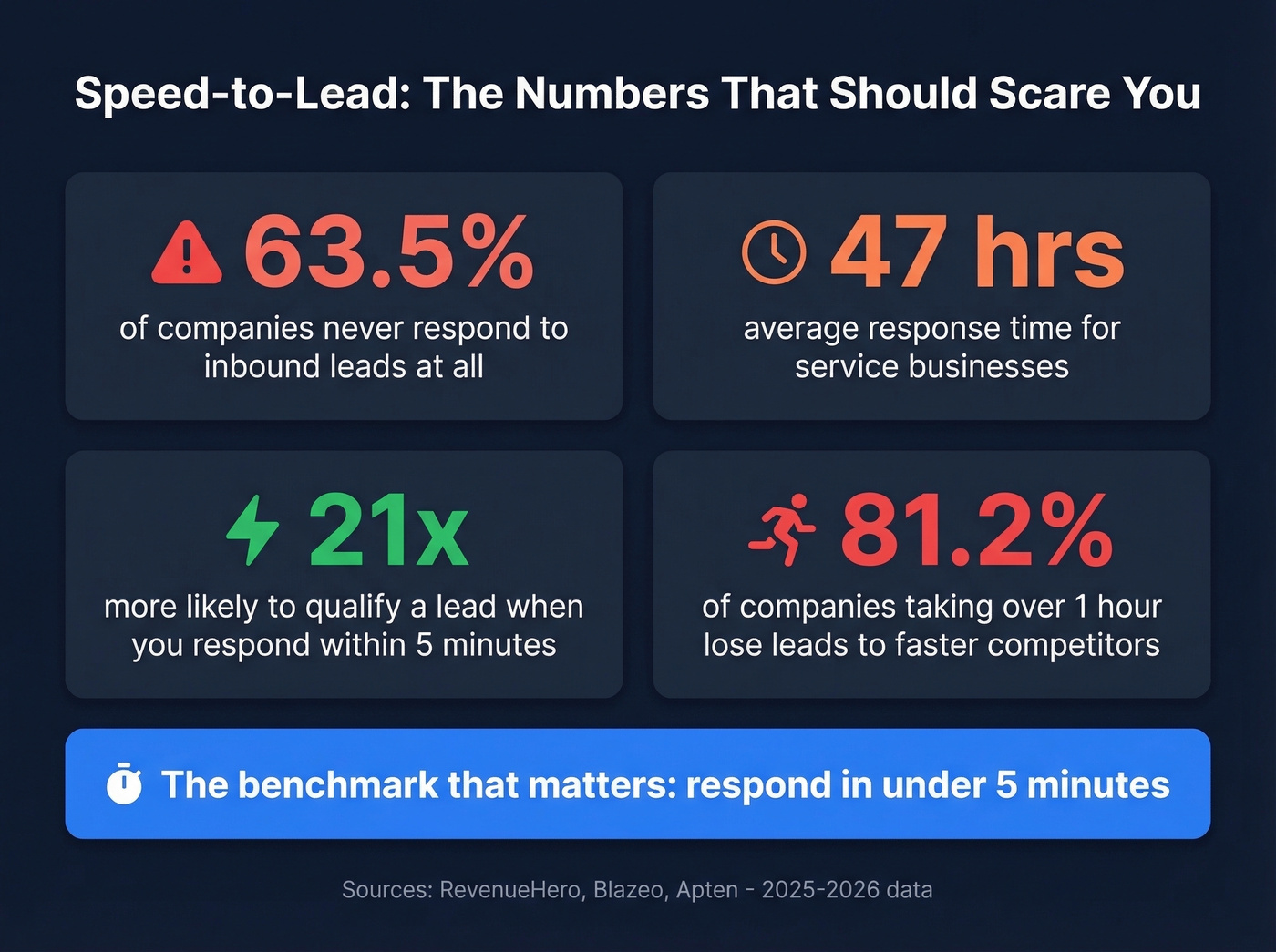
The 5-minute window is the benchmark that matters. Responding within 5 minutes makes you 21x more likely to qualify the lead compared to waiting 30 minutes. And 81.2% of companies that take longer than an hour report losing leads to faster competitors.
But fast response requires accurate contact data. If the email bounces or the phone number is dead, speed doesn't matter - you're just failing faster. Prospeo's 98% email accuracy and 7-day data refresh cycle close that gap, so when you do respond in 5 minutes, you actually reach someone.
Inbound Lead Generation in 2026
Roughly 30% of marketers report decreased search traffic as buyers shift to AI tools. Small business owners on Reddit describe the same pattern: impressions hold steady, but clicks drop as AI Overviews answer queries directly - sometimes recommending competitors in the process.
The silver lining? Leads who do convert are more educated. They've already consumed your content through AI summaries, compared alternatives, and understand pricing before they ever fill out a form. The meaning of an inbound lead has shifted - these are higher-quality hand-raisers, but there are fewer of them. Inbound lead generation today is less about volume and more about capturing the smaller pool of buyers who've already done their homework.
When every inbound lead costs more to acquire, you can't afford to lose them to bounced emails or stale phone numbers. Verify your contact data in real time so the leads you earned through content actually reach a human.
If you're tightening your process end-to-end, map your lead generation workflow and track the right lead generation metrics so you can see exactly where leads stall.
Qualification frameworks like BANT and CHAMP only work when you have complete data on who just raised their hand. Prospeo fills the gaps - firmographics, department headcount, tech stack, even buyer intent across 15,000 topics - so you know if an inbound lead fits your ICP before the first call.
Qualify inbound leads on Fit, Engagement, and Readiness with real data - not guesswork.
FAQ
What's the difference between an inbound lead and an MQL?
An inbound lead is anyone who initiates contact - a form fill, download, or chat - while an MQL is an inbound lead that meets specific marketing-defined criteria like lead score threshold, ICP fit, and engagement level. Every MQL started as an inbound lead, but not every inbound lead becomes an MQL. Aligning on this distinction across your team prevents the classic marketing-sales blame game.
How do inbound leads differ from outbound leads?
Inbound leads are prospects who found you and raised their hand through organic search, content downloads, or demo requests. Outbound leads are contacts your team identified and reached cold. Inbound typically converts at higher rates with shorter sales cycles because the buyer already has intent, while outbound requires building awareness from scratch.
What's a good inbound lead conversion rate?
The average across 14 industries is 2.9% visitor to qualified lead. B2B SaaS companies with 25,000+ monthly visitors typically see under 1% visitor-to-demo-request rates. Focus on stage-to-stage conversion - visitor to lead, lead to MQL, MQL to SQL - rather than a single top-line number.
How do I stop inbound leads from going cold?
Set a 5-minute speed-to-lead SLA. Companies that respond within 5 minutes are 21x more likely to qualify the lead than those waiting 30 minutes. Verify contact data before outreach so emails don't bounce, and automate your routing so leads hit the right rep's queue instantly instead of sitting in a shared inbox.
What channels generate the most inbound leads?
According to HubSpot's State of Marketing report, the highest-ROI B2B channels are website/blog/SEO, paid social, and social media shopping tools. Organic search still drives the most volume, but paid social is closing the gap - especially for mid-funnel content like case studies and comparison pages that attract higher-intent visitors.