

Inbound Lead Nurturing: Why Your Program Isn't Moving Pipeline (and How to Fix It)
A RevOps lead we know ran an inbound lead nurturing audit last quarter. Open rates looked fine - 28%, right in the sweet spot. Pipeline influenced by nurture? Zero. The emails were reaching inboxes, getting opened, and doing absolutely nothing. The problem wasn't the copy or the cadence. It was everything underneath.
What You Need (Quick Version)
- Fix your data first. If your bounce rate is above 5%, stop tweaking subject lines and go verify your list. Nothing else matters until deliverability is solid.
- Build a lead scoring model with negative signals. A pricing page visit is +10. A bounced email is -25. Scoring without penalties is just a vanity leaderboard.
- Go multichannel. Email-only nurture reaches 20-30% of your audience at best. McKinsey found that B2B customers now engage across an average of 10 channels before purchase - if you're email-only, you're nurturing a fraction of your pipeline.
What Is Inbound Lead Nurturing?
Most teams think they're nurturing leads. They're actually running drip campaigns - and the difference is critical.
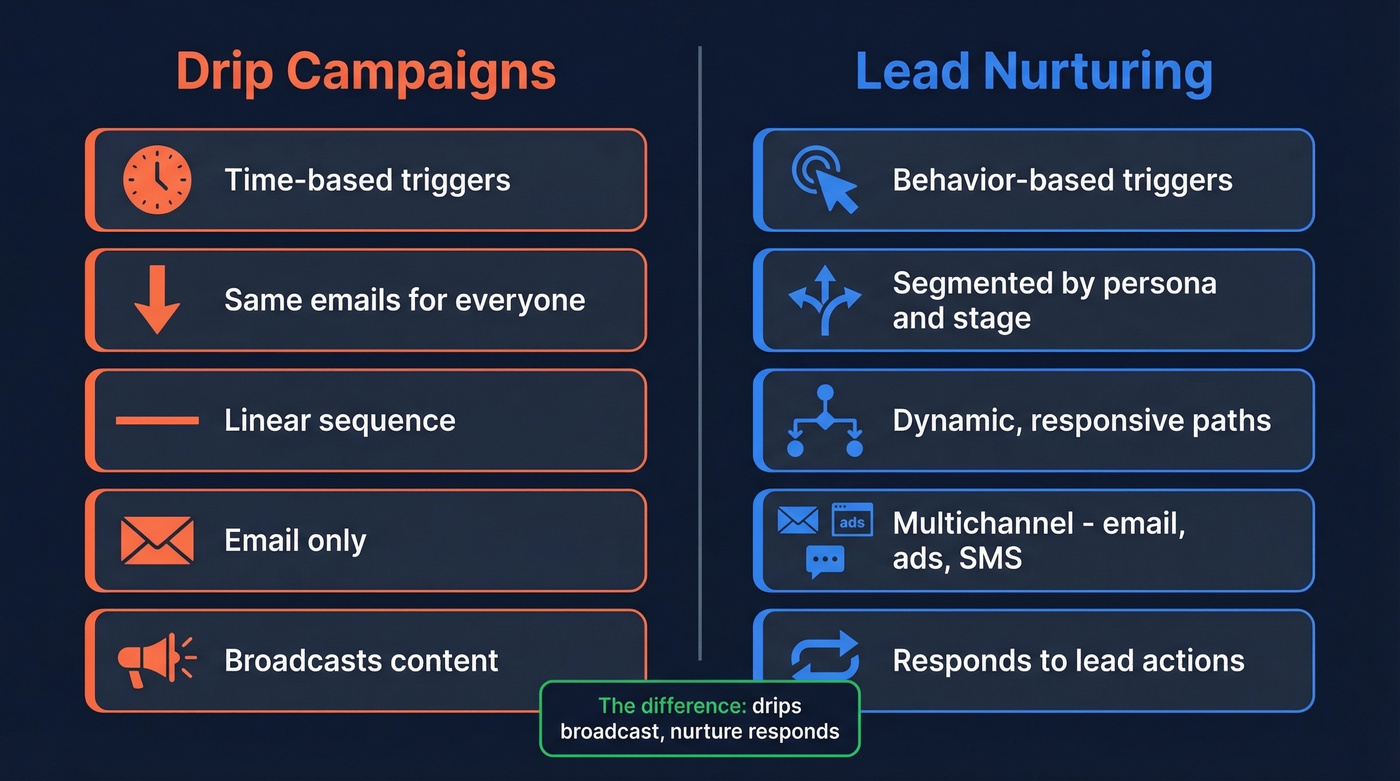
Drips are time-based and linear: everyone gets the same emails on the same schedule. Nurturing is triggered by what a lead actually does, segmented by who they are, and delivered across multiple channels. It responds. Drips broadcast.
The mechanics also differ sharply between B2B and B2C:
| B2B | B2C | |
|---|---|---|
| Tone | Consultative, ROI-focused | Emotional, lifestyle-driven |
| Content | Case studies, ROI calcs, demos | Product showcases, offers |
| Sequence length | 7-15+ touches over weeks | 3-5 touches, tighter windows |
| Decision cycle | Months, committee-driven | Days to weeks, individual |
One question that rarely gets asked: who owns the nurture program? In our experience, the best results come when RevOps owns the infrastructure and scoring model while marketing owns the content and cadence. Split ownership kills accountability.
Why It Matters
The average B2B buying cycle runs 10.1 months. That's not a typo. The winning vendor is on the buyer's Day One shortlist 95% of the time, and by the time a lead contacts you, they're already 61% through their decision process. If you're not running a nurture program between that first touch and the moment they're ready to buy, you're invisible when the decision happens.
79% of marketing leads never convert into sales. The usual culprit isn't bad leads - it's the absence of a program that moves them forward. Forrester's research shows that companies doing nurture well generate 50% more sales-ready leads at 33% lower cost per lead. Nurtured leads also make 47% larger purchases. SEO-driven inbound leads close at 14.6% versus 1.7% for outbound. The leads are good. The follow-through is where most teams fall apart.
Here's the thing: most companies don't have a lead quality problem. They have a lead neglect problem. The data is overwhelming - nurture works. The reason most programs fail isn't strategic. It's mechanical: bad data, wrong channels, no negative scoring. Fix the plumbing and the pipeline follows.

The Foundation Everyone Ignores - Data Quality
Let's say you've built a beautiful 7-email nurture sequence. The copy is sharp, the timing is dialed, and the content maps perfectly to each funnel stage. Then 12% of your list bounces on the first send. Your domain reputation craters. Your next three sends land in spam for everyone - including the good contacts. The whole program is dead before it started.
That's not hypothetical. It's what happens when teams skip the data layer and jump straight to copywriting.
Map Content to the Funnel
A lead who downloaded a top-of-funnel guide doesn't need a pricing comparison - they need education. A lead who visited your pricing page three times doesn't need another blog post. They need a demo invite.
| Funnel Stage | Content Types | Goal |
|---|---|---|
| TOFU | Guides, blogs, thought leadership | Build awareness and trust |
| MOFU | Case studies, webinars, comparisons | Establish consideration |
| BOFU | Demos, free trials, pricing pages | Drive decision |
The 70/30 rule works well here: roughly 70% educational content, 30% product-focused. Teams that flip this ratio see engagement crater after email two. Think of TOFU and MOFU content as air cover - even if a specific email doesn't get opened, consistent presence builds recall. When the buying window opens, you're already on the shortlist.

You just read it: 12% bounce rates kill nurture programs before they start. Prospeo's 5-step email verification delivers 98% accuracy, refreshed every 7 days - not every 6 weeks. Teams using Prospeo cut bounce rates from 35% to under 4%.
Stop nurturing contacts that don't exist. Verify your list first.
Build Your Lead Scoring Model
Lead scoring without negative signals is just a vanity leaderboard. Every contact trends upward over time, which means your "hot leads" list eventually includes everyone who's been in your CRM long enough. We've seen teams route hundreds of "SQLs" to sales that were actually dead contacts with inflated scores - and then wonder why sales stopped trusting marketing.
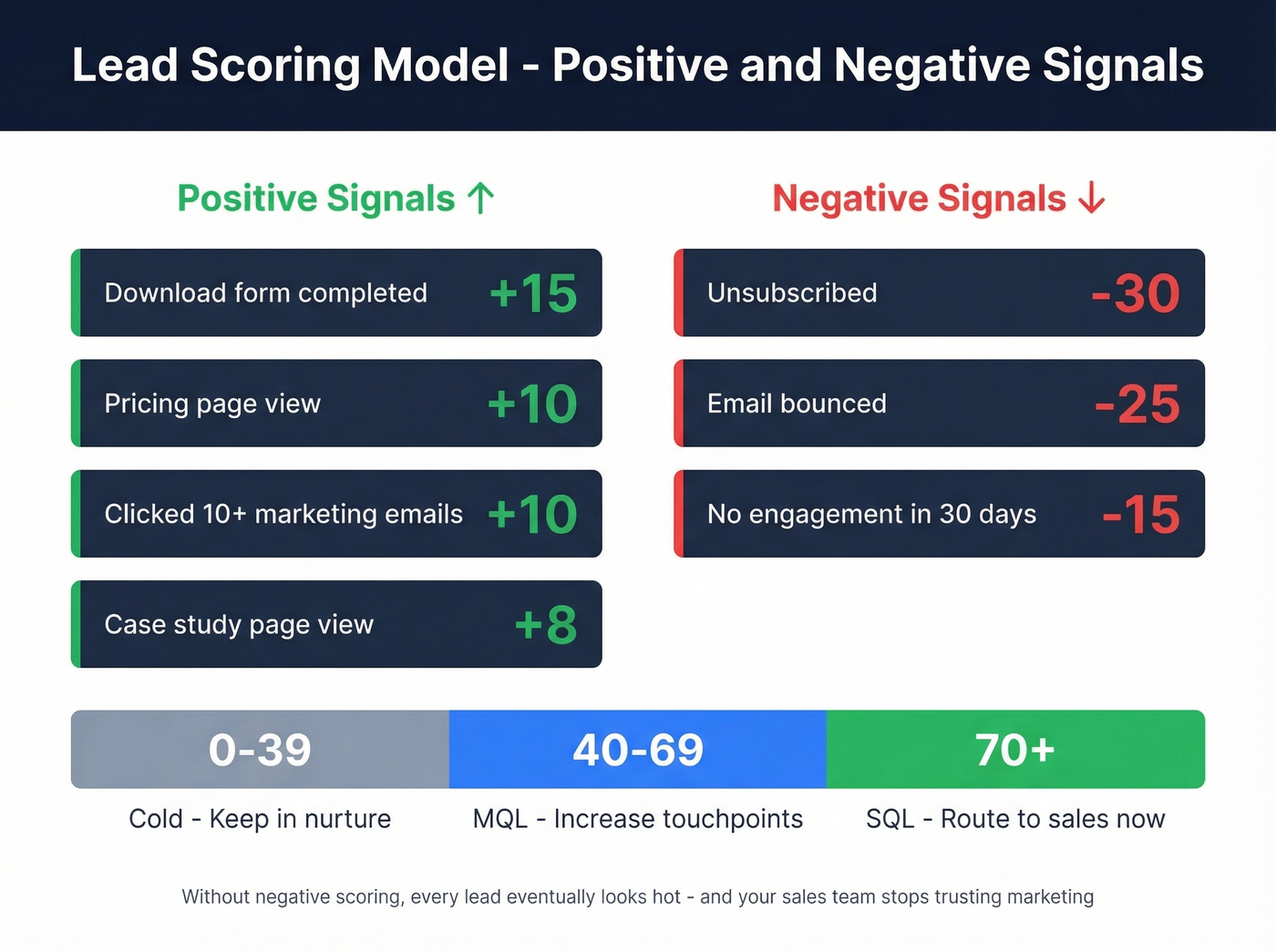
Here's a scoring template based on the Belkins model that actually works:
| Action | Points |
|---|---|
| Pricing page view | +10 |
| Download form completed | +15 |
| Clicked 10+ marketing emails | +10 |
| Case study page view | +8 |
| Email bounced | -25 |
| Unsubscribed | -30 |
| No engagement in 30 days | -15 |
Score across four dimensions: firmographic fit (right company size and industry), role authority (decision-maker vs. individual contributor), behavioral signals (page visits, downloads), and engagement recency. Then set clear thresholds:
- 0-39: Cold. Keep in nurture, don't pass to sales.
- 40-69: MQL. Increase touchpoint frequency, add sales visibility.
- 70+: SQL. Route to sales immediately.
One thing worth flagging: Apple Mail Privacy Protection has made open rates unreliable as a scoring input. Shift your weight toward on-site behavior - pricing page visits, form submissions, content downloads. Opens tell you almost nothing anymore.
Workflow Blueprints That Move Pipeline
Welcome/Onboarding
Remix ran a 3-step welcome flow for new registrations: if no purchase after one week, prompt users to save search preferences. A few days later, follow up with brand showcases. Final email explains how to combine orders and save money. Result: 104% jump in first purchases versus the previous quarter. The takeaway isn't the specific emails - it's the trigger logic. Start with inactivity, not a calendar.
Multichannel Sequence
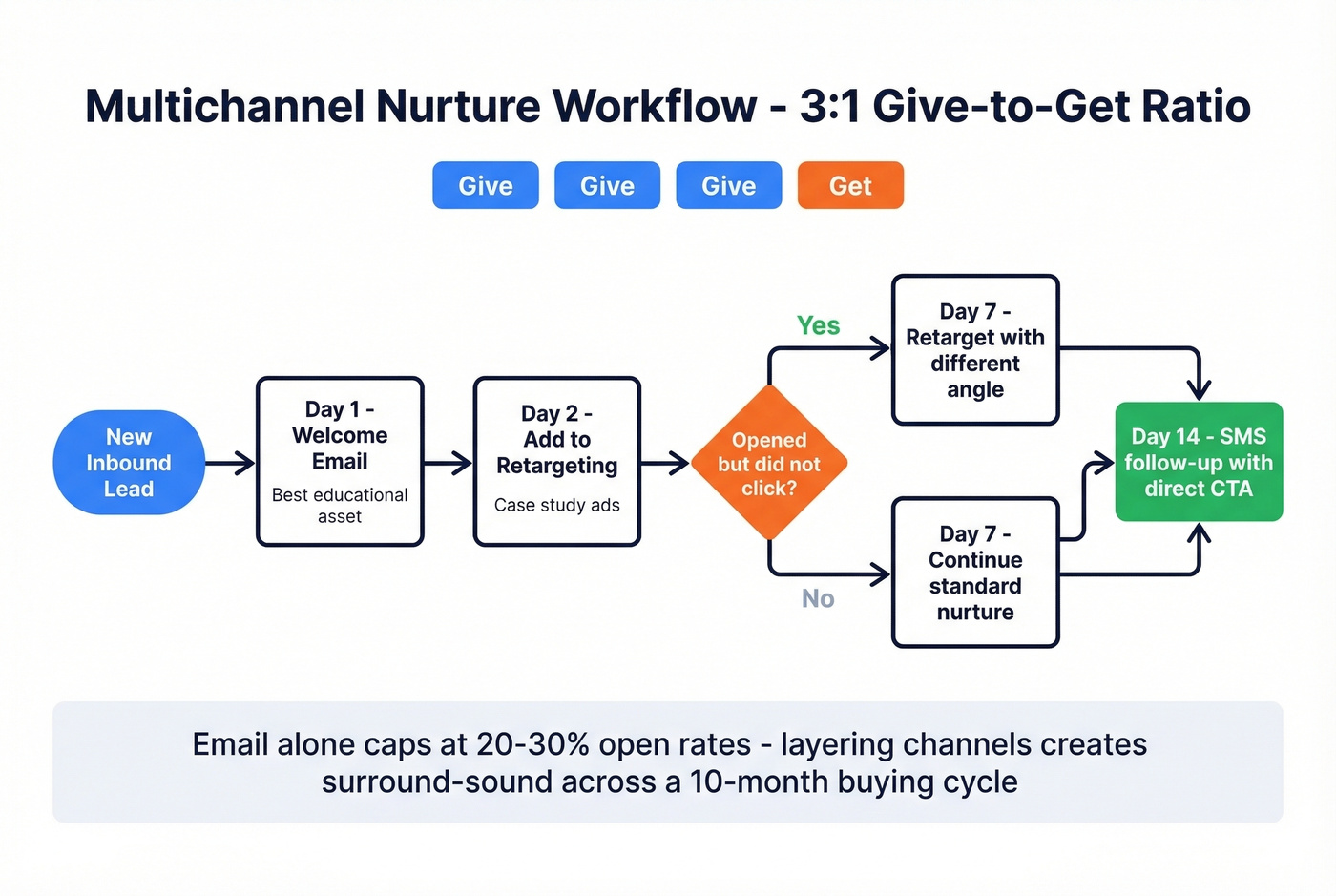
Use the 3:1 give-to-get ratio - three value touches before any strong ask.
Day 1: welcome email with your best educational asset. Day 2: add the lead to a retargeting audience for case study ads. Day 7: if they opened but didn't click, retarget with a different angle. Day 14: SMS follow-up (with consent) featuring a direct CTA. This works because email alone caps at 20-30% open rates. Layering channels creates the surround-sound effect that keeps you top of mind across a 10-month buying cycle.
Re-Engagement
Set a 45-day inactivity trigger. When a contact goes dark, segment first - don't just blast a "we miss you" email. One HubSpot community member segmented 20,000 unlabeled contacts down to 16,000 meaningful records by filtering on engagement and assigning tags. From there, personalized video plus automation can reactivate dormant accounts that generic emails won't touch.
Post-Sale Expansion
Nurturing doesn't stop at closed-won.
Your best expansion revenue comes from customers who are already engaged. Build a post-sale sequence that triggers on product usage milestones, delivers case studies about adjacent use cases, and surfaces upgrade opportunities at natural inflection points. Companies that run post-sale nurture consistently see higher net revenue retention - and it costs a fraction of new customer acquisition.
Nurture Email Templates
Here's a 7-email sequence skeleton. Space emails 3-7 days apart early, then stretch to weekly.
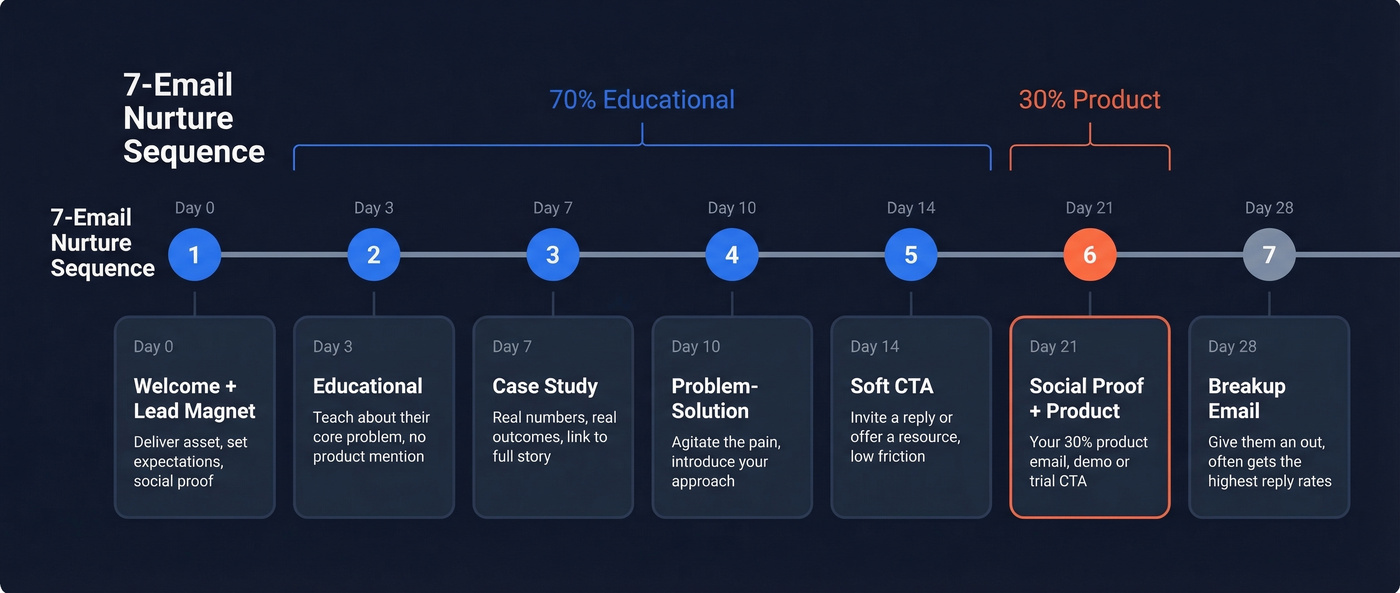
- Day 0 - Welcome + lead magnet delivery. Deliver the asset, set expectations, one line of social proof.
- Day 3 - Educational. Teach something useful about their core problem. No product mention.
- Day 7 - Case study. Real numbers, real outcomes. Link to the full story.
- Day 10 - Problem-solution. Agitate the pain, introduce your approach - not your product.
- Day 14 - Soft CTA. Invite a reply or offer a resource. Low friction.
- Day 21 - Social proof + product. This is your 30% product-focused email. Demo or trial CTA.
- Day 28 - Breakup. Give them an out. Breakup emails often get the highest reply rates because they create urgency without pressure.
Keep the 13 nurture email categories from Moosend as a planning checklist. You don't need all 13 in one flow, but you should be using at least 5-6 across your active programs.
Mistakes That Kill Your Pipeline
The most common failure is confusing drips with nurturing. If every contact gets the same emails regardless of behavior, that's not nurture - it's a newsletter with extra steps.
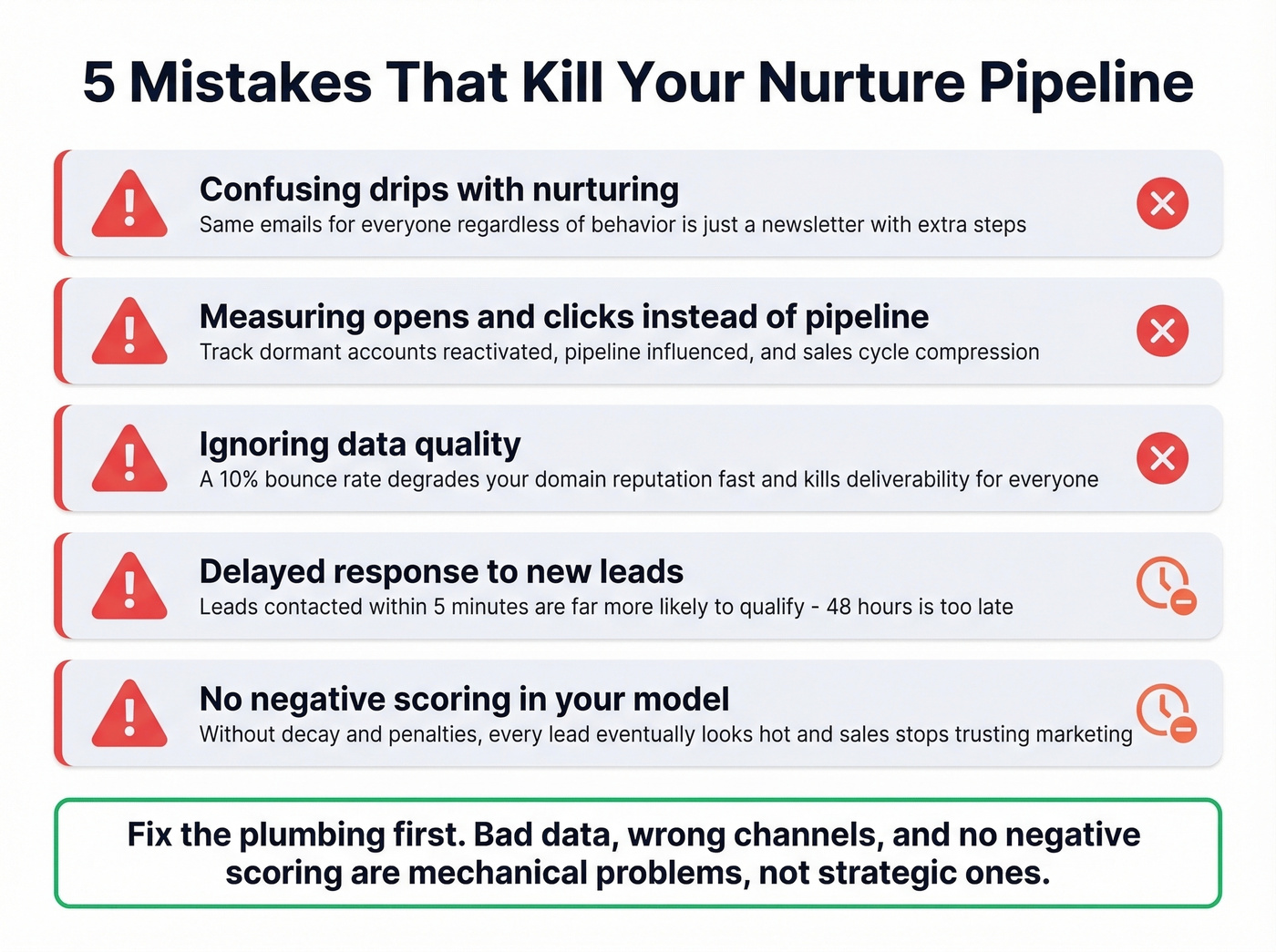
The second killer is measuring opens and clicks instead of pipeline. Opens and clicks aren't pipeline metrics. Stop reporting them to your VP of Sales. Track dormant accounts reactivated, pipeline influenced, and sales cycle compression instead.
Then there's the data problem. Your ability to nurture inbound leads is only as good as your contact list. A 10% bounce rate can degrade your domain reputation fast. As one practitioner put it on r/Emailmarketing, too many teams confuse "sending emails" with "actually nurturing" - and bad data is usually the root cause.
Three more mistakes worth flagging:
- Delayed response. Leads contacted within 5 minutes are far more likely to qualify. If your nurture starts 48 hours after a form fill, you've already lost.
- Generic, unsegmented emails. Sending the same sequence to a VP of Engineering and a marketing coordinator wastes both their time and tanks your engagement metrics.
- No negative scoring. Without decay and penalties, every lead eventually looks hot. That's how you waste your sales team's time on dead contacts.
Skip re-engagement workflows entirely if you haven't fixed your scoring model first. Reactivating contacts who were never properly scored just floods your pipeline with noise.
Tools by Company Size
You don't need 10 tools. You need a CRM, a marketing automation platform, and a data provider that doesn't feed you garbage.
| Tool | Best For | Starting Price |
|---|---|---|
| Prospeo | Data quality / enrichment | Free tier, ~$0.01/email |
| HubSpot | SMB to mid-market | $15/user/mo |
| Salesforce | Mid-market to enterprise | $25/user/mo |
| ActiveCampaign | SMB email automation | ~$29/mo |
| Marketo | Enterprise nurture | ~$1,000-3,000+/mo |
| Act-On | Mid-market marketing | $900/mo |
| Customer.io | Product-led / event-driven | ~$100/mo |
| Engagebay | Budget-conscious SMBs | Free tier, ~$12/user/mo |
| Pipedrive | Sales-first small teams | ~$14/user/mo |
| Close | Inside sales teams | $49/user/mo |
For teams spending under $500/mo, HubSpot's free CRM paired with a verified data source covers most of what you need. Enterprise teams running Marketo or Salesforce Marketing Cloud should focus less on the platform and more on the data flowing into it - the best automation in the world can't fix a list full of dead addresses.
Lead scoring only works when the data underneath it is real. Prospeo enriches every contact with 50+ data points - firmographics, job titles, verified emails, direct dials - so your scoring model reflects actual buyer signals, not stale CRM records.
Enrich your CRM contacts and make every lead score mean something.
Metrics That Actually Matter
| Vanity Metrics | Pipeline Metrics |
|---|---|
| Open rate | Dormant accounts reactivated |
| Click rate | Pipeline influenced revenue |
| Emails sent | Sales cycle compression |
| List size | MQL-to-SQL conversion rate |
Act-On ran an internal nurture audit and saw open rates jump from 25% to 48% and CTR from 1.32% to 17.93% after revamping their program. Those are impressive engagement numbers, but the metric that mattered was MQL-to-Opportunity conversion moving from 37% to 45%. That's pipeline.
Measure at the account level, not the contact level. B2B decisions are made by buying committees. If three people at the same company are engaging with your nurture content, that's one opportunity heating up - not three separate leads.
FAQ
How many touches does it take to convert a lead?
The Aberdeen Group benchmark is 10 marketing-driven touches from first contact to conversion. Space them 3-7 days apart early, then shift to weekly. Multichannel touches - email, ads, SMS - count toward this number and tend to accelerate the timeline.
What's the difference between a drip campaign and lead nurturing?
Drip campaigns are time-based and linear - every contact gets the same sequence regardless of behavior. Lead nurturing is behavior-triggered, segmented by persona and funnel stage, and delivered across multiple channels. Nurture adapts; drips don't.