

Best Inside Sales CRM in 2026 (8 Tools Compared)
An inside sales CRM should claw back selling time. Most don't. Sales reps spend only 28% of their week actually selling - the other 72% disappears into data entry, tab-toggling, and chasing stale contact info. Pick the wrong CRM and you've just added another admin burden to the pile.
Here are eight tools worth evaluating in 2026, sorted by what actually matters for high-velocity sales workflows.
Our Picks
- Best overall for SMB inside sales: Pipedrive - from $14/seat/mo, live in 2-3 days, sequences at the Growth tier.
- Best for phone-heavy SDR teams: Close - built-in dialer and SMS, from $35/seat/mo.
- Best for CRM data accuracy: Prospeo - 98% email accuracy on a 7-day refresh cycle, free tier available. Your CRM is only as useful as the contacts inside it.
What Sets an Inside Sales CRM Apart
A generic CRM tracks deals and stores contacts. A CRM built for inside sales does that plus the things high-velocity teams actually need: a built-in dialer, email sequences, automated lead routing, speed-to-lead tracking, and activity metrics like dials per day and connect rate. The difference matters because inside sales lives and dies on volume and speed. With 91% of companies with 10+ employees now running CRM software, the bar isn't whether you use one - it's whether you use one built for your workflow.
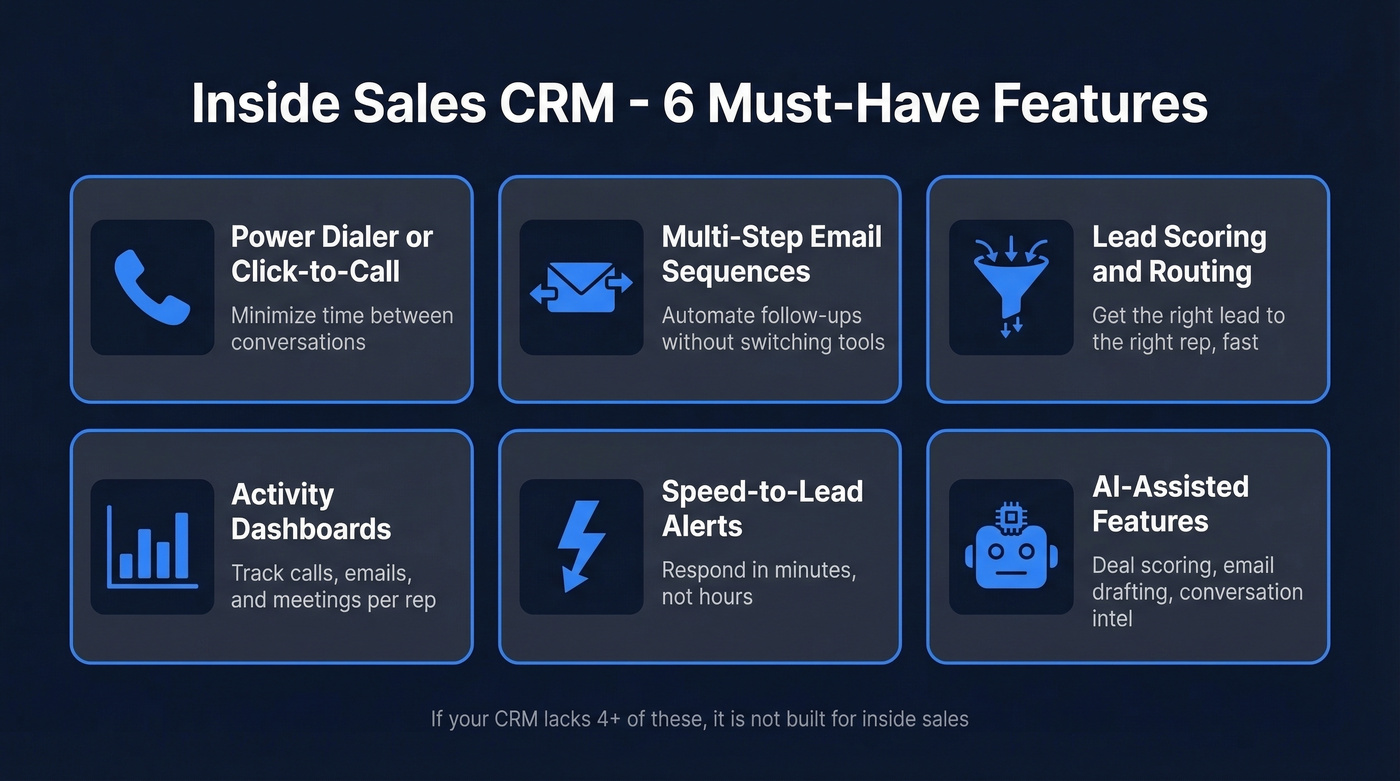
If a CRM doesn't offer at least four of these natively or via tight integrations, it's not built for inside sales:
- Power dialer or click-to-call
- Multi-step email sequences with automation
- Lead scoring and routing
- Activity dashboards (calls, emails, meetings per rep)
- Speed-to-lead alerts
- AI-assisted features like deal scoring, email drafting, or conversation intelligence
50% of buyers cite contact management as the top issue they want a CRM to solve. For inside sales teams, it's really about workflow velocity - how fast you can move from lead to conversation to close.
Here's the thing: if your average deal size is under $15K, you probably don't need Salesforce-level complexity. A $14-$35/seat CRM with clean data will outperform a $150/seat platform your reps refuse to update.
Pricing and Setup at a Glance
Pricing varies wildly, and the "starting at" number rarely tells the full story. Setup time is the hidden cost nobody talks about - every week of implementation is a week of lost pipeline.
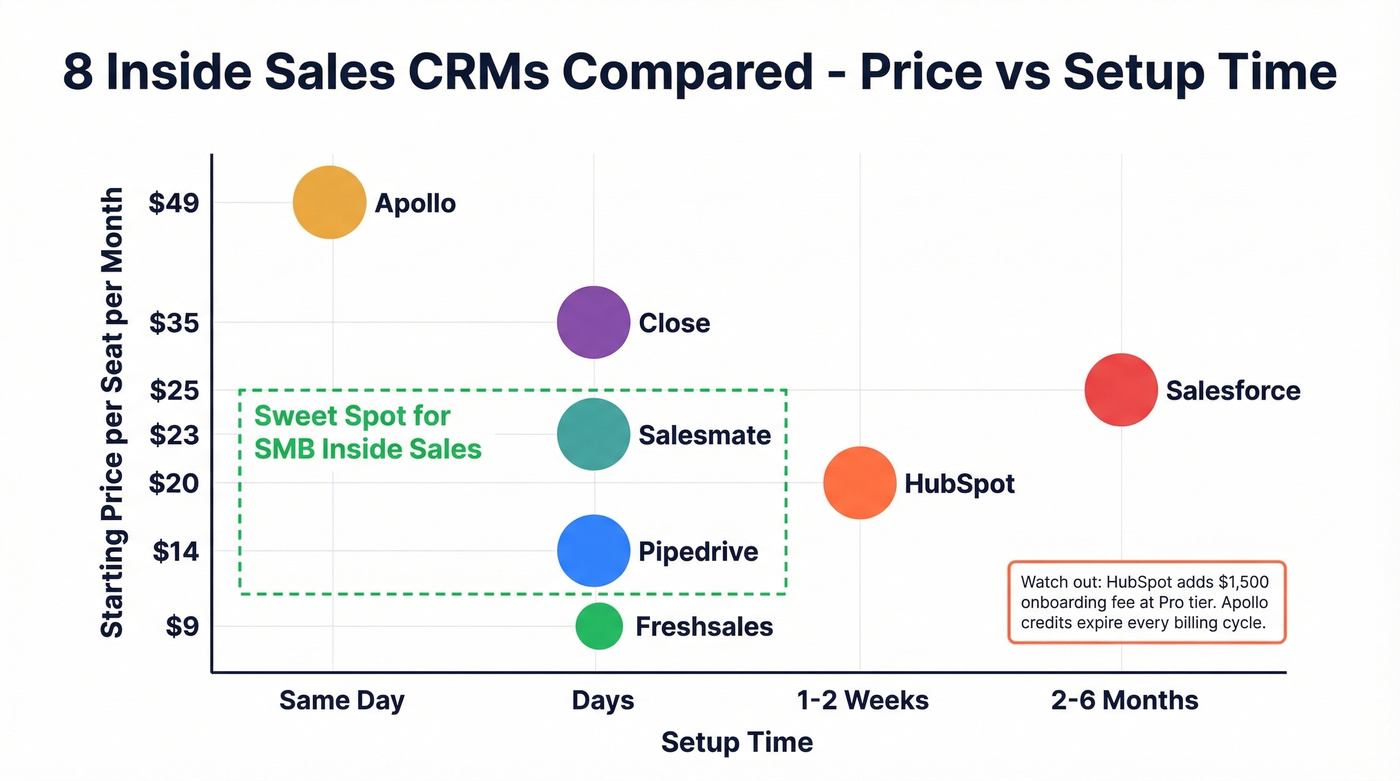
| Tool | Starting Price | Best For | Dialer + Sequences | Setup Time |
|---|---|---|---|---|
| Pipedrive | $14/seat/mo | SMB inside sales | Dialer: add-on; Sequences: Growth+ | 2-3 days |
| Close | $35/seat/mo | Phone-first SDRs | Both included | A few days to ~1 week |
| HubSpot | $20/seat/mo | Marketing alignment | Dialer: Starter (capped); Sequences: Pro ($500+) | 1-2 weeks |
| Salesmate | $23/user/mo | Mid-market inside sales | Both included | Days |
| Apollo | $49/user/mo | Prospecting + CRM-lite | Dialer: Pro ($79+); Sequences: Basic+ | Same day for basic setup |
| Freshsales | ~$9/user/mo | Budget teams | Dialer + sequences on higher tiers | Days |
| Salesforce | $25/user/mo | Enterprise (50+ reps) | Both: third-party/add-on | 2-6 months |
Two things worth calling out. HubSpot charges a mandatory $1,500 onboarding fee at Professional and $3,500 at Enterprise. Apollo credits expire every billing cycle - they don't roll over, so "cheap per seat" can get expensive fast at scale.

Your reps spend 72% of their week not selling - and stale CRM data is a major reason why. Prospeo enriches your Salesforce or HubSpot contacts automatically with 98% verified emails, direct dials, and 50+ data points per record. All refreshed every 7 days, not every 6 weeks.
Stop letting bad data kill your inside sales velocity.
The Best Tools for Inside Sales in 2026
Pipedrive
Use this if: You're a team under 50 reps that wants a CRM live in days, not months. The Growth tier at $39/seat/mo unlocks sequences, email tracking, and automations - that's the sweet spot for most teams.
Skip this if: You need a built-in power dialer or heavy phone functionality. Pipedrive's calling features require add-ons or third-party tools like Kixie (from $35/mo).
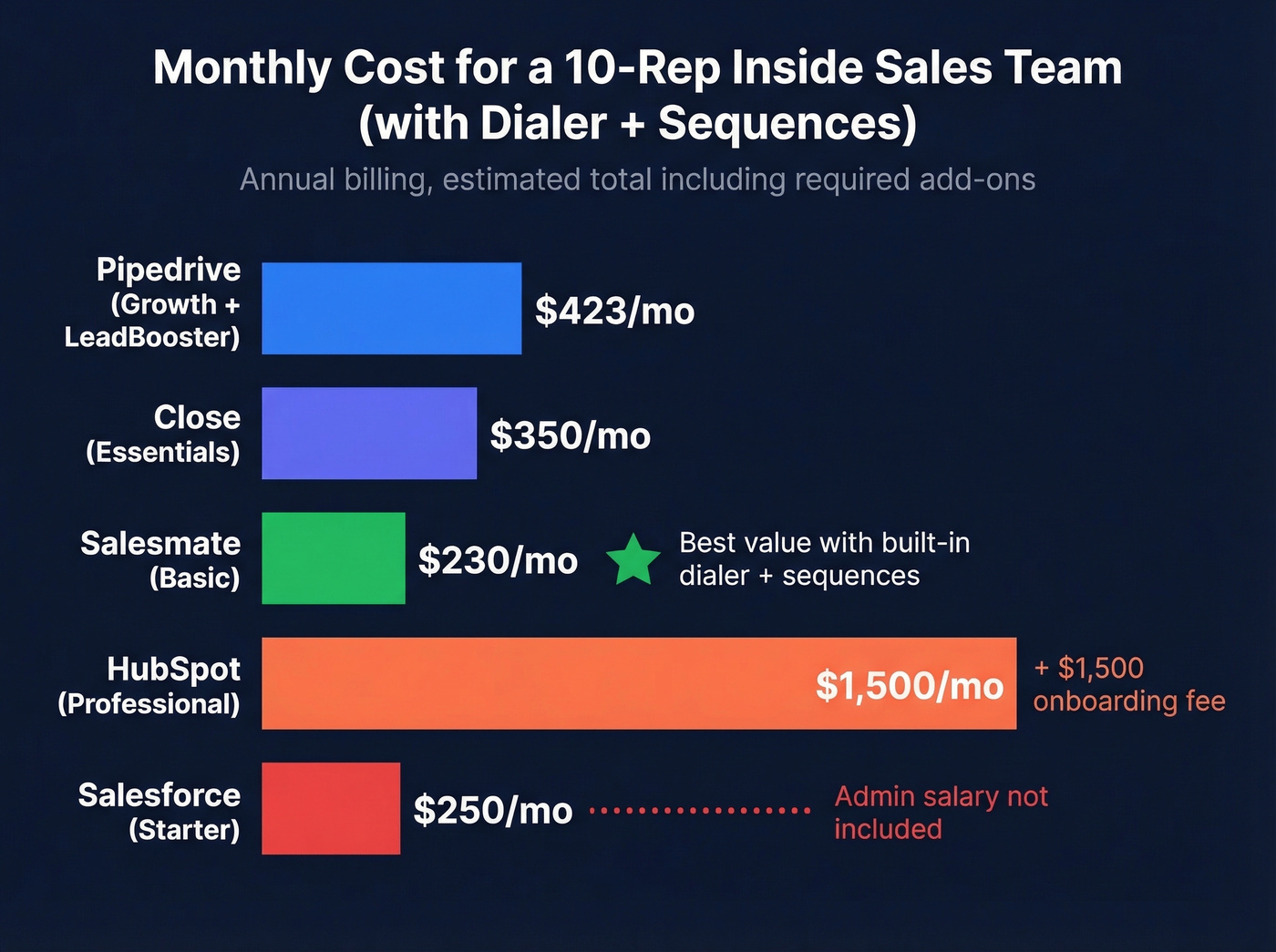
Pipedrive's pricing is genuinely straightforward: $14 (Lite), $39 (Growth), $59 (Premium), $79 (Ultimate) per seat per month on annual billing. The add-ons are per company, not per user - LeadBooster from $32.50/mo, Web Visitors from $41/mo. For a 10-rep team on Growth with LeadBooster, you're looking at roughly $422.50/mo. That's hard to beat for a sales platform that lets reps move fast without enterprise overhead.
Teams regularly go from signup to first pipeline report in 2-3 days, which is rare for any CRM that isn't a toy. The AI Sales Assistant surfaces deal insights and suggests next actions - a nice touch, though it's no replacement for a rep who actually knows their pipeline.

Close
Close is what Pipedrive would be if Pipedrive cared about phone-first sales teams. The built-in dialer isn't an afterthought - it's the core product. Reps log calls automatically, voicemails drop with one click, and sequences blend calls and emails without switching tools.
Pricing: Essentials ($35), Growth ($99), Scale ($139) per seat per month. If your reps make 40+ calls a day and you're tired of paying for a separate dialer, Close is the answer. It's the most underrated tool on the market for high-velocity outbound.
Skip this if you need deep marketing automation or ABM features. Close is built for sales activity, not marketing alignment.

Prospeo
Most CRMs share the same fundamental problem: the data inside them is garbage. Contacts change jobs, emails bounce, phone numbers go stale. CRM data decays 30%+ per year, and once reps stop trusting the data, they stop logging activity - your pipeline visibility collapses.
Prospeo solves this at the source. The platform covers 300M+ professional profiles with 143M+ verified emails and 125M+ verified mobile numbers, all refreshed on a 7-day cycle. The industry average refresh is six weeks. Email accuracy runs 98%, and the API match rate hits 92% returning 50+ data points per enrichment.
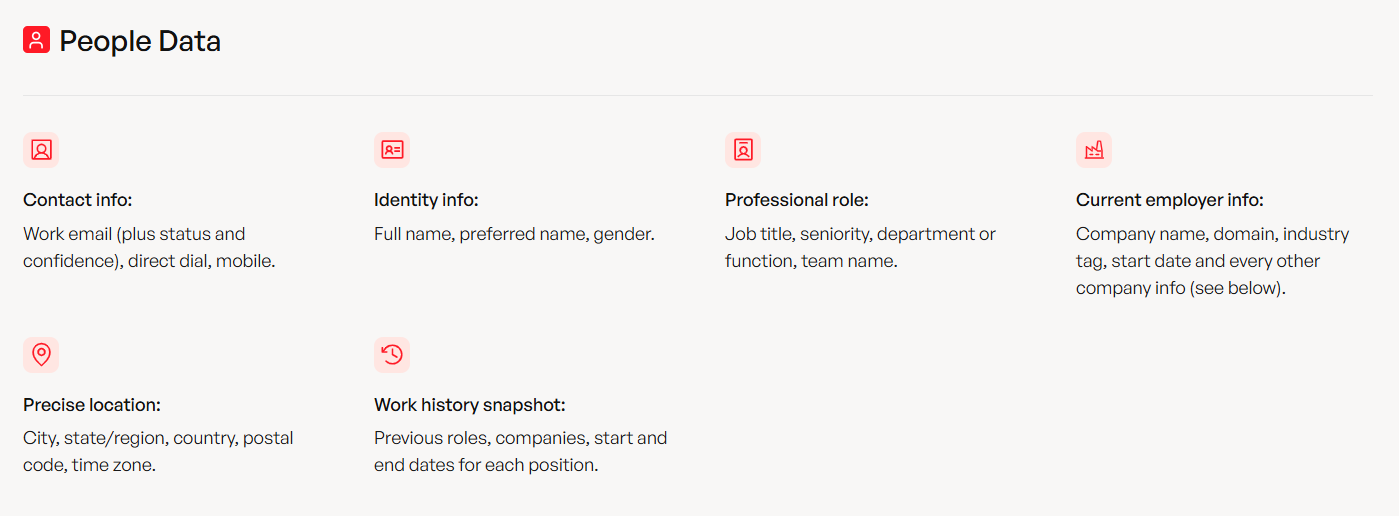
Native integrations with Salesforce and HubSpot mean enrichment happens automatically. When Snyk rolled this into their workflow for 50 AEs, bounce rates dropped from 35-40% to under 5%, and AE-sourced pipeline jumped 180%. The free tier gives you 75 emails and 100 Chrome extension credits per month - enough to test whether your current CRM data is as bad as you suspect. Paid plans run about $0.01 per email.
HubSpot Sales Hub
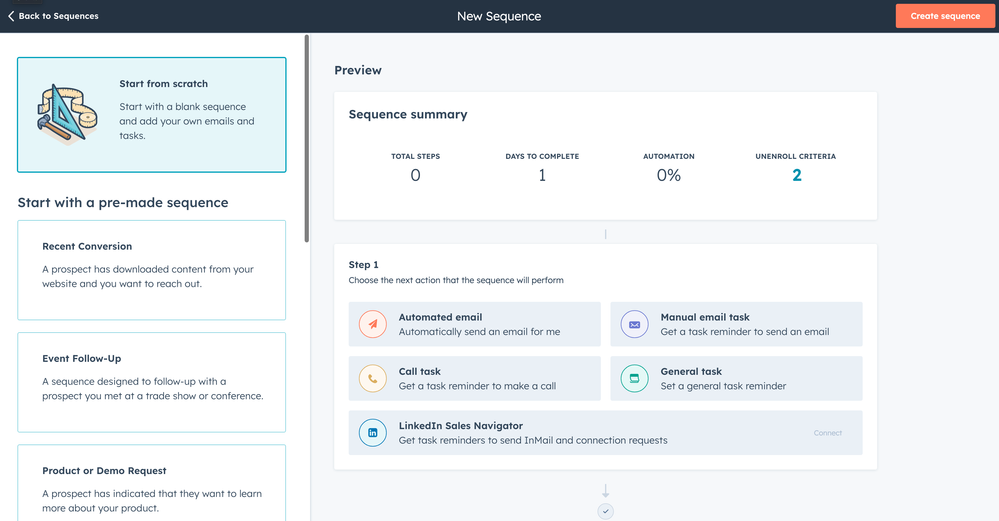
HubSpot's free tier is a trojan horse. It gets you in the door with basic pipeline management and contact storage, but sequences - the feature inside sales teams actually need - are locked behind Professional at $500/mo base (includes 5 seats) plus $100/seat/mo. The mandatory $1,500 onboarding fee stings. And Starter's 500 calling minutes per month gets consumed in a week by any real SDR team.
The upside is genuine, though: marketing-to-sales alignment is the strongest in the market if you're already on HubSpot Marketing. Teams using integrated CRM and marketing platforms report up to 38% higher lead conversion rates, which is HubSpot's strongest argument. AI features at Professional and above include an email writer and conversation intelligence. Budget for Professional from day one or pick something else. A 10-seat Professional plan runs roughly $1,500/mo plus the onboarding fee.
Salesmate
Salesmate is the dark horse. Power dialer, built-in calling and texting, virtual numbers in 80+ countries, and sequences - all starting at $23/user/mo (Basic). The Business tier at $63/user/mo adds lead scoring and advanced automation.
Where it falls short is ecosystem breadth. The integration library and enterprise customization options can't match HubSpot or Salesforce. But if you're a 15-50 rep team running a phone-heavy playbook and don't need a massive app marketplace, Salesmate delivers more per dollar than almost anything else on this list. We've seen teams pick it over Close purely on price, and they don't regret it.
Apollo
Apollo is the obvious starting point if you need prospecting and light CRM in one tool. The hybrid approach means reps can find leads from a 200M+ contact database and sequence them without leaving the platform. Basic plan starts at $49/user/mo with 1,000 email credits; the dialer unlocks at Professional ($79/user/mo).
Don't confuse "CRM-lite" with "CRM." Credits expire every billing cycle. The Organization tier ($119/user/mo) requires a minimum of three seats. We've watched teams outgrow Apollo's CRM features faster than they expected, then face a painful migration to a dedicated platform. For teams past 10 reps who need serious pipeline management, treat Apollo as your prospecting layer and pair it with a separate CRM.
If you're building a modern outbound stack, it can help to map Apollo into your broader SDR tools and sales prospecting techniques so reps don't end up living in five tabs.
Freshsales
Freshsales is the budget pick for teams that need basic pipeline management with built-in phone and email. Paid plans run roughly $9 to $59/user/mo. Advanced features are thin, but at $9/user/mo, you're paying for a functional pipeline - not bells and whistles. Higher tiers add a dialer and sequences, and Freddy AI provides basic lead scoring.
For a team of five just getting started with structured sales, Freshsales gets out of the way and lets you sell.
Salesforce Sales Cloud
Salesforce typically runs $25 to $500/user/mo with a 2-6 month implementation timeline and a dedicated admin requirement. It's overkill for inside sales teams under 20 reps.
But if you're scaling past 100 and need enterprise customization, workflow automation at scale, and Einstein AI for predictive forecasting, it's still the default for a reason. Simple things like follow-up task management by date - something Pipedrive and Close handle natively - often require configuration in Salesforce. That gap tells you everything about who each tool is built for.
If you want the full cost breakdown, see our deep dive on Salesforce pricing.
The Data Quality Multiplier
We see this pattern constantly. A team spends months evaluating CRMs, picks the right one, nails the implementation - and then watches adoption crater within six months. The reason is almost always data quality.
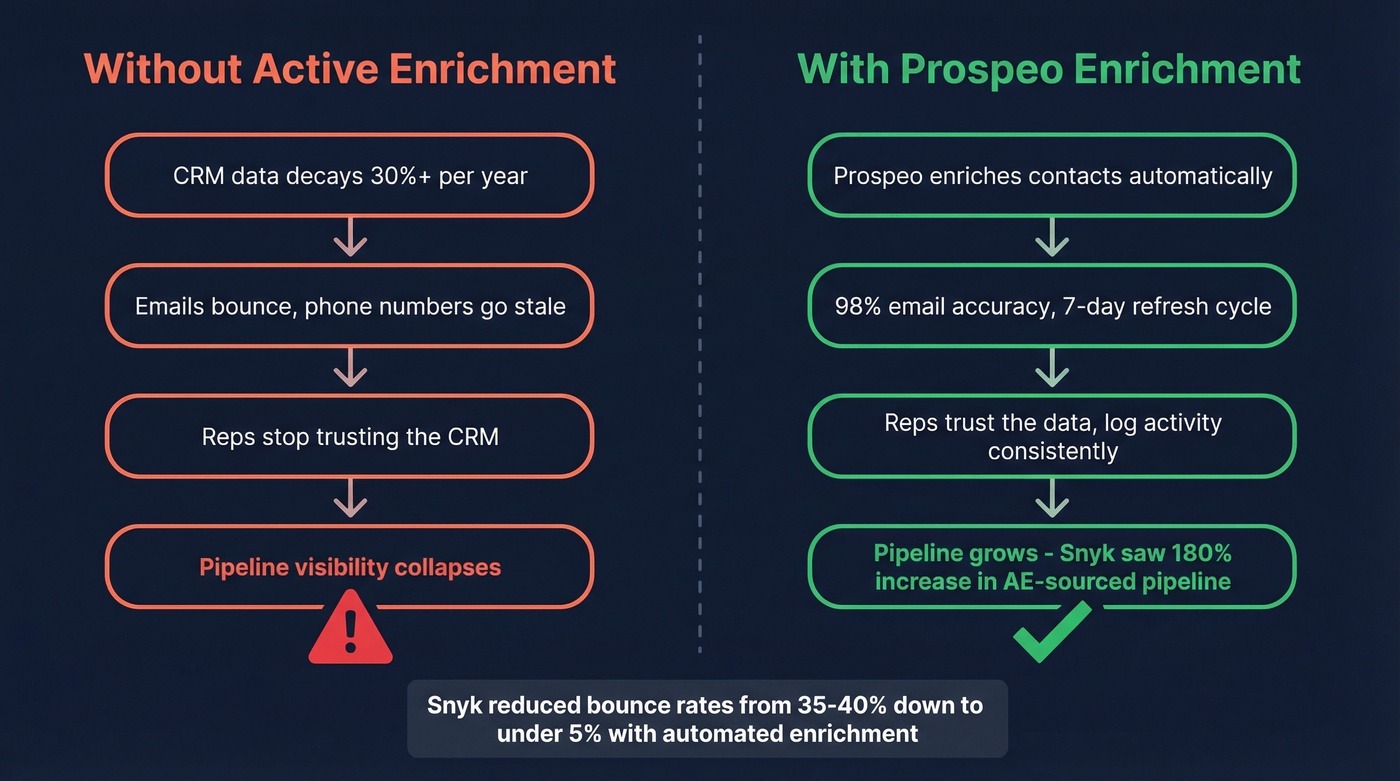
Reps open a contact record, see a bounced email and a disconnected phone number, and mentally check out of the CRM entirely. CRM data decays 30%+ per year as people change jobs, companies get acquired, and phone numbers rotate. Without an active data layer, your CRM becomes a graveyard of stale records.
This is why CRM usage increases sales by 29%, productivity by 34%, and forecast accuracy by 42% only when the underlying data is accurate. Dirty data negates every one of those gains.

When Meritt plugged a continuous enrichment layer into their CRM workflow, pipeline tripled from $100K to $300K per week and bounce rates dropped from 35% to under 4%. Your CRM is a container. The data layer you pair with it determines whether reps trust what's inside.
If you're comparing vendors, start with a shortlist of data enrichment services and a clear lead generation workflow so enrichment doesn't become another one-off project.
Snyk's 50 AEs cut bounce rates from 35-40% to under 5% and grew AE-sourced pipeline 180% after plugging Prospeo into their CRM. At $0.01 per email with 92% API match rates, it costs less than one bounced sequence to find out if your CRM data is holding your team back.
Test your CRM data quality with 75 free verified emails.
How to Choose the Right Tool
Four steps. Don't overthink it.
Define team size and budget. A 5-rep team on Pipedrive Growth pays ~$195/mo. The same team on HubSpot Professional pays $1,000+/mo. That gap funds a lot of other tools.
Identify your must-have features. Phone-heavy team? Close or Salesmate. Marketing alignment critical? HubSpot. Need it live this week? Pipedrive.
Test setup time. Pipedrive goes live in 2-3 days. HubSpot takes 1-2 weeks. Salesforce takes 2-6 months. If you're a startup, months of implementation means months of lost pipeline.
Plan your data layer. Pair your CRM with an enrichment tool from day one. Clean data drives adoption; stale data kills it.
Mistakes That Kill Adoption
Too many required fields at launch. Start with 5-7 fields max. You can always add more once reps trust the system.
No phased rollout. Don't go company-wide on day one. Start with one team, iterate, then expand. Let's be honest - most failed CRM rollouts happen because someone tried to boil the ocean in week one.
No defined success metrics. Set measurable KPIs before go-live: adoption rate, data completeness, pipeline velocity.
Skipping change management. A CRM nobody uses is a CRM nobody needs. Budget for training, not just licenses.
No mobile access. 73% of people use personal smartphones for work. If your CRM doesn't work on mobile, reps will log activity in their heads instead.
If you're standardizing what "good" looks like, it helps to document sales activities and keep a shared library of sales follow-up templates so reps aren't reinventing the wheel.
FAQ
What's the best free CRM for inside sales?
HubSpot Free offers basic pipeline management and contact storage, but sequences and automation are locked behind the $500/mo Professional tier. Pipedrive's 14-day trial gives full access to evaluate the real product. For data, Prospeo's free tier includes 75 emails and 100 Chrome extension credits monthly - enough to test enrichment alongside any CRM.
Do inside sales teams need a separate dialer?
Not if you pick the right platform. Close and Salesmate include built-in dialers at their base tiers. HubSpot and Pipedrive typically require third-party integrations like Kixie (from $35/mo) for serious calling volume. If your reps make 30+ calls a day, a native dialer saves both money and context-switching time.
How do you keep CRM data accurate?
CRM data decays 30%+ per year as contacts change jobs and companies. A CRM enrichment layer that re-verifies records on a weekly cycle keeps pipeline data fresh automatically - look for 90%+ email accuracy and native CRM integrations. Without active enrichment, even the best inside sales CRM becomes unreliable within months.
Is Salesforce worth it for small inside sales teams?
For teams under 20 reps, Salesforce is typically overkill. Implementation takes 2-6 months, requires a dedicated admin, and costs $25/user/mo-$500/user/mo before add-ons. Pipedrive ($14/seat) or Close ($35/seat) deliver faster time-to-value with built-in features that Salesforce often needs custom configuration to match.