

Inside Sales Outsourcing: What It Costs, Who Does It Best, and Why Most Programs Fail
Only 7% of companies say inside sales outsourcing "really worked." Another 26% say it "sort of worked." That leaves roughly two-thirds of programs that didn't deliver. One founder on Reddit summed it up bluntly: "zero success" and "burned through cash" before pulling the plug. Meanwhile, 84% of reps missed quota last year, and the pressure to outsource pipeline generation has never been higher.
The gap between those numbers tells you everything. Outsourcing your inside sales delivers when done right, but the default outcome is disappointment. Here's what separates the 7% from everyone else.
The Quick Version
Outsourced SDR retainers run $2,500-$15,000/mo depending on whether you're buying entry-level appointment setting or enterprise-grade multichannel programs. Expect $3,000-$5,000 per meeting booked in year one - that number drops dramatically by year three if you stick with it.
The 7% success rate isn't random. Companies that win treat providers as extensions of their team, define "qualified meeting" down to the syllable, and obsess over data quality. Top providers for mid-market B2B: Belkins (starts at $5,500/mo, strong in SaaS and healthcare) and CIENCE ($10K-$50K projects, tech-heavy).
What Does Outsourced Inside Sales Actually Mean?
Outsourced inside sales means hiring an external firm to handle some or all of your remote selling activities - prospecting, lead qualification, appointment setting, and sometimes closing. Most companies outsource the top of funnel: finding prospects, running multichannel sequences across email, phone, and social, and booking meetings for internal AEs.
Some providers offer full-cycle outsourcing where external reps handle everything through close, but that model works best for transactional sales with shorter cycles. Unlike outsourced field sales, which involves reps meeting prospects face-to-face in specific territories, everything here stays remote - making it faster to scale and easier to measure. The sweet spot for most B2B companies is outsourcing the prospecting grind while keeping qualification and closing in-house.
Why Demand Is Surging in 2026
The math on building an in-house SDR team has gotten ugly. Average quota attainment sits around 43%, and SDR attrition runs roughly 39%. You're replacing a third of your team every year.
Then there's the productivity problem. Salesforce's own research shows reps spend about 70% of their time on non-selling activities. Gartner pegs the average B2B buying committee at 6-10 stakeholders, with newer studies pushing that to 10-11 for mid-market deals. Multi-threading across that many contacts requires dedicated prospecting capacity most lean sales teams simply don't have.
Here's the stat that should keep every sales leader up at night: 50% of sales go to the first vendor that responds. Speed kills in outbound. Ramping an in-house SDR takes 3-6 months. An outsourced team is operational in 4-6 weeks. When your board wants pipeline yesterday and your last two SDR hires quit after eight months, outsourcing isn't a shortcut - it's the only viable path.
How Much Does It Actually Cost?
Pricing varies wildly by provider tier, but here are the benchmarks that hold up across the market:
| Tier | Retainer/Mo | Pay-Per-Meeting | Meetings/Mo |
|---|---|---|---|
| Entry | $2,500-$4,000 | $125-$250 | 8-12 |
| Mid-market | $4,000-$7,500 | $250-$450 | 12-20 |
| Enterprise | $7,500-$15,000 | $450-$800+ | 20-35+ |
Add setup fees of $1,500-$5,000 on top for ICP development, tech stack configuration, and sequence building.
A fully loaded in-house SDR costs $125K-$150K/year - salary, benefits, tools, management overhead. That's $10K-$12.5K/month before they book a single meeting. Providers deliver an outsourced SDR for roughly $42K-$45K/year in total cost; your retainer covers this plus margin, management, and tooling.
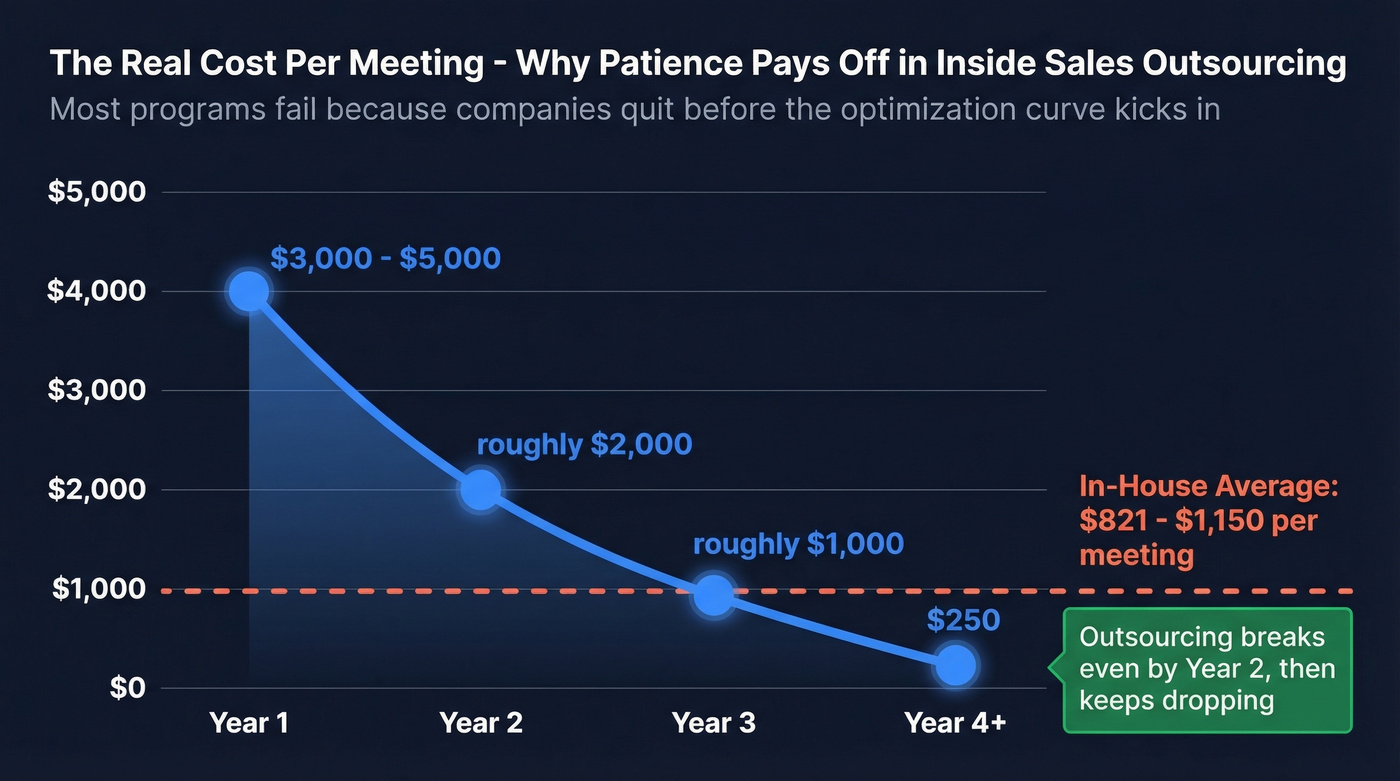
The cost-per-meeting comparison is where outsourcing shines: in-house teams average $821-$1,150 per meeting booked, while outsourced retainer models deliver meetings at $357-$500 each. But those numbers assume a mature program.
Belkins is transparent about this: year-one cost per meeting runs $3,000-$5,000. By year two it drops to roughly $2,000, year three to roughly $1,000, and eventually settles around $250. The optimization curve is real, but you need patience and budget to ride it.
Build vs. Buy
Outsource when:
- You need pipeline in weeks, not quarters
- Your deal values support the economics (generally $10K+ contracts)
- You don't have SDR management expertise in-house
- You're entering a new market and need to test messaging fast
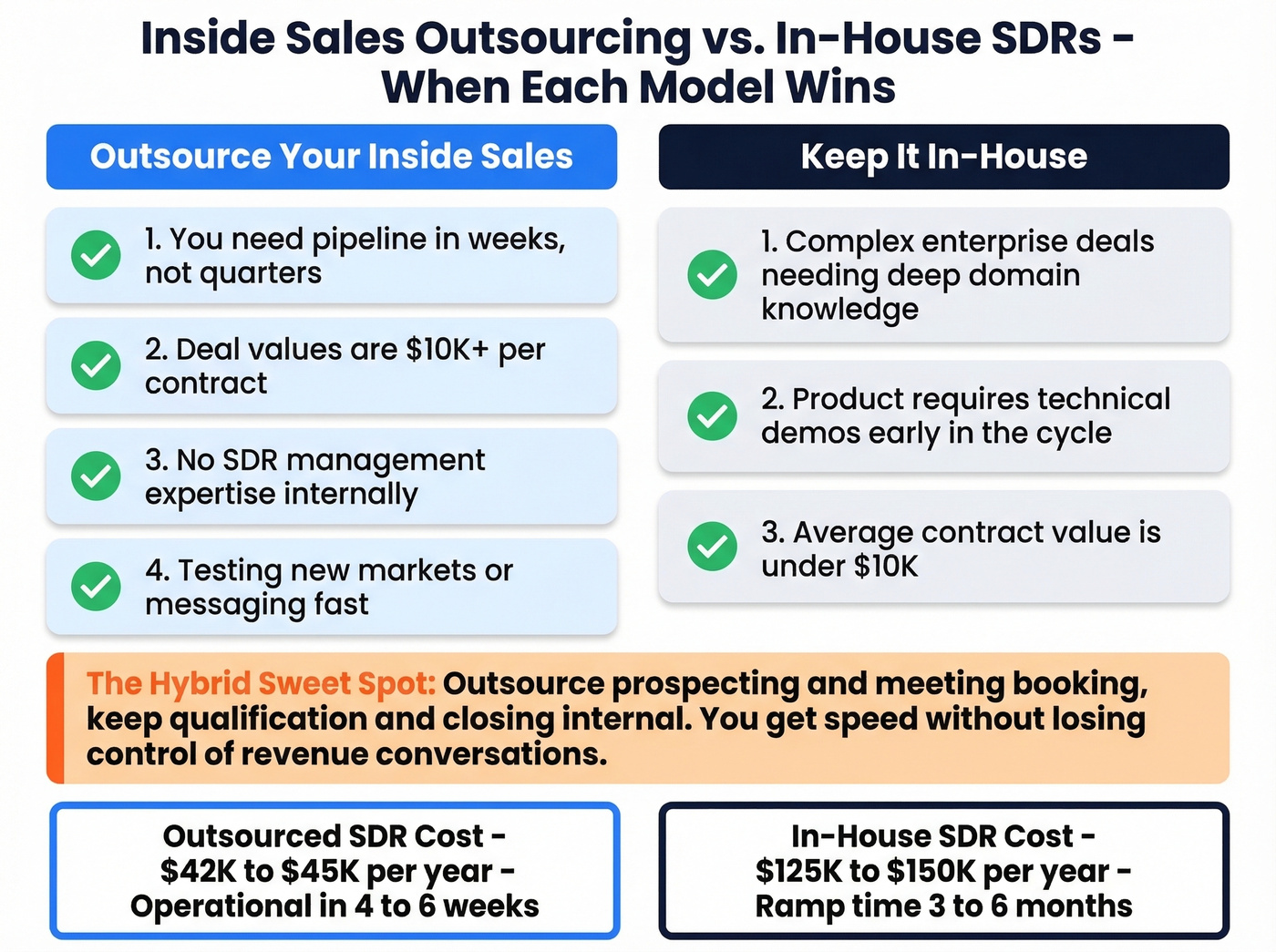
Keep it in-house when:
- You're selling complex enterprise deals requiring deep domain knowledge
- Your product needs technical demos early in the sales cycle
- Deal values sit in the low four figures
Here's the thing: if your average contract value is under $10K, you almost certainly shouldn't outsource prospecting. Invest in product-led growth or inbound marketing instead. The math doesn't work at low deal values, and no provider will tell you that because they want your retainer.
The hybrid model works best for most startups and SMBs. Outsource initial prospecting and meeting booking, keep qualification and closing internal. You get speed without losing control of the conversations that close revenue.

The article says it: data quality separates the 7% who succeed from the 93% who don't. Outsourced SDR programs burn cash when reps prospect with stale contacts and bounced emails. Prospeo refreshes 300M+ profiles every 7 days - not every 6 weeks - and delivers 98% email accuracy. Whether you run prospecting in-house or hand it to a provider, the data layer determines everything.
Stop paying $5,000 per meeting because your provider's data bounces at 35%.
What Modern Outsourcing Looks Like
The legacy model - a bullpen of callers reading scripts - is mostly dead. Modern providers run pod-based teams with dedicated SDRs handling conversations, separate lead researchers building targeted lists, and GTM engineers managing data, tooling, and reporting.
AI has changed the operating model significantly. The best providers use AI for draft generation, lead scoring, and initial qualification, with human QA layered on top. The numbers from early adopters are striking: AI SDRs answer technical questions immediately 87% of the time versus 15% for humans, and time to technical qualification drops from 8.3 days to 2.1 days. Fully automated approaches without human oversight still degrade quality, though. The winning formula is AI-assisted, human-verified.
Multichannel execution is the other differentiator. Providers running coordinated email, phone, and social sequences see 287% higher engagement than single-channel approaches. A well-run outsourced program should generate $50K-$150K in pipeline per SDR per month with 60-70% held-to-opportunity conversion rates. If your provider isn't hitting those benchmarks after six months, something is broken.
Mistakes That Kill Outsourced Programs
These are the patterns behind the two-thirds failure rate. We've seen every one of them firsthand.
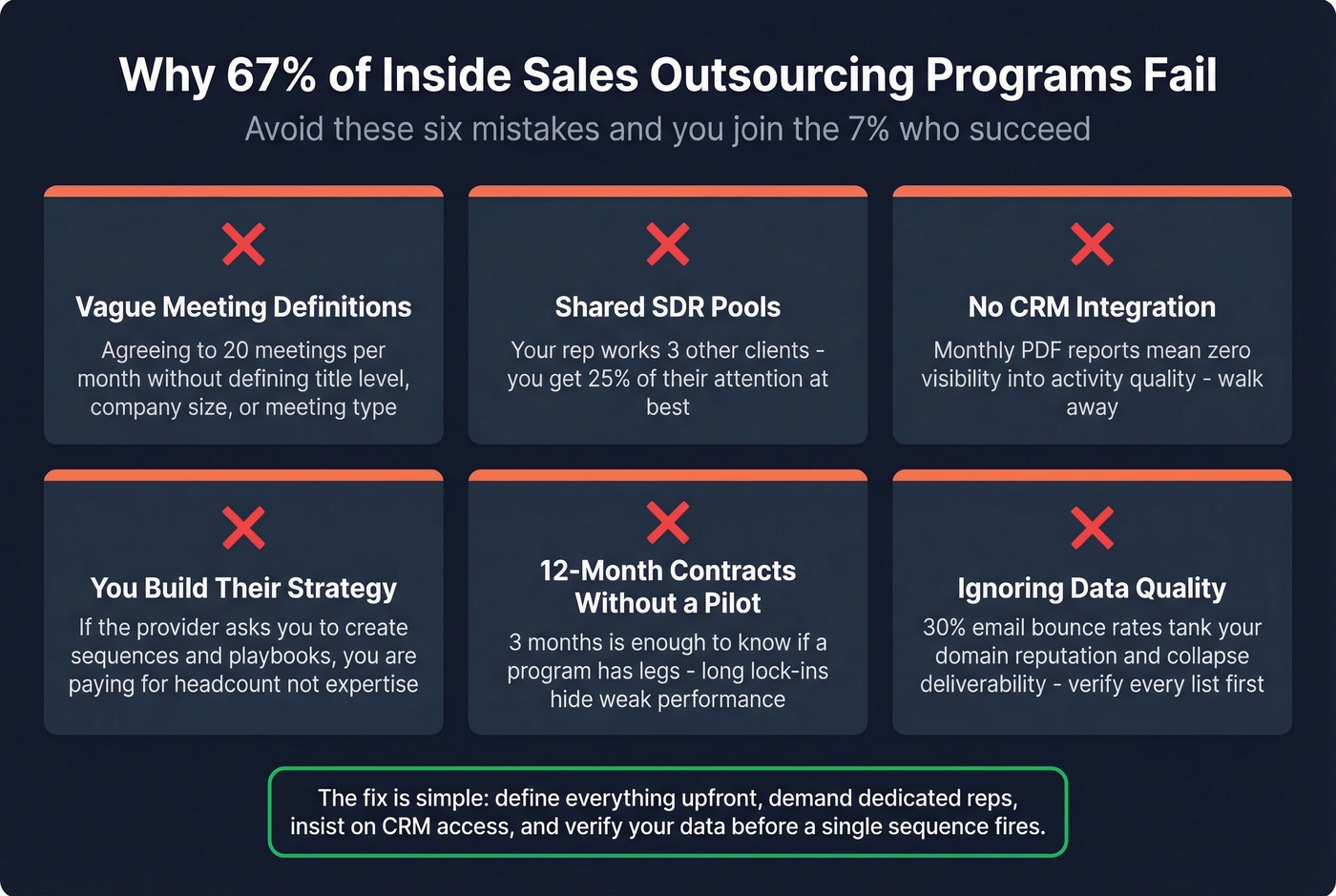
Buying volume guarantees without shared definitions. "20 meetings per month" means nothing if you haven't agreed on what qualifies. Define it in the contract - title level, company size, and whether it's a 15-minute intro or a discovery with a decision-maker.
Accepting shared SDR pools. If your SDR is also working three other clients, your program gets 25% of their attention. Push for dedicated reps. Always.
Tolerating no CRM integration. If your provider sends monthly PDF reports instead of working inside your CRM, you have zero visibility into activity quality. Walk away.
Outsourcing strategy back to yourself. The provider should bring a proven playbook - sequences, objection handling, cadence structure. If they're asking you to build all of this, you're paying for headcount, not expertise.
Signing long contracts without a pilot. Three months is enough to know if a program has legs. Any provider demanding 12 months upfront without a pilot period is hiding something.
Ignoring data quality. This is the silent killer. Your outsourced team runs perfect sequences, but if 30% of emails bounce, your domain reputation tanks and deliverability collapses. The provider blames your ICP. You blame the provider. Everyone loses. Verify every list before handoff - we've seen teams cut bounce rates from 35% to under 4% just by running lists through proper verification before a single sequence fires.

Skipping deliverability compliance. Post-2024 Gmail and Yahoo requirements aren't optional. SPF, DKIM, DMARC alignment, List-Unsubscribe headers, and spam rates under 0.3%. If your provider can't explain their compliance setup in detail, they'll burn your domain.
How to Evaluate a Provider
EBQ's framework nails the four pillars:
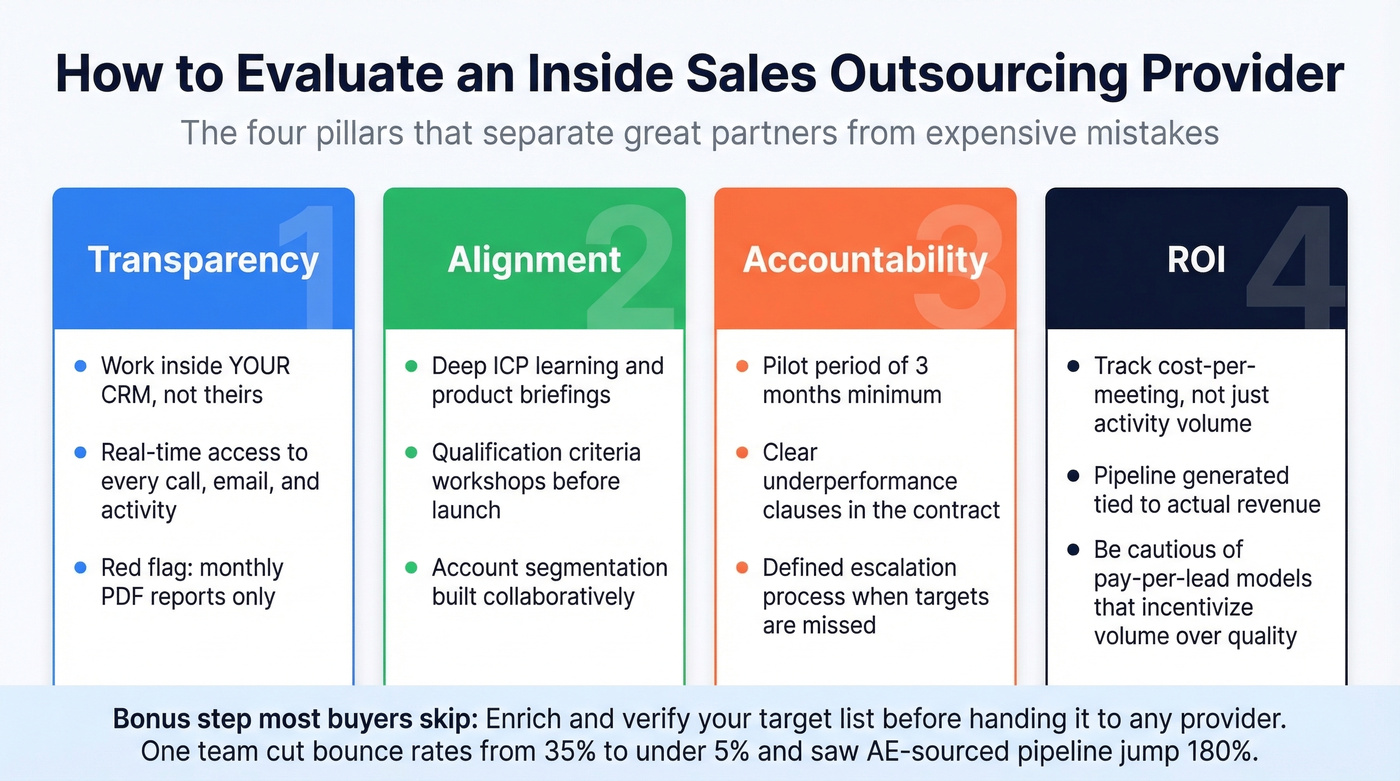
Transparency. Do they work inside your CRM? Can you see every call, email, and activity in real time? Monthly PDFs are a red flag.
Alignment. Will they learn your ICP deeply enough to represent your brand? Their onboarding should include product briefings, qualification criteria workshops, and account segmentation.
Accountability. Is there a pilot period? What happens if they underperform? Get specifics in the contract.
ROI. Do they track cost-per-meeting and pipeline generated, or just activity volume? Pay-per-lead models incentivize volume over quality - be cautious.
One step most buyers skip: enrich and verify your target list before handing it over. Snyk's 50-person AE team dropped bounce rates from 35% to under 5% after running lists through verification, and AE-sourced pipeline jumped 180%. That's the difference clean data makes before a single outsourced sequence fires.
Also ask about data ownership. When the contract ends, do you keep the lists, sequences, and call recordings? If not, you're building on rented land.
Top Outsourced Inside Sales Companies
| Provider | Sweet Spot | Pricing | Best For |
|---|---|---|---|
| Belkins | SaaS, IT, healthcare | From $5,500/mo | Mid-market B2B wanting proven multichannel |
| CIENCE | Tech, SaaS, high-growth | $10K-$50K/project | Research-heavy, multichannel campaigns |
| Callbox | Medical, tech, long-cycle | ~$3K-$8K/mo | Companies with 6+ month sales cycles |
| Martal Group | SaaS, tech (NA focus) | ~$4K-$8K/mo | Teams needing North American time zone reps |
| memoryBlue | SDR hiring + outsourcing | ~$4K-$10K/mo | Bridging from outsourced to in-house |
| TTEC | Enterprise scale | $10K-$25K+/mo | Large orgs scaling 10+ seats internationally |
Belkins
The provider most mid-market B2B companies should evaluate first. Starting at $5,500/mo with 223 Clutch reviews at 4.9 stars, they've built a reputation on multichannel outbound and ABM campaigns across SaaS, IT, healthcare, and manufacturing. Their transparency about the cost curve - acknowledging that year-one meetings are expensive before economics improve - is refreshing in a space full of unrealistic promises. In our experience, providers who are honest about ramp timelines tend to be honest about everything else too.
CIENCE
Project-based engagements, typically $10K-$50K on Clutch. They combine AI tools with human SDRs and are strongest with tech companies. The 142 Clutch reviews at 4.2 stars tell an honest story: clients consistently praise the multichannel approach and research depth, but several flag inconsistent lead quality. If you go with CIENCE, define quality standards extremely tightly upfront.
The Rest of the Field
Callbox has been running since 2004 and excels with long sales cycles - medical devices, complex B2B services, and deals that take six months to close. Skip them if your sales cycle is under 90 days.
Martal Group staffs North American SDRs who understand the NA market and work in your time zone. That matters more than most buyers realize - response time correlates directly with conversion.
memoryBlue plays a unique game: they'll outsource SDRs to you and help you hire them permanently if they're a fit. Over 20 years and 2,000+ clients, they've become the go-to for companies that want outsourcing as a bridge to building in-house. For teams that know they'll eventually bring prospecting internal, this is the smartest path.
TTEC is the enterprise-scale operation with 54,000+ employees. Overkill for startups, but the right fit for large organizations needing 10+ outsourced seats with global coverage.
The Data Quality Factor
Your outsourcing program is only as good as the contact data feeding it. Belkins themselves acknowledge that underperforming programs typically deliver only 70% of deliverables and 50% of projected results. Bad data is the root cause more often than bad reps.
When 30% of emails bounce, your sender domain takes the hit. Deliverability drops. Sequences that should generate replies generate spam flags instead. We've watched this pattern destroy programs that had everything else right - good messaging, good reps, good ICP definition - all undermined by stale contact records.

Stack Optimize used Prospeo to build from $0 to $1M ARR - client deliverability stayed above 94%, bounce rates under 3%, zero domain flags across all clients. Whether you're handing lists to Belkins or building them for an in-house team, verify everything first. It's the single highest-ROI step in the entire process.
Outsourced SDR teams need multi-threaded outreach across 6-10 stakeholders per deal. That means verified emails and direct dials for every contact on the buying committee - not just one champion. Prospeo gives you 143M+ verified emails and 125M+ mobile numbers with 30% pickup rates, plus 30 filters to target by intent, technographics, and headcount growth. At $0.01 per email, your cost-per-meeting drops whether you outsource or build in-house.
Arm your outsourced team with data that actually connects to real buyers.
FAQ
Is inside sales outsourcing worth it?
For companies with deal values above $10K and willingness to invest 6-12 months, yes. The 7% who succeed treat providers as team extensions with shared definitions, tight governance, and verified contact data feeding every sequence.
How long until an outsourced program produces results?
Expect 4-6 weeks for ramp and 3-6 months for optimized economics. Year-one cost per meeting runs $3,000-$5,000; by year three it drops to roughly $250 per booked meeting.
What's the difference between inside sales and SDR outsourcing?
Inside sales outsourcing covers prospecting through closing. SDR outsourcing refers specifically to top-of-funnel prospecting and appointment setting - which is what most companies actually buy. Full-cycle outsourcing suits transactional deals under 60-day cycles.
Can I outsource just part of my sales process?
Yes, and you should. Outsource prospecting and meeting booking while keeping qualification and closing in-house. This hybrid model gives you speed without losing control of the conversations that close revenue.
How do I make sure my outsourced team has accurate contact data?
Verify your target list before handing it over. Clean data is the single biggest variable between programs that work and programs that fail - we've seen bounce rates drop from 35% to under 5% just by adding a verification step before sequences launch.