

Inside Sales to Outside Sales: What Changes, What It Costs, and How to Survive
The shift from inside sales to outside sales hits you on Monday morning. You're loading a laptop bag into your car at 6:45 AM, checking a route with five stops across three zip codes, and realizing your entire day depends on whether the contacts you're visiting actually still work at those companies. You went from 40-60 touches a day behind a screen to 3-5 face-to-face meetings - and every missed one costs you an hour of windshield time, not just a dial tone.
The Short Version
The $34K pay gap between inside and outside sales shrinks fast once you factor in $15-40K in annual expenses and how much your company reimburses. Expect a 6-9 month ramp to full productivity - roughly double what you're used to. And three things separate reps who survive from those who don't: disciplined route planning, obsessive CRM hygiene, and verified prospect data before you leave the office.
What Actually Changes
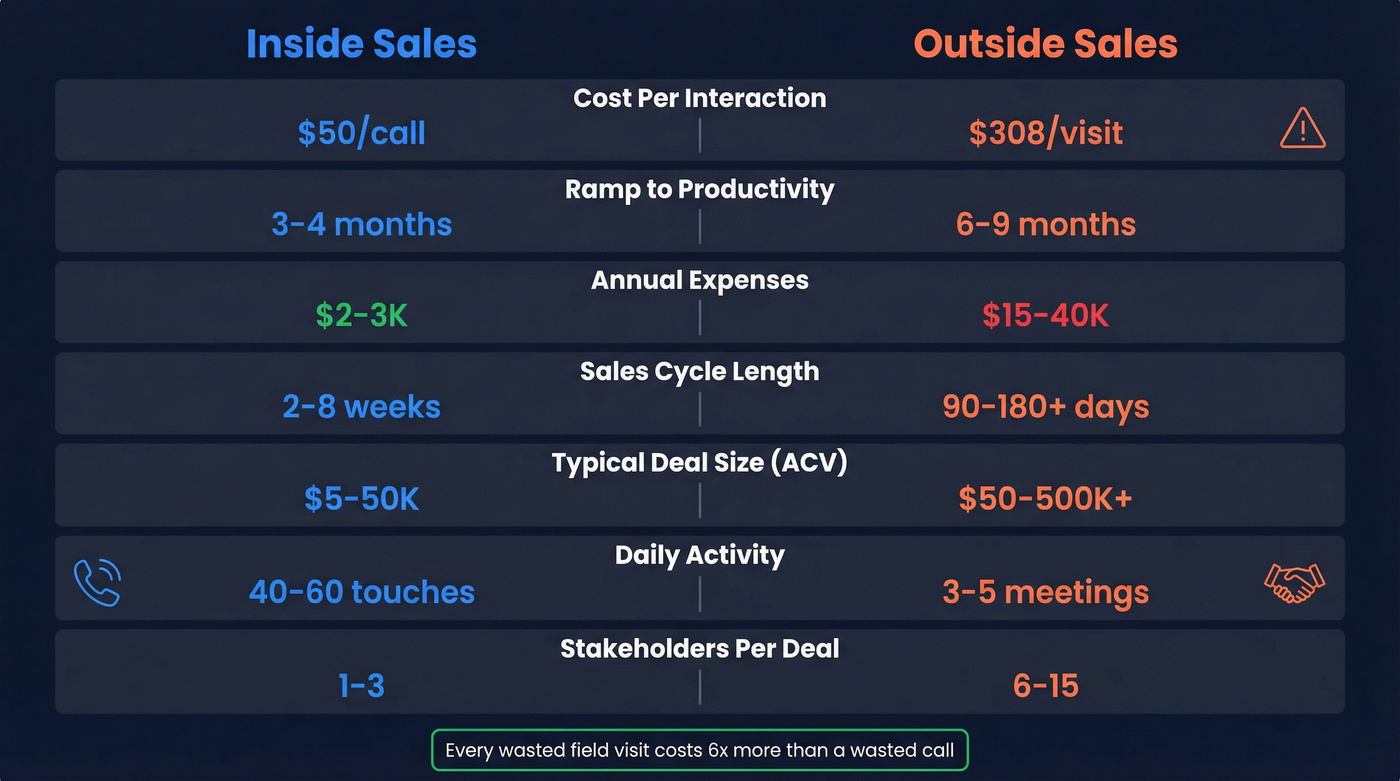
The shift isn't just "now I drive places." It's a fundamentally different operating model.
| Dimension | Inside Sales | Outside Sales |
|---|---|---|
| Cost per interaction | ~$50/call | ~$308/visit |
| Ramp to productivity | 3-4 months | 6-9 months |
| Annual expenses | $2-3K | $15-40K |
| Typical sales cycle | 2-8 weeks | 90-180+ days |
| Typical ACV | $5-50K | $50-500K+ |
| Daily activity | 40-60 touches | 3-5 meetings |
| Stakeholders per deal | 1-3 | 6-15 |
That cost-per-interaction gap should make you pause. Every wasted visit is about 6x more expensive than a wasted call. And the stakeholder jump is what makes deals drag - you're not selling to one buyer anymore, you're navigating a committee where the CFO holds final approval in 79% of B2B deals. With 70-80% of the buying process now happening before a buyer ever talks to a rep, every face-to-face minute carries more weight than it did five years ago.
Is the Money Actually Better?
On paper, yes. Glassdoor's median total pay for inside sales sits at $118K/yr. Outside sales comes in at $152K/yr. That's a $34K premium.
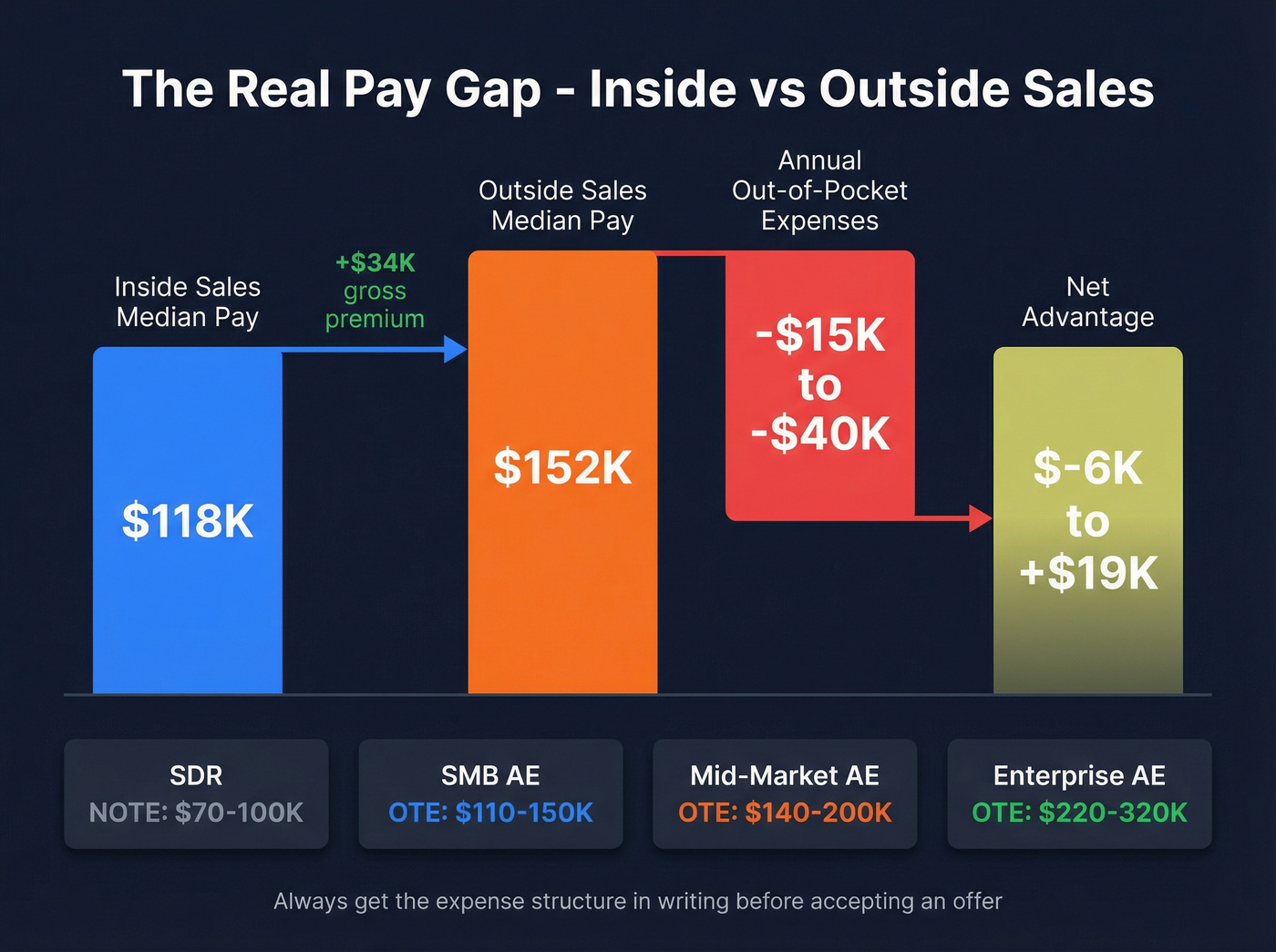
Now subtract reality. Outside reps carry $15-40K in annual expenses - vehicle costs, travel, meals, tech. If you're covering $25K out of pocket with partial reimbursement, your net advantage drops to roughly $9K. For a longer sales cycle, more stress, and double the ramp time. Worth it? Depends on the deal sizes you're chasing.
Here's what OTE looks like by segment: SDRs typically land $70-100K, SMB AEs $110-150K, mid-market AEs $140-200K, and enterprise AEs $220-320K. Comp splits for AEs often run 50/50 base-to-variable, sometimes 60/40 for transactional segments. The variable portion is where the upside lives - and where the risk lives too. Before you accept an offer, ask what percentage of the team hit quota in the last 3-4 quarters. If the answer is vague, that's your answer.

A wasted dial costs you 30 seconds. A wasted field visit costs you an hour and $308. Prospeo's 7-day data refresh catches job changes before you drive to an empty desk - with 98% email accuracy and 125M+ verified mobile numbers so you can confirm meetings before burning gas.
Audit your territory list in minutes, not after a wasted afternoon.
What Nobody Tells You
Every rep who's made this transition will tell you the same things afterward. Here's what catches people off guard:
After-hours admin is real. After a full day of meetings, expect roughly two hours logging CRM notes, sending follow-ups, and updating pipeline stages. Inside, you did this between calls. Outside, it piles up because you were driving.
Details blur fast. After 10-15 prospecting meetings in a week, who mentioned the Q3 budget freeze? Which VP wanted the ROI deck? If you're not logging notes in the parking lot immediately after each meeting, you're building pipeline on half-remembered conversations. We've watched reps lose deals they should've closed simply because they forgot a detail from meeting two that mattered in meeting five.
Bad data costs you hours, not seconds. Driving to meet someone who left the company last quarter doesn't cost you 30 seconds on a dial - it costs you an hour round-trip in the car. We've seen reps lose entire afternoons to a territory list that hadn't been cleaned in six months. Prospeo's 7-day data refresh cycle catches job changes that static CRM exports miss, and the free tier gives you 75 email verifications a month - enough to audit a weekly route list before you burn gas on dead leads.
One contrarian note: if you're leaving inside sales because you're burned out, outside sales will make it worse. Turnover in field sales runs as high as 35%. The autonomy is real, but so is the isolation.
Your First 90 Days in the Field
Weeks 1-4: Learn the Territory
Don't sell yet. Verify your territory contact list before your first field day so you're not driving to dead ends. Shadow the top-performing rep on their route. Learn how they plan their week, which accounts they skip, and why.
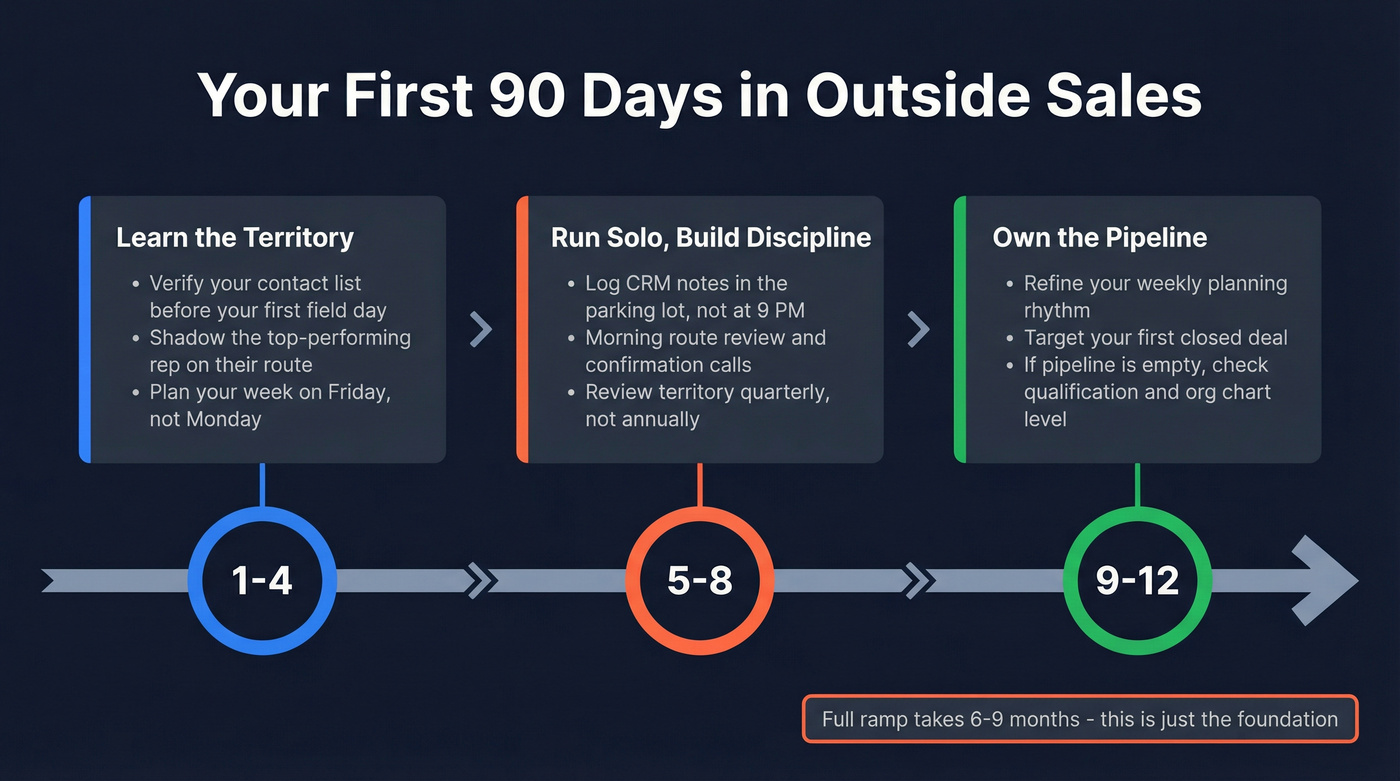
57% of field sales pros plan weekly, not daily - usually end-of-week for the upcoming week. Companies miss up to 10% of annual sales from poor sales planning. In our experience, the reps who survive the transition all share one habit: they plan their week on Friday, not Monday.
Weeks 5-8: Run Solo, Build Discipline
Start taking meetings on your own. Build the CRM habit now - log notes in the parking lot, not at 9 PM. Here's a daily field routine that works: morning route review and confirmation calls, pre-meeting research in the car, post-meeting CRM notes before you start the engine, and end-of-day pipeline update with follow-up emails. Review your territory quarterly, not annually. Rebalance coverage early when you spot accounts that aren't worth the drive.
If you need a repeatable system for the admin load, keep a set of sales follow-ups ready before you hit the road.
Weeks 9-12: Own the Pipeline
By now you should have a working route cadence and a pipeline you trust. Refine your weekly planning rhythm. Target your first closed deal. If you haven't closed by week 12, that's normal - outside sales cycles run 90-180+ days, and complex deals can stretch to 11-12 months. But you should have deals in motion. If you don't, the problem is almost always one of two things: you're visiting too many accounts that aren't qualified, or you're not getting high enough in the org chart.
This is where tighter sales qualification and better sales prospecting techniques stop you from wasting drive time.
Outside sales deals involve 6-15 stakeholders, and you need direct lines to every one of them. Prospeo gives you verified emails and mobile numbers for the full buying committee - at ~$0.01/email, no contracts, with 30+ filters to find the CFO who holds final approval.
Stop showing up to meetings missing half the decision-makers.
When NOT to Make the Move
Let's be honest: for most reps under 30, staying inside is the better career move. Inside sales hiring outpaces field sales - inside reps are hired at a 10:1 ratio over outside reps. The fastest path to VP at many companies runs SDR to AE to team lead to management, and that ladder is easier to climb when you're visible in the office, not on the road.
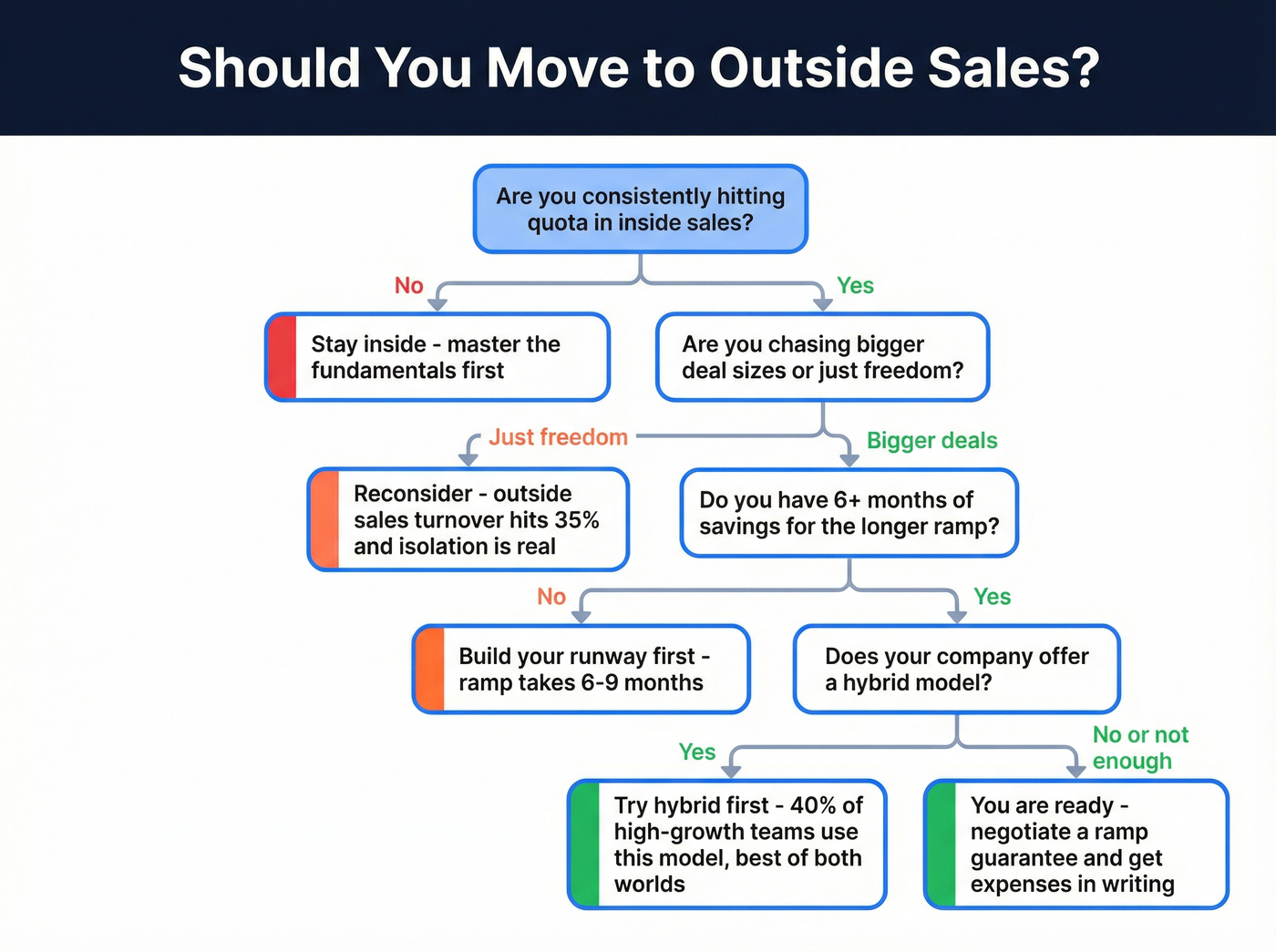
40% of high-growth teams now run hybrid models where inside reps qualify and outside reps close high-value deals. If your company is moving toward hybrid, you get the best of both worlds without the full expense burden.
Skip the move entirely if any of these are true: you haven't consistently hit quota inside yet, you're chasing "freedom" rather than bigger deal sizes, or you don't have at least six months of savings to cover the longer ramp. Outside reps in some industries travel 50-75% of the time - that's not autonomy, that's a lifestyle change. Make sure you're chasing the role as it exists in 2026, not as it existed in 2016.
FAQ
How long does it take to ramp in outside sales?
Most reps feel operationally competent after 60-90 days, but full ramp to quota-carrying productivity takes 6-9 months - roughly double the typical inside sales ramp. Plan your finances accordingly and negotiate a ramp guarantee if you can.
Do outside sales reps earn more after expenses?
Median outside pay is ~$34K higher than inside, but annual out-of-pocket expenses run $15-40K. Net advantage depends on your deal size and reimbursement policy. Always get the expense structure in writing before accepting an offer.
What about moving from outside sales back to inside?
The reverse move is less common but increasingly viable as hybrid models grow. Reps who've built field relationships often thrive when they shift to a higher-volume inside role because they already understand complex deal dynamics - they just need to adapt to a faster cadence and more screen time.
How do I avoid wasting drive time on bad contacts?
Verify your prospect list before heading to the field. A 7-day data refresh cycle catches job changes that static CRM exports miss - even auditing 75 contacts a month is enough to keep a weekly route list clean and avoid driving to meet someone who left the company last quarter.