

What Is an Intent Database - and Why Do Most Teams Get It Wrong?
You just spent $60K on an intent data contract. Six months later, your SDRs are ignoring the alerts and your Slack channel of "hot accounts" is muted. The problem isn't intent data - it's that you never built an intent database to make it actionable.
An intent database without workflows, scoring logic, and decay handling is just an expensive spreadsheet. That's exactly what most teams end up with.
The B2B intent data market hit $4.49B in 2026, and most of that spend is underperforming. 91% of B2B marketers use intent data, but only 24% report exceptional ROI. The fix: understand the schema, layer first-party and third-party signals - in a benchmark across 500+ ABM campaigns, hybrid models cut false positives to 11% - and pair intent with verified contact data you can actually reach.
What Is an Intent Database?
Intent data is the raw signal - a company researching "CRM migration." An intent database is the structured, queryable system that stores those signals, scores them, timestamps them, and decays them so your team can filter and act. One is a pile of receipts. The other is a general ledger.
Here's a simplified schema:
| Field | Example | Purpose |
|---|---|---|
| account | Acme Corp | Company match |
| contact | jane@acme.com | Person-level ID |
| signal_type | Content download | Behavior category |
| topic | CRM migration | Bombora/custom topic |
| confidence_score | 82 | Weighted relevance |
| timestamp | 2026-06-14 | When it happened |
| source | First-party web | Origin channel |
| decay_window | 14 days | Expiration trigger |
If your vendor can't explain what's behind the score, the score is worthless.
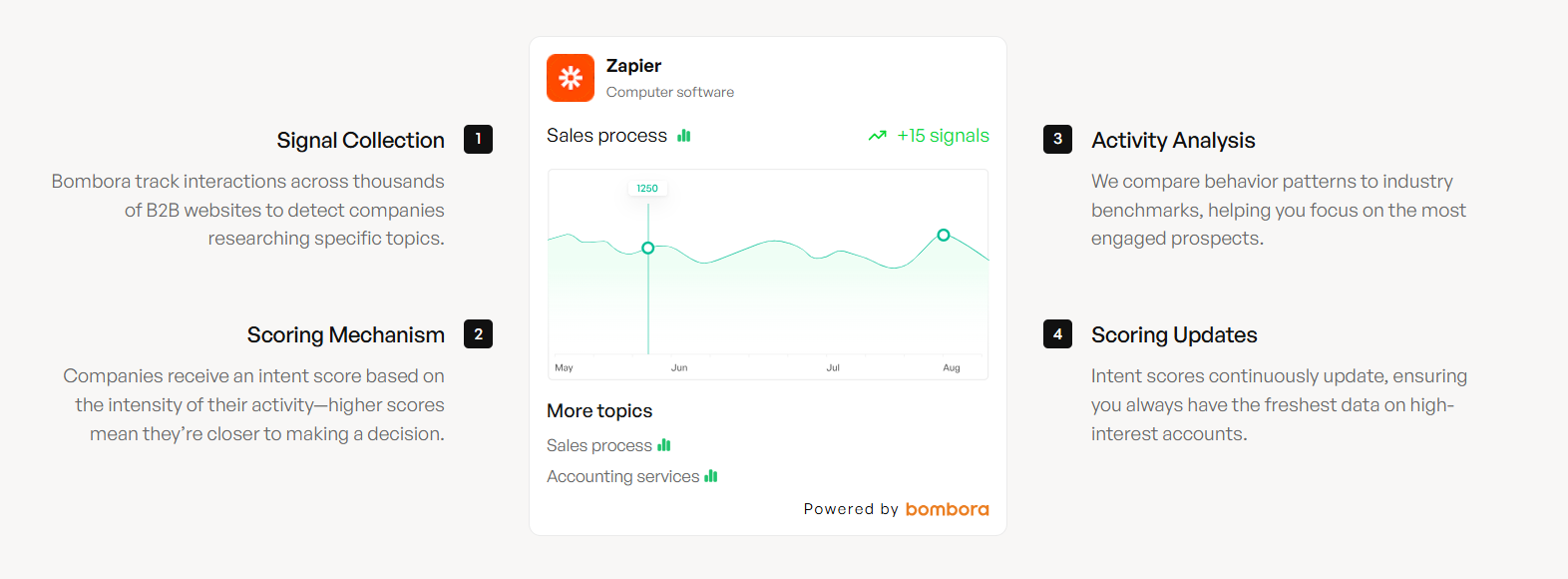
How Signals Become Usable Data
Signals break into three buckets: first-party (your website, CRM, marketing automation - page views, downloads, form fills), third-party (publisher co-ops like Bombora, bidstream data, review sites like G2), and hybrid (both layered with intersection logic). A lot of third-party databases surface the same companies - Apollo and ZoomInfo often overlap on the same accounts - which is why supplementing with first-party signals matters so much.
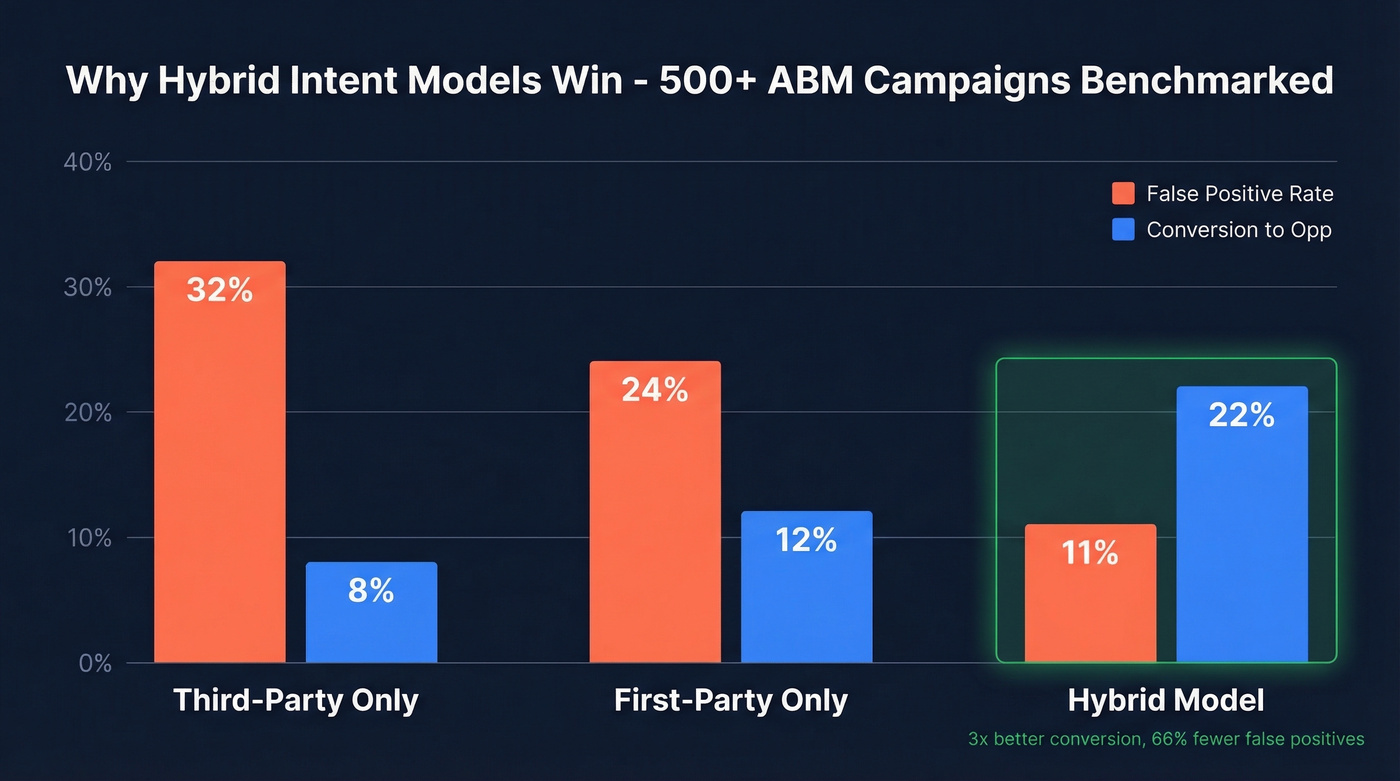
We've tested hybrid models against single-source setups, and the benchmark data across 500+ ABM campaigns holds up:
| Strategy | False Positive Rate | Conversion to Opp |
|---|---|---|
| Third-party only | 32% | 8% |
| First-party only | 24% | 12% |
| Hybrid | 11% | 22% |
Hybrid models nearly tripled conversion rates while cutting false positives by two-thirds. That's not marginal.
What It Actually Costs
Intent data is expensive, and total cost of ownership is almost always higher than the license fee. Here's what real contracts look like:
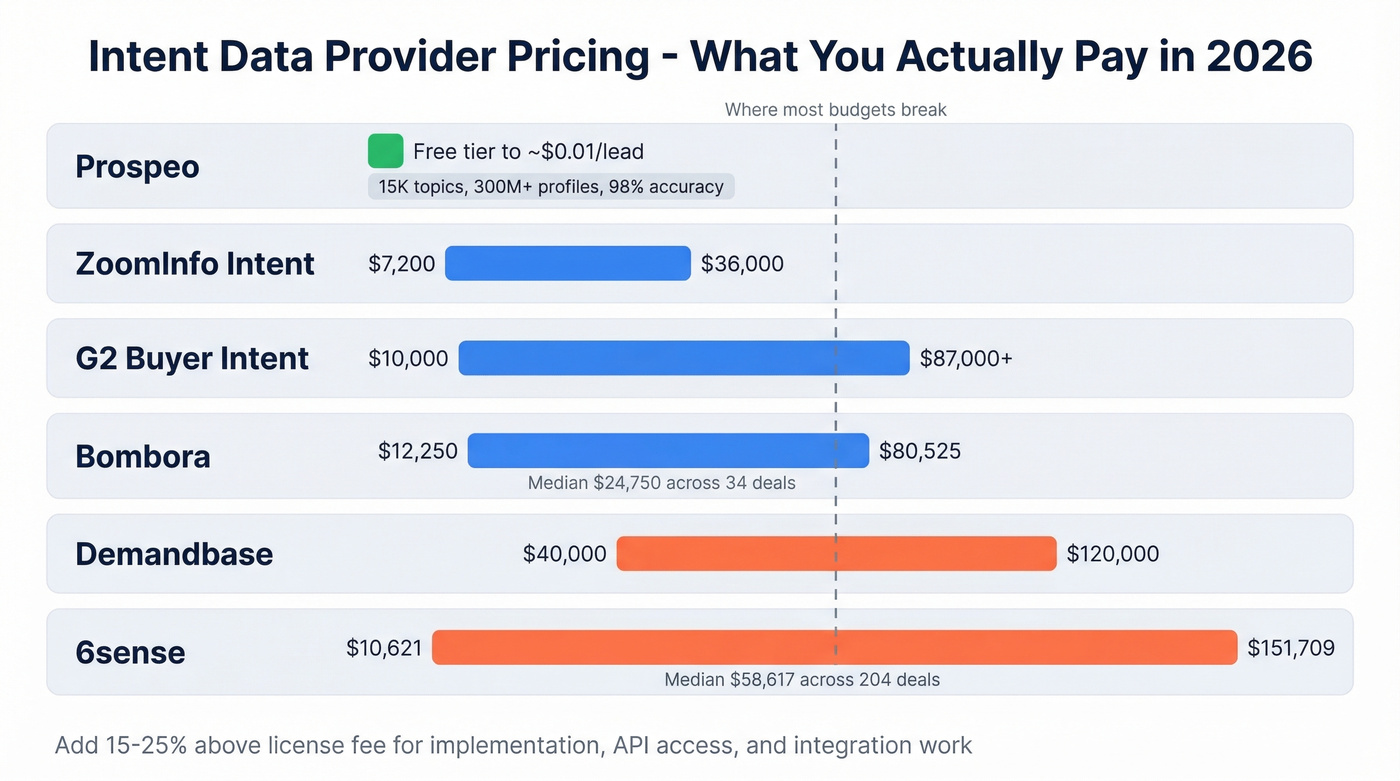
| Provider | Annual Cost | What You Get |
|---|---|---|
| Prospeo | Free tier; ~$0.01/lead | 15K topics, 300M+ profiles, 98% accuracy |
| Bombora | $24,750 median ($12,250-$80,525) | Topic-based intent signals |
| ZoomInfo Intent | $7,200-$36,000 | Intent module in GTM platform |
| 6sense | $58,617 median ($10,621-$151,709) | Full ABM + intent platform |
| Demandbase | $40,000-$120,000 | ABM + intent + advertising |
| G2 Buyer Intent | $10,000-$87,000+ | Review-based intent (add-on) |
Those Bombora and 6sense medians come from Vendr's marketplace data - 34 Bombora purchases and 204 6sense deals handled, respectively. Bombora topic pricing alone runs $500-$2,000 per basic topic and $5,000-$25,000 per premium topic annually. Add API access, implementation, and integration work, and you should budget 15-25% above the license fee. A realistic all-in stack with Bombora plus activation tools runs $73,600-$200K+/year.
For teams that don't need a six-figure ABM platform, Prospeo bundles Bombora-powered intent across 15,000 topics with verified contacts - starting free, no contracts.


Most teams pay $60K+ for intent signals they can't act on because the contact data underneath is garbage. Prospeo layers Bombora-powered intent across 15,000 topics directly onto 300M+ verified profiles - 98% email accuracy, 7-day refresh, starting at $0.01/lead. No six-figure contracts.
Stop paying enterprise prices for intent data you can't activate.
Build vs. Buy Your Intent Database
Buy if you've got under 5 reps, no engineering resources, and need to move this quarter. Grab a platform that bundles intent with contacts and start testing signals against pipeline outcomes. Best-performing teams act on intent signals within 24 hours.
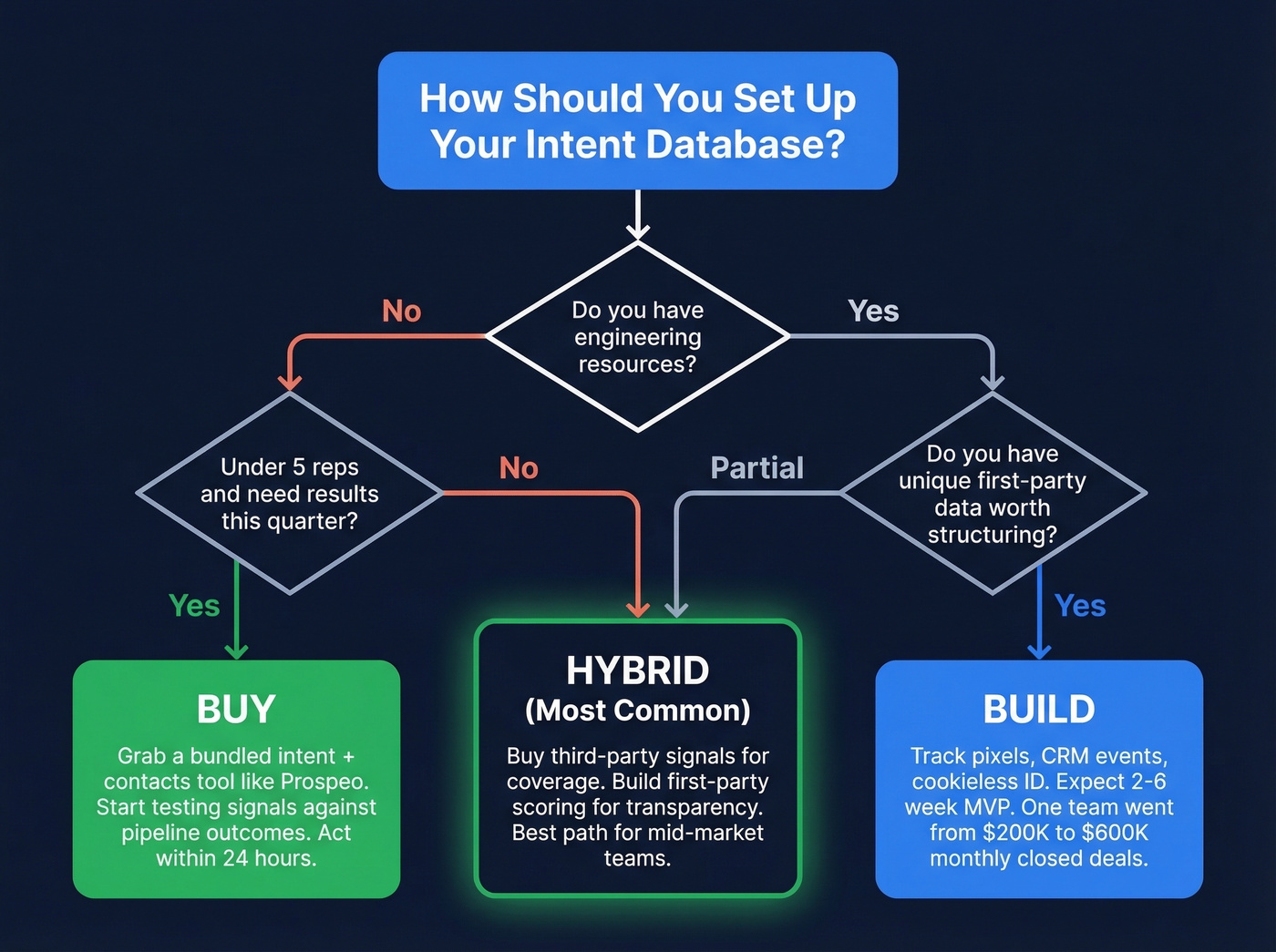
Build if you have engineering capacity and unique first-party data worth structuring. One practitioner on r/LeadGeneration built their own intent system after testing 6sense, ZoomInfo, and Bombora - monthly closed deals jumped from $200K to roughly $600K. The key was replacing "mysterious intent scores" with evidence-backed signals reps actually trusted. First-party collection methods include tracking pixels, CRM event logging, and cookieless identification. Expect a 2-6 week MVP build.
Hybrid (most common): Buy third-party signals, build first-party scoring logic. Clay workflows are popular for the composable approach. In our experience, the hybrid path works best for most mid-market teams - you get signal coverage without surrendering scoring transparency.
5 Mistakes That Kill Intent Database ROI
These come from Forrester's intent data research and patterns we've seen repeatedly in the field.
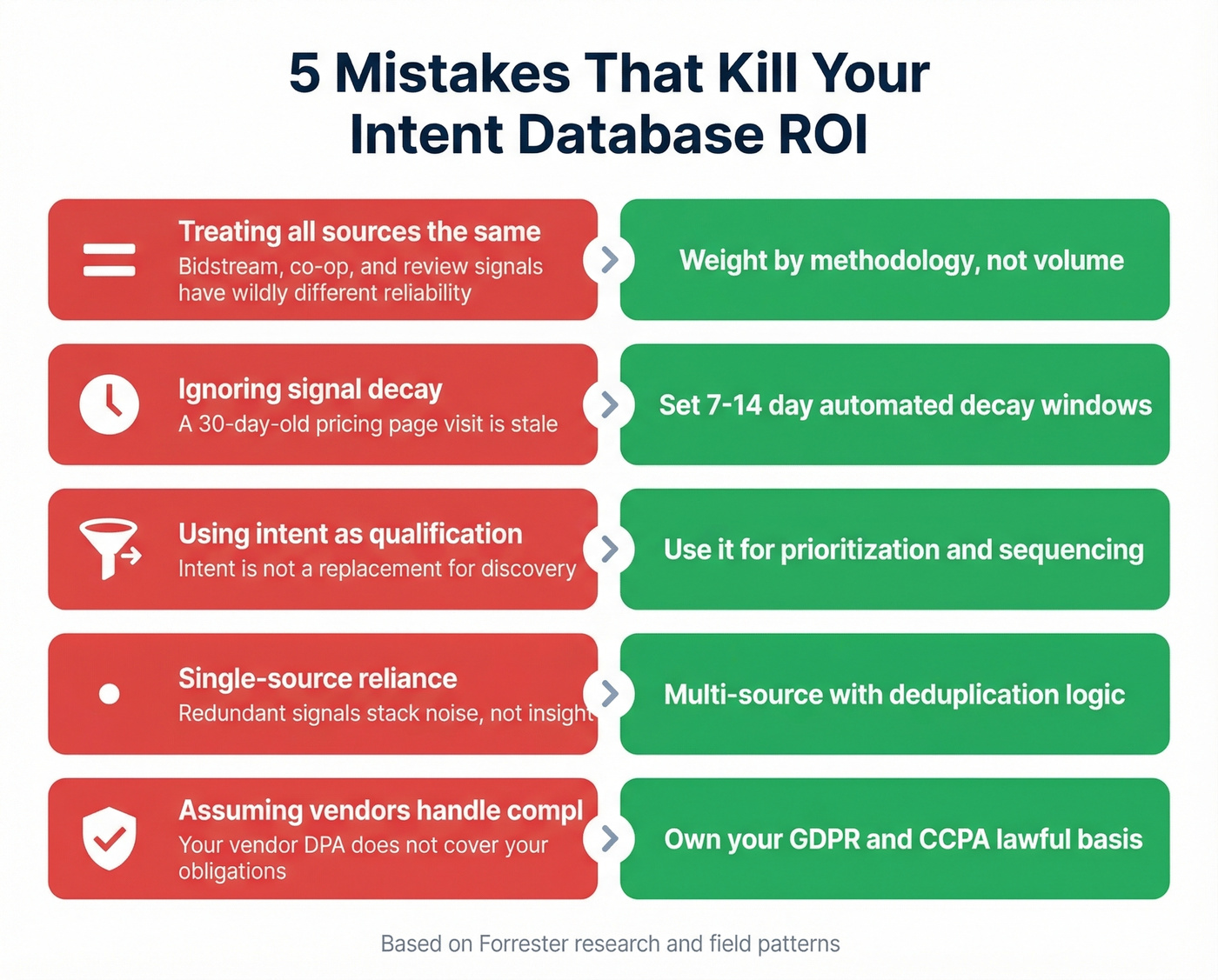
1. Treating all sources the same. Bidstream data, publisher co-op data, and review-site signals have wildly different reliability. Methodology matters more than volume.
2. Ignoring signal decay. A pricing-page visit from 30 days ago is stale. Your database needs automated expiration - 7-14 days is the standard decay window.
3. Using intent as qualification instead of prioritization. Intent tells you who to call first, not who to qualify in. It's a sequencing tool, not a replacement for discovery.
4. Single-source reliance. Multi-source intent is more predictive - but only if you're deduplicating, not stacking redundant signals.
5. Assuming vendors handle compliance. You still need lawful basis under GDPR and CCPA. Your vendor's DPA doesn't absolve your own obligations.
Here's the thing: the recurring frustration on Reddit is telling. Practitioners describe intent alerts as "noise dressed up as signal" and "yet another Slack channel everyone mutes." That's not a data problem. It's an architecture problem.
How to Choose the Right Provider
Let's be honest: if your average deal size is under $15K, you almost certainly don't need a six-figure intent platform. A bundled intent-plus-contacts tool and disciplined first-party tracking will outperform a bloated ABM stack your team never fully implements.
Three tiers based on team size and budget:
Self-serve teams wanting intent + contacts: Prospeo. 15,000 Bombora intent topics layered with 300M+ verified profiles, 98% email accuracy, 125M+ mobile numbers - on a 7-day refresh cycle. Start free, scale on credits.
HubSpot-native teams: HubSpot Buyer Intent works within your existing workflow with credit-based pricing. Skip this if you aren't already on HubSpot - the standalone value doesn't justify a platform switch.
Enterprise ABM programs with dedicated ops: Demandbase or 6sense. Budget $60K-$150K/year plus 15-25% for implementation. Full orchestration - advertising, account scoring, journey analytics - and ongoing ops support required. We've seen teams take 3-6 months just to get these platforms configured properly, so don't expect quick wins.
Pick the tier that matches your team's ability to actually activate the data, not the tier that sounds most impressive on a vendor slide deck. If you need a tighter system for prioritization, pair your intent model with an Ideal Customer Profile and a clear lead scoring rubric.
Hybrid intent models cut false positives to 11% - but only if you can actually reach the accounts that light up. Prospeo gives you intent signals paired with 143M+ verified emails and 125M+ direct dials, refreshed every 7 days. That's the missing layer between signal and pipeline.
Turn intent signals into booked meetings, not muted Slack channels.
Intent Database FAQ
What's the difference between intent data and an intent database?
Intent data is the raw signal - a company researching "CRM software." An intent database is the structured system that stores, scores, timestamps, and decays those signals so your team can query and act on them. Without the database layer, you're just collecting noise with no way to prioritize it.
How quickly do intent signals expire?
Most buyer intent signals lose relevance within 7-14 days. A pricing-page visit from 30 days ago is stale. Build automated decay windows into your schema and purge expired records so SDRs never chase cold signals.
Can I get intent data without a $25K+ annual contract?
Yes. Prospeo bundles Bombora-powered intent across 15,000 topics with verified contact data on a free tier - no annual commitment. HubSpot also offers credit-based buyer intent for existing users. Six-figure platforms are only justified for enterprise ABM programs with dedicated ops teams.
What's the best way to reduce false positives?
Layer first-party and third-party signals into a hybrid model. Benchmark data across 500+ ABM campaigns shows hybrid approaches cut false positives to 11%, compared to 32% for third-party-only setups. Deduplication and intersection logic are key.