

Interest-Based Negotiation: The Practitioner's Complete Playbook
Your biggest vendor just sent the renewal quote - 40% higher than last year. The rep won't budge, and your CFO wants to know why you're paying for modules nobody uses. This is exactly the kind of impasse where interest-based negotiation changes everything. Instead of digging in on the number and haggling for weeks, you shift the conversation from positions to interests and walk out with a deal that actually works for both sides.
Fisher and Ury laid this out in Getting to Yes back in 1981, and the core idea hasn't aged a day: stop arguing over positions and start exploring the reasons behind them. When you do, you find solutions that positional haggling never surfaces.
The Framework (Quick Version)
Four principles, one non-negotiable prep step:
- Separate people from the problem. Emotions aren't the enemy - ignoring them is.
- Focus on interests, not positions. Ask "why?" before you counter.
- Invent options for mutual gain. Brainstorm before you decide.
- Use objective criteria. Market data and precedent beat opinions.
And the prep step: know your BATNA (Best Alternative to a Negotiated Agreement) before you sit down. Without it, collaboration becomes capitulation.
Let's be honest - this approach doesn't work in every situation. If the other side is acting in bad faith or there's only one issue on the table, you need a different playbook. More on that below.
Positional vs. Interest-Based Approaches
The classic illustration is the orange. Two people want the same orange. A positional negotiator splits it in half. An interest-based negotiator asks why each person wants it. One needs the juice; the other needs the peel for baking. Both get 100% of what they actually need.
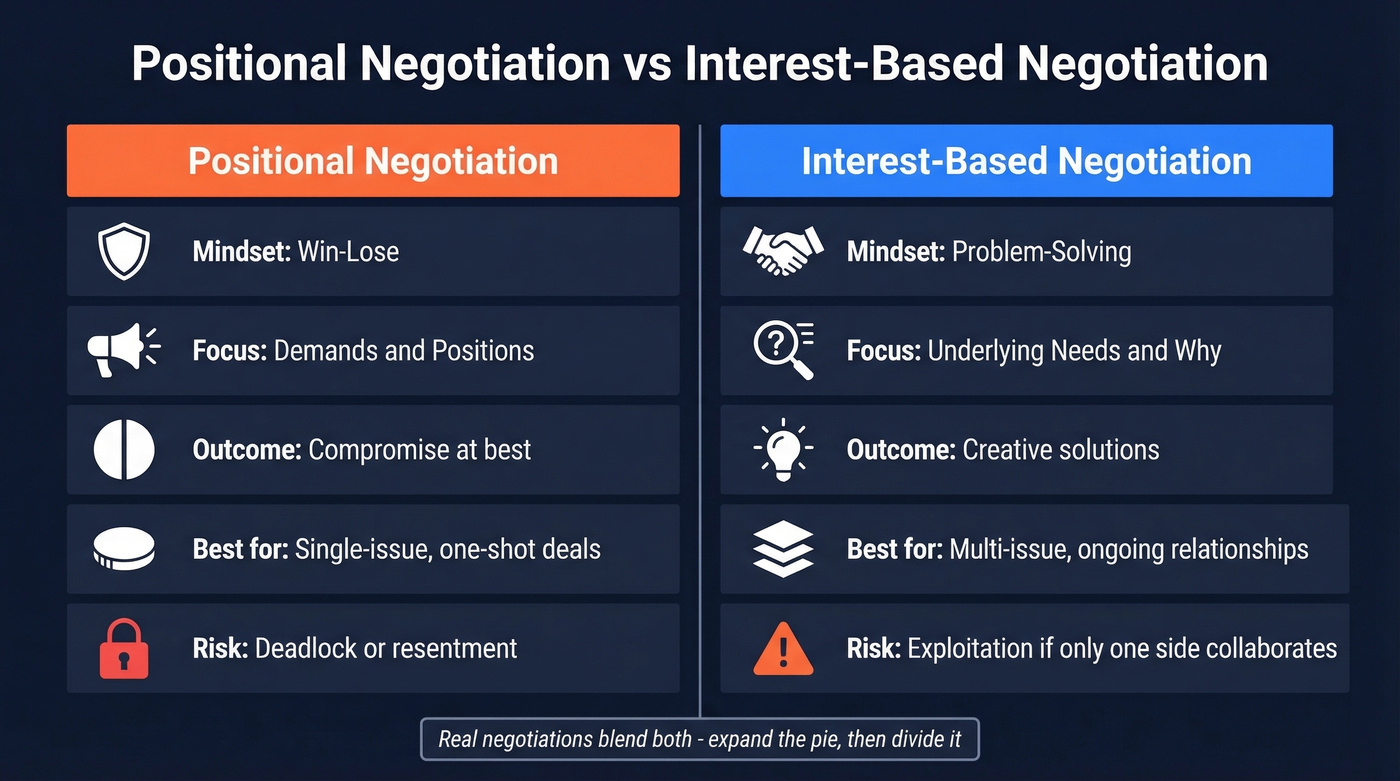
Simple example, but it reveals the critical condition: integration only exists when multiple issues are involved. If there's genuinely one issue and one resource, you're in a distributive negotiation whether you like it or not. The integrative approach shines when there are multiple issues to trade across - price, timeline, scope, payment terms, exclusivity, support levels.
| Dimension | Positional | Interest-Based |
|---|---|---|
| Mindset | Win-lose | Problem-solving |
| Focus | Demands | Underlying needs |
| Typical outcome | Compromise | Creative solution |
| Best for | Single-issue, one-shot | Multi-issue, ongoing |
| Risk | Deadlock or resentment | Exploitation if unilateral |
The table makes it look binary, but real negotiations blend both. You use collaborative techniques to expand the pie - then you still have to divide it. The point isn't to avoid hard conversations. It's to have smarter ones.
Here's our take: most teams default to positional bargaining not because it's better, but because it requires zero preparation. Interest-based negotiation is harder upfront and easier everywhere else. Every experienced negotiator we've talked to says the same thing - the teams that invest in prep consistently outperform the ones that wing it.
The Four Principles Explained
Separate People from the Problem
Every negotiation has two layers: the substance and the relationship. Most people conflate them. When someone pushes back on your proposal, it feels personal - but it usually isn't.
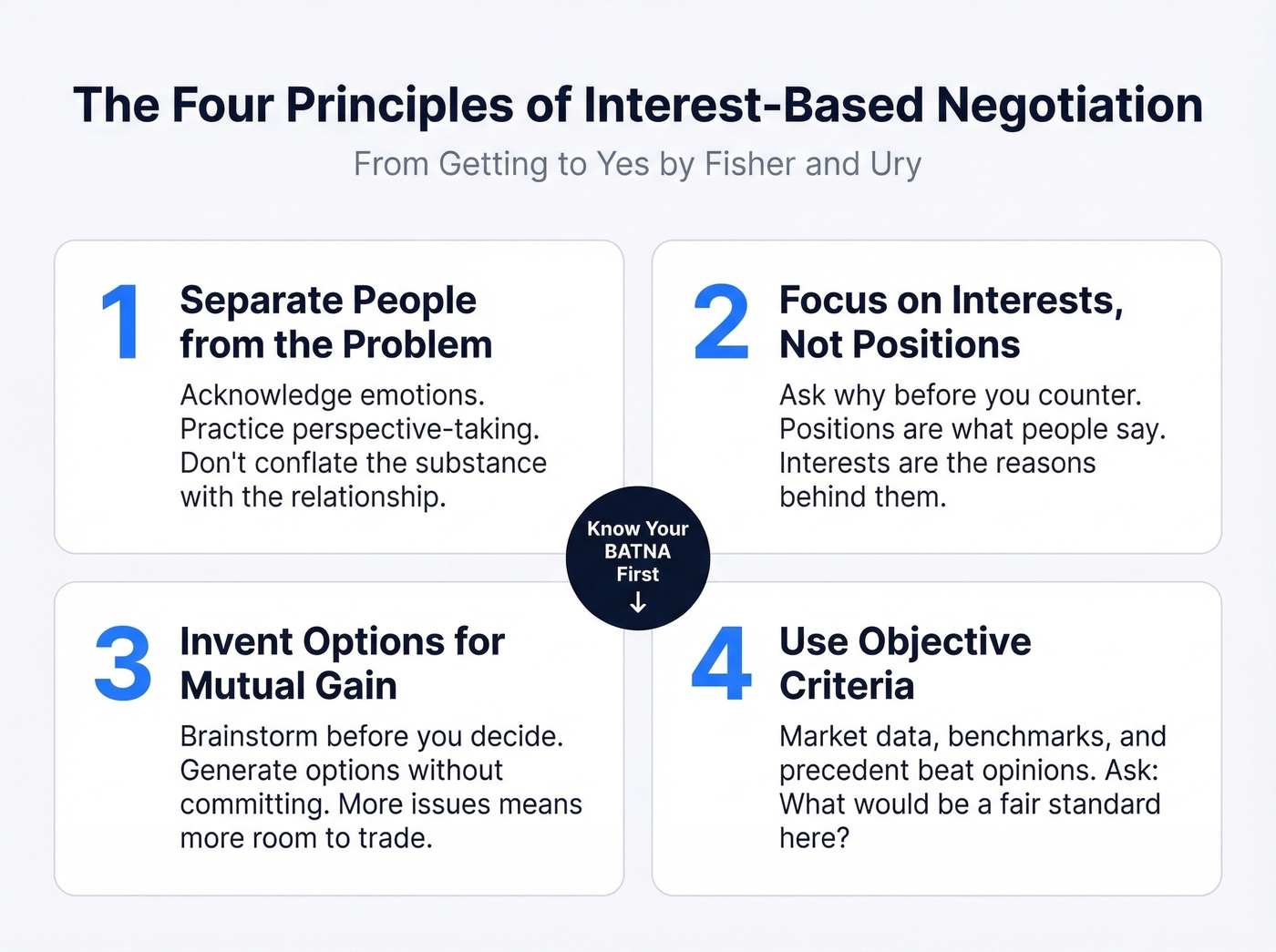
Practice perspective-taking before the meeting. What pressures is the other side facing? What does their boss care about? Acknowledge emotions explicitly - "I can see this timeline is creating real pressure for your team" - rather than pretending they don't exist. Express appreciation for what the other side brings to the table. These aren't soft moves; they prevent the action-reaction escalation that kills deals. Separate intent from impact: they may not be trying to lowball you; they may genuinely have a budget constraint you don't know about.
Focus on Interests, Not Positions
Positions are what people say they want. Interests are why they want it. A vendor demanding a two-year contract isn't necessarily greedy - they need revenue predictability for their own planning cycle.
Two questions that reliably surface interests:
- "Why is this important to you?"
- "What problem are you trying to solve?"
These aren't soft questions. They're diagnostic tools. The answers change the negotiation completely because they reveal tradeoffs the other side will actually accept.
Invent Options for Mutual Gain
Most negotiators evaluate options too early. They hear one proposal, react, and counter. The interest-based approach inserts a brainstorming phase before decision-making.
Generate options without committing to any of them. "What if we extended the term but reduced the annual rate?" "What if we added implementation support instead of discounting?" This only works when multiple issues are on the table. If you're stuck on a single number, you haven't identified enough issues yet. Before finalizing any proposal, run an empathetic analysis - evaluate the consequences of your offer from the other side's perspective, because if it creates a problem for them internally, it'll create a problem for you eventually.
Use Objective Criteria
When interests conflict, objective standards break the deadlock. Market rates, industry benchmarks, published pricing data, precedent from similar deals, independent appraisals - these carry weight because they're not tied to either party's preferences.
The phrase "What would be a fair standard for us to use here?" is disarming. It shifts the conversation from "what I want vs. what you want" to "what's reasonable."
Step-by-Step Worksheet
A seven-step framework you can use before any business negotiation.
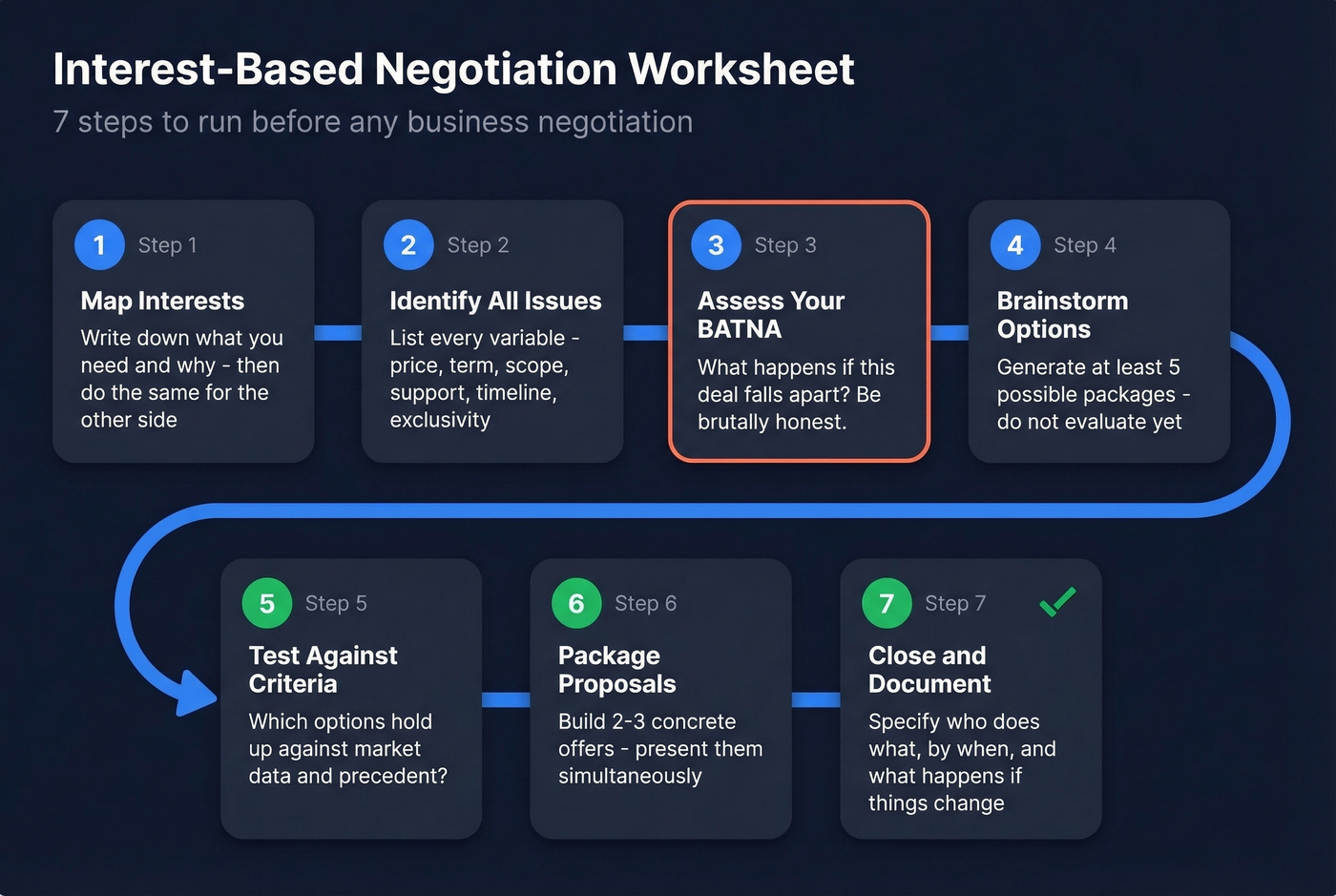
1. Map interests - yours and theirs. Write down what you need and why. Then do the same for the other side, even if you're guessing. The act of writing it down forces specificity.
2. Identify all issues on the table. Don't let the negotiation collapse to a single number. List every variable: price, term length, payment schedule, scope, support, exclusivity, renewal terms, implementation timeline. More issues mean more room for creative trades.
3. Assess your BATNA. What's your best alternative if this deal falls apart? Be brutally honest. A weak BATNA means you need this deal more than you think. (If you want to formalize it, set a clear walkaway point before the meeting.)
4. Brainstorm options. Generate at least five possible packages before the meeting. Don't evaluate them yet - just create. Mix and match across issues.
5. Evaluate against objective criteria. Which options are defensible using market data, precedent, or industry standards? Discard anything that only works if the other side caves.
6. Package proposals. Build two or three concrete proposals that address both sides' interests. Present them simultaneously rather than sequentially - simultaneous offers signal flexibility without weakness.
7. Close and implement. Once you've agreed, document everything immediately. Ambiguity after a handshake kills deals. Specify who does what, by when, and what happens if circumstances change.

Interest-based negotiation only works when you're talking to the actual decision-maker. Prospeo gives you 98% accurate emails and 125M+ verified mobile numbers so you reach the person who can say yes - not a gatekeeper who can only say no.
Stop negotiating with the wrong people. Start with the right data.
10 Questions That Uncover Interests
Keep these in your back pocket. They work in vendor negotiations, salary discussions, partnership deals, and internal resource conversations.
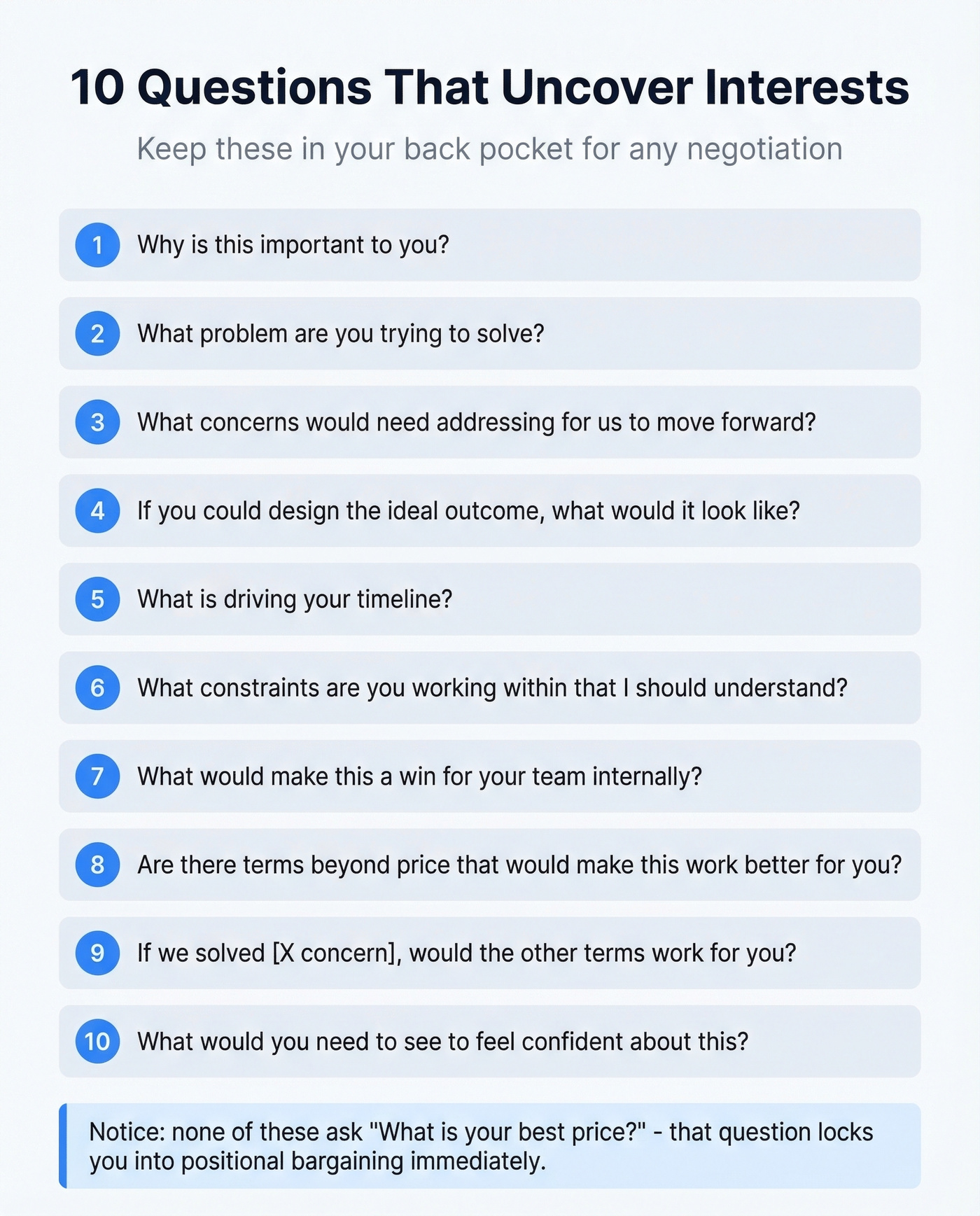
- "Why is this important to you?"
- "What problem are you trying to solve?"
- "What concerns would need addressing for us to move forward?"
- "If you could design the ideal outcome, what would it look like?"
- "What's driving your timeline?"
- "What constraints are you working within that I should understand?"
- "What would make this a win for your team internally?"
- "Are there terms beyond price that would make this work better for you?"
- "If we solved [X concern], would the other terms work for you?"
- "What would you need to see to feel confident about this?"
Every question targets the why behind a position. None of them ask "What's your best price?" - because that question locks you into positional bargaining immediately.
Common Mistakes That Derail Deals
1. Poor planning. In our experience, this accounts for more blown deals than bad tactics. Negotiators who don't map interests, identify their BATNA, or research the other side's situation walk in blind. Stanford GSB highlights poor planning as the #1 negotiation pitfall. (A simple way to systematize this is to use a discovery questions checklist before the meeting.)
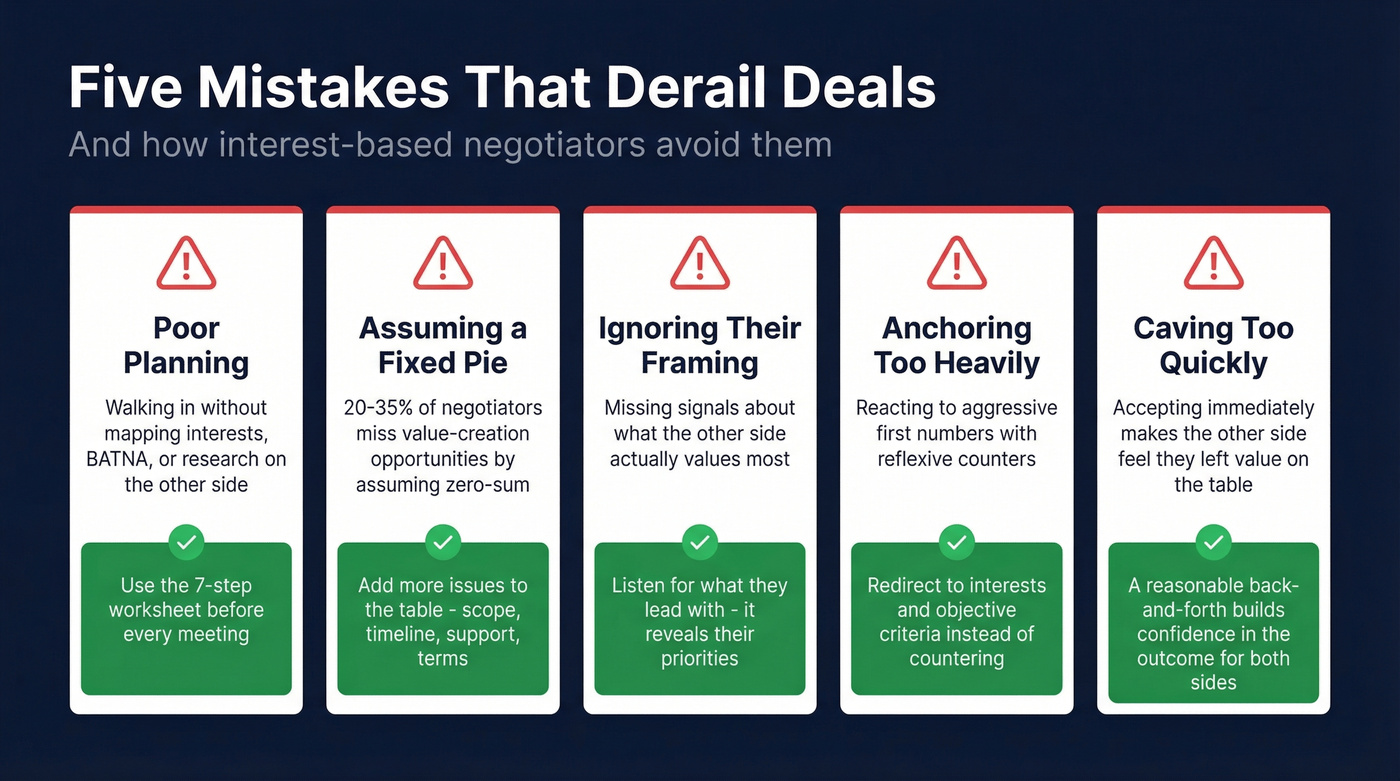
2. Assuming the pie is fixed. Stanford professor Margaret Neale found that 20-35% of her negotiation students miss obvious value-creation opportunities because they assume the deal is zero-sum. If you're only talking about price, you're almost certainly missing value.
3. Ignoring the other side's framing. How someone presents an offer tells you what they value. If they lead with timeline, time matters more to them than money. If they keep mentioning risk, they need certainty. Listen for the frame - it's a map to their interests.
4. Anchoring too heavily. First numbers carry disproportionate weight. If the other side throws out an aggressive anchor, don't counter reflexively. Redirect to interests and objective criteria instead. Fisher and Ury call this "negotiation jujitsu" - deflecting positional pressure back toward problem-solving. (If you want to go deeper, see our guide to the anchor in negotiation.)
5. Caving too quickly. Counterintuitive, but giving in fast backfires. When you accept immediately, the other side often feels they left value on the table - even if the deal is fair. A reasonable amount of back-and-forth builds confidence in the outcome for both parties.
When NOT to Use This Approach
Bad-faith counterparts. If the other side is lying, manipulating, or weaponizing information you share, collaborative techniques become a liability. Protect your interests with a positional or BATNA-driven approach instead.
Single-issue, zero-sum disputes. When there's genuinely one variable and one pool of value - the final price on a commodity with no other terms to negotiate - integrative techniques have nothing to work with.
Extreme power imbalance. If one side holds all the leverage and has no incentive to collaborate, interest-based negotiation won't create incentive where none exists. You need external leverage first: competition, public pressure, regulatory options.
One-shot transactions. The collaborative approach pays dividends over time. If you're buying a used car from a stranger you'll never see again, the relationship investment has minimal return.
Time-critical crises. When speed matters more than optimization - emergency procurement, crisis response, regulatory deadlines - the brainstorming and interest-mapping phases are a luxury you can't afford.
Real-World Case Studies
Disney & Lucasfilm ($4.05B)
When Disney acquired Lucasfilm for $4.05 billion, Bob Iger and George Lucas negotiated personally for more than two years. Lucas cared deeply about the legacy of his characters - that's an interest, not a price point. Iger built trust by demonstrating Disney's track record with Pixar and Marvel. Lucas felt his life's work was in good hands; Disney got the franchise of a generation. The deal worked because both sides explored what mattered beyond the number on the check.
Merck & Johnson & Johnson (Vaccine Production)
During the COVID-19 vaccine push, the U.S. government offered Merck $250 million+ to help produce J&J's vaccine - despite the two being direct competitors. The interest-based frame: both companies needed the pandemic to end for market recovery, public health, and regulatory goodwill, and their manufacturing capabilities were complementary. Value creation through shared interests, not zero-sum competition.
Salary Negotiation - The Gender Gap
Here's the thing: according to 2024 research from Scotwork, men are 20% more likely to negotiate salary, and 20% of women have never negotiated salary at all. An interest-based framing helps close this gap because it reframes salary conversations from adversarial to collaborative. When the conversation includes equity, flexibility, title, growth path, and benefits alongside base pay, there are more issues to trade - and more room for both sides to win.
Creative Deal Terms - Alec Guinness & Star Wars
Alec Guinness negotiated 2% royalties on Star Wars, later raised to 2.25%, ultimately earning roughly 0.45% of total box office revenue - a deal worth far more than any upfront salary increase would have been. The lesson: if you're only negotiating the number on the check, you're not negotiating enough issues. We've watched negotiations collapse because both sides treated a multi-issue deal like a single-number haggle.
Preparation Is Everything
Ask any sales leader who's been through a multi-year vendor negotiation and they'll tell you the same thing: the prep matters more than the pitch. We've seen teams spend weeks preparing slide decks and zero minutes mapping the other side's interests. That's backwards.
The BATNA discipline alone separates good negotiators from mediocre ones. Consider the homeowner's insurance example from Harvard's Program on Negotiation: a policy that looks 30% cheaper on the surface can be worse once you compare coverage exclusions and deductibles on equivalent terms. Superficial BATNA analysis is worse than no analysis - it gives you false confidence.
Ongoing reassessment matters too. Your BATNA changes as new information emerges. The other side's BATNA changes. Treat preparation as a living process, not a one-time exercise.
One more thing: you can't negotiate effectively if you're talking to the wrong person. Before any business negotiation, verify you're reaching the actual decision-maker - not a gatekeeper who'll relay your proposal with half the context stripped out. Tools like Prospeo let you search 300M+ professional profiles with 30+ filters to confirm the right contact before you invest hours in preparation. If you're building lists for outreach, start with a clear ideal customer profile and tighten your targeting with firmographic filters. Getting to the decision-maker isn't a negotiation tactic - it's a prerequisite.
Step 2 of your worksheet says to identify every issue on the table. Step 0 is knowing who to negotiate with. Prospeo's 30+ search filters - buyer intent, funding, headcount growth - surface the prospects worth your prep time.
Great negotiators prepare. The best ones prepare with better data.
FAQ
What's the difference between interest-based and positional negotiation?
Positional negotiation focuses on fixed demands and grudging compromise; interest-based negotiation digs into underlying needs to create solutions that satisfy both parties. Positions are what you say you want; interests are why you want it. The integrative approach works best when multiple issues - price, timeline, scope, terms - are on the table.
Does this approach work when the other side won't cooperate?
Use "negotiation jujitsu" - redirect attacks toward interests and objective criteria rather than countering position with position. Fisher and Ury recommend deflecting positional pressure back toward problem-solving. But if the counterpart acts in bad faith, switch to a BATNA-driven approach. Collaboration requires at least minimal reciprocity.
What is BATNA and why does it matter?
BATNA stands for Best Alternative to a Negotiated Agreement - your walkaway option if the current deal falls apart. It prevents collaborative negotiation from becoming capitulation. Always assess yours on truly equivalent terms before sitting down; a superficially cheaper alternative with hidden downsides is worse than no alternative at all.
Can interest-based negotiation improve salary discussions?
Yes. Expanding the conversation beyond base pay to include equity, flexibility, title, growth path, benefits, and review timelines gives both sides more issues to trade. Research from Scotwork shows 20% of women have never negotiated salary at all; reframing the discussion as collaborative rather than adversarial helps close that gap.
How do you find the right person to negotiate with?
Verify you're reaching the actual decision-maker before investing hours in preparation. Prospeo lets you search 300M+ professional profiles with 30+ filters - including job title, seniority, and department - so you can confirm the right contact with 98% email accuracy. Reaching a gatekeeper who strips half your context wastes everyone's time.