

How to Build an International Go-to-Market Strategy (Without Copying Your Domestic Playbook)
The CEO announces "EMEA expansion" in the all-hands like it's a switch you flip. Two weeks later, someone's asking you to hire a country manager, "localize the website," and stand up pipeline by next quarter. That's how teams walk into the 40-60% of international expansions that hit serious trouble in the first 12-18 months. The failure mode isn't ambition - it's copying the domestic playbook and calling it "global."
We've watched this play out dozens of times, and the pattern on r/sales and RevOps communities is always the same: teams assume their home-market sales cycle and channel mix will transfer. They don't. Every market demands its own playbook, built from scratch.
What Is an International GTM Strategy?
An international GTM strategy is the plan for how you'll create demand, sell, deliver, and retain customers in a new country or region - with local constraints baked in from day one. It's not "our GTM, but translated." A global go-to-market approach requires rethinking assumptions about buyers, channels, and competitive dynamics for each market you enter.
The urgency is real. Emerging markets represent 4.3 billion people and roughly half of global GDP growth over the past decade, per BCG's research on emerging economies. We've seen a tight 3-month market entry sprint drive 3x faster adoption and 50% higher conversions when the team did the homework upfront. The difference is discipline, not luck.
Score and Select Your Target Market
You don't need a 40-row spreadsheet. You need 5-7 criteria, honest weights, and a quarterly cadence where you're willing to change your mind. That quarterly revisit is the most underrated part of any market-scoring approach.
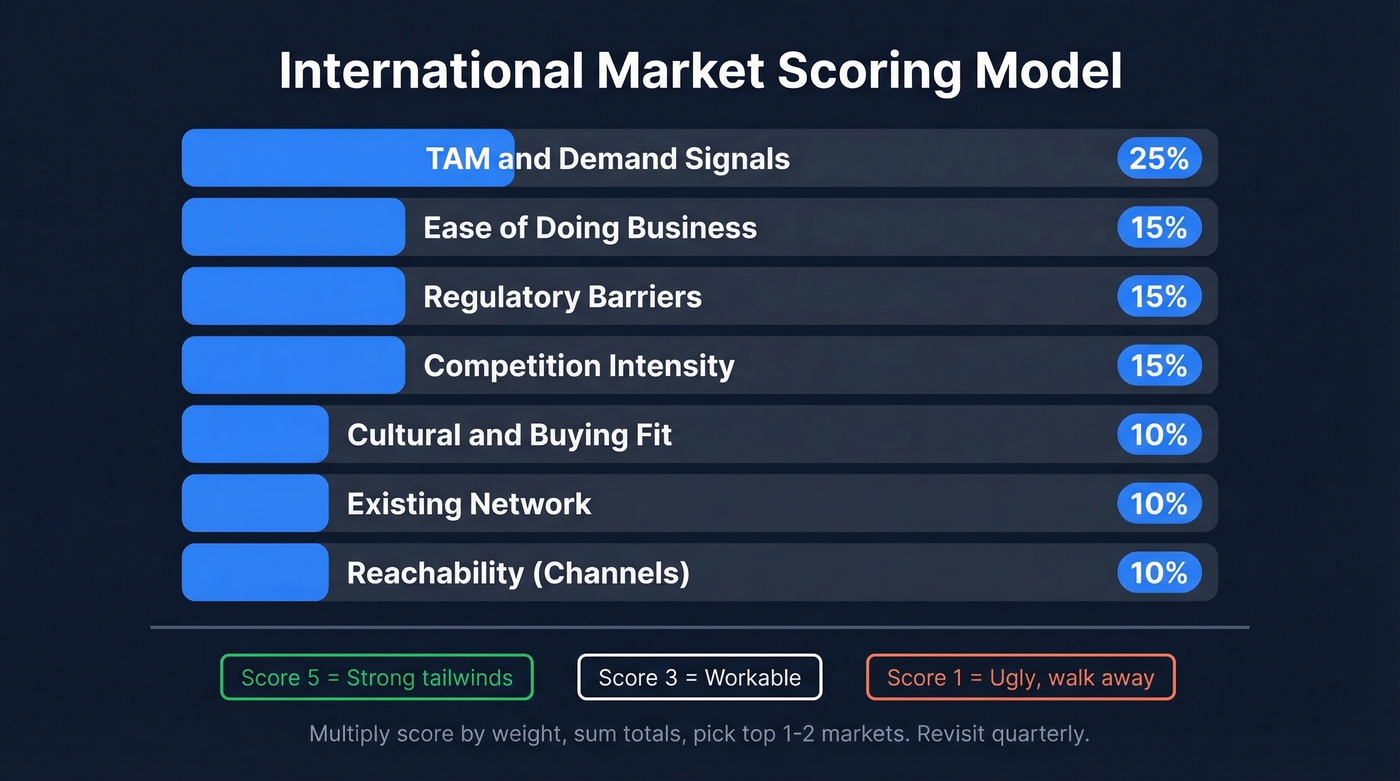
| Criteria | Weight | Score (1-5) | Weighted |
|---|---|---|---|
| TAM / demand signals | 25% | ||
| Ease of doing business | 15% | ||
| Regulatory barriers | 15% | ||
| Competition intensity | 15% | ||
| Cultural / buying fit | 10% | ||
| Existing network | 10% | ||
| Reachability (channels) | 10% |
1 = ugly, 3 = workable, 5 = strong tailwinds. Multiply score by weight, sum totals, then pick the top 1-2 markets to test. Not five.
Here's the thing: we've run bake-offs where the "best" market on paper lost because reachability was terrible - no partners, low email deliverability, and buyers who only trusted local references. Put reachability into the model early, or you'll learn it the expensive way.
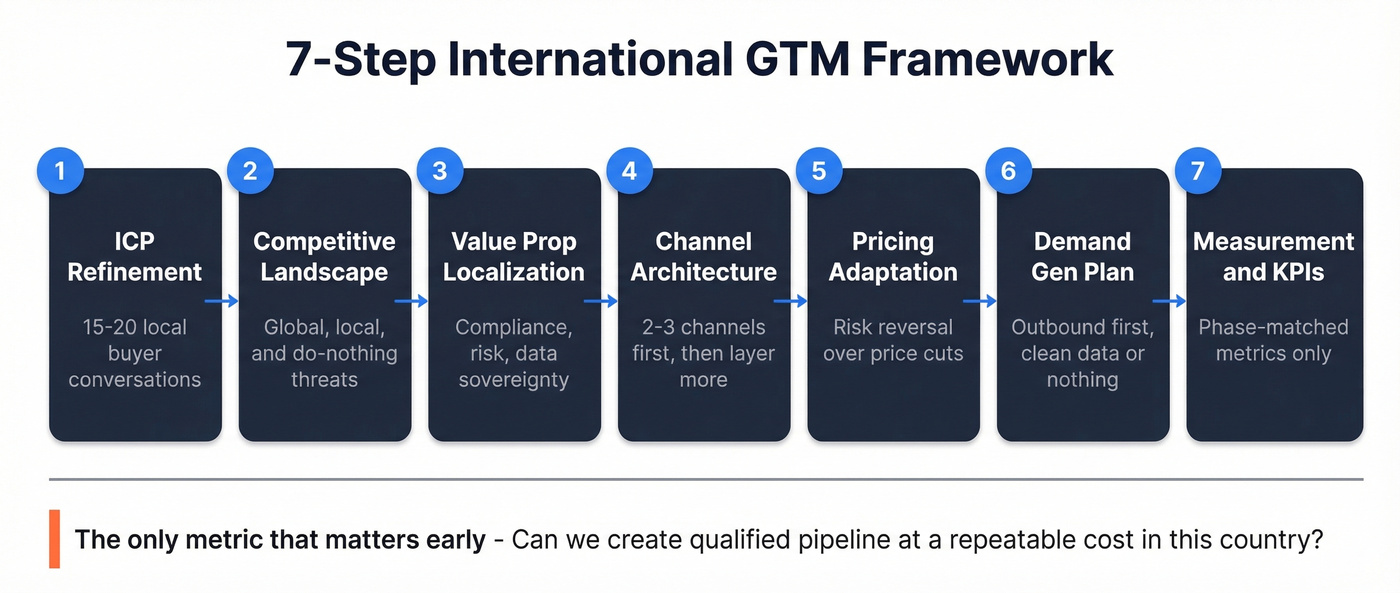
The 7-Step International GTM Framework
1. ICP Refinement
Rewrite your ICP for the new region: firmographics, tech stack, and the internal buyer committee. Titles shift by country, and "who owns budget" can move between IT, Ops, and Finance depending on local norms. Do 15-20 customer conversations before you touch headcount plans. Your ICP template is universal, but the details are always local - a VP of Sales in Germany often has a very different mandate and purchasing authority than one in the US.
2. Competitive Landscape
Map competitors in three buckets: global incumbents, strong local players, and "good enough" internal alternatives. Your biggest competitor in a new region is usually "do nothing this year," not the tool you're obsessed with back home.
3. Value Prop Localization
Translation is table stakes. Localization means aligning to what the market actually cares about: risk, compliance, payments, operational control. A quick win from the Weglot playbook: translate your website first to validate demand via traffic and conversion before heavier investment.
Data sovereignty is the new landmine. HBR's 2026 analysis is blunt: localization increasingly means in-country data processing and operational duplication to meet government mandates. GDPR fines alone have exceeded EUR 5.88B, and breach notification windows have shrunk to 24-72 hours in some jurisdictions. If your product touches customer data, your compliance posture is your GTM.
4. Channel Architecture
Don't over-index on one motion. McKinsey's B2B Pulse research shows the "rule of thirds" holds across geographies - roughly equal preference for in-person, remote, and digital self-serve - and buyers now use an average of 10 channels, up from 5 in 2016. Pick 2-3 to start, then layer in the rest once you've got a message that converts.
5. Pricing Adaptation
Keep packaging stable, but expect to adapt currency, invoicing norms, and discount expectations. Local competitors may anchor price lower, but win rates hinge more on perceived risk than list price. Build a "risk reversal" offer - a pilot, implementation guarantee, or a clear exit clause - instead of cutting price to match local anchors. That single move has saved more deals in our experience than any pricing page redesign.
6. Demand Gen Plan
When you're entering a market with zero inbound pipeline, outbound is your fastest learning loop. But only if your data is clean.
Average cold email reply rates sit around 5.8%, and "timeline hooks" can hit 10.01% in the same benchmark set. Those numbers collapse if you're bouncing 8-12% because your list is stale. In a region where you have no brand yet, bounced emails don't just waste credits - they burn your sender reputation before you've had a single conversation.
This is where data quality becomes existential. Prospeo's 98% email accuracy and 7-day refresh cycle matter most in exactly this scenario: new market, no inbound, zero margin for error on deliverability. Filter by region, industry, job title, and intent data across 15,000 topics, export, and start testing messaging the same day.

7. Measurement and KPIs
Pick a small set that matches the phase. In discovery, track reply rate, meeting rate, and top objections. In validation, track pipeline created, stage conversion, and sales cycle length. In scale, track CAC payback, retention, and partner-sourced percentage.
The only metric that matters early: "Can we create qualified pipeline at a repeatable cost in this country?"

Your first outbound campaign in a new market has zero margin for error. Bounced emails kill sender reputation before you land a single meeting. Prospeo gives you 98% email accuracy with a 7-day refresh cycle - filter 300M+ profiles by region, industry, job title, and buyer intent across 15,000 topics to build launch-ready lists for any country.
Stop burning domain reputation in markets where you have no brand yet.
Direct vs. Partner-Led Entry
Use direct if you've got a tight ICP, short onboarding, and you can win with a small remote pod. Use partners when you need distribution, services capacity, or credibility fast. BVP's taxonomy is the cleanest mental model here: VARs, resellers/distributors, service partners/SIs, referral partners, and marketplaces.
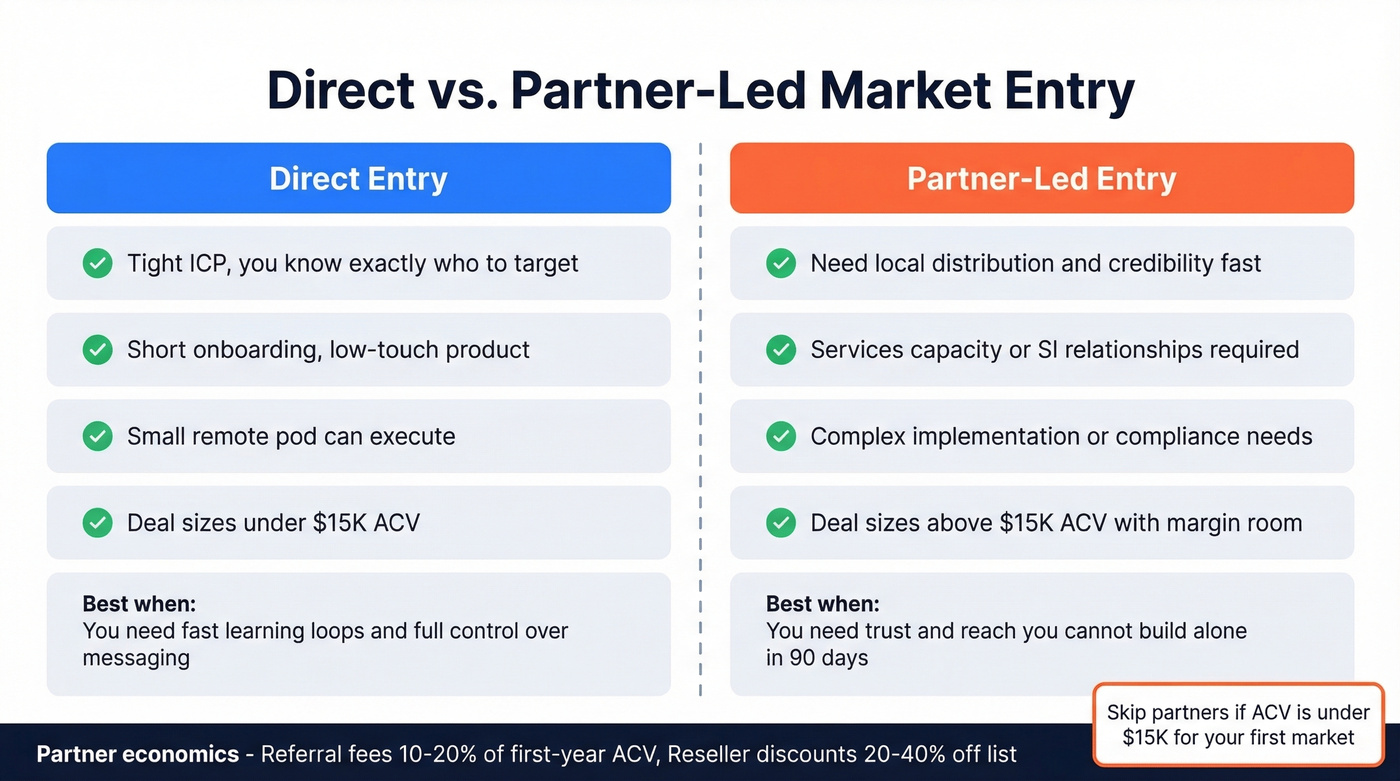
For concrete options, consider distributors like TD SYNNEX and Ingram Micro, or marketplaces like AWS Marketplace and Salesforce AppExchange. Expect referral fees around 10-20% of first-year ACV and reseller discounts around 20-40% off list, depending on who owns the customer relationship.
Let's be honest: if your deal sizes sit below $15K, skip the partner-led motion entirely for your first market. The margin math doesn't work until you've proven the value prop directly. Partners need a reason to sell you, and "we're new here" isn't one.
Billion-Dollar Failures That Prove the Point
Uber went into China, fought a subsidy war, lost billions, and sold operations to Didi in 2016. Walmart spent nine years in Germany, misread culture and labor laws, and exited after roughly a $1B loss. Target opened 100+ stores in Canada fast, then watched supply chain execution collapse - full exit within two years.
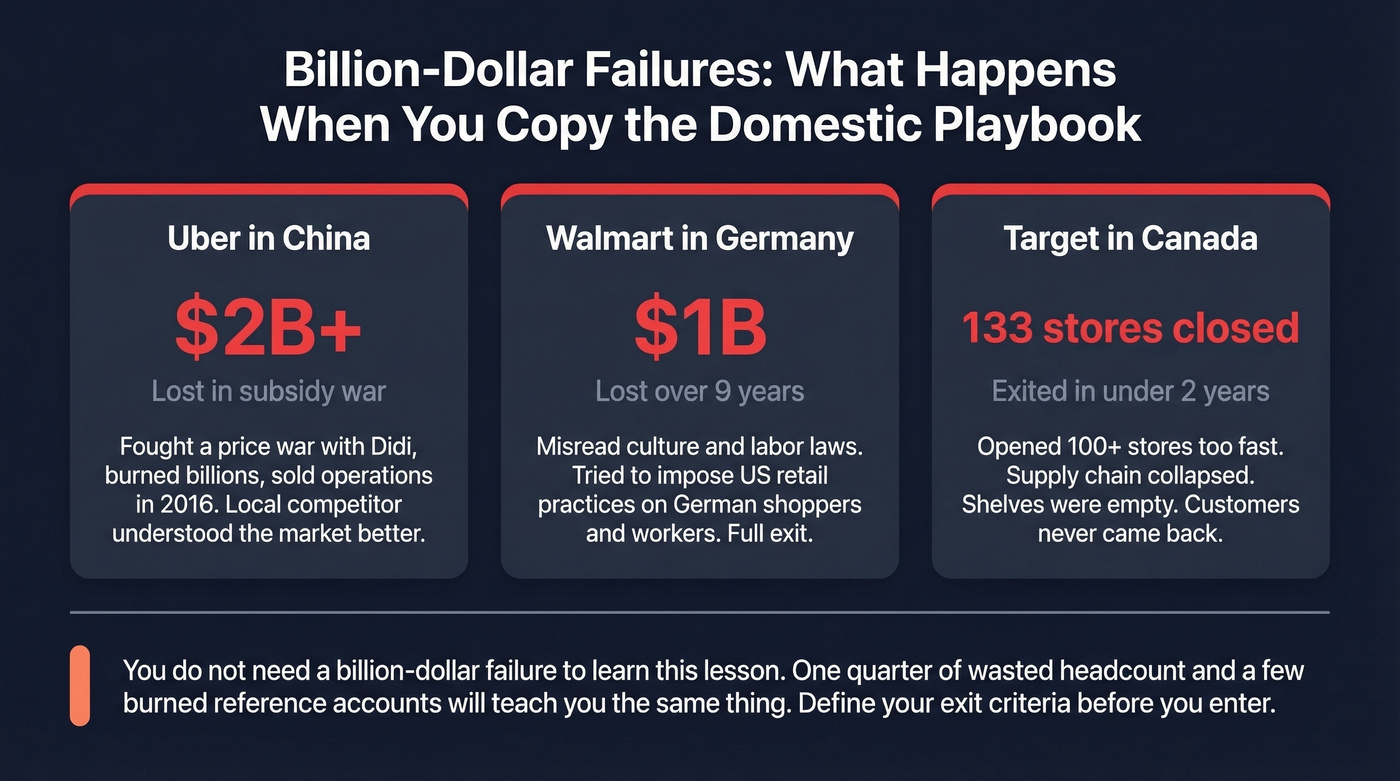
Those aren't "big company problems." They're the same mistake at different scales: copying the domestic playbook and assuming the market will bend. You don't need a billion-dollar failure to learn the lesson - one quarter of wasted headcount and a few burned reference accounts will do it. Every international go-to-market strategy needs a built-in kill switch before sunk costs take over. Define your exit criteria before you enter.
The 90-Day Prove-It Timeline
This execution arc forces learning before commitment. It's the fastest way to validate whether your global sales expansion thesis holds water or falls apart on contact with reality.
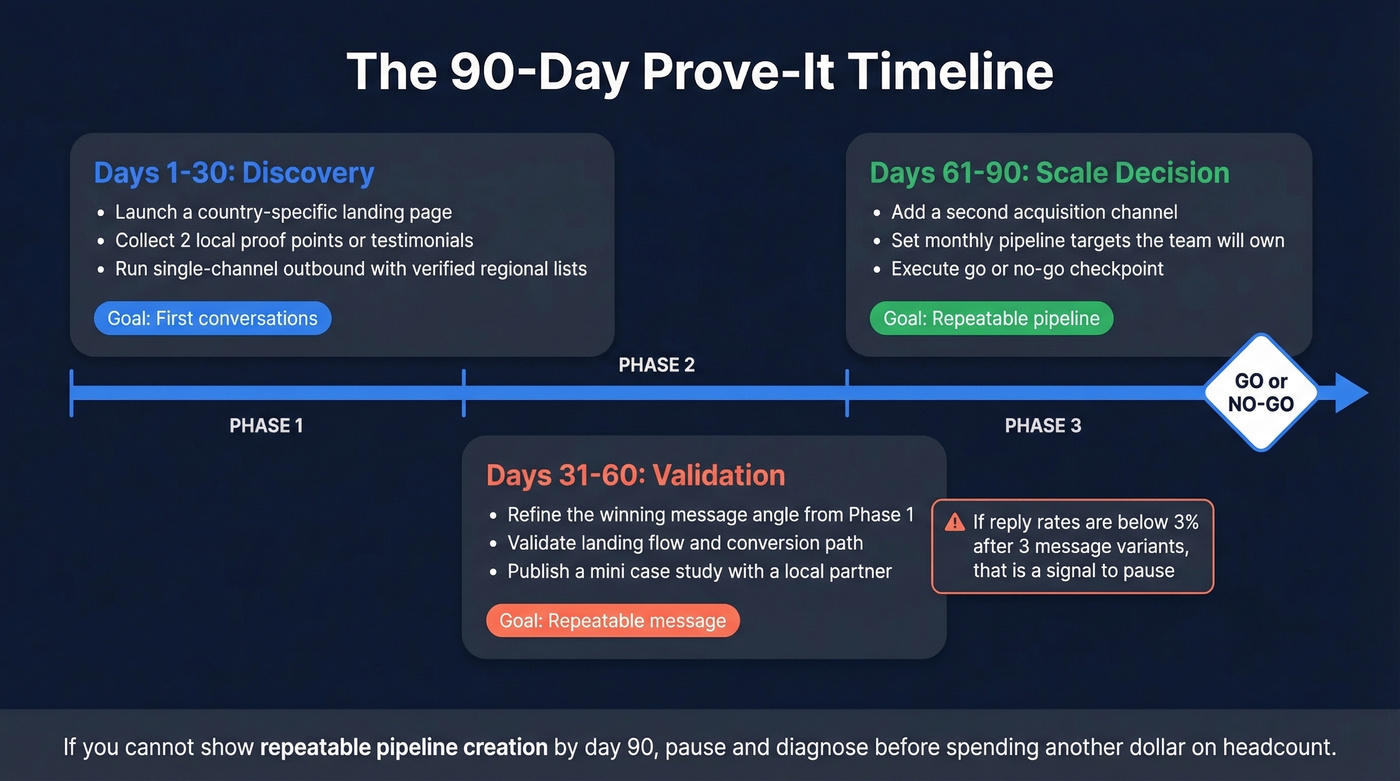
Days 1-30: Launch a country page, collect 2 local proof points, run single-channel discovery. Build your first outbound list with region and intent filters so you go from zero to verified prospects in hours, not weeks.
Days 31-60: Refine the winning angle, validate the landing flow, publish a mini case study with a local partner or customer. If reply rates are below 3% and you've tested three message variants, that's a signal - not a reason to double down.
Days 61-90: Add a second acquisition channel and set monthly targets you'll actually hold the team to. This is your go/no-go checkpoint. If you can't show repeatable pipeline creation by day 90, pause and diagnose before spending another dollar on headcount.
International expansion dies when your data can't keep up. Stale contacts, wrong titles, bounced emails - that's how 40-60% of expansions stall. Prospeo refreshes every record every 7 days (industry average: 6 weeks), verifies emails through a 5-step process, and covers 125M+ verified mobile numbers globally with a 30% pickup rate. All at $0.01/email, no contracts.
Enter any market with data that's accurate this week, not last quarter.
FAQ
How much does an international GTM strategy cost for SaaS?
A single-market entry typically runs $50K-$150K for mid-market SaaS and $200K-$500K+ for enterprise motions. SaaS Capital benchmarks put median spend at 13% of ARR on sales and 8% on marketing. Budget for at least one full 90-day validation cycle before committing to permanent headcount.
How long before a new market generates pipeline?
Expect 90 days to prove demand, 3-6 months to build repeatable pipeline, and 6-18 months before the region contributes meaningful ARR. In Europe, enterprise sales cycles can run 6-12 months longer than comparable home-market deals.
What's the fastest way to build a prospect list in a new region?
Use a B2B data platform with strong region-specific filtering and intent signals. You need verified contacts on day one - not a month into your entry sprint - because bounces burn sender reputation before you've built any brand equity. Speed and accuracy aren't optional here; they're the difference between a productive first quarter and a wasted one.
What's the biggest mistake in a global go-to-market strategy?
Treating expansion as a translation exercise instead of a full rebuild. The ICP, channel mix, pricing, and competitive landscape all shift by market. Teams that run a structured 90-day validation before committing headcount consistently outperform those that hire first and learn later.