

How to Introduce a Person via Email: Templates, Etiquette, and Rules Nobody Teaches You
Someone you know introduces a job seeker to you by email - without asking. You can't help. You don't have time. But now the job seeker is following up every week, and you're stuck between being rude and being honest. That scenario, straight from a Reddit career advice thread, is exactly why introducing a person via email goes wrong so often. The problem isn't the format. It's the process around it.
We've seen this play out dozens of times across sales, recruiting, and partnership contexts, and the fix is always the same: get permission first, keep the email short, and close the loop after. Whether you're the connector, the person asking for an intro, or the person being introduced, the same principles apply. Let's break it down.
What You Need (Quick Version)
- Always get permission from both people before making the intro. This is called double opt-in, and skipping it is the fastest way to burn social capital.
- Keep the intro email to 4-6 sentences. Who they are, why they should talk, what to do next.
- Write the forwardable blurb yourself if you're requesting an intro. Don't make the connector do the work. This single move doubles your chances of getting a yes.
Always Ask First
The double opt-in isn't optional - it's the entire foundation. Before you write a single word of the intro email, send a quick permission request to both people. Here's the script, adapted from Nick Gray's intro framework:
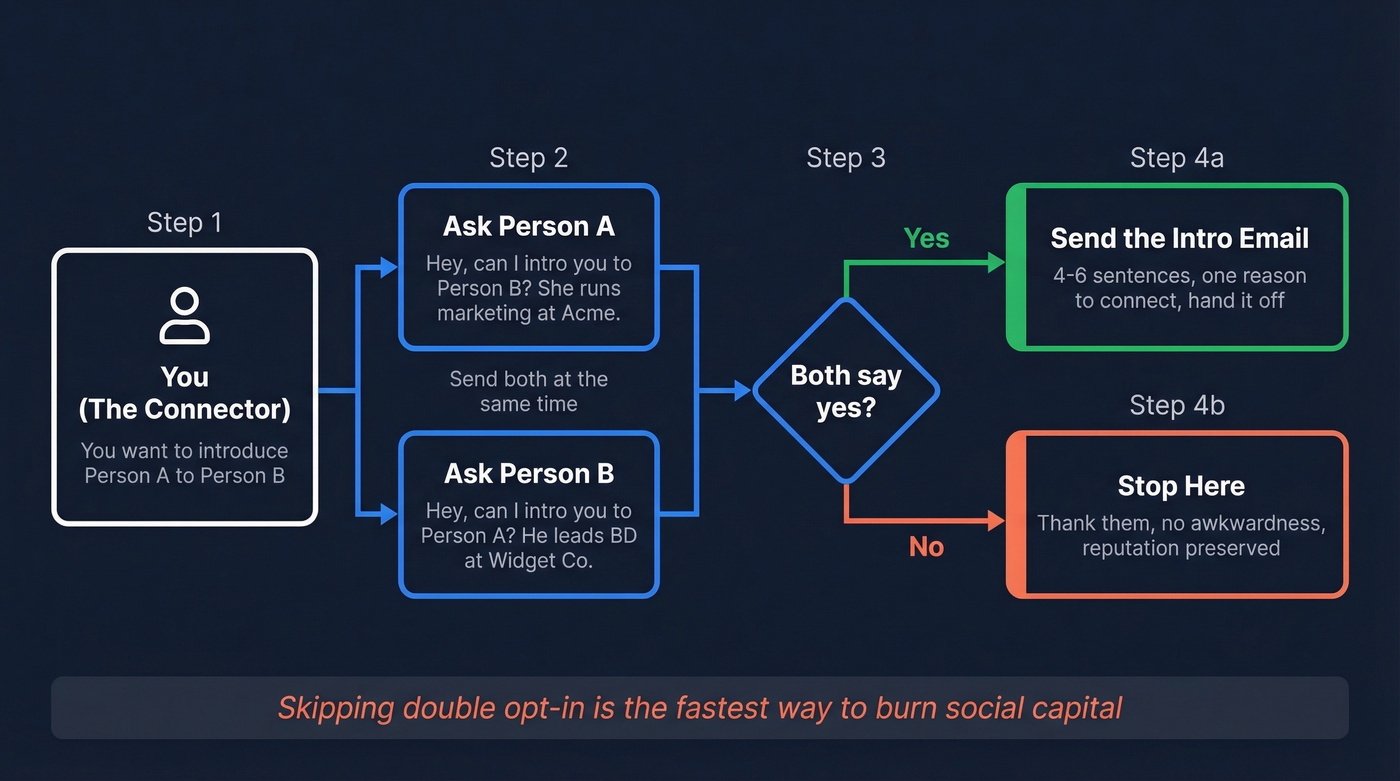
Hi [Person 1], can I introduce you to [Person 2]? She runs marketing at [Company] and I think you two could talk about [specific topic]. If you're open to it, I'll send a joint email.
Send the same message to Person 2 simultaneously - no need to wait for Person 1 to reply first. If either person declines, you've saved everyone the awkwardness.
Here's the thing: we've watched connectors lose credibility over a single unsolicited intro. If you skip this step, you're gambling with your reputation. The person on the receiving end didn't ask for this, and they'll remember who put them in that position. The "I would like to introduce you to" email should only go out after both parties have opted in.
Writing the Introduction Email
Once both people say yes, the intro email itself is the easy part. Professionals receive 100-120 emails per day, so brevity isn't polite - it's mandatory.
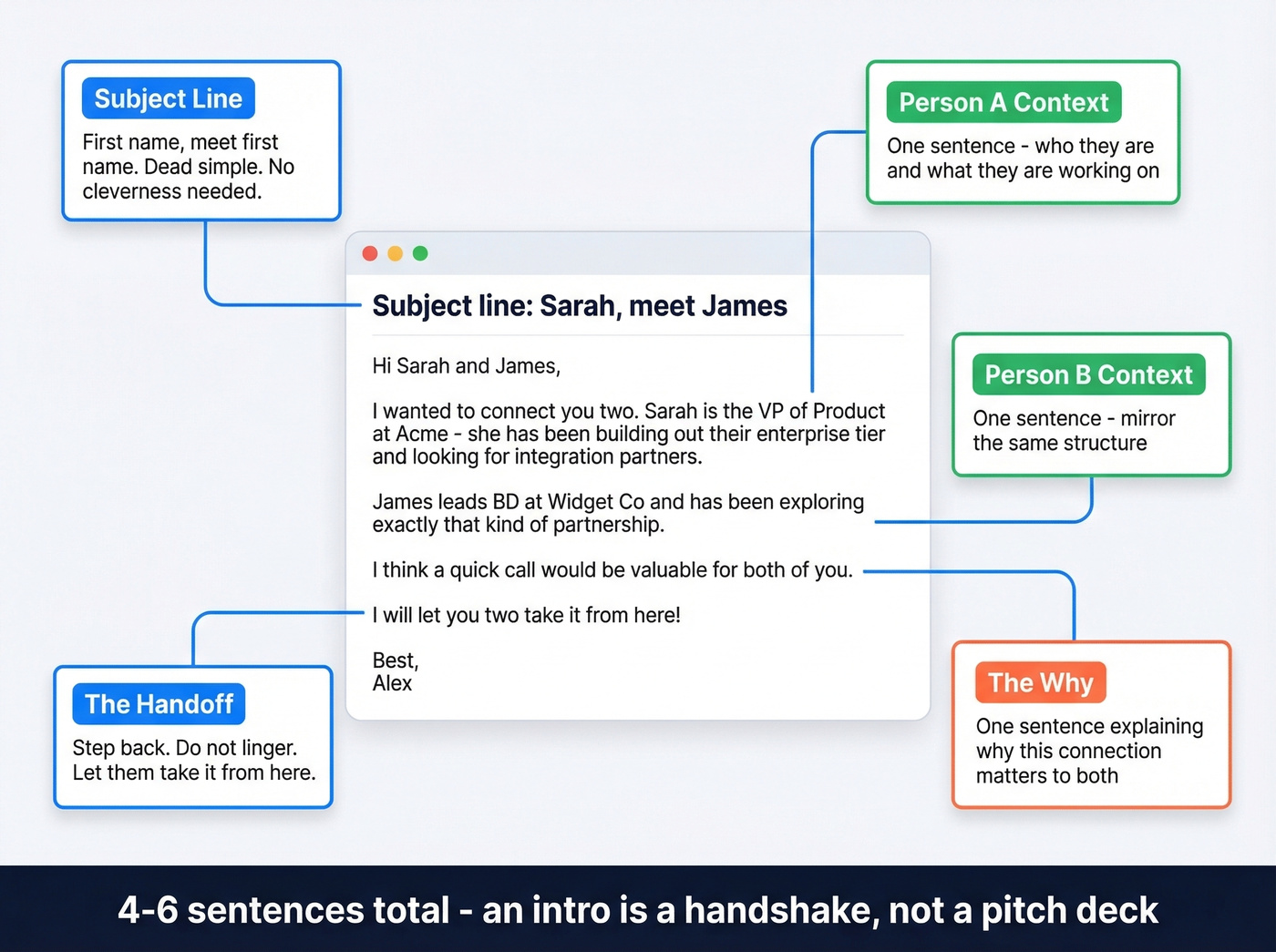
Subject line: "Sarah, meet James" or "Intro: Sarah <> James." Dead simple. (If you want more options, borrow from these Subject line patterns.)
Body (4-6 sentences):
Hi Sarah and James,
I wanted to connect you two. Sarah is the VP of Product at Acme - she's been building out their enterprise tier and looking for integration partners. James leads BD at Widget Co and has been exploring exactly that kind of partnership.
I think a quick call would be valuable for both of you. I'll let you two take it from here!
Best, [Your name]
One sentence about each person, one sentence on why they should connect, one sentence handing off. Don't include extra links or attachments unless specifically requested - the intro email is a handshake, not a pitch deck. Drop gendered titles like Mr. or Ms. unless you're certain of someone's preference; first names are safer and more modern.
This structure works as an email template for introducing two parties in virtually any professional context: sales, recruiting, investing, or mentorship. The only thing that changes is the "why." (For adjacent formats, see a connection email and a company introduction email.)
Before you hit send, verify both email addresses are current. Many professionals change roles every few years, and a bounced intro email wastes everyone's time and makes you look careless. Prospeo's email finder checks addresses in real time with 98% accuracy, which takes that risk off the table in about ten seconds. (If you need a broader deliverability checklist, use this email deliverability guide.)

How to Ask for an Introduction
Asking someone for an intro means asking them to spend social capital on your behalf. Respect that by reducing their effort to zero.
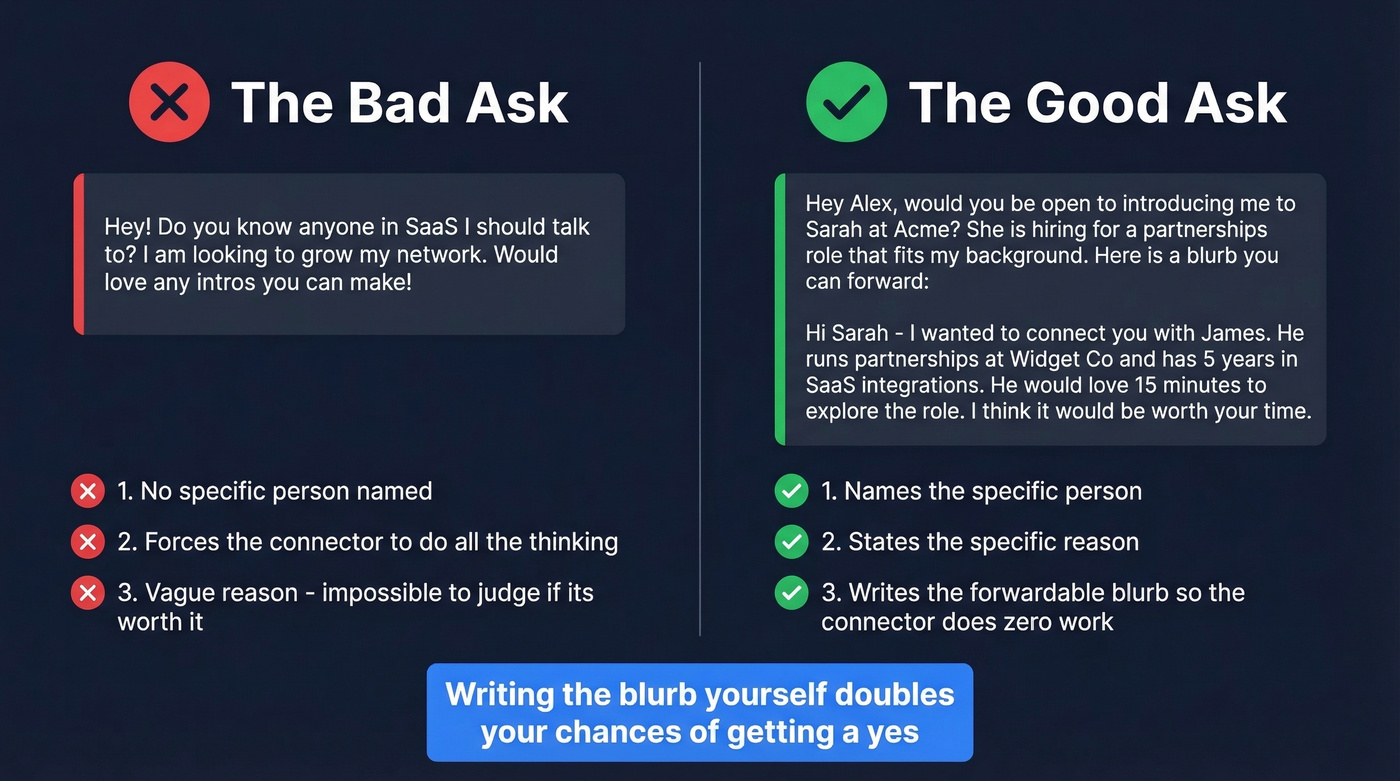
The single best tactic - and in our experience, the thing that separates intros that happen from intros that stall - is to write the forwardable blurb yourself:
Hey [Connector], would you be open to introducing me to Sarah at Acme? If so, here's a blurb you can forward:
"Hi Sarah - I wanted to connect you with [Your Name]. He runs partnerships at Widget Co and has been working on [specific thing relevant to Sarah]. He'd love 15 minutes to explore whether there's a fit. I think it'd be worth your time."
Name the person. State the reason. "Know anyone I should talk to?" is a non-starter - it forces the connector to do all the thinking. As 4Degrees' networking guide puts it, context is what lets the connector judge whether the intro is worth making. If you're unsure how to write a connection email like this, model it on the template above: specific ask, specific reason, zero ambiguity. (If you need help with the ask itself, use this email wording to schedule a meeting framework.)

A warm intro only works if the email actually lands. Bounced introduction emails waste social capital and make you look careless. Prospeo's email finder verifies addresses in real time with 98% accuracy - so every intro you send reaches the right inbox.
Verify both sides of your next intro before you hit send.
How to Respond to an Email Introduction
You've been introduced. The clock starts now. Reply within 24 hours.
Hi Sarah,
Great to meet you - thanks for being open to connecting. [Connector], thanks for the intro! Moving you to BCC to spare your inbox.
I'd love to find 20 minutes to chat about [topic]. Would any of these work? - Tuesday 3/18, 2-3 PM ET - Wednesday 3/19, 10-11 AM ET - Thursday 3/20, 1-2 PM ET
Three things matter here. First, propose specific times - not a vague "let's find time." Harvard's Office of Public Interest Advising uses the same basic structure for informational interview requests: brief context, a clear ask, and appreciation. Second, reply-all on the first message so the connector sees the connection happened. Third, move the connector to BCC with explicit language - this norm is widely endorsed on Reddit and it's the considerate move.
A slow or vague reply signals disinterest and reflects poorly on the connector who vouched for you. Don't be that person. (If you need a clean follow-up, use these sales follow-up templates as a starting point.)
Close the Loop
After the intro leads to a meeting, email the connector. Tell them what happened and say thanks. Connectors remember who followed through and who disappeared into a black hole - this is how you earn future introductions.
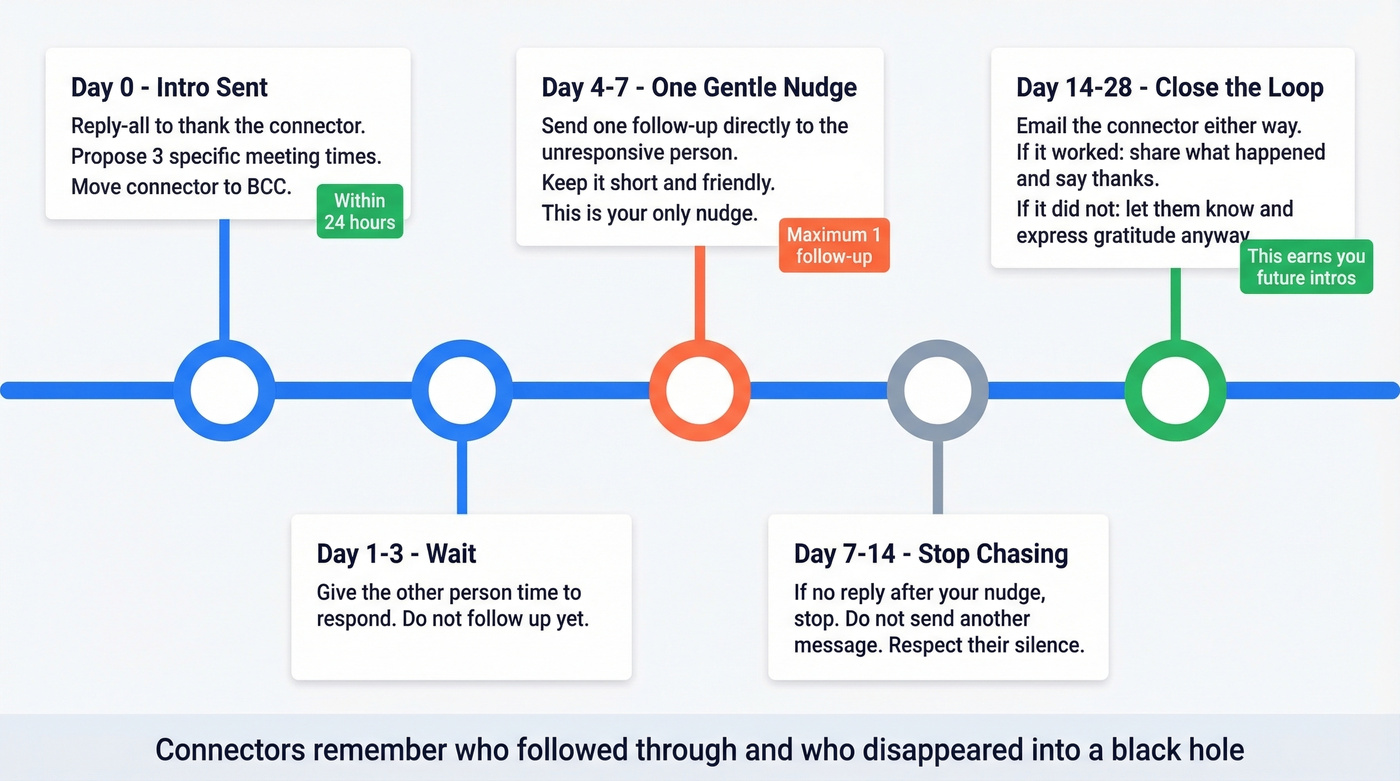
If the introduced person hasn't responded after 4-7 days, one gentle nudge is appropriate. After that, stop chasing. If the intro went nowhere after 3-4 weeks, close the loop with the connector anyway: "Hey, we weren't able to connect, but I really appreciate you making the intro." That small gesture matters more than most people realize, and it keeps the door open for next time. (For timing, see When Should You Follow Up on an Email?.)
When to Say No
Not every intro is worth making. The filter from Better Humans' intro framework is simple: if you can't explain in one sentence why both people benefit, don't make the intro.
Most bad introductions aren't malicious - they're lazy. Someone thinks "these two should know each other" without thinking about why. That vague instinct isn't enough. If you can't articulate the mutual value, you're not connecting people. You're creating an obligation.
When you need to decline, keep it graceful: "I don't think I'm the right connector for this, but [Name] might be a better fit - want me to check?" And if someone asks you to make an intro and the other party declines, relay it honestly: "She's heads-down on a big project right now and isn't taking new meetings. Bad timing, not bad fit."
Scenario Templates
Four variations showing how the email introduction shifts by context. Copy, customize, send.
Sales intro:
[Name] runs procurement at [Company] and mentioned they're evaluating [category]. [Name 2] leads our solutions team and can walk through how we've helped similar orgs. Connecting you two.
Investor intro:
[Founder] is building [one-line description] and just closed [milestone]. [Investor], I think this fits your thesis on [sector]. I'll let you two take it from here.
For investor intros, send Tuesday through Thursday between 10 AM and 2 PM for best visibility.
Mentorship intro:
[Mentee] is a product manager exploring the shift to leadership and specifically wants to learn about [topic]. [Mentor], your experience at [Company] makes you the perfect person to talk to.
Hiring/referral intro:
[Candidate] has [X years] in [role] and is actively looking. [Hiring Manager], you mentioned the open [position] - I think this is a strong fit worth a conversation.
Skip the hiring template if the candidate hasn't explicitly asked you to make the intro. Forwarding someone's resume without their knowledge is a fast way to create an uncomfortable situation for everyone involved.
Writing the perfect forwardable blurb means nothing if you're guessing at email addresses. Prospeo gives you verified contact data for 300M+ professionals - so when you ask a connector to make an intro, you already know the recipient's current, working email.
Stop guessing. Start every introduction with a verified email.
FAQ
Should I CC or BCC the Introducer?
Reply-all once to thank the connector, then move them to BCC on your next message. If they're actively involved in the deal or project, keep them on. Otherwise, spare their inbox - they've done their part.
How Long Should an Intro Email Be?
Four to six sentences maximum. If you need a full paragraph to explain why two people should meet, the intro probably isn't strong enough. Brevity signals the connection is obvious and valuable.
What If the Introduced Person Doesn't Respond?
Wait 4-7 days, then send one gentle follow-up directly to the unresponsive party. After that, stop chasing. Close the loop with the connector either way so they know the outcome.
How Do I Verify an Email Before Sending an Intro?
Use a real-time verification tool like Prospeo's email finder, which checks deliverability with 98% accuracy and includes a free tier of 75 credits per month. A bounced intro email wastes everyone's time and makes you look unprepared - it takes ten seconds to check.