


7 Best Invoca Alternatives for 2026 - Compared With Real Pricing
$1,000/month as a starting point for call tracking. That's the reality with Invoca, and you won't find that number anywhere on their website. For enterprise teams running high call volumes across multiple locations, Invoca's Signal AI earns that price tag. For everyone else? You're paying for a Ferrari to drive to the grocery store.
Invoca holds a 4.5/5 on G2 from 963 reviews, and the praise is deserved - strong attribution, solid analytics, responsive support. But the cons tell the switching story: steep learning curves, complex reporting, integration friction, and pricing that always requires a sales conversation.
Our Picks (TL;DR)
- Best for SMBs: CallRail - transparent pricing, live in a day, most of what mid-market teams use in Invoca at a fraction of the cost.
- Best for agencies: WhatConverts - unified call/form/chat tracking with lead qualification workflows starting at $60/mo.
- Best for teams with bad contact data: Prospeo - 125M+ verified mobile numbers so your reps actually reach someone when they dial.
Why Teams Switch From Invoca
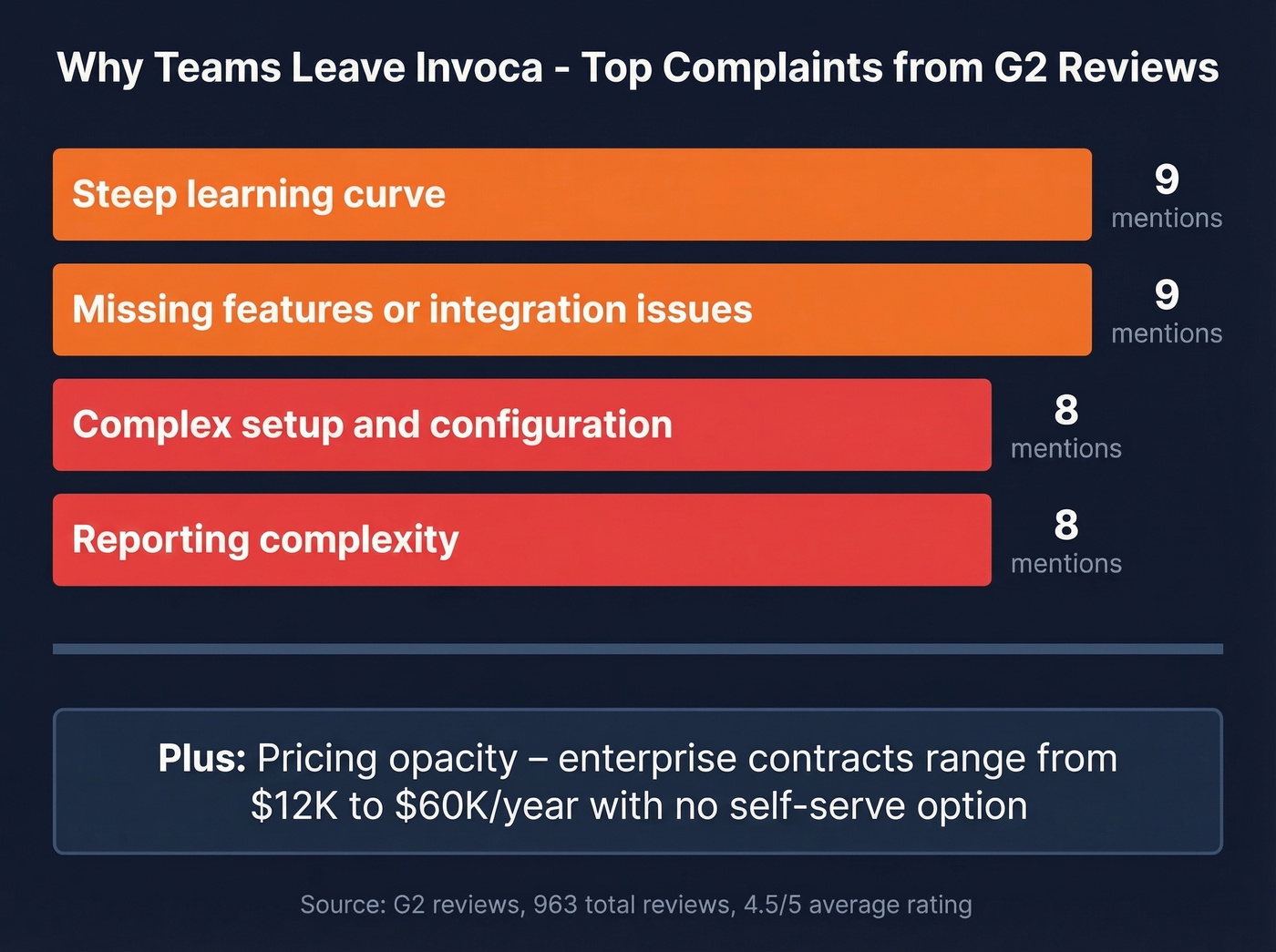
The G2 review data paints a clear picture. Nine reviewers flag a steep learning curve. Nine more cite missing features or integration challenges. Eight call out complex setup, and another eight mention reporting complexity. That's a pattern, not noise.
Then there's the pricing opacity. Enterprise contracts run $12,000-$60,000/year depending on call volume, add-ons like Signal AI and Quality Management, and integrations. We've watched teams pay enterprise prices while using maybe 40% of the platform. If you're not running a contact center or managing thousands of inbound calls monthly, that math doesn't work.
Practitioners in r/PPC tend to gravitate toward simpler options, which tells you where the market is actually moving.

Before you spend $1,000/mo tracking calls, make sure those calls actually connect. Prospeo gives your reps 125M+ verified mobile numbers refreshed every 7 days - not the stale data rotting in your CRM. At $0.01 per lead, fixing your dial-to-connect rate costs less than one day of Invoca.
Fix the data before you track the calls.
Pricing Comparison
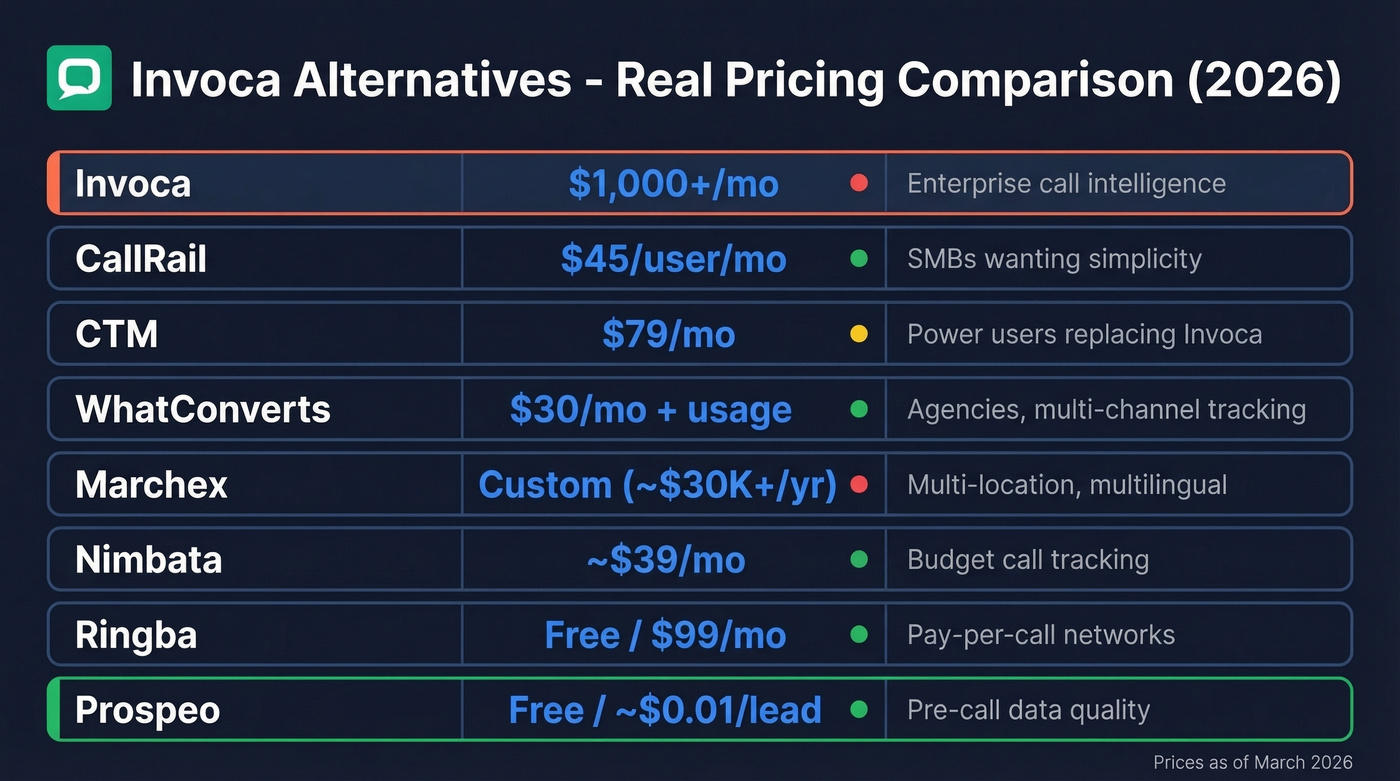
Here's what you'll actually pay. Invoca is one of the few here that won't publish pricing upfront.
| Tool | Starting Price | Best For | Call Tracking | Conversation AI | Free Trial |
|---|---|---|---|---|---|
| Invoca | ~$1,000/mo+ | Enterprise call intelligence | ✅ | ✅ Signal AI | - |
| CallRail | $45/user/mo | SMBs wanting simplicity | ✅ | ✅ ($90/user/mo tier) | 14-day |
| CTM | $79/mo | Power users replacing Invoca | ✅ | ✅ AskAI | - |
| WhatConverts | $30/mo + usage | $30/mo + usage | Agencies, multi-channel | ✅ | ✅ AI add-on | 14-day |
| Marchex | Custom (~$30K+/yr) | Multi-location, multilingual | ✅ | ✅ | - |
| Nimbata | ~$39/mo | Budget call tracking | ✅ | Limited | - |
| Ringba | Free / $99/mo | Pay-per-call networks | ✅ | Limited | Free tier |
| Prospeo | Free / ~$0.01/lead | Pre-call data quality | - | - | Free tier |
The Best Invoca Alternatives Compared
CallRail
Use this if you want call tracking working by end of day. CallRail is the default choice for a reason - four transparent tiers from $45/user/mo to $135/user/mo for the full suite with conversation intelligence and form tracking. from $45/user/mo to $135/user/mo for the full suite with conversation intelligence and form tracking. Every plan includes 5 numbers and 250 minutes. Overages are predictable at $0.05/min and $3/number/month.
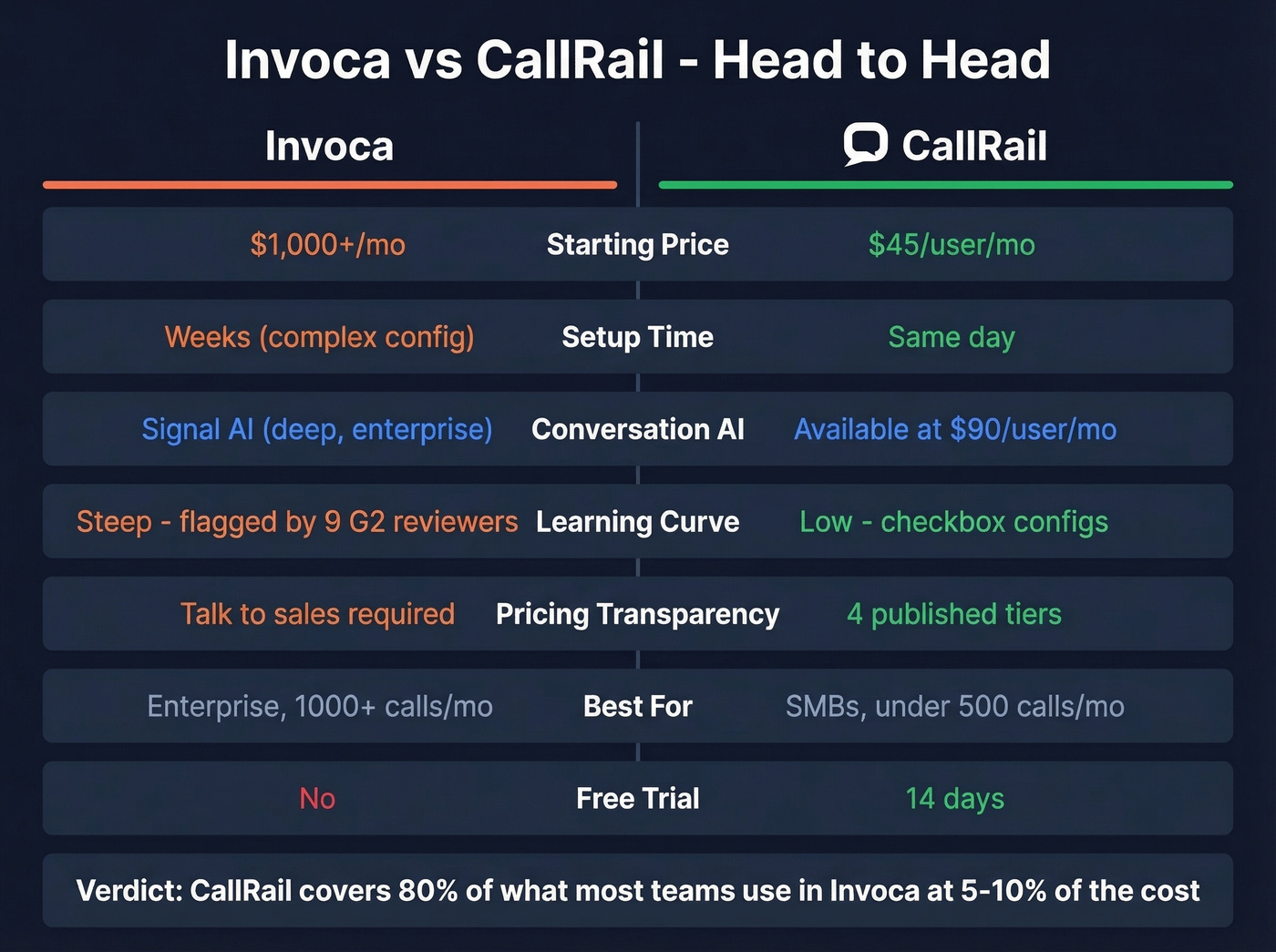
Conversation intelligence kicks in at $90/user/mo, giving you transcription, keyword spotting, and call scoring. It's not as deep as Invoca's Signal AI, but for teams handling hundreds of monthly calls rather than thousands, it's more than enough. In our testing, first-time vs. repeat call conversion setup was a checkbox - not a trigger-rule workflow. That alone saves hours of admin time every week.
Skip this if you need multi-channel lead tracking beyond calls and forms, or you're an agency managing 20+ client accounts where per-user pricing compounds fast.
Prospeo
Most call tracking competitors solve the same problem: what happened on the call. Prospeo solves the step before - making sure the call actually happens.
Here's the thing: if your reps are dialing outdated numbers from a CRM that hasn't been enriched in months, no call tracking platform fixes that. Prospeo's database covers 125M+ verified mobile numbers with a 30% pickup rate. That means roughly one in three dials connects to a real person, compared to industry averages where teams burn through lists of dead numbers before reaching anyone worth tracking.
The platform runs on a 7-day data refresh cycle - the industry average is six weeks - so the numbers your reps dial are current, not stale. The free tier gives you 75 emails and 100 Chrome extension credits monthly, enough to test whether your data enrichment problem is upstream of your call tracking problem. Paid plans work out to roughly $0.01 per lead, making it trivially cheap to layer onto whatever call tracking tool you pick.
We're biased - this is our blog. But we've watched teams spend $40K/year on call intelligence while their reps dial wrong numbers half the time. Fix the data first.
CallTrackingMetrics (CTM)
CTM is the closest feature-for-feature Invoca replacement without the enterprise price tag. Pricing runs $79-$1,999/mo, with 2-year prepay discounts dropping Marketing Pro to $135/mo. Every tier includes unlimited users - a real advantage over per-seat models.

AskAI runs $0.05/activity after included thresholds, and transcription costs $0.02/min. Sales Engage at $329/mo adds a softphone, smart dialer, and Salesforce integration. Let's be honest - CTM packs more raw capability than CallRail, but one r/PPC poster noted that Google Ads and GA4 integrations aren't as straightforward, and configuring conversion triggers feels more complex. The consensus in that thread was that CTM rewards patience; CallRail rewards speed.
Skip this if you want plug-and-play simplicity. CTM is for power users who'll invest time in configuration.
WhatConverts
Agencies managing multiple clients across calls, forms, and chat need a single dashboard - and that's exactly where WhatConverts lives. Pricing starts at $30/mo for basic call tracking, but the sweet spot is the Plus tier at $60/mo with form and chat tracking included. Agency plans with unlimited accounts run $500-$800/mo.
The subscription-plus-usage model means your base fee unlocks features, then you pay for tracked activity volume. Each account includes a $30 free usage credit, so light-volume clients won't spike your bill. Pro tier at $100/mo adds a report builder, scheduled reports, and HIPAA compliance - useful for healthcare clients.
Skip this if you only need call tracking. You'd be paying for multi-channel capabilities you won't use.
Marchex
Marchex is the pick only if you're a multi-location enterprise with multilingual call volume. The platform handles dynamic number insertion, conversation intelligence, and - the real differentiator - auto-detects, transcribes, and translates Spanish and French calls into English, including mixed-language conversations. For automotive dealerships or healthcare networks with diverse caller bases, that capability is genuinely hard to find elsewhere. Expect $30K+ annually for a multi-location deployment.
Nimbata
Nimbata is a budget entry point for basic call attribution, with paid plans from ~$39/mo. Good for small teams testing the waters without committing real money. Don't expect conversation intelligence depth here.
Ringba
Ringba targets pay-per-call and affiliate marketing networks. Free tier available, premium from $99/mo. If you're running performance marketing campaigns with call-based payouts, it's purpose-built for that workflow. Everyone else can skip it.
Teams switching from Invoca save $12K-$60K/year on call intelligence. But the biggest ROI comes from ensuring reps reach real people. Prospeo's 30% mobile pickup rate means 3x more live conversations per dial session - no call tracking platform can manufacture that.
Every call tracking tool is useless if the number is dead.
How to Pick the Right Tool
Look - most teams shopping for Invoca competitors don't actually need a cheaper Invoca. They need a simpler tool paired with better data. If your average deal size is under $25K and you're handling fewer than 500 inbound calls a month, CallRail at $90/user/mo covers most of what Invoca does.
If you're building a broader outbound motion, pair call tracking with a tighter sales prospecting process and a clean contact management layer so reps aren't dialing junk.
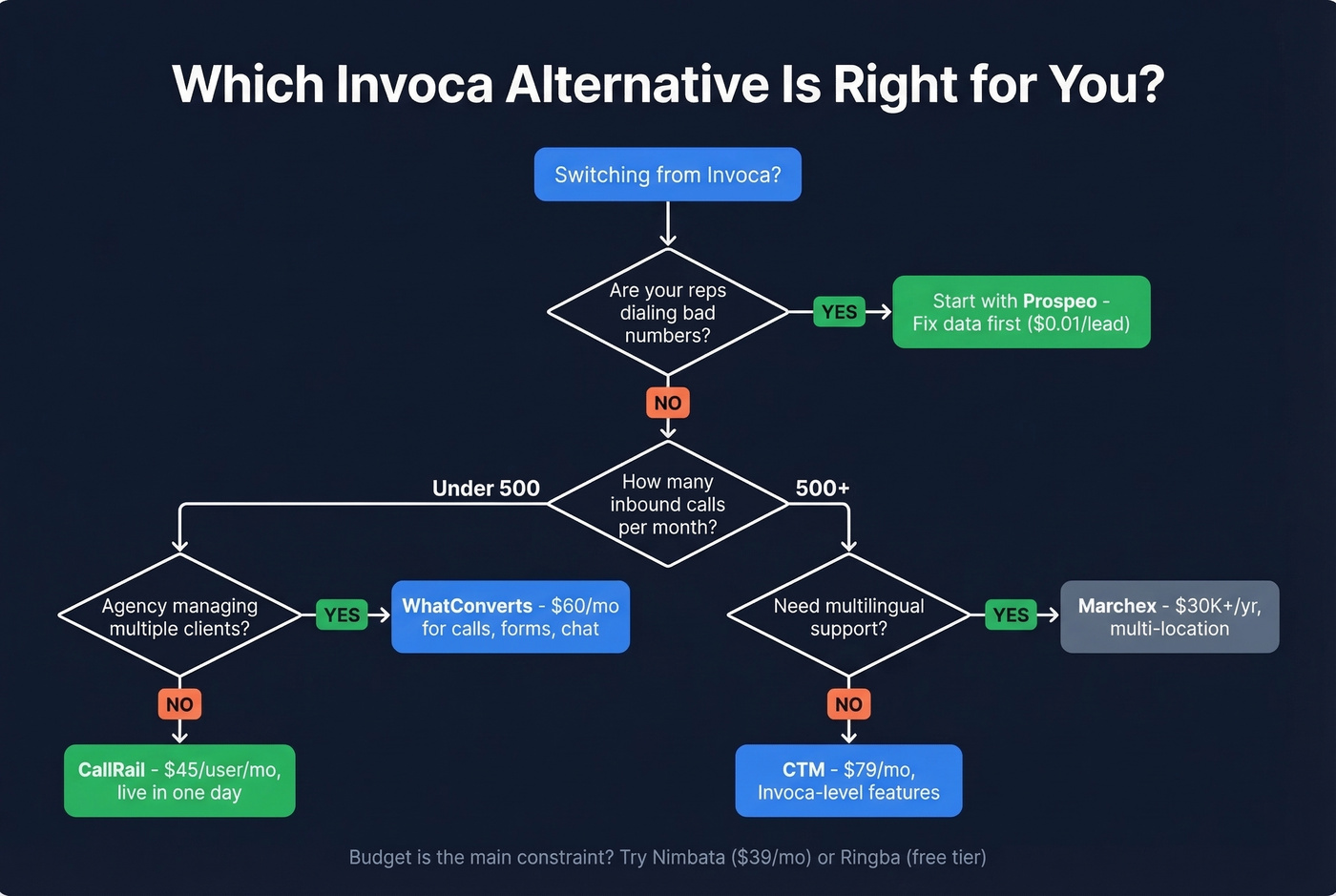
Pick CallRail for transparent pricing and same-day setup. Pick CTM for Invoca-level features without Invoca pricing, if you'll invest in configuration. Pick WhatConverts for agency multi-client management across calls, forms, and chat. Pick Marchex only for enterprise multilingual, multi-location call volume. And for Nimbata or Ringba, go there when budget is the primary constraint or you're in pay-per-call.
The best call intelligence in the world can't analyze a call that never connected. If your reps are dialing dead numbers, fix the data upstream before upgrading the tracking.
FAQ
How much does Invoca actually cost?
Plans start around $1,000/month, with enterprise contracts running $12,000-$60,000/year depending on call volume, integrations, and add-ons like Signal AI. There's no self-serve option - you'll need to talk to sales for any tier.
What's the easiest Invoca alternative to set up?
CallRail. Most teams are live within a day. First-time vs. repeat call conversions are simple checkboxes, not trigger-rule workflows. CTM has comparable features but a steeper learning curve around Google Ads and GA4 integration.
What if my real problem is bad phone numbers, not call tracking?
No call tracking tool fixes wrong numbers. Prospeo's database covers 125M+ verified mobiles with a 30% pickup rate and a 7-day refresh cycle, so you can validate your contact data before investing in attribution. The free tier includes 75 emails and 100 credits monthly - enough to diagnose whether data quality is the real bottleneck.