

Why "Just a Follow Up" Emails Get Ignored (And What to Say Instead)
You sent a proposal Monday. It's Thursday. Radio silence. You open a blank compose window and type the five words that kill more deals than bad pricing: "Just wanted to follow up."
That email lands in an inbox competing with 392.5 billion others sent every day in 2026. It's bringing nothing to the fight.
Here's the thing - the problem isn't that you're following up. Following up is essential. The problem is that most follow-ups are empty calories: no new information, no reason to reply, no respect for the recipient's time. We've watched teams double their reply rates just by rethinking what goes into that second email. Let's break down how.
The Short Version
Never send a follow-up that doesn't add something new. A data point, a question, a resource. If you can't name what's new, don't hit send.
Two follow-ups is the sweet spot. After that, every additional touch must earn its place with fresh value - or you're training the recipient to ignore you.
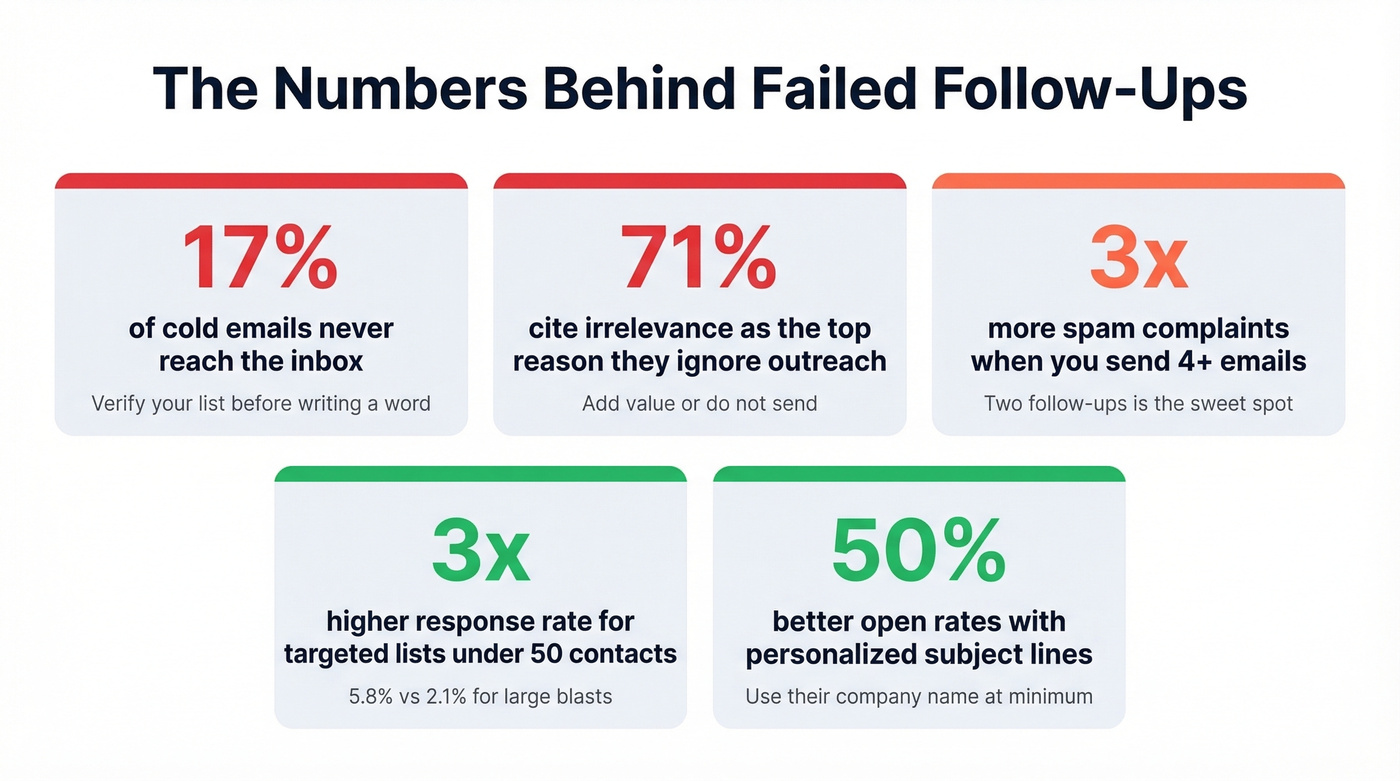
Verify your contact list before you write a single word. 17% of cold emails never reach the inbox. Dead addresses and deliverability issues tank your sender reputation before your copy gets a chance.
Why "Just Following Up" Fails
People don't ignore your email because they hate you. They ignore it because saying no feels awkward, and your follow-up gave them zero reason to say yes.
FieldMotion breaks down the five reasons prospects go silent: they're busy, they're comparing options, they're waiting on internal approval, they're confused about something in your proposal, or they're simply not ready. Notice what's missing - "they forgot about you." The silence is almost never about awareness. It's about readiness, and a hollow "circling back" email doesn't change anyone's readiness.
Phrases like "checking in," "circling back," and "just following up" are associated with sales pressure. Recipients tune them out reflexively, the same way you skip past "URGENT" subject lines from your bank. 71% of decision-makers cite irrelevance as the top reason they don't respond to cold outreach. A generic follow-up is the definition of irrelevant - it's about your need for a response, not their need for a solution.
What the Data Actually Says About Follow-Ups
QuickMail analyzed their last one million detected replies and found a clear pattern of diminishing returns:
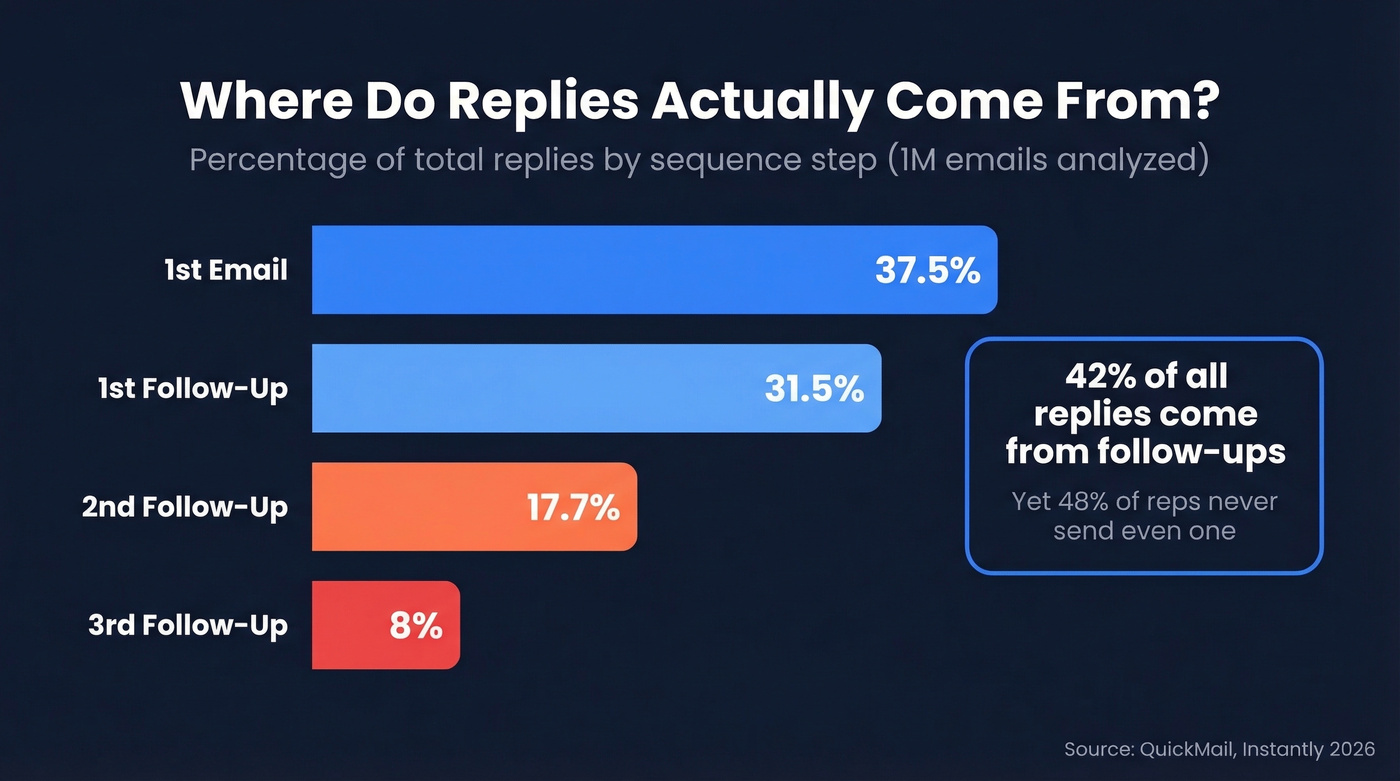
| Sequence Step | % of Total Replies |
|---|---|
| 1st email | 37.5% |
| 1st follow-up | 31.5% |
| 2nd follow-up | 17.7% |
| 3rd follow-up | 8% |
That first follow-up is almost as productive as the initial email. The second still pulls its weight. By the third, you're scraping the bottom.
Instantly's 2026 benchmark report, drawn from billions of cold email interactions, puts the average reply rate at 3.43%. Elite campaigns (top 10%) exceed 10%. The critical finding: 42% of all replies come from follow-ups, not the initial email. Yet 48% of reps never send a second message. Half the sales floor is leaving nearly half their replies on the table.
That same data suggests 4-7 touchpoints as the optimal sequence length for cold outreach, and that top-performing campaigns keep emails under 80 words. If your follow-up is longer than a text message, it's probably too long.
But there's a counterpoint worth taking seriously. Belkins' 2025 study of 16.5 million emails found the sweet spot is one initial email plus one follow-up, with reply rates around 8%. Sending four or more emails triples spam complaint rates. The teams that blast seven-step sequences without adding value don't get more replies - they get more spam reports.
Our take: two follow-ups is enough for most situations. The 4-7 touchpoint data works for cold outbound sequences where each step adds genuine value. But if you're following up on a proposal or a warm conversation, two touches with real substance will outperform five touches of "just checking in" every single time. Quality beats quantity. The data supports it.
One more number: Mailforge found that smaller, targeted campaigns of 50 or fewer recipients get a 5.8% response rate, compared to 2.1% for lists of 1,000+. Spray-and-pray follow-ups don't just feel lazy - they mathematically underperform.

42% of replies come from follow-ups - but only if they reach the inbox. 17% of cold emails never do. Prospeo's 5-step verification delivers 98% email accuracy, so every carefully crafted follow-up actually lands.
Stop perfecting copy that bounces. Fix the data first.
The Follow-Up Cadence That Works
Smartlead tested this across 37.53 million deliveries and landed on a staged timeline:
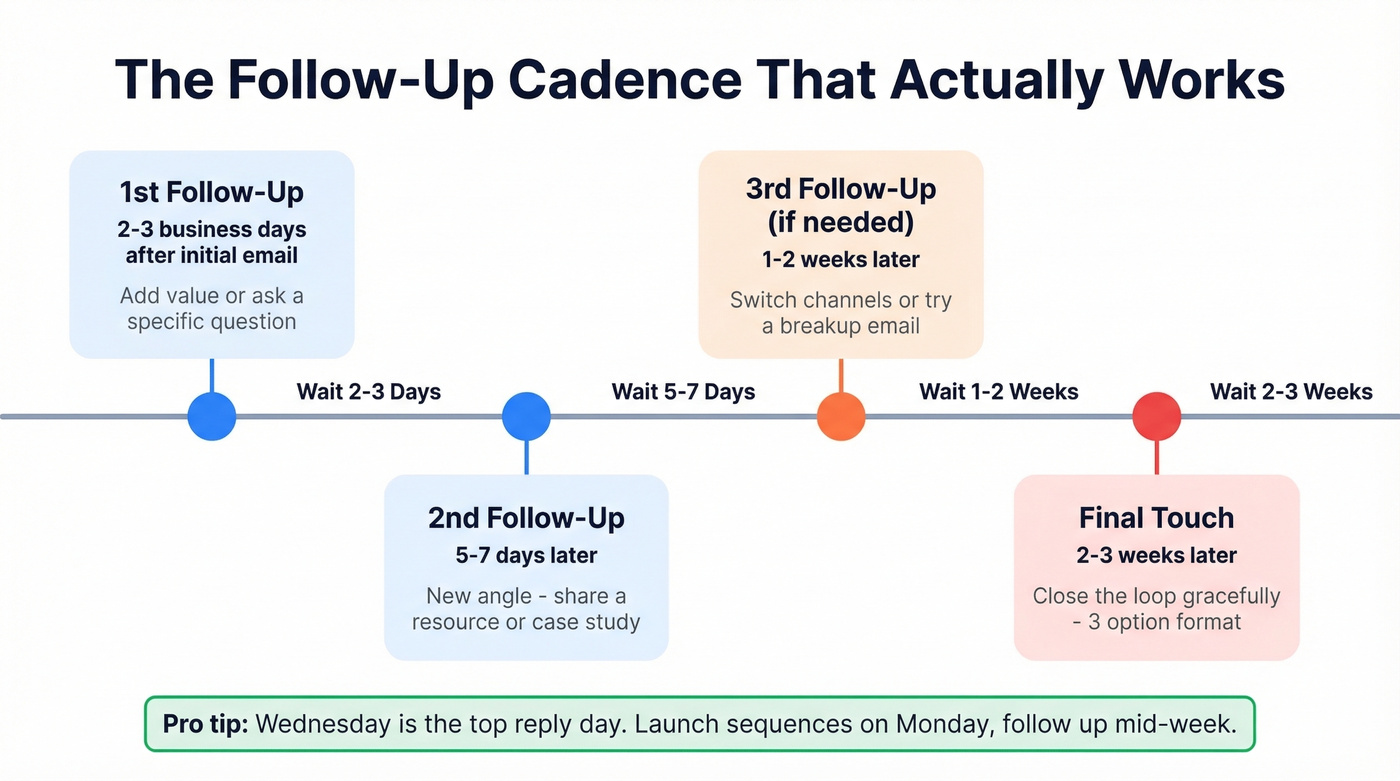
| Follow-Up | Wait Time | What to Do |
|---|---|---|
| 1st | 2-3 business days | Add value or ask a question |
| 2nd | 5-7 days later | New angle: resource or case study |
| 3rd (if needed) | 1-2 weeks later | Switch channels or break up |
| Final | 2-3 weeks later | Close the loop gracefully |
Wednesday is the top reply day according to 2026 benchmarks. Launch sequences on Monday, follow up mid-week.
When to automate vs. send manually: automate the timing and reminders, but write the actual follow-up copy yourself for warm prospects. Automated sequences work for cold outbound at scale. For proposal follow-ups and warm leads, a manually written reply-in-thread email will always outperform a templated drip.
One tactic that's underrated: pre-framing the follow-up before you even need one. Ask during your initial conversation, "When are you looking to make a decision on this?" Now your follow-up has a built-in reason - you're not chasing, you're honoring their timeline.
If your second follow-up gets no response, switch channels. A short phone call, a voice note, or a brief message on a professional platform can break through where email can't.
What to Say Instead of "Just Following Up"
Each of these approaches works in a different situation. Pick the one that matches where your prospect actually is.
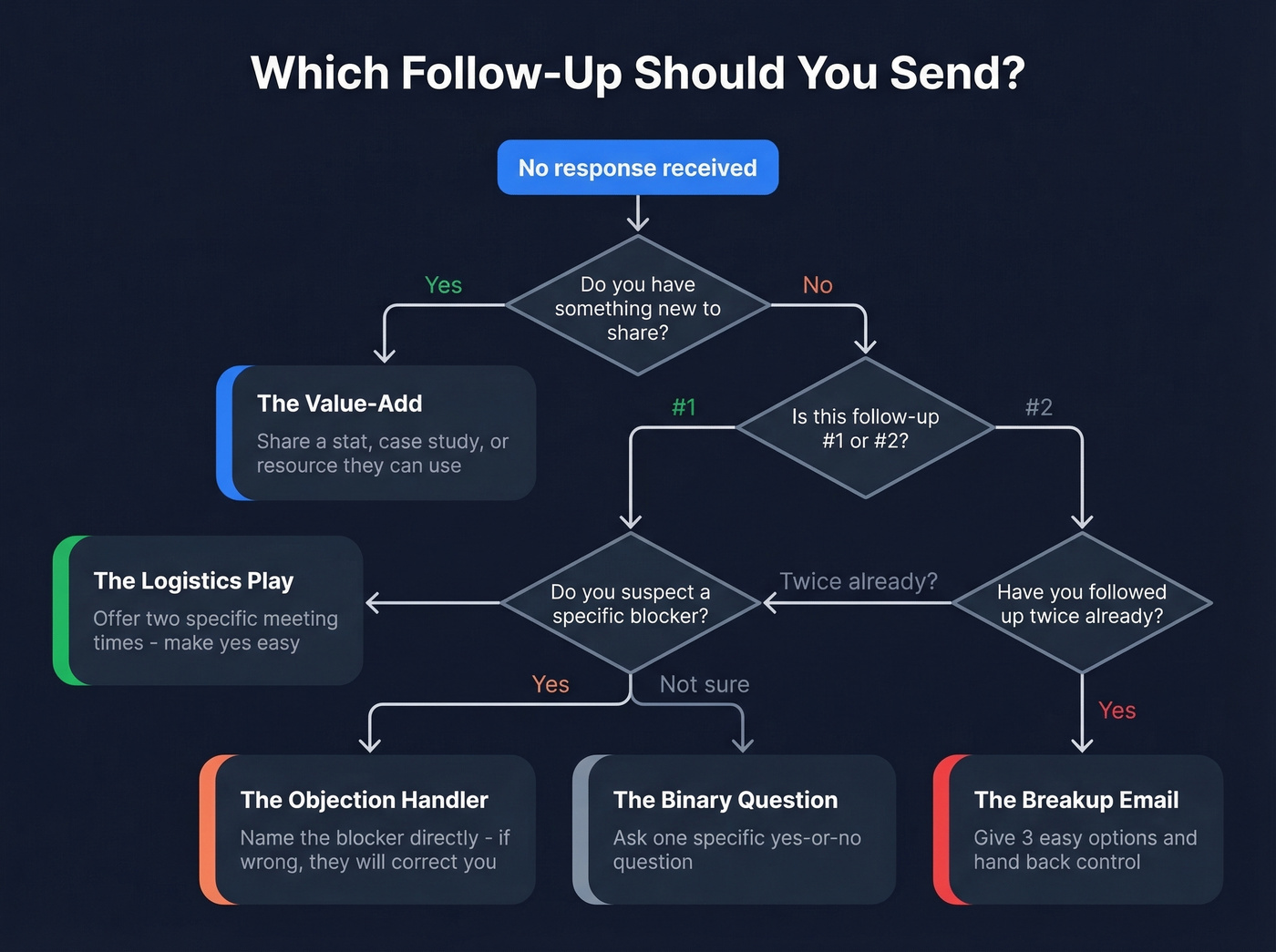
The Value-Add
Use this when you have something genuinely new to share - a relevant case study, a stat that supports their business case, a product update.
Subject: Re: [original thread]
Hi Sarah,
We just published benchmarks from 200 SaaS companies on onboarding drop-off - the average is 34% by day 7, which is higher than most teams expect. Thought this might help with the proposal you're building internally.
Here's the link: [URL]
Happy to walk through how it maps to your numbers if useful.
Best, [Name]
Short, specific, and the recipient gets something useful whether they reply or not.
The Logistics Play
Make "yes" easier than "let me think about it."
Subject: Re: [original thread]
Hi Mark,
I'm locking in my schedule for next week. Does Tuesday at 2pm or Thursday at 10am work for a quick call?
If neither works, just throw out a time and I'll make it fit.
[Name]
No fluff. A concrete reason to reply and two options that make responding take ten seconds.
The Binary Question
When you suspect confusion or hesitation, ask one specific, binary question. Don't ask open-ended questions that require effort. "Quick question - is the integration timeline the main concern, or is it more about budget approval?" makes it easy. "What are your thoughts?" does not.
The Objection-Handler
I know the timing felt tight last week. We just opened Q2 slots, so there's more runway if that changes things. Want me to pencil you in tentatively?
Address cost, urgency, or trust head-on. Name the blocker. If you guess wrong, they'll often correct you - which is still a reply.
The Permission-Based Close
When you've followed up twice with no response, hand control back to the prospect: "Should I check back in a few weeks instead?" It's respectful, low-pressure, and effective because it removes the obligation to decide right now.
The Breakup Email
This is your final touch, and it often gets strong reply rates because it makes responding easy:
Subject: Should I close your file?
Hi Alex,
I haven't heard back, so I want to respect your time. Three options:
- You're still interested - just say the word and I'll send over next steps.
- Timing's off - I'll circle back in Q3.
- It's a no - totally fine, just let me know so I can update my notes.
Either way, no hard feelings.
[Name]
The three-option framing works because every option is easy and none of them feel like pressure.
Instantly's data shows that emails written to feel like replies outperform formal follow-ups by roughly 30%. Short, plain-text, reply-in-thread. No fancy formatting. No HTML templates. Just a person writing to another person. For follow-ups specifically, keep emails between 50 and 125 words - that range performs best.
Subject Line Rules
Do:
- Reply in the same thread by default. "Re: Q2 onboarding proposal" preserves context and feels like a conversation, not a campaign.
- Use curiosity-driven alternatives when starting a new thread: "I forgot to mention..." or "Quick question about [specific topic]."
- Keep it to five to seven words. The subject line's only job is to get the email opened.
Don't:
- Use "Follow-up" or "Following up" as your subject line. It adds no value and increases the odds of being ignored.
- Write vague subjects like "Checking in" or "Touching base." These are the email equivalent of knocking on someone's door and saying "I'm here."
- Skip personalization. Customized subject lines improve open rates by 50%. Even swapping in the prospect's company name helps.
Mistakes That Kill Follow-Ups
Bumping with no new information. "Just making sure you saw this" rarely changes outcomes. If your follow-up doesn't contain something the first email didn't, it's noise.
Over-designed emails. Short, plain-text, reply-in-thread emails outperform polished HTML templates. Your follow-up should look like it was written by a human in 45 seconds, not generated by a marketing platform.
Wrong frequency. Sending four or more emails triples your spam complaint rate. If you're blasting a seven-step sequence with nothing new in steps three through seven, you're not persistent - you're annoying. (If you're building longer sequences, see sequence management.)
Generic subject lines. "Follow-up" as a subject line is a fast track to the archive folder. Use context-specific subjects that give the recipient a reason to open. For more ideas, borrow from these email subject line examples.
Emailing bad data. This is the silent killer. 17% of cold emails never reach the inbox - and you won't know which ones unless you verify first. We run our lists through Prospeo before launching any sequence. With 98% email accuracy and a 7-day data refresh cycle, you're sending to addresses verified this week, not six months ago. No amount of perfect copy fixes an email that never lands. If you're troubleshooting bounces, start with email bounce rate and then work through an email deliverability guide.
Let's be honest about the math. Your sequence has 500 contacts. 17% never reach the inbox. Irrelevance is the #1 reason people don't respond (71%). You're following up with ghosts. The upstream problem isn't your copy - it's your data. Fix the list first, then worry about the words. If you need a system for list quality, compare data enrichment services and use email reputation tools to monitor the damage.
Smaller, targeted campaigns get 3x the response rate of spray-and-pray lists. Prospeo's 30+ filters - buyer intent, job changes, headcount growth - let you build tight lists of 50 prospects who actually need what you sell. At $0.01 per verified email, precision outreach costs less than mass blasting.
Build the list that makes your second email worth sending.
FAQ
How many follow-up emails should I send?
One to two follow-ups is the data-backed sweet spot. The first follow-up captures 31.5% of replies, the second gets 17.7%, and everything after that drops sharply. Beyond two, each additional touch must add genuinely new value or you risk tripling your spam complaint rate.
How long should I wait before following up?
Two to three business days for your first follow-up, then five to seven days for the second. Rushing the cadence signals desperation more than persistence. Wednesday is the highest-reply day according to 2026 benchmarks, so time your sends accordingly.
Should I reply in the same thread or start a new one?
Reply in the same thread by default. Reply-in-thread emails outperform standalone messages by roughly 30%. It preserves context and feels like a conversation rather than a campaign.
Why do my follow-up emails keep bouncing?
Outdated contact data and deliverability issues. People change jobs, addresses go stale, and your sender reputation takes the hit. Verify your list before every campaign launch - 17% of cold emails never reach the inbox due to invalid addresses alone.