

Key Account Management: The Complete Guide for Teams That Actually Want Results
Account plans sitting in a Google Drive folder nobody's opened since January. A quarterly business review that's really just a slide deck recycled from last year. A "strategic" account list that's actually just your biggest revenue logos with no plan attached.
Sound familiar?
87% of companies aren't among the best at account management, according to RAIN Group. That's not a rounding error - it's a systemic failure. The gap between companies that run key account management well and everyone else shows up directly in revenue growth, retention, and profit.
KAM success comes down to three things: picking the right accounts, keeping a living plan for each one, and measuring what matters. Everything else is a subset.
What Is Key Account Management?
Key account management is a structured, cross-functional approach to managing and growing your most important customer relationships. It's not "being nice to big accounts." It's a deliberate business model that allocates disproportionate resources - executive time, custom solutions, dedicated support - to the accounts that drive disproportionate value.
Regular sales is transactional: find a need, pitch a solution, close, move on. KAM is relational and strategic. You're co-creating value over years, not quarters. You're embedded in the customer's business deeply enough to anticipate needs before they surface.
KAM and strategic account management (SAM) aren't the same thing. SAM is the sharper end of the spear - fewer accounts (often single digits), executive sponsorship at the C-level, and dedicated cross-functional teams built around each account. KAM is the broader "top accounts" tier. Most companies need KAM before they're ready for SAM.
As Cranfield's research puts it, KAM is a different business model, not a new way of selling. That framing changes everything about implementation.
The Business Case for KAM
New business from key accounts is 60-70% more likely to close compared to 5-20% likelihood with new prospects. A 5% increase in customer retention can increase profits by up to 95%. These are the economics that make KAM the highest-ROI investment most sales orgs can make.
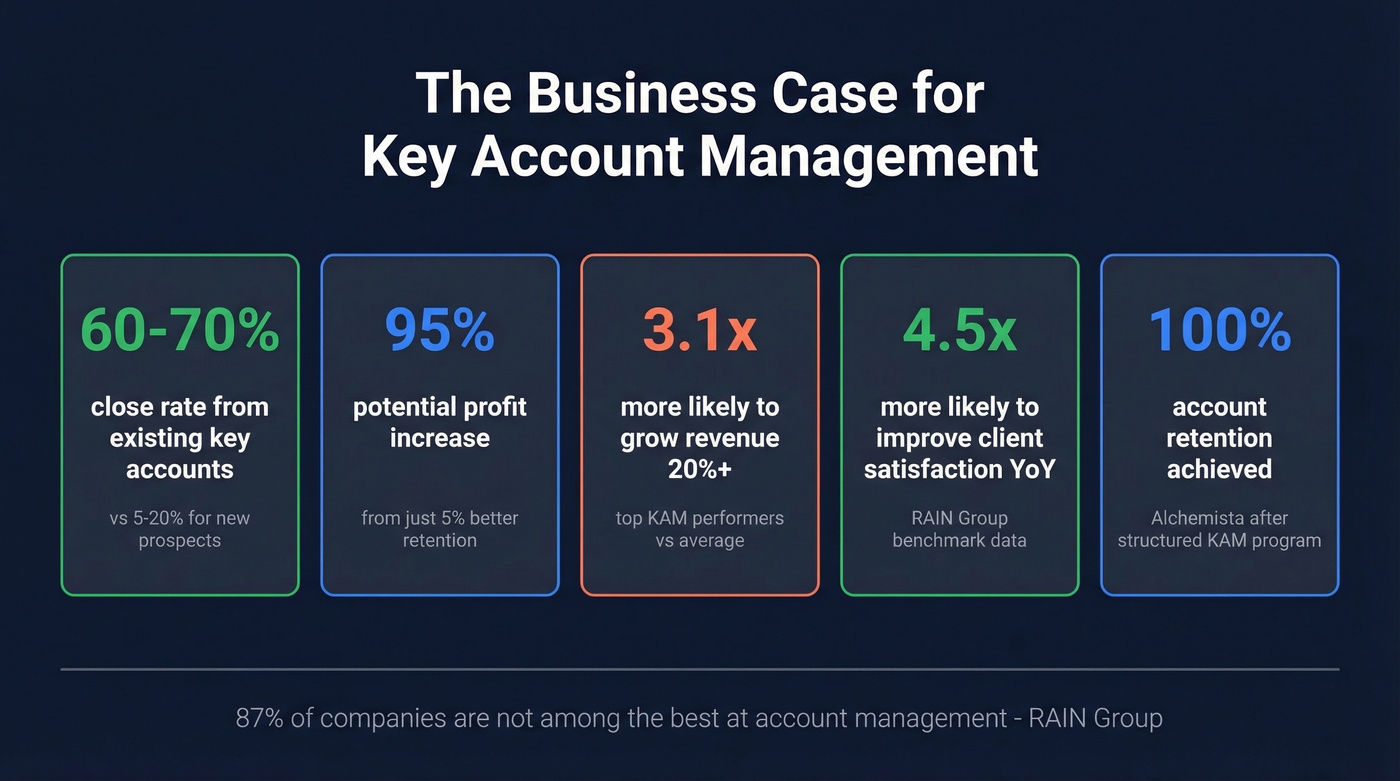
RAIN Group's benchmark data makes the gap painful. Top KAM performers are 3.1x more likely to grow key-account revenue by 20%+, 3.4x more likely to grow profit by 20%+, and 4.5x more likely to see year-over-year client satisfaction improvement. That's not marginal - it's a completely different trajectory.
Alchemista, a food services company, lost one of their biggest accounts in 2019, costing them up to 20% of revenue. After implementing a structured account experience program with quarterly NPS surveys across multiple stakeholders, they achieved 100% account retention. That's the swing a disciplined KAM program creates.
Cognition Solutions reports similar results across industries: a 25% year-over-year revenue lift from top 10 accounts after adopting data-driven account intelligence, and an 18% retention improvement for an industrial manufacturer. The 80/20 principle - a small fraction of accounts driving the majority of revenue - is the foundational logic behind every program.
How to Select Key Accounts
Most KAM programs fail at step one. They pick accounts based on current revenue alone, which means they're optimizing for the past, not the future.
Weighted ICP Scoring Framework
Score each criterion 1-10, multiply by weight, sum the total:
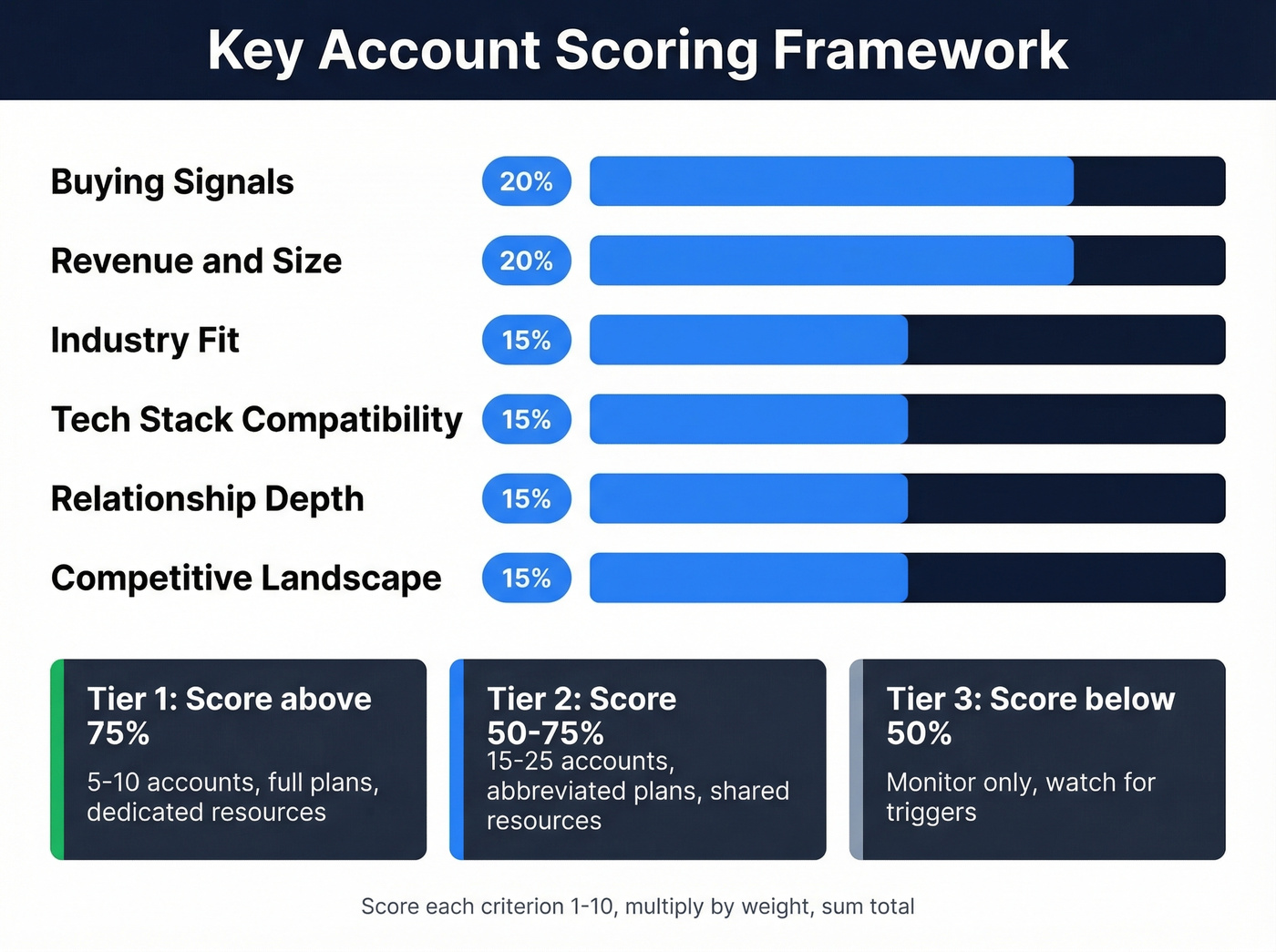
| Criterion | Weight | What You're Measuring |
|---|---|---|
| Buying Signals | 20% | Active intent, expansion indicators |
| Revenue / Size | 20% | Current + potential spend |
| Industry Fit | 15% | Alignment with your ICP |
| Tech Stack | 15% | Compatibility, integrations |
| Relationship Depth | 15% | Champion access, sponsors |
| Competitive Landscape | 15% | Incumbent risk, switching cost |
Then tier your accounts:
- Tier 1 (score >75%): 5-10 accounts. Full account plans, quarterly executive reviews, dedicated cross-functional resources.
- Tier 2 (score 50-75%): 15-25 accounts. Abbreviated plans, semi-annual reviews, shared resources.
- Tier 3 (score <50%): Monitor for signals. No dedicated plan - just watch for triggers that would move them up.
Only 5% of B2B accounts are actively looking to buy at any given time, and fewer than 20% of companies have fully embedded account planning into their operations. The bar for doing this well is shockingly low.
Here's the thing: we've seen teams try to run "full KAM" on 50 accounts. It doesn't work. You end up with 50 mediocre plans instead of 8 excellent ones. Be ruthless about Tier 1. If an account doesn't score above 75%, it doesn't get the full treatment.
Building a Living Account Plan
Annual account plans are dead. One r/sales practitioner summed it up perfectly: at the start of the year, plans feel important - by March, "nothing... 'the plans' just sit there." The problem isn't the plan. It's the cadence.
The One-Page Template
Every key account needs a living document with seven elements, adapted from Smartsheet's framework:
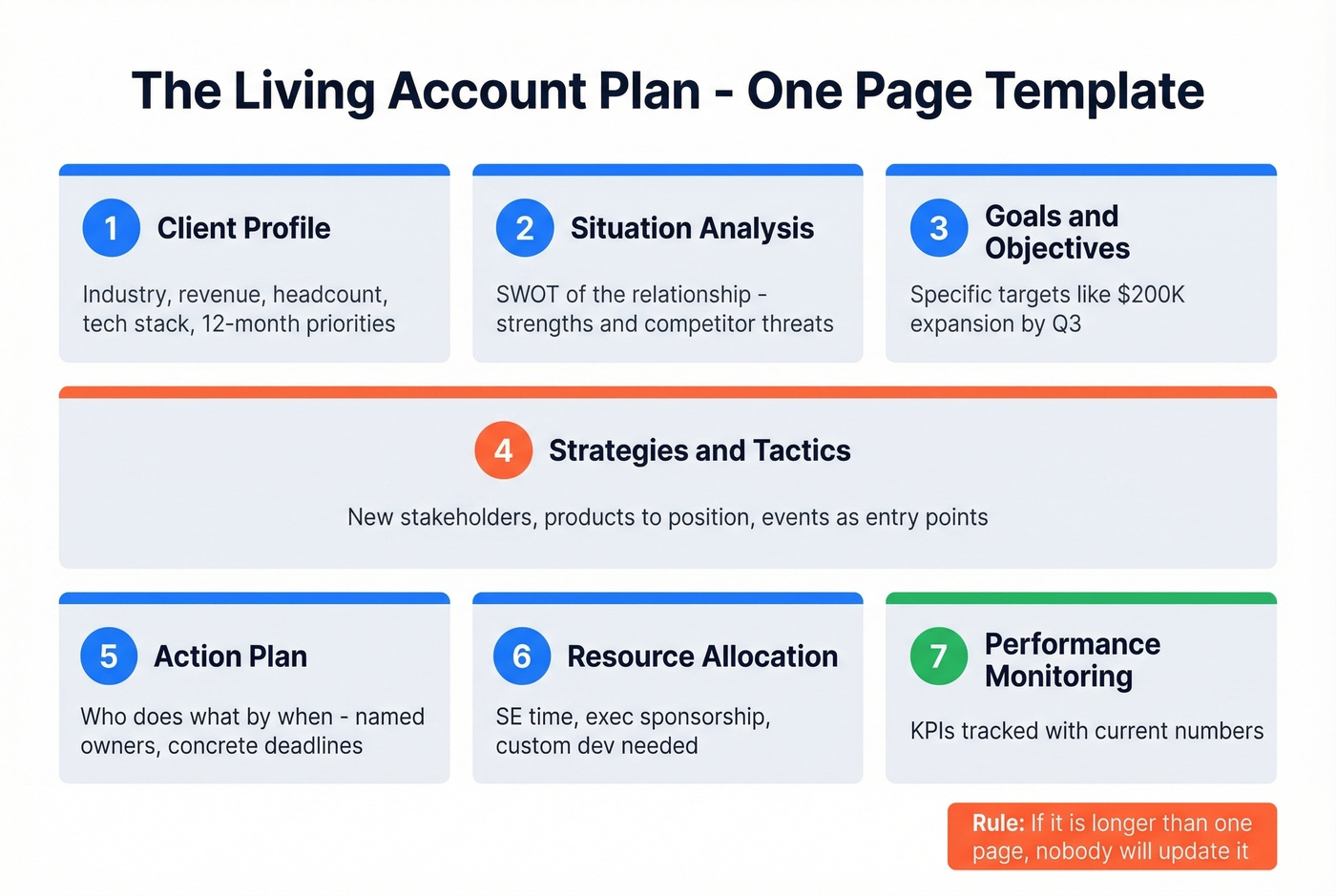
- Client Profile: Industry, revenue, headcount, tech stack, strategic priorities for the next 12 months.
- Situation Analysis: SWOT of the relationship - where you're strong, where competitors are circling.
- Goals & Objectives: Specific, measurable targets. "$200K expansion by Q3" beats "grow the account."
- Strategies & Tactics: New stakeholders to engage, products to position, events to use as entry points.
- Action Plan: Who does what by when. Named owners, concrete deadlines.
- Resource Allocation: SE time, exec sponsorship, custom dev this account needs.
- Performance Monitoring: Which KPIs you're tracking and the current numbers.
Keep it to one page. The moment an account plan becomes a 15-slide deck, nobody updates it.
Making Plans Dynamic
The minimum update cadence is quarterly, aligned with QBRs. But the real shift is moving to signal-driven updates. When a key account announces a new funding round, changes their CTO, or starts evaluating a competitor's product, that's a trigger to revisit the plan immediately - not at the next scheduled review.
Set three automatic triggers: executive change at the account, competitive threat detected, and any deal above a threshold dollar amount entering the pipeline.

Your account plans are only as good as your stakeholder data. Prospeo gives you 98% accurate emails and 125M+ verified mobile numbers so you can multi-thread into every key account with confidence - no bounces, no guessing.
Stop losing key accounts because you couldn't reach the right stakeholders.
The KAM Playbook in Practice
Stakeholder Mapping and Multi-Threading
Your CEO asks why you lost Acme. Turns out there were 11 people in the renewal decision and your team knew two of them.
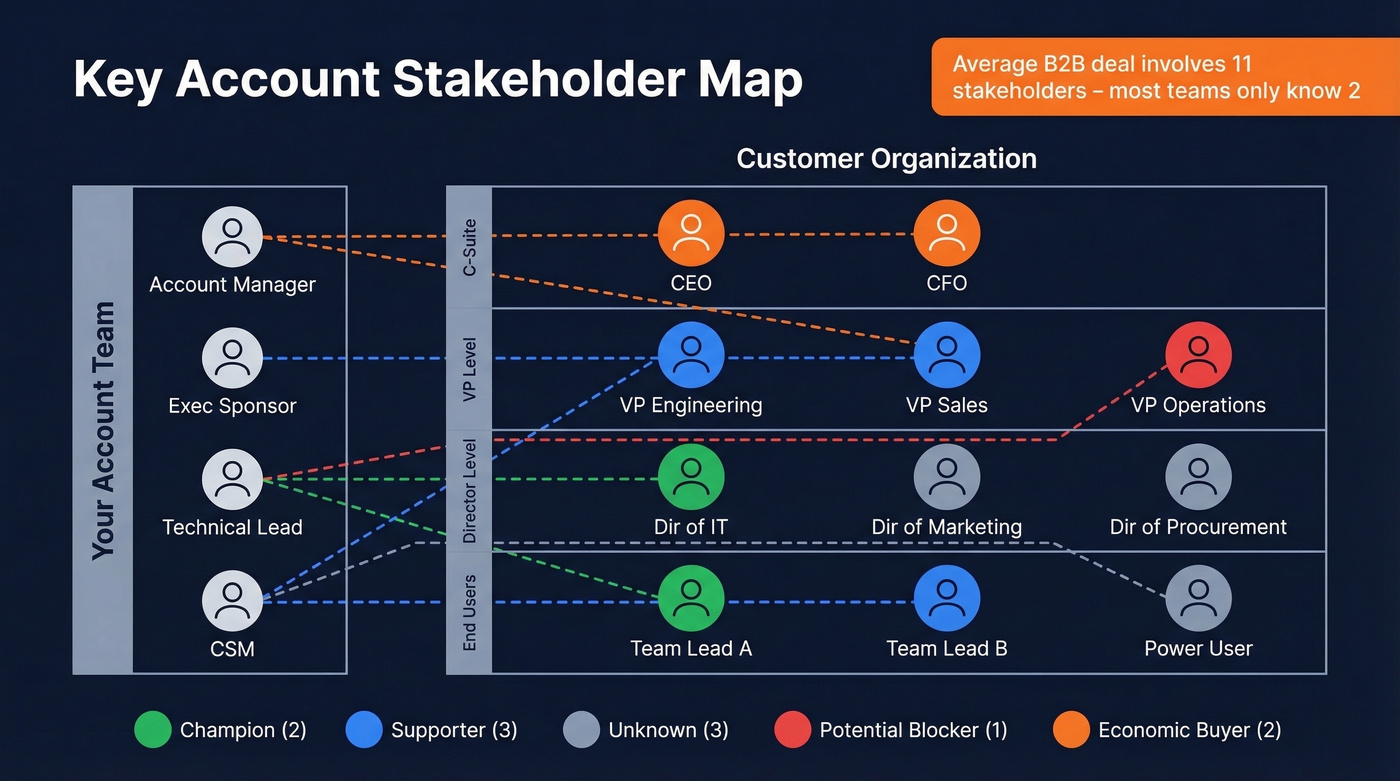
This scenario plays out constantly. B2B deals involve an average of 11 stakeholders, and most account teams are dangerously under-threaded. For every Tier 1 account, identify every stakeholder who influences, approves, or can block a decision. Then get verified, current contact data for each one. Poor data quality costs businesses roughly $15M yearly - and stale CRM records are where multi-threading strategies go to die.
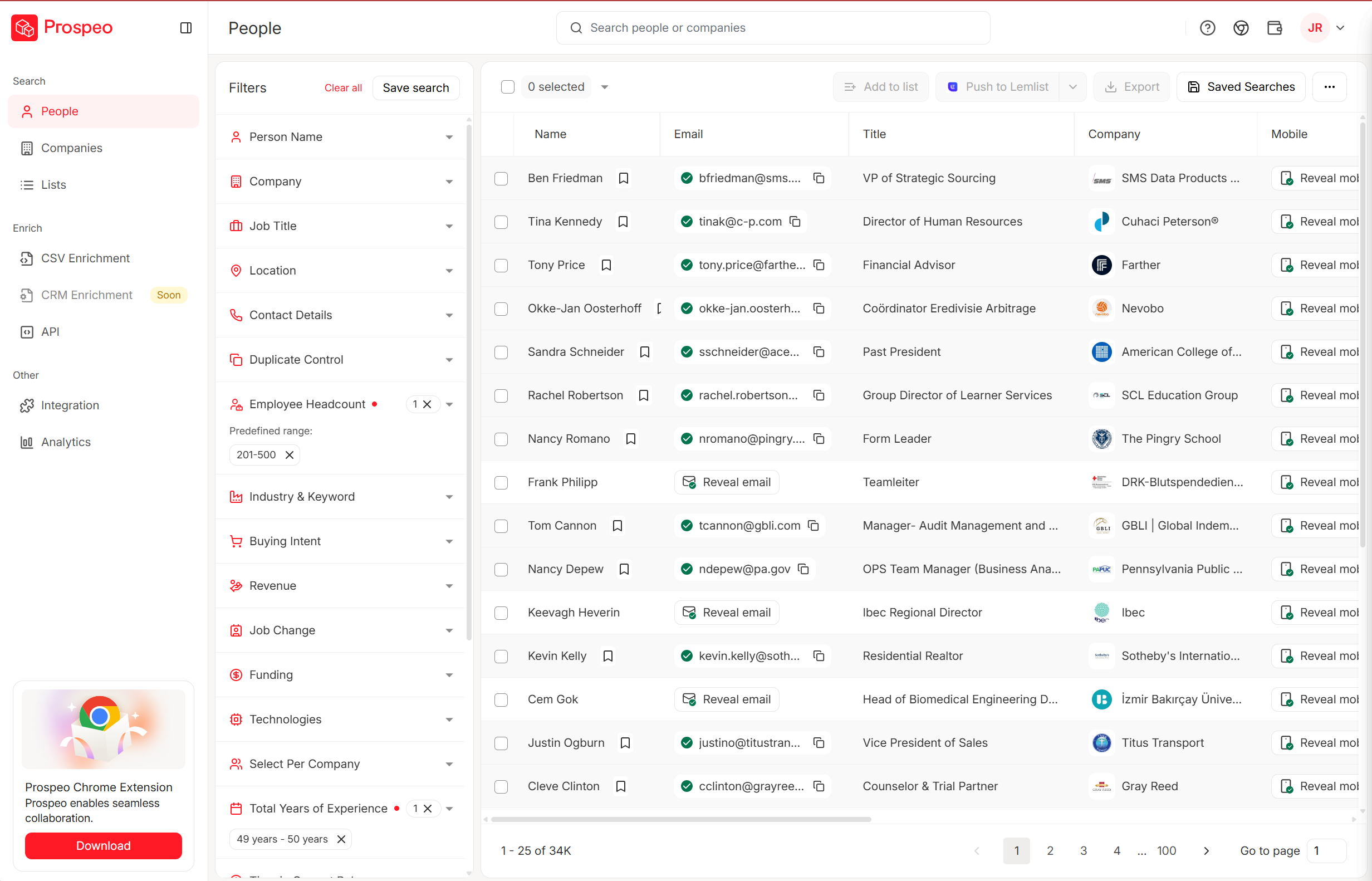
Prospeo's 7-day refresh cycle across 300M+ professional profiles, with 98% email accuracy and 125M+ verified mobile numbers, means you're working off current data rather than last quarter's records. The Chrome extension finds verified emails and phones from any website or CRM in one click, which makes building stakeholder coverage fast instead of painful.
Build a relationship map for each Tier 1 account. Identify champions, economic buyers, technical evaluators, and potential blockers. Assign an internal owner to each relationship. Review the map quarterly and after any organizational change.
KAM relationships evolve through distinct stages - from tactical vendor-buyer transactions through cooperative and interdependent phases, ultimately reaching strategic partnership where you're co-creating value. Your stakeholder map should reflect which stage each relationship is in and what it takes to advance it.
The Six KAM Roles
A common mistake is assuming one person can do everything. Effective programs distribute responsibilities across six distinct roles: the account manager who owns the relationship, the executive sponsor who provides C-level access, the technical lead who solves integration and product challenges, the customer success manager who handles day-to-day health, the subject matter expert who delivers domain credibility, and the project coordinator who keeps action items moving.
Not every account needs all six as dedicated headcount. But every function must be covered.
Contact Cadence That Adds Value
The fear of "annoying" customers is real - it comes up in every Reddit thread about KAM. One practitioner put it bluntly: "I'd rather under-communicate than become the vendor they dread hearing from." But the solution isn't less contact. It's better contact.
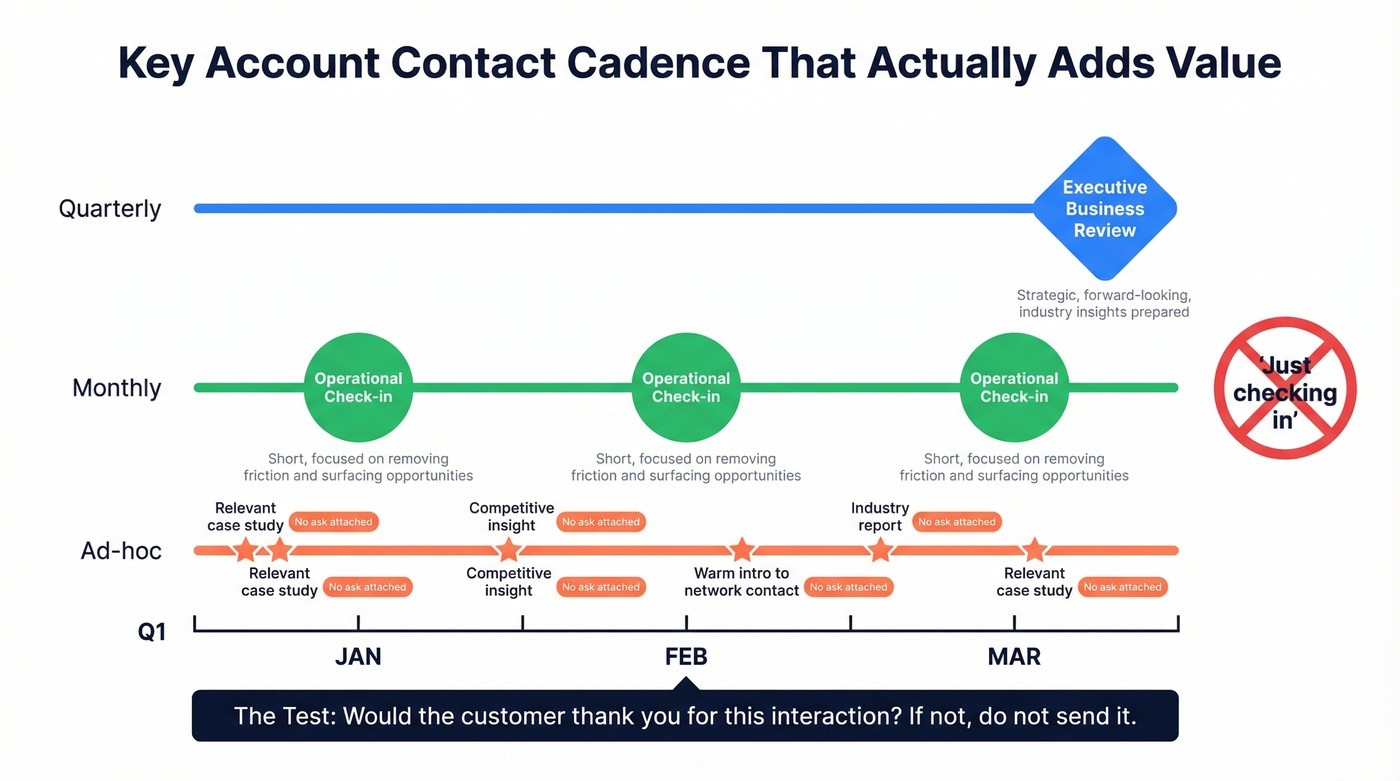
Quarterly: Executive business reviews. Strategic, forward-looking, with prepared insights about their industry.
Monthly: Operational check-ins with day-to-day contacts. Short, focused on removing friction and surfacing opportunities.
Ad-hoc: Value drops - a relevant case study, a competitive insight, an introduction to someone in your network. No ask attached.
If you're calling just to "check in," you're wasting their time and eroding trust. The test: would the customer thank you for this interaction?
Whitespace Analysis
The expansion opportunity inside key accounts is where KAM pays for itself. Map every product or service you offer against every department or use case at the account. Where are you present? Where aren't you? Where is a competitor filling a gap you could own?
Land-and-expand is the execution model. Start with a single team, deliver exceptional results, then use those results as proof points to expand into adjacent teams. The account plan should track whitespace explicitly - which departments you're not in, what the estimated opportunity is, and what the entry strategy looks like.
How to Measure KAM Success
Most programs measure the wrong things. Here are the five KPI buckets that matter, with formulas and worked examples from ExecViva's framework:
| KPI | Formula | Example |
|---|---|---|
| Customer Lifetime Value | Avg Monthly Revenue x Months | $2,000/mo x 48 = $96,000 |
| NPS | % Promoters - % Detractors | 70% - 10% = NPS 60 |
| Churn Rate | (Lost / Start) x 100 | (25 / 500) x 100 = 5% |
| Upsell + Cross-Sell Revenue | Sum of expansion deals | $20K + $15K = $35K |
| Sales Growth | (New - Old) / Old x 100 | ($600K - $500K) / $500K = 20% |
For SaaS companies, benchmark your churn against industry norms: early-stage companies typically see 5-10% monthly churn, while mature SaaS runs 2-5% monthly. If your key accounts are churning above these benchmarks, no amount of upselling will fix it.
Track these monthly at the account level and roll them up quarterly for program reporting. CLV and growth metrics tell you if you're expanding. NPS tells you if the relationship is healthy. Churn tells you if you're losing.
One more metric worth tracking: stakeholder coverage. What percentage of the buying committee do you have active relationships with? Under 50% means you're exposed.
Why KAM Programs Fail
Cranfield's research identifies six failure modes that kill programs before they produce results:
1. No strategy - treating KAM as a sales initiative. It isn't a sales tactic. It's an organizational commitment that touches product, support, finance, and executive leadership.
2. Underinvesting and expecting quick results. KAM is a multi-year change program. The accounts that matter most take 12-18 months to show meaningful expansion.
3. Staying product-pushy instead of co-creating value. If your account managers lead with product pitches instead of business conversations, you're doing enterprise sales, not strategic account work.
4. "Captain Super-KAM" - no cross-functional support. A single account manager can't deliver alone. They need SE resources, executive sponsors, product input, and customer success alignment.
5. Not measuring differently. Evaluating KAM with transactional sales metrics like quota attainment and deal count incentivizes the wrong behavior entirely.
6. No board-level sponsorship. Programs without executive champions get deprioritized the moment quarterly pressure hits.
Every failure above is a variation of getting one of three things wrong: right accounts, living plans, measuring what matters.
KAM Software and Tools
You don't need a $50K platform to start. You need a CRM, a one-page account plan, and accurate contact data. The dedicated tools add value at scale, but they aren't prerequisites.
Let's be honest: if your average contract value is under $25K, skip the purpose-built KAM platforms entirely. A well-maintained Salesforce instance with disciplined account planning will outperform a $50K DemandFarm deployment that nobody actually uses.
| Tool | Best For | Pricing | Rating |
|---|---|---|---|
| Prospeo | B2B data / contact verification | Free tier, ~$0.01/email | - |
| Salesforce | Full CRM + account planning | From $25/user/mo | 4.4/5 Gartner |
| HubSpot Sales Hub | Mid-market CRM + KAM | $15-$150/user/mo | - |
| DemandFarm | Dedicated account planning | ~$15K-$50K/yr | 4.7/5 Gartner |
| Kapta | KAM-specific workflows | ~$10K-$30K/yr | - |
| Gainsight | CS + account health | ~$30K-$100K+/yr | - |
| Totango | CS journeys + retention | Free tier, from ~$2.5K/yr | - |
| Pipedrive | SMB pipeline + accounts | $14-$79/user/mo | - |
DemandFarm and Kapta are purpose-built for KAM - org charts, relationship mapping, whitespace analysis, health scoring. Kapta users report finding 17% more upsell opportunities through structured account planning. These tools are excellent if you have 20+ Tier 1 accounts and a dedicated team. For everyone else, Salesforce or HubSpot with disciplined processes gets you 80% of the way there.
The tool most teams overlook is the data layer underneath everything else. Your CRM is only as good as the contact data inside it, and in our experience, stale data is the single biggest silent killer of KAM programs - not bad strategy, not wrong tools, but contacts that bounced three months ago and nobody noticed. If you want to operationalize this, start with a lightweight data quality audit before you buy more software.
Signal-driven account plans need real-time data. Prospeo refreshes every 7 days - not 6 weeks - so you catch executive changes, new hires, and expansion signals before your competitors do. Layer in buyer intent across 15,000 topics to know which key accounts are actively in-market.
Turn static account plans into living intelligence with data that's never stale.
The Future of KAM
The next wave is AI shifting from workflow digitization to an intelligence layer that synthesizes CRM data, call transcripts, email sentiment, and transactional patterns from CPQ and procurement systems.
The practical applications are already emerging: agentic workflows that recommend next-best-actions based on stakeholder movement, churn early-warning systems that detect subtle concerns in meeting transcripts weeks before a formal complaint, and auto-scheduling follow-ups based on engagement patterns rather than arbitrary cadences. We're tracking these developments closely, and the teams investing in data quality and signal infrastructure now will be best positioned when these tools mature.
Key account management in 2026 is as much about data infrastructure as it is about relationship skills. The companies that win won't just have better account plans - they'll have intelligence that tells them which accounts need attention before the account manager even asks.
FAQ
What's the difference between key account management and sales?
Sales is transactional - close a deal, move on. Key account management is a strategic, cross-functional discipline focused on growing your most valuable relationships over years with dedicated resources and executive sponsorship. The metrics, cadences, and team structures are fundamentally different.
How many key accounts should one manager handle?
Five to ten Tier 1 accounts per manager is the sweet spot. Beyond 10, engagement depth drops dramatically and plans go stale. A manager handling 15-25 accounts is doing Tier 2 coverage - lighter plans, less strategic depth, and higher churn risk.
What KPIs matter most for KAM programs?
Track five buckets: customer lifetime value, NPS/CSAT, churn rate, upsell and cross-sell revenue, and year-over-year sales growth. Report monthly at the account level and roll up quarterly. Add stakeholder coverage percentage - under 50% means you're exposed to single-thread risk.
How do I find verified contacts for key account stakeholders?
Use a B2B data platform with high accuracy and frequent refresh cycles. Prospeo covers 300M+ professional profiles with 98% email accuracy and a 7-day refresh cycle - far faster than the 6-week industry average. The free tier includes 75 verified emails to start mapping buying committees immediately.