

Enterprise Sales Skills That Actually Win Deals
Only 43.5% of sales professionals hit quota last year. In enterprise - where cycles stretch past six months and buying committees run 8-12 deep - that number feels generous. Reps spend 70% of their time on non-selling activities, and the 30% they do spend selling often targets the wrong stakeholder entirely.
The enterprise sales skills that actually move pipeline are specific, measurable, and learnable. Here's what matters most.
What Makes Enterprise Selling Different
Enterprise isn't just "bigger deals." It's a different discipline. The table below shows why reps who crush it in SMB often struggle when they move upmarket.
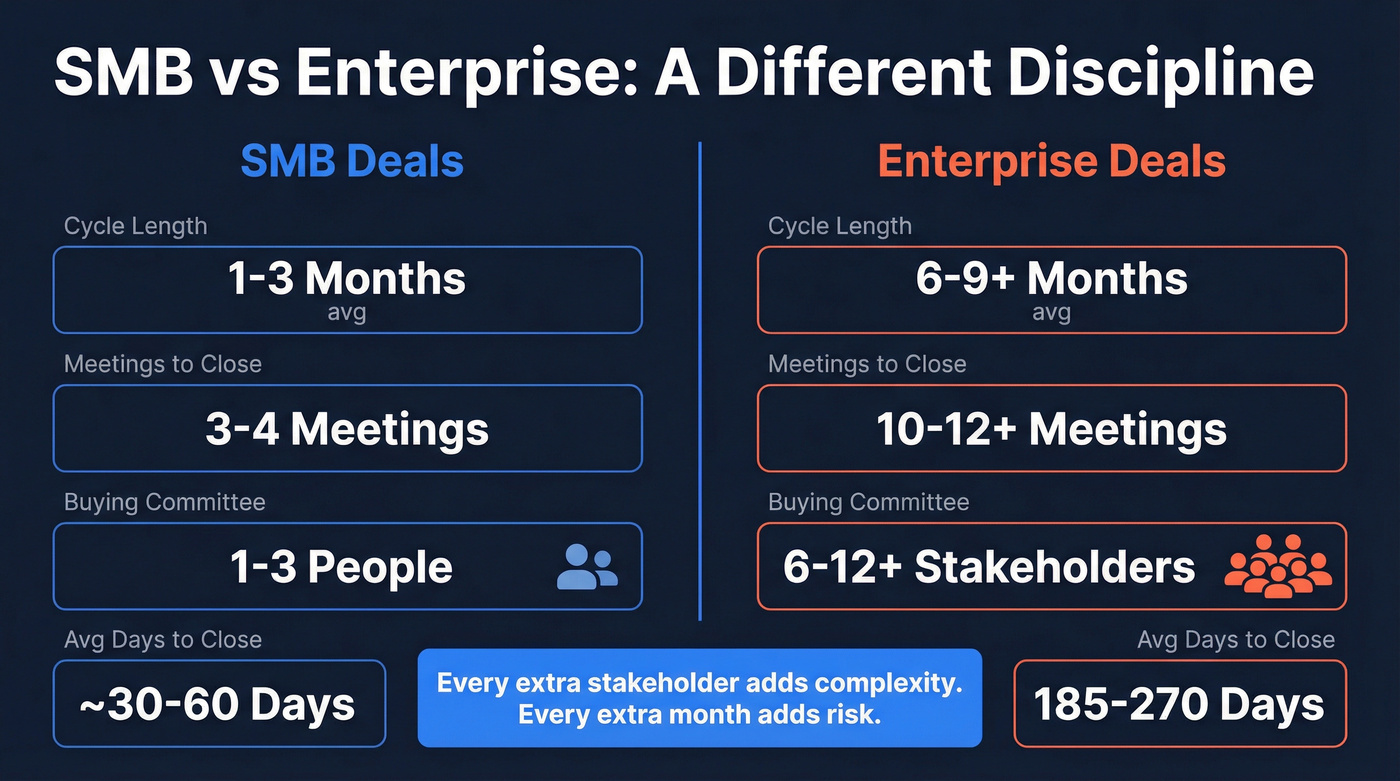
| Metric | SMB | Enterprise |
|---|---|---|
| Cycle length | 1-3 months | 6-9+ months |
| Meetings to close | 3-4 | 10-12+ |
| Buying committee | 1-3 people | 6.3 avg |
At companies with 10,000+ employees, cycles average 185 days. For $500K+ deals, expect 270 days. In SaaS, plan for 8-12 stakeholders on the buying committee as a practical floor - every extra stakeholder adds complexity, and every extra month adds risk. The skills that win here aren't the ones that close a 14-day SMB deal.
7 Skills That Move Enterprise Pipeline
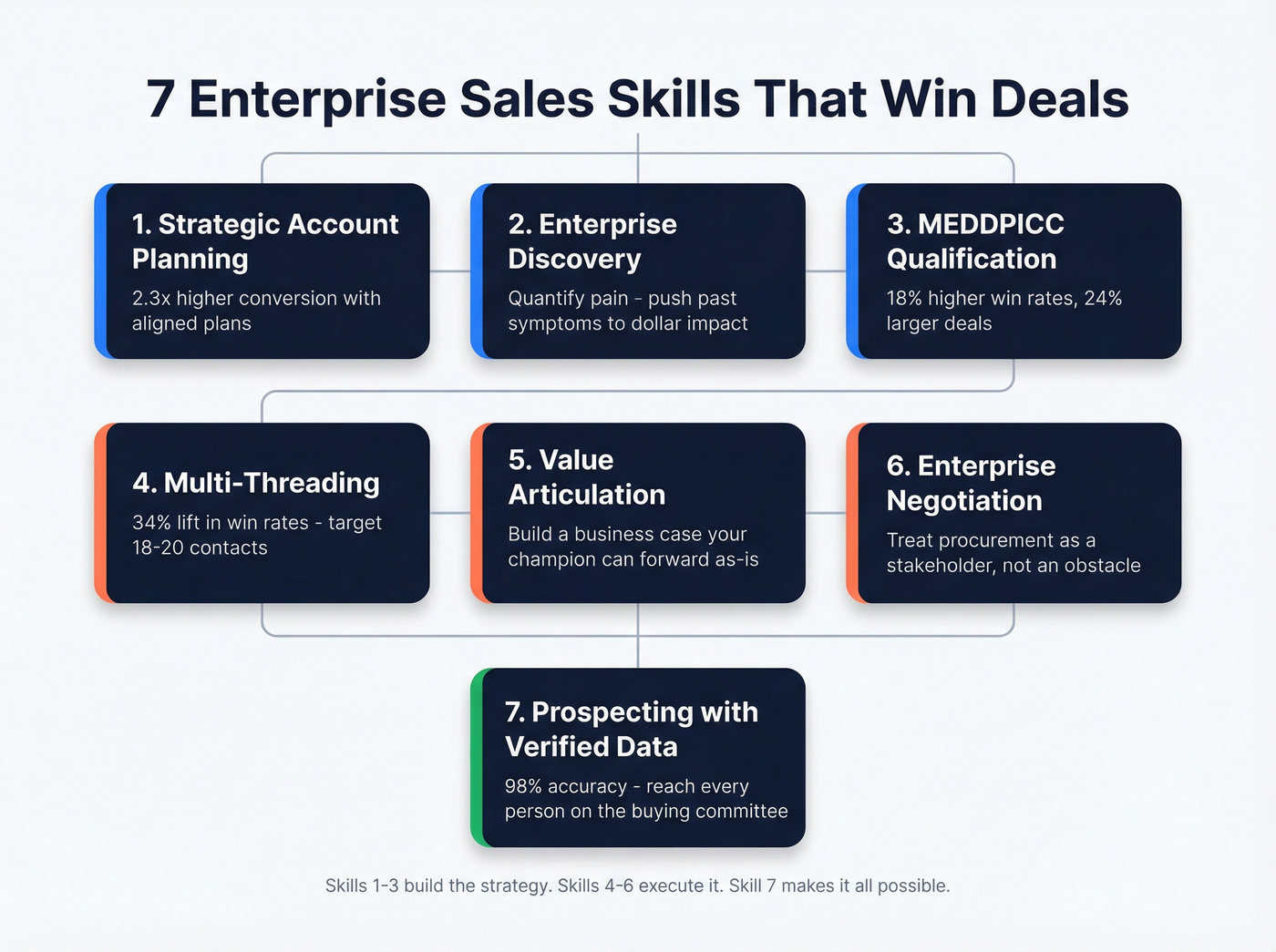
1. Strategic Account Planning
Enterprise deals are won before the first call. You need pre-engagement research across 8-12 stakeholders - their priorities, their org chart relationships, their budget cycles. Teams that align sales, marketing, and CS around a shared account plan see 2.3x higher conversion and 1.6x faster revenue growth.
Winging it doesn't scale past midmarket.
2. Enterprise Discovery
Good discovery in enterprise isn't a checklist - it's an excavation. The "So what?" technique is the single most underused move in complex sales: push from the symptom ("we're doing data entry manually") to the quantified business impact ("that's costing you $400K/year in FTE time and adding 3 weeks to every deal"). Listen more than you talk. Count to two after the prospect finishes a sentence before you respond - you'll be surprised how often they keep going and hand you the real objection.
Map your questions to MEDDIC components:
- Metrics: "What key metrics define success for this initiative?"
- Economic Buyer: "Who has final budget authority on this?"
- Decision Process: "Walk me through the steps from evaluation to signed contract."
- Identify Pain: "What's the business cost of not solving this in the next quarter?"
Never end a discovery call without a concrete next meeting on the calendar.
3. MEDDPICC Qualification
73% of SaaS companies selling above $100K ARR use some version of MEDDPICC - Metrics, Economic Buyer, Decision Criteria, Decision Process, Identify Pain, Paper Process, Champion, Competition. Adoption doubled from 11% to 21% between 2021 and 2022, and organizations that fully adopt it report 18% higher win rates and 24% larger deal sizes.
The element most reps skip is Paper Process. That's a mistake. 28% of deals fail when buyers can't navigate internal approval - procurement, legal, security review. If you haven't mapped these steps by the second meeting, you're flying blind. And if you can't access the Economic Buyer? You're not selling. You're providing free consulting.
4. Multi-Threading and Stakeholder Navigation
Single-threading is the most expensive mistake in enterprise sales. Ask any enterprise AE what kills deals and you'll hear the same answer: your champion gets promoted, goes on leave, or simply loses internal momentum - and your deal dies with the relationship.
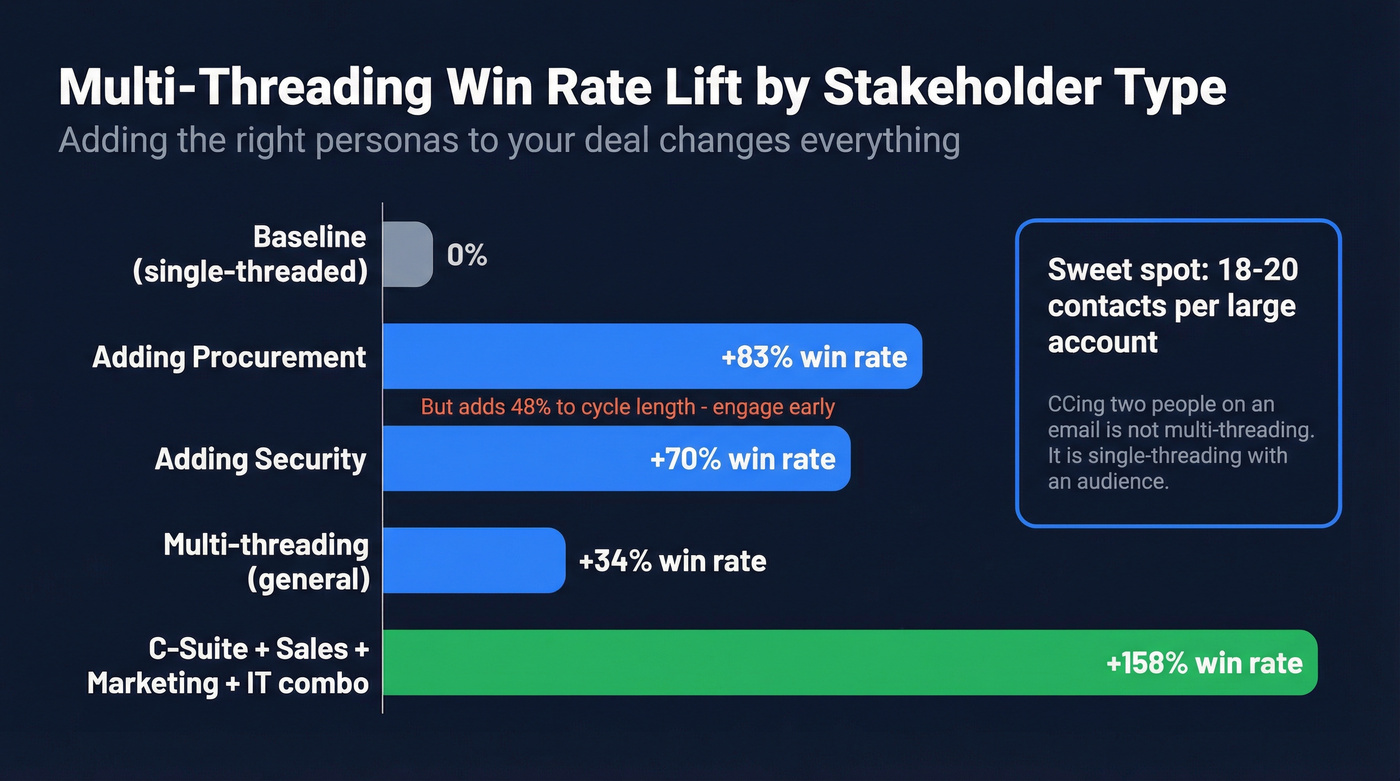
Multi-threading - engaging multiple stakeholders simultaneously - delivers a 34% lift in win rates. For large accounts, targeting 18-20 individuals yields the best results. Adding procurement to a deal lifts win rates by 83%. Security adds 70%. The combination of C-suite + Sales + Marketing + IT lifts win rates by 158%.
But procurement also extends cycles by 48%, so engage them early - not as a surprise in month five.
We've seen reps who think they're multi-threading because they CC'd two people on an email. That's not multi-threading. It's single-threading with an audience.
5. Value Articulation and Business Case Building
Your champion has to pitch the CFO without you in the room. That's the test.
If your value story can't survive that handoff, you don't have a value story - you have a demo script. Tie every claim to specific metrics the buyer already cares about: revenue impact, time saved, cost reduced, risk mitigated. Build a one-page business case your champion can forward without editing, because they won't edit it - they'll either forward it as-is or not at all.
6. Enterprise Negotiation
Procurement extends deal cycles by 48%. That's not a bug - it's their job. The best enterprise reps treat procurement as a stakeholder to win over, not an obstacle to route around. One SaaStr operator put it bluntly: "I never lost a customer I visited in person." In a remote-first world, that's a competitive edge most reps ignore.
And close doesn't mean signed contract. It means a clean handoff to CS with success metrics and onboarding expectations documented. Enterprise buyers who feel abandoned post-signature don't renew.
7. Prospecting with Verified Data
Every skill above depends on reaching the right people. Enterprise multi-threading means finding verified contact info for 8-12 stakeholders per account - the CFO, the procurement lead, the security director, the end-user champion. When bounce rates hit 30%+, you're not multi-threading. You're spamming into the void.
Here's the thing: you've mapped the buying committee, built the business case, identified the champion - and then your sequence bounces off three of the five stakeholders you need. We've watched this kill six-figure deals.

Prospeo's database covers 300M+ professional profiles with 98% email accuracy and 125M+ verified mobile numbers. The 7-day data refresh cycle means you're not working off contacts verified six weeks ago - which is the industry average. When you're targeting a VP of Engineering at a 15,000-person company, the difference between a 7-day refresh and a 6-week refresh is the difference between a live conversation and a bounced email.
If you're cleaning lists before outreach, start with email bounce rate fundamentals and a repeatable email deliverability checklist.

Enterprise multi-threading only works when you can actually reach every stakeholder on the buying committee. Prospeo gives you 98% verified emails and 125M+ direct dials across 300M+ profiles - refreshed every 7 days, not 6 weeks. Map 18-20 contacts per account and know every sequence will land.
Stop losing six-figure deals to bounced emails and dead phone numbers.
You've run MEDDPICC, identified the Economic Buyer, and built the business case. Now you need verified contact data for the CFO, procurement lead, and security director - all at once. Prospeo delivers at ~$0.01/email with 30% mobile pickup rates, so your multi-threaded outreach actually connects.
Your deal strategy is only as good as the data behind it.
Enterprise Deal Killers
These destroy more pipeline than any competitor:
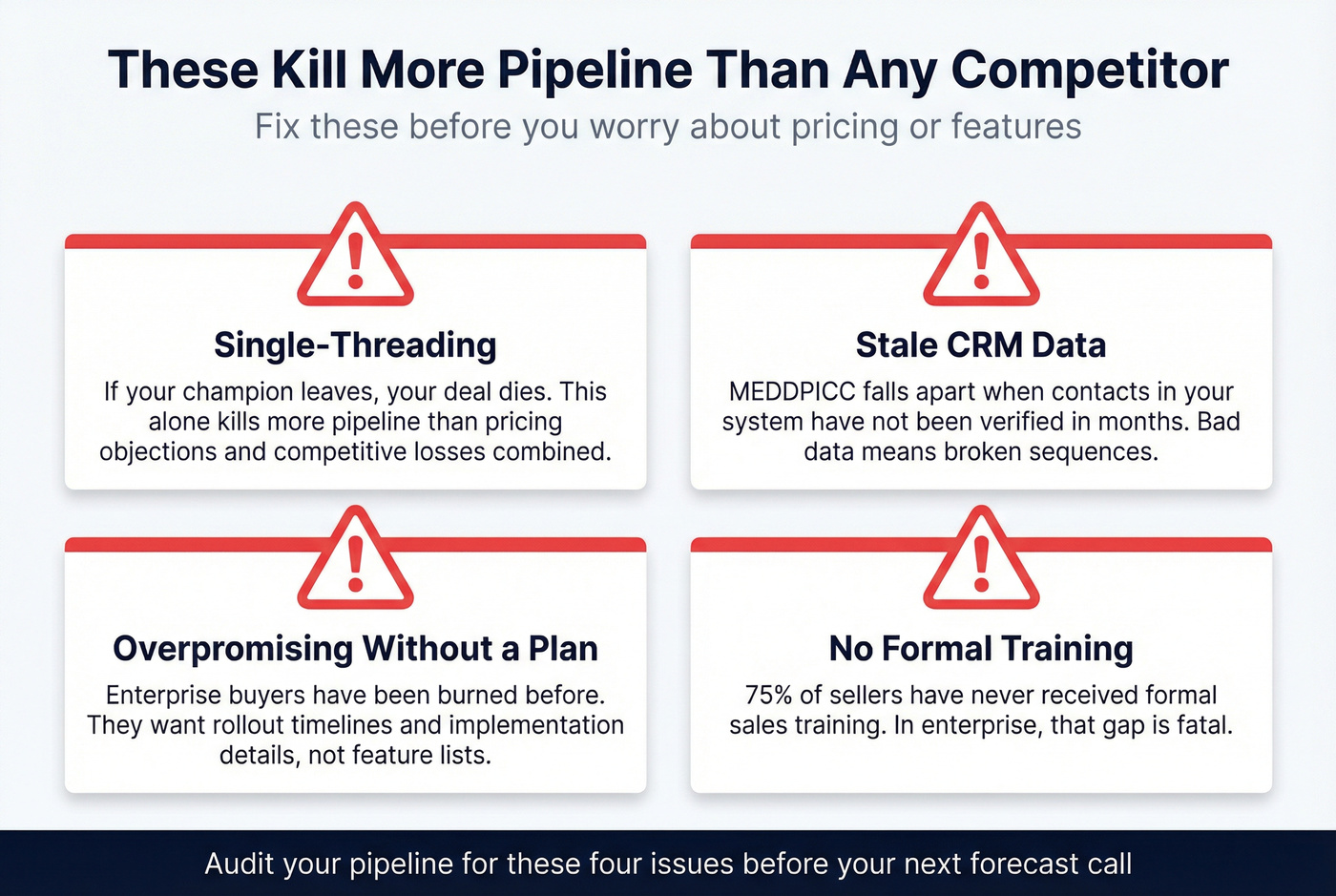
- Single-threading. If your champion leaves, your deal dies. Period.
- Stale CRM data. MEDDPICC falls apart when the contacts in your system haven't been verified in months. (If you're auditing your stack, compare options in our guide to contact management software.)
- Overpromising without an implementation plan. Enterprise buyers have been burned before. They want rollout timelines, not feature lists.
- No formal training. Nearly 75% of sellers have never received formal sales training. In enterprise, that gap is fatal.
Skip the temptation to treat these as minor issues. In our experience, single-threading alone accounts for more lost pipeline than pricing objections and competitive losses combined.
Skills AI Won't Replace in 2026
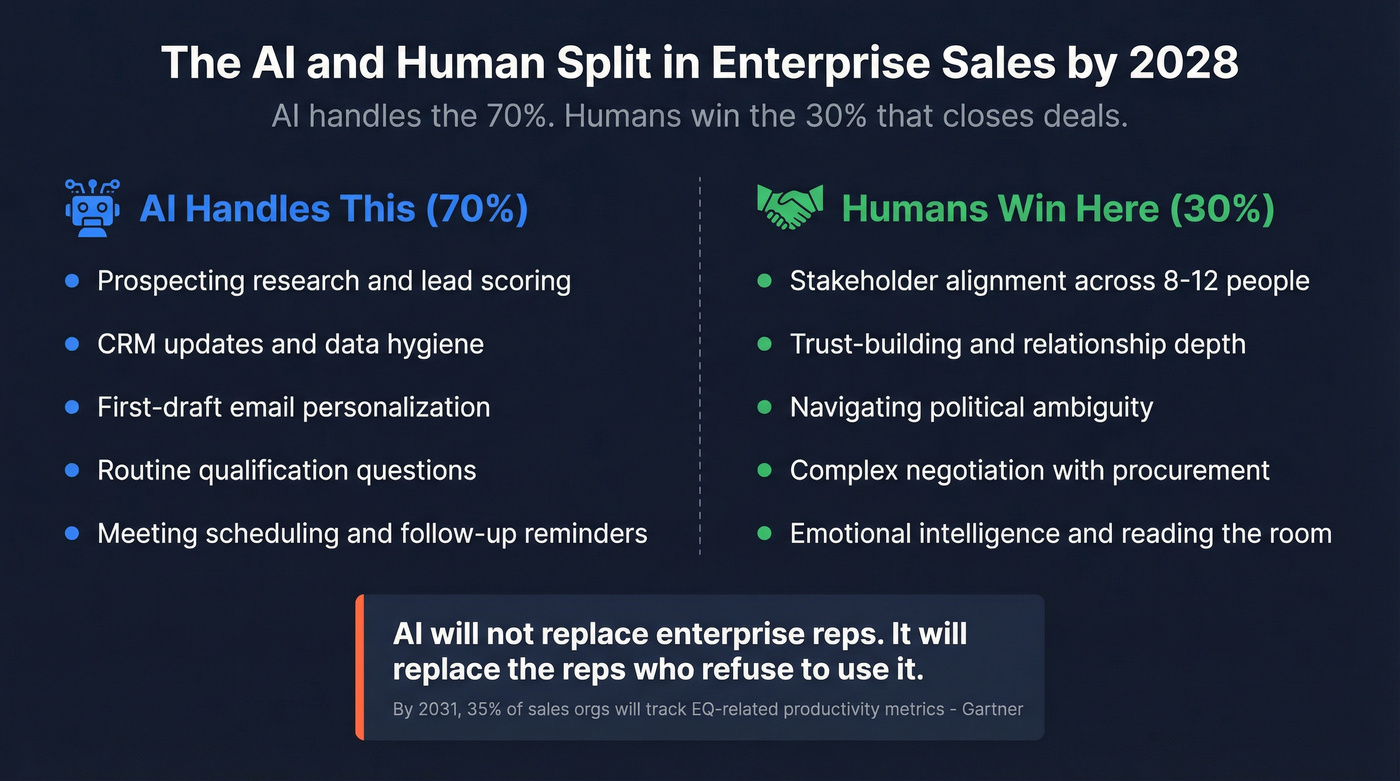
Gartner projects that by 2028, AI will close 70% of sales cycles by automating prospecting, qualification, and routine negotiations. By 2031, 35% of sales orgs will introduce EQ-related productivity metrics because human skills will be what separates top performers.
Let's be honest about what this means: if your ACV is above $100K, AI won't replace your reps - but it will replace the reps who refuse to use it. AI handles research, lead scoring, CRM updates, and first-draft personalization. Humans differentiate on stakeholder alignment, trust-building, and navigating the ambiguity that defines every enterprise deal. The consensus on r/sales tracks with this - the reps who thrive won't resist AI. They'll use it for the 70% so they can invest all their energy in the 30% machines can't touch.
If you're modernizing your outbound motion, pair this with proven sales prospecting techniques and a tighter lead scoring model.
FAQ
What's the hardest enterprise sales skill to learn?
Multi-threading. Most reps default to single-threading because it's comfortable. Building relationships with 8-12 stakeholders simultaneously - each with different priorities and political dynamics - requires deliberate practice and a repeatable system. The deals that slip are almost always the ones where only one contact went dark.
How long does a typical enterprise deal cycle take?
Six to nine months on average. Deals at companies with 10,000+ employees average 185 days. Deals above $500K average 270 days. Build your forecast and your patience accordingly.
What do enterprise sales reps earn?
Glassdoor puts the average at around $141K, while ZipRecruiter reports closer to $77K - the spread depends heavily on base vs. OTE and industry. A reasonable midpoint for a full-cycle enterprise AE in SaaS is $100K-$140K base with OTE pushing well above $200K for top performers.
How do I find verified contacts for large buying committees?
Filter by company size, department, and job title across a database with 300M+ profiles. At 98% email accuracy and a 7-day refresh cycle, tools like Prospeo are built for the multi-threading reality of enterprise deals - where bouncing off even one key stakeholder can stall a six-figure opportunity.