

How to Launch a New Sales Territory in 2026: The Practitioner's Playbook
A RevOps lead we work with inherited a greenfield territory last year. No accounts, no pipeline, no warm introductions. Eight weeks in, she'd booked 14 discovery calls and had $180K in early-stage pipeline. The rep who took over the same territory type the quarter before? Zero pipeline at day 60 because he skipped the fundamentals and started dialing random accounts from a stale list.
The difference wasn't talent. It was process. 78% of sellers missed quota last year, and the average SaaS ramp now sits at 5.7 months - up 32% since 2020. Buying committees average 25 stakeholders (up from 16 in 2017), and the average B2B sales cycle stretches to 6.5 months. You can't afford to wing the first 90 days.
Here's the thing: most territory launches fail before a single call is made. They fail in the planning - or the lack of it. The reps who invest two weeks in intelligence before touching a phone consistently outperform the ones who start dialing on day one.
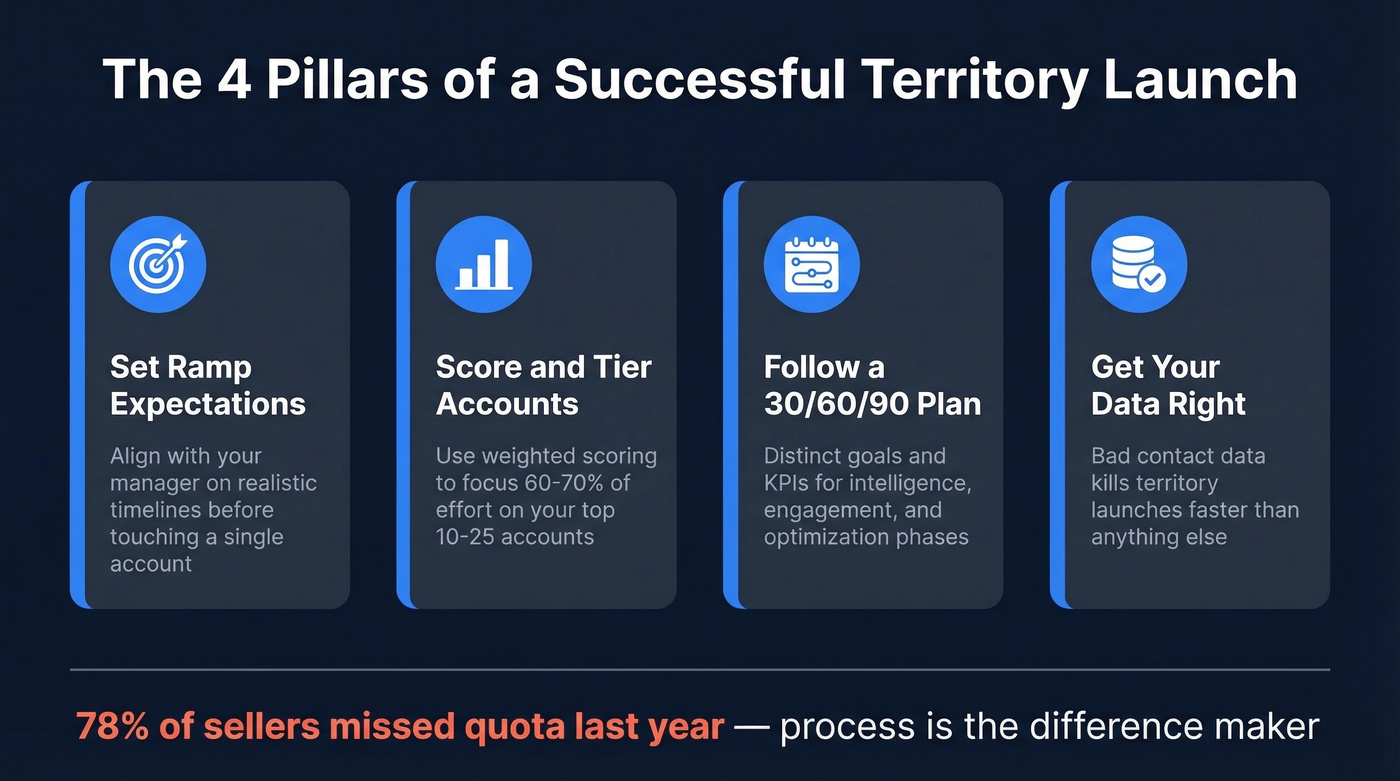
The Four Pillars
- Set realistic ramp expectations with your manager before you touch a single account. Jump to ramp benchmarks →
- Score and tier your accounts so you're not randomly dialing into a spreadsheet. Jump to scoring model →
- Follow a phased 30/60/90 plan with distinct KPIs for each stage. Jump to the plan →
- Get your contact data right before outreach - bad data kills territory launches faster than anything else. Jump to data quality →
Assess Your Starting Point
Not all territory launches are the same. Your first move depends entirely on what you're walking into. LSA Global's framework breaks it into three scenarios:
Inherited a strong territory? Your job is continuity. Get a knowledge transfer from the outgoing rep, meet every active opportunity, and protect existing relationships before you try to expand. Don't fix what isn't broken.
Inherited a failing territory? Diagnose before you prescribe. Talk to your manager, review lost deals in the CRM, and figure out whether the problem was the rep, the accounts, or the market. A quick SWOT analysis - mapping strengths, weaknesses, opportunities, and threats - can surface patterns that raw CRM data alone won't reveal. Then rebuild the account tiers from scratch.
Greenfield - building from zero? This is the hardest and the most rewarding. Heavy ICP research, aggressive account mapping, and a disciplined outreach cadence from day one. No shortcuts.
LSA Global's research found that strategic sales clarity accounts for 31% of the difference between high- and low-performing sales teams. Knowing which scenario you're in - and acting accordingly - is step one.
Set Realistic Ramp Expectations
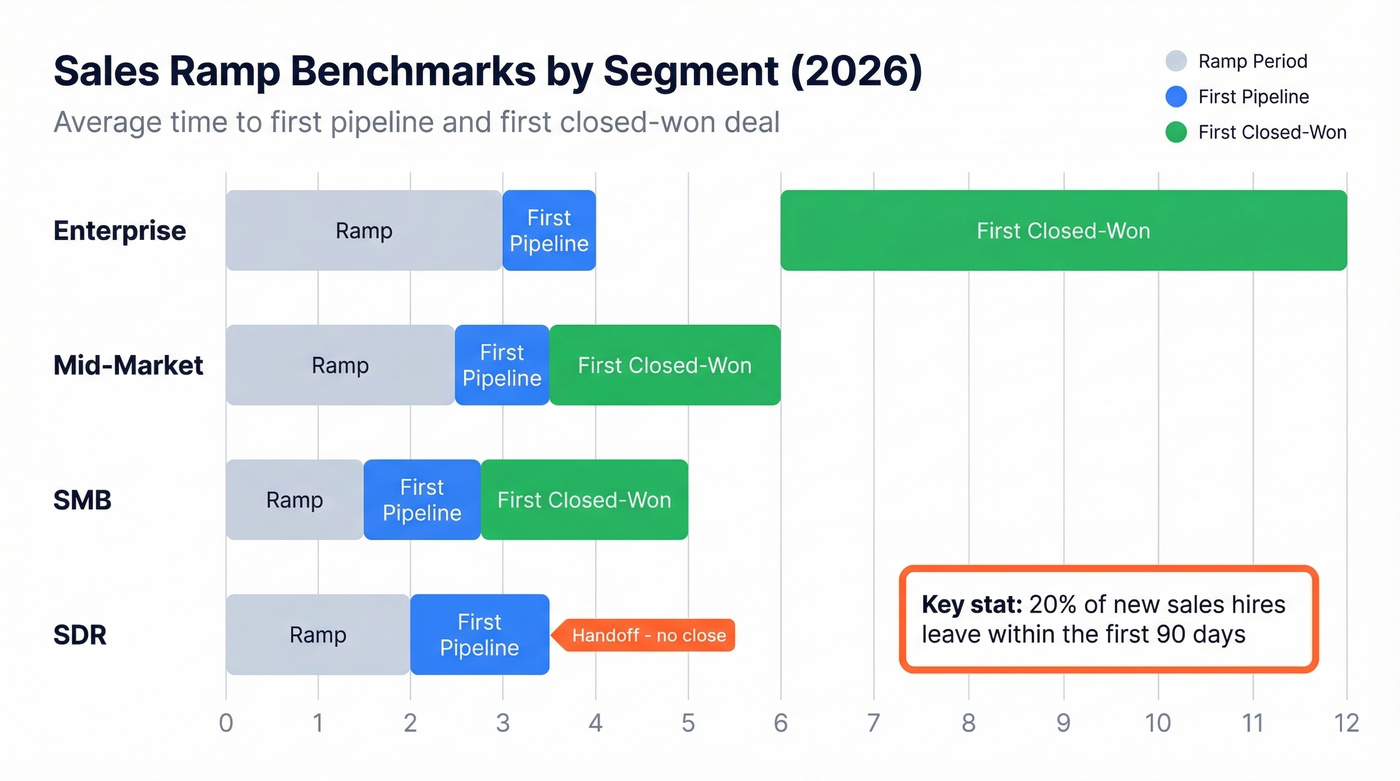
Most territory launches fail not because the rep is bad, but because expectations are misaligned. Your VP expects pipeline in week 3. You're still figuring out the CRM. That gap creates pressure, shortcuts, and eventually turnover - 20% of new sales hires leave within the first 90 days.
The cost of getting this wrong is brutal. Replacing a failed rep runs roughly 3x their base salary when you factor in recruiting, training, and lost productivity. On the flip side, structured onboarding reduces ramp time by up to 34%, and effective territory realignment can lift revenue 2-7% without adding headcount - but only if you give the plan time to work.
Share these benchmarks with your manager in week one. Negotiate a ramp quota or guaranteed draw for the first 90 days if you can. Align on what "good" looks like at each stage:
| Segment | Avg Ramp | First Pipeline | First Closed-Won |
|---|---|---|---|
| Enterprise | 9-12 mo | Months 3-4 | Months 6-12 |
| Mid-Market | 4-6 mo | Months 2-3 | Months 3-6 |
| SMB | 1-3 mo | Weeks 3-6 | Months 1-3 |
| SDR | 3.2 mo | Weeks 2-4 | N/A (handoff) |
If you're selling enterprise deals with 6+ month cycles, nobody should expect closed-won revenue in your first quarter. Get that conversation on paper early.
Score and Tier Your Accounts
Random dialing is the fastest way to waste your first 90 days. Before you make a single call, score every account in your territory using a weighted model. This is the foundation - it's the difference between 8-15% outreach-to-meeting conversion on your best accounts and 1-3% on everything else.
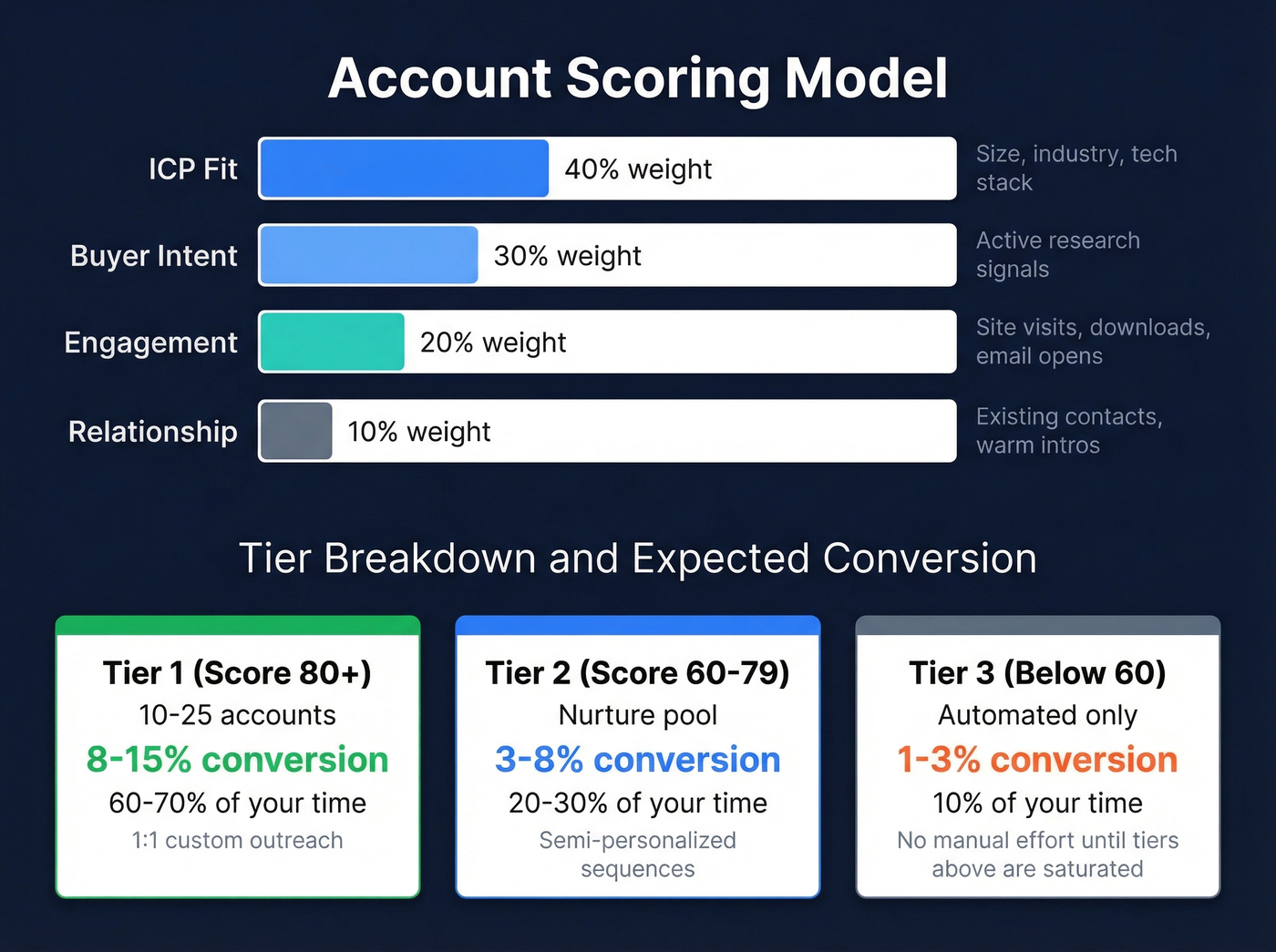
| Factor | Weight | What to Measure |
|---|---|---|
| Fit | 40% | ICP match: size, industry, tech stack |
| Intent | 30% | Active research signals |
| Engagement | 20% | Website visits, content downloads, email opens |
| Relationship | 10% | Existing contacts, warm intros |
Score each account 0-100, then tier them:
- Tier 1 (80+): 10-25 accounts. These get genuine 1:1 outreach, custom messaging, and multi-threaded engagement. If your Tier 1 has 200 accounts, you don't have tiers - you have a list.
- Tier 2 (60-79): Nurture with semi-personalized sequences. Monitor for intent spikes that push them to Tier 1.
- Tier 3 (below 60): Automated sequences only. Don't spend manual effort here until higher tiers are saturated.
Layer buyer intent on top of firmographic fit. An account that fits your ICP and is actively researching solutions right now is worth ten that just fit the profile. Standalone intent data from providers like Bombora typically runs $25K-60K per year, which puts it out of reach for most reps launching a territory. Prospeo bundles Bombora intent data across 15,000 topics into its platform at a fraction of that cost, so you can run intent-driven scoring without an enterprise procurement cycle.
Expected outreach-to-meeting conversion by tier: Tier 1 runs 8-15%, Tier 2 drops to 3-8%, and Tier 3 sits at 1-3%. These benchmarks should drive how you allocate your time - Tier 1 gets 60-70% of your effort.
Your 30/60/90 Day Territory Plan
This is the centerpiece. A strong 30/60/90 day plan gives you distinct goals, actions, and KPIs at every phase. Don't skip ahead - the temptation to start outreach in week one is real, but the reps who invest in intelligence first consistently outperform those who don't.
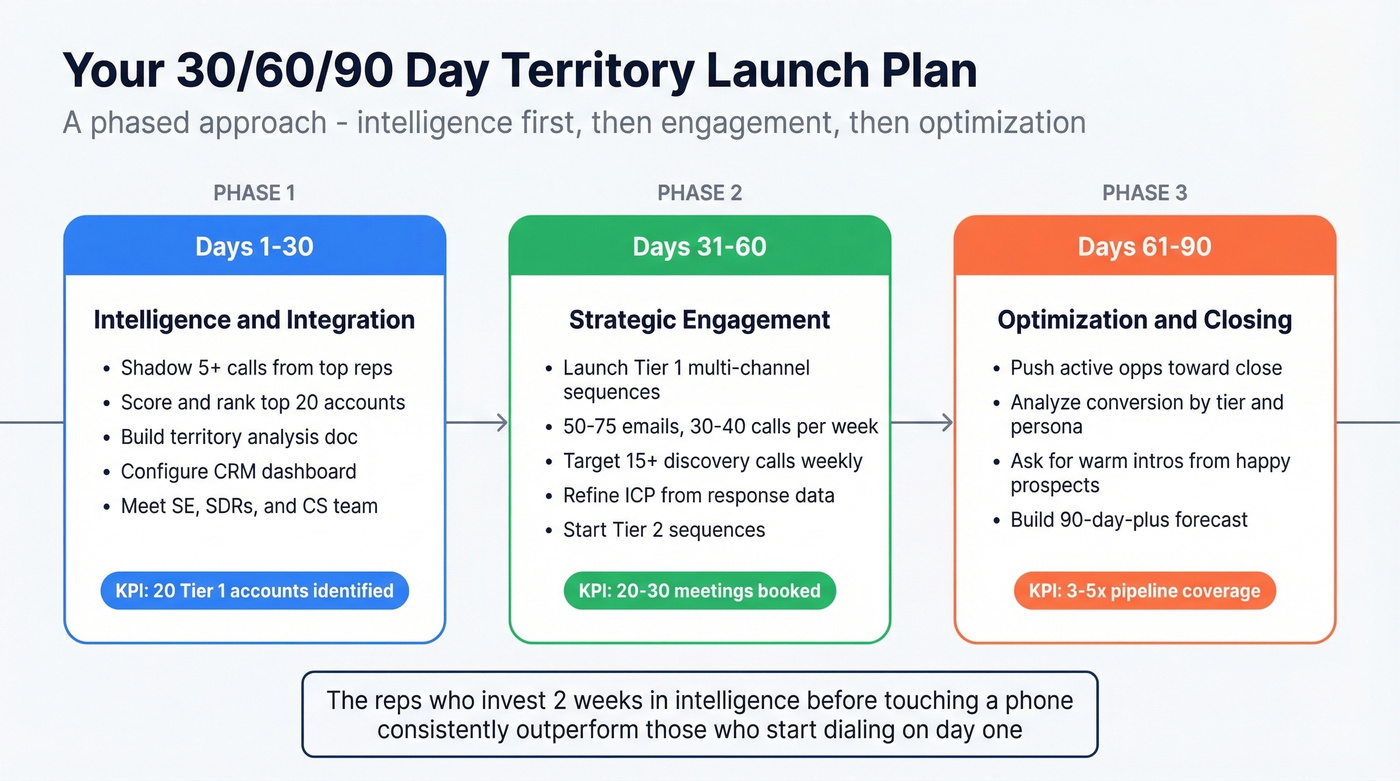
| Phase | Focus | Key KPI | Target |
|---|---|---|---|
| Days 1-30 | Intelligence & integration | Top accounts identified & scored | 20 Tier 1 accounts |
| Days 31-60 | Strategic engagement | Meetings booked | 20-30 (mid-market) |
| Days 61-90 | Optimization & closing | Pipeline created | 3-5x quota coverage |
Days 1-30: Intelligence & Integration
Your only job in the first 30 days is to learn and prepare. Resist the urge to blast emails.
Goals: Master your product's business impact. Map your territory so the top 20% of accounts - which will drive 80% of opportunities - are identified and scored. Integrate with your internal team through collaborative planning sessions with your manager, SE, and SDRs.
Actions:
- Complete product training and shadow at least 5 calls from top-performing reps
- Review CRM records of the 10 largest closed-won deals in adjacent territories
- Set up your CRM views: pipeline stages, activity logging, and a territory dashboard showing accounts by tier
- Schedule 1:1s with your manager, SE, SDRs, and customer success
- Build your territory analysis doc: market size, top industries, competitors, whitespace
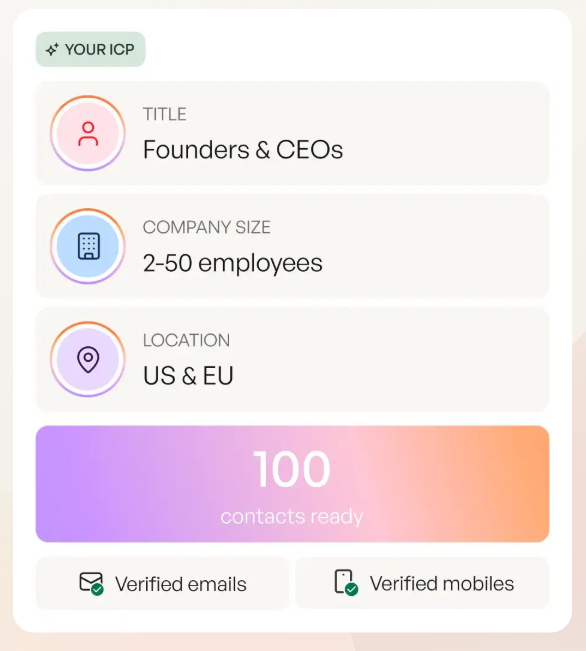
- Build your initial contact list - filter by industry, headcount, funding stage, technographics, and buyer intent to match your ICP
- Identify and document your top 20 target accounts
KPIs: Territory analysis doc completed. Top 20 target accounts identified and scored. CRM dashboard configured. Internal stakeholder meetings done. Calls shadowed.
Days 31-60: Strategic Engagement
Now you execute. The intelligence from Phase 1 becomes outreach.
Goals: Launch multi-channel sequences to Tier 1 accounts. Book your first discovery meetings. Start building real pipeline.
Actions:
- Launch personalized outreach sequences to all Tier 1 accounts across phone, email, and social
- Hit weekly activity targets: 50-75 emails, 30-40 calls, and 10-15 social touches for Tier 1 accounts; scale down to 30-50 emails and 15-20 calls for Tier 2
- Target 15+ discovery calls per week
- Refine your ICP based on early response data - which titles respond? Which industries engage?
- Begin Tier 2 semi-automated sequences
- Document objections and competitive intel from every conversation
KPIs: Meetings booked (target: 20-30 for mid-market). Pipeline created ($). Outreach response rates by tier. Percentage of Tier 1 accounts contacted.
Days 61-90: Optimization & Closing
Phase 3 is about converting early pipeline and sharpening your approach based on 60 days of real data.
Goals: Close first deals. Analyze conversion data to rebalance account tiers. Establish a referral pipeline from early wins.
Actions:
- Push active opportunities toward close - involve your SE and leadership for executive alignment
- Analyze conversion rates by tier, industry, and persona, then rebalance tiers accordingly
- Ask every happy prospect for one warm introduction; referrals convert 4-5x better than cold outreach
- Build your 90-day-and-beyond forecast with realistic pipeline coverage
KPIs: Closed-won deals (even one is a signal). Pipeline coverage ratio of 3-5x quota. Conversion rates by tier. Forecast accuracy.

Your territory scoring model is only as good as the data behind it. Prospeo layers Bombora intent data across 15,000 topics with 30+ filters - firmographics, technographics, headcount growth, funding - so you can build Tier 1 lists that actually convert at 8-15%. No enterprise contract required.
Score and prioritize your territory accounts in minutes, not weeks.
Do the Pipeline Math
Work backward from your quota. If you're carrying $500K for the year and need 3-5x pipeline coverage, you need $1.5-2.5M in pipeline. Assume a 20% close rate and $50K average deal size - that's 30-50 opportunities needed, which means 150-300 qualified meetings at a 20% meeting-to-opportunity rate, which means thousands of outreach touches.
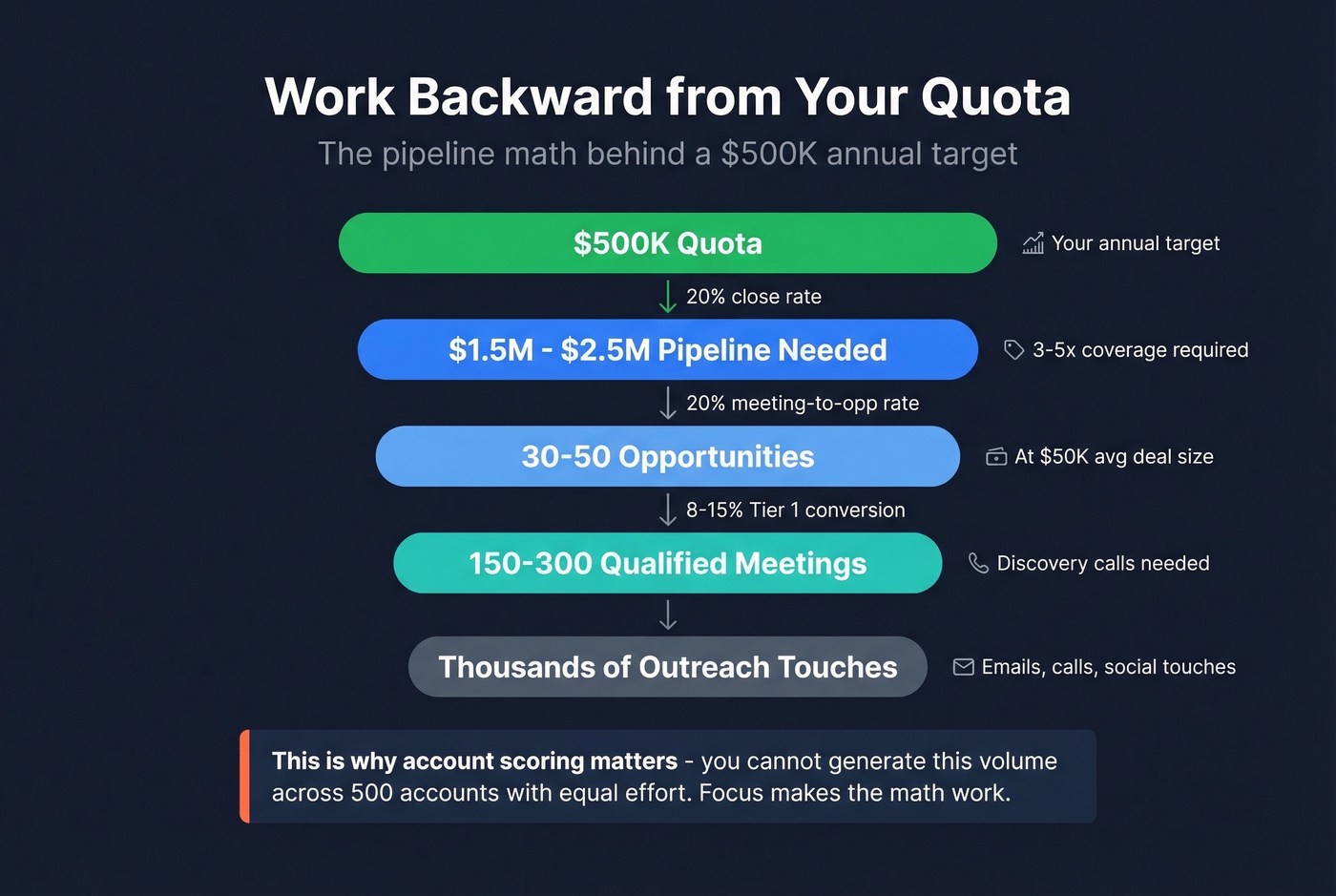
The math gets sobering fast. That's why account scoring matters - you can't generate that volume across 500 accounts with equal effort. Focus is what makes the math work.
The pipeline math also shifts dramatically depending on whether you're running a commercial vs mid-market motion. Smaller deal sizes mean higher volume requirements, while mid-market and enterprise deals demand fewer but deeper engagements. McKinsey research shows that disciplined territory planning makes teams 1.3x more likely to outperform peers in revenue growth. Run this calculation in week one, share it with your manager, and revisit it monthly.
Get Your Data Right Before You Dial
It's week 3. You've scored your accounts, built your tiers, and you're ready to launch sequences. Then 35% of your emails bounce. Your domain reputation tanks. Replies dry up - not because your messaging is bad, but because half your list was dead on arrival.
We've seen this pattern destroy territory launches. Reps spend only 28-30% of their time actually selling. Bad data makes that number worse by burning hours on bounced emails, wrong numbers, and manual research to fill gaps.
Look - if you're launching a greenfield territory, you need a data source that's accurate on day one, not one that requires weeks of manual cleanup. Prospeo delivers 98% email accuracy across 143M+ verified addresses and 125M+ verified mobile numbers with a 30% pickup rate, all on a 7-day refresh cycle while the industry average sits at six weeks. At roughly $0.01 per email with a free tier to start, it's built for reps launching territories - not enterprise procurement cycles. GreyScout cut rep ramp time from 8-10 weeks to 4 weeks after switching their data source, and Meritt dropped bounce rates from 35% to under 4%.

Your territory is only as good as the data underneath it. Get this right before you dial.
Bad contact data is the #1 territory killer. Every bounced email burns your domain and wastes ramp time you can't afford. Prospeo delivers 98% email accuracy with a 7-day refresh cycle, so every dial and send in your 30/60/90 plan hits a real person - not a dead inbox.
Stop burning your first 90 days on stale data. Get verified contacts at $0.01 each.
Mistakes That Kill New Territories
Sticking to static territory models. Markets shift. Accounts grow, shrink, get acquired. Xactly's research flags this as a major pitfall - territories need real-time adjustments, not annual reviews. Revisit tiers monthly.
No account scoring. Dialing alphabetically through a list of 400 accounts is a recipe for burnout and missed quota. Implement the weighted scoring model above before you make your first call.
Relying on reps without a playbook. Repsly's analysis found that accountability without structure just creates frustration. Standardize your outreach cadence, call framework, and reporting templates.
Only using email. Multi-channel outreach - phone, email, video, social - outperforms single-channel in modern B2B. Gartner found buyers are 1.8x more likely to complete a high-quality deal through hybrid digital + human interactions. Build sequences that blend at least three channels.
Ignoring data quality. Launching outreach on unverified contacts is like pouring water into a bucket with holes. Verify every contact before it enters a sequence. Period. (If you need a deliverability baseline, start with email bounce rate benchmarks and fixes.)
Scaling Beyond 90 Days
Once your 30/60/90 plan is working and early pipeline is converting, the question shifts from "how do I get started" to "how do I scale." That's a different mindset entirely - you're optimizing a system, not building one from scratch.
If you're expanding into new geographies, the playbook adapts significantly. A territory plan for EMEA needs to account for language barriers, GDPR compliance, and fragmented buying cultures across countries. Teams planning UK expansion should factor in post-Brexit data regulations and the preference for relationship-driven selling in British enterprise accounts. A DACH territory demands German-language outreach and an understanding that decision cycles in Germany tend to run longer and more consensus-driven than in the US or UK.
The core framework - score, tier, phase your outreach - still applies. But the weights in your scoring model, the channels you prioritize, and the ramp timelines all shift based on region and segment.
Presenting Your Territory Plan
At some point - whether it's a QBR, a new-hire onboarding review, or a board meeting - you'll need to present your territory plan to stakeholders. A strong presentation shows your methodology, quantifies the opportunity, and sets clear milestones.
Structure it around the framework in this playbook:
- Slides 1-2: Territory overview - segment, geography, total addressable accounts, and your starting scenario
- Slides 3-4: Account scoring model and tier breakdown with expected conversion rates
- Slides 5-6: Your 30/60/90 day plan with KPIs for each phase (use this deeper 30/60/90 day plan format if needed)
- Slide 7: Pipeline math - quota, required coverage, and the activity volume needed to get there
- Slide 8: Data quality strategy and tooling
Keep it concise. Leadership wants to see that you've done the thinking, not that you've made 40 slides.
Review and Rebalance Quarterly
A territory plan isn't a document you write once and file away. It's a living system. Well-designed plans boost productivity up to 20% and increase revenue 15-30% - but only when they're actively managed.
Monthly review checklist:
- Response rates by tier - are your Tier 1 accounts actually converting better than Tier 2?
- Pipeline velocity - how fast are deals moving through stages?
- Conversion rates by account score - is the scoring model predictive?
- Accounts that should move up or down a tier based on new engagement or intent data
Quarterly rebalance:
- Reassess total addressable accounts. New companies enter your territory; others get acquired or go dark. (If you need a clean definition, revisit your TAM, SAM, SOM.)
- Recalibrate scoring weights based on three months of conversion data.
- Adjust time allocation across tiers based on where pipeline is actually coming from.
The consensus on r/sales is pretty consistent: reps who review and adjust quarterly outperform those running the same playbook from month one. Don't be the rep still working a stale Tier 1 list in Q4.
FAQ
How long does it take to ramp a new territory?
SMB territories ramp in 1-3 months, mid-market in 4-6, and enterprise in 9-12. The average SaaS ramp is 5.7 months and climbing. Set expectations with your manager in week one - misaligned timelines are the #1 reason territory launches feel like failures even when they're on track.
How many accounts should I focus on first?
Your Tier 1 should be 10-25 accounts that get genuine 1:1 outreach. If your "top tier" has 200 accounts, you don't have tiers - you have a list. Prioritize ruthlessly using a weighted scoring model, and expand only after Tier 1 is fully engaged.
What tools do I need to launch a territory?
Three essentials: a CRM like Salesforce or HubSpot, a verified data platform for contacts and intent signals, and an engagement tool like Outreach or Salesloft for sequencing. Everything else is nice-to-have until you've got pipeline.
What's a 30/60/90 day plan for a new territory?
A phased roadmap with distinct goals at each stage. Days 1-30 focus on learning your product, mapping accounts, and building your contact list. Days 31-60 shift to outreach and pipeline creation. Days 61-90 are about closing first deals and optimizing based on real conversion data. Each phase has specific KPIs - the table and breakdown above give you the full picture.
How does an enterprise territory plan differ from mid-market?
Enterprise plans focus on fewer, higher-value accounts with longer sales cycles and multi-threaded engagement across larger buying committees - typically 10-15 Tier 1 accounts. Mid-market plans prioritize higher volume with faster conversion cycles, often 20-25 Tier 1 accounts. Scoring weights shift too: relationship and executive access matter more in enterprise, while intent signals and speed-to-contact drive mid-market wins.