

Lead Acquisition Strategy: The Operating System Most Teams Are Missing
Your SDR manager just told you half the emails in last week's sequence bounced. Leadership wants more outbound, more pipeline, more everything. But nobody's asking the real question: do you have a lead acquisition strategy, or just a list of channels and a prayer?
One agency owner on r/sales put it perfectly - they wanted "predictable, data-driven CAC/pipeline" without having to "become a social media influencer." That's exactly what a real strategy delivers. Not a shopping list of tools. An engine that connects targeting, data quality, scoring, routing, and measurement into something that actually produces revenue.
Most guides stop at definitions. This one gives you the actual numbers: CPL benchmarks, a scoring rubric you can copy, ROI formulas with guardrails, and the minimum stack to run it all.
What Is Lead Acquisition?
People use "demand gen," "lead gen," and "lead acquisition" interchangeably. They shouldn't.
| Demand Generation | Lead Generation | Lead Acquisition | |
|---|---|---|---|
| Goal | Build awareness, educate | Capture intent, convert | Full system: target, capture, qualify, route, measure |
| Funnel stage | Top of sales funnel | Mid/bottom | All stages |
| Key metrics | Engagement, traffic | MQLs, form fills, SQLs | CPL, SQL rate, LTV:CAC, revenue |
Demand gen creates the conditions. Lead gen captures the hand-raisers. Lead acquisition is the entire engine - from defining who you want to reach, through verifying their data, scoring their buyer intent signals, routing them to the right rep, and measuring whether any of it produced revenue.
Generation is one step inside acquisition.
What You Need (Quick Version)
If you only do three things this week:
- Define your ICP and explicit disqualifiers. Stop acquiring leads you'll never close. If a company has fewer than 50 employees and you've never closed a deal under 100, that's a disqualifier. Write it down.
- Install a scoring model and a routing SLA. Leads should reach the right rep in under an hour. After 24 hours, conversion is effectively zero.
- Fix data quality before scaling volume. Verify emails, enrich contacts, then send. Prospeo handles this with 98% email accuracy on a 7-day refresh cycle - 75 emails plus 100 Chrome extension credits per month on the free tier to test before you commit a dollar.
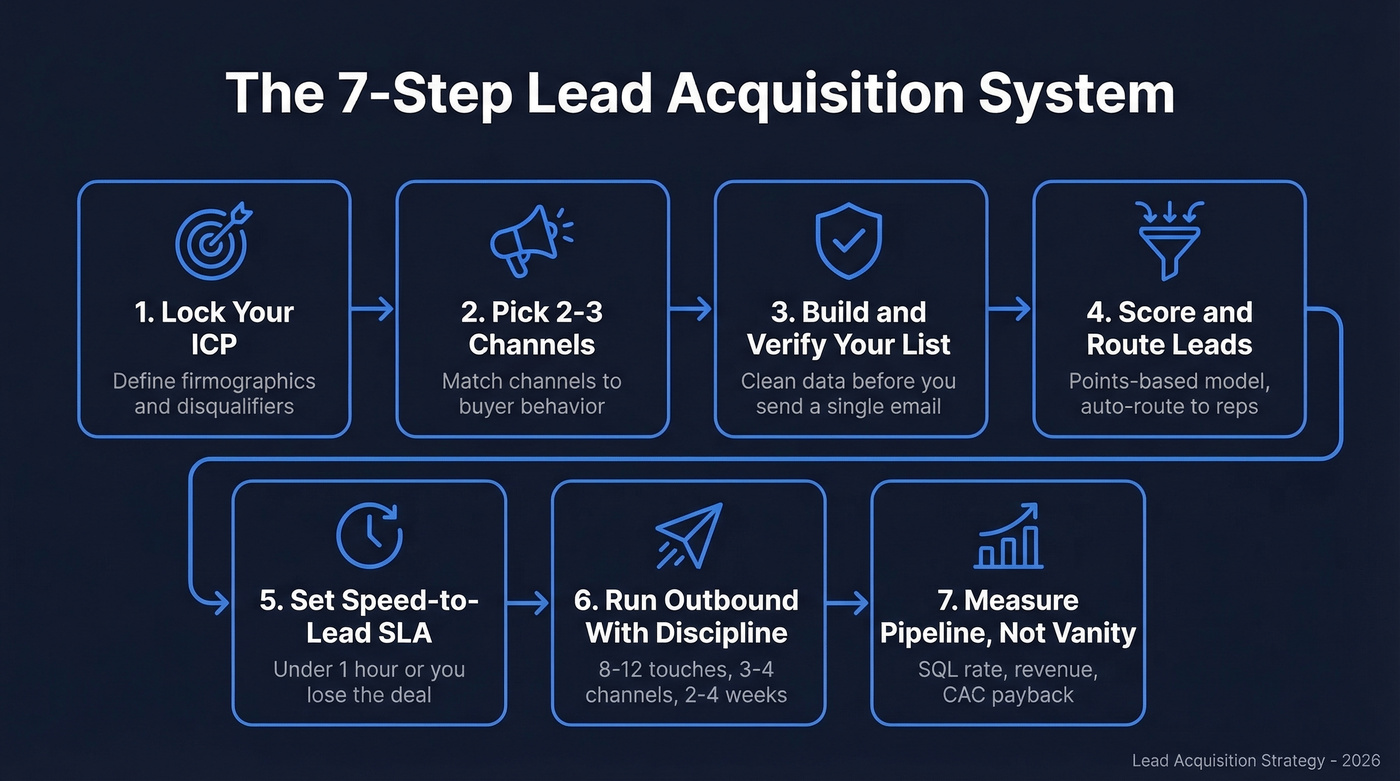
Build Your Strategy in 7 Steps
1. Lock Your ICP and Disqualifiers
Overly broad targeting is the most common mistake we see teams make. Casting a wide net feels productive, but it fills the funnel with contacts that never convert.
Start with firmographic criteria - industry, headcount, revenue, geography - then layer in behavioral signals like tech stack, hiring patterns, and funding events. Define your disqualifiers: the attributes that mean "don't waste a touch on this." Frame it as TAM to SAM to SOM: total addressable market, serviceable addressable market, then the slice you can actually win. If you can't articulate your disqualifiers in one sentence, your ICP isn't tight enough.
2. Choose 2-3 Channels (Not 7)
Companies using 3+ channels see 287% higher purchase rates than single-channel teams. But "multichannel" doesn't mean "every channel at once."
Some benchmarks to calibrate: paid search converts at about 3.75% for B2B, email marketing returns an average of 36x per dollar invested, and LinkedIn generates around 80% of B2B social media leads with InMail pulling 18-25% response rates - up to 3x standard email. For enterprise targets, direct mail still pulls 80-90% open rates and 3-5% response rates, worth testing if your deal size justifies the cost. Pick channels that match your ICP's buying behavior, not the ones that sound impressive in a board deck.
3. Build Your List and Verify It
None of the previous steps matter if your data is garbage. Hard bounce rates above 3% damage sender reputation, and once that's gone, even your best emails land in spam.
Here's the thing: we've watched teams spend months perfecting their messaging only to torch their domain reputation in the first week of sending because 15% of their list was dead addresses. The data layer isn't a nice-to-have. It's the foundation everything else sits on. Prospeo's proprietary 5-step verification - including catch-all handling, spam-trap removal, and honeypot filtering - keeps bounce rates well under that 3% threshold so the rest of your lead acquisition strategy actually delivers.

4. Score and Route Leads
Not every lead deserves a rep's time at the same moment. Build a point-based scoring model that weights behavior over demographics. A pricing page visit is worth more than an email open - especially now that email privacy changes have made open tracking unreliable.
Set an MQL threshold at 50 points and an SQL threshold at 80, then route automatically. We'll give you the full rubric below.
5. Set a Speed-to-Lead SLA
Conversion drops dramatically after one hour and is effectively gone after 24. This isn't a soft guideline - it's physics.
Automate alerts so that when a lead crosses your MQL threshold, the assigned rep gets a notification immediately. If your routing takes longer than an hour, you're leaking pipeline. Full stop.
6. Run Outbound With Discipline
Modern outbound isn't spray-and-pray. Run 8-12 touches over 2-4 weeks across 3-4 channels. Use dedicated cold-only domains, warm your inboxes for at least two weeks before sending, and cap volume at 30-50 sends per day per inbox. Set up SPF, DKIM, and DMARC on every sending domain. Google and Yahoo enforce a 0.3% spam complaint threshold - exceed it and your deliverability craters.
7. Measure Pipeline, Not Vanity
MQLs feel good in a dashboard. They mean almost nothing if they don't convert to conversations, pipeline, and revenue.
Shift your reporting to what matters: SQL conversion rate, pipeline created, closed-won revenue, and CAC payback period. If you can't trace a lead from first touch to closed deal, your measurement system has a hole. Let's be honest - most teams can't do this, and that's why they keep throwing money at channels that look busy but produce nothing.

You just read why data quality is the foundation of every lead acquisition strategy. Prospeo gives you 300M+ profiles with 98% email accuracy, 5-step verification, and a 7-day refresh cycle - so your sequences hit real inboxes instead of destroying your domain. Teams using Prospeo book 26% more meetings than ZoomInfo users and keep bounce rates under 4%.
Stop building strategy on bad data. Verify before you send.
CPL Benchmarks by Industry
Use these to sanity-check your spend. If you're paying $500 per lead in B2B SaaS, you're likely overpaying or buying low-quality leads. In financial services, $653 blended is normal.
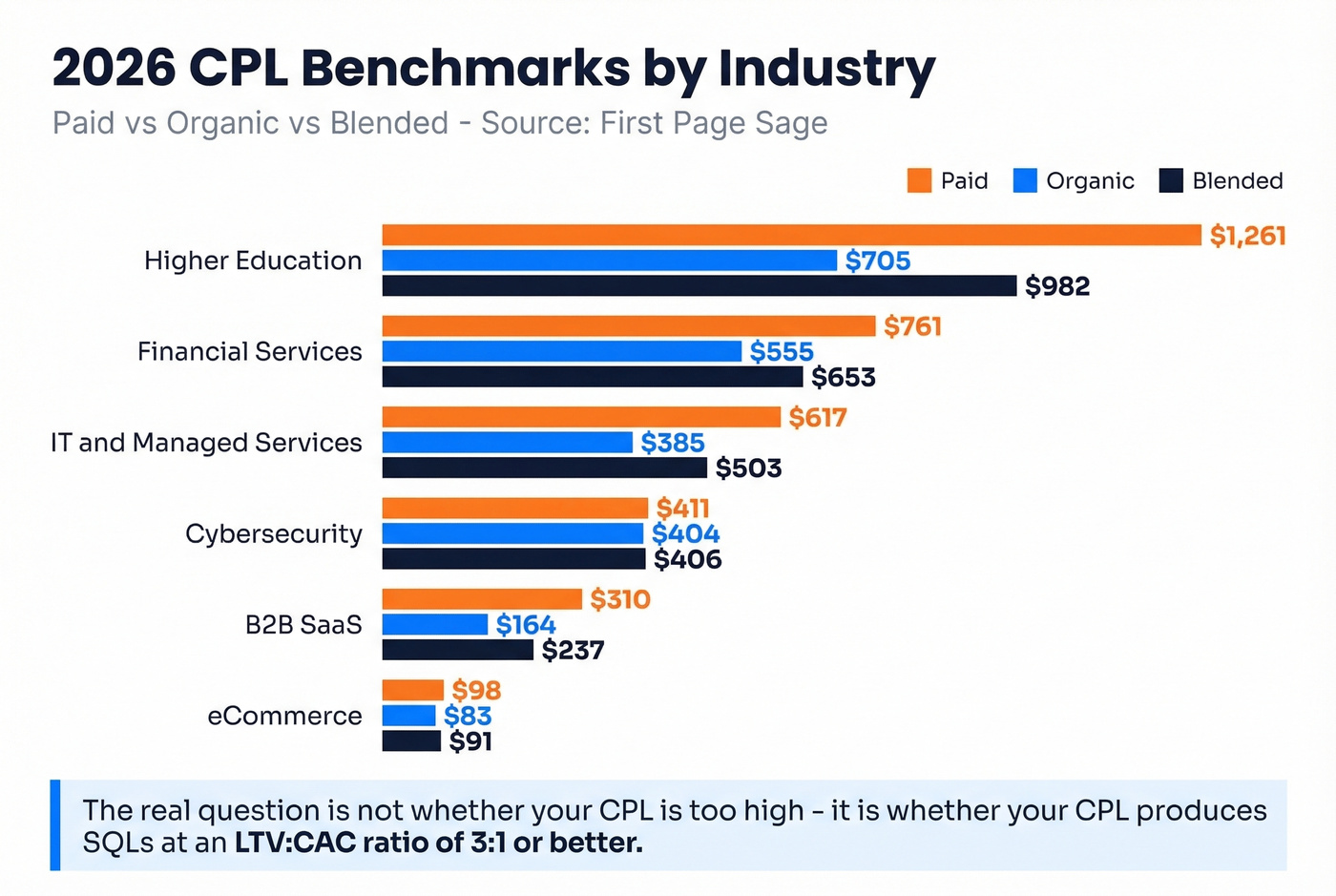
| Industry | Paid CPL | Organic CPL | Blended CPL |
|---|---|---|---|
| B2B SaaS | $310 | $164 | $237 |
| Cybersecurity | $411 | $404 | $406 |
| IT & Managed Services | $617 | $385 | $503 |
| Financial Services | $761 | $555 | $653 |
| eCommerce | $98 | $83 | $91 |
| Higher Education | $1,261 | $705 | $982 |
Data from First Page Sage's 2026 CPL report. The better question isn't "is my CPL too high?" - it's "does my CPL produce SQLs at an LTV:CAC ratio of 3:1 or better?"
A Scoring Rubric You Can Copy
Most teams know they need lead scoring. Few have actually built one. Here's a concrete model based on Belkins' HubSpot implementation you can adapt today.
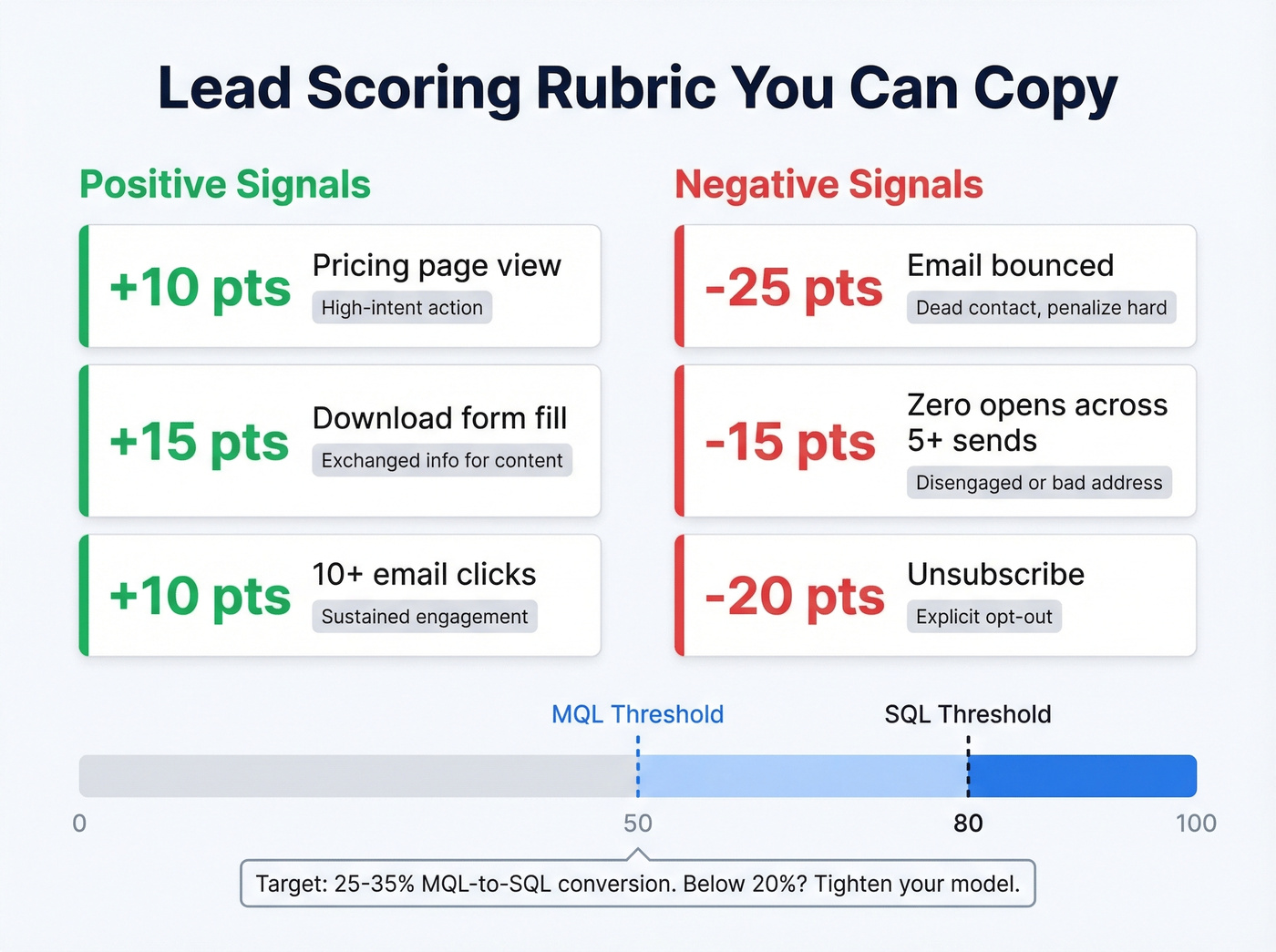
| Signal | Points | Rationale |
|---|---|---|
| Pricing page view | +10 | High-intent action |
| Download form fill | +15 | Exchanged info for content |
| 10+ marketing email clicks | +10 | Sustained engagement |
| Email bounced | -25 | Dead contact, penalize hard |
| 0 opens across 5+ sends | -15 | Disengaged or bad address |
| Unsubscribe | -20 | Explicit opt-out |
Set MQL at roughly 50 points, SQL at 80. Weight on-site behavior over email engagement - open tracking is unreliable post-Apple Mail Privacy Protection. A lead who visited your pricing page twice and filled out a form is worth more than one who opened ten newsletters.
For calibration, strong B2B teams see 25-35% MQL-to-SQL conversion rates. If yours is below 20%, your scoring model needs tightening. In our experience, the most common fix is penalizing dead signals harder - that -25 for a bounced email isn't aggressive enough for some teams.
ROI Math That Works
Net New ARR = SQLs x Close Rate x ACV
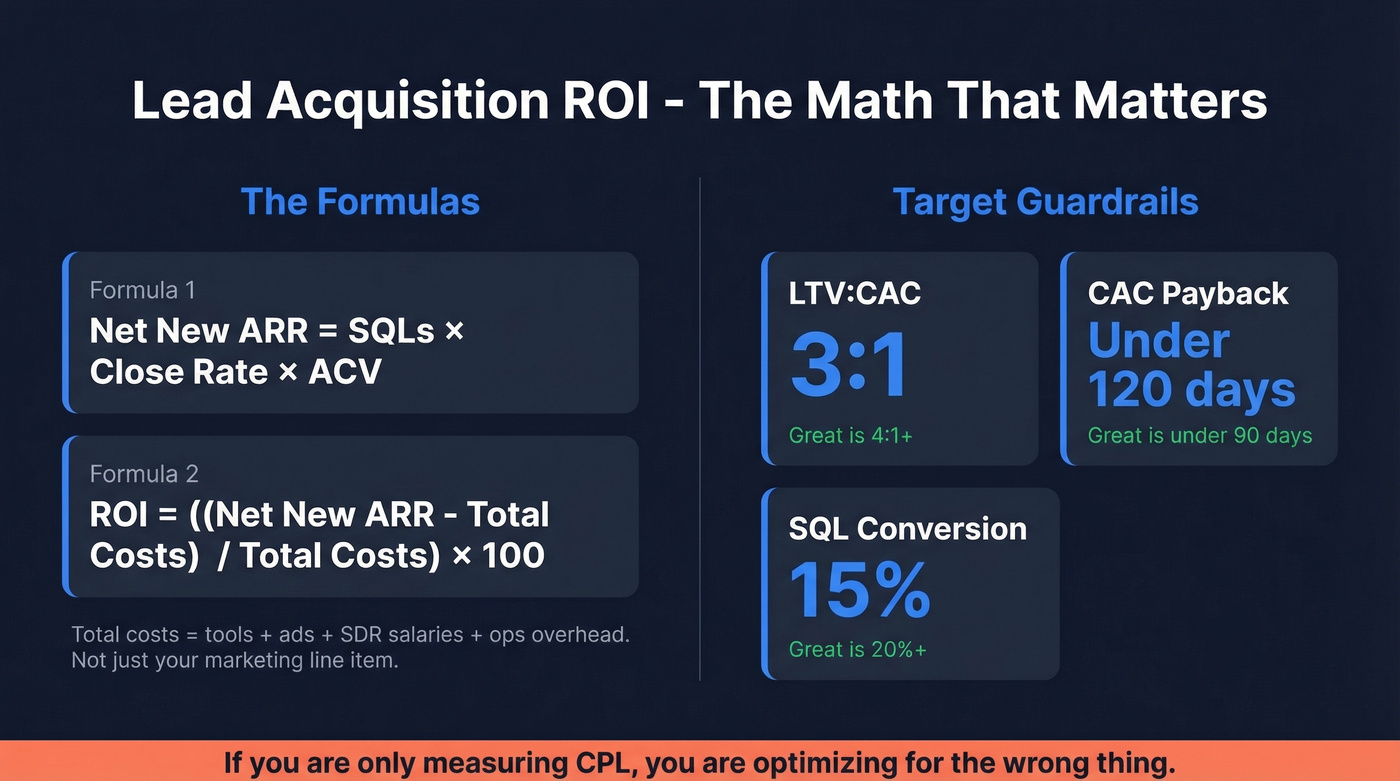
ROI = [(Net New ARR - Total Costs) / Total Costs] x 100
Total costs means everything: tool spend, ad budget, SDR salaries, ops overhead. Not just your marketing line item.
Target guardrails: LTV:CAC of 3:1 (great is 4:1+), CAC payback under 120 days (great is under 90), and SQL conversion rate of 15% (great is 20%+). Track the full chain - true cost to pipeline created to revenue closed to payback period. If you're only measuring CPL, you're optimizing for the wrong thing.
Look - if your average contract value sits below $10k, you probably don't need a $30k/year data platform. A self-serve tool with verified data and a $99/month sequencer will outperform an enterprise stack that nobody on your team fully uses.
Your Minimum Viable Stack
You don't need 12 tools. You need five categories covered.
| Category | Tool | Starting Price |
|---|---|---|
| CRM | HubSpot | Free-$15/user/mo |
| CRM (enterprise) | Salesforce | From $25/user/mo |
| Outreach automation | Reply.io | ~$99/mo |
| Routing + scheduling | Default | ~$500/mo |
| Data + verification | Prospeo | ~$0.01/email, free tier |
| Analytics | GA4 | Free |
The data layer is where most stacks fall apart. You can have the best CRM and the slickest sequences, but if 15% of your emails bounce, none of it matters. Skip enterprise data platforms if your team is under 10 reps - you'll pay for features you won't touch and get locked into annual contracts that don't make sense at your scale.
A lead acquisition strategy without scoring, routing, and clean data is just a channel list. Prospeo combines 30+ search filters - buyer intent, technographics, job changes, funding - with 143M+ verified emails so you can target your exact ICP, score on real signals, and route leads that actually convert. All self-serve, no contracts, starting at $0.01 per email.
Target, verify, and route - all from one platform.
FAQ
What's the difference between lead acquisition and lead generation?
Lead generation captures interest through forms, downloads, and webinars. Lead acquisition is the full system - targeting, capturing, scoring, routing, and measuring leads through to a sales conversation. Generation is one step inside acquisition.
How much should a B2B lead cost?
B2B SaaS averages $237 blended CPL; eCommerce averages $91; higher education runs nearly $1,000. The real question: does your CPL produce SQLs at an LTV:CAC ratio of 3:1 or better? A $500 lead that closes a $50k deal is cheap.
How do I keep outbound from hurting my domain?
Use dedicated cold-only domains, warm inboxes for 2+ weeks, cap sends at 30-50 per day per inbox, and verify every email before sending. Add SPF, DKIM, and DMARC authentication on every sending domain. The consensus on r/coldemail is that bounce rates above 3% are where sender reputation starts degrading - and once it's damaged, recovery takes weeks.