

Best Lead Capture Tools in 2026: Real Pricing, Real Opinions
You ran a webinar last quarter. 400 registrations. Marketing high-fived. Then you loaded the list into your sequencer and 35% bounced. The "leads" were garbage - typos, disposable emails, people who typed asdf@gmail.com to get the recording.
Choosing the right lead capture tool isn't a form design problem. It's a data quality problem, and most guides completely ignore that half of the equation.
The right capture mechanism for your channel, paired with verification that keeps your sender reputation intact - that's what actually moves pipeline. Here's every tool worth paying for, with real pricing, real limits, and the opinions most articles are too polite to include.
Our Top Picks
| Use Case | Pick | Starting Price | One-Line Verdict |
|---|---|---|---|
| Best for most teams | HubSpot Marketing Hub | Free (paid from $9/seat/mo billed annually) | Forms + CRM + email in one place, free tier is legit |
| Best for verified B2B data | Prospeo | Free (paid ~$0.01/email) | 98% email accuracy, no contracts, self-serve |
| Best for conversion optimization | OptinMonster | $7/mo (intro, billed annually) | Exit-intent popups that actually move numbers |
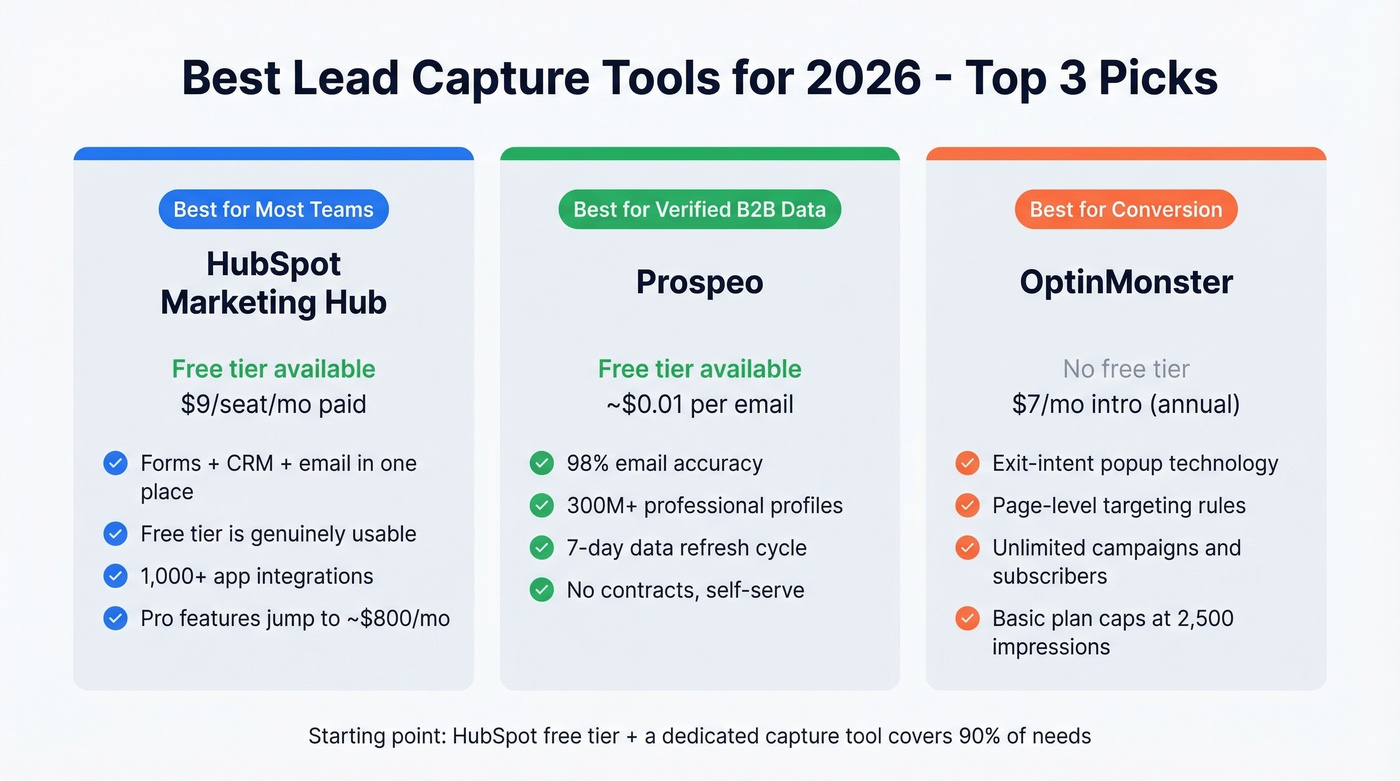
If you're only going to test one tool, HubSpot's free tier is the no-brainer starting point. If you're doing outbound and need verified contacts - not form fills - Prospeo is the pick. And if your site traffic converts below 2%, OptinMonster's targeting rules will move the needle faster than redesigning your landing page.
What Good Conversion Rates Actually Look Like
Before you blame your tools, calibrate expectations. Unbounce analyzed 41,000 landing pages across 464M pageviews and found a median conversion rate of 6.6%. Sounds great until you look at the SaaS median: 3.8%.
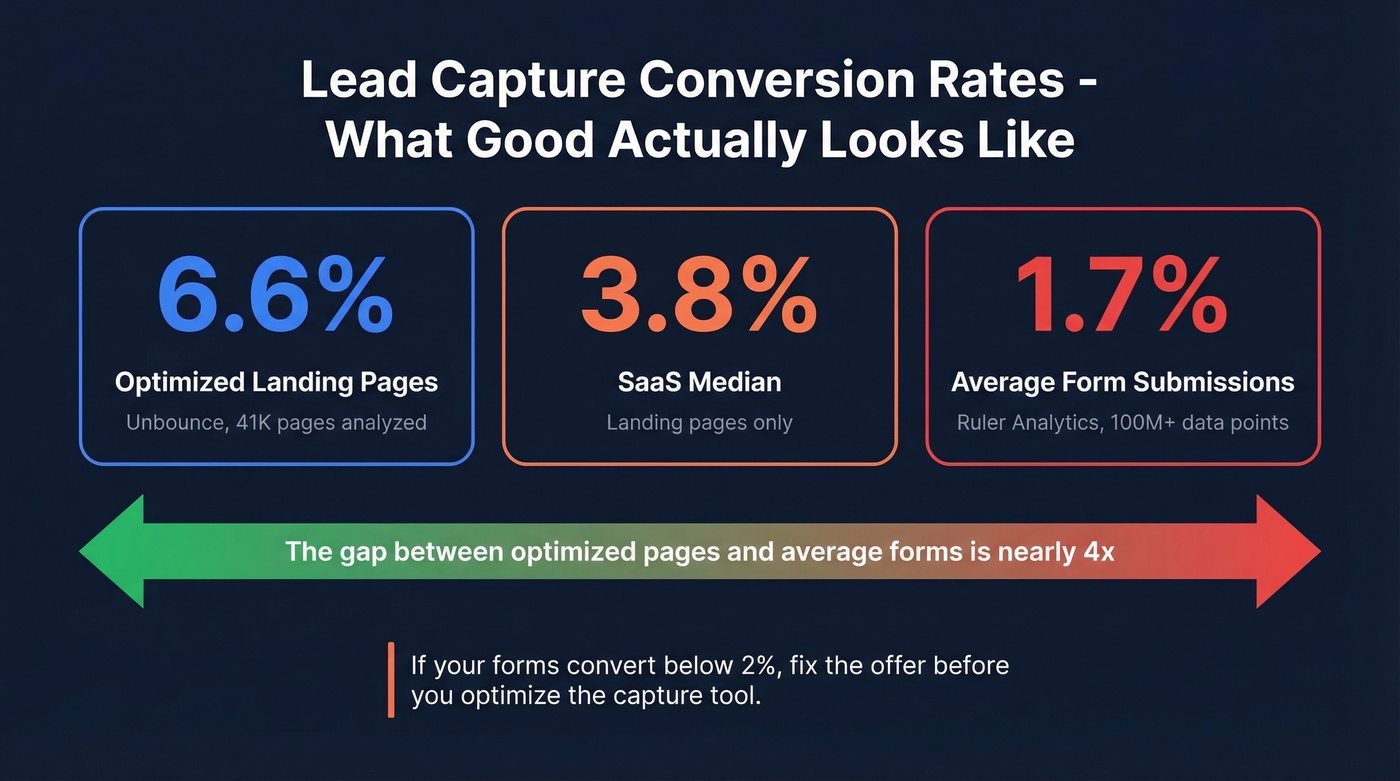
Ruler Analytics tells a different story when you zoom out. Across 100M+ data points and 14 industries, the average conversion rate drops to 2.9%, with form submissions specifically averaging 1.7%.
That gap - 6.6% on optimized landing pages vs. 1.7% on average forms - is the most important benchmark in this entire article. If your forms convert below 2%, no amount of exit-intent popups will fix a weak lead magnet. Get the offer right first, then optimize the capture mechanism.
Best Lead Capture Software by Category
HubSpot Marketing Hub - Best All-in-One
Use this if you need forms, email, and a CRM in one place and don't want to duct-tape five tools together. The free tier is genuinely usable - forms, contact management, and basic reporting. For a startup or small team, it's the obvious starting point.
Skip this if you need advanced reporting, custom workflows, or deeper automation. Those features sit behind the Professional plan (typically around $800/mo) - a massive jump from the $9/seat/mo Starter tier. We've watched teams sign up for Starter thinking they'll grow into it, only to hit a paywall the moment they need a branching workflow.
HubSpot's toolkit includes forms, landing pages, and chatbots that sync captured contact info into your CRM, plus a drag-and-drop editor for building forms. The App Marketplace has 1,000+ pre-built integrations. As a platform, it's the closest thing to a single-vendor solution for teams that want everything under one roof.
For most teams under 10 people, the free tier plus a dedicated capture tool like OptinMonster covers 90% of what you need.
Prospeo - Best for Verified B2B Data
Most guides only cover inbound - forms, popups, chatbots. That misses half the picture. Prospeo is for teams that don't wait for form fills. They find verified contacts matching their ICP and push them straight into sequences.
The database covers 300M+ professional profiles with 143M+ verified emails and 125M+ verified mobile numbers. Email accuracy runs 98%. Snyk's team validated this firsthand: bounce rates dropped from 35-40% to under 5% after switching, generating 200+ new opportunities per month. Data refreshes every 7 days, compared to the 6-week industry average.
Search filters go deep - 30+ options including buyer intent powered by Bombora across 15,000 topics, technographics, job changes, headcount growth, and funding signals. Export verified contacts and push them to Salesforce, HubSpot, Smartlead, Instantly, Lemlist, or Clay through native integrations. The free tier gives you 75 verified emails and 100 Chrome extension credits monthly. Paid plans run ~$0.01 per email with no contracts and no sales calls required.

OptinMonster - Best for On-Site Conversion
Use this if you have existing site traffic and want to convert more of it. OptinMonster's exit-intent technology and page-level targeting rules are the best in the popup category - different offers based on referral source, page visited, time on site, or scroll depth.
Skip this if you need more than 2,500 campaign impressions per month. The Basic plan ($7/mo intro pricing billed annually) caps at 2,500 campaign impressions on one site. You'll hit the ceiling fast.
Pricing scales by sites and impressions: Plus at $19/mo (2 sites, 10K impressions), Pro at $29/mo (3 sites, 25K), Growth at $49/mo (5 sites, 100K). All plans include unlimited campaigns and subscribers. These are annual intro prices - renewals run higher.
Leadpages - Simple Landing Pages
Clean drag-and-drop builder, unlimited traffic and leads on all plans, and a 14-day free trial. The Pro plan ($74/mo monthly, or $99/mo billed annually) unlocks unlimited landing pages and 3 custom domains.
The catch most articles skip: the Standard plan ($37/mo monthly, $49/mo billed annually) caps you at 5 landing pages and 1 domain. If you're running multiple campaigns, you'll outgrow Standard in a month.
For teams that need a few high-converting landing pages without learning Unbounce's more complex builder, Leadpages is the simpler, cheaper option.
Unbounce - Best for A/B Testing
Unbounce earns its premium pricing if - and only if - you're running enough traffic to test variants. Below 5,000 monthly visitors, you won't get statistically significant results fast enough to justify the cost. Above that threshold, it's the best A/B testing in the landing page category, with Smart Traffic AI that auto-routes visitors to higher-converting variants and unlimited conversions on all plans.
The Starter plan at $29/mo caps at 500 visitors and 5 pages - that's a test drive, not a plan. If you're running paid traffic, start at Build ($99/mo, 20K visitors). Annual billing saves 25%, bringing Build down to $74/mo.
Typeform - The $0.39-Per-Response Form
Use this if you need the most polished form experience on the market. The one-question-at-a-time format drives higher engagement for complex lead qualification, and it integrates with everything via Zapier.
Skip this if you're cost-conscious at scale. Basic runs $39/mo for 100 responses - that's $0.39 per response before you've done anything with the lead. Plus ($79/mo) gets 1,000 responses, Business ($129/mo) gets 10,000. The free plan caps at 10 responses per month, which is essentially useless.
At 500 responses a month, you're on Plus minimum. For simple capture, Jotform or HubSpot's free forms do the job at a fraction of the cost.
Intercom - Chat-Based Capture
For SaaS companies with high-intent website visitors, chat capture converts faster than forms. Intercom's Fin AI agent qualifies leads 24/7 through conversational chat, and the Essential plan at $29/seat/mo includes unlimited live chat with a 14-day free trial.
Here's the thing about Intercom's pricing: the $0.99 per Fin AI resolution fee sneaks up on you. Model your volume before committing. 1,000 AI conversations per month costs an extra $990 - nearly doubling your bill for a single seat. Add-ons like Copilot ($29/agent/mo) and Pro AI features ($99/mo) stack fast. Advanced ($85/seat/mo) and Expert ($132/seat/mo) tiers add analytics and workflow features, but the per-resolution cost stays.
Jotform - Best Free Form Builder
Jotform's free plan gives you 5 forms and 100 submissions per month - enough for a small business testing lead capture forms for the first time. Paid plans start at ~$19.50/mo billed annually with 10,000+ templates. Not fancy, but it works.
Leadfeeder (Dealfront) - Visitor Identification
Leadfeeder identifies companies visiting your site even when nobody fills out a form. The free plan shows the last 7 days of data; paid starts at $99/mo. If you're running ABM and want to know which target accounts are browsing your pricing page, this fills a gap no form tool can.
Tidio - Budget Chat Widget
Starting at $25/user/mo with a free plan and a 7-day trial, Tidio is the budget alternative to Intercom for small teams that want live chat without the AI pricing complexity. It won't qualify leads as intelligently, but it captures them.
QuickTapSurvey - Best for Events
From $19/mo. If you're capturing leads at trade shows and conferences on tablets, QuickTapSurvey is the niche lead capture app built specifically for that workflow - offline data collection, badge scanning, and instant CRM sync.
We also evaluated LeadsBridge, LeadBoxer, and AeroLeads but found them too niche or too expensive for most teams compared to the tools above.

Your lead capture forms are only as good as the data behind them. While 35% of webinar leads bounce, Prospeo's 300M+ database delivers 98% email accuracy with 7-day refresh cycles - so every contact you capture is real, verified, and reachable.
Skip the junk leads. Start with verified contacts at $0.01 each.
Pricing Comparison Table
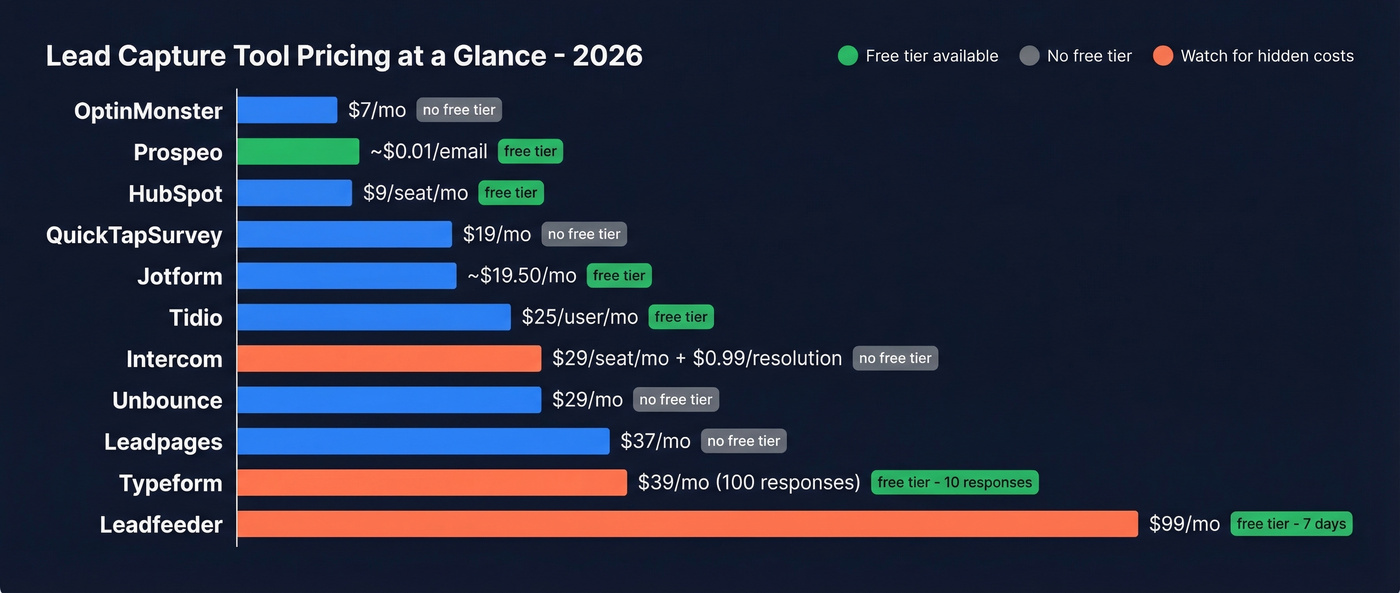
Every tool's starting price, free tier status, and the limit that actually matters - in one table.
| Tool | Starting Price | Free Tier | Key Limit | Best For |
|---|---|---|---|---|
| HubSpot | $9/seat/mo (annual) | Yes | Pro features ~$800/mo | All-in-one CRM + forms |
| Prospeo | ~$0.01/email | Yes | 75 emails/mo on free | B2B data & verification |
| OptinMonster | $7/mo (annual intro) | No | 2,500 impressions (Basic) | On-site popups |
| Leadpages | $37/mo | No (14-day trial) | 5 pages on Standard | Simple landing pages |
| Unbounce | $29/mo | No (14-day trial) | 500 visitors on Starter | A/B testing pages |
| Typeform | $39/mo | Yes (10 responses) | 100 responses on Basic | Conversational forms |
| Intercom | $29/seat/mo | No (14-day trial) | +$0.99/Fin resolution | Chat-based capture |
| Jotform | ~$19.50/mo (annual) | Yes | 5 forms, 100 subs on free | Free form builder |
| Leadfeeder | $99/mo | Yes (7 days data) | Historical data on free | Visitor identification |
| Tidio | $25/user/mo | Yes | Varies by tier | Budget chat widget |
| QuickTapSurvey | $19/mo | No | Basic plan features | Event lead capture |
The Data Quality Problem Nobody Mentions
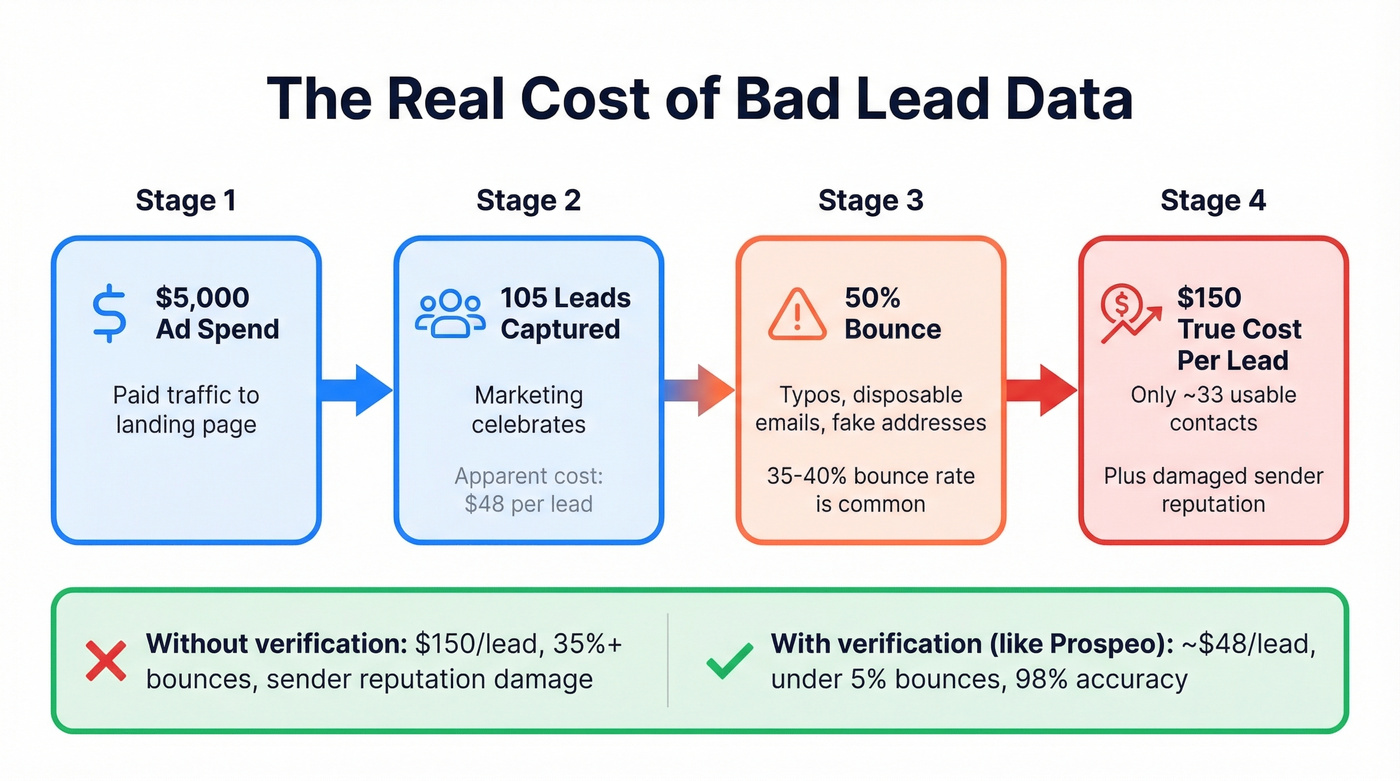
Let's be honest about what actually happens. A team spends $5,000 on ads driving traffic to a landing page. They capture 105 leads. Marketing celebrates. Then sales loads the list and half the emails bounce. The real cost per lead wasn't $48 - it was closer to $150, and the bounces just dinged their domain reputation.
The consensus on r/LeadGeneration is blunt about this: Apollo is a "jack of all trades, master of none" with user-populated data that isn't independently verified. Practitioners recommend verifying exported data separately with at least two tools.
Some tools verify at the point of capture, which helps with outbound lists. But inbound form data - typos, disposable emails, people gaming your lead magnet - can't be caught at entry. Post-capture verification is still essential. Run every captured list through a verification tool before outreach. Stack Optimize built their agency to $1M ARR using this approach: client deliverability stays above 94%, bounce rates under 3%, zero domain flags across all clients.
Our hot take: most teams overspend on lead capture software and underspend on data hygiene. A $7/mo popup tool feeding verified contacts into a free CRM will outperform a $500/mo marketing suite full of unverified garbage. The tool that captures the lead matters less than what happens to the data afterward.

Forms convert at 1.7% on average. Why wait for inbound when you can find verified decision-makers matching your ICP right now? Prospeo's 30+ filters - intent data, technographics, job changes - let you build pipeline without a single form fill.
Capture leads proactively. 75 free verified emails to start, no contract required.
How to Improve Your Capture Rate
Three changes you can make today, backed by Typeform's lead capture form report analyzing 10,000 forms:
- Use exclusivity wording. Phrases like "limited access" or "invitation only" correlated with a 10.6% increase in completion rates. People want what feels scarce.
- Add hidden fields. Forms using hidden fields for UTM parameters, referral source, and page URL saw a 4.8% completion lift. Fewer visible fields means less friction, while hidden fields still capture the data you need for routing and attribution.
- Remove questions from your welcome screen. Putting a question on the first screen correlated with a 5% decrease in completion. Lead with the value proposition, not the ask.
These aren't tool-specific. They work whether you're using Typeform, HubSpot, Jotform, or a custom form. The biggest capture rate gains come from offer and copy changes, not tool switches.
How to Choose the Right Stack
You need 2-3 tools max, not 11.
Inbound capture? Start with HubSpot's free tier for forms and CRM, then add OptinMonster if you want popup-level conversion optimization. That combination covers 80% of inbound use cases for under $30/mo.
Outbound lead sourcing? Find verified contacts matching your ICP, push them to your sequencer, skip the form-fill-and-pray approach entirely.
Both? Combine them. HubSpot handles inbound capture and CRM. A B2B data tool handles outbound and verification. OptinMonster optimizes on-site conversion. Three tools, full coverage, under $100/mo total on starter tiers.
One more thing worth flagging: speed matters. Average B2B response windows sit around 47 hours - so automate the handoff from capture to outreach. Leads dying in a spreadsheet is the most expensive leak in your funnel, and we've seen teams lose 30-40% of their qualified pipeline to slow follow-up alone. If you want a tighter process, start with a simple lead generation workflow and a set of sales follow-up templates.
FAQ
What is a lead capture tool?
Software that collects contact information from prospects through forms, popups, chatbots, landing pages, or B2B databases. The category spans everything from a simple email signup form to a prospecting platform that finds verified contacts proactively - no form fill required.
What's a good form conversion rate?
The median landing page conversion rate is 6.6% across 41,000 pages (Unbounce). Average form submission rate across industries is 1.7% (Ruler Analytics, 100M+ data points). Below 2% usually means the offer needs work, not the tool.
Are free lead capture tools worth using?
Yes. HubSpot's free tier covers forms and CRM for unlimited contacts. Jotform's free plan handles 5 forms and 100 submissions monthly. Prospeo's free tier includes 75 verified emails plus 100 Chrome extension credits. All three are genuinely usable for small teams, not just demos.
How do I verify leads after capturing them?
Run your list through a dedicated verification service before any outreach. Multi-step verification catches invalid addresses, spam traps, and honeypots - reducing bounce rates to under 5%. This protects your domain reputation and keeps sequences out of spam folders.
Do I need a CRM alongside capture software?
Not strictly. Most tools - OptinMonster, Typeform, Jotform - export to CSV or connect via Zapier. But a free CRM like HubSpot makes follow-up dramatically easier and prevents leads from dying in a spreadsheet.