

The Practitioner's Guide to AI Lead Generation Agents in 2026
Your VP just said "look into AI agents for lead gen," and now you're staring at a market that can't even agree on what the term means. On Reddit, practitioners are openly asking whether a lead generation agent means cold email automation, an AI-powered agency, or something else entirely. 62% of organizations are experimenting with AI agents for lead generation, yet only 23% have scaled them. That gap between hype and execution is massive.
Here's the thing: the agent itself is the least important part of your stack. The data feeding it determines whether you build pipeline or burn your domain. Most teams get this backwards, and we've watched it happen over and over.
What Is a Lead Generation Agent?
Let's clear up the confusion. "Lead generation agent" in 2026 means three completely different things depending on who's talking:
AI software agent - an autonomous system that researches prospects, qualifies leads, and executes outreach sequences with minimal human oversight. This is what we're covering here.
Lead gen agency - a service company, sometimes AI-powered, that generates leads on your behalf for a monthly retainer.
Human sales agent - a person in real estate or insurance whose job title literally includes "agent."
The difference between an AI agent and traditional automation matters more than most people realize. Traditional automation runs pre-programmed sequences: if X, then Y. An AI agent makes independent decisions based on real-time context - it learns which messaging resonates, adjusts timing, and handles exceptions without waiting for a human to update a workflow.
The practical impact is speed. Context-building on a prospect - company size, tech stack, recent funding, org chart - takes a human 30-45 minutes. An AI agent does it in seconds. Multiply that across 200 prospects a day, and you're looking at a completely different operating model.
The Reddit skepticism is warranted, though. As one r/SaaS thread put it, companies "throw AI at their existing process and hope something sticks." An agent layered on bad data and broken workflows just fails faster.
Types of AI Lead Gen Agents
Not all agents do the same job. Here's the taxonomy that actually matters.
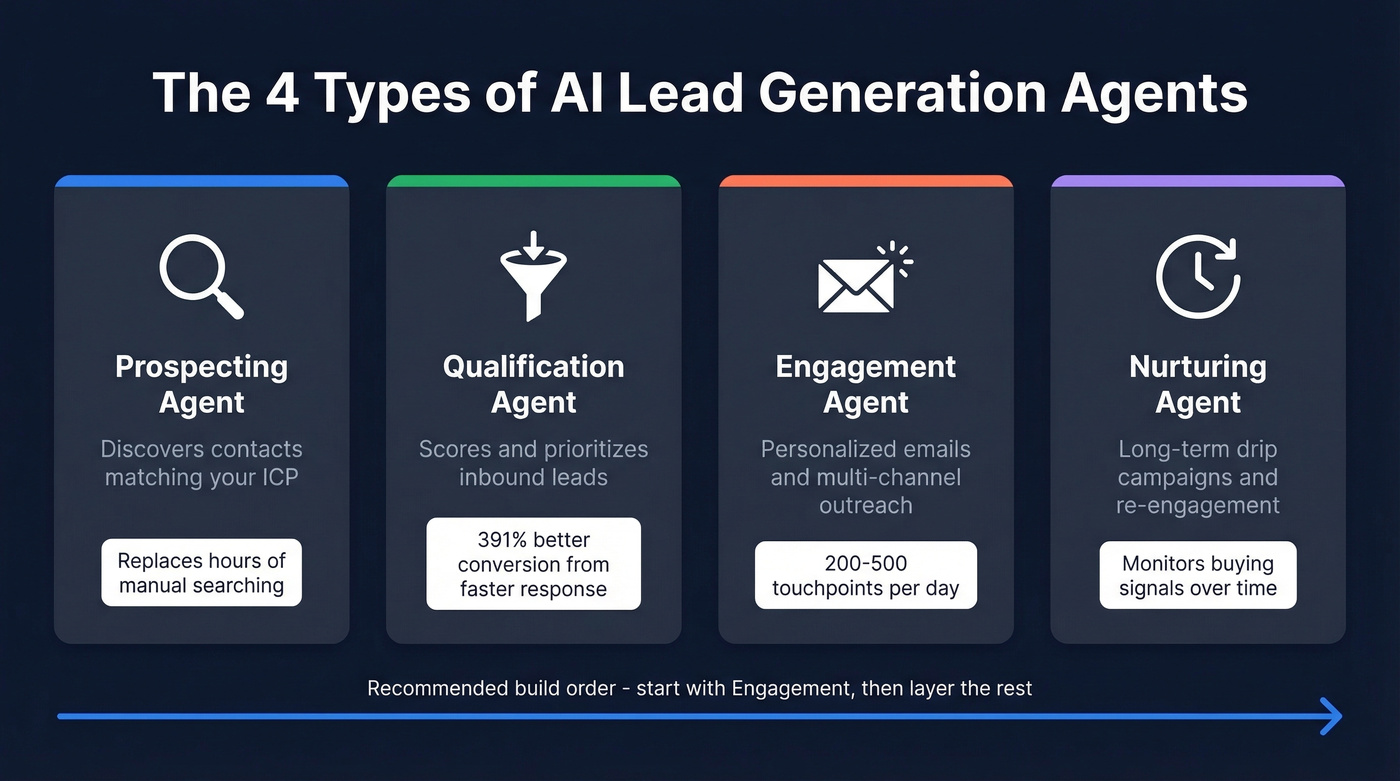
Prospecting agents are the workhorses. They scour databases, websites, and professional profiles to build targeted lead lists matching your ICP, replacing the hours reps spend manually searching and filtering. Think of them as your AI-powered discovery engine, surfacing contacts that match your exact criteria without a human touching a search bar.
Qualification agents solve the response-time problem. How many inbound leads does your team ignore because nobody gets back fast enough? These agents score and prioritize leads using firmographic, behavioral, and intent signals, routing hot prospects to reps instantly while nurturing the rest automatically. Benchmarks show a 391% improvement in conversion rates just from faster response times.
Engagement agents deliver the highest immediate ROI for most teams. They handle personalized emails, follow-up sequences, and multi-channel touchpoints at a scale no human SDR can match - 200-500 touchpoints daily versus 30-50. Start here if you're building from scratch.
Nurturing agents play the long game, managing prospects who aren't ready to buy yet. They drip relevant content, monitor buying signals, and re-engage when intent spikes. Add these once your prospecting and engagement agents are running smoothly.
AI Agent vs Human SDR
Let's put real numbers on this.
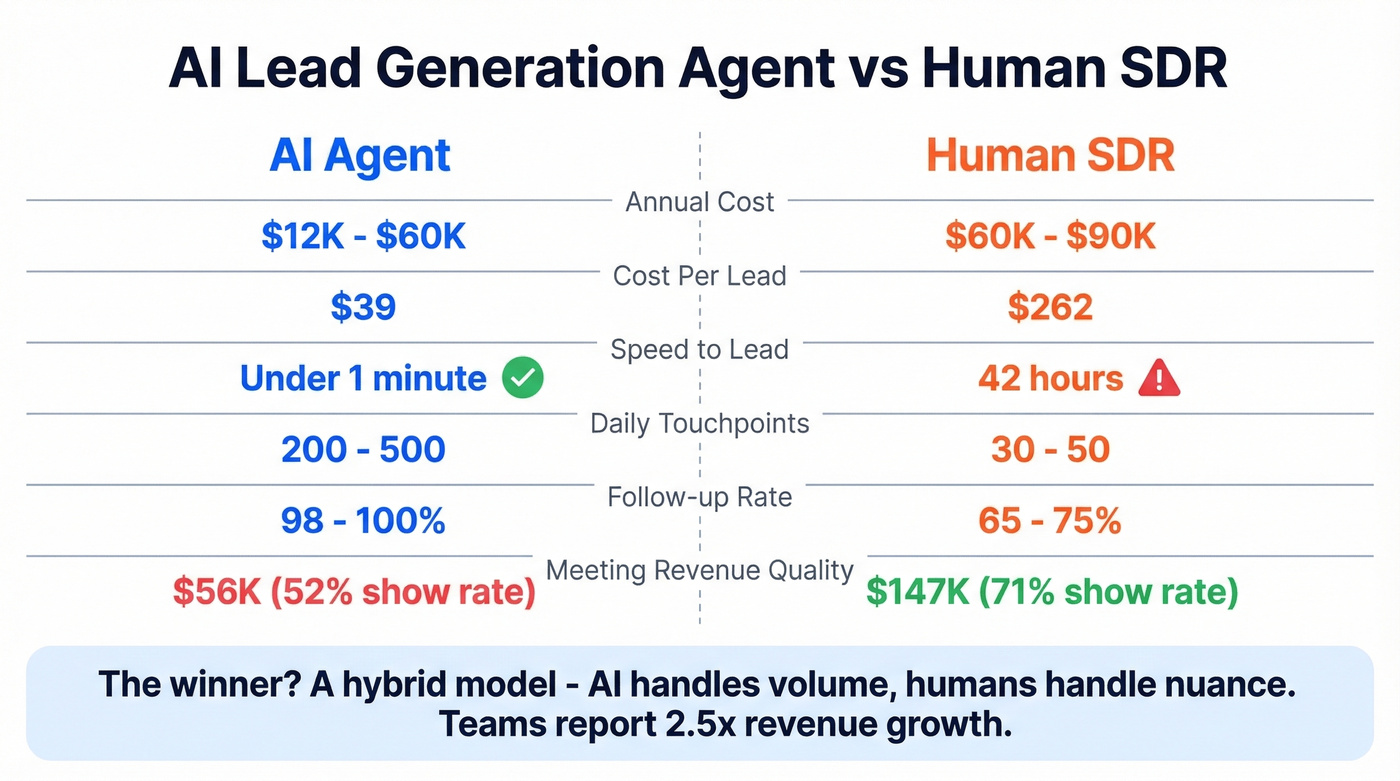
| Metric | AI Agent | Human SDR |
|---|---|---|
| Annual cost | $12K-$60K | $60K-$90K |
| Cost per lead | ~$39 | ~$262 |
| Speed to lead | <1 minute | ~42 hours |
| Daily touchpoints | 200-500 | 30-50 |
| Follow-up rate | 98-100% | 65-75% |
| Annual attrition | 0% | 30-40% |
Sources: UserGems, LeadsAtScale
The speed-to-lead gap is the killer stat. Responding within 5 minutes yields 21x higher qualification rates than waiting 30 minutes. Most human SDR teams average 42 hours. That's not a performance gap - it's a different sport.
But AI agents aren't universally better. In one experiment tracked from July 2025 to January 2026, AI was 54x cheaper but human SDRs generated $147K in revenue versus $56K from AI. Meeting show rates were 71% for human-booked versus 52% for AI-booked. Complex enterprise deals still need a human who can read a room.
The hybrid model wins. Teams running AI for initial outreach and humans for high-value conversations report 35% productivity boosts, 25% more SQLs, 30% shorter sales cycles, and 2.5x revenue growth. Greenhouse saw chat-to-meeting conversion jump from 20% to 50-70% after deploying AI agents for inbound engagement. AI handles volume. Humans handle nuance.
The Data Quality Problem
Here's where most AI agent deployments actually fail - and it's not the AI's fault.
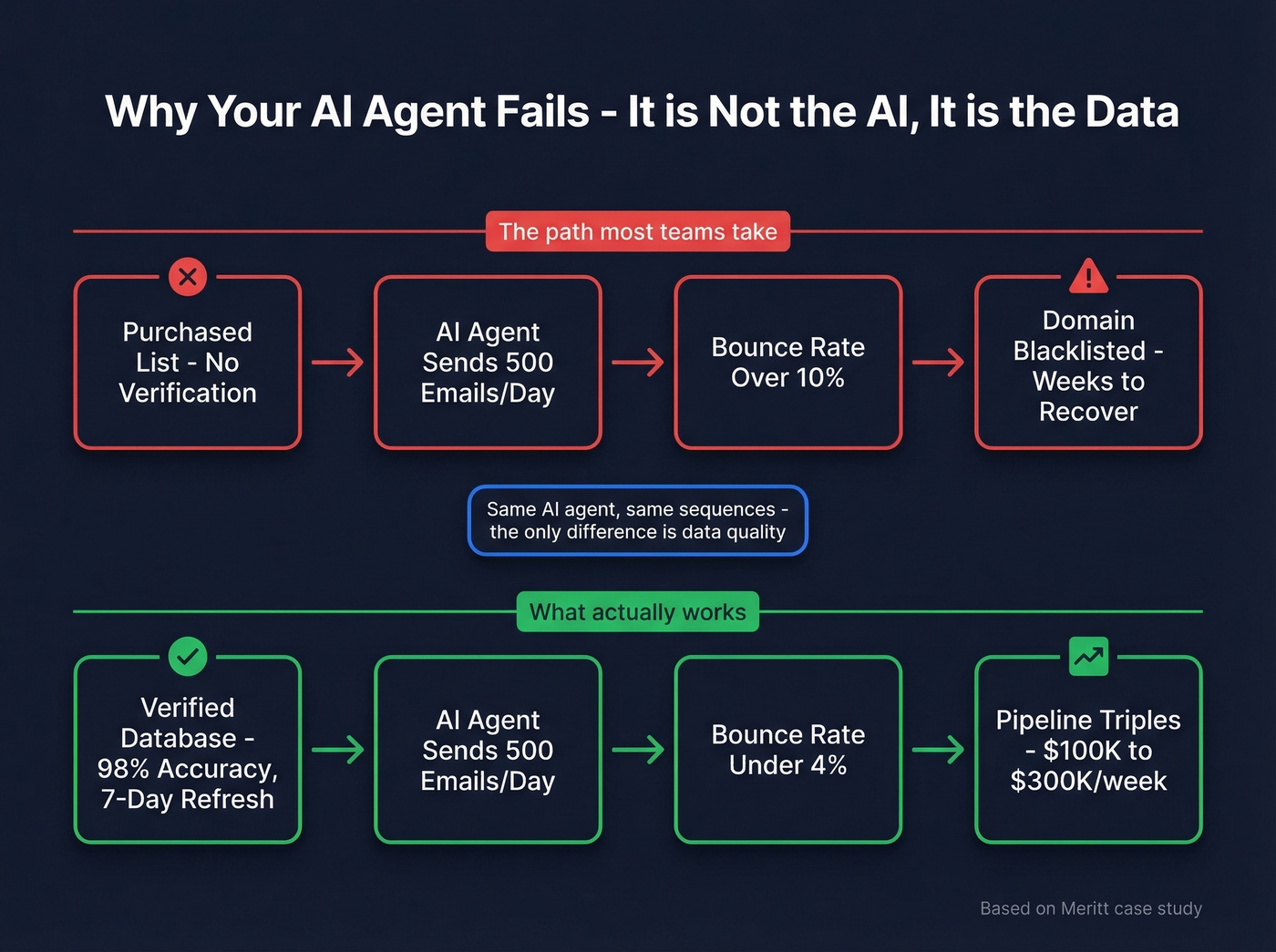
An agent sending 500 personalized emails a day to unverified addresses doesn't scale your pipeline. It scales your domain reputation damage. Bounce rates above 5% trigger spam filters. Above 10%, you're looking at domain blacklisting that takes weeks to recover from. We've seen teams torch their sender reputation in a single week because they fed an AI agent a purchased list with no verification.

This is why the data layer matters more than the agent layer. A database with 98% email accuracy and a 7-day refresh cycle catches job changes and role shifts that a 6-week refresh cycle misses entirely. That freshness gap is enormous when you're running automated sequences - a contact who changed jobs three weeks ago is a bounced email waiting to happen.
The proof is in the results. Meritt went from a 35% bounce rate to under 4% after switching their data layer, and pipeline tripled from $100K to $300K/week. That's not an AI improvement. It's a data quality improvement that made everything downstream work.

Your lead generation agent will scale whatever you feed it - including bad data. Prospeo's 98% email accuracy and 7-day refresh cycle mean your AI sends to real people at current companies, not bounced addresses that torch your domain.
Stop letting stale data sabotage your AI agent's outreach.
Best Platforms for Building Your Stack
Prospeo
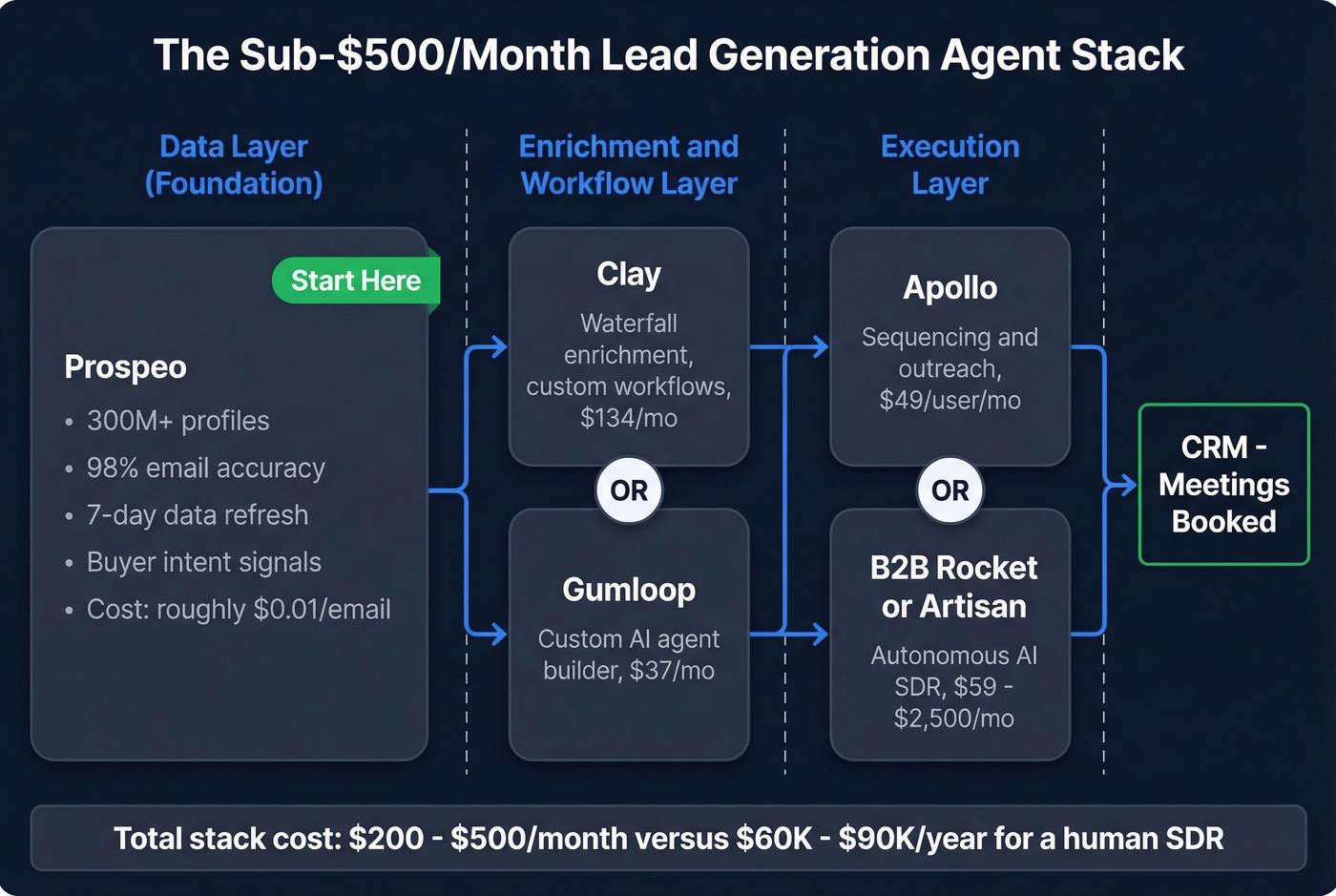
Every other tool on this list needs clean data to function. Prospeo is where that data comes from. The B2B database covers 300M+ profiles with 143M+ verified emails and 125M+ verified mobile numbers. You get 30+ search filters including buyer intent powered by Bombora across 15,000 topics, technographics, job changes, and headcount growth signals.

At ~$0.01 per email with a free tier of 75 verified emails plus 100 Chrome extension credits monthly, it's roughly 90% cheaper than ZoomInfo with higher accuracy - 98% versus 87%. Snyk's 50-person AE team dropped bounce rates from 35-40% to under 5% and generated 200+ new opportunities per month after deploying it as their data foundation. The 7-day refresh cycle means your AI agent isn't working with stale records. Self-serve, GDPR compliant, no contracts.
Apollo
Best for: Teams that want to go from zero to running outbound in under an hour.
Skip if: Email accuracy above 90% is non-negotiable for your domain health.
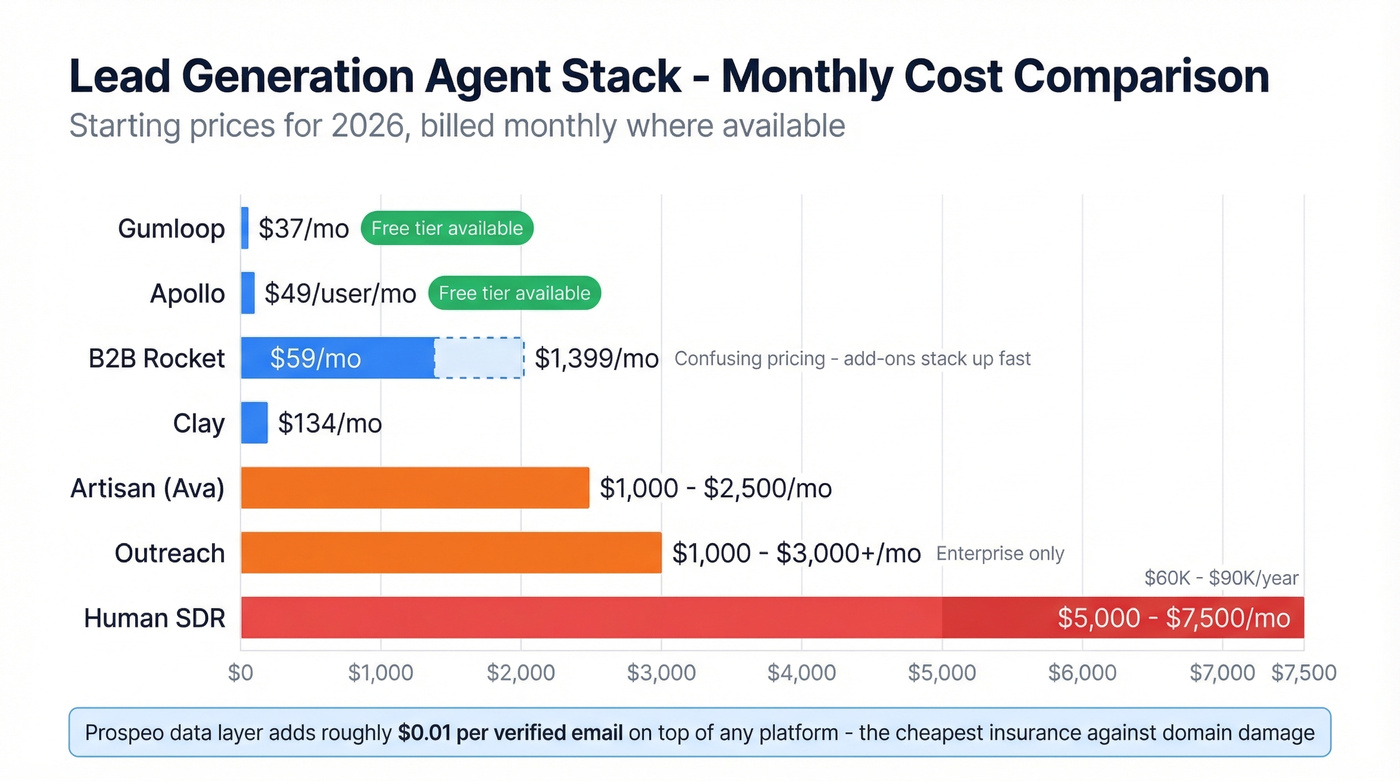
Apollo's free tier gives you a solid contact database plus AI-powered sequencing. Paid plans start at $49/user/month. The database is large, but email accuracy runs around 79% based on available benchmarks - workable for testing, risky at scale without a verification layer on top. For teams just getting started with AI-driven outreach, the price-to-capability ratio is hard to beat.
Clay
Clay is the enrichment powerhouse for RevOps teams who think in waterfall enrichment logic. Starting at $134/month for 2,000 enrichment credits, it pulls data from dozens of sources and lets you build custom workflows. The framework is powerful but demands technical comfort - you're building data pipelines, not clicking buttons. Pair it with a verification layer for validated output. Skip it if you want plug-and-play simplicity.
B2B Rocket
Use this if you want a dedicated AI agent platform that handles the full outbound cycle autonomously.
Skip this if you're confused by pricing pages. B2B Rocket has two separate plan tiers with overlapping names - there's a "Scale" plan at $149/month billed annually and another "Scale" plan at $999/month. The Starter tier at $59/month gets you in the door, but add-ons stack up fast: $25 per 500 database credits, $100 per additional team member, $20 per multichannel account. On the high-ticket side, plans run $599-$1,399/month depending on tier.
Gumloop
Picture this: you want an AI agent that checks a prospect's recent blog posts, cross-references their tech stack, and writes a personalized opener - all before adding them to a sequence. That's what Gumloop lets you build. Pick your AI model, connect your data sources, and define the agent's skills through instructions. Free plan available, then $37/month. It's the cheapest path to a custom agent, but you need to be comfortable with a workflow builder.
Outreach
Best for: Large sales orgs already running complex multi-channel sequences who want AI layered on top.
Skip if: Your team is under 20 reps or your budget is under $1,000/month.
Enterprise AI revenue platform with dedicated Deal, Research, and Revenue agents. Expect $1,000-$3,000+/month. Early adopters report 15-20% reply rate increases. If you're already Salesforce-native, Einstein plus Agentforce is the alternative - but expect complex configuration and dedicated IT resources.
Artisan (Ava)
Fully autonomous AI SDR - Ava handles prospecting through booking. Custom pricing, typically ~$1,000-$2,500/month. I haven't tested this one deeply enough to recommend it confidently, but it's on our radar for teams wanting a true "set and forget" outbound agent.
Pricing at a Glance
| Platform | Starting Price | Best For |
|---|---|---|
| Apollo | Free / $49/user/mo | All-in-one start |
| Clay | $134/mo | Enrichment workflows |
| B2B Rocket | $59-$1,399/mo | Dedicated AI agents |
| Gumloop | Free / $37/mo | DIY agent builders |
| Outreach | $1,000-$3,000+/mo | Enterprise teams |
| Artisan (Ava) | ~$1,000-$2,500/mo | Autonomous AI SDR |
| Human SDR | $60K-$90K/yr | Complex deals |
How to Build Your Stack
Five steps, $500/month, no enterprise contract required. Most teams deploy a working lead generation agent within 2-4 weeks.
2. Enrich via API. Push leads through an enrichment API to fill in 50+ data points per contact - direct dials, tech stack, funding stage, department headcount. A 92% match rate means minimal gaps in your agent's context.
3. Segment by firmographics, intent, and behavior. Group leads by ICP fit, buying signals, and engagement history. This is where your agent gets smart about who to prioritize (and where intent signals actually matter).
4. Deploy your AI agent. Apollo's built-in sequencing works for most teams. Gumloop gives you more control if you want custom logic. Let the agent handle personalized outreach and follow-up.
5. Track in your CRM. HubSpot's free tier or Salesforce if you're already there. Close the loop so you know which agent-sourced leads actually convert. Make sure your data provider is GDPR compliant and enforces opt-outs - this isn't optional when running automated outreach at scale (use a GDPR compliant database checklist if you need one).
The math: a verified data layer at ~$100/month plus Apollo paid at $49/month plus HubSpot free = under $200/month. Scale up to $500 when you add Clay for enrichment or Gumloop for custom agents. That replaces a $60K-$90K SDR hire.
5 Mistakes That Kill Performance
1. The monolithic agent bottleneck. Building one giant agent that handles everything - prospecting, qualifying, emailing, nurturing - creates a single point of failure. Split into specialized modules. A prospecting agent feeds a qualification agent feeds an engagement agent. Each one does its job well.
2. Skipping data verification. This is the most expensive mistake on the list. An AI agent blasting 500 emails to unverified addresses will damage your sender reputation within days. Run every list through a verification layer before your agent touches it. The cost of verification at ~$0.01/email is trivial compared to rebuilding a blacklisted domain (here’s a deeper guide to outbound email spam prevention).
3. Multi-agent coordination chaos. When three agents run simultaneously without defined roles, they overlap, contradict each other, and confuse prospects. Define clear handoff protocols and shared knowledge bases before scaling beyond a single agent.
4. Runaway AI costs. Token usage adds up fast when agents make thousands of API calls daily. Monitor usage, optimize prompts, use smaller models for simple tasks, and set budget alerts. We've seen teams burn through $2,000 in API costs in a week because nobody was watching the meter.
5. Overengineering. Not everything needs an AI agent. If a task is purely rules-based - routing leads by geography or company size - use traditional automation. Save the AI for tasks that require judgment, personalization, and adaptation.
When to Use AI vs Humans
Use AI agents when volume matters more than nuance. High-velocity outbound to mid-market prospects, speed-to-lead on inbound forms, and repetitive follow-up sequences are where agents dominate. If you're sending 200+ touchpoints a day, a human can't keep up. AI-driven appointment setting is another strong use case - agents that qualify inbound interest and book meetings directly on a rep's calendar eliminate the back-and-forth that kills conversion rates.
Use human SDRs when you're selling six-figure enterprise deals with complex buying committees. Relationship-driven sales cycles, multi-stakeholder negotiations, and accounts that require strategic account mapping still need a person who can adapt in real time.
Use both when you want the best results - and that's most B2B teams. AI handles the first touch, qualification, and follow-up cadence. Humans step in for booked meetings, objection handling, and deal progression. Companies running this hybrid model report 9.2x ROI compared to either approach alone.
Meritt fed their AI stack with Prospeo data and went from 35% bounce rates to under 4% - tripling pipeline to $300K/week. 300M+ profiles, 143M+ verified emails, 30+ ICP filters, and intent data across 15,000 topics. That's the data layer your agent actually needs.
Build your agent stack on data that won't burn your domain.
FAQ
How much does a lead generation agent cost?
AI agent platforms range from $37/month (Gumloop) to $1,399/month (B2B Rocket Unlimited). Add a data layer at ~$0.01/email. Total stack cost for most teams lands at $200-$600/month - compared to $60K-$90K/year for a human SDR with benefits and overhead.
Can AI agents fully replace human SDRs?
Not for complex deals. AI agents handle volume - 200-500 touchpoints daily with sub-minute response times - but human SDRs outperform on enterprise sales and relationship building. The hybrid model delivers 9.2x ROI when AI handles initial outreach and humans take high-value conversations.
What's the biggest risk of using AI for lead generation?
Bad data. An agent sending hundreds of emails to unverified addresses will get your domain flagged within days. Always verify contacts before deploying any automated outreach. A 98% email accuracy threshold is the minimum - Prospeo's free tier of 75 verified emails/month lets you test this without risk, and standalone tools like NeverBounce work for additional verification.
What's the best free tool to start with?
Prospeo's free plan gives you 75 verified emails and 100 Chrome extension credits monthly - enough to validate a workflow before spending anything. Pair it with Apollo's free tier for sequencing and HubSpot's free CRM for tracking. Total cost: $0 to prove the concept works.