

Lead Generation and Qualification: The Operational Playbook for 2026
Your SDR just spent 45 minutes on a discovery call with someone who has no budget, no authority, and no timeline. Meanwhile, three accounts showing active buying signals sat untouched in the CRM. This happens every day at companies that treat lead generation and qualification as separate problems - or worse, as the same problem.
Only 25% of leads are actually qualified enough to warrant a sales conversation. Three out of four leads your team touches are a waste of time. The fix isn't generating more leads. It's building an operational system where generation and qualification work as a single, data-driven pipeline that filters noise before it reaches your reps.
What You Need (Quick Version)
- Pick one framework and enforce it. BANT for transactional SMB deals, MEDDIC for enterprise. Don't let reps freestyle qualification criteria - make the fields required in your CRM before a lead can advance to SQL.
- Build a scoring model with real point values. Include negative scoring (bounced emails, inactivity) and decay rules. A lead that downloaded a whitepaper six months ago isn't warm anymore.
- Fix your data first. If emails bounce and phone numbers are dead, no framework saves you. Data quality is the prerequisite, not the afterthought.
Generation vs. Qualification: Why Both Matter
Lead generation is how you attract and capture potential buyers - inbound content, paid campaigns, outbound sequences, events. Lead qualification is how you filter those leads by fit, intent, and readiness to buy. Generation fills the funnel. Qualification ensures only viable prospects reach sales.
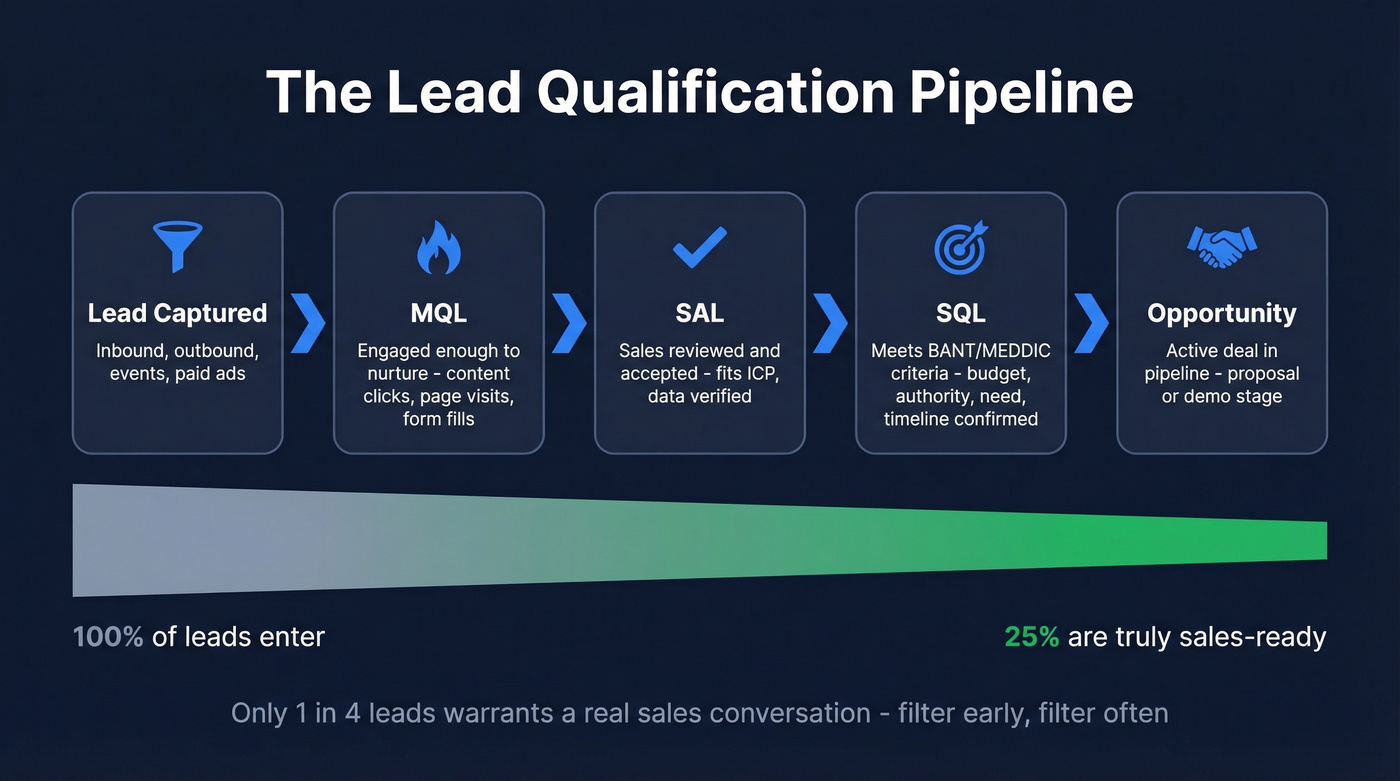
The average website converts at just 2.9% across industries. That's a thin stream of leads to begin with, and wasting it on unqualified contacts is how pipeline forecasts collapse.
The stages matter because they define handoff points. An MQL (marketing qualified lead) has shown enough engagement to warrant nurturing. An SQL (sales qualified lead) meets your firmographic and behavioral criteria for a sales conversation. A PQL (product qualified lead) has used your product and hit activation thresholds. An SAL (sales accepted lead) is an MQL that sales has reviewed and agreed to work.
Here's what reframes how you should think about MQLs: 67% of customers prefer self-service over talking to a rep. Your MQL definition can't rely solely on "requested a demo." Pricing page visits, repeated product page sessions, and content consumption patterns are the real qualifying signals. Gated whitepapers still generate MQLs, but they're increasingly low-intent - most serious buyers won't trade their email for content they can find ungated elsewhere.
Why Data Quality Comes First
Every qualification framework assumes you can actually reach the lead. If your emails bounce and your phone numbers connect to nobody, you're scoring ghosts.
The pain is real. One practitioner building an automated qualification workflow put it bluntly on Reddit: "A lot of the data is invalid... phone numbers are often unreachable." They'd built the enrichment pipeline, the scoring logic, the routing rules - and the whole thing broke because the underlying contact data was garbage.
B2B contact data decays at roughly 30% per year. People change jobs, companies restructure, email domains rotate. If your data provider refreshes on a 6-week cycle (a common industry average), you're working with stale records for most of the quarter.
This is where we've seen the biggest impact from investing in data infrastructure early. Prospeo's 5-step verification process delivers 98% email accuracy on 143M+ verified emails, with a 7-day refresh cycle that keeps records current. Snyk's 50-person AE team went from a 35-40% bounce rate to under 5% after switching, generating 200+ new opportunities per month. When your data is clean, your scoring model actually works. When it's not, you're building on sand.


Your qualification model is only as good as your data. Prospeo verifies emails at 98% accuracy across 143M+ contacts, refreshes every 7 days, and costs ~$0.01 per email - so your scoring model grades real buyers, not ghosts.
Stop scoring dead contacts. Start qualifying leads that actually pick up.
Qualification Frameworks Compared
A dozen frameworks float around sales Twitter. Every methodology ultimately reduces to four questions: Does this prospect have a need? Can they pay? Who decides? When?
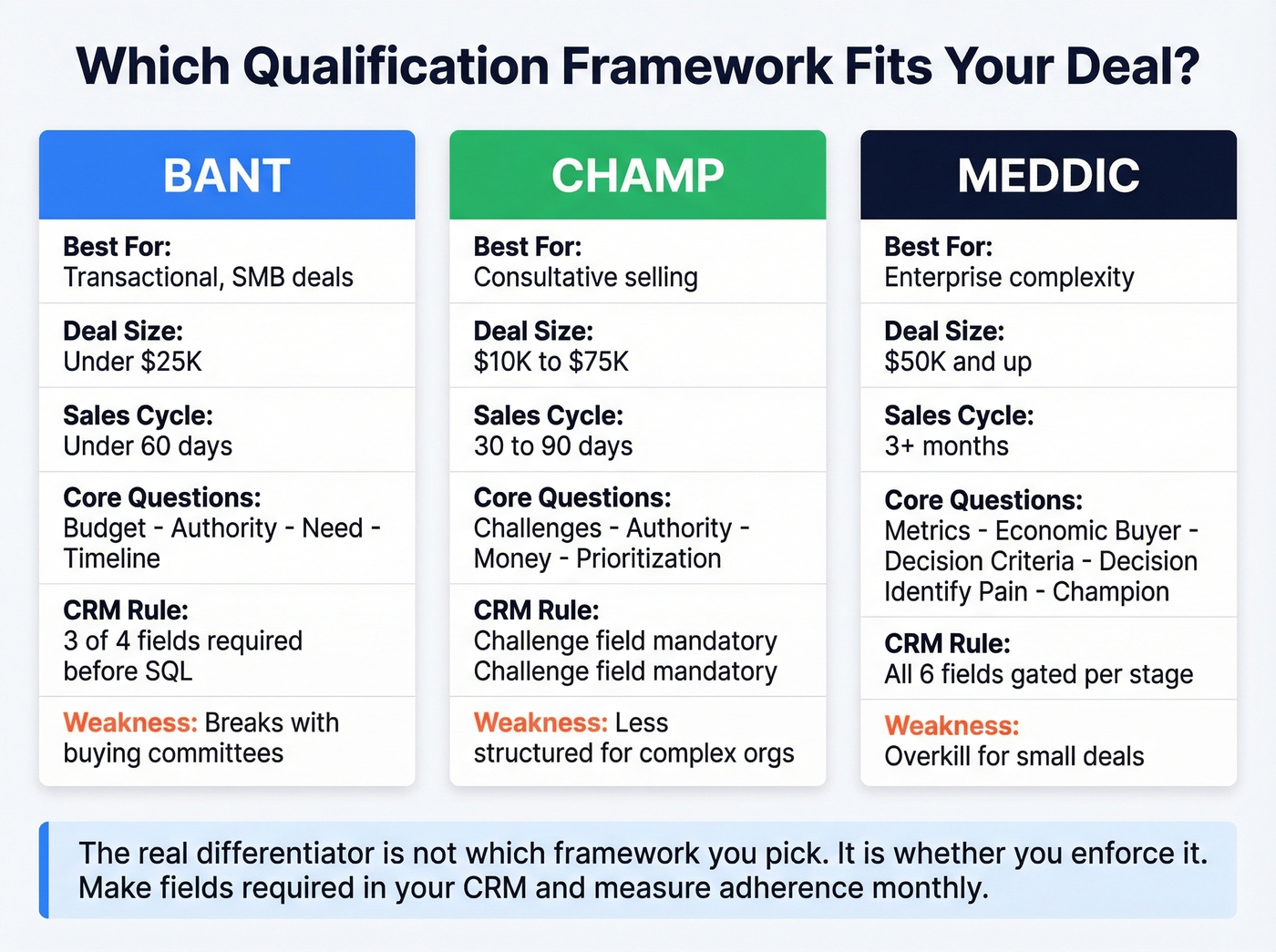
The consensus on r/sales backs this up - most reps feel that frameworks are "basically the same" at the fundamentals level. The difference is which question you lead with and how rigorously you enforce the criteria. Before applying any framework, match leads against your ICP (ideal customer profile) - firmographic fit should be the gate before behavioral scoring even begins.
| Framework | Best For | Size / Cycle | Min. Criteria | CRM Rule |
|---|---|---|---|---|
| BANT | Transactional / SMB | <$25K / <60 days | 3 of 4 criteria | Required fields before SQL |
| CHAMP | Consultative selling | $10K-$75K / 30-90 days | Challenge + Authority | Challenge field mandatory |
| MEDDIC | Enterprise complexity | $50K+ / 3+ months | Pain + Buyer + Champion | All 6 fields gated per stage |
BANT works beautifully for short-cycle, lower-ticket deals. A rep can qualify in a single call: do they have the budget, the authority, the need, and the timeline? If three of four check out, move them forward.
But BANT breaks when buying committees get involved. Modern B2B purchases involve an average of seven stakeholders. "Authority" isn't one person - it's a web of influencers, champions, and economic buyers. That's where MEDDIC earns its complexity. For enterprise deals over $50K with multi-month cycles, you need to map the Metrics, Economic Buyer, Decision criteria, Decision process, Identify pain, and Champion. Every field should be gated per stage in your CRM - no advancing without completing the required data.
CHAMP leads with Challenges rather than Budget, which fits consultative sales where the prospect doesn't yet know what they need to spend. If your reps advise more than they order-take, CHAMP gives them a natural conversation structure.
Let's be honest about what separates good teams from great ones here: pick one framework, train the team, enforce it in the CRM with required fields, and measure adherence monthly. Frameworks don't fail because they're wrong. They fail because reps skip the fields.
Building a Lead Scoring Model
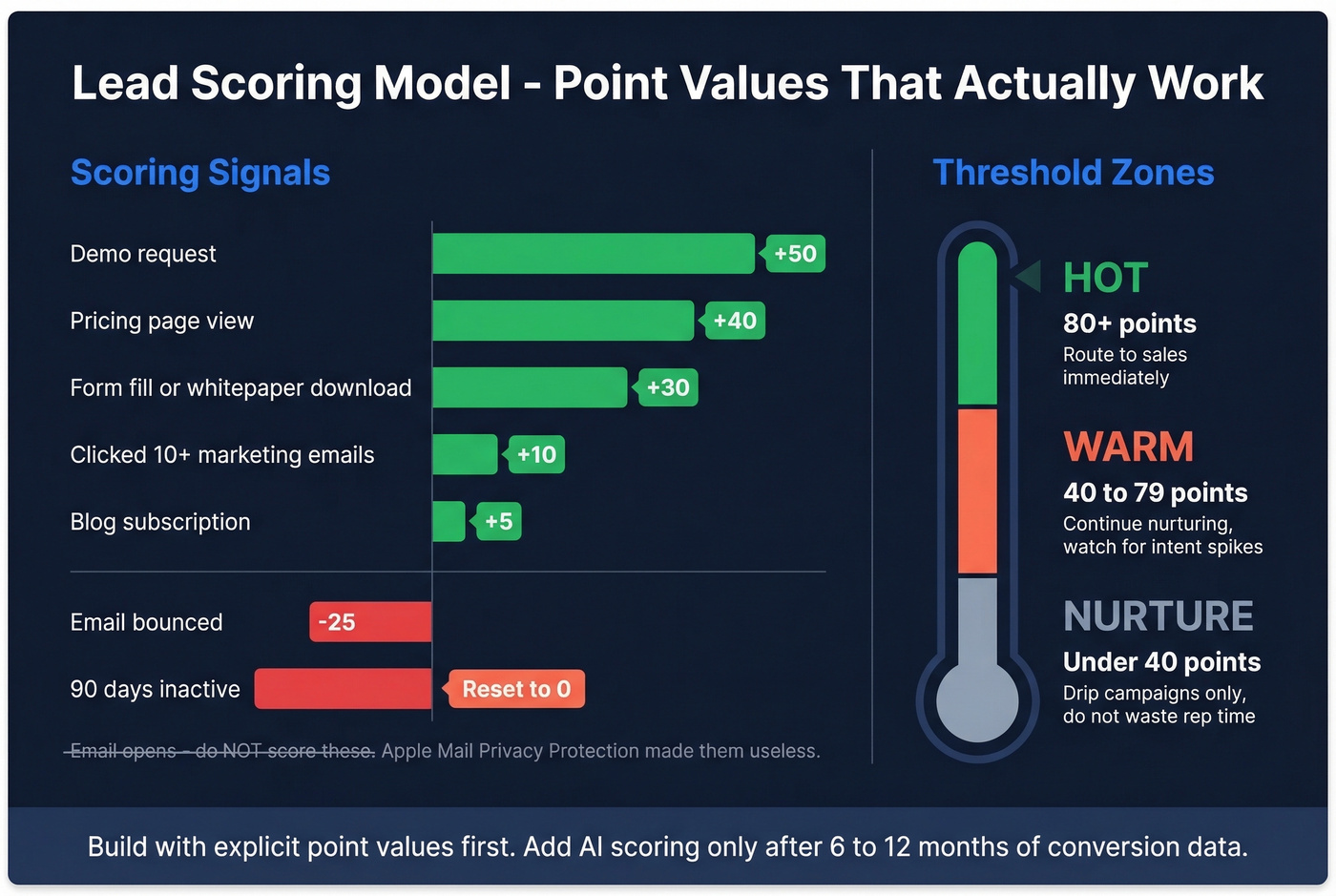
Scoring translates qualification criteria into numbers your CRM can act on. Assign points to specific signals - both positive and negative.
| Signal | Points | Type |
|---|---|---|
| Demo request | +50 | High intent |
| Pricing page view | +40 | High intent |
| Form fill / whitepaper | +30 | Medium intent |
| 10+ marketing emails clicked | +10 | Engagement |
| Blog subscription | +5 | Low intent |
| Email bounced | -25 | Negative |
| 90 days inactive | Reset to 0 | Decay |
Thresholds: Hot > 80 | Warm 40-79 | Nurture < 40
Demo requests and pricing page views get the highest weight because they signal active buying evaluation. Blog subscriptions get almost nothing - interest isn't intent.
Negative scoring matters just as much. A bounced email should cost -25 points because it means your data is bad and the lead is unreachable. Stop scoring email opens entirely. Apple Mail Privacy Protection inflated open rates across the board, making opens a useless signal. Score clicks, page visits, and form submissions instead.
Build your scoring model with explicit point values and transparent logic first. Add AI-assisted scoring only after you've accumulated enough historical conversion data - typically 6-12 months. AI without sufficient training data produces confident but wrong predictions, and you won't catch the errors until pipeline is already damaged.
BANT, MEDDIC, CHAMP - none of them work when 30% of your contact data decays each year. Prospeo's 7-day refresh cycle and 5-step verification keep your pipeline current. Snyk's 50 AEs cut bounce rates from 40% to under 5% and generated 200+ opportunities per month.
Fix your data layer and every qualification framework starts working.
MQL to SQL Benchmarks
Benchmarks give you a reality check. If your MQL-to-SQL conversion rate is wildly off from your industry, something's broken in your criteria.
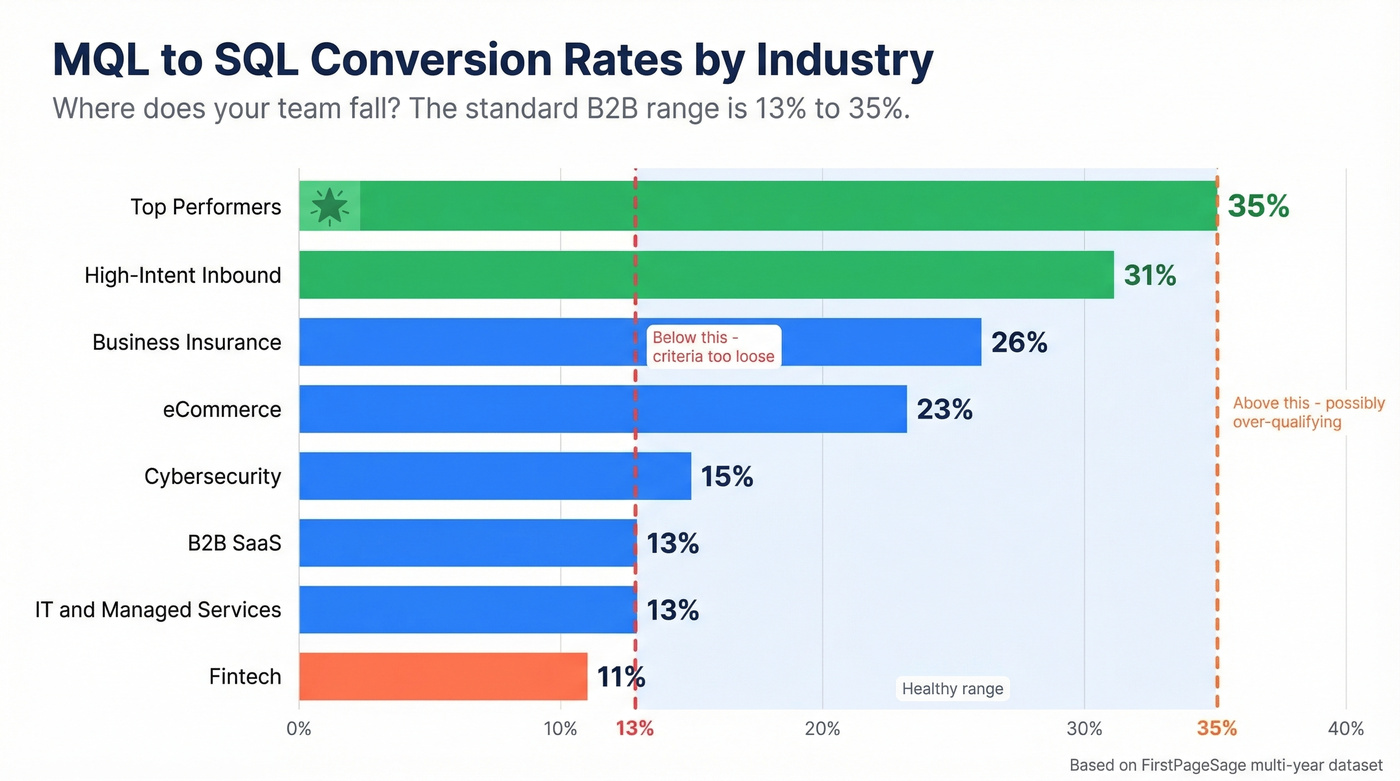
| Industry | MQL to SQL Rate |
|---|---|
| B2B SaaS | 13% |
| Cybersecurity | 15% |
| Business Insurance | 26% |
| eCommerce | 23% |
| Fintech | 11% |
| IT & Managed Services | 13% |
| High-Intent Inbound | 31% |
| Top Performers | 35%+ |
The standard B2B benchmark range is 13-35%, based on FirstPageSage's multi-year dataset.
Below 13% means your qualification criteria are too loose - you're flooding sales with leads that don't convert. Above 35% likely means you're over-qualifying and leaving viable opportunities on the table. Neither extreme is good. The goal is a conversion rate that matches your industry while steadily improving quarter over quarter.
Intent Data for Smarter Qualification
65% of marketers say intent signals have improved their pipeline forecasting accuracy, per Demand Gen Report's research. That's because intent data catches buyers before they fill out a form - the difference between calling someone cold and calling someone who's been reading competitor reviews for two weeks.
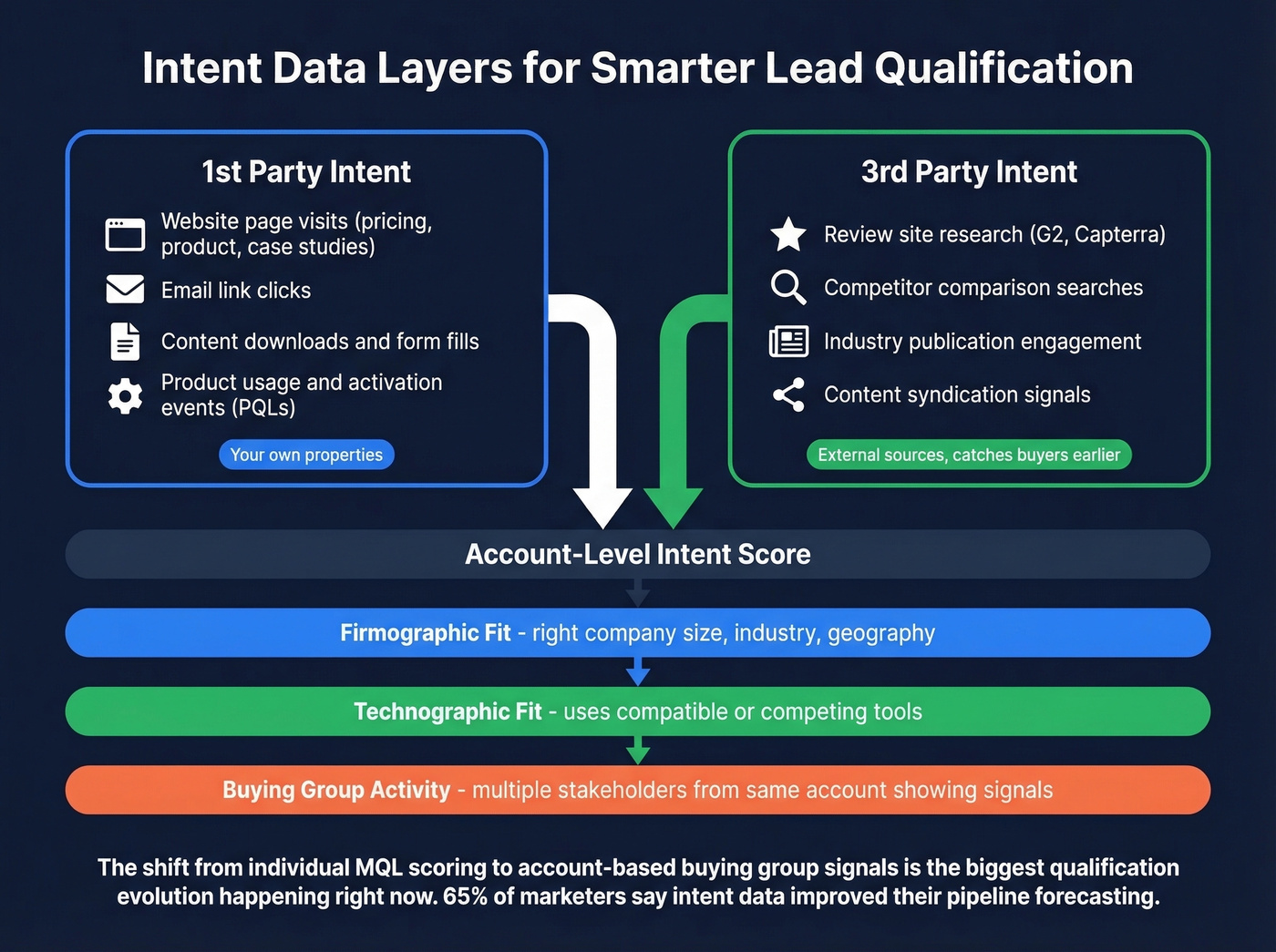
First-party intent comes from your own properties: website visits, email clicks, content downloads. Third-party intent comes from external publishers, review sites, and content syndication networks - it catches buyers earlier in the journey, before they've hit your site.
Individual lead scoring is becoming obsolete for enterprise deals. When buying committees include 6-10 stakeholders, the signal that matters is account-level intent - are multiple people at the same company researching your category? The shift from individual MQL scoring to account-based buying group signals is the biggest qualification evolution happening right now. Account-based teams already operate this way; the rest of the market is catching up. Layer intent data with firmographic and technographic filters so you're scoring leads not just on who they are, but on what they're actively researching - and routing them accordingly.
Five Mistakes That Kill Pipeline
We've seen teams build a $2M pipeline that's actually $400K of real opportunity. The gap almost always traces back to one of these failures.
Stale contact data. Your reps can't qualify leads they can't reach. Verify contacts before every campaign and use tools with weekly refresh cycles. A 30% annual decay rate means a third of your database is dead weight by year-end.
Chasing volume over quality. More MQLs doesn't mean more revenue. Cap MQL volume if needed and measure your MQL-to-SQL rate weekly. If it's dropping, you're generating noise, not pipeline. Qualified lead generation - where every contact meets baseline fit criteria before entering the funnel - consistently outperforms high-volume approaches.
Inconsistent criteria across reps. When one rep qualifies on gut feel and another follows MEDDIC religiously, your forecast is fiction. Required CRM fields, shared definitions, and monthly calibration sessions fix this.
Ignoring intent signals. A prospect visiting your pricing page three times in a week is a hotter lead than someone who downloaded a whitepaper six months ago. Layer behavioral scoring on top of firmographic fit. Tools like Bombora track thousands of intent topics across the web, and that data can feed directly into your scoring model.
Slow follow-up. Speed-to-lead is a revenue KPI, not a vanity metric. Every hour of delay reduces contact rates. Automate routing so hot leads hit a rep's queue in minutes, not days.
The Marketing-Sales Handoff
Most lead gen programs don't fail at targeting. They fail post-capture - at the handoff between marketing and sales. Here's the SLA checklist that prevents it:
Shared definitions. Marketing and sales must agree on what constitutes an MQL and an SQL. Write it down. Review it quarterly. If your teams can't agree on lead definitions, no tool or framework will save you.
Speed-to-lead commitment. Define a maximum response time - 5 minutes for high-intent inbound, 24 hours for lower-scoring leads. Automate routing through HubSpot or Salesforce workflows.
Feedback loop. Sales flags bad MQLs with a reason code. Marketing uses those codes to adjust scoring weights monthly. Without this loop, marketing optimizes for volume and sales drowns in garbage.
Routing automation. Manual lead assignment is where pipeline goes to die. One team used HubSpot workflows to automatically segment and tag 16,000 unlabeled contacts into meaningful groups - the same automation logic applies to real-time round-robin or territory-based lead routing. Skip this if you're a two-person team where the founder handles everything; for anyone with 3+ reps, automated routing isn't optional.
Finding and Qualifying Leads Systematically
The teams that consistently hit quota don't rely on a single channel or a single rep's instincts. They build a repeatable system across inbound, outbound, and product-led motions simultaneously.
Start by mapping your ICP to specific data sources - role-based targeting on professional networks, intent data providers for in-market accounts, and your own website analytics for first-party signals. Then run every captured contact through your scoring model before it ever reaches a rep. I've watched teams cut their average qualification time in half just by automating this pre-screening step, and the reps are happier because they're spending time on real conversations instead of dead-end dials.
The goal is to ensure that by the time a lead lands in a rep's queue, it already meets minimum firmographic and behavioral thresholds. This is how you scale pipeline without burning out your sales team on dead-end conversations.
Lead Generation and Qualification FAQ
What's the difference between generation and qualification?
Lead generation attracts and captures potential buyers through content, ads, outbound, and events. Qualification filters those leads by fit, intent, and readiness to buy. Generation fills the funnel; qualification ensures only viable prospects reach sales. Without qualification, you're collecting contacts - not building pipeline.
Which qualification framework should I use?
BANT for transactional deals under $25K with short cycles. MEDDIC for enterprise deals over $50K with multiple stakeholders. CHAMP for consultative selling where challenges lead the conversation. Pick one, enforce it in your CRM with required fields, and measure adherence monthly.
What's a good MQL-to-SQL conversion rate?
The standard B2B range is 13-35%. Below 13% means your qualification criteria are too loose - you're flooding sales with unqualified leads. Above 35% likely means you're over-qualifying and missing viable opportunities. Benchmark against your specific industry using FirstPageSage data.
How does data quality affect lead qualification?
Bad data breaks every framework. If emails bounce at 30%+ and phone numbers are dead, reps can't reach leads - let alone qualify them. A 7-day data refresh cycle and 98%+ email accuracy keep scoring models working with real, reachable contacts rather than decayed records.
Should I use AI for lead scoring?
Start with rule-based scoring for transparency and control. Add AI-assisted scoring after you've accumulated 6-12 months of historical conversion data to train on. AI without sufficient data produces confident but wrong predictions - and you won't catch the errors until pipeline is already damaged.