

How to Build Lead Generation Lists That Don't Go Stale
A RevOps lead we know spent $350/month on purchased lead generation lists for local business outreach. The data was 80% garbage - closed businesses, generic info@ inboxes, contacts who'd changed jobs two years ago. Bounce rate hit 12%, and their sender reputation cratered. After switching to a build-your-own workflow with verified data, bounces dropped under 2%. That's not a marginal improvement. That's the difference between a pipeline and a spam folder.
Most teams waste money on stale data. Here's how to stop wasting yours.
What Is a Lead Generation List?
A lead generation list is a structured dataset of potential buyers - people who match your ideal customer profile and haven't told you to go away yet. No magic.
Lists break into temperature tiers. Cold lists are prospects who've never interacted with you. Warm lists include people who've engaged - downloaded a resource, attended a webinar, visited your pricing page. Hot lists are hand-raisers ready for a conversation.
On the qualification side, you'll hear MQL (marketing qualified), SQL (sales qualified), and PQL (product qualified, common in PLG companies). Every list should contain, at minimum: full name, job title, verified email, direct phone number, company name, industry, company size, source, and date added. That last pair - source and date - is what separates a usable list from a liability. Without them, you can't track decay or prove compliance.
Why Most Lead Lists Fail
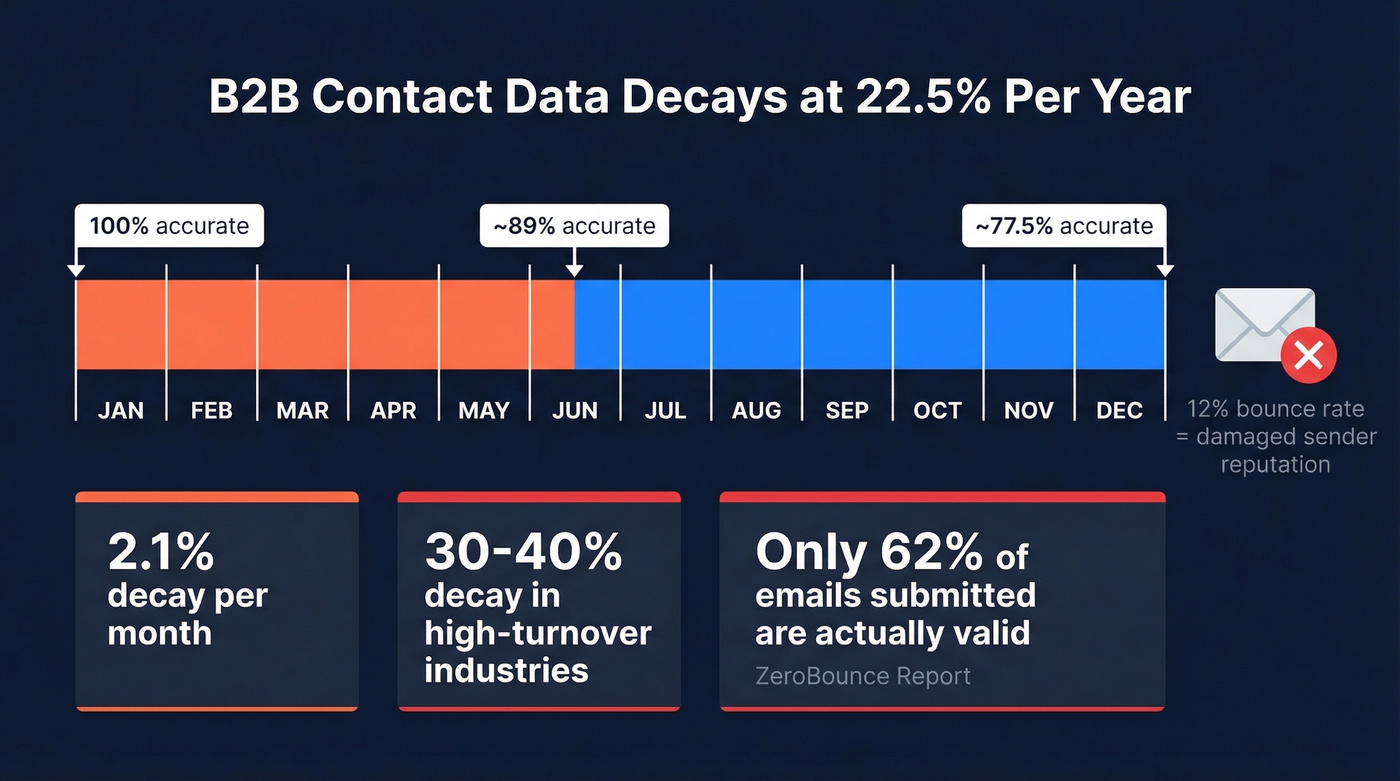
B2B contact data decays at roughly 22.5% per year, about 2.1% per month. A list you built in January is missing nearly a quarter of its accuracy by December. In high-turnover industries, decay hits 30-40% annually.

ZeroBounce's email statistics report found that only 62% of emails submitted were valid. Nearly four in ten emails people thought were good weren't. Catch-all emails accounted for over 9% of checked addresses - essentially unverifiable without sending.
Then there's the "overused contacts" problem. One practitioner on r/b2bmarketing put it bluntly: when everyone's pulling from the same Apollo or ZoomInfo database, your prospects are getting hammered by competitors using identical lists. They reported 70% of phone numbers from large databases were wrong. Reply rates tank not just because the data is bad, but because the contacts who are reachable are exhausted.
A 12% bounce rate doesn't just mean wasted emails. It means damaged sender reputation, lower inbox placement on your next campaign, and a compounding problem that gets harder to fix the longer you ignore it.
Buy vs. Build Your Lead List
Building outperforms buying in almost every scenario we've seen.
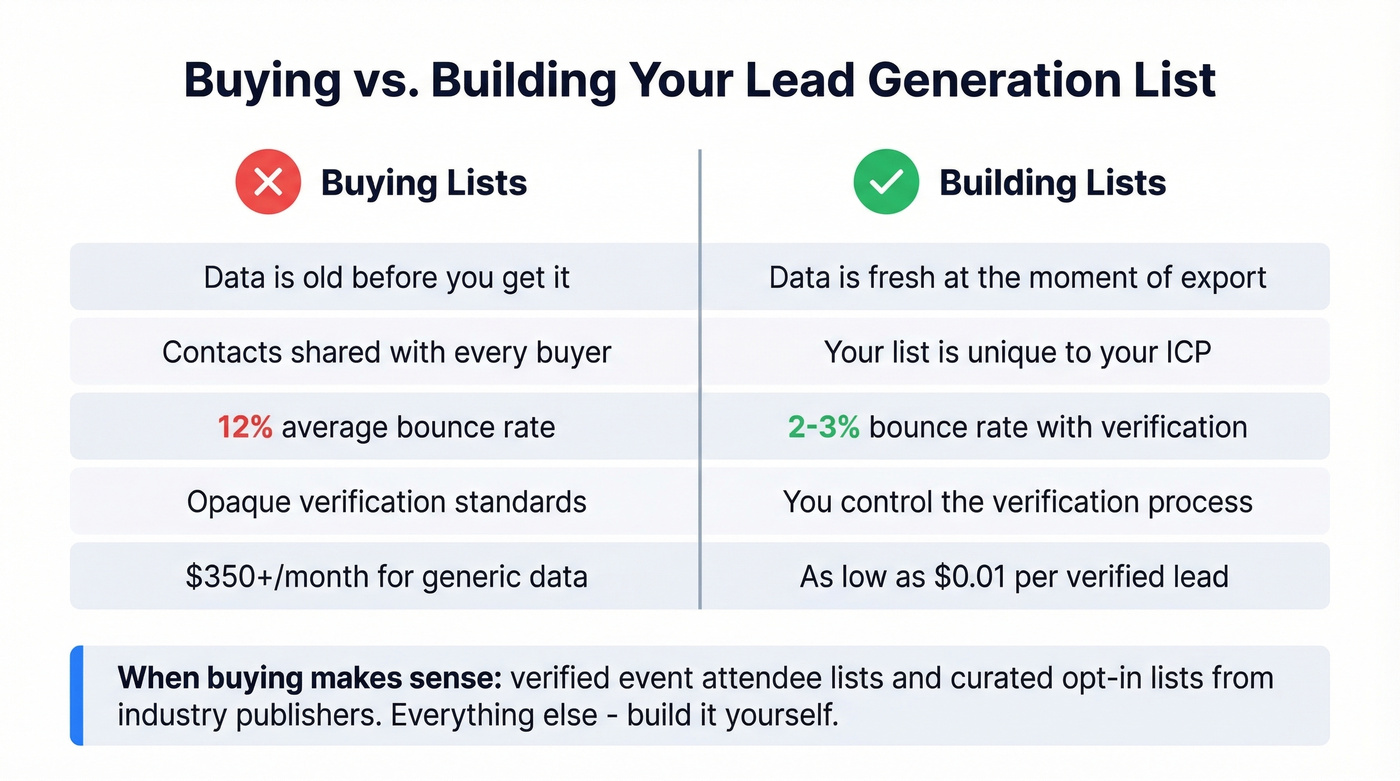
The $350/month purchased list story isn't unusual - it's the norm. Purchased lists suffer from three structural problems: the data is old by the time you get it, the contacts are shared with every other buyer, and the verification standards are opaque at best. That same team who ditched purchased lists tested 80 emails to roofing contractors in Phoenix scraped fresh from Google Maps - 2 bounces. A 2.5% bounce rate versus the 12% they were getting before. For local business outreach, scraping Google Maps and verifying decision-maker contacts is one of the highest-ROI workflows available.
When does buying make sense? Two narrow cases: verified event attendee lists where you know the data was collected recently with consent, and curated opt-in lists from industry publishers. Everything else, build it yourself.
Here's the thing: if your average deal size is under $10K, you almost certainly don't need a $14K/year data platform. A free-tier tool with verified data and a disciplined ICP will outperform an enterprise database used lazily.

You just read that B2B data decays at 2.1% per month and 62% of emails people trust are actually invalid. Prospeo's 5-step verification delivers 98% email accuracy across 143M+ verified addresses - refreshed every 7 days, not every 6 weeks. At $0.01 per email, a clean lead generation list costs less than the bounces from a dirty one.
Build lead lists that convert instead of lists that bounce.
How to Build B2B Lead Generation Lists That Convert
Define Your ICP
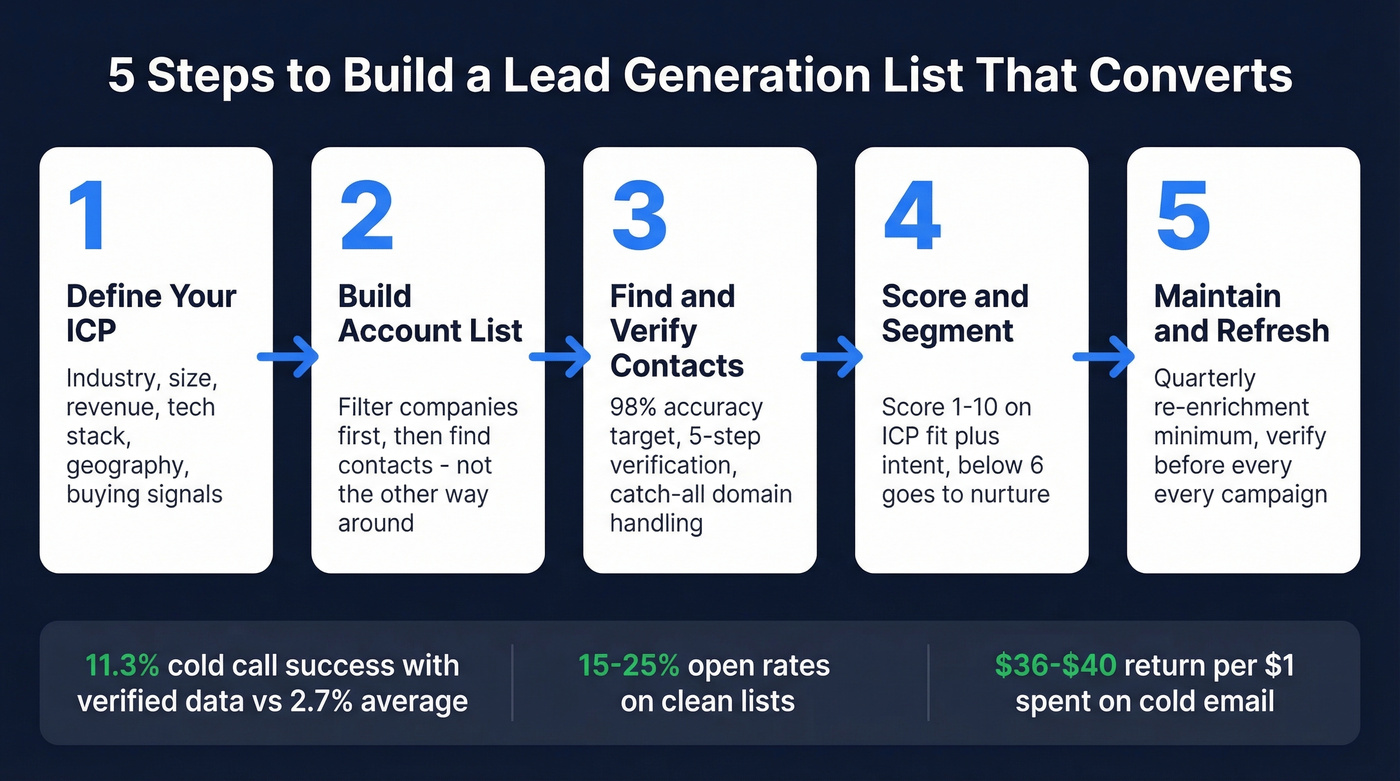
Start with the account profile, not the contact. Industry, company size range, revenue band, tech stack, geographic focus, and buying signals. If you can't describe your ideal customer profile in two sentences, you're not ready to build a list - you're ready to waste credits.
Build Your Account List First
The "filter twice" method works: build your company list first, then find contacts within those companies. Use Google Maps for local outreach or B2B database filters for enterprise targeting to create a master account list. This prevents the classic mistake of exporting 10,000 random contacts and hoping some match your ICP.
Find and Verify Contacts
This is where the list lives or dies.
Once you have your account list, you need verified contact data for the right people at those companies. Prospeo covers 300M+ professional profiles with 143M+ verified emails and 125M+ verified mobile numbers. The 30+ search filters - including buyer intent, technographics, job changes, and headcount growth - let you narrow from account list to decision-maker list fast. A 5-step verification process handles catch-all domains, spam traps, and honeypots, which is why email accuracy sits at 98%. The 7-day refresh cycle means you're not pulling data that's already six weeks stale.
Score and Segment
Not all leads deserve equal attention. Score contacts 1-10 based on ICP fit plus intent signals - anyone below a 6 stays in nurture. Prioritize by who's actively researching solutions, who just got promoted into a buying role, and who's at a company that just raised funding. Segment by geography and time zone for calling campaigns.
Teams using quality-verified data with precise ICP targeting achieve 11.3% cold calling success rates versus the 2.7% industry average. On the email side, expect 15-25% open rates, 1-5% reply rates, and 0.2-2% conversion rates on cold outbound. Well-built B2B lead lists return roughly $36-$40 for every $1 spent on cold email, but only if the data is clean going in.
Set a Maintenance Schedule
Quarterly re-enrichment is the minimum. Track your bounce rates - if they're climbing 1-2% per quarter, that's normal decay. Faster than that means your source data has a freshness problem. Run verification passes before every major campaign, not just on a schedule.
One more thing most teams miss: use 4-6 email sequences instead of single-touch sends. Multi-step sequences drive up to 50% higher reply rates, and they're the only way to get real signal from a cold list.
Intent Signals: The Differentiator
Static lists are a commodity. Intent signals separate teams that book meetings from teams that burn through data credits.
The signals that matter most:
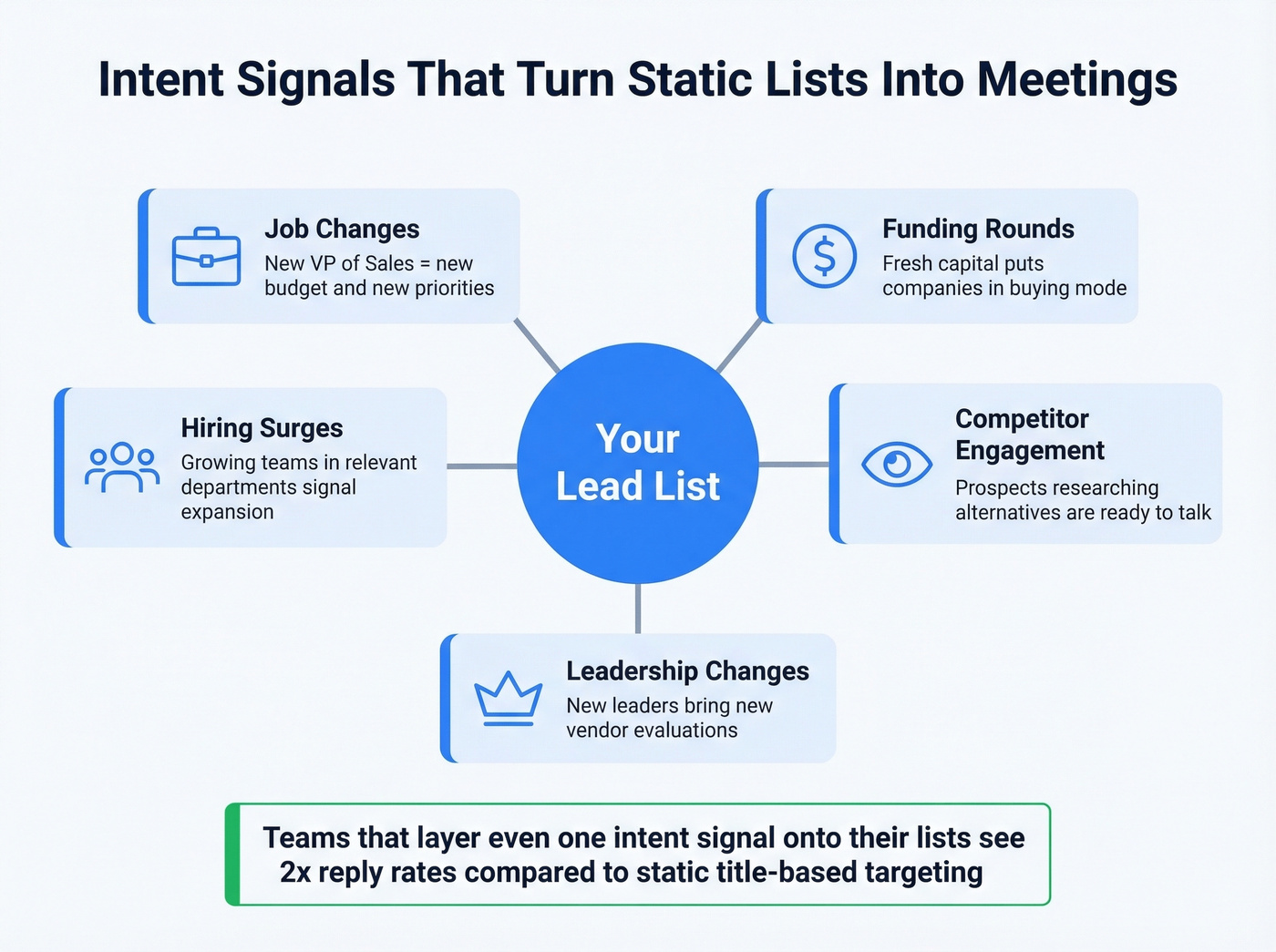
- Job changes - a new VP of Sales means new budget and new priorities
- Funding rounds - fresh capital puts companies in buying mode
- Hiring surges in relevant departments
- Engagement with competitor content
- Leadership changes at target accounts
These fix the "overused contacts" problem. Instead of emailing everyone who matches a title filter, you're reaching people at the moment they're most likely to care. We've seen teams double their reply rates just by layering a single intent signal onto an otherwise identical list.
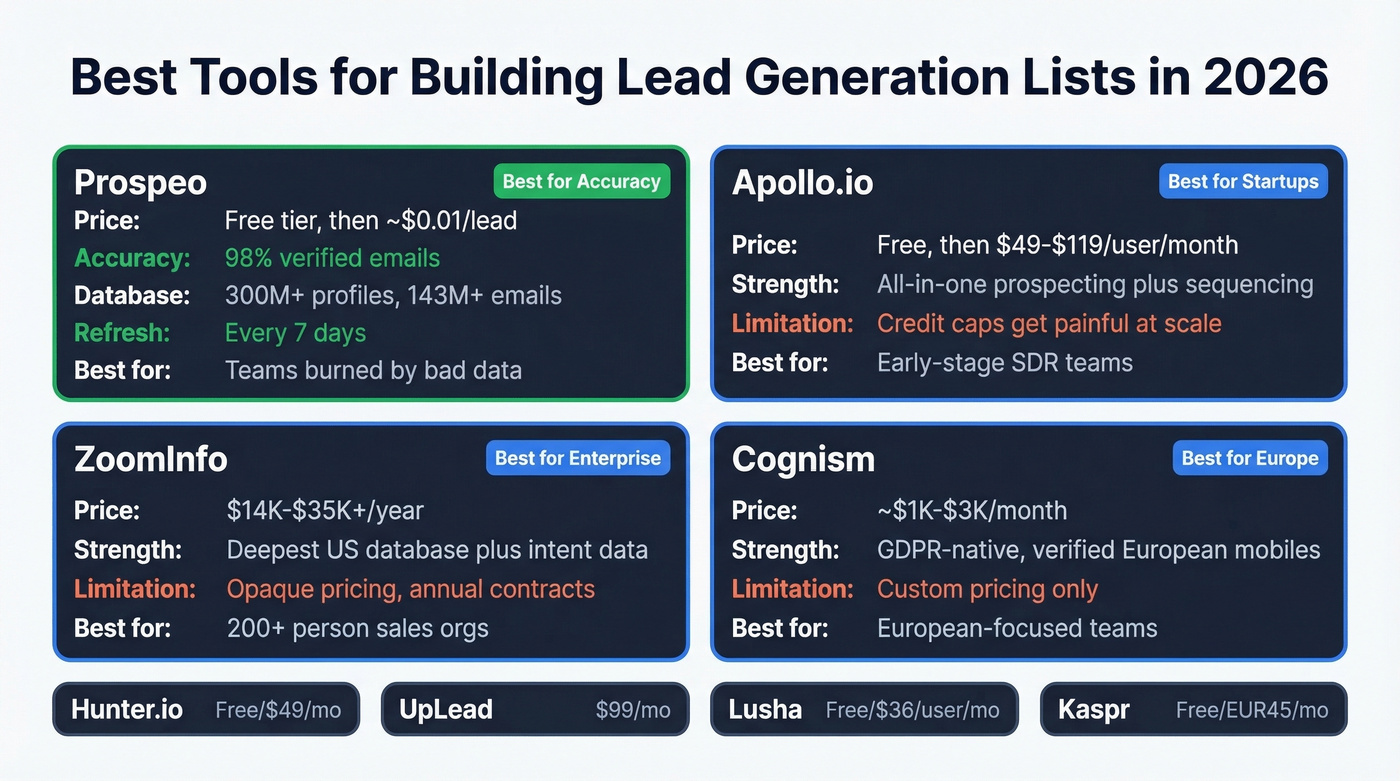
Best Tools for Building Lead Generation Lists
| Tool | Best For | Starting Price | Key Strength | Limitation |
|---|---|---|---|---|
| Prospeo | Accurate data, self-serve | Free / ~$0.01/lead | 98% accuracy, 7-day refresh | Self-serve only |
| Apollo.io | Startups, all-in-one | Free / $49/user/mo | Free tier + sequencing | Credit caps at scale |
| ZoomInfo | Enterprise, US coverage | ~$14K-$35K+/year | Deep US database | Opaque pricing, contracts |
| Cognism | European teams, GDPR | ~$1K-$3K/mo | GDPR-native, verified mobiles | Custom pricing only |
| UpLead | Mid-market, real-time verify | $99/month | Verification on export | Smaller database |
| Hunter.io | Email lookups | Free / ~$49/month | Simple, fast | Email only |
| Lusha | Quick lookups | Free / $36/user/mo | Chrome extension | Credit-heavy |
| Kaspr | European SMBs | Free / EUR45/month | European phone data | Limited US coverage |
Prospeo
This is the tool we'd hand to any team that's been burned by bad data. The numbers: 300M+ profiles, 143M+ verified emails at 98% accuracy, 125M+ verified mobile numbers with a 30% pickup rate. The 7-day data refresh cycle is rare - most competitors refresh every four to six weeks, which means you're working with data that's already decaying by the time you export it.
Meritt tripled their pipeline from $100K to $300K per week after switching, with bounce rates dropping from 35% to under 4%. That's not a marginal gain - that's a different business.
Pricing is transparent and self-serve: roughly $0.01 per lead, free tier with 75 emails and 100 Chrome extension credits per month, no contracts. For teams that need enterprise-grade data without enterprise pricing or procurement cycles, it's the obvious first choice.
Use this if: You care about data accuracy above all else and want to start in minutes, not weeks.
Apollo.io
Apollo is the obvious starting point for most startup and SMB teams. The free tier is generous - basic search, limited exports, and built-in email sequencing without spending a dollar. Paid plans run $49, $79, and $119 per user per month, scaling with credits and features.
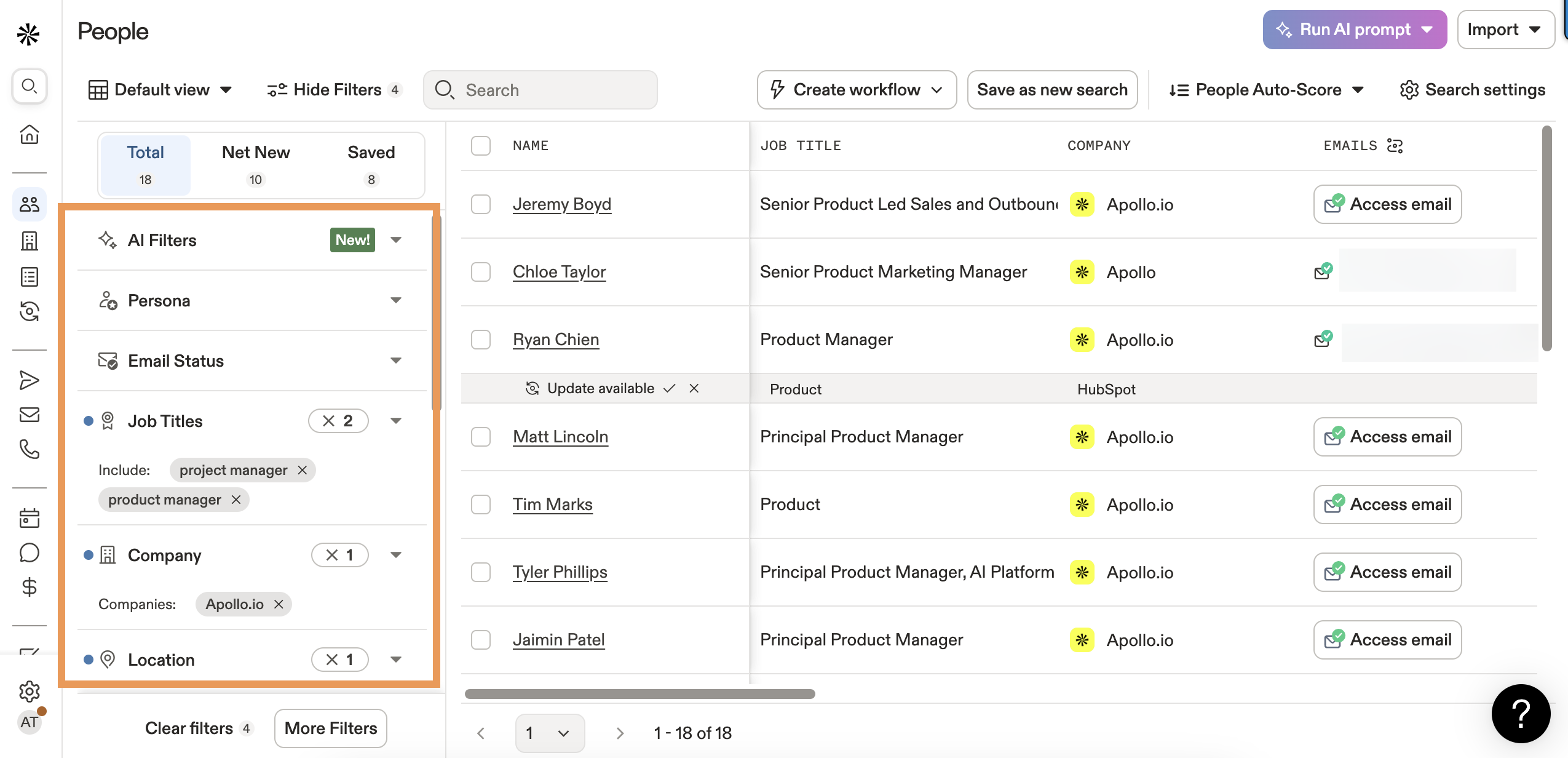
The all-in-one pitch is real: prospecting, enrichment, sequencing, and basic analytics in one platform. For a 3-person SDR team getting started with outbound, it's hard to beat the time-to-value.
Use this if: You're an early-stage team that wants prospecting and sequencing in one tool without stitching together a tech stack.
Skip this if: You're scaling past 10 reps. The credit model gets painful - Apollo charges separate credits for email and phone exports, and the highest plan caps mobile credits at 125. That scarcity mindset changes how reps prospect, and not in a good way.
ZoomInfo
ZoomInfo has one of the broadest US databases and one of the deepest intelligence suites on the market. Intent data, org charts, technographics, website visitor identification - it's a lot. For a 200-person sales org running coordinated outbound, ABM, and intent-driven plays, ZoomInfo earns its price tag.
That price tag, though. Expect $14K-$35K+ per year depending on seats and modules, with annual contracts and mandatory sales calls. Reddit's #1 complaint about ZoomInfo? Price - and specifically, paying for modules you don't use. Data refresh is also slower than weekly-cycle competitors, which matters if you're targeting fast-moving segments.
Use this if: You're an enterprise team with budget for the full intelligence suite and need deep US coverage. Skip this if: You're a team under 20 reps. You'll pay for capabilities you won't touch.
Cognism
Cognism is the right call for European revenue teams. GDPR compliance comes standard - not bolted on as an afterthought - with DNC checks across the US, UK, Canada, Australia, and Europe built into every export. The Diamond tier includes mobile-verified phone numbers, a real differentiator for calling campaigns into EMEA markets where mobile data is notoriously patchy. Pricing runs ~$1,000-$3,000/month, custom quoted.
Use this if: Your primary market is EMEA and compliance is non-negotiable. Skip this if: You're US-focused.
UpLead
UpLead's standout feature is real-time email verification on export - you don't download a contact unless the email checks out. They report 95%+ accuracy, and the workflow eliminates the "export then verify" step. Free 7-day trial, paid plans from $99/month. A solid mid-market option for teams that want cleaner data than Apollo's free tier without the full intelligence suite of ZoomInfo.
Hunter.io and Lusha
Hunter.io does email finding and verification, nothing more. Free tier gives you 25 searches per month, paid plans start at ~$49/month. Best for one-off lookups when you already know who you want to reach.
Lusha is a Chrome extension for quick contact lookups while browsing professional profiles or company websites. Free plan available, paid from $36/user/month. Credit-based, so costs scale with volume. Both are solid for lightweight use cases but won't replace a full prospecting workflow.
Kaspr
Europe-focused, freemium model. Paid plans from EUR45/month. Good for European SMBs who need EMEA phone numbers without paying Cognism prices. Limited US coverage makes it a poor fit for North American teams.
Compliance You Can't Ignore
Bad data doesn't just hurt your pipeline - it can hurt your bank account.
| Regulation | Penalty Range | Key Requirement |
|---|---|---|
| TCPA | $500-$1,500/violation | Prior consent for calls/texts |
| CAN-SPAM | Up to $53,088/email | Unsubscribe within 10 days |
| GDPR | 4% revenue or EUR20M | Legitimate interest or consent |
| CCPA | $2,663-$7,988/violation | Right to opt out of data sale |
Let's be honest - most teams treat compliance as an afterthought until something goes wrong. The operational basics aren't optional: document consent for every contact, honor opt-outs within 10 business days, maintain suppression lists that sync across your tools, follow calling hour limits (8am-9pm local time), and retain consent records for at least four years. A 1,000-contact TCPA violation can mean $500K-$1.5M in exposure.
If you need a tighter system end-to-end, map this into a repeatable lead generation workflow and keep your list clean with ongoing lead enrichment.
The article's math is clear: well-built lead generation lists return $36-$40 for every $1 spent on cold email. Prospeo's 30+ filters - buyer intent, technographics, job changes, headcount growth - let you build account-first lists with verified decision-maker contacts. No shared databases. No stale exports. 300M+ profiles filtered to your exact ICP.
Stop sharing lead lists with every competitor in your space.
FAQ
How often should I refresh my lead list?
Quarterly at minimum - B2B data decays at roughly 22.5% per year, or about 2.1% per month. Track bounce rates each campaign; if they climb faster than 1-2% per quarter, your source data needs upgrading. Tools with weekly refresh cycles reduce this burden significantly.
Is it better to buy a lead list or build one?
Build. Purchased lists consistently deliver 10-12% bounce rates and overused contacts your competitors are already emailing. Teams that build with verified, ICP-filtered data routinely see bounce rates under 3% and 2-4x higher reply rates compared to purchased alternatives.
What fields should a lead list include?
Full name, job title, verified email, direct phone, company name, industry, company size, source, and date added. Source and date are the fields most teams skip - and they're critical for tracking data hygiene and proving regulatory compliance under GDPR, CAN-SPAM, and TCPA.
How large should a B2B lead list be?
A list of 200-500 verified, ICP-matched contacts will outperform 10,000 unverified names. Start small, run your first campaign, measure open rates and replies, then scale volume. Quality-first lists return $36-$40 per $1 spent on cold email versus near-zero ROI from bloated, unverified exports.
What's a good free tool for building lead generation lists?
Prospeo's free tier includes 75 verified emails and 100 Chrome extension credits per month with no credit card required. Apollo.io also offers a free plan with basic search and limited exports. For email-only lookups, Hunter.io provides 25 free searches per month.