

Lead Nurturing: Sequences, Scoring Models, and Benchmarks That Actually Work
You ran a webinar last quarter. Two hundred people registered, 85 showed up, and then... nothing. No follow-up sequence, no segmentation, no scoring. Two months later, someone on the team sends a "hey, just checking in" email to the entire list. Replies: zero.
That list isn't dead. It was killed by neglect.
The real problem isn't that outbound is broken - it's that most teams generate leads and then abandon them. Lead nurturing is the bridge between "someone raised their hand" and "someone signed a contract." Here's how to build that bridge with sequences, scoring models, and benchmarks that hold up in the real world.
The Short Version
- Segment your list into Cold / Warm / Hot. One-size-fits-all nurturing is just spam with extra steps.
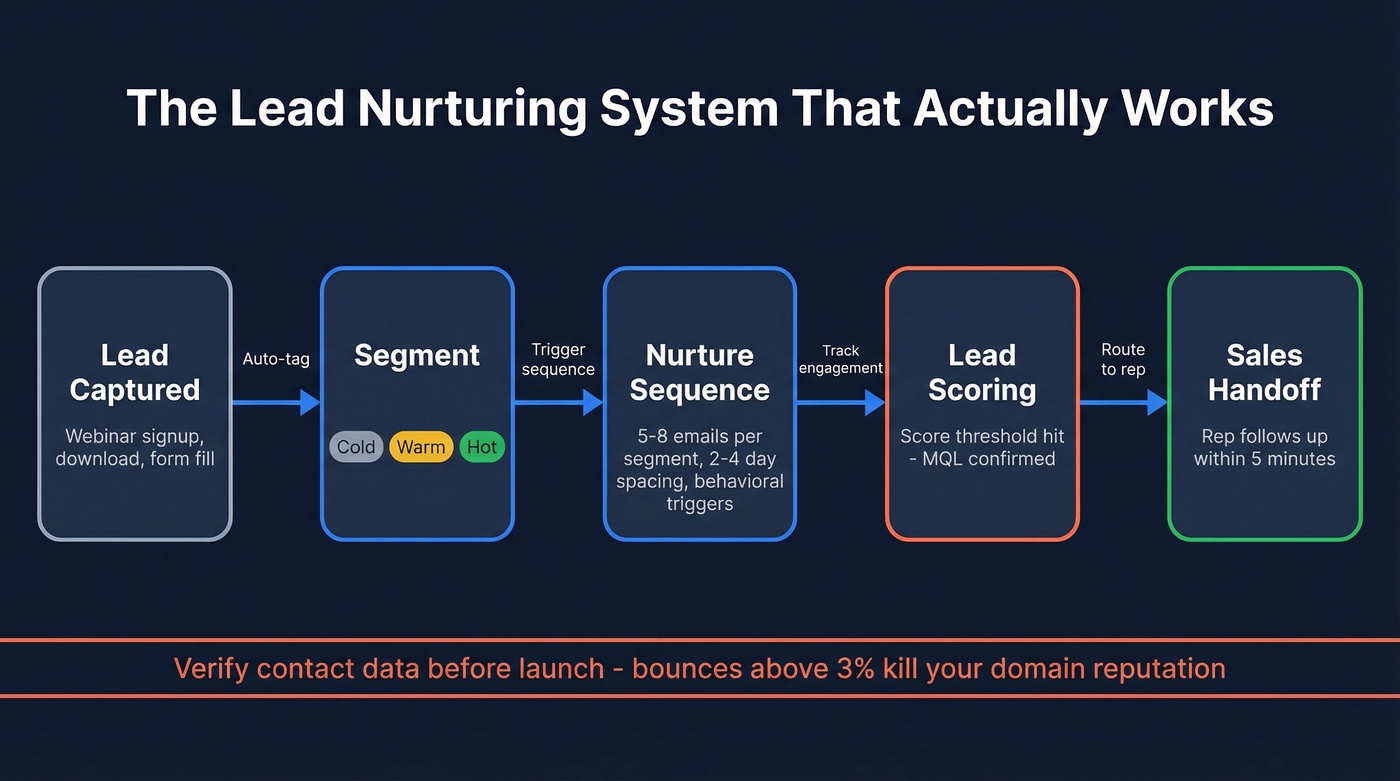
- Build a 5-8 email sequence per segment with 2-4 day spacing. Keep each email under 100 words with a single CTA.
- Implement lead scoring so you know when to hand off to sales - not when you feel like it, but when the data says so.
- Verify your contact data before launching. Bounces above 3% damage your domain reputation, and no nurture strategy survives a blacklisted sender domain.
- Automate triggers based on behavior, not just time. A prospect who downloads a case study on Tuesday needs a different next touch than someone who hasn't opened an email in three weeks.
What Is Lead Nurturing, Really?
Lead nurturing is the process of building relationships with prospects who aren't ready to buy yet - and staying relevant until they are. It's not lead generation. Generation fills the top of the funnel; nurturing moves people through it. Generation is about volume; nurturing is about relevance and timing.
The working definition that matters in practice: a system of sequenced, segmented, multi-touch engagement designed to move a prospect from initial awareness to purchase readiness on their timeline, not yours.
Why does this distinction matter so much? Because B2B buying cycles are long. 40.4% of buyers take 6-12 months to make a purchase decision, and 45.8% consume more than seven content pieces before they're ready to talk to sales. That's not a world where one email or cold call closes deals. On average, it takes about 10 marketing-driven touches to convert a lead into a sales-ready opportunity.
Nurturing isn't a "nice to have" tacked onto your marketing stack. It's the system that turns a list of names into pipeline.
Why It Works (The Numbers)
Forrester's research is widely cited here: companies excelling at lead nurturing generate 50% more sales-ready leads at 33% lower cost. That's not a marginal improvement - it's a fundamentally different cost structure. Nurtured leads also make 47% larger purchases and move through a 23% shorter sales cycle.
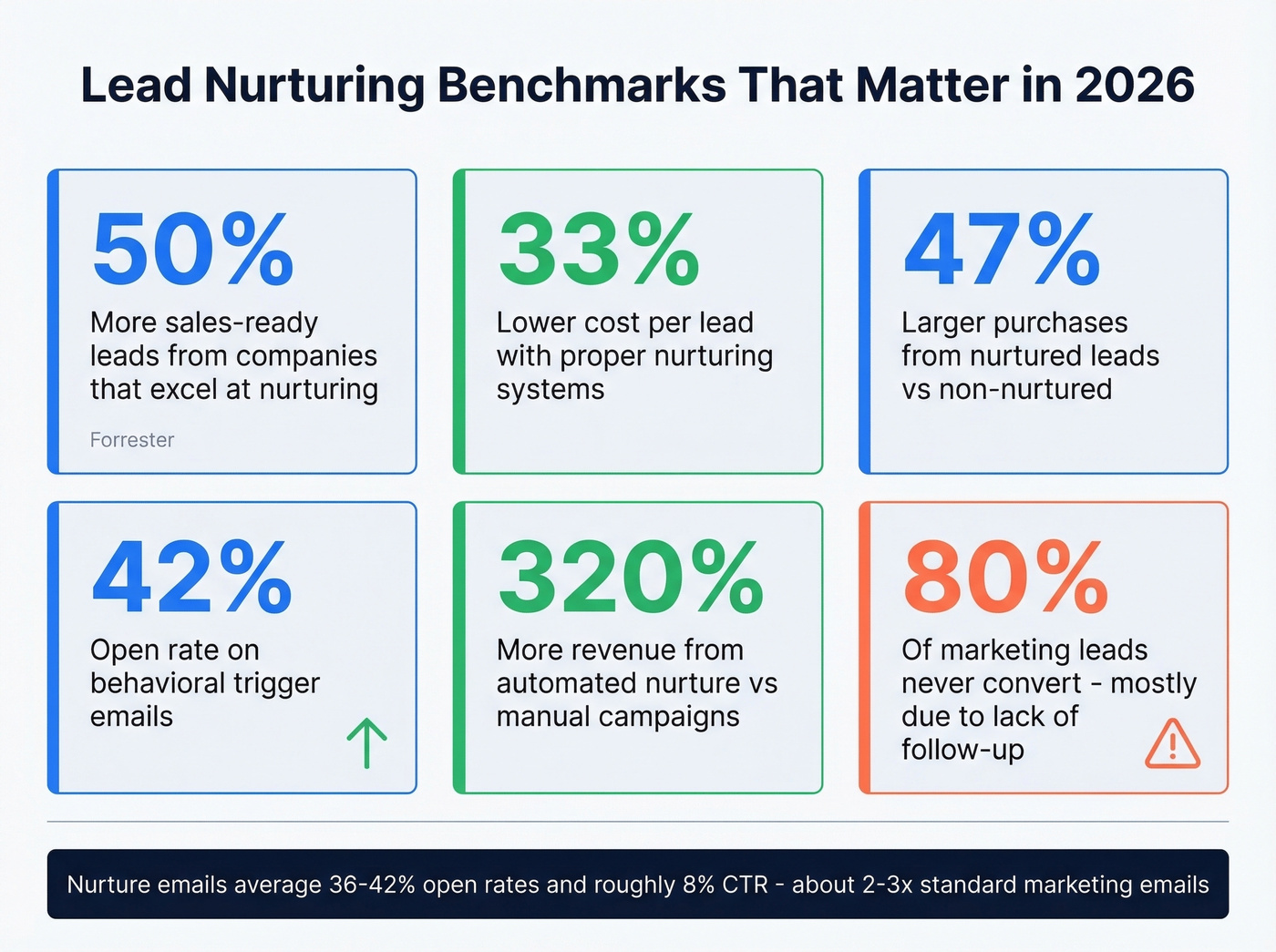
The flip side is brutal. Almost 80% of marketing leads never convert into sales, and the primary reason is lack of follow-up. That's not a data problem or a targeting problem. It's a neglect problem.
Benchmarks worth pinning to your wall:
- Nurture emails average 36.7-42.35% open rates and ~8% CTR - roughly 2-3x standard marketing emails
- Behavioral triggers hit 42% open rates and can drive 10x higher ROI than broadcasts
- Automated nurturing emails generate 320% more revenue than manual campaigns
- High-performing campaigns reach 55%+ opens and 10-12% CTR
The math is clear. The question isn't whether to nurture - it's how to build a system that actually works.
How to Build a Lead Nurturing Strategy
Define Your ICP and Buyer Personas
Everything downstream depends on this. If you don't know who you're nurturing, you'll default to generic messaging - and generic messaging is just noise.
Define your ideal customer profile at the company level: industry, headcount, tech stack, revenue range. Then define buyer personas at the individual level: role, seniority, pain points, buying authority. A mid-market SaaS company selling to VP-level buyers at 50-500 employee companies with a Salesforce tech stack will nurture very differently than an agency targeting marketing directors at e-commerce brands. Most teams need 2-4 personas. More than that and you'll never build enough content to serve them all.
Segment Your Database
Three buckets, each with a different nurture approach.
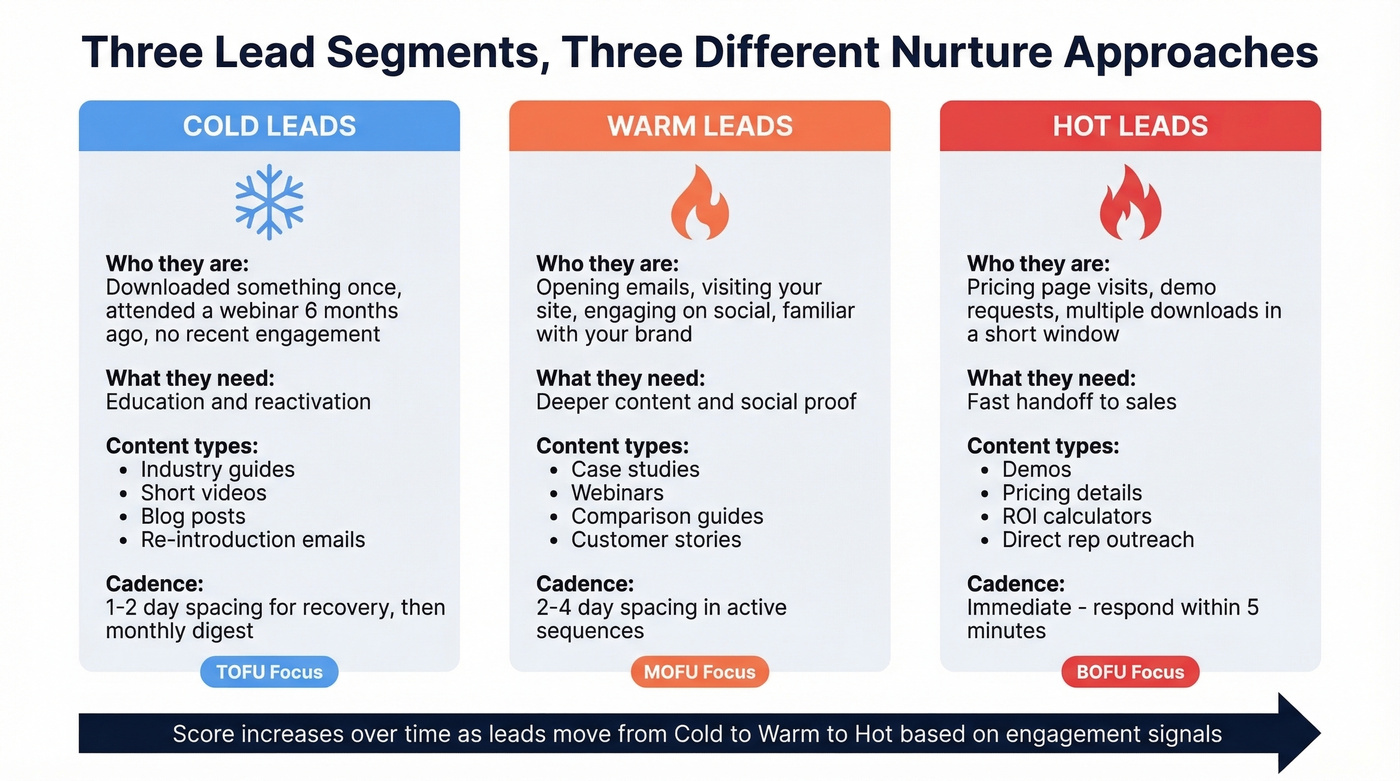
Cold leads have no engagement - they downloaded something once or attended a webinar six months ago. They need education and reactivation. Warm leads are familiar with you but not sales-ready - they're opening emails, visiting your site, engaging on social. They need deeper content and social proof. Hot leads are showing buying signals - pricing page visits, demo requests, multiple content downloads in a short window. They need a fast handoff to sales.
Map Content to Funnel Stages
| Stage | Content Types | Goal |
|---|---|---|
| TOFU | Industry guides, short videos, blog posts | Build awareness |
| MOFU | Case studies, webinars, comparisons | Establish credibility |
| BOFU | Demos, pricing, ROI calculators | Drive decision |
The mistake most teams make is sending BOFU content to TOFU leads. A prospect who just learned your category exists doesn't want a pricing sheet - they want to understand why the problem matters.
Build Your Lead Scoring Model
The full scoring template is in the next section, but the principle is simple: assign point values to actions and attributes, set a threshold, and route leads to sales when they cross it. Start rule-based. Layer AI once you have enough historical data to train on.
Set Up Automation and Triggers
Time-based drips are table stakes. The real gains come from behavioral triggers - sometimes called "digital body language" - actions that fire a specific response. A pricing page visit triggers a sales alert. A case study download triggers a follow-up email with a related customer story.
Behavioral triggers hit 42% open rates versus the mid-to-high 30s you'll see across scheduled broadcasts. That difference compounds across thousands of leads.
Don't limit triggers to email. A prospect who crosses your engagement threshold should also trigger a connection request from the assigned rep, a retargeting ad campaign, and a sales call task. We've seen one team reopen dormant deals by embedding 30-second personalized video clips in their reactivation flows - a small change that produced outsized results. Multichannel nurturing isn't optional anymore; it's what separates programs that produce pipeline from programs that produce reports.
Align Sales and Marketing on Handoffs
This is where most nurturing programs quietly die.
Marketing defines an MQL one way, sales defines it another, and leads fall into a gap between the two. Sit down together and agree on three things: what score triggers a handoff, what information sales needs at handoff, and how fast sales commits to following up. Document it. Revisit it quarterly.
In enterprise deals with 6-10 stakeholders, 68% of qualified opportunities stall because engagement loses context as deals progress. Nurturing contacts individually without opportunity-level awareness yields 40% lower conversion rates. If your deal involves a buying committee, your nurture program needs to track engagement at the account level, not just the contact level.

Bounces above 3% kill your nurture sequences and your domain reputation. Prospeo's 5-step email verification delivers 98% accuracy with catch-all handling and spam-trap removal - so your carefully crafted sequences actually reach inboxes.
Stop nurturing bounced emails. Start nurturing real buyers.
Lead Scoring Template You Can Copy
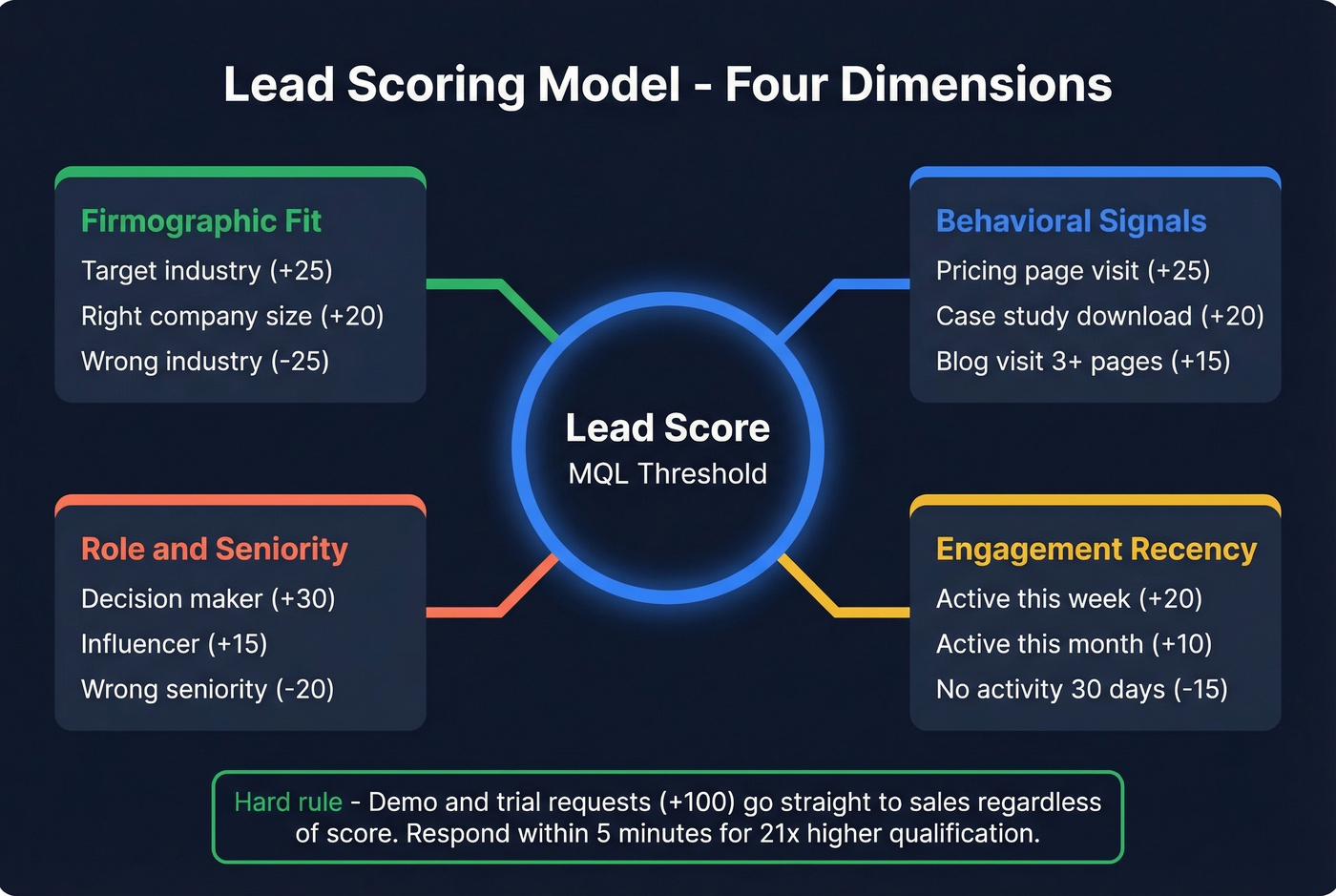
Here's a concrete scoring model you can adapt. The point values aren't sacred - calibrate them to your sales cycle and feedback loops.
| Action / Attribute | Points |
|---|---|
| Demo or trial request | +100 |
| Pricing page visit | +25 |
| Webinar registration | +30 |
| Case study download | +20 |
| Email open | +5 |
| Email click-through | +10 |
| Blog visit (3+ pages) | +15 |
| No activity for 30 days | -15 |
| Outside target industry | -25 |
| Wrong seniority level | -20 |
The model works across four dimensions: firmographic fit (company matches your ICP), behavioral signals (what they're doing on your site and in your emails), role and seniority (right person in the org), and engagement recency (when they last took action). A VP of Engineering at a target-size SaaS company who visited your pricing page yesterday scores very differently from a marketing intern at a non-profit who opened one email three months ago.
Your MQL threshold should be driven by sales capacity and feedback - not an arbitrary number. MQL answers the question "should I call them?" not "is this an opportunity?" One team we worked with improved their MQL-to-meeting rate by 13% just by adjusting their threshold based on sales feedback over two quarters.
One hard rule: demo and trial requests go straight to sales regardless of score. Someone raising their hand doesn't need to accumulate more points - they need a human qualifier within five minutes. Intent-based routing within that window increases qualification likelihood by 21x.
Email Sequences That Convert
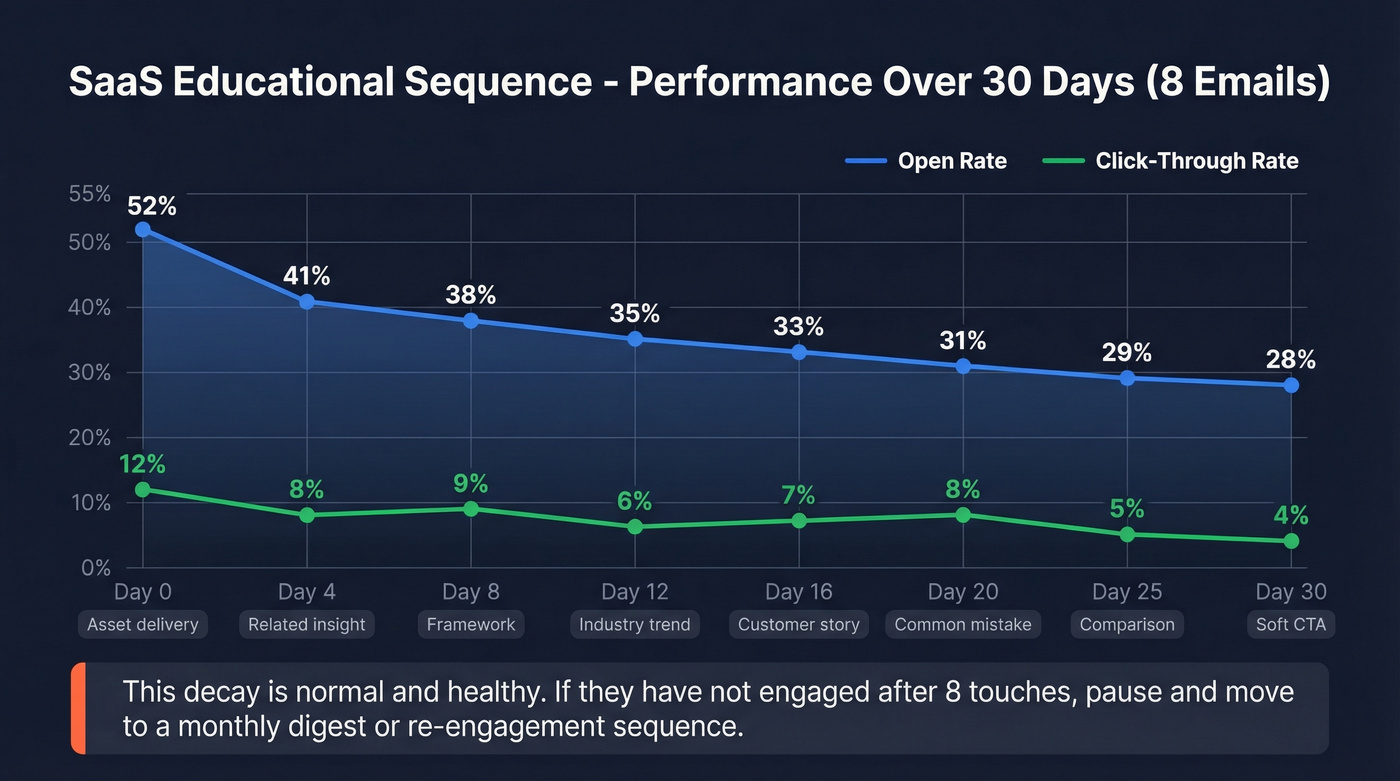
SaaS Educational Sequence (8 Emails / 30 Days)
This sequence triggers when a prospect downloads a report or guide. Educate first, build credibility second, convert third.
| Day | Open Rate | CTR | |
|---|---|---|---|
| 1 - Asset delivery + welcome | 0 | 52% | 12% |
| 2 - Related insight | 4 | 41% | 8% |
| 3 - Framework / how-to | 8 | 38% | 9% |
| 4 - Industry trend | 12 | 35% | 6% |
| 5 - Customer story | 16 | 33% | 7% |
| 6 - Common mistake | 20 | 31% | 8% |
| 7 - Comparison / evaluation | 25 | 29% | 5% |
| 8 - Soft CTA (demo/call) | 30 | 28% | 4% |
Notice the decay curve. Day 0 opens at 52%; by Day 30 you're at 28%. That's normal and healthy. If they haven't engaged after 8 touches, pause - don't spam. Move them to a lower-frequency monthly digest or a re-engagement sequence.
Ghosted List Recovery Sequence (6 Emails / 6 Days)
This is for the list you forgot about - the webinar attendees, the lead magnet signups, the trade show scans that sat in a spreadsheet for two months. It's aggressive on cadence because you're fighting recency decay.
Day 0: Re-introduction. Remind them who you are and what they signed up for. Set expectations for the next few emails. Day 1: Deliver an exclusive resource - a template, SOP, or framework they can't get elsewhere. Day 2: Share a repurposing framework or tactical tip. Pure value, no pitch. Day 3: Case study with a soft CTA. "Here's how [company] solved [problem]. Want to see if it applies to you?" Day 4: Common mistake in their space plus your fix framework. Day 6: Hard pitch. Limited offer, clear CTA, deadline if you have one.
Keep every email under 100 words. One CTA per email. Space them 1-2 days apart for recovery sequences - tighter than the 2-4 day standard for educational flows.
Five Mistakes That Kill Your Pipeline
1. Ghosting After the Lead Magnet
This is the single most common nurturing failure. Someone downloads your guide, you deliver it, and then... silence. Two months later you send a blast email to a list that's forgotten you exist. One poster on r/Emailmarketing described this exact scenario - roughly 100 signups, zero follow-up for months, then surprise when nobody responded. Your Day 0 email should go out within minutes of the download, not weeks.
2. Sending Generic Messages to Everyone
80% of buyers say the experience a company provides matters as much as its products. When you send the same email to a CISO and a marketing director, you're telling both of them you don't understand their world. Segment by role, by funnel stage, by engagement level. It's more work upfront. It's dramatically more effective downstream.
3. Pushing for the Sale Too Early
Remember: 40.4% of B2B buyers take 6-12 months to decide, and 15.4% take over a year. Sending a "ready to buy?" email on Day 3 of a nurture sequence doesn't accelerate the sale - it kills trust.
Here's the thing: if your average deal size is under $10k, you probably don't need a 30-day nurture sequence at all. A tight 3-email series with a clear CTA will outperform a bloated drip campaign that tries to mimic enterprise sales motions. Match the complexity of your nurture to the complexity of the buying decision.
4. Stopping After the First Purchase
Nurturing doesn't end at closed-won. Renewal cadences, expansion plays, and customer education sequences drive net revenue retention. The cheapest pipeline you'll ever build comes from existing customers who already trust you. Build a post-purchase sequence: onboarding value emails for the first 30 days, a check-in at Day 60, and renewal/expansion touches at 90, 60, and 30 days before contract end.
5. Ignoring Data Quality and Deliverability
None of the above matters if your emails don't arrive. We watched an SDR team send 500 emails from a carefully crafted nurture sequence and bounce 60 of them - a 12% bounce rate that cratered their domain reputation within a week. The rule is simple: keep bounce rate under 3%.
Before you activate any nurture sequence, verify your contact list. Prospeo's 5-step email verification catches invalid addresses, spam traps, and honeypots before they hit your automation platform. With 98% email accuracy and a 7-day data refresh cycle, it keeps your list clean without manual effort. The free tier covers 75 verifications per month - enough to test before committing.
Great lead scoring needs complete data. Prospeo enriches every contact with 50+ data points - job title, seniority, tech stack, intent signals - so your scoring model routes the right leads to sales at exactly the right moment.
Enrich your database and score leads with data that's refreshed every 7 days.
AI's Role in Nurture Programs
Sellers spend just 28% of their time actually selling - the rest goes to admin, research, and data entry. AI's biggest impact on nurturing isn't writing emails. It's eliminating the manual work that prevents nurturing from happening at all.
BCG's analysis found that AI-leading companies achieve 1.7x revenue growth and 40% greater cost reductions than laggards. AI-driven personalization can increase revenue by up to 15%. And 49% of B2B marketers now prioritize leads using high-intent data signals - a workflow that's nearly impossible to run manually at scale.
But AI-only nurturing fails. Robotic, generic outreach erodes trust faster than no outreach at all. The winning model is hybrid:
| Responsibility | AI Handles | Humans Handle |
|---|---|---|
| Signal detection | ✓ | |
| Lead scoring | ✓ | |
| Trigger automation | ✓ | |
| Send-time optimization | ✓ | |
| Tone and voice | ✓ | |
| Complex deal conversations | ✓ | |
| Relationship building | ✓ | |
| Edge-case interpretation | ✓ |
Let's be honest: start rule-based. Build your scoring model with explicit point values and thresholds. Layer AI once you have 6-12 months of historical conversion data to train on. AI without data is just guessing with more confidence.
Lead Nurturing Tools Worth Evaluating
When evaluating nurturing tools, prioritize five capabilities: lead scoring with segmentation, multi-channel automation beyond just email, AI-powered personalization, real-time analytics, and native CRM integrations. Skip any platform missing more than one of these - you'll end up duct-taping gaps with manual work.
| Tool | Best For | Starting Price | Key Strength |
|---|---|---|---|
| HubSpot | SMBs starting out | Free / from $15/user/mo | All-in-one CRM + nurture |
| ActiveCampaign | Behavioral triggers | ~$29/mo | Advanced automation |
| Mailchimp | Simple sequences | Free / ~$13/mo | Easy setup, low cost |
| Marketo Engage | Enterprise | ~$1,000-3,000+/mo | Scale + sophisticated scoring |
| Pipedrive | Sales-led teams | $12/user/mo | Pipeline-native nurture |
| Close | Inside sales | $49/user/mo | Built-in calling + email |
| Act-On | Mid-market | ~$900/mo | Multi-channel campaigns |
Prospeo sits upstream of any nurturing platform - verify first, nurture second. It doesn't replace your HubSpot or ActiveCampaign; it ensures the data flowing into them is clean. Teams like Stack Optimize have maintained 94%+ deliverability and sub-3% bounce rates across all client campaigns using this approach.
For most SMB teams, HubSpot's free CRM paired with a verification layer is the fastest path to a working nurture program. Enterprise teams running complex multi-touch, multi-persona campaigns will outgrow it quickly - that's where Marketo or Act-On earn their price tags.
FAQ
What's the definition of lead nurturing?
Lead nurturing is the process of building relationships with prospects through sequenced, multi-channel touchpoints so your solution is top-of-mind when they're ready to buy. It's distinct from lead generation, which captures initial interest. Nurturing cultivates that interest over weeks or months using segmented content matched to each prospect's funnel stage.
What's the difference between lead generation and lead nurturing?
Lead generation fills the top of the funnel with names; nurturing moves those names toward a buying decision through relevance and timing. Generation is about volume and reach - ads, content offers, events. Nurturing is about trust-building with sequenced, personalized follow-up that matches the buyer's timeline.
How many emails should a nurture sequence have?
Five to eight emails over two to four weeks is the sweet spot for most B2B sequences. Open rates fall from ~52% on Day 0 to ~28% by Day 30. If a prospect hasn't engaged after eight touches, pause and move them to a lower-frequency monthly cadence rather than continuing to send.
What's a good open rate for nurture emails?
Nurture emails average 36.7-42.35% open rates and ~8% CTR - roughly 2-3x standard marketing email performance. High-performing campaigns hit 55%+ opens. If you're below 30%, audit your subject lines, sender reputation, and list quality before tweaking content.
How do I keep bounce rates low in nurture campaigns?
Keep bounce rates under 3% by verifying every email address before it enters your automation platform. A 5-step verification process covering catch-all domains, spam traps, and honeypots is the standard. Our free tier includes 75 verifications per month if you want to test before scaling.