

Lead Nurturing Workflows That Move Pipeline (2026)
You built the sequences. You wrote the emails. You set the delays. Six months later, your "nurture program" has generated a pile of open-rate reports and exactly zero pipeline.
Here's the thing: 80% of new leads never convert, and most lead nurturing workflows don't change that number because they're not actually nurturing anything. They're just sending emails on a timer. Real nurture moves leads through buying stages with the right content, at the right time, across the right channels. Let's break down how to build workflows that do that - starting with the three that matter most.
Start With Three Workflows
Don't try to build seven workflows on day one. Start here:
- Speed-to-lead qualification - respond within five minutes, branch by buyer type, route to sales or nurture.
- Welcome series - 3-5 emails over 7-10 days that set expectations and deliver your best content.
- Re-engagement - a 3-email sequence that fires when contacts go dark for 30-60 days.
These three cover the critical moments: first touch, early education, and the inevitable drop-off. Build them, measure by pipeline influenced (not open rates), and iterate before adding complexity. Together they form the backbone of any nurturing program worth running.
One prerequisite before you activate anything: verify your contact data. Bounced emails tank sender reputation and skew every metric downstream.
The Funnel Math Behind Nurturing
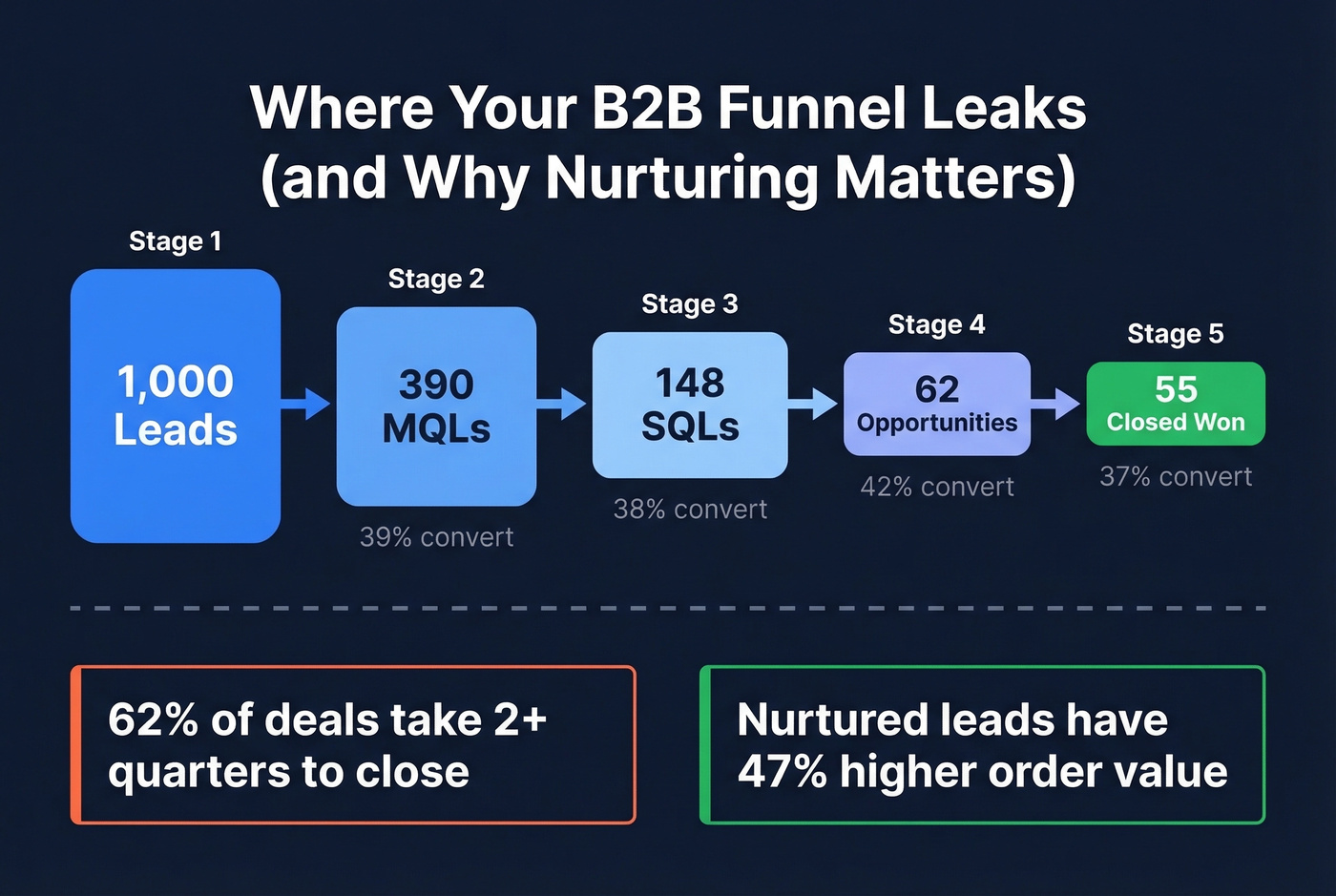
Lead nurturing workflows exist because B2B funnels leak at every stage. Typical B2B SaaS conversion rates tell the story:
| Stage | Conversion Rate |
|---|---|
| Lead to MQL | 39% |
| MQL to SQL | 38% |
| SQL to Opportunity | 42% |
| SQL to Closed Won | 37% |
For every 1,000 leads, roughly 148 become SQLs, and about 55 close. The math gets worse when you factor in time - 62.2% of B2B sales cycles last over two quarters. Your leads aren't ignoring you. They're just not ready yet.
This is exactly where nurturing earns its keep. Deals closing with nurtured leads receive 47% higher order value than non-nurtured leads. The ROI isn't in sending more emails - it's in staying relevant during those two-plus quarters while the buying committee makes up its mind.
7 Workflows That Move Pipeline
1. Speed-to-Lead Qualification
Leads contacted within five minutes are 100x more likely to qualify than those contacted after 30 minutes. That stat gets quoted everywhere. It's still true.
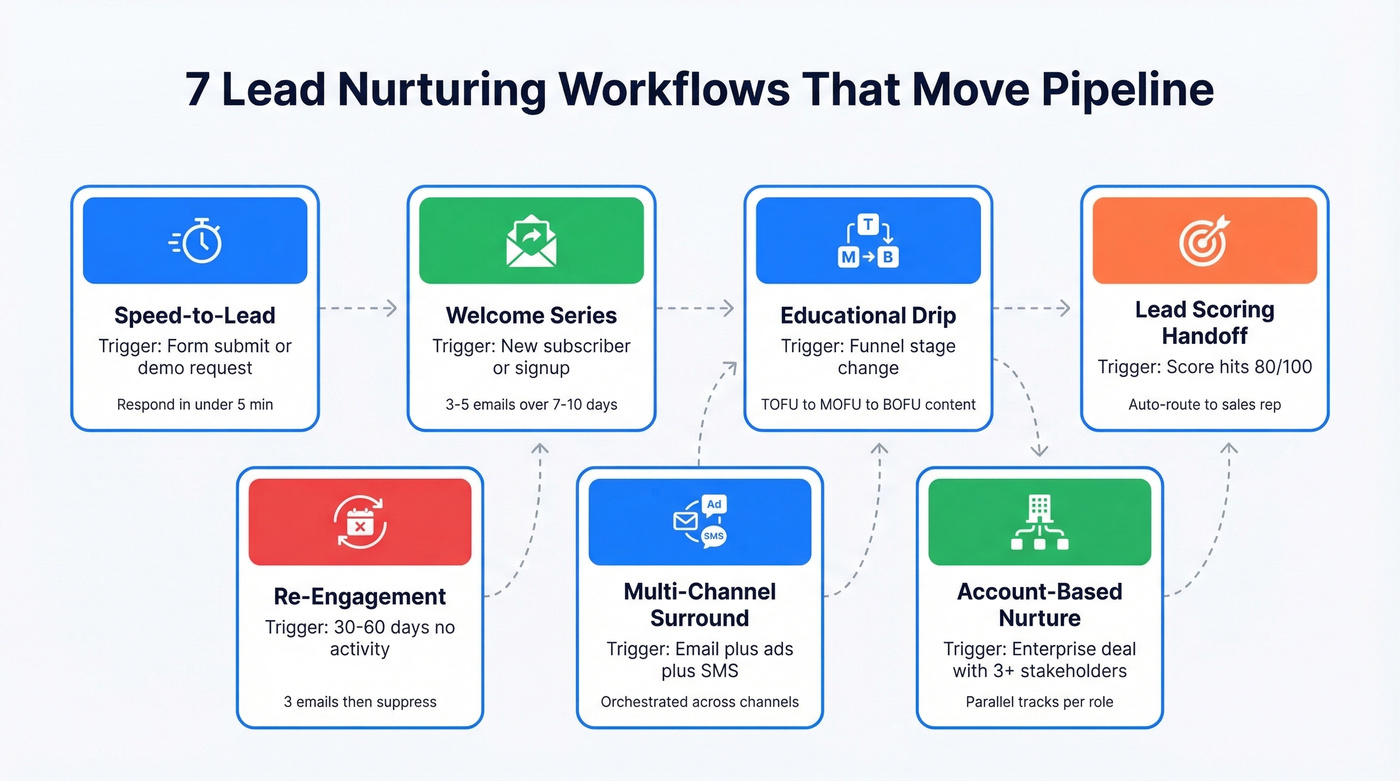
Trigger: Form submission, demo request, or pricing page visit with an identified contact.
Branch within 48 hours:
- Lead matches your ICP firmographics? Route to sales for immediate outreach. Tag as "technical buyer" or "economic buyer" based on job title and let the rep adjust the first call accordingly.
- Doesn't match ICP or isn't sales-ready? Enroll in the welcome series with a qualification score attached.
The key mistake is treating speed-to-lead as "call everyone immediately." It's not. It's about fast qualification and smart routing. A technical evaluator needs a different first touch than a VP who controls budget. This is the first decision point in every nurture journey - get it wrong and nothing downstream matters.
2. Welcome + Onboarding Series
Your welcome series is the highest-engagement window you'll ever get. Don't waste it on a single "thanks for signing up" email.
Cadence: 3-5 emails over 7-10 days.
- Day 0: Set expectations. What they'll receive, how often, and one quick win - a template, a benchmark, a tool.
- Day 3: Deliver your single best piece of content. The one that makes people reply "this is great."
- Day 7: Next step. A case study, a webinar invite, or a soft CTA to book a call.
Remix, an eCommerce platform, ran a welcome sequence following this pattern and saw a 104% jump in first purchases versus the previous quarter. The structure works across B2B and B2C because the psychology is the same: deliver value before asking for anything.
3. Educational Drip by Funnel Stage
Not every lead needs the same content. Map your drip to where they are:
| Stage | Content Type | Goal |
|---|---|---|
| TOFU | Guides, blog posts, benchmarks | Build awareness |
| MOFU | Case studies, webinars, comparisons | Create preference |
| BOFU | Demos, trials, ROI calculators | Drive decision |
Run this as a weekly cadence over 2-4 weeks. The critical ratio: give value three times before you ask for anything. Three emails of content followed by a demo request? You're in the right zone. Two product pitches and then a "just checking in"? You've already lost them. Webinar follow-ups fit naturally at the MOFU stage - registrants have shown intent, and post-event sequences with recordings and related resources keep them moving toward a decision.
4. Lead Scoring + Sales Handoff
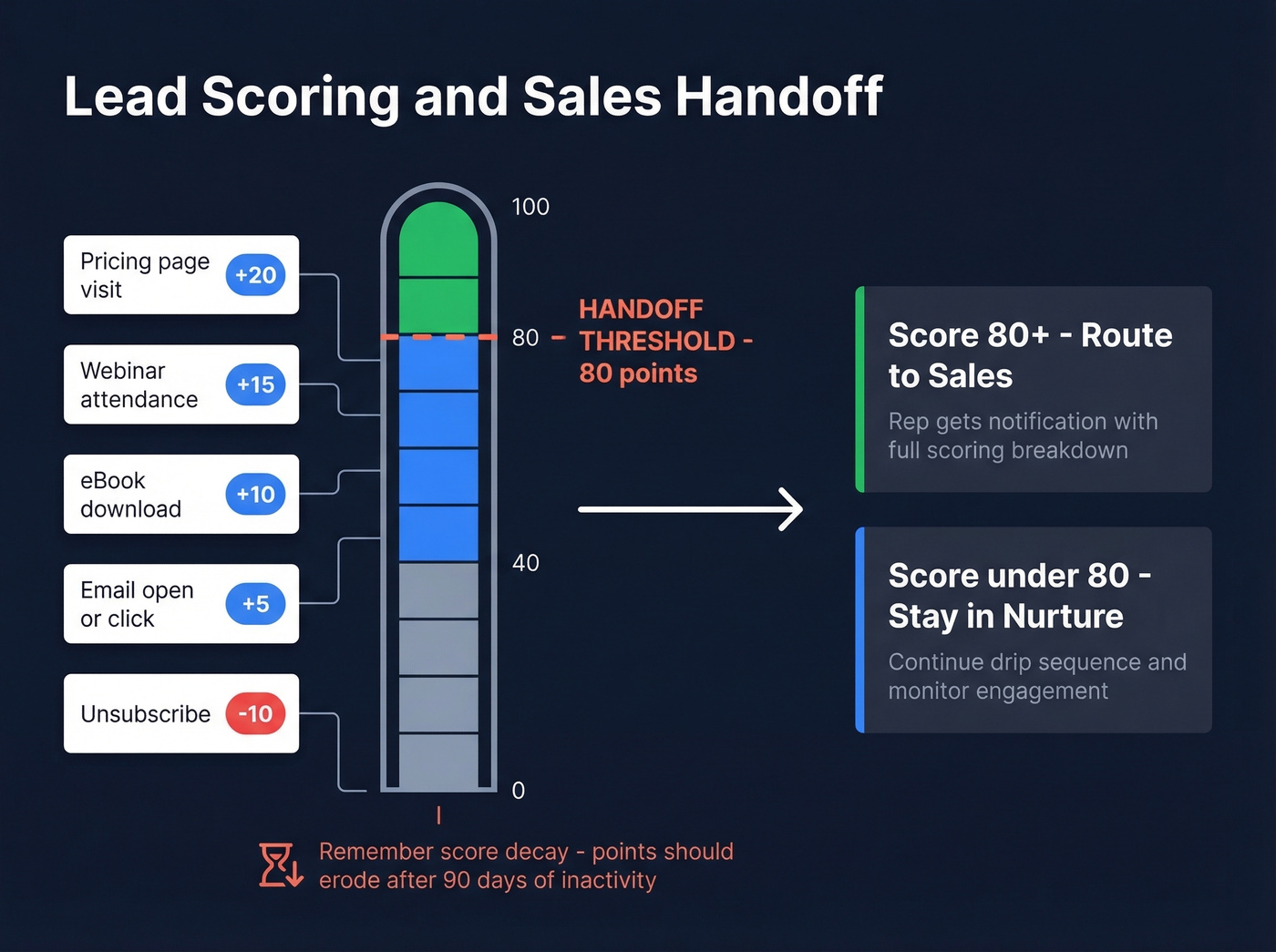
Scoring turns behavioral signals into a number your sales team can act on. It's the mechanism that makes nurturing measurable rather than aspirational.
| Action | Points |
|---|---|
| Pricing page visit | +20 |
| eBook download | +10 |
| Email open/click | +5 |
| Webinar attendance | +15 |
| Unsubscribe | -10 |
Handoff trigger: Score crosses 80/100. The contact exits nurture and enters a sales sequence with a notification to the assigned rep that includes the scoring breakdown.
Two things most teams miss. First, score decay: if someone scored 75 three months ago but hasn't engaged since, those points should erode. A contact who visited your pricing page in January isn't a hot lead in June. Second, the gap between manual and predictive scoring. Manual scoring (HubSpot Professional, most MAPs) uses rules you define. Predictive scoring (HubSpot Enterprise) uses ML to find patterns you didn't think to look for. Start manual, graduate to predictive when you have enough closed-won data to train the model.
5. Re-Engagement Workflow
Trigger: No opens or clicks for 30-60 days.
Sequence:
- Feedback email - "We noticed you've been quiet. What would be more useful?" Include a one-click preference update.
- Value offer - Your single best resource, a new benchmark, or an exclusive invite. One tactic gaining traction: a 30-second Loom from the assigned rep outperforms templated emails for reactivation because it breaks the pattern of every other email in the inbox.
- Breakup email - "We'll stop emailing unless you want to stay." This one consistently gets the highest reply rates.
Re-engagement emails can revive up to 45% of dormant leads. Even when the number is lower for your list, the workflow pays for itself because it also cleans your list - contacts who don't respond get suppressed, improving deliverability for everyone else.
6. Multi-Channel Surround Sound
Email-only nurturing is a 2019 strategy. The 2026 standard is multi-channel orchestration - and it's what separates a basic drip from a true nurture strategy.
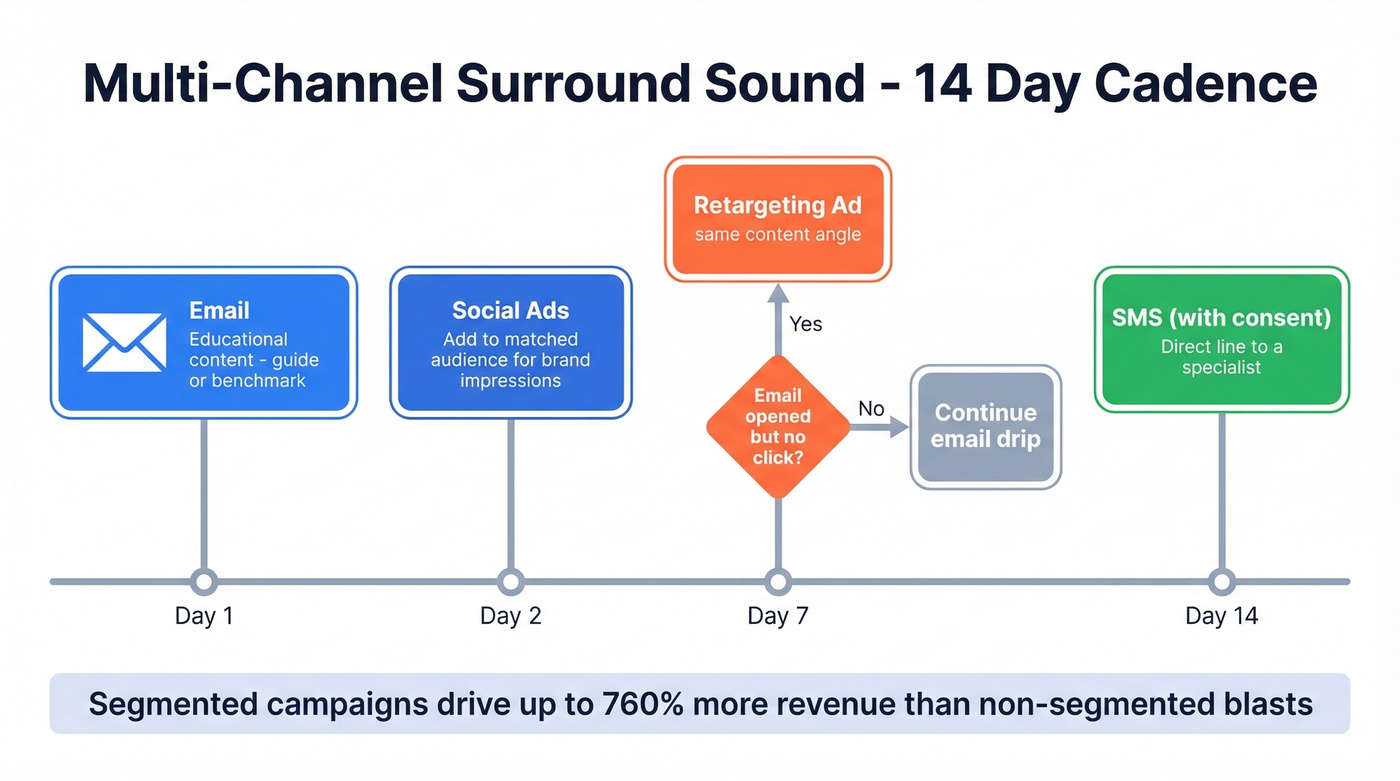
Example cadence:
- Day 1: Email with educational content
- Day 2: Add contact to a matched social audience for brand impressions
- Day 7: If email opened but no click, retargeting ad with the same content angle
- Day 14: SMS (with consent) offering a direct line to a specialist
Segmented campaigns drive up to 760% more revenue than non-segmented blasts. When you layer channels on top of segmentation, you create the "air cover" effect practitioners talk about on r/Emailmarketing - consistent brand exposure that creates recall even when individual emails aren't opened.
7. Account-Based Nurturing
Enterprise deals involve 6-10 stakeholders, and 68% of qualified opportunities stall not because of budget or timing, but because teams fail to maintain relevant engagement across the committee. Contact-based nurturing in enterprise deals produces 40% lower conversion rates and 30% longer sales cycles compared to opportunity-focused engagement.
The fix: nurture the account, not the individual. Map the buying committee - champion, economic buyer, technical evaluator, end user - and create parallel content tracks. Your champion gets ROI content to share internally. Your technical evaluator gets architecture docs and security whitepapers. The economic buyer gets peer benchmarks and cost comparisons.
Use this if: You're selling deals above $50k with 3+ month sales cycles and multiple stakeholders.
Skip this if: Your average deal closes in under 30 days with a single decision-maker. You'll over-engineer the process and slow yourself down.
Bonus: Post-Purchase Nurturing
Most teams stop nurturing the moment a deal closes. That's a mistake.
Onboarding sequences, quarterly business reviews, and expansion triggers use the same workflow logic as pre-sale nurturing - just pointed at retention and upsell. A simple post-purchase cadence (onboarding checklist, 30-day health check, quarterly value recap) reduces churn and surfaces expansion opportunities your CSMs would otherwise miss. Industries with long policy cycles, like insurance, benefit especially from post-purchase workflows that keep clients engaged between renewal windows.
The Data Foundation Most Teams Skip
Every workflow above assumes one thing: your contact data is accurate. For most teams, it's not.
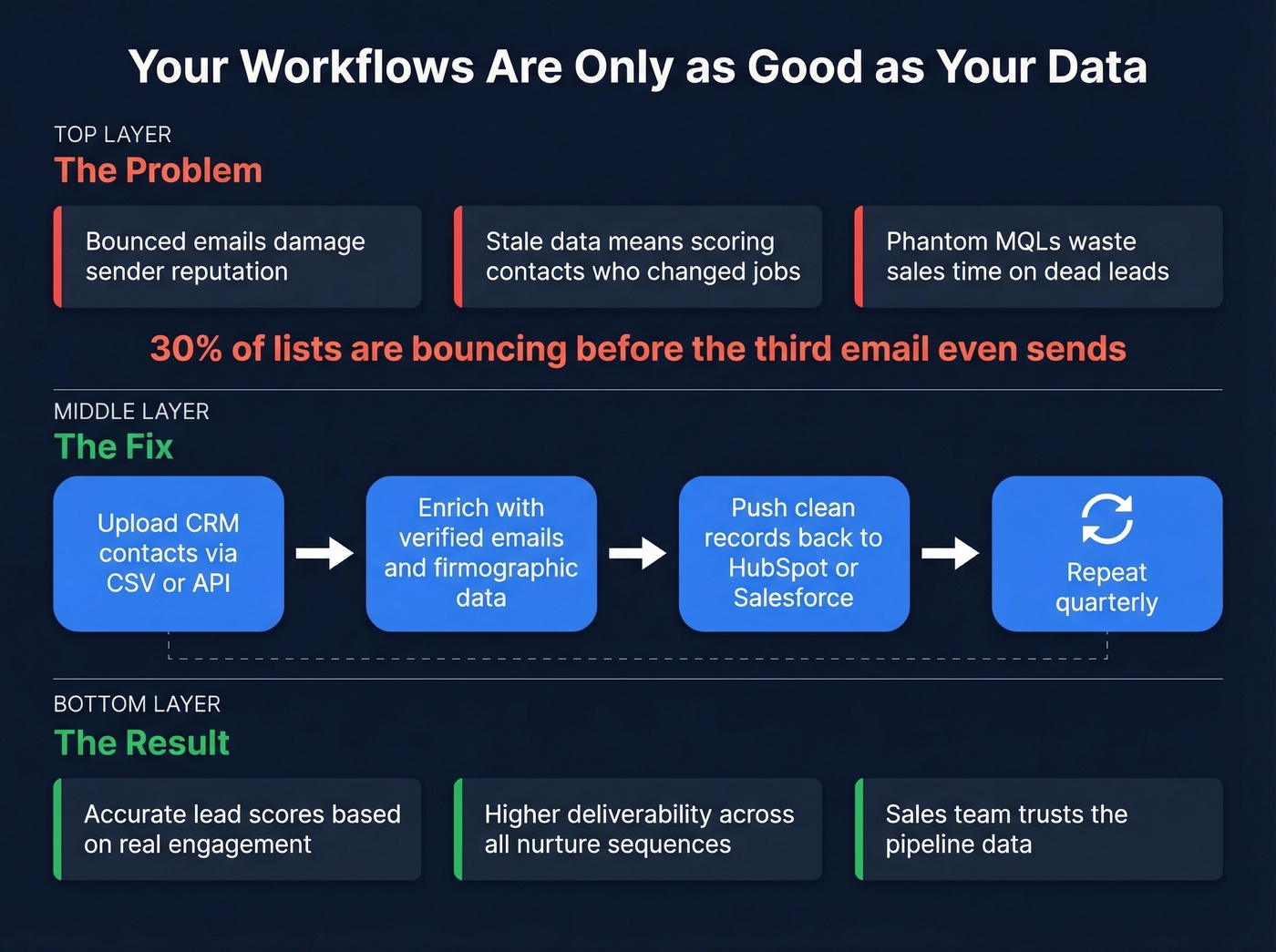
Bounced emails don't just waste sends - they damage sender reputation, which tanks deliverability for your entire domain. Stale data means you're scoring contacts who changed jobs six months ago. Phantom MQLs clog your pipeline and waste sales time on dead leads. We've seen teams build beautiful 12-touch nurture sequences only to discover that 30% of their list was bouncing, which meant their domain reputation was in the gutter before the third email even sent.
The practical workflow: upload your CRM contacts via CSV or connect through the API, enrich with verified emails and firmographic data, then push clean records back into HubSpot or Salesforce. Do this before you build a single workflow, and repeat it quarterly.
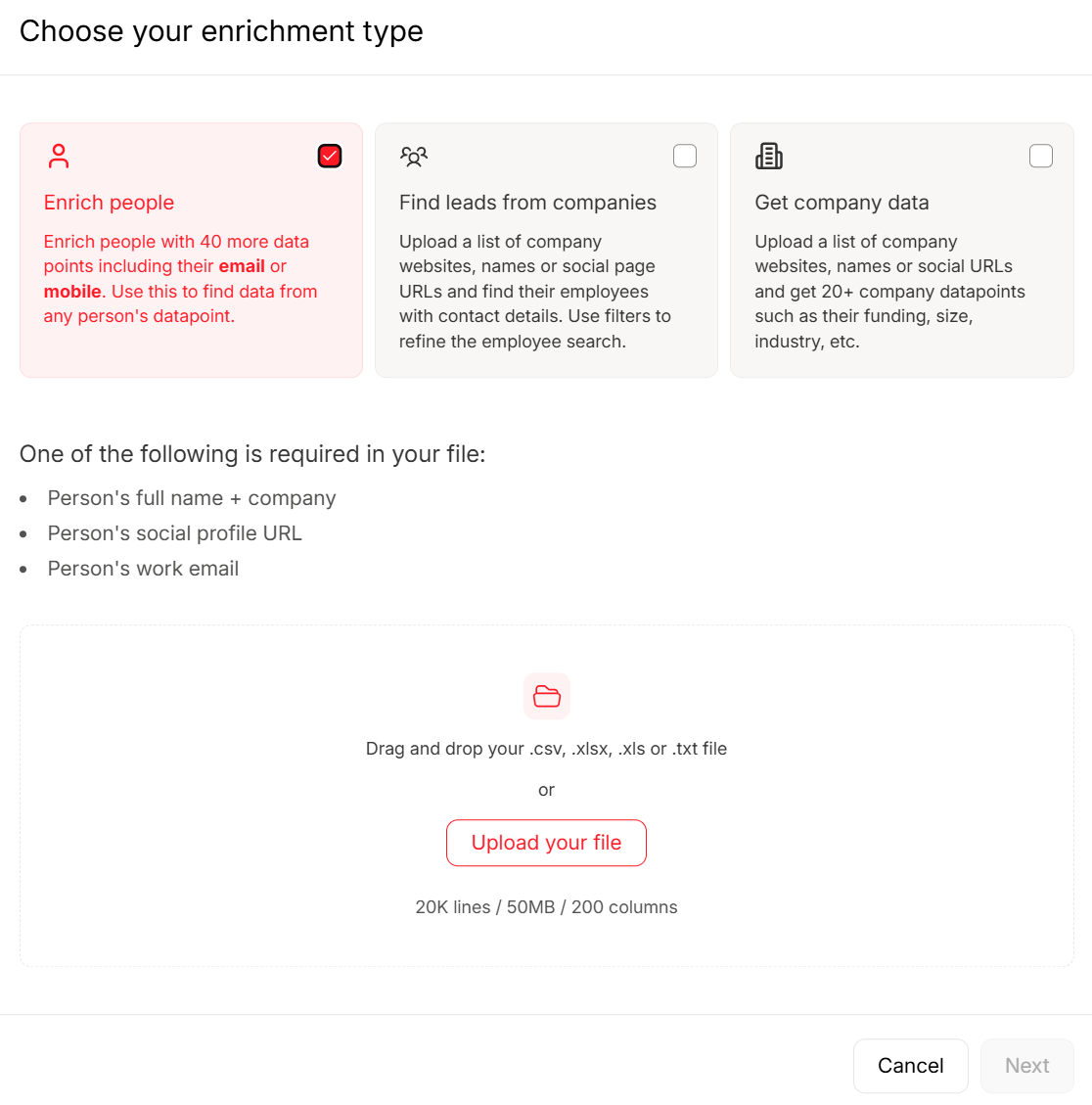

Your nurture workflows are only as good as the data feeding them. Bounced emails kill sender reputation, skew lead scores, and make every metric downstream unreliable. Prospeo's 98% email accuracy and 7-day data refresh mean your welcome series, drips, and re-engagement sequences actually reach real inboxes - not spam traps.
Stop nurturing bounced emails. Start with data you can trust.
You just read that 62% of B2B deals take two-plus quarters to close. That's months of nurture emails hitting contacts whose job titles, companies, and emails go stale. Prospeo refreshes 300M+ profiles every 7 days - not every 6 weeks like competitors - so your scoring, routing, and handoffs stay accurate throughout the entire buying cycle.
Keep your pipeline data fresh while the buying committee decides.
5 Mistakes That Kill Pipeline
Nurturing contacts instead of opportunities. When you send the same drip to every contact regardless of account context, you're broadcasting, not nurturing. Group contacts by account and buying stage. The champion and the CFO shouldn't get the same email.
Generic messaging at scale. "Hi {First Name}, I wanted to share this resource" isn't personalization. Segment by entry point, persona, and funnel stage at minimum. The 3:1 give-to-get ratio only works if the "give" is actually relevant to the recipient.
No speed-to-lead system. Look, we've watched teams spend months perfecting their drip sequences while inbound leads sit untouched for days. If a prospect fills out a demo form and gets a response 48 hours later, you've already lost momentum. Automate the first response. Route immediately. Then nurture.
Repetitive content with no cooldown. Sending the same content angle three times in two weeks is a fast path to unsubscribes. Build in cooldown periods between similar content types, and vary the format - a blog post, then a video, then a benchmark - even when the topic stays the same.
Workflow conflicts. This is the silent killer. A lead gets routed to sales while simultaneously enrolled in a nurture that sends a redundant demo request. Or the same company submits multiple forms and gets misrouted to different reps. The distinction between nurture campaigns (build awareness over time) and connect campaigns (aim for an immediate conversation) is critical - enrolling a lead in both simultaneously creates confusion and contradictory messaging. Audit your enrollment logic quarterly. Map every active workflow on a whiteboard and look for overlaps. The HubSpot community is full of horror stories about broken Calendly integrations and leads vanishing into dead workflows.
AI-Powered Nurturing in 2026
AI isn't a future state for lead nurturing - it's the current baseline for teams with 10,000+ contacts. BCG's analysis found that AI-leading companies achieve 1.7x revenue growth compared to laggards. The gap is widening, partly because sellers still spend only 28% of their time actually selling.
Three AI applications that are production-ready right now:
Predictive scoring evaluates 100+ signals - firmographic, behavioral, timing - to surface leads that manual rules would miss. Teams using AI segmentation see a 25% conversion increase within six months.
Behavioral trigger emails generate 30x more revenue per recipient than batch sends. Identifying the right moments (pricing page revisit, competitor comparison download, usage milestone) and letting the AI fire the right message automatically is where the real gains live.
Send-time optimization removes the guesswork from cadence design. Instead of "send Tuesday at 10 a.m.," the system learns when each contact is most likely to engage and through which channel.
Hot take: if your average deal is under $15k and your list is under 5,000 contacts, skip AI scoring entirely. Well-designed manual workflows with clean data will outperform a poorly trained model every time. AI nurturing is powerful, but only when you have enough volume and closed-won data to feed it.
Tools for Building Nurture Workflows
The platform matters less than the workflow architecture underneath it. Pick based on four criteria: CRM integration depth, branching logic complexity, channel support, and cost at your contact volume.
| Tool | Best For | Starting Price | Key Note |
|---|---|---|---|
| HubSpot | All-in-one CRM + automation | Free / $15/user/mo | Workflows require Marketing Hub Professional+ |
| Prospeo | Verified contact data layer | Free / ~$0.01/email | Pairs with any automation platform |
| ActiveCampaign | Complex branching on a budget | ~$29/mo | Strongest standalone automation |
| Marketo Engage | Enterprise ABM orchestration | ~$1k-$5k+/mo | Complex setup, high cost |
| Pipedrive | Sales-first teams | $12/user/mo | Limited marketing automation |
| Close | Inside sales teams | $49/user/mo | Minimal multi-channel nurturing |
| Zoho | Budget-friendly automation | ~$19/mo | Smaller ecosystem |
In our experience, the biggest ROI gains don't come from upgrading your MAP - they come from cleaning the data feeding it. A $29/month tool running on verified contacts will outperform a $5k/month platform running on a dirty list.
Benchmarks Worth Tracking
If your dashboard only shows opens and clicks, you're measuring the wrong thing.
| Vanity Metrics | Pipeline Metrics |
|---|---|
| Open rate (20-30% typical) | MQL to SQL conversion rate |
| CTR (1-3% for B2B) | Dormant accounts reactivated |
| List growth rate | Sales cycle length (shortened?) |
| Unsubscribe rate | Pipeline influenced ($) |
Email benchmarks are useful for diagnostics - a 6.9% response rate for 2-email sequences and Wednesday 7-11 a.m. as the best send window give you starting points. But the metrics that justify your nurture program's existence are on the right side of that table. Pipeline influenced, sales cycles shortened, dormant accounts brought back to life - those are the numbers your leadership team cares about.
FAQ
How many emails should a nurture workflow include?
Mid-funnel sequences run 6-12 touches over 3-6 weeks. Welcome series are shorter: 3-5 emails over 7-10 days. Match length to your sales cycle - a 90-day enterprise cycle needs more touches than a 14-day self-serve conversion.
What's the difference between a drip campaign and a nurturing workflow?
Drip campaigns send pre-scheduled emails on a fixed timeline regardless of behavior. Nurturing workflows branch based on recipient actions, score engagement dynamically, and exit contacts into sales sequences when they're ready to buy.
When should I hand a lead from nurturing to sales?
When their lead score crosses your threshold - typically 80/100. Combine behavioral signals (pricing page visits, demo requests) with firmographic fit, and include score decay so stale leads don't trigger false handoffs.
How do I keep nurture emails from going to spam?
Verify your entire list before activating any workflow - high bounce rates destroy sender reputation. Authenticate with SPF, DKIM, and DMARC. Using a verification layer with 98% email accuracy and frequent data refreshes prevents the stale-data bounces that most commonly trigger spam filters.
Do I need an expensive platform to build lead nurturing workflows?
No. HubSpot's free CRM handles basic sequences, and ActiveCampaign starts at ~$29/month with advanced branching. The platform matters far less than data quality - clean, verified contacts outperform a $5k/month tool running on a dirty list every time.