

Lead Response Time: The Data, the Benchmarks, and What Actually Fixes It
Your team knows the 5-minute rule. They still take 42 hours to respond to inbound leads.
That gap between knowing and doing is where lead response breaks down - and where pipeline goes to die. Here's the contrarian take nobody wants to hear: optimizing response time without fixing your data is just failing faster. A 3-minute callback to a disconnected number is still a missed opportunity. We're going to walk through the benchmarks, the math, and the playbook to fix both sides of the problem.
What Is Lead Response Time?
Lead response time is the gap between a prospect's first expression of interest - a form fill, demo request, chat message, content download - and your team's first meaningful follow-up.
Lead response time = Timestamp of first follow-up - Timestamp of initial contact
To get your team's average, sum the response times for all leads in a given period and divide by the number of contacts. Most CRMs can automate this with a simple workflow rule, though you'd be surprised how many teams have never set it up.
What counts as "first follow-up" matters here. An automated confirmation email doesn't count. The clock stops when a human rep makes a call, sends a personalized email, or responds to a chat. If your only response is a "thanks, we'll be in touch" autoresponder, you haven't responded - you've acknowledged.
Why Speed to Lead Matters in 2026
HubSpot data shows 82% of consumers expect an "immediate" response when they have a sales question - and most people define "immediate" as 10 minutes or less. Not "same day." Not "within a few hours." Immediate.
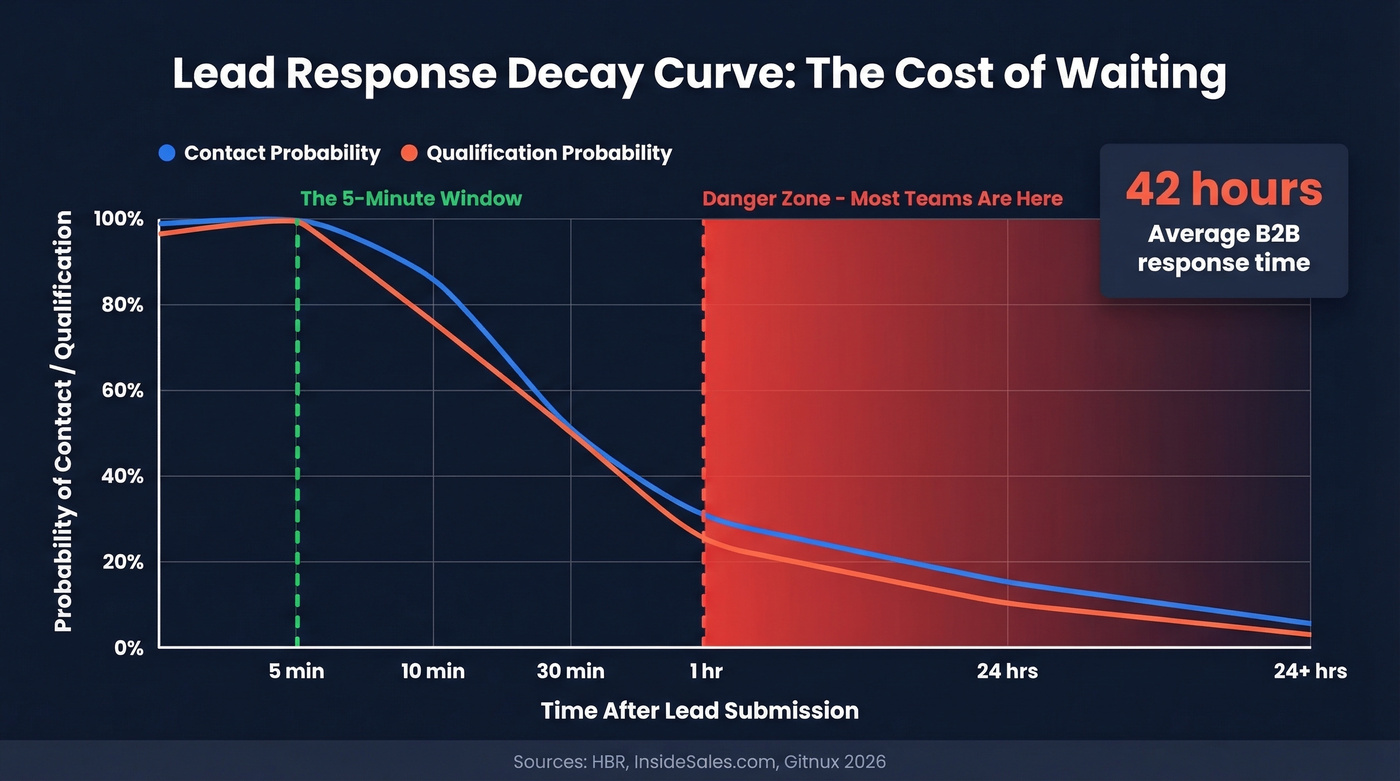
The foundational research is Harvard Business Review's "[The Short Life of Online Sales Leads](https://hbr.org/2011/03/the-short-life-of-online-sales-leads)" (March 2011) by James B. Oldroyd, Kristina McElheran, and David Elkington. The industry stats popularized around this research are the ones every sales team quotes: contacting leads within 5 minutes makes you 100x more likely to connect and 21x more likely to qualify them than waiting 30 minutes. Those numbers are 15 years old and most teams still can't hit the benchmark. That's not a data problem. It's an execution problem.
The decay curve is brutal:
| Time After Submission | Contact Probability | Qualification Probability |
|---|---|---|
| 0-5 min | Baseline (100%) | Baseline (100%) |
| 5-10 min | ~80% | ~80% |
| 10-30 min | ~50% | ~50% |
| 30-60 min | ~30% | ~25% |
| 1-24 hrs | ~15% | ~10% |
| 24+ hrs | <5% | <5% |
78% of customers purchase from the company that responds first. Not the cheapest. Not the one with the best product. The first one to show up. Chili Piper's benchmark data highlights a 391% increase in conversions when companies respond within the first minute. And Gitnux puts the average response time at 23 hours and 58 minutes - meaning most teams aren't even in the game.
Every minute you wait, you're not just losing that lead. You're wasting the marketing dollars that generated it. A $200 CPL lead that never gets a callback is $200 in the trash.
2026 Lead Response Benchmarks
By Industry
A RevenueHero study of 1,000 companies found that 63.5% never responded at all. Among those that did, the average response time was 29+ hours.
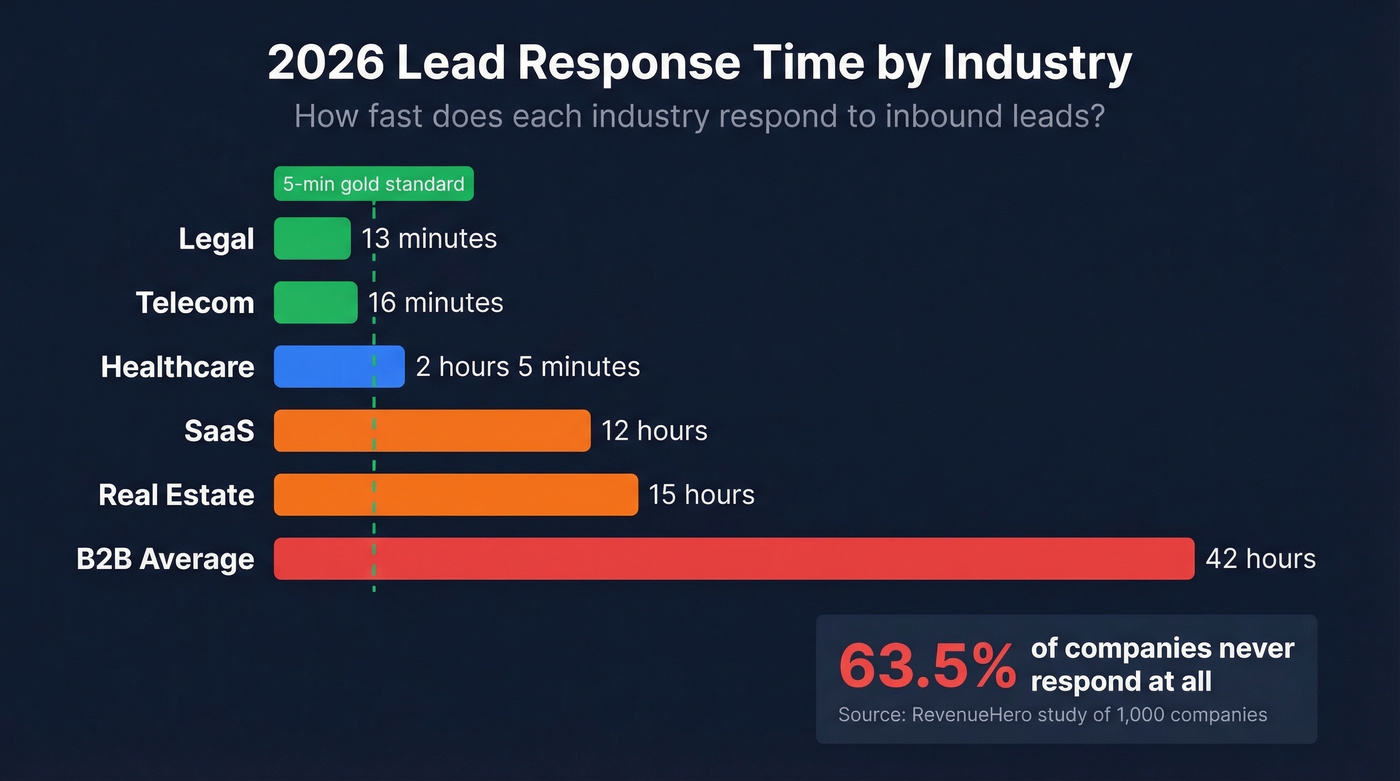
| Industry | Avg Response Time | Notes |
|---|---|---|
| Legal | 13 min | Best performer |
| Telecom | 16 min | Strong automation |
| Healthcare | 2h 5m | Heavily regulated |
| SaaS | 12h | Surprisingly slow |
| Real Estate | 15h | After-hours gap |
| HVAC/Home Services | 88% take >5 min | Worst category |
The B2B average across all industries sits at roughly 42 hours. Legal and telecom lead because they've invested in routing automation. SaaS - the industry that builds these tools - averages 12 hours. The irony isn't lost on anyone.
The Blazeo 2026 Speed-to-Lead Benchmark Report surveyed 573 companies and found a telling expectation gap: 35.4% of leaders say responding within 5 minutes is essential, yet 38% of those same leaders fail to meet their own standard.
By Company Size
Smaller teams respond faster because there's less routing complexity. Enterprise teams have more leads but more layers - territory rules, round-robin logic, manager approvals - and every layer adds latency.
| Company Size | Avg Response Time |
|---|---|
| Small (1-300 employees) | 48 minutes |
| Medium (301-2,500 employees) | 1 hour 38 minutes |
A useful framework from LeanData: decompose your response time into processing time (how long it takes to route the lead to the right rep) and rep response time (how long the rep takes to act). Most teams obsess over the second number while ignoring the first. If your routing adds dead time before a rep even sees the lead, no amount of rep hustle fixes that.
AI vs. Manual & SLA Impact
The gap between teams using automation and those relying on manual processes is massive.
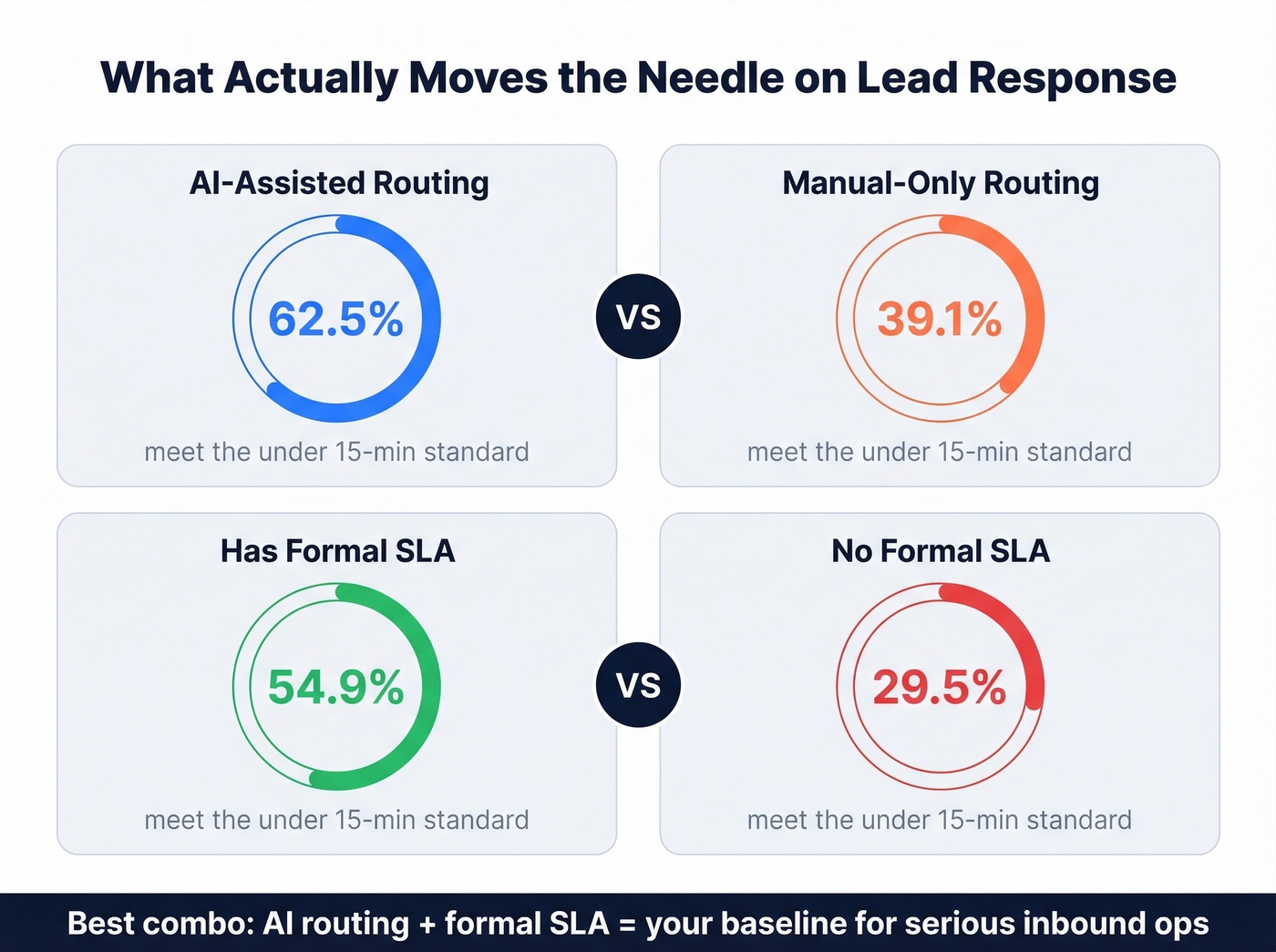
| Category | % Meeting <15 Min |
|---|---|
| AI-assisted routing | 62.5% |
| Manual-only routing | 39.1% |
| Has formal SLA | 54.9% |
| No formal SLA | 29.5% |
Teams with a formal response-time SLA are nearly twice as likely to respond within 15 minutes. Teams using AI-assisted routing outperform manual teams by 23 percentage points. The combination of both - SLA plus automation - is the baseline for any serious inbound operation.
When benchmarking, don't just look at your overall average. Segment response time by channel and by lead source. The averages hide massive variance, and the variance is where you find the fix.

You just saw the data: speed to lead only works when reps reach real people. Prospeo's 98% email accuracy and 125M+ verified mobile numbers mean your 3-minute callback actually connects. Data refreshed every 7 days - not 6 weeks - so the VP who filled out your form yesterday still picks up today.
Stop responding fast to bad numbers. Start connecting.
Five Mistakes That Kill Your Conversion Rate
1. No formal SLA. Without a written, measured, published SLA, "respond quickly" means whatever each rep decides it means. 54.9% of teams with an SLA meet the 15-minute standard vs. 29.5% without one. Write it down. Measure it weekly. Make it visible.
2. Manual routing bottlenecks. If leads sit in a shared inbox waiting for someone to claim them, you've already lost. Round-robin assignment, territory-based routing, and auto-escalation aren't nice-to-haves - they're the minimum.
3. Stale contact data. Here's the thing: your VP of Sales pulls up the dashboard on Monday morning. Average response time is under 4 minutes. But the connect rate hasn't budged. Reps are calling fast and hitting disconnected numbers. Emails fire in seconds and bounce. Speed without data quality is fast failure.

4. Misaligned marketing-to-sales handoffs. Marketing captures the lead. Sales doesn't know it exists for 6 hours. This happens constantly when teams use separate systems without real-time sync, or when MQL definitions are fuzzy enough that leads sit in a nurture queue when they should be getting a phone call.
5. No after-hours coverage. If your team clocks out at 5 PM and doesn't have chat, SMS autoresponders, or a distributed team covering time zones, a big chunk of your inbound pipeline waits until morning. By then, your competitor's already had the conversation.
How to Improve Lead Response Times
None of these are revolutionary. The hard part is implementing all of them at once, and the consensus on r/sales is that most teams stall after fixing one or two items and call it done.
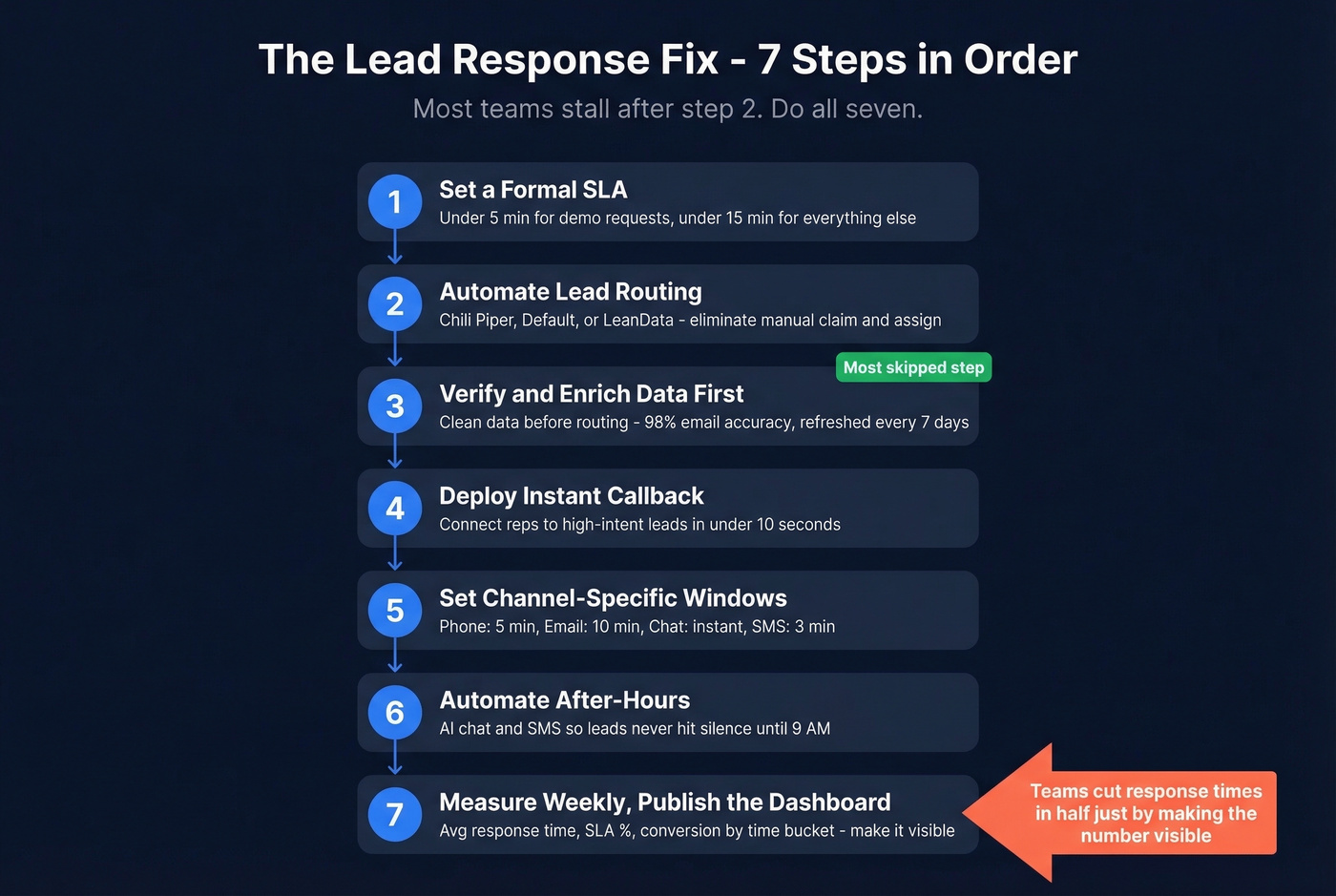
Set a formal SLA. Under 5 minutes for high-intent leads like demo requests and pricing page visits. Under 15 minutes for everything else. Publish it. Review it weekly in your team standup.
Automate lead routing. Tools like Chili Piper, Default, or LeanData eliminate the manual claim-and-assign step. Route by territory, round-robin, or lead score - just make sure it's instant.
Verify and enrich lead data before routing. This is the step most teams skip. Before you optimize routing, make sure your data is current. Prospeo refreshes records every 7 days - compared to the 6-week industry average - and verifies emails at 98% accuracy, so reps reach live contacts instead of dead records. The free tier gives you 75 email verifications per month to test what clean data does to your connect rate.
Use instant callback for demo requests. Tools like Calldrip can connect a rep with a lead in about 10 seconds after a form submission. For high-intent leads, this is the single highest-ROI tactic you can deploy.
Build channel-specific response windows. Phone: under 5 minutes. Email: under 10 minutes. Live chat: instant. SMS: under 3 minutes. Each channel has different expectations - don't apply a blanket SLA across all of them.
Automate after-hours with AI chat and SMS. Platforms like Podium can engage leads when your team is offline. It's not as good as a human, but it's dramatically better than silence until 9 AM.
Measure weekly and publish the dashboard. Display average response time, median response time, percentage meeting SLA, response time by rep, and conversion rate by response-time bucket where the whole team can see it. We've seen teams cut their times in half just by making the number visible.
Stale data is the silent killer of lead response. Your SLA says 5 minutes, your reps hit it, and the email still bounces. Prospeo's 5-step verification and 7-day refresh cycle keep your contact data current - 98% email accuracy, 30% mobile pickup rate. At $0.01 per email, fixing your data costs less than one wasted callback.
Every bounced email is a lead response failure your dashboard won't show you.
How AI Changes Lead Response
A Harvard Business School study analyzing 256,934 conversations across 138 agents found that AI-assisted responses were 22% faster and improved customer sentiment by +0.45 on a 5-point scale. The effect was even more dramatic for less-experienced reps: 70% faster response times and +1.63 sentiment improvement.
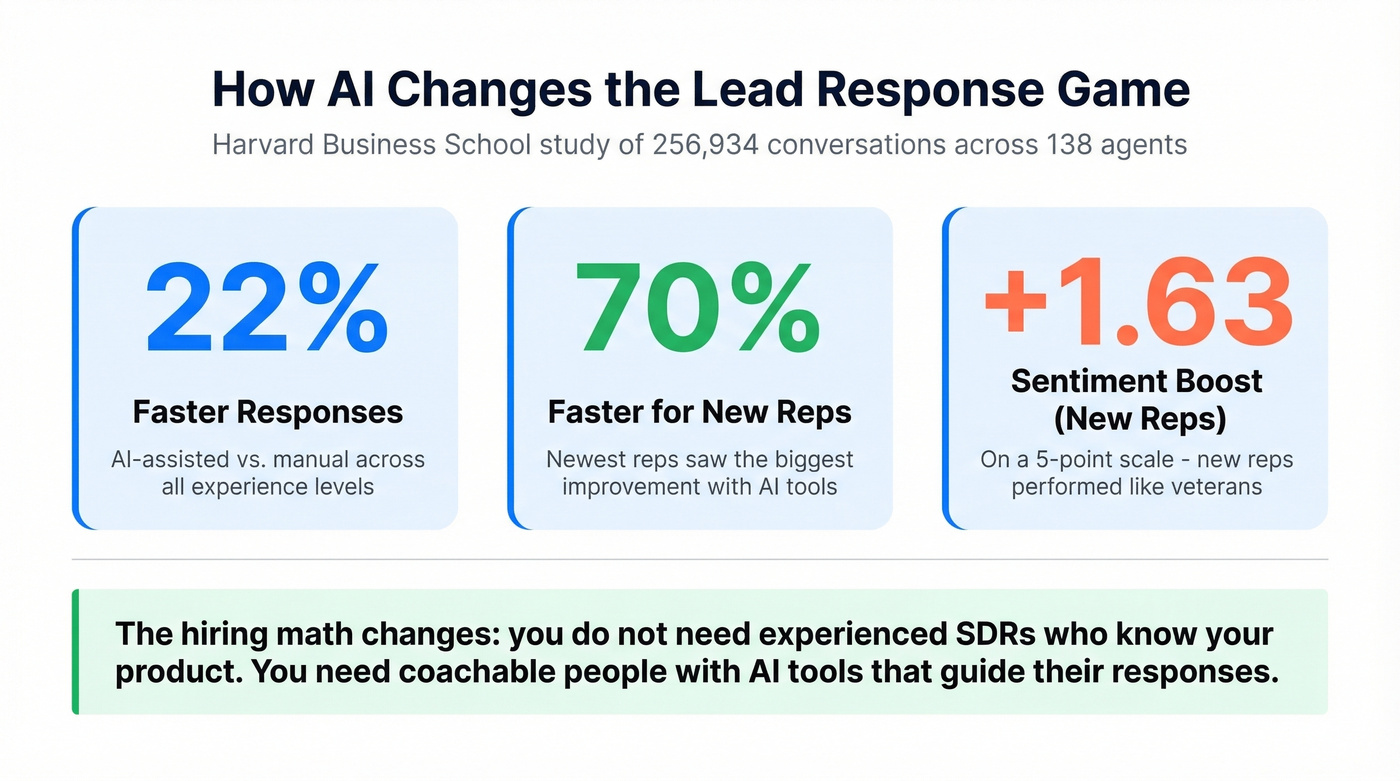
That last number changes the hiring math entirely. AI doesn't just make your best reps slightly better - it makes your newest reps perform like veterans. You don't need to find experienced SDRs who already know your product. You need coachable people with AI tools that guide their responses.
The benchmark data backs this up: 62.5% of AI-using companies meet the under-15-minute standard vs. 39.1% for manual-only teams. Skip AI-assisted routing in 2026 and you're competing with one hand tied behind your back.
One caveat worth noting: the HBS study found that responses that were too fast in certain situations confused customers and reduced sentiment gains. The sweet spot is AI drafting the response and a human reviewing it in seconds, not minutes.
The ROI of Faster Lead Response
Let's make this concrete. A B2B SaaS company generating 200 leads per month with a 4-hour average response time and a 12% qualification rate implemented instant callback. Response time dropped to under 10 seconds. Within 60 days, their qualification rate jumped to 38% - a 3.2x improvement from changing one variable.
30% of leads are never contacted at all. If you're spending $50k/month on demand gen and a third of those leads never get a callback, that's $16,500 on fire every month. Not because the leads were bad - because nobody picked up the phone.
If your deal sizes clear $5k, you probably don't need more leads. You need to stop wasting the ones you already have.
The ROI framework is simple: segment your leads by response-time bucket (under 5 minutes, 5-30 minutes, 30-60 minutes, 1+ hours) and compare conversion rates across buckets. In our experience, we've never seen a team do this exercise and not find a massive gap. The leads are the same quality. The only variable is speed - and whether the contact data is live when the rep dials.
FAQ
What is a good lead response time?
Under 5 minutes for high-intent leads like demo requests and pricing page visits; under 15 minutes for all other inbound inquiries. Qualification rates drop 21x after 30 minutes, so anything beyond that window means you're working against steep odds.
What is the 5-minute rule for leads?
The 5-minute rule comes from the 2011 Harvard Business Review piece "The Short Life of Online Sales Leads" by Oldroyd, McElheran, and Elkington. The core finding: contacting leads within 5 minutes makes you 100x more likely to connect and 21x more likely to qualify them than waiting 30 minutes.
How do you measure lead response time in a CRM?
Track the timestamp when a lead enters your CRM (form submission, chat, call) and the timestamp of the first rep action (call, email, SMS). The difference is your response time. Salesforce and HubSpot both support this with workflow rules - most teams just haven't configured them.
Why is my response time fast but my connect rate still low?
Speed alone doesn't help if your contact data is stale. If emails bounce or phone numbers are disconnected, a 3-minute callback hits a dead end. Verify data before it reaches reps - tools like Prospeo with 98% email accuracy and 125M+ verified mobile numbers close this gap, and the free tier lets you test with 75 verifications.
Does AI actually improve lead response?
Yes. The Harvard Business School study of 256,934 conversations found AI-assisted responses were 22% faster and improved customer sentiment. The effect was strongest for newer reps, who saw 70% faster response times. AI handles the speed; humans handle the nuance.