

Lead vs Opportunity: What Actually Matters in 2026
Your VP just pulled the pipeline report. It shows $2.4M in "opportunities" - but half of them are prospects who said "sure, send me some info" three months ago. Nobody updated the stage, nobody confirmed budget, and the close dates are all fiction. The lead vs opportunity distinction isn't the problem. Enforcement is.
Companies where sales and marketing actually agree on when a lead becomes an opportunity convert 65% more prospects into pipeline. That's the difference between a forecast your board trusts and one everyone knows is theater. What follows: frameworks, benchmarks, and copy-paste checklists for Salesforce and HubSpot that close the enforcement gap.
The Short Version
A lead is unqualified interest. An opportunity is a qualified deal with revenue potential, a close date, and a next step. The real question isn't "what's the difference?" - it's "when exactly does one become the other, and how do you enforce it in your CRM?"
Sales Lead vs Sales Opportunity
Most teams use these terms interchangeably, which is exactly how pipelines get polluted.
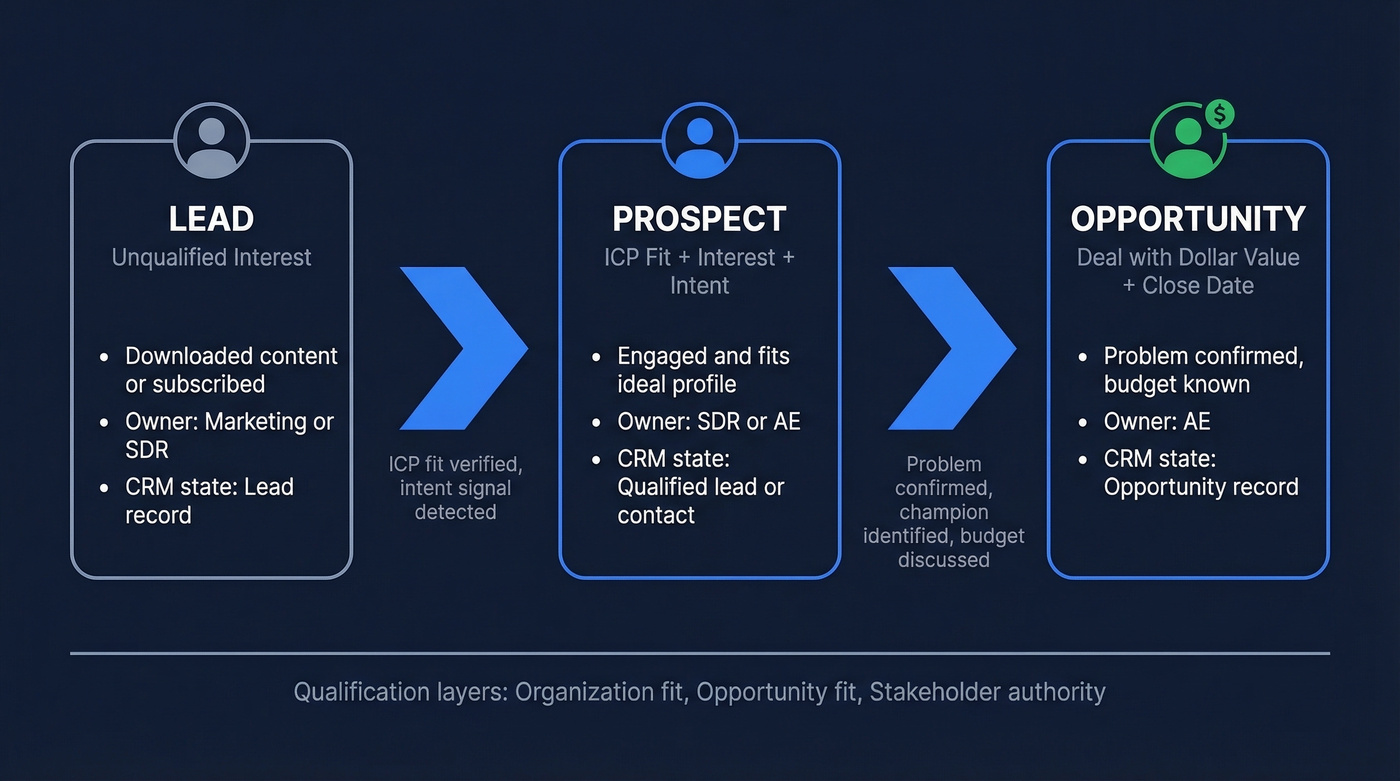
| Lead | Prospect | Opportunity | |
|---|---|---|---|
| Definition | Captured, not vetted | ICP fit + interest + intent | Deal with $ value + close date |
| Owner | Marketing or SDR | SDR or AE | AE |
| Key signal | Downloaded, subscribed | Engaged, fits profile | Problem confirmed, budget known |
| CRM state | Lead record | Qualified lead/contact | Opportunity record |
Qualification works in three layers: organization-level (ICP fit), opportunity-level (can they benefit and implement?), and stakeholder-level (do they have authority?). A lead that clears all three is a deal worth tracking. Anything less is still a prospect at best - and treating it otherwise is how you end up with a pipeline full of ghosts.
Understanding the distinction at each layer is what separates teams that forecast accurately from teams that guess.
When a Lead Becomes an Opportunity
Qualification Frameworks Compared
BANT is fine for high-velocity inbound. It's terrible for enterprise deals. Stop using one framework for everything.
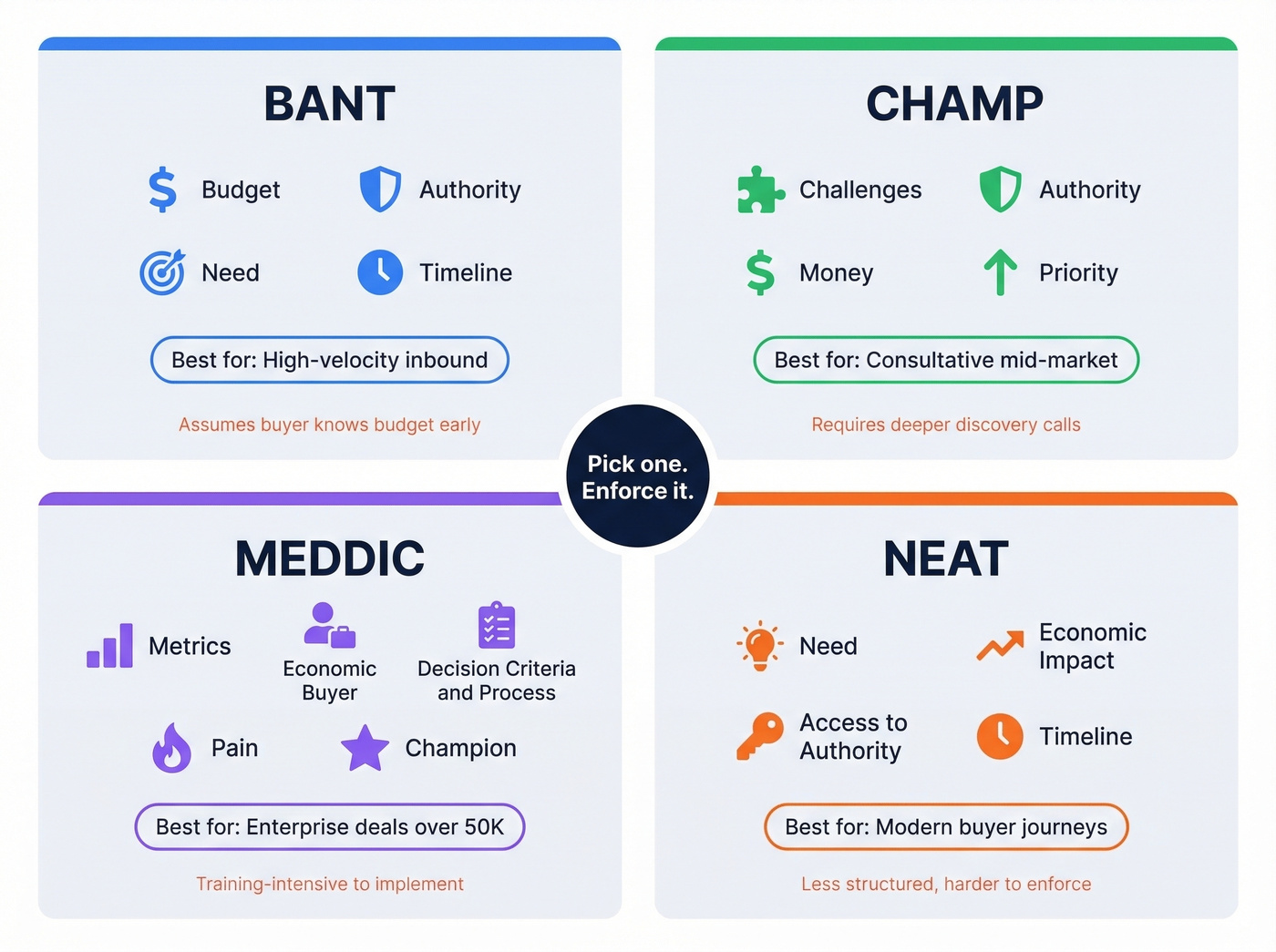
| Framework | Criteria | Best for | Limitation |
|---|---|---|---|
| BANT | Budget, Authority, Need, Timeline | High-velocity inbound | Assumes buyer knows budget early |
| CHAMP | Challenges, Authority, Money, Priority | Consultative mid-market | Requires deeper discovery |
| MEDDIC | Metrics, Econ Buyer, Decision Criteria/Process, Pain, Champion | Enterprise $50K+ | Training-intensive |
| NEAT | Need, Economic Impact, Access to Authority, Timeline | Modern buyer journeys | Less structured |
A common rule of thumb: a lead qualifies when it meets 3 of 4 BANT criteria. That works for transactional deals. But modern B2B purchases involve roughly 7 stakeholders on average, which is why MEDDIC's insistence on mapping the decision process and identifying a champion matters for anything complex. Lead scoring can automate some of this triage, but it only works if the scoring model reflects your actual conversion criteria - not arbitrary point values someone set up two years ago and forgot about.
Here's the thing: the framework you pick matters less than whether you actually enforce it. A BANT checklist that lives in a Google Doc nobody opens is worse than no framework at all.
Stage-Gate Checklists
These are the gates we've seen work across dozens of implementations. Copy them into your CRM as required fields or validation rules.
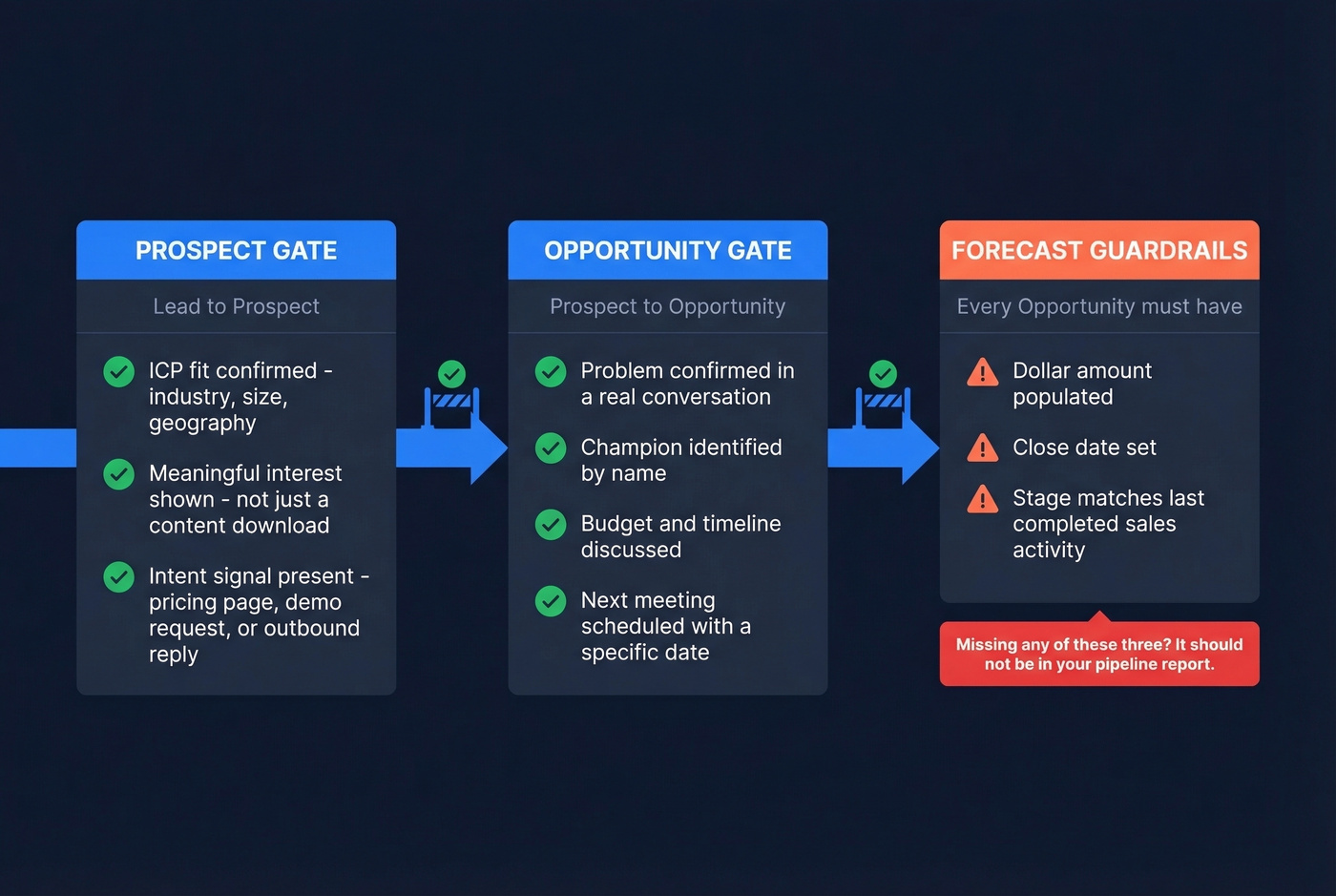
Prospect gate (Lead to Prospect):
- ICP fit confirmed across industry, company size, and geography
- Meaningful interest demonstrated - a content download alone doesn't count
- Intent signal present: visited pricing page, requested demo, or engaged with outbound
Opportunity gate (Prospect to Opportunity):
- Problem confirmed in a conversation
- Champion identified by name
- Budget and timeline discussed, even if not yet approved
- Next meeting scheduled with a specific date
Forecast guardrails (every Opportunity must have):
- Dollar amount populated
- Close date set
- Stage accurately reflects last completed sales activity
If an "opportunity" in your CRM is missing any of those three forecast fields, it shouldn't be in your pipeline report. Period.
Let's be honest about something: most teams don't have a conversion problem. They have a definition problem dressed up as a conversion problem. If your MQL-to-SQL handoff rate is below 15%, the fix isn't better nurture sequences - it's getting marketing and sales in a room until they agree on what "qualified" actually means. That single conversation will do more for your pipeline than any tool or automation.
Funnel Benchmarks Worth Knowing
Numbers without context are useless. Here's what "normal" actually looks like across the funnel.
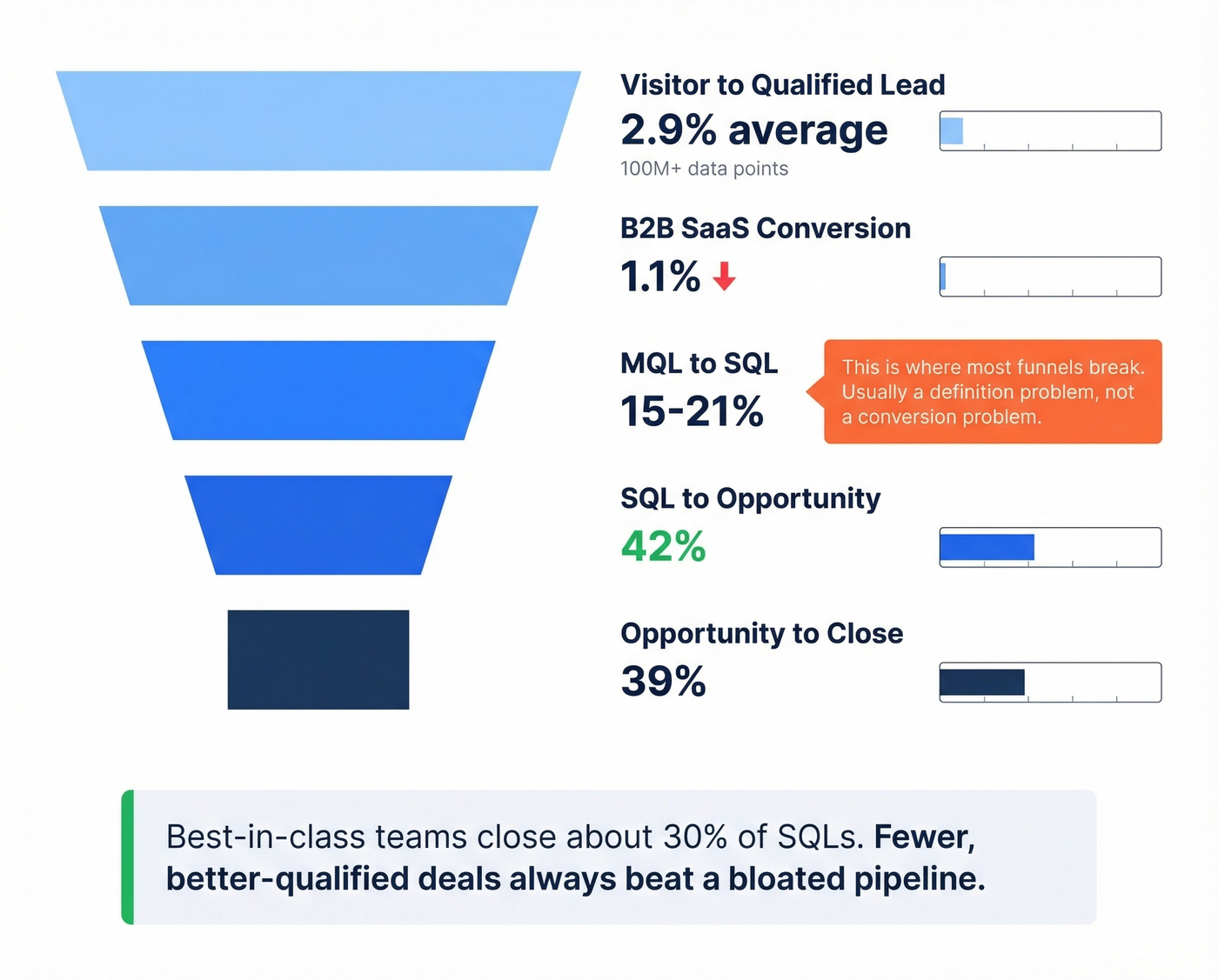
| Stage | Benchmark | Source |
|---|---|---|
| Visitor to Qualified Lead | 2.9% average | Ruler Analytics, 100M+ data points |
| B2B SaaS conversion | 1.1% | First Page Sage |
| Manufacturing conversion | 2.2% | First Page Sage |
| Legal Services conversion | 7.4% | First Page Sage |
| MQL to SQL | 15-21% | Digital Bloom |
| SQL to Opportunity | 42% | Digital Bloom |
| Opportunity to Close | 39% | Digital Bloom |
The MQL-to-SQL handoff at 15-21% is where most funnels hemorrhage. That's not a conversion problem - it's a definition problem. If marketing and sales don't agree on what "qualified" means, the handoff will always leak.
Best-in-class companies close about 30% of their sales qualified leads. If you're well below that, the issue is usually upstream: you're creating opportunities from leads that never should've been converted. Fewer, better-qualified deals will always outperform a bloated pipeline that makes everyone feel busy but produces nothing.

Your opportunity gate requires a confirmed problem, a named champion, and a real budget conversation. That starts with reaching the right people. Prospeo gives you 300M+ profiles with 30+ filters - buyer intent, job changes, headcount growth - so every lead entering your pipeline already clears the ICP gate before your SDR picks up the phone.
Fill your pipeline with leads that actually convert to opportunities.
CRM Setup: Salesforce
Salesforce's object model runs Lead to Account/Contact, with an optional Opportunity created during conversion. That conversion is a one-way door - you can't unconvert a Lead once it's been converted. Getting the conversion criteria right matters enormously because mistakes are permanent.
Default opportunity stages include Prospecting (~10%), Needs Analysis, Value Proposition, Proposal/Negotiation (up to ~90%), Closed Won, and Closed Lost. These feed into forecast categories - Pipeline, Best Case, Commit, Omitted, and Closed - which is how your VP builds that board report.
The enforcement mechanism is a validation rule on lead conversion. The trigger checks ISCHANGED(IsConverted), then requires specific fields like Initial_Meeting_Date__c or Budget_Confirmed__c to be populated before the conversion completes. Scope it further by checking ConvertedOpportunityId so it only fires when creating an Opportunity, not just converting to a Contact. Without this validation rule, reps will convert leads the moment a prospect says "sounds interesting." We've seen it happen in every org that doesn't enforce conversion criteria programmatically.
CRM Setup: HubSpot
HubSpot's lifecycle stages run sequentially: Subscriber, Lead, MQL, SQL, Opportunity, Customer, Evangelist. The key distinction: in HubSpot, "Opportunity" means a contact or company associated with a deal. No deal record, no Opportunity stage.
One critical operational detail that trips up a lot of teams during implementation: HubSpot's default automation only moves lifecycle stages forward. If you need to move someone backward - an Opportunity that went cold, for instance - you have to clear the existing value first, then set the new one.
Lead Status is a separate, sales-focused property that works as a subset within lifecycle stage. The standard values (New, Open, In Progress, Connected, Open Deal, Unqualified) track where a lead sits in the sales process specifically. "Open Deal" aligns to the Opportunity lifecycle stage, which is your signal that the handoff from qualification to pipeline happened.
If you're syncing HubSpot with Salesforce, Opportunities map to Deals. Make sure your lifecycle stage automation accounts for this or you'll end up with records stuck in limbo between the two systems.
Common Mistakes and Edge Cases
"Everything is an opportunity" is the single most common pipeline killer. One insurance org we studied loaded every cross-sell target, every automation-generated quote, and every inbound inquiry as an Opportunity. Reps stopped trusting the pipeline because "opportunity" no longer meant anything. The fix was straightforward: load items as Leads, run nurture and assignment, and convert only after validated intent.
If you need a clean operational baseline, start by documenting your sales activities and what counts as stage progression.
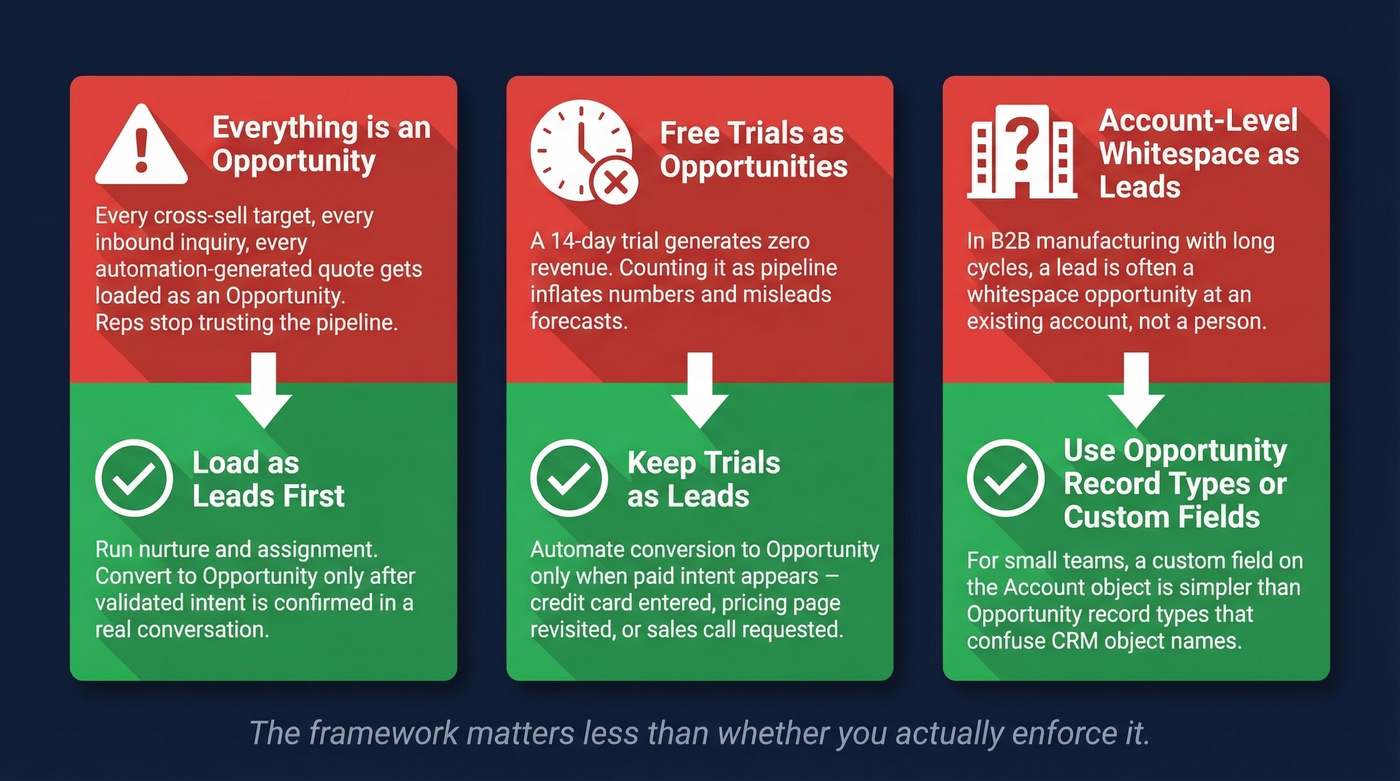
What about free trials? A 14-day trial generates no revenue. Keep trial users as Leads and automate conversion to Opportunity only when paid intent appears - credit card entered, pricing page revisited, sales conversation requested.
The trickiest edge case shows up in account-centric sales. Salesforce's Lead object assumes a named individual, but in B2B manufacturing with 2-3 year cycles, a "lead" is often a whitespace opportunity at an existing account - not a person at all. The r/salesforce community flags this constantly. Most teams work around it with Opportunity record types, but that creates its own confusion when business language doesn't match CRM object names. Skip this workaround if your team is small enough to just use a custom field on the Account object instead.
The Data Quality Variable
Every framework, checklist, and validation rule above assumes one thing: the contact data entering your CRM is accurate. When it isn't, the entire system breaks down. Bounced emails waste rep time. Wrong phone numbers erode trust in the CRM. Stale records create phantom pipeline that nobody can close.
Data quality has to be solved at the point of lead creation - before qualification even begins. Tools like Prospeo handle this by verifying emails in real time at 98% accuracy, with a database of 300M+ professional profiles refreshed every 7 days while the industry average sits at six weeks. When leads enter your funnel already verified and enriched, your conversion metrics actually mean something - and your stage-gate checklists aren't wasted on contacts who were never reachable in the first place.
If you're evaluating vendors, compare data enrichment services and how they handle refresh cycles and verification.
A bloated pipeline full of ghost opportunities starts with bad data. When 35% of your emails bounce, reps mark unresponsive contacts as 'opportunities' just to hit activity metrics. Prospeo's 98% email accuracy and 125M+ verified mobiles mean your team connects with real buyers - so the deals in your forecast are deals that actually close.
Kill pipeline fiction at the source. Start with data that connects.
FAQ
What's the average lead-to-opportunity conversion rate?
SQL-to-Opportunity conversion runs about 42% for B2B SaaS, with Opportunity-to-Close at 39%. The real bottleneck is MQL-to-SQL at 15-21% - that's where most funnels lose volume. Rates vary by industry and how strictly your org defines each stage.
Can you revert an opportunity back to a lead in Salesforce?
No. Salesforce lead conversion is irreversible. Once converted, the Lead record becomes a Contact, Account, and optionally an Opportunity. This is why validation rules enforcing conversion criteria are essential. Convert too early and you're stuck with pipeline pollution you can't clean up without deleting records.
How do you prevent bad data from polluting your pipeline?
Verify contact data before it enters your CRM, not after. Run real-time email verification at the point of lead creation and pair it with the stage-gate checklists above. When every record entering your funnel is clean and current, your pipeline reflects reality instead of wishful thinking.
Does the lead vs opportunity distinction change for enterprise deals?
Yes. Enterprise cycles with $50K+ deal sizes need MEDDIC or similar multi-stakeholder frameworks instead of simple BANT. A lead becomes an opportunity only after you've mapped the decision process, identified an economic buyer, and confirmed a quantifiable pain. Skipping these steps inflates pipeline with deals that stall at procurement.